Dr. “Jim” (James J. S. Johnson) shared this with me and asked me (Lee) to post it. He’s tied up in a conference.
See Other Crow Articles:
Crows are something to Crow about.
The Crow and the Screwdriver
Sunday Inspiration – Crows and Jays
Dr. “Jim” (James J. S. Johnson) shared this with me and asked me (Lee) to post it. He’s tied up in a conference.
See Other Crow Articles:
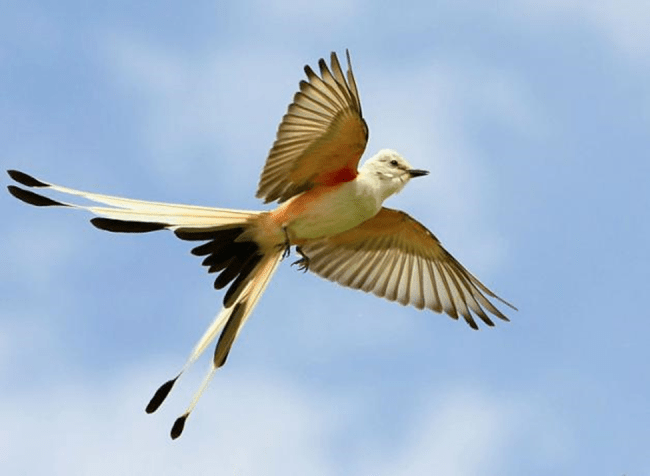
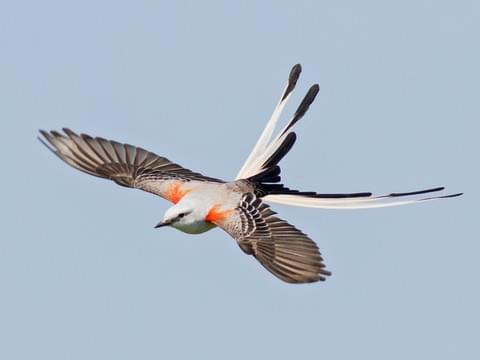
Hallelujah! — A Beautiful Scissortail!
Dr. James J. S. Johnson
He [i.e., God] hath made every thing beautiful in His time; also He hath set the world in their heart, so that no man can find out the work that God maketh from the beginning to the end.
Ecclesiastes 3:11

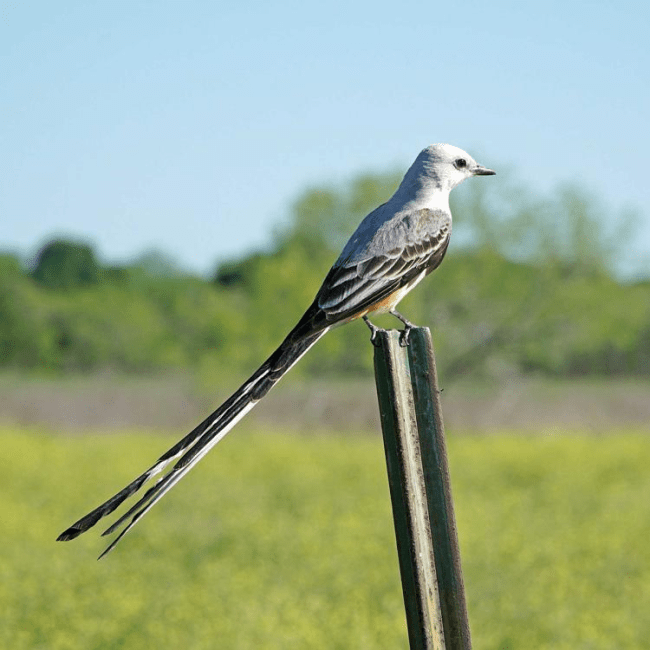
It was a welcome sight to see a beautiful Scissor-tailed Flycatcher, last week, when my wife and I were returning home, in our van, near the Elm Fork of Texas’s Trinity River. The scissortail was perched upon a utility line, paralleling the roadside, near the edge of a forested area–and what a beautiful bird the scissor tail is!
For relevant information (and pictures) of the Scissor-tailed Flycatcher, see my earlier blogpost, “SCISSOR-TAILED FLYCATCHER: the Texas Bird of Paradise”, posted at https://leesbird.com/2022/06/17/scissor-tailed-flycatcher-the-texas-bird-of-paradise/ .

Enjoying even a quick view, of what Lee Dusing calls “God’s avian wonders”, is a reminder that we need to get outside more often, especially as the weather permits. (Can I get an “Amen” on that?)
The need to enjoy nature is recognized by many folks, including non-Christians (as is evidenced by the quote below), yet Christians especially should be enjoying God’s interactive handwork–especially “God’s avian wonders”.
Tracking a white-tailed deer through a forest, hooking a smallmouth bass or rockfish, feeding ruby-throated hummingbirds in your backyard, or just watching a beautiful butterfly visit flower after flower in your garden — these are all activities that connect us not only to nature but to each other. And a growing body of research shows that we are healthier and happier when we spend more time outdoors.
This passion for wildlife and wild places is reflected in the preliminary findings of the 2022 National Survey of Fishing, Hunting and Wildlife-Associated Recreation, coordinated by my employer, the U.S. Fish and Wildlife Service. First conducted in 1955 — and every five or six years since — this survey is based on interviews with thousands of citizens from all walks of life.
In 2022, more than 259 million Americans participated in some form of wildlife-associated recreation including fishing, hunting, birdwatching, photography and more. Watching wildlife was most popular (148 million), followed by fishing (almost 40 million) and hunting (14 million). This translates into 57% of Americans spending time observing wildlife. About 15% fished, and 6% hunted. The Mid-Atlantic region mimicked this trend with 17.8 million (54%) citizens engaged in wildlife watching, while 4 million fished (13%) and 1.5 million hunted (5%).
The survey defines wildlife watching primarily as taking a special interest in wildlife around homes or taking a trip for the primary purpose of seeing animals of one kind or another. But it also includes feeding animals (mainly birds), photographing them and maintaining or planting natural areas for the benefit of wildlife. Most people did these things around or near their homes (146 million). A comparison of results from the 2022 survey with those of the 2016 survey revealed there was a 72% increase in the number of Americans engaged in wildlife watching.
Kathy Reshetiloff, “More Than Ever, we like to go where the wild things are”, CHESAPEAKE BAY JOURNAL, 33(7):40 (October 2023), emphasis added.

Wow! Wildlife watching is really a big deal!
And the most popular form of wildlife watching is birdwatching. (THANKS, LEE, for hosting this Christian birdwatching blog–all these many years–so that we can cyber-share in these beautiful birdwatching experiences, with all of those who–in God’s providence–visit this wonderful blog.)
Of course, of all those who enjoy birdwatching (in the wild or via cyber “watching”), surely Christians should enjoy birdwatching the most, because Christians personally know the marvelous Maker of all the beautiful birds (John 17:3; 2nd Corinthians 10:17; Jeremiah 9:23-24), including scissortails!
Hope you have been enjoying the updated Christmas Birds. This is another new one to the series. Gold is in the names of birds and their goldish-yellow colors are plentiful.
When they had heard the king, they departed; and, lo, the star, which they saw in the east, went before them, till it came and stood over where the young child was. When they saw the star, they rejoiced with exceeding great joy. And when they were come into the house, they saw the young child with Mary his mother, and fell down, and worshipped him: and when they had opened their treasures, they presented unto him gifts; gold, and frankincense, and myrrh. (Matthew 2:9-11 KJV)
*
*
Then entered in those Wise Men three,
Full reverently upon the knee,
And offered there, in His presence,
Their gold and myrrh and frankincense.Noel, Noel, Noel, Noel,
Born is the King of Israel.
The Christmas Birds 2022 so far:
*
*
This year I am adding Silver Birds to our collection of Christmas Birds. Grey and white sometimes look like silver when in certain light. Some of them are also used.
The words of the LORD are pure words: as silver tried in a furnace of earth, purified seven times. Thou shalt keep them, O LORD, thou shalt preserve them from this generation for ever. (Psalms 12:6-7 KJV)
*
saying, “Where is He who has been born King of the Jews? For we have seen His star in the East and have come to worship Him.”
(Matthew 2:2 NKJV)
*
Listen to Silver Star by Horatio R. Palmer (1834-1907) as you view the slideshow. I have inserted the words to this song at the bottom. Never heard it before, but the words are great.
The Christmas Birds 2022 so far:
*
Silver Star
On the brow of night there shines a silver star,
And the wise men gaze on its heav’nly rays,
Till they find the King, whose throne they sought afar,
In the Babe of Bethlehem.
Refrain
Silver star, holy light,
Shine afar, o’er the night,
Till the world shall come where the young Child lay,
And enter the gates of the newborn day.
’Tis the lamp of God high hanging in the air,
And it guides our feet thro’ the royal street;
There is sweet soul-rest for those who seek it there,
From the Babe of Bethlehem.
Refrain
Silver star, holy light,
Shine afar, o’er the night,
Till the world shall come where the young Child lay,
And enter the gates of the newborn day.
Bring your gifts of gold, of frankincense and myrrh,
For the King we own is on David’s throne;
Let the holy Child your best affections stir;
’Tis the Babe of Bethlehem.
Refrain
Silver star, holy light,
Shine afar, o’er the night,
Till the world shall come where the young Child lay,
And enter the gates of the newborn day.
*
Now that Christmas is just over a week away, it’s time to see some of the birds that have “traditional” Christmas colors. Today’s color will be birds that have some sort of red on them. Other colors will be shown during the week. I have added new photos this year and some new colors later in the week.
When the Lord created the birds (fowls), He used many different colors, most for the protection of the bird (to blend in) or for display to attract a mate (to stand out).
We trust you enjoy the photos and that you are blessed as you consider the bird’s Creator, Who came to earth as a babe in a manger, so that He might redeem us from our sin. “All things were made through him, and without him was not any thing made that was made. (John 1:3)
But made himself of no reputation, and took upon him the form of a servant, and was made in the likeness of men: And being found in fashion as a man, he humbled himself, and became obedient unto death, even the death of the cross. (Philippians 2:7-8 KJV)
*
Come now, and let us reason together, saith the LORD: though your sins be as scarlet, they shall be as white as snow; though they be red like crimson, they shall be as wool. (Isaiah 1:18 KJV)
Music to listen to while viewing the photos from Birds In Christmas Hymns – Thou Didst Leave Thy Throne
*
Christmas Birds – Revisited (2022)
I thought it might be enjoyable to bring back a series of Christmas Birds that were first published in 2010 and reposted in 2013. [Who can remember back then? :) ] I hope you will enjoy seeing them again, or for the first time.
Luke 2:15-20 KJV
(15) And it came to pass, as the angels were gone away from them into heaven, the shepherds said one to another, Let us now go even unto Bethlehem, and see this thing which is come to pass, which the Lord hath made known unto us.
(16) And they came with haste, and found Mary, and Joseph, and the babe lying in a manger.
(17) And when they had seen it, they made known abroad the saying which was told them concerning this child.
(18) And all they that heard it wondered at those things which were told them by the shepherds.
(19) But Mary kept all these things, and pondered them in her heart.
(20) And the shepherds returned, glorifying and praising God for all the things that they had heard and seen, as it was told unto them.
While searching to find birds to write about with a Christmas theme, I came across the Territory of Christmas Island which belongs to Australia. It is in the Indian Ocean and only has a population of 1,403 residents who live in a number of “settlement areas” on the northern tip of the island.
*
The island’s geographic isolation and history of minimal human disturbance has led to a high level of endemism (or state of being unique to a defined geographic location, such as an island, nation or other defined zone, or habitat type, and found only there) among its flora and fauna, which is of significant interest to scientists and naturalists. 63% of its 135 square kilometres (52 sq mi) is an Australian national park. There exist large areas of primary monsoonal forest.
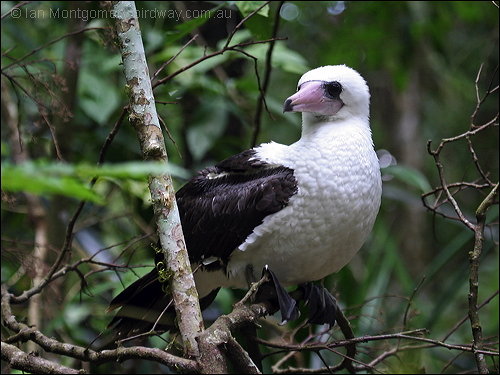
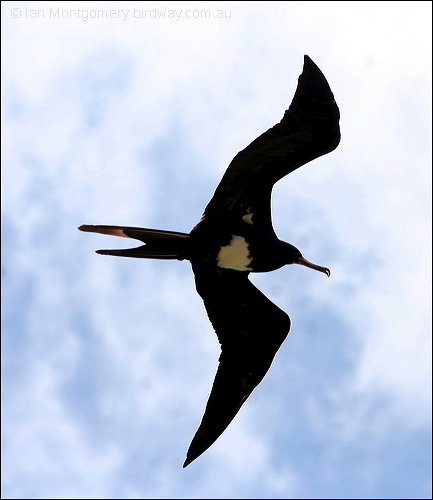
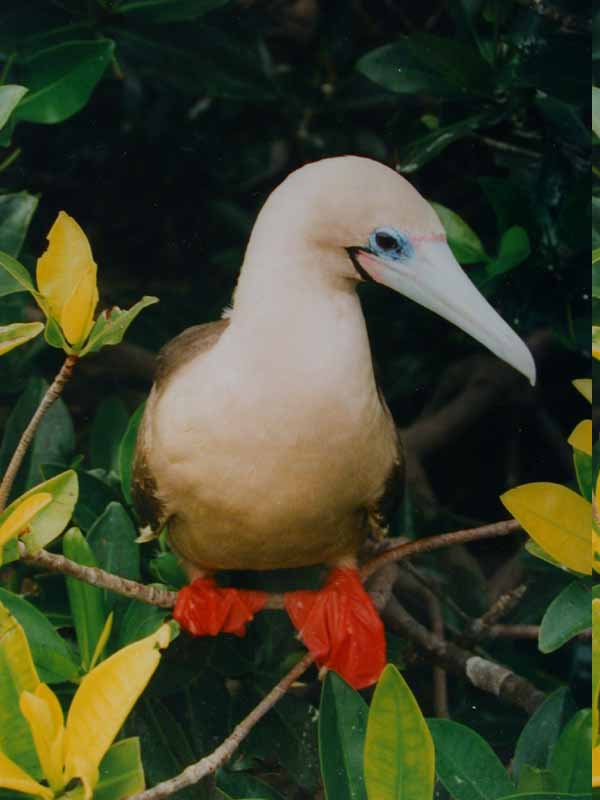
Christmas Island is a focal point for sea birds of various species. Eight species or subspecies of sea birds nest on the island. The most numerous is the Red-footed Booby that nests in colonies, in trees, on many parts of the shore terrace. The widespread Brown Booby nests on the ground near the edge of the seacliff and inland cliffs. Abbott’s Booby nests on tall emergent trees of the western, northern and southern plateau rainforest. The Christmas Island forest is the only nesting habitat of the Abbott’s Booby left in the world. The endemic Christmas Island Frigatebird (listed as endangered) has nesting areas on the north-eastern shore terraces and the more widespread Great Frigatebirds nest in semi-deciduous trees on the shore terrace with the greatest concentrations being in the North West and South Point areas. The Common Noddy and two species of bosuns or tropicbirds, with their brilliant gold or silver plumage and distinctive streamer tail feathers, also nest on the island.
Of the ten native land birds and shorebirds, seven are endemic species or subspecies. This includes the Christmas Island Thrush, and the Christmas Island Imperial Pigeon. Some 86 migrant bird species have been recorded as visitors to the Island.
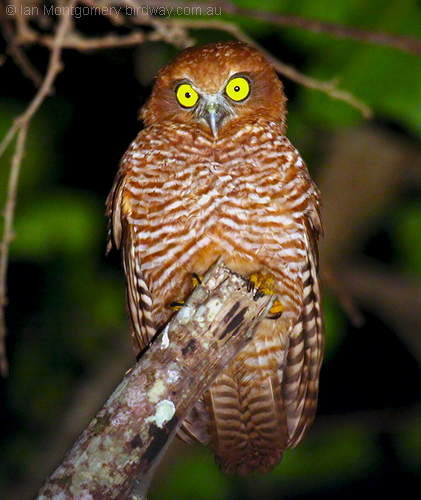
The list of birds from the I.O.C., which I use, lists five birds starting with Christmas. The Christmas Boobook (or Christmas Island Hawk-Owl), Christmas Frigatebird, Christmas Imperial Pigeon, Christmas Shearwater, and the Christmas White-eye.
*
*
Some information from Wikipedia and other internet sources.
See Also:
Christmas Island – Wikipedia
(This was originally posted at Christmas time 2010 and again 2013)
(Starting the 17th, there is a series of Christmas Birds coming.)
*
“And every living substance was destroyed which was upon the face of the ground, both man, and cattle, and the creeping things, and the fowl of the heaven;.” Genesis 7:23a
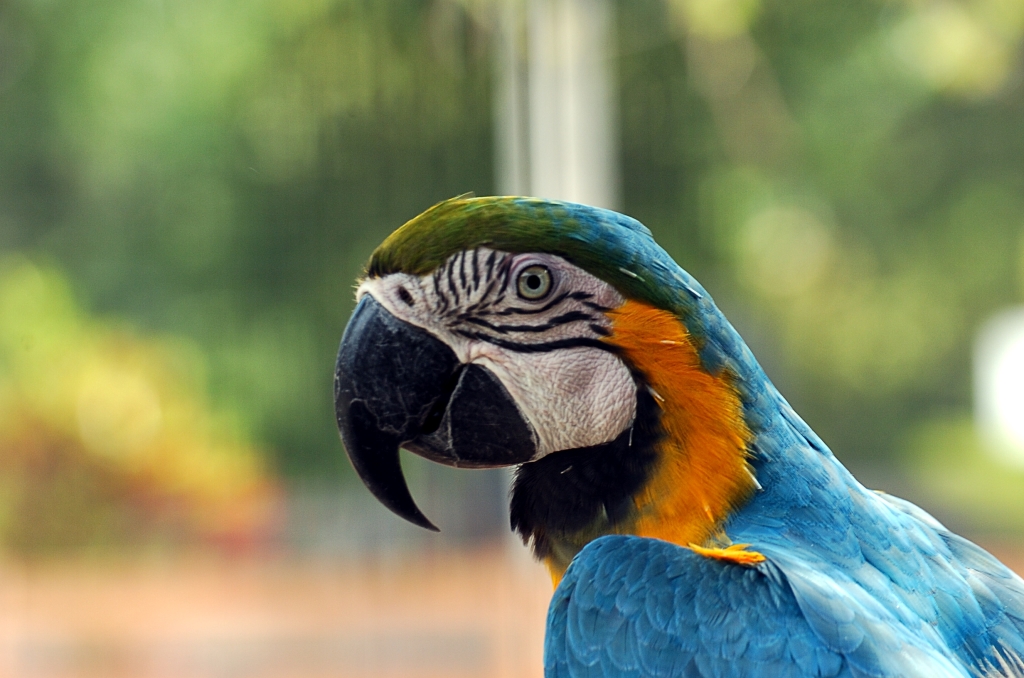
According to evolution theory, birds should not have been around at the time of the dinosaurs. This is especially true of the parrot, which is supposed, by those who believe in evolution, to be a more highly-evolved bird.
A fossilized parrot’s beak was dug up 40 years ago, but ignored. It was recently rediscovered at the University of California, Berkeley, by a graduate student. The problem, for evolutionists, is that they date the rock in which the beak was found as coming from the Cretaceous period when the dinosaurs lived and birds had not yet evolved. X‑ray study of the fossilized beak shows that the beak has the same blood vessel and nerve channels as a modern parrot. But it is not just one parrot’s beak that has been found in rocks from the age of dinosaurs. Loons, frigate‑birds and other shore bird fossils have also been found in rock that was supposedly laid down during the time of the dinosaurs!
Fossils are remains of living things rapidly buried, we believe, at the time of the Genesis Flood. However, it is perhaps not too surprising that bird fossils and dinosaur fossils are generally not found together; indeed, bird fossils in any part of the earth’s strata are extremely rare. This is because while dinosaur bones are very robust, bird bones and beaks are extremely fragile and would not have survived the turmoil of the Genesis Flood. The very few that have been fossilized tell us of very rapid and deep burial that would be expected during the Biblical Flood.
Prayer: I thank You, Lord, for making Your Word trustworthy in everything. Amen.
© 2022 Creation Moments. (Used with permission)
Other Articles from Creation Moments
Dr. James J. S. Johnson
“Behold the fowls of the air, for they sow not, neither do they reap, nor gather into barns; yet your heavenly Father feedeth them. Are ye not much better than they?”
Matthew 6:26 [quoting the Lord Jesus Christ]
Beholds the fowls of the air, especially when they land and walk nearby.
The Lord Jesus Christ told us to “behold” the birds of the air. Of course, that is easier to do if some of those flying fowl land on the ground long enough for us to observe them at close range.

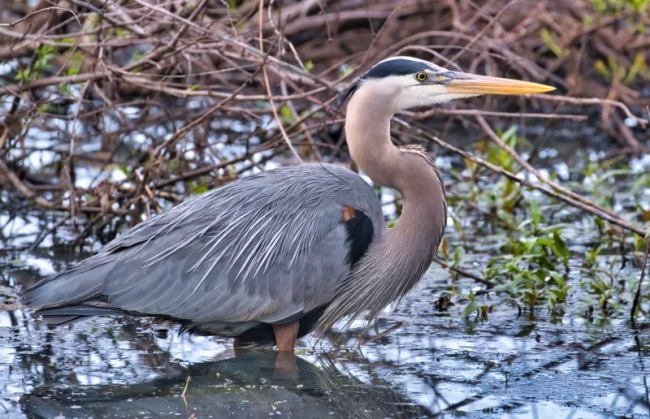
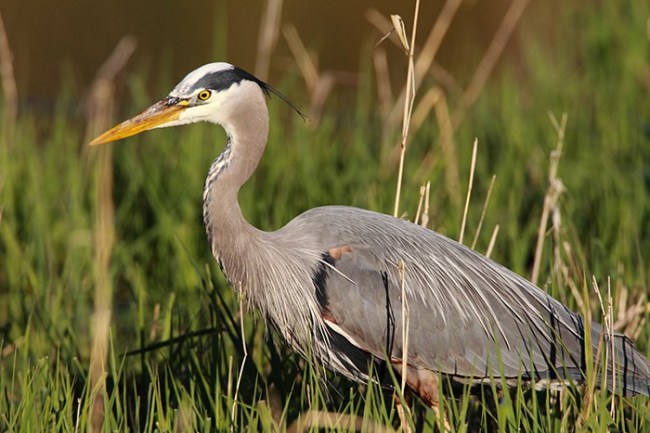
Yesterday I walked to my mailbox, to check for something I am anticipating – and nearby I saw a young Great Blue Heron, stalking in the drainage ditch that still retains pooled run-off rainwater from recent showers. The heron eyed me carefully, apparently concluding that I was not an immediate threat—since I was careful to walk slowly and meekly toward my mailbox. When I left the area the heron was still there, wading in the standing water of the drainage ditch. Probably the heron was foraging, looking for a frog or some other meal.

With that memory in mind I have a limerick:
GREAT BLUE HERON IN THE DRAINAGE DITCH
Should I check out a drainage ditch?
For wetland birds it’s a niche;
If rain runoff flows through therein
It might attract great blue heron —
So, go check out a drainage ditch!
Happy birding—even if your birdwatching happens next to your own mailbox!


After that it’s just a question of whether you’re an introvert or an extrovert. An introvert gets a deep personal satisfaction from achieving a complete collection, an extrovert gets a sense of triumph in beating the competition. Of course, you may be a bit of both: I’m mainly an introvert, but publishing all this stuff as the Irregular Bird, showing off obviously, is characteristic of extroverts.
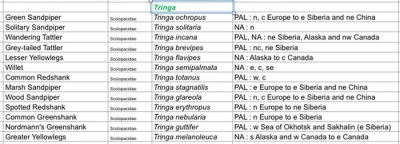
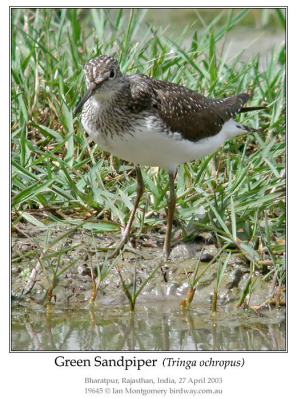
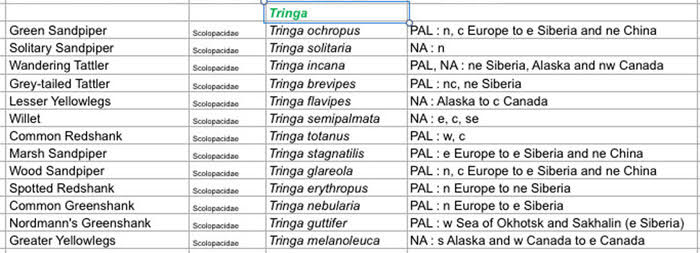
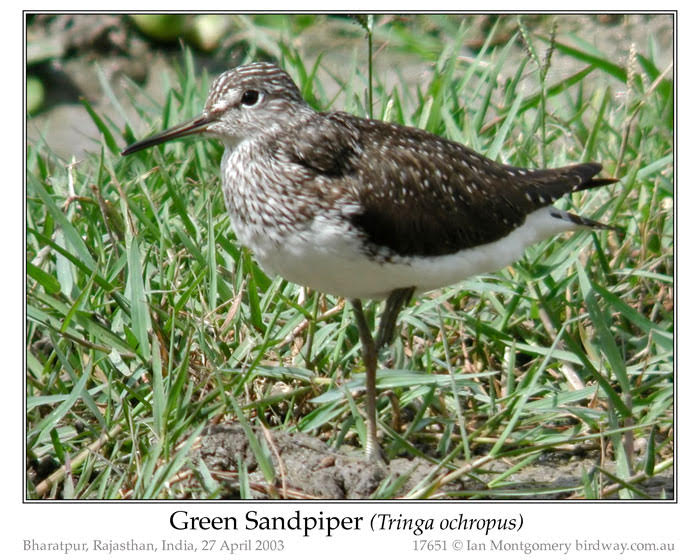
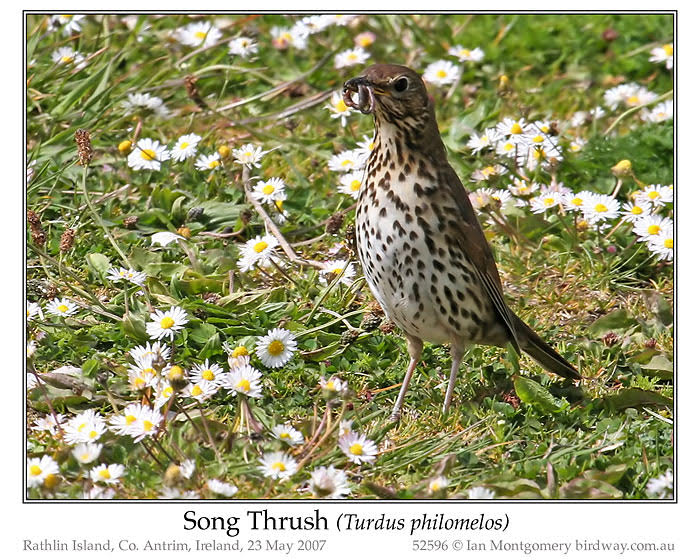
I mentioned when discussing the unusual arboreal nest building habits of Nordmann’s Greenshank that the Green and Solitary Sandpipers also nest in trees, but use the old nests of thrushes. Coincidentally the name Tringa comes from a description of a thrush-sized waterbird by Aristotle (“trungas”). He didn’t distinguish it further but later authors have suggested it was a sandpiper, a Wagtail Motacilla or a Dipper Cinclus. Thanks very much. While we’re at it, ochropus means pale-yellow footed, while the specific identifier of Normann’s Greenshank, guttifer, means spotted, which isn’t very illuminating either. Aristotle preceded the taxonomic and evolutionary ideas of Linnaeus and Darwin, and “thrush-like waterbird” is a reasonable description, except for the length of the legs. He was interested in biology, classified 500 species of animals in the work later known by philosophers as the Scala Naturae and would have been familiar with the Song Thrush, below, in Greece. The Scala Naturae was approved by the Christian Church (and probably all others) as it is hierarchical in form with man at the top, towering above all the lower species.
—
Lee’s Addition:
Now when Jesus was born in Bethlehem of Judaea in the days of Herod the king, behold, there came wise men from the east to Jerusalem, Saying, Where is he that is born King of the Jews? for we have seen his star in the east, and are come to worship him. (Matthew 2:1-2 KJV)
Thought you might enjoy a Christmas post from the past. (2012)
Today I am doing something a little different. Instead of a song, there is a short Christmas message from my pastor. This was given during the Camel Lot Christmas Musical that we had in 2012. It applies for today, as well. Listen to Pastor Nathan Osborne III as you watch some of the Lord Jesus Christ’s creation among the birds.
The birth of the Jesus, His death on the cross and His resurrection are all a part of Christmas.
Our Pastor at the Christmas Camel Lot Musical – 2012
*
(Started adding Christmas colored birds, but then added newer photos from this year.)
Some Previous Christmas Articles
Be gracious in your speech. The goal is to bring out the best in others in a conversation, not put them down, not cut them out. Colossians 4:6 The Message

Brown Thrasher singing in a tree against a blue sky. March, 2018; Walton County, Georgia. ©www.williamwisephoto.com.
Last summer I decided to try my hand at recording bird songs. I downloaded a recommended app and went out into the field. While listening to the wonderful songs of a Brown Thrasher, I just knew I had a great recording. But when I got back inside to listen, I was shocked. Car engines, airplane noise, the air conditioning unit… all of them destroying the talented thrush’s solo. I soon found that the hardest part of getting good bird recordings was finding a quiet place to record them.
Noise pollution! I had never really realized just how much noise there is out there… in nature as well as the world of social interactions! The good and pleasant conversation is drowned out by contempt and complaint.
Ecclesiastes 10:20 Never curse the king, not even in your thoughts, nor the rich man, either; for a little bird may tell them what you’ve said.
Often, there isn’t much you can do to control nose pollution, except to decide that you won’t add to it. You can control your own speech! Am I adding to the noise pollution by complaining, attacking and slandering? Am I civil and encouraging in my speech? How are people left feeling after a conversation with me: uplifted or dragged down into the mud?
How did people feel after an encounter with Jesus? The disciples on the road to Emmaus related their experience: “They began telling each other how their hearts were warmed as he talked with them and explained the Scriptures during the walk down the road.” Let us strive to produce the same fruit with our words.
Deuteronomy 32:2 NLT “Let my teaching fall on you like rain; let my speech settle like dew. Let my words fall like rain on tender grass, like gentle showers on young plants.”
Hi, I’m wildlife photographer and nature writer William Wise. I was saved under a campus ministry while studying wildlife biology at the University of Georgia. My love of the outdoors quickly turned into a love for the Creator and His works. I’m currently an animal shelter director and live in Athens, Georgia with my wife and two teenage daughters, who are all also actively involved in ministry. Creation Speaks is my teaching ministry that glorifies our Creator and teaches the truth of creation. — “What a wildly wonderful world, God! You made it all, with Wisdom at Your side, made earth overflow with your wonderful creations.” Psalms 104, The Message.
Have you ever shouted to God, “COME OUT, COME OUT WHEREVER YOU ARE!”?
Ezekiel 39:29 “Neither will I hide my face any more from them…”

A Brown-headed Nuthatch (Sitta pusilla) appears to play hide-and-seek in a nest cavity. March 31, 2017; Walton County, Georgia. ©www.williamwisephoto.com.
Birding can sometimes feel like a game of hide-and-seek. The birds have the “hide” part down pat! They are masters of camouflage and stealth, and seem to know the cleverest places to hide. So the birders must play the “seek” side of the game. We maximize our chances of finding particular bird species by learning where they live – their range and habitat within the range – and going where the birds are!
There are times it seems like God is playing hide-and-seek with us. Our theology says God is omnipresent, but our feelings say He has hidden Himself and is nowhere to be found. Like Martha and Mary when their brother Lazarus passed away, we blame God for being absent when crisis and need hits — “Lord, if thou hadst been here, my brother had not died.” (John 11:21).
But have you thought that maybe God isn’t hiding; and perhaps the problem is with our seeking? Jesus was quite willing to commune with those who desired His company. When two disciples asked, “Where dwellest thou?” Jesus offered the open invitation of come and see (John 1:38). Since the Bible promises us that He is a rewarder of them that diligently seek Him (Hebrews 11:6), perhaps our seeking isn’t as diligent as we thought.
God is not hiding. He can be seen in the design, order and complexity of nature around us… especially the birds! And just like searching for a bird in its range and habitat, we maximize our chances by seeking God in the right places. Where does God “hide”? Maybe He is “hidden” in that Bible on your bookshelf? Or perhaps He can be found in that church down the road? One thing is certain: if you are honest and diligent, He will be found!
Deuteronomy 30:11-14 “For this commandment which I command thee this day, it is not hidden from thee, neither is it far off. It is not in heaven, that thou shouldest say, Who shall go up for us to heaven, and bring it unto us, that we may hear it, and do it? Neither is it beyond the sea, that thou shouldest say, Who shall go over the sea for us, and bring it unto us, that we may hear it, and do it? But the word is very nigh unto thee, in thy mouth, and in thy heart, that thou mayest do it.”
Hi, I’m wildlife photographer and nature writer William Wise. I was saved under a campus ministry while studying wildlife biology at the University of Georgia. My love of the outdoors quickly turned into a love for the Creator and His works. I’m currently an animal shelter director and live in Athens, Georgia with my wife and two teenage daughters, who are all also actively involved in ministry. Creation Speaks is my teaching ministry that glorifies our Creator and teaches the truth of creation. — “What a wildly wonderful world, God! You made it all, with Wisdom at Your side, made earth overflow with your wonderful creations.” Psalms 104, The Message.