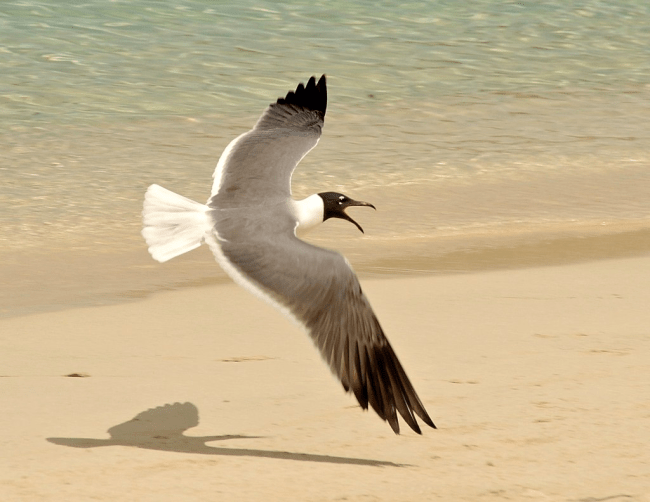
LAUGHING GULL at tidewater shore, Virgin Islands (Wikipedia image)
To everything there is a season, and a time for every purpose under the heaven … a time to weep and a time to laugh….
(Ecclesiastes 3:1 & 3:4a)
When you think about seagull conservation, you might feel like laughing.
Years ago, in AD2015, I wrote about an avian conservation success, the comeback of the Trumpeter Swan—specifically, increasing the American population of Trumpeter Swans from less than 70 to well beyond 46,000! (See “Trumpeter Swans: Trumpeting a Wildlife Conservation Comeback”, posted at https://leesbird.com/2015/08/21/trumpeting-a-wildlife-conservation-comeback/ .)
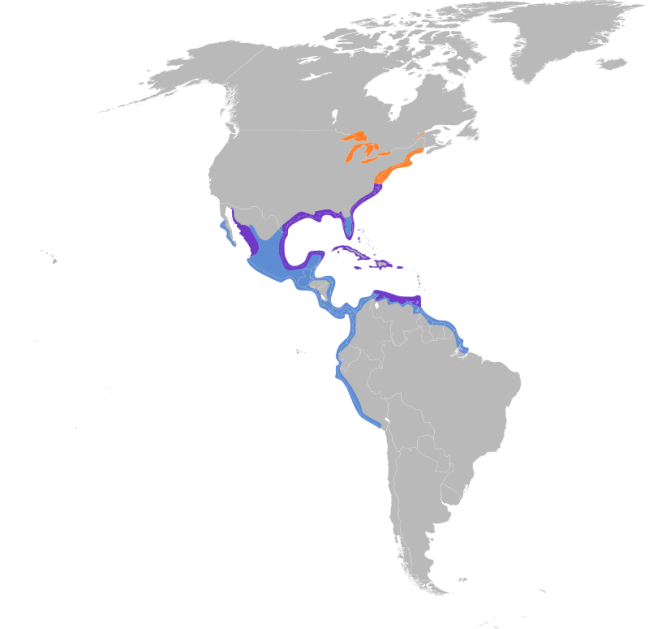
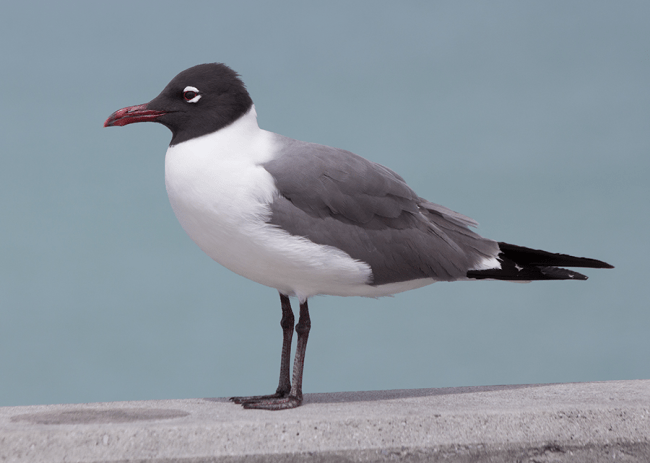
Today, however, we can also appreciate another such avian conservation success, the Laughing Gull (Leucophaeus atricilla), now well-populated in coastlands of both North and South America. This seagull is recognized by its laughter-like call, as well as (during summer) by its black-hooded head and its white eye-liner-like crescents (above and below its eyes); otherwise, this gull’s plumage is mostly white below and mostly grey above.
RANGE of LAUGHING GULL (Wikipedia image credit)
Alonso Abugattas, writing for the CHESAPEAKE BAY JOURNAL [volume, 34, issue 5, page 39 (July-August 2024)], notes this Laughing Gull population rebound:
By the late 1800s and very early 1900s, the coast-hugging laughing gull (Leucophaeus atricilla) had been all but wiped out by hunters and poachers who profited from their feathers and eggs. At the beginning of the new [20th] century, a series of federal laws—the 1900 Lacy Act, followed in 1913 by the Weeks-McLean Act and finally the Migratory Bird Treaty Act of 1918—afforded enough protection to laughing gulls that they gradually recovered. Fast forward to this [21st] century, and the [Laughing Gulls] are no longer threatened but have become the most abundant seabirds breeding in the eastern U.S., with 528,000—538,000 breeding pairs, according to the North American Waterbird Conservation Plan. . . .
Laughing gulls have recovered extremely well. They are quite adaptable, can feed on so many things besides fish or mollusks, and have no trouble living near people. Indeed, for many of us, they are the soundtrack of a day at the beach. [Quoting Alonso Abugattas, cited above]
Population recovery success, and then some!
And that fetches happy memories of dozens of times at the beach, in Florida, near St. Petersburg (where Laughing Gulls reside, year-round), when I would visit those white-sandy beaches with Chaplain Bob and Marcia Webel, who now reside in Missouri. Happy memories!
As the Irish say, you need to laugh to keep from crying. That’s often true; yet it’s also true that it’s good to laugh at other times (Proverbs 17:22; Psalm 126:2), even if you don’t feel like weeping. As Solomon observed, in Ecclesiastes 3:4a (quoted above), sometimes it’s just a good time to laugh.
LAUGHING GULL in summer plumage (Ben Keen photograph, via Wikipedia)
One thought on “Seagull Recovery: A Time to Laugh”
Yes laughter is medicine for the soul, is well said, and often helps dissolve the stress in arguments and difficult moments. Us Aussies are so use to laughing at ourselves because many have come from a tough and difficult heritage.
 Lee's Birdwatching Adventures Plus
Yes laughter is medicine for the soul, is well said, and often helps dissolve the stress in arguments and difficult moments. Us Aussies are so use to laughing at ourselves because many have come from a tough and difficult heritage.
LikeLike