Swans Return, in November, for Chesapeake Bay Over-wintering
Dr. James J. S. Johnson
To every thing there is a season, and a time to every purpose under the heaven . . . . He hath made every thing beautiful in his time; also He has set the world in their heart, so that no man can find out the work that God makes from the beginning to the end. (Ecclesiastes 3:1 & 3:11)
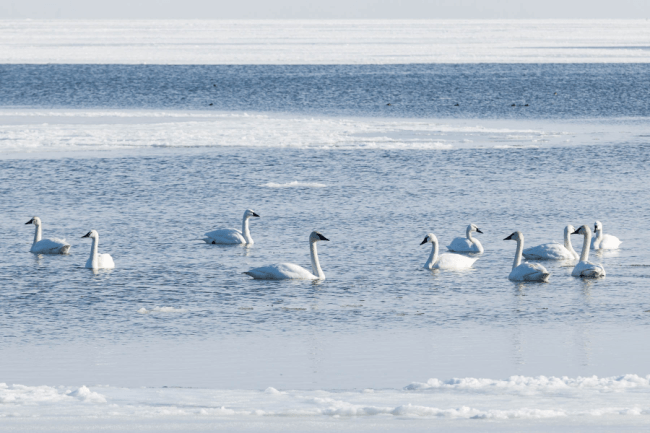
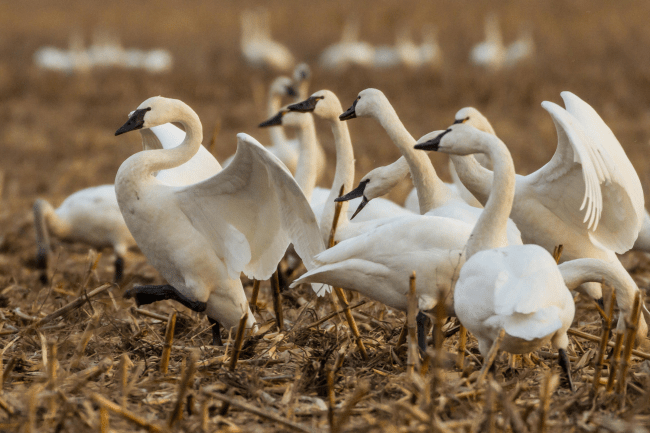
TUNDRA SWANS as “Winter Marylanders” (Will Parson/Chesapeake Bay Program photo credit)
Seasons come and seasons go, demonstrating the faithfulness of God’s post-Flood promise to Noah and Noah’s Ark passengers:
While the earth remains, seedtime and harvest, and cold and heat, and summer and winter, and day and night shall not cease. (Genesis 8:22)
Only a half-year ago the May migrants were blanketing shorelands of the Delmarva [Delaware-Maryland-Virginia] Peninsula, and other parts of the the Chesapeake Bay’s watershed shorelands, here and there:
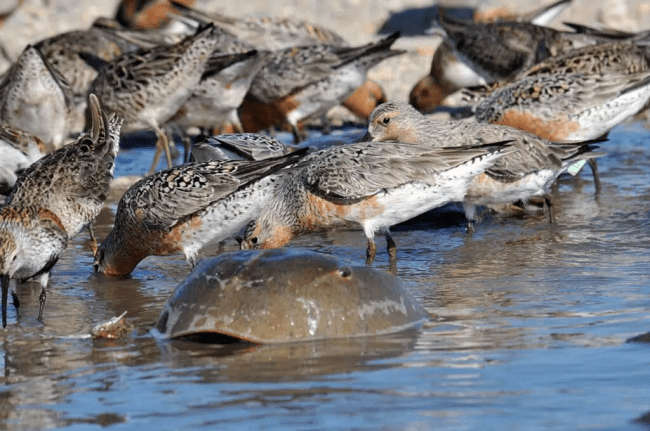
In May we were tramping the saltmarshes and beaches of the lower Delmarva Peninsula with biologists from the Nature Conservancy, collecting vital data on a variety of shorebirds, from willets to whimbrels, plovers to dunlins, red knots to ruddy turnstones. Some, like the curved-beaked whimbrels, may be airborne without stopping for up to five days, arriving at the lush marshes and mudflats of our region famished from their winter haunts in South America. For several weeks they will refuel here, nonstop, chowing down on fiddler crabs. Then, one spring evening, something in them stirs, and they are aloft by the thousands, not to alight before reaching breeding grounds that stretch from Hudson Bay to far northwest Canada’s Mackenzie River Delta. [Quoting Tom Horton, CHESAPEAKE BAY JOURNAL, 34(5):30 (July -August 2024).]
But now, in November, the phenological reverse occurs — because, during May (and earlier), migrant birds fly northward, to seek out their summer breeding grounds; whereas, during November (and earlier), migrant birds are flying southbound, leaving their breeding grounds behind, as they emigrate by air to their over-wintering grounds.
Come this autumn we’ll be on Deer Creek on the Susquehanna River . . . [including] days in the wet and snow over the winter, filming tundra swans, one of the largest long-distance migrators of the bird world. They [i.e., tundra swans] spend a good portion of their lives on the wing, moving from breeding grounds across Alaska’s North Slope and the Yukon each fall into the Chesapeake and North Carolina — a 9,000-mile round trip. . . . . In November, not long after the last monarch [butterfly, emigrating southward to Mexico] has passed through, and as the silver eels [migrating snake-shaped ray-finned fish] stream from the Chesapeake’s mouth toward Sargasso depths, there will come the lovely, wild hallooing of “swanfall” — the descent of the tundra swans from on high to grace our winter. [Quoting Tom Horton, CHESAPEAKE BAY JOURNAL, 34(5):30 (July -August 2024).]
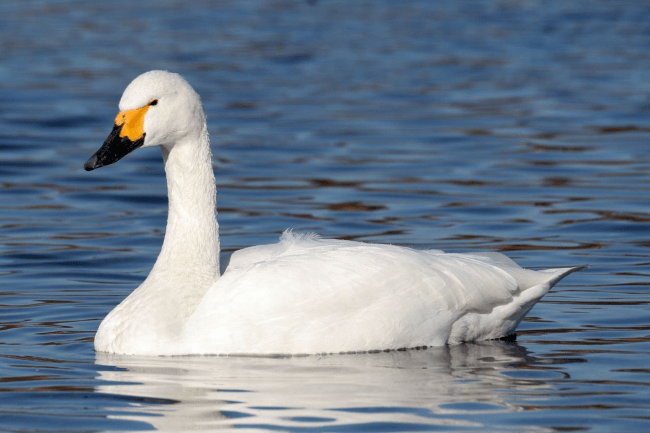
TUNDRA SWAN (Wikipedia / Maga-chan photo credit)
Tundra swans — they are huge [some would say “yooge”] geese-like birds.
So, what kinds of waterfowl are phenologically (and providentially) programmed, by the Lord Jesus Christ, to winter in ice-free estuaries like the Chesapeake Bay?
“Duck, duck, goose!”—and swans (such as Tundra Swans), just to name the most obvious. For example, Tundra Swans—being “yooge” birds—are easy to observe, especially if they are afloat in waters of an estuarial (or lacustrine) habitat that you may be visiting.
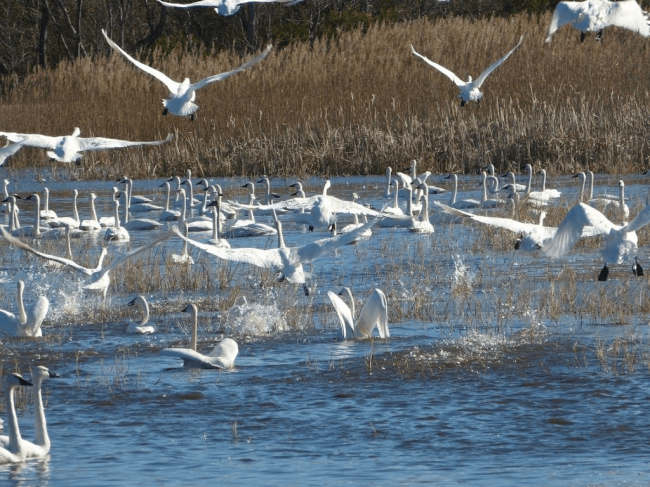
TUNDRA SWANS in North Carolina (USF&WS photo / public domain)
Swans are the largest waterfowl, and the tundra swans travel the farthest, more than 4,000 miles in some cases. They winter primarily on the Delmarva [Delaware-Maryland-Virginia] Peninsula and the estuarine edges of North Carolina. These large white birds are easily recognized by their black bills and straight or nearly straight necks. Tundra swans often form flocks on shallow ponds. [Quoting Kathy Reshetiloff, “Chesapeake’s Abundance Lures Wintering Waterfowl”, CHESAPEAKE BAY JOURNAL, 33(9):40 (December 2023), posted at http://www.bayjournal.com/columns/bay_naturalist/chesapeake-s-abundance-lures-wintering-waterfowl/article_4463317a-887f-11ee-a208-8768dc34c5a7.html .]
Wow! — what a wonder these wintering waterfowl are!
Or, more appropriately said, Hallelujah! — what a treasure of phenological providence these wonderful waterbirds are, showing God’s handiwork and caring kindness for His own creatures. May God bless them all, as they faithfully do their respective parts to “be fruitful, and multiply upon the earth” (Genesis 8:17).
 Lee's Birdwatching Adventures Plus
I absolutely love swans, along with many other birds. Thank you for the very interesting post! I learned so much!
LikeLike
Wow! Beautiful! Thanks for sharing.
LikeLike