Heard, But Not Seen

Caught Dan on the Boardwalk trying to find a bird

Caught Dan on the Boardwalk trying to find a bird

Yesterday Dan and I went birdwatching at the Mosaic Peace River Park in Homeland, FL. It was a gorgeous morning and the temperature was around 73° when we got there around 10 am. While we were getting our gear out a Northern Cardinal landed nearby. I aimed my camera and realized I had not taken the lens cap off yet. By the time I did remove it, you guessed it, he flew away into the trees. That was the story of our trip. The birds were “heard, but not seen.”

For those that may be new to birdwatching, when a bird is heard even though not seen, it can be counted on your list. Some are not aware of that fact. The problem is, knowing what the birds sound like. I was sorry yesterday that I had not spent enough time practicing hearing sounds. My list would have been much longer. Where we were has a boardwalk winding between the trees and ends up at the Peace River. Other than that Cardinal and the ones flying way overhead, no birds were seen. Yet, our list included 16 species.

I have decided to test you some and help you learn. Below are the sounds of some of the birds we heard, but I won’t  ID until later in the article.

Sound #1

Sound #2

Sound #3

Sound #4

Sound #5

So, have you figured them all out. They are fairly common to this area of the US. To help you out, here is a link to their photos:
Bird #1 ~ ~ Bird #2 ~ ~ Bird #3 ~ ~ Bird #4 ~ ~ Bird #5
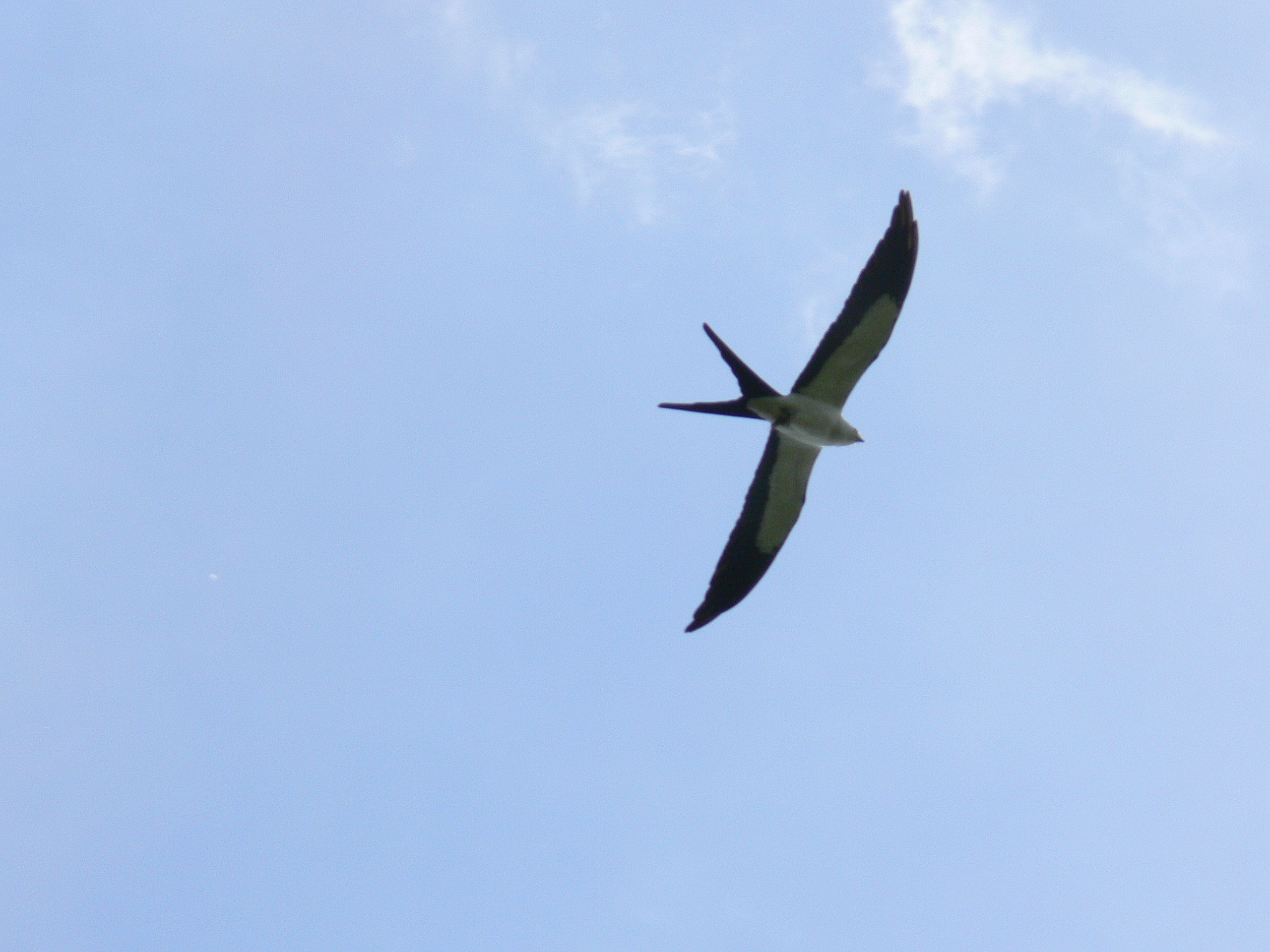
Swallow-tailed Kite - the one bird I got a photo of as it flew overhead

Swallow-tailed Kite – the one bird I got a photo of as it flew overhead

That Bird #5 had given me a test of my memory. I wrote down on my list “squeeky wheel bird.” I knew I had heard it before and planned to look it up when we got home. Luckily, on the way back to the car, we met a group of birdwatchers from Martin county Audubon. We compared lists, which is normal for birdwatchers, and then I asked about the “squeeky wheel bird” and they gave me it’s name right off. (I should have been birding with them) I checked out my recordings at home and sure enough, that is what it was.

All the sound recording came from xeno-canto.org and there are numerous other places to find the sounds of birds. Birding by Ear Basics from About.com/Birds has good tips. Cornell Lab of Ornithology is one of the best for seeing and hearing the birds.

We hear the birds and know they are there even though we do not see them. In the Christian realm, we do not see the Lord in person today, but we know He is alive and speaks to us through the things He has created and most of all by His Word.

He who is of God hears God’s words; …” (John 8:47a NKJV)

Now to the King eternal, immortal, invisible, to God who alone is wise, be honor and glory forever and ever. Amen. (1 Timothy 1:17 NKJV)

For since the creation of the world His invisible attributes are clearly seen, being understood by the things that are made, even His eternal power and Godhead, so that they are without excuse, (Romans 1:20 NKJV)

*
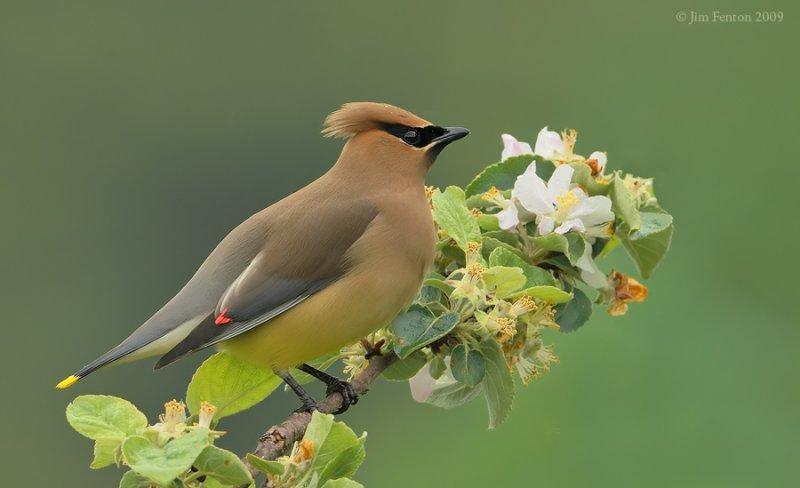
Cedar Waxwing – by A. J. Mithra

Cedar Waxwing

Cedar Waxwing (Bombycilla cedrorum) by J Fenton

Cedar Waxwing (Bombycilla cedrorum) by J Fenton

The Cedar Waxwing is one of the
few North American birds
that specializes in eating fruit.
It can survive on fruit alone
for several months…
The birds’ name derives
from their appetite
for cedar berries in winter…

Cedar is used in the temple
for purification..
Our body is the temple of GOD..
This bird seems to ask us
if we are leading a holy and pure life
isn’t it?

and he shall cleanse the house with the blood of the bird, and with the running water, and with the living bird, and with the cedar wood, and with the hyssop, and with the scarlet:  (Leviticus 14:53)

Cedar Waxwings inhabit
particularly along streams,,,
When JESUS comes into us
we will always dwell by the
Living Waters…

And he shall be like a tree planted by the rivers of water, that bringeth forth his fruit in his season; his leaf also shall not wither; and whatsoever he doeth shall prosper. ( Psalm 1:3)

Cedar Waxwing (Bombycilla cedrorum) by Daves BirdingPix

Cedar Waxwing (Bombycilla cedrorum) by Daves BirdingPix

The orange color is the result
of a red pigment picked up
from the berries of a
species of honeysuckle.
If a waxwing eats
enough of the berries
while growing its tail feathers
the tip of its feathers will be orange…

It is by HIS blood
that we are cleansed
and by HIS grace we become
more like HIM…
When “I” becomes less
and “JESUS” becomes more,
we would be like JESUS..
If these birds can pick up
the red color from the berries they eat,
don’t you think that we would
become more like JESUS
when we eat more of THE WORD,
THE LIVING BREAD?

By the way,
did you eat THE BREAD today?

Yours in YESHUA,
A. J. Mithra

Please visit us at: Crosstree

Christmas Birds – Ornaments

Here are the last of the Christmas Birds. The colors and designs would be pretty in ornaments. But most of all, they are superb examples of the Lord’s omniscient creative designs.

He was in the world, and the world was made by him, and the world knew him not. He came unto his own, and his own received him not. But as many as received him, to them gave he power to become the sons of God, even to them that believe on his name:.. And the Word was made flesh, and dwelt among us, (and we beheld his glory, the glory as of the only begotten of the Father,) full of grace and truth. (John 1:10-12, 14 KJV)

*

This slideshow requires JavaScript.

*

Birds of the Bible – Study Tips

When the Birds of the Bible were introduced in February, 2008, “Introduction to Birds of the Bible“, the goal was to acquaint you with each bird that is mentioned in the Bible and for you to learn of God’s great handiwork in their creation. These blogs have grown greatly since then.  I would like to share some of the methods that I use to produce these articles and to study God’s Word.

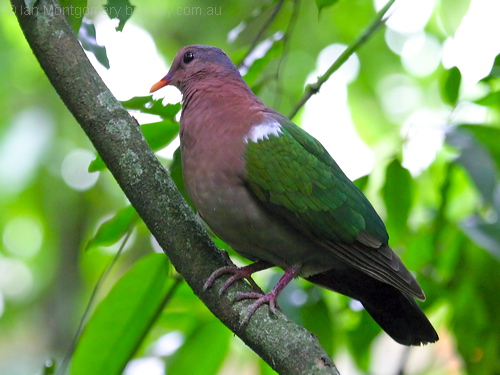
Emerald Dove by Birdway

Emerald Dove by Birdway

As you are reading along in your Bible, you may come across the mention of a particular bird (or any other topic)  in a verse. You see a bird and are wondering whether it is mentioned in Scripture. Your curiosity is caught and you want to find out more. What do you do?

  • As a “birdwatcher,” you can pull our your handy bird handbooks like: Peterson Field Guide for Birds, Smithsonian Field Guide to the Birds, The Sibley Guide to Birds, etc.
  • As an “internet birdwatcher,” you can “Google” that bird and get instant information (more than you can ever read) and learn many interesting things.
  • As a “Bible birdwatcher,” you can look in your concordance for references to that bird and if you have a Bible software program, such as “e-Sword” (free), you can search for the bird.
  • Also as a “Bible birdwatcher,” you may want to see why the bird is mentioned and what applications can be made by that passage of Scripture used. I like to use the Topical references, like Nave’s Topical Bible and Torrey’s New Topical Textbook. That is one reason that they are available here to help in the study of the “Birds of the Bible.” The ones here are different in that I put a picture of the bird on its page.

But now ask the beasts, and they will teach you; And the birds of the air, and they will tell you; (Job 12:7 NKJV)

This verse has been quoted many times in these blogs and we have tried to apply it to the lessons to be learned. Also, there are many other verses that give encouragement to study God’s Word.

These were more noble than those in Thessalonica, in that they received the word with all readiness of mind, and searched the scriptures daily, whether those things were so. (Acts 17:11 KJV)
Study to shew thyself approved unto God, a workman that needeth not to be ashamed, rightly dividing the word of truth. (2 Timothy 2:15 KJV)

As you study about the birds (or whatever in the Bible), I trust you will:

Let the word of Christ dwell in you richly in all wisdom; teaching and admonishing one another in psalms and hymns and spiritual songs, singing with grace in your hearts to the Lord. (Colossians 3:16 KJV)

Peterson Field Guide – Videos

Ring-necked Duck at Lake Morton by Dan

Ring-necked Duck at Lake Morton by Dan

I finally got all the current “Peterson Field Guide” – Videos posted and they are all indexed on the following page. I trust you will watch them and some of the additional links provided here on this site.

The Videos are very good and you can learn much from them. Hopefully, they will be producing more. If so, they will also be added to this blog. Again, Peterson Field Guides has recently begun producing short videos on YouTube. Birdwatching was advanced greatly because of Roger Tory Peterson. I have several of the Peterson Field Guides and use them very frequently.

Peterson Field Guide Video Series

“Peterson Field Guide” Videos is from petersonfieldguides at YouTube


Finches


Finches are a diverse group united by their short, heavy bills designed for cracking seeds as well as a tendency toward bright colors and cheerful songs.


Back to the Peterson Field Guide Video Series

“Finches” Video is from petersonfieldguides at YouTube

*

Sparrows

Sparrows are a family that deserve a second look. Often maligned as being dull-colored and confusing, with a little study sparrows become a favorite of many birdwatchers.


Back to the Peterson Field Guide Video Series

“Sparrows” Video is from petersonfieldguides at YouTube


See Also:
Birds of the Bible – Sparrows I
Birds of the Bible – Sparrows II
Eye of the Beholder – House Sparrows
Birds in Hymns – His Eye Is On The Sparrow

Northern Cardinal

A serious contender for the title of “Most Brilliant Backyard Bird,” the Northern Cardinal is on just about everyone’s list of favorite birds.


Back to the Peterson Field Guide Video Series

“Northern Cardinal” Video is from petersonfieldguides at YouTube


See Also:

Michael Cardinal


Warblers

Tiny, restless, and often stunningly beautiful, the warblers are a reliable source of joy and occasional frustration for birdwatchers in the New World.


Back to the Peterson Field Guide Video Series

“Warblers” Video is from petersonfieldguides at YouTube


American Robin

Roger Tory Peterson referred to the American Robin as the one bird that everybody knows, but there’s more to this species than its trademark orange breast.


Back to the Peterson Field Guide Video Series

“American Robin” Video is from petersonfieldguides at YouTube


Woodpeckers

Woodpeckers are surely one of the most distinctive families of birds, hitching their way up trees, chiseling out their food with specially designed bills and reinforced skulls. Woodpeckers tend to be attractively clad in bold patterns of black, white, and red.


Back to the Peterson Field Guide Video Series

“Woodpeckers” Video is from petersonfieldguides at YouTube


See Also:
God’s Amazing Pileated Woodpecker

*