After Being Buried for 350 Years, Nottingham Sheriff’s Two Swans Reappear
Dr. James J. S. Johnson
(Leviticus 11:18)
Recently (today being June 26th of AD2023), an ancient (about 350 years old!) gold signet ring of interest to birdwatchers –– was found by a man in Nottingham (England), using a metal detector.
But why would this ancient ring be of interest to birdwatchers? Because the signet ring displayed an armorial coat of arms that features 2 birds that look like swans or geese. In fact, the 2 birds are swans.
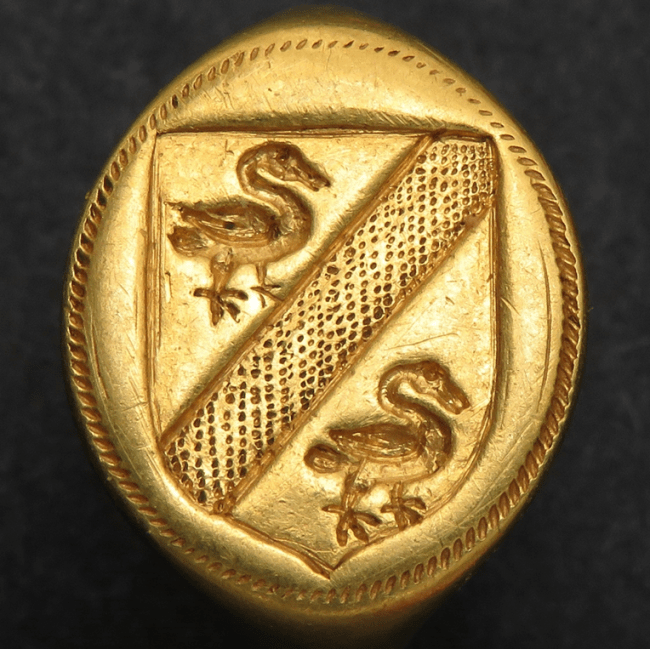
It was found by Graham Harrison, a retired British Merchant Navy engineer, according to a news report (that was recently brought to my attention by my good wife):
“Graham Harrison spends his time searching the hills in his town with a metal detector, in hopes of finding something special. The former merchant navy engineer struck gold, quite literally, in the form of a 350-year-old gold signet ring that was owned by Nottingham’s most famous sheriff. The ring belonged to Sir Matthew Jenison who was the Sheriff of Nottingham from 1683 and 1684, looking after the famous Sherwood Forest. Harrison found the ring on farmland about 26 miles from the forest. After finding the ring, he sent it to the British Museum’s Portable Antiquities Scheme where it was authenticated. ….
[An auctioneer’s expert] consultant valuer Adam Staples said, ‘The ring has survived in near perfect condition and the front face bears a detailed engraving of the Jenison family arms, two swans separated by a diagonal bend. This would have been pressed into melted wax in order to seal the family crest on important letters and documents’. … Jennison [who served as Nottingham’s Sheriff, guarding England’s Sherwood Forest, once home to the original Robin Hood] was born in 1654 and became a knight in 1683. As sheriff, his job was to keep watch on the trees in the Sherwood Forest. Despite starting his life defending the law, and being elected to British parliament, Jenison got himself jailed for refusing to pay legal costs from a lawsuit he was involved in … [eventually dying] in prison in 1734.”
Quoting Christina Williams, “Retiree Unearths 350-year-old Ring”, THE DAILY ACORN (May 23rd AD2023)

(photo image credits: from The Royal Society for the Protection of Birds)
The Hebrew word translated “swan” in Leviticus 11:18 (and also in Deuteronomy 14:16) is tinšemeh, meaning breath/wind-blower, derived from the Hebrew root verb nâšam, denoting the noise of wind blowing or someone breathing. Swans are like avian woodwind instruments, famous for their vocalized nasal-sounding noises—honking, trumpeting, whooping, etc.
Since the typical swan having winter range in England is the Whooper Swan (Cygnus cygnus), it’s most likely that the signet ring displays a pair of Whooper Swans. In fact, even today there are whooper swans in England, according to Nottinghamshire Wildlife Trust ( www.nottinghamshirewildlife.org/wildlife-explorer/birds/waterfowl/whooper-swan ); these huge (and noisy) waterfowl have been protected in England since AD1981, pursuant to the Wildlife and Countryside Act.
And, thanks to conservation efforts, the United Kingdom is now seeing more swans–especially whooper swans–in places like Northern Ireland, Scotland, and England (especially East Anglia and northern England, not far from the Sherwood Forest that Nottingham’s Sheriff was famous for guarding).

One may wonder, looking at the ring’s engraved impression, how many times those 2 swan molds were used to squish and shape melted wax into a 3-dimensional seal, leaving a wax-hardened bas-relief image of 2 swans upon the wax seal of some legal document that recorded official business of England’s Sheriff of Nottingham.
Of course, signet rings have been around–being used by government officials to solemnify and authenticate legal documents for many centuries. For example, the Persian king’s signet ring played an important role in the political drama recorded in the Old Testament’s book of ESTHER.
And the king took his ring from his hand, and he gave it unto Haman the son of Hammedatha the Agagite, the Jews’ enemy.
(Esther 3:10)
Notice that the Persian king’s ring was a signet ring that was used to seal official documents.
Then were the king’s scribes called on the thirteenth day of the first month, and there was written according to all that Haman had commanded unto the king’s lieutenants, and to the governors that were over every province, and to the rulers of every people of every province according to the writing thereof, and to every people after their language; in the name of king Ahasuerus was it written, and sealed with the king’s ring.
(Esther 3:12)
In the above-quoted verses the king’s signet ring was used by a wicked government official, Haman.

However, later–thanks to God’s providence (in answer to fervent prayers of God’s people)–the king’s signet ring was used by Haman’s adversary, Mordecai, to secure a work-around solution that overcame the evils done by Haman.
And the king took off his ring, which he had taken from Haman, and gave it unto Mordecai. And Esther set Mordecai over the house of Haman. … Write ye also for the Jews, as it liketh you, in the king’s name, and seal it with the king’s ring: for the writing which is written in the king’s name, and sealed with the king’s ring, may no man reverse. … And he [i.e., Mordecai] wrote in the king Ahasuerus’ name, and sealed it with the king’s ring, and sent letters by posts on horseback, and riders on mules, camels, and young dromedaries ….
(Esther 8:2 & 8: & 8:10)
Thank God for His kind and caring providences! Without God’s providential care we have no hope!
Meanwhile, most signet rings–although important–are not used for such Earth-shaking intrigues. And, in the case of the Nottingham Sheriff’s signet ring, obscurity lasted 350 years, buried underground.
So, there you have it—a gold signet rings bearing 2 swans, within the sheriff’s armorial coat of arms. Those 2 engraved swans had to wait 350 years to see the life of day (so to speak), again, after being buried. Wow! That almost makes me want to buy a metal detector!—who knows what I might find?

ABOUT THE AUTHOR: Dr. James J. S. Johnson has been a birdwatcher since 2nd grade, thanks to Mrs. Thelma Bumgardner, who gave him his 1st bird-book (which he still has). Jim has taught ornithology and ecology at Dallas Christian College, for ACSI, for ICR-SOBA, and has served as a naturalist-historian guest lecturer aboard 9 different international cruise ships, for a half-century observing many birds in many places, including in Great Britain. profjjsj@aol.com ><> JJSJ






 Lee's Birdwatching Adventures Plus