Bird Nests, illustrating God’s Providence

Bird Nests, illustrating God’s Providence

Dr. James J. S. Johnson

There shall the great owl make her nest, and lay, and hatch, and gather under her shadow.

(Isaiah 34:15a) 
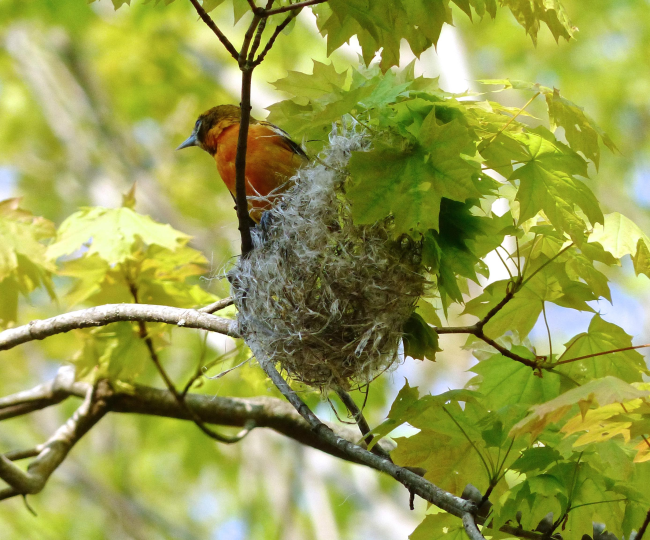
BALTIMORE ORIOLE upon its nest
Sharon Friends of Conservation photo credit

NEST — this simple word “nest” represents an enormously important context for a bird’s early life, and for bird parents, so bird nests are critically important for the life of entire bird families. A baby bird’s beginning is experienced inside a nest.  From embryonic egg to hatchling, from hatchling to fledgling, a baby bird’s life adventures are “hatched” inside a nest of some kind.  Consequently, nests are the childhood homes to young nestling birds, plus parent birds repeat their multi-generational nest life as they reproduce and nurture the next generation of their own kind.

For most birds, springtime means mating, and mating time means nesting.  As soon as nesting begins in earnest, everything changes.  The earth becomes quieter, the sight of a bird [displaying to attract a prospective mate] rarer.  Despite the seeming tranquility, there’s much ado and excitement among the birds.  The joy of expressing the springtime, of finding or reclaiming a mate, has been exchanged for the silence and secrecy of very private moments as birds begin the work of creating their homes. 

[Quoting Cohen, 1993, page 7.]

Do you recall the first times you ever saw a bird nest, close up? Did you realize, then, that the nest was “home” to the birds who resided therein?

rooftop nest of WHITE STORK
pixy.org photo credit

And what a variety of nests there are, because God has programmed different birds to build and indwell different types of nests! 

The variety of nests in the world of birds is fascinating.  Numerous species build elaborate structures.  The Dark-necked Tailorbird (Orthotomus atrogularis) builds its nest out of vegetable matter inside two leaves sewn together or in a single large leaf that is also sewn up with a thin length of thread; weaverbirds, and in particular the Sociable Weaverbirds (Philetarius socius), build large collective nests … certain Australian moundbirds (Megapodidae) build huge nests of earth and vegetable matter, using the heat produced as it decomposes to incubate the [compost-buried] eggs. Many species build rudimentary nests, others lay their eggs on the ground, in sand and among pebbles.  …  The nest is a structure used almost exclusively for reproductive purposes [or as a resting-place] …. The influences of the hormonal system combined with the physiological changes that take place in the bird’s body in the reproductive period determine the construction of the nest.  The choice of the site, the materials used and the time taken to build it, and the activity of the male or female in the construction, all vary from species to species. 

[Quoting Bologna, 1981, pages 39-42]

By the way, for a sampling of the diverse bird nests of the Chesapeake Bay ecosystem, see Kathy Reshetiloff’s “Cups, Cavities, Scrapes or Spheres–to Each Bird its own Nest”, CHESAPEAKE BAY JOURNAL, 34(2):40 (April 2024), posted at http://www.bayjournal.com/columns/bay_naturalist/cups-cavities-scrapes-or-spheres-to-each-bird-its-own-nest/article_cbbad062-f0ec-11ee-8cc0-dbe15dde1460.html .

These nests must accommodate the bird family’s collective weight and activities, as well as tolerate foul weather, such as winds and precipitation.  Of course, nests constructed upon or inside the ground, such as the mound-nests of the Megapode “incubator bird” (Martin, 1994, pages 43-46), need not be concerned with the weight of the nest.

Some nests are mere scrapes upon a strategic patch of ground.  The Arctic Tern (Sterna paradisaea) is famous for its record-breaking migration treks, from the Arctic regions to the Antarctic regions, and vice versa (Egevang et al., 2010, page 2078), so the Artic Tern cannot afford a nest-building habit, during its breeding season (in the Arctic), that would invest too much time or material in nest-building. 

ARCTIC TERN on simple nest
WeForAnimals.com photo credit

Since the Arctic summer is so brief, a simple scrape that does not shorten brooding time is the best solution.

[Quoting Cohen, 1993, page 46].

Other bird nests are burrowed underground or into the side of a muddy riverbank [Peterson & Chalif, 1973, page 112; Cohen, 1993, 50-53].  In Texas prairies, for example, one such underground-dwelling bird is the Burrowing Owl (Speotyto cunicularia).

One of the strangest and most beguiling members of the owl family is the burrowing owl.  It lives in a hole in the ground, often on a treeless prairie or desert, and is most frequently seen standing beside its burrow or perched on a nearby fence post. … These charming little owls breed locally in the [Texas] Panhandle and West Texas, frequently associated with prairie dog villages, where they [i.e., the burrowing owls] utilize the ready-made burrows and tunnel systems.  Other adapt abandoned homes of ground squirrels and pocket gophers, enlarging them by kicking dirt backwards with their feet.  

[Quoting Tveten, 1993, page 173]

Many are designed to be camouflaged or otherwise hidden.  Some such tree cavities are claimed by house wrens or certain types of owls, after they are abandoned by the original tree-hole excavators (Cohen, 1993, page 58; Bologna, 1981, pages 52 & 418). However, other tree cavity nests are the products of the birds who inhabit them after they peck them into existence, in the sides of trees or cacti (Shunk, 2016, page 15), such as tree cavity nests of the Pileated Woodpecker (Dryocopus pileatus).

PILEATED WOODPECKERS in tree cavity nest
Steve large’s Wildlife Blog photo credit

For secrecy, few hiding places can compare to a tree cavity. … Usually, the foliage of surrounding trees provides ample camouflage; sometimes height is the great advantage.  No matter the case, birds nesting in tree cavities are safe from most predators—except tree-climbing snakes and an occasional agile mammal.  A tree must be large and structurally sound enough to support a cavity, especially when carved by the Pileated Woodpecker [Dryocopus pileatus].  The Pileated digs a hollow up to two feet into the tree, although the 3½-inch entranceway is only a fraction [of] that size. The Pileated Woodpecker is [providentially] equipped with one of the strongest beaks of all birds, yet excavating comes as no easy chore.  The process takes days, and is completed mostly by the male with some assistance from his mate.  Many choose dead trees, but even so their efforts may be frustrated by a particularly recalcitrant tree.

[Quoting Cohen, 1993, page 54]

Some bird nests are tree-nestled demitasses, such as large cup-shaped nests of the American Crow (Corvus brachyrynchos), the medium-sized cup-nests of the Magnolia Warbler (Dendroica magnolia), and the fragile mini-nests of most hummingbirds, including the Rufous Hummingbird (Selasphorus rufus).
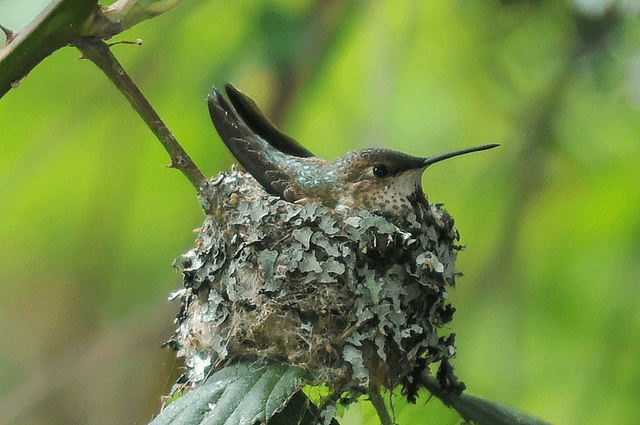
RUFOUS HUMMINGBIRD in nest
AnimalSpot.net photo credit

RUFOUS HUMMINGBIRD:  Nest of downy plant fibers and moss, covered with lichens, held together with spider’s silk; placed on downward-sloping limb of tree or shrub.

[Quoting Stokes & Stokes, 1996, page 263]

Even the most careful observer would be challenged to locate a hummingbird’s nest.  This smallest of [bird] nests is nearly impossible to find, not only because of its size [~2 inches diameter/width of nest exterior, with ~1 inch diameter/width of nest’s inner cup], but as a result of the plant camouflage the female incorporates into the structure.  Because of the importance of camouflage, males are not welcome visitors to the hummingbird nest.  Their bright colors draw too much attention and might endanger the offspring, so they take no part in nest-building, incubation, or chick-rearing.  Often they return after the chicks are fledged and help produce a second brood in the same season. …  Not every bird could manage a cup nest.  Because of the high walls [which prevent the nestling young from tumbling out by accident], a cup must be entered from above, a feat best accomplished by skilled aviators such as songbirds.  Master of wing control [as demonstrated by multi-directional flight and hovering], the hummingbird is a natural cup nester. 

[Quoting Cohen, 1993, page 64]

Since hummingbirds are tiny birds, it is unsurprising that their nests are likewise (realtively) tiny.  However, hatchling hummingbird young do more than eat in those tiny nests—they also learn about life, especially from parental teaching:

The staff at ICR [i.e., the Institute for Creation Research] … noticed months ago that an adult bird was weaving a nest on a palm frond. Being a science organization and lovers of God’s living creation, we closely followed the maternal events as they unfolded. The tiny eggs hatched and in due time, the two rapidly-growing hatchlings were literally bursting from the confines of their nest. It was interesting that the mother, perched on a nearby branch (always the same one), would intently watch her little ones in the nest. She would occasionally zoom around the nest, showing her crouching, bewildered offspring that “this is how you do it!” 

[Sherwin, 2006]

Other bird nests are quite roomy, resembling hanging sacks or book-bags, such as the pocket-like sack-nest of the Baltimore Oriole (Icterus galbula).
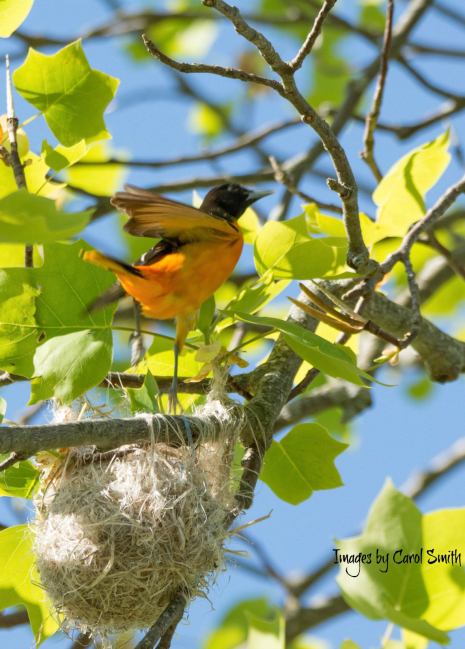
BALTIMORE ORIOLE above nest
Carol Smith / Carol’s View of New England photo credit

Orioles are as well known for their nests as they are for any other aspect of their behavior.  The nest is a long woven sack, suspended from the tip of a drooping branch.  These nests are obvious in winter, especially hanging over roads, and it’s always interesting to see how many Orioles actually nested in your area, even though you were unaware of them during the breeding season [which is when the orioles’ family privacy is most important!].  Usually the female builds the nest.  First a few long fibers are attached to the branch and looped underneath.  After that, she brings other fibers one at a time and pushes them through one side, and then arbitrarily pulls fibers in from the other side.  The actions [appear] random … [yet] she gradually creates a suspended mass of material.  Then, entering from near the top, she lines it with soft material such as feathers, grasses, wool, and dandelion or willow fuzz.  The nest can take from five to eight or more days to complete.  Orioles usually build a new nest each year, but in some instances they have been known to repair old nests.  When building a new nest, they frequently take [and recycle] material from one of their old nests or some other bird’s nest. 

[Quoting Stokes & Stokes, 1983, page 231]

Some bird nests are mostly reshaped mud, such as the pottery-like mud-ness of the Rufous Ovenbird (Firnarius rufus), the Cliff Swallow (Hirundo pyrrhonota), the Bank Swallow (Riparia riparia), and the Greater Flamingo (Phoenicopterus ruber). 

BANK SWALLOWS with nesting bank-side cavities
Annandale Advocate photo credit

BANK SWALLOW (a/k/a SAND MARTIN):  It usually nests near water in holes in steep banks [e.g., inside a nesting hole within a muddy riverbank], either natural or artificial, of earth or sand.  The hole is made by both adults and ends in a wider space [e.g., a pocketed riparian mudbank cavity], where the female lays clutches of 3-7 eggs (most often 4 or 5). Both sexes incubate the eggs for 12-16 days.  The nidicolous [i.e., nesting for a long time before fledging] nestlings are reared by both parents and stay in the nest for about 19 days [which is a relatively long time before fledging].  They feed on flying insects.

[Quoting Bologna, 1981, page 353]

Mud is an excellent choice of nesting material.  When it is cemented into place, mud creates a sturdy nest that is nearly impermeable to any threat but rain, at least for the time needed to raise a family of chicks.  Cliff Swallows Hirundo pyrrhonota) build their nests as do most other mud-nesters, in stages.  As many as one thousand [1,000!] mud pellets, each carried separately to the site and placed in layers, are needed to complete the task.  Before each succeeding [mud-nest] layer can be added, the previous one must dry completely [unlike brick masonry courses constructed by human bricklayers!]. Too much weight, and the nest could topple over.  The whole tasks needs about two weeks to complete and may take even longer during periods of drought or too much rain.  A mud hole seems almost alive when dozens of Cliff Swallows are jockeying for the choicest mud they can find. 

[Quoting Cohen, 1993, page 74]

Some bird nests are located on shorelines of freshwater or brackish water, such as nests of Great Blue Heron (Ardea herodias) and nests of Common Loon (Gavia immer).  Likewise, some birds nests are located on oceanic beaches and rocky seashore cliffsides, such as nests of Red-legged Kittiwakes (Rissa brevirostris) and nests of Thick-billed Murres (Uria lomvia).

Many aquatic birds build their nests very close to or just on top of the water.  Some birds, such as coots, build their own private nest islands on the water, while grebes anchor floating platforms to a nearby water plant.  As long as the eggs stay dry (and out of the jaws of a predator), the unhatched chicks remain safe.  … Though loons fish in both fresh and salt water, they nest near fresh water [usually lentic freshwater, such as ponds and lakes] only.  Free of the currents and tidal motion of seawater, the calmer waters of inland lakes are easier for neonates to negotiate while learning the diving techniques crucial for their adult survival. 

[Quoting Cohen, 1993, page 78]

The [Common Loon] nests are usually sheltered by surrounding vegetation and upon first being built are right at the water’s edge.  ….  Nests are built of earth, grasses, moss, [and/or] dense floating vegetation. Little in the way of a nest is built before the eggs are laid.  The nest at this time is usually only a little depression in the substrate with a small amount of [added] material collected around it.

[Quoting Stokes & Stokes, 1989, page 18]

They [i.e., Double-crested Cormorants] nest in colonies, their stick nests usually in cottonwoods near or over water.  Cormorants are abundant on the lakes and reservoirs of eastern Colorado in summer; a few remain in winter. 

[Quoting Gray, 1998, page 27]

Some bird nests are in rocks, often at high altitudes.

The vivid description in [verses 27-28] Job 39 must surely refer to the griffon-vulture [Gyps fulvus]: ‘Doth the eagle mount up at thy command, and make her nest on high? She dwelleth and abideth on the rock, upon the crag of the rock, and the strong place.’ This passage well describes a typical nesting-site.

[Quoting Cansdale, 1976, page 144].  

The size of Bald Eagle (Haliaeetus leucocephalus) nests is impressive—some eagle nests are built to colossal sizes, more than 12 feet deep, 8 feet wide, and weighing up to a ton! 

[Cohen, 1993, pages 62-63]. 

The Bald Eagle (Haliaeetus leucocephalus) uses a platform nest as its base and then builds a more complicated cup nest into the surface.  If disturbed during egg-laying or early chick-rearing, a Bald Eagle pair may abandon tis nest.  [Quoting Cohen, 1993, page 62]

[Quoting Cohen, 1993, page 62]

Eagles—like many other territorial birds of prey—often nest far from other eagles, yet this is obviously not characteristic of Bald Eagle populations along the coasts of Southeastern Alaska (Kavanaugh, 1997, page 59; personal observations during summer itineraries aboard cruise ships, serving a historian/naturalist, during AD2000, AD2001, and after). 

Thousands [of Bald Eagles, migrating seasonally to the Alaska Chilkat Bald Eagle Preserve] congregate to feed on spawning salmon in the Chilkat [River] Valley in autumn and early winter. 

[Quoting Kavanaugh, 1997, page 59]

Many bird populations nest in colonies, with some wading bird colonies called “rookeries” (Griggs, 1997, page 41), in keeping with other gregarious habits that justify the old saying: “birds of a feather flock together”. Such gregarious behavior certainly includes the wonderful icterids we call grackles, often seen congregating in or above parking lots, such as the Common Grackle (Quiscalus quiscula) and the Great-tailed Grackle (Quiscalus mexicanus).

Grackle nest-building may occur over a period of up to six weeks or even more, and in these extended cases seems to be closely tied with pair formation.  Grackles are somewhat colonial in their nesting habits, many pairs often nesting in the same area.  After a pair have become established they spend most of their time at a breeding site, first just exploring: visiting old nests and hopping about prospective nest sites.  During these activities [as with similar activities by human pairs] the female is always in the lead. 

[Quoting Stokes,1979, page 296]

Thus, for God’s multitude of bird varieties God programmed those birds to make and to use a prodigious variety of bird nests. This fits God’s Genesis Mandate, for birds to be fruitful, multiply, and fill the earth — because biodiversity is enhanced by a variety of habitats to house that biodiversity (Johnson, 2012a, pages 10-12).

Many bird nests (such as hummingbird nests) go unnoticed by human eyes, yet our Heavenly Father always notices and cares about bird nests, everywhere and at all times, because He cares about the birds whose needs are met by those nests.

Are not two sparrows sold for a farthing? And one of them shall not fall on the ground without your Father. 

(Matthew 10:29)

The diversity of avian nesting habits displays God’s love for variety (Johnson, 2012b, pages 8-9), as one would expect, since we see countless proofs of God’s love of variety in how animals (including birds of all kinds) are fruitful, multiply, and fill niches all over the earth (Johnson, 2012a, pages 10-12).

Accordingly, expect to find variety in bird nests.

A hummingbird hovers over a spider’s web, spending several seconds latching onto a thread of silk [to be incorporated as stabilizing material for the hummer’s coin-sized nest].  A woodpecker suspends his tree-drumming and instead works on excavating a nest hole with his mate.  A shorebird slinks into a quiet area unnoticed and lays her single egg on [a strategically selected patch of] bare sand.  In the privacy of their own world[s], often far beyond human ken, birds settle down to build their nests and breed young. 

[Quoting Cohen, 1993, page 7.]

The importance of bird nests is no surprise, because nest life is at the heart of a bird population’s critical habitat. Nest life is where a parental generation of birds facilitate the launching of the next (i.e., filial) generation of those birds [Bologna, 1981, pages 37-45; Cohen, 1993, pages 7-8.]

But, the physiology of birds requires a nest life that differs from many non-birds, because birds (including pre-hatched birds) are warm-blooded animals.

What makes birds different from other egg-laying creatures is that the embryo inside each egg is as warm-blooded as a human, and like a human, requires the warmth provided by its parent, or by an adequate substitute, to develop and to thrive.  Because it is so fragile, the egg must be coddled in a secure place until its occupant is ready to leave and face the rigors of the outside world.  Encased in its [calcium carbonate-structured] shell, the tiny chick’s only hope is that its parents [or foster-parents] do know what is best.  The nest the adult birds provide furnishes the warmth and protection necessary for the chicks’ survival.

[Quoting Cohen, 1993, page 8.]

Nests are so important, because God made them to have useful value, so we should expect them to be mentioned within the HOLY BIBLE’s pages.  And, sure enough, the holy Scriptures refer to bird nests, repeatedly.  A few such examples follow.

Before reviewing those examples, however, it is worth noticing that the usual Hebrew noun translated “nest” is qên (Wigram, 20123, page 1111), which first appears in Genesis 6:14 (referring to “homes” aboard Noah’s Ark), where the King James Version of the English Bible translates it as “rooms”.  Yet, even in that Ark housing context, a qên was one of many temporal “homes” (i.e., onboard chambers, like “cabins” or “staterooms” within an ocean-faring cruise ship), used for security and protection from hostile external conditions. 

Based upon etymologically related Hebrew words (Wigram, 20123, pages 1111-1112), it appears that the underlying connotation is the idea of specifically claimed property (i.e., acquired and possessed as “private” property) that belongs to a specific individual, or to a specific group (such as a specific family).

Accordingly, the Hebrew words for “nest” (both as a noun and as a verb) denote the structural home of a bird family, that belongs to that bird family—the family nest is specifically claimed property (i.e., acquired and possessed as “private” property), situated within the bird family’s ecological neighborhood.

  1. Location, location, location:  where you nest matters! 

Where a bird nest is positioned is important.  Maybe the best place for a nest—such as an Osprey nest—is high upon a relatively inaccessible rocky clifftop, or within the higher branches of a tall tree (Stokes & Stokes, 1989, page 163).

And he looked on the Kenites, and took up his parable, and said, ‘Strong is thy dwelling-place, and thou puttest [i.e., you position] thy nest in a rock.’ 

(Numbers 24:21, with “nest” [qên] as noun)

And for many large birds of prey, such as eagles, nesting in high places is the way to go.  (Perhaps such birds feel “high and mighty”!)

Thy terribleness hath deceived thee, and the pride of thine heart, O thou that dwellest in the clefts of the rock, who holds the height of the hill; though thou shouldest make thy nest as high as the eagle, I will bring thee down from thence, saith the Lord.

(Jeremiah 49:16, with “nest” [qên] as noun)

Though thou exalt thyself as the eagle, and though thou set thy nest among the stars, thence will I bring thee down, saith the Lord. 

(Obadiah 1:4, with “nest” [qên] as noun)

Woe to him that covets an evil covetousness to his house, that he may set his nest on high, that he may be delivered from the power of evil!   )

(Habakkuk 2:9, with “nest” [qên] as noun)

No need for humans to feel “high and mighty” – God resists the proud but he upholds the humble-hearted.  (And pride routinely “goeth” before a fall.)

2. Multi-generational reproductive success is priority!

Birds of prey include hawks, eagles, owls, and more.

Yet birds themselves are often prey to predators of many kinds, including humans who eat birds, both domesticated and wild—such as chicken, turkey, goose, and the eggs fo many kinds of birds.  But if one generation of predators greedily consumes all of a prey population, the next generation of those predators would be deprived of a food source, which would be harmful to both the predator population and the prey population. 

Accordingly, it is good for a generation of predators to only eat a limited amount of a prey population, so that future generations of both predators and prey can benefit (from continued reproductive success of the prey population.  That stewardship principle—applying restraint in lieu of greedy wastefulness—is what Moses commanded the Israelites as a conservation law for their future entry into and settlement in the Promised Land of Canaan.

If a bird’s nest chance to be before thee in the way in any tree, or on the ground, whether they be young ones, or eggs, and the mother sitting upon the young, or upon the eggs, thou shalt not take the mother with the young; but thou shalt in any wise let the mother go, and take the young to thee; that it may be well with thee, and that thou mayest prolong days.  (Deuteronomy 22:6-7, with “nest” [qên] as noun)

(Deuteronomy 22:6-7, with “nest” [qên] as noun)

3. Nests are where good parenting is needed!

How eagle parents treat their young has been a subject of some confusion over the years, due to a less-than-clear-and-accurate translation of Deuteronomy 32:11.  That confusion has already been addressed in an earlier article (Johnson, 2020, pages 57-59) examining that all-too-often misinterpreted passage, so that discussion will not be repeated here. 

Suffice it to say, here, that eagle parents care for their young!  Like many (but not all) animal parents, eagle parents go to great efforts to raise their nestling children, training them, from hatchlings unto fledglings, for their future lives.

As an eagle, he [i.e., God, in relation to His people Israel] stirs up his [i.e., God’s] nest, he {i.e., God] flutters over his [i.e., God’s] young, he [I.e., God] spreads abroad his [i.e., God’s] wings, he [i.e., God] taketh them, he [i.e., God] bears them [i.e., the Israelites as God’s people] on his [i.e., God’s] wings….

(Deuteronomy 32:11, literal translation, with editorial clarifications: “nest” [qên] as metaphoric noun)

This is comparable to how the Lord Jesus Christ compared His willingness to protect Jews to a mother hen’s protectiveness, as demonstrated in her welcoming and refuge-providing wingspread, noted in Matthew 23:37 and also in Luke 13:34.

4. Nests should be places of domestic security: “home sweet home”.

Then I said, I shall die in my nest, and I shall multiply my days as the sand. 

(Job 29:18, with “nest” [qên] as noun)

The patriarch Job, unto his “friendly” counsellors, once lamented his former life of blessing, before his torturous trials were suddenly dumped upon his head. Job related how he expected to live a long life of uninterrupted blessing, ultimately dying at peace in his own “nest” (i.e., “home sweet home”).  But, God had other plans—ultimately better (albeit bumpier) plans for Job’s earthly pilgrimage.

5. The ability, of birds to make nests, is God-given, i.e., God-programmed.

Doth the eagle mount up at thy command, and make her nest on high? 

(Job 39:27, with “nest” [qên] as noun)

The eagle was designed (i.e., pre-programmed) with built-in abilities and inclinations, endowed at creation by the Lord Jesus Christ, to make its nest in high places (Obadiah 1:4), and to mount up into the air suing thermal air currents.

The eagle did not invent these purposeful traits; God designed the eagle’s physical traits and its pre-programmed abilities, including the know-how (and the how-to) needed for successfully building eyries atop high montane places or in tall trees. For more on this Scripture about eagle behavior, see an earlier CRSQ article (Johnson, 2021, page 290).

6. Nests are for raising children, i.e., the next generation.

Yea, the sparrow hath found a house, and the swallow a nest for herself, where she may lay her young, even thine altars, O Lord of hosts, my King, and my God. 

(Psalm 84:3, with “nest” [qên] as noun)

Notice that the sparrow’s “house” is parallel in meaning to the “nest’ of the swallow.  In other words, a “nest” is a “house” for dwelling in, and especially for raising young in.

7. Particular types of nests are selected according who will be living therein.

Where the birds make their nests: as for the stork, the fir trees are her house. 

(Psalm 104:17, with “nest” [qânan] as verb)

In the above-quoted psalm we are reminded that storks are known to make their homes within the branches of fir trees.  Storks are also known as predictable migrants—see Jeremiah 8:7 (Johnson, 2013).

8. Wandering from the security of the nest can lead to many dangers.

As a bird that wanders from her nest, so is a man that wanders from his place. 

(Proverbs 27:8, with “nest” [qên] as noun)

For it shall be, that, as a wandering bird cast out of the nest, so the daughters of Moab shall be at the fords of Arnon.  (Isaiah 16:2, with “nest” [qên] as noun)

One of the advantages of many bird nests is camouflage—being hidden from the sight of hungry predators.  There is a security that comes with staying inside one’s proper home.  Not that any home (or nest) is “bulletproof” from danger, but there are often many more dangers lurking about, the farther that one wanders away from home. (The same is true for young who are expelled from home.) 

Consequently, the high mortality rate is why birds routinely try to raise more hatchlings than themselves.  In other words, two parent birds need to strive for replacing themselves with more than just two children, in order to mitigate the risks that their progeny will become prey (literally “dead meat”) before they progeny can successfully reproduce the next generation. 

[NOTE: the overall concept of multi-generational replacement, as a matter of population biology, is discussed in my population biology article “Post-Flood Repopulation:  From 8 to 8,000,000,000!” posted at  www.icr.org/article/post-flood-repopulation-from-8-8000000000 .]

9. Bird eggs are a valuable source of good (i.e., nutritionally rich) food.

And my hand hath found as a nest the riches of the people: and as one gathers eggs that are left, have I gathered all the earth; and there was none that moved the wing, or opened the mouth, or peeped. 

(Isaiah 10:14, with “nest” [qên] as noun)

Isaiah stated the obvious—eggs are valuable; in fact, they are like a store of “riches”, nutritionally speaking.  This nutrition fact concurs with the mention of eggs as a “good” food, in contrast to bad food.  See Luke 11:11-13, where giving eggs to eat is recognized (by the Lord Jesus Christ Himself, the Creator of all food) as “good gifts to your children”.   

10. Places are recognized as “wild places”, if dominated by many predators.

There shall the great owl make her nest, and lay, and hatch, and gather under her shadow; there shall the vultures also be gathered, everyone with her mate.

(Isaiah 34:15, with “nest” [qânan] as verb)

Isaiah’s somber prophecy warns that God will be judging (i.e., punishing) the Edomites, because of the Edomites’ wicked mistreatment of Israelites (see Isaiah 34:6-8); the resultant judgment includes severe desolation of the Edomites’ land—which desolation shall include Edomite lands becoming overtaken by birds of prey (see Isaiah 34:10-16).  Because Edomite lands, in the prophesied future, will be dominated by nests of predatory animals—including predatory birds—such lands will become “wild places” (i.e., wildernesses), not fit for human habitation.

11. Flexibility increases opportunities to “fit” and “fill” different situations.

O ye that dwell in Moab, leave the cities, and dwell in the rock, and be like the dove that makes her nest in the sides of the hole’s mouth.

 (Jeremiah 48:28, with “nest” [qânan] as verb)

For example, doves (which include pigeons), are famous for resiliently adjusting themselves to the most diverse of habitats–this is a behavioral trait that this writer has observed frequently, over the years–even in the most unlikely of habitats. Decades ago, this writer (with family members) was exploring an underground “lava tube” cave at Craters of the Moon–a park (designated as a “national monument”), in Idaho.  Inside this most ecologically inhospitable venue, perched within a crack in the cavernous ceiling, there was a nest with two pigeons therein!  Doves can live successfully almost anywhere – they are peaceful, yet flexible and opportunistic “generalists”.  

12. Tree branches are often a hospitable home for nesting birds.

All the fowls of heaven made their nests in his boughs, and under his branches did all the beasts of the field bring forth their young, and under his shadow dwelt all great nations.

(Ezekiel 31:6, with “nest” [qânan] as verb)

The tree that thou sawest, which grew, and was strong, whose height reached unto the heaven, and the sight thereof to all the earth, whose leaves were fair, and the fruit thereof much, and in it was meat for all; under which the beasts of the field dwelt, and upon whose branches the fowls of the heaven had their habitation.

(Daniel 4:20-21)

Even in Nebuchadnezzar’s dream he recognized that tree branches (a/k/a boughs) are good sites for bird nests!

13. Nests, although sturdy and secure, are only temporal.

Though thou exalt thyself as the eagle, and though thou set thy nest among the stars, thence will I bring thee down, saith the Lord. 

(Obadiah 1:4, with “nest” [n] as noun)

Eagle nests are sturdy and secure – setting records for their size and weight (as noted above) – yet they too are, after all, only temporal.  This provides a good reminder about this passing world.  This world will “groan” till the Lord Jesus cancels the curse of sin and death (Romans 8:22-23; 1st Corinthians 15).  Till then, we too “groan” (2nd Corinthians 5:2-4).

14. Christ prepared for bird homes via nesting habitats and nesting skills.

And Jesus saith unto him, The foxes have holes, and the birds of the air have nests; but the Son of man hath not where to lay his head. 

(Matthew 8:20, with “nests” [κατασκηνωσεις] as noun)

And Jesus said unto him, Foxes have holes, and birds of the air have nests; but the Son of man hath not where to lay his head. 

(Luke 9:58, with “nest” [κατασκηνωσεις] as noun)

Behold the kindness of our Lord Jesus Christ:  He did not insist on having a “home” when He came to Earth to be our Savior.  Christ was goal-oriented, undistracted, and not fixated on the things of this passing world. 

However, as our kind Creator, He even prepared fitting homes for His multifarious animal creatures, such as foxes and “birds of the air”.   Speaking of “home”, it is the very Creator-Redeemer, our Lord Jesus Christ, Who is our true home.

Accordingly, settling (domesticating) specific niches in the earth—even migratory stopover homes—and utilizing home bases for family life activities is needful to fill the multitude of Earth’s multifarious habitats. To achieve this goal, God has providentially equipped creatures with physical bodies (with helpful anatomies and physiologies) and programmed bio-informational instructions (coding and equipping for habitat-interactive behaviors) that are fitted to the dynamic challenges of physical environments (and biotic communities) all over the globe. As earthbound pilgrims, we pass through this mortal life (Hebrews 11:131 Peter 2:11), interfacing with an all-too-often hostile culture (Hebrews 11:36-38). We long for a truly secure home—where we really belong. But, as Christians, what is our true home? It is not residential real estate housing (Philippians 3:20Hebrews 11:8-14). Our true homes are not even the earthly bodies that we temporally inhabit, although they are the “tents” we know best (2 Corinthians 5:1-42 Peter 1:13). For Christians, ultimately, our real eternal home is God Himself (Psalm 90:12 Corinthians 5:6John 14:2-6). As our Creator, He started us. As our Redeemer, we finish with Him. What a homecoming we wait for! 

{Quoting Johnson, 2015, page 20)

Maybe there are more examples, of bird nests being mentioned in Scripture.  But, at least, the examples listed above show that bird nests are important, so important (to God) that they merit repeated mention, in the only book that God Himself wrote.

REFERENCES

Bologna, Gianfranco. 1981. A Guide to Birds of the World.  English translation by Arnoldo Mondadori.  Fireside Books / Simon & Schuster, New York, NY.

Cansdale, George S. 1976. All the Animals of the Bible Lands. Zondervan, Grand Rapids, MI.

Cohen, Sharon A. 1993. Bird Nests. Harper Collins, San Francisco, CA.

Egevang, Carsten, Iain J. Stenhouse, Richard A. Phillips, & Janet R. D. Silk. 2010. Tracking of Arctic terns (Sterna paradisaea) reveals longest animal migration. Proceedings of the National Academy of Sciences. 107(5):2078-2081.

Gray, Mary Taylor. 1998. The Guide to Colorado Birds.  Westcliffe Press, Englewood, CO.

Griggs, Jack. 1997. All the Birds of North America. Harper Collins, New York, NY.

Johnson, James J. S. 2012a. God Fitted Habitats for Biodiversity. Acts & Facts. 41(3):10-12 (March 2012), posted at www.icr.org/article/god-fitted-habitats-for-biodiversity .

Johnson, James J. S.  2012b. Valuing God’s Variety. Acts & Facts. 41(9):8-9 (September 2012), posted at www.icr.org/article/valuing-gods-variety .

Johnson, James J. S. 2013. A Lesson from the Stork. Days of Praise (December 22, 2013), posted at www.icr.org/article/lesson-from-stork .

Johnson, James J. S.  2015. Why We Want to Go Home. Acts & Facts. 44(4):20 (April 2015), posted at www.icr.org/article/why-we-want-go-home .

Johnson, James J. S.  2020. Clarifying Confusion about Eagles’ Wings. CRSQ. 57(1):57-59 (summer 2020).

Johnson, James J. S.  2021. Doxological Biodiversity in Job Chapter 39: God’s Wisdom and Providence as the Caring Creator, Exhibited in the Creation Ecology of Wildlife. CRSQ. 57(4):286-291 (spring 2021).

Kavanaugh, James. 1997.  The Nature of Alaska:  An Introduction to Familiar Plants and Animals and Natural Attractions.  Waterford Press, Blaine, WA.

Martin, Jobe.  1994. The Evolution of a Creationist.  Biblicla Discipleship Ministries, Rockwall, TX.

Peterson, Roger Tory, & Edward L. Chalif. 1973. A Field Guide to Mexican Birds Houghton Mifflin, Boston, MA.

Sherwin, Frank. 2006.  Hummingbirds at ICR.  Acts & Facts. 35(9):unpaginated.

Shunk, Stephen A. 2016. Peterson Reference Guide to Woodpeckers of North America. Houghton Mifflin Harcourt, Boston, MA.

Stokes, Donald. 1979. Stokes Guide to Bird Behavior, Volume I. Little, Brown & Company, Boston, MA.

Stokes, Donald, & Lillian Stokes. 1983. Stokes Guide to Bird Behavior, Volume II. Little, Brown & Company, Boston, MA.

Stokes, Donald, & Lillian Stokes. 1989. Stokes Guide to Bird Behavior, Volume III. Little, Brown & Company, Boston, MA.

Stokes, Donald, & Lillian Stokes. 1996. Stokes Field Guide to Birds: Western Region. Little, Brown & Company, Boston, MA.

Tveten, John L. 1993.  The Birds of Texas.  Shearer Publishing, Fredericksburg, TX.

Wigram, George V. 2013. The Englishman’s Hebrew Concordance of the Old Testament, 3rd edition. Hendrickson Publishers, Peabody, MA (originally published in 1874, by Samuel Bagster & Sons, London, UK).

BALTIMORE ORIOLE female weaving a nest  
(BirdNote.org photo credit)
Bird Nests are Important — the Bible Says So

Dr. James J. S. Johnson

BIRD NESTS ARE IMPORTANT: THE BIBLE SAYS SO

And Jesus said unto him, Foxes have holes, and birds of the air have nests; but the Son of man hath not where to lay his head.  (Luke 9:58)

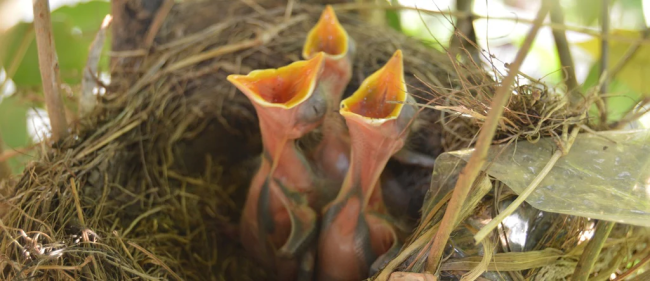
Hungry nestlings! (WhirlyBird photo credit)

NEST – this simple word “nest” represents an enormously important part of a bird’s life.  

Do you recall the first times you ever saw a bird nest, close up? Did you realize, then, that the nest was “home” to the birds who resided therein?

A baby bird’s beginning is experienced inside a nest.  From embryonic egg to hatchling, from hatchling to fledgling, a baby bird’s life adventures are “hatched” inside a nest of some kind.  Consequently, nests are the childhood homes to young nestling birds, plus parent birds repeat their multi-generational nest life as they reproduce and nurture their own next generation of their kind.

For most birds, springtime means mating, and mating time means nesting.  As soon as nesting begins in earnest, everything changes.  The earth becomes quieter, the sight of a bird [displaying to attract a prospective mate] rarer.  Despite the seeming tranquility, there’s much ado and excitement among the birds.  The joy of expressing the springtime, of finding or reclaiming a mate, has been exchanged for the silence and secrecy of very private moments as birds begin the work of creating their homes. 

[Quoting Sharon A. Cohen, BIRD NESTS (Harper Collins, 1993), page 7.]

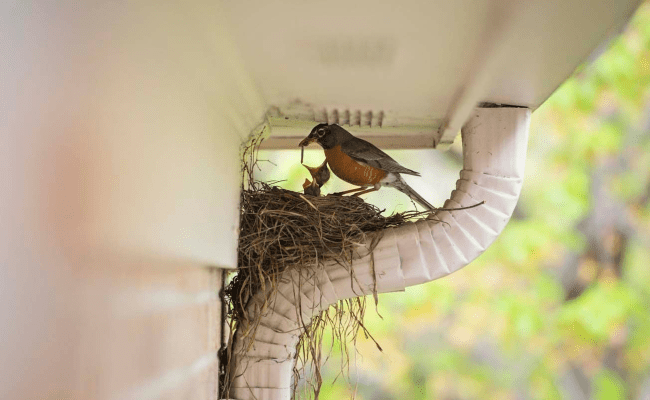
GUTTER NEST! (Bob Vila photo credit)

And what a variety of nests there are, because God has programmed different birds to build and indwell different types of nests. 

Some nests are mere scrapes upon a strategic patch of ground.  Other nests are burrowed underground.  Many are designed to be camouflaged or otherwise hidden.  Some nests are tree-nestled demitasses.  Some nests are holes on the sides fo trees or cacti.  Some nests are mostly reshaped mud.  Some nests are located on shorelines of freshwater, brackish water, or oceanic seashores. Some nests are in rocks, often at high altitudes. 

Many bird nests go unnoticed by human eyes, yet our Heavenly Father always notices and cares about bird nests, everywhere and at all times.

Are not two sparrows sold for a farthing? And one of them shall not fall on the ground without your Father.  (Matthew 10:29)

The diversity of avian nesting habits displays God’s love for variety, as one would expect, since we see countless proofs of God’s love of variety in how animals (including birds of all kinds) are fruitful, multiply, and fill niches all over the earth. [See JJSJ, “Valuing God’s Variety”, posted at www.icr.org/article/valuing-gods-variety  —  see also JJSJ, “God Fitted Habitats for Biodiversity”, posted at www.icr.org/article/god-fitted-habitats-for-biodiversity .]

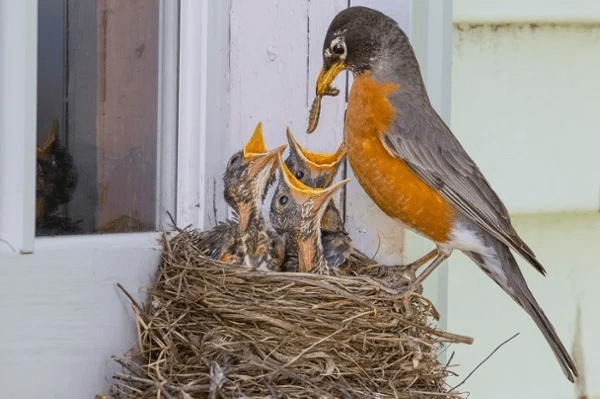
ROBIN NEST (Bird Barrier photo credit)

Accordingly, expect to find variety in bird nests.

A hummingbird hovers over a spider’s web, spending several seconds latching onto a thread of silk [to be incorporated as stabilizing material for the hummer’s coin-sized nest].  A woodpecker suspends his tree-drumming and instead works on excavating a nest hole with his mate.  A shorebird slinks into a quiet area unnoticed and lays her single egg on [a strategically selected patch of] bare sand.  In the privacy of their own world[s], often far beyond human ken, birds settle down to build their nests and breed young.  After mating takes place, attracting attention is no longer a priority.  Instead it is protecting the nest and incubating eggs that matter.  All living beings are driven to reproduce, and most lay eggs.  What makes birds different form other egg-laying creatures is that the embryo inside each egg is as warm-blooded as a human, and like a human, requires the warmth provided by its parent, or by an adequate substitute, to develop and to thrive.  Because it is so fragile, the egg must be coddled in a secure place until its occupant is ready to leave and face the rigors of the outside world.  Encased in its [calcium carbonate-structured] shell, the tiny chick’s only hope is that its parents [or foster-parents] do know what is best.  The nest the adult birds provide furnishes the warmth and protection necessary for the chicks’ survival.

[Quoting Sharon A. Cohen, BIRD NESTS (Harper Collins, 1993), pages 7-8.]

Nest are so important – because God made them to have value  —  that we should expect them to be mentioned within the HOLY BIBLE’s pages. 

Sure enough, the holy Scriptures refer to bird nests, repeatedly.  A few such examples follow.

Before reviewing those examples, however, it is worth noticing that the usual Hebrew noun translated “nest” is qên, which first appears in Genesis 6:14 (referring to “homes” aboard Noah’s Ark), where the King James Version of the English Bible translates it as “rooms”.  Yet, even in that Ark housing context, a qên was one of many temporal “homes” (i.e., onboard chambers, like “cabins” or “staterooms” within an ocean-faring cruise ship), used for security and protection from hostile external conditions.  Based upon etymologically related Hebrew words it appears that the underlying connotation is the idea of specifically claimed property (i.e., acquired and possessed as “private” property) that belongs to a specific individual, or to a specific group (such as a specific family).

OSPREYS NESTING
(photo credit: Massachusetts Wildlife)
  1. Location, location, location —  where you nest matters! 

Where a bird nest is positioned is important.  Maybe the best place for a nest—such as an Osprey nest—is high upon a relatively inaccessible rocky clifftop, or within the higher branches of a tall tree.  [See Donald Stokes & Lillian Stokes, A GUIDE TO BIRD BEHAVIOR, Volume III (Little Brown & Co., 1989), page 163.]

And he looked on the Kenites, and took up his parable, and said, ‘Strong is thy dwelling-place, and thou puttest [i.e., you position] thy nest in a rock.’  (Numbers 24:21, with “nest” [qên] as noun)

And for many large birds of prey, such as eagles, nesting in high places is the way to go.  (Perhaps such birds feel “high and mighty”!)

Thy terribleness hath deceived thee, and the pride of thine heart, O thou that dwellest in the clefts of the rock, that holdest the height of the hill: though thou shouldest make thy nest as high as the eagle, I will bring thee down from thence, saith the Lord. (Jeremiah 49:16, with “nest” [qên] as noun)

Though thou exalt thyself as the eagle, and though thou set thy nest among the stars, thence will I bring thee down, saith the Lord.  (Obadiah 1:4)

Woe to him that covets an evil covetousness to his house, that he may set his nest on high, that he may be delivered from the power of evil!   (Habakkuk 2:9, with “nest” [qên] as noun)

No need for humans to feel “high and mighty” – God resists the proud but he upholds the humble-hearted.  (And pride routinely “goeth” before a fall.)

2. Multi-generational reproductive success is priority!

Birds of prey include hawks, eagles, owls, and more. Yet birds themselves are often prey to predators of many kinds, including humans who eat birds, both domesticated and wild—such as chicken, turkey, goose, and the eggs fo many kinds of birds.  But if one generation of predators greedily consumes all of a prey population, the next generation of those predators would be deprived of a food source, which would be harmful to both the predator population and the prey population.  Accordingly, it is good for a generation of predators to only eat a limited amount of a prey population, so that future generations of both predators and prey can benefit (form continued reproductive success of the prey population.  That stewardship principle—applying restraint in lieu of greedy wastefulness—is what Moses commanded the Israelites as a conservation law for their future entry into and settlement in the Promised Land of Canaan.

If a bird’s nest chance to be before thee in the way in any tree, or on the ground, whether they be young ones, or eggs, and the mother sitting upon the young, or upon the eggs, thou shalt not take the mother with the young; but thou shalt in any wise let the mother go, and take the young to thee; that it may be well with thee, and that thou mayest prolong days.  (Deuteronomy 22:6-7, with “nest” [qên] as noun)

3. Nests are where good parenting is needed!

How eagle parents treat their young has been a subject of some confusion over the  years, due to a less-than-clear-and-accurate translation of Deuteronomy 32:11.  That confusion has already been addressed in “Clarifying Confusion about Eagles’ Wings”, posted at  https://leesbird.com/2022/09/27/clarifying-confusion-about-eagles-wings/   —   so that discussion will not be repeated here.  Suffice it to say, here, that eagle parents care for their young!  Like many—but not all—animal parents, eagle parents go to great efforts to raise their nestling children, training them for life as fledglings.

As an eagle, he [i.e., God, in relation to His people Israel] stirs up his [i.e., God’s] nest, he {i.e., God] flutters over his [i.e., God’s] young, he [I.e., God] spreads abroad his [i.e., God’s] wings, he [i.e., God] taketh them, he [i.e., God] bears them [i.e., the Israelites as God’s people] on his [i.e., God’s] wings…. (Deuteronomy 32:11, literal translation, with editorial clarifications, with “nest” [qên] as a metaphoric noun)

This is comparable to how the Lord Jesus Christ compared His willingness to protect Jews to a mother hen’s protectiveness, as demonstrated in her welcoming and refuge-providing wingspread, noted in Matthew 23:37 and also in Luke 13:34.

4. Nests should be places of domestic security: “home sweet home”.

Then I said, I shall die in my nest, and I shall multiply my days as the sand.  (Job 29:18, with “nest” [qên] as noun)

The patriarch Job, unto his “friendly” counsellors, once lamented his former life of blessing, before his torturous trials were suddenly dumped upon his head. Job related how he expected to live a long life of uninterrupted blessing, ultimately dying at peace in his own “nest” (i.e., “home sweet home”).  But, God had other plans—ultimately better (albeit bumpier) plans for Job’s earthly pilgrimage.

5. The ability, of birds to make nests, is God-given, i.e., God-programmed.

Doth the eagle mount up at thy command, and make her nest on high?  (Job 39:27, with “nest” [qên] as noun)

The eagle has designed (i.e., pre-programmed) abilities and inclinations to make its nest in high places, and to mount up into the air suing thermal air currents.  The eagle did not invent these designed traits – God designed the eagle’s physical traits and pre-programmed abilities, including the know-how (and the how-to) needed for successfully building eyries atop high montane places or in trees. [For more on this Scripture about eagle behavior, see “JOB Chapter 39:  God’s Wisdom and Providence, Exhibited in Wildlife Pair””, posted at  ttps://rockdoveblog.wordpress.com/?s=Job+39%3A27 .]

6. Nests are for raising children, i.e., the next generation.

Yea, the sparrow hath found a house, and the swallow a nest for herself, where she may lay her young, even thine altars, O Lord of hosts, my King, and my God.  (Psalm 84:3, with “nest” [qên] as noun)

Notice that the sparrow’s “house” is parallel in meaning to the “nest’ of the swallow.  In other words, a “nest” is a “house” for dwelling in, and especially for raising young in.

7. Particular types of nests are selected according who will be living therein.

Where the birds make their nests: as for the stork, the fir trees are her house.  (Psalm 104:17, with “nest” [qânan] as verb)

In the above-quoted psalm we are reminded that storks are known to make their homes within the branches of fir trees.  (Storks are also known as predictable migrants—see Jeremiah 8:7, described in “A Lesson from the Stork”, posted at www.icr.org/article/lesson-from-stork .)

8. Wandering from the security of the nest can lead to many dangers.

As a bird that wanders from her nest, so is a man that wanders from his place.  (Proverbs 27:8, with “nest” [qên] as noun)

For it shall be, that, as a wandering bird cast out of the nest, so the daughters of Moab shall be at the fords of Arnon.  (Isaiah 16:2, with “nest” [qên] as noun)

One of the advantages of many bird nests is camouflage—being hidden form the sight of hungry predators.  There is a security that comes with staying inside one’s proper home.  Not that any home (or nest) is “bulletproof” from danger, but there are often many more dangers lurking about, the farther that one wanders away from home. (The same is true for young who are expelled from home.)  Consequently, the high mortality rate is why birds routinely try to raise more hatchlings than themselves.  In other words, two parent birds need to strive for replacing themselves with more than just two children, in order to mitigate the risks that their progeny will become prey (literally “dead meat”) before they progeny can successfully reproduce the next generation. 

[The overall concept of multi-generational replacement, as a matter of population biology, is discussed in “Post-Flood Repopulation:  From 8 to 8,000,000,000!” posted at  www.icr.org/article/post-flood-repopulation-from-8-8000000000 .]

9. Bird eggs are a valuable source of good (i.e., nutritionally rich) food.

And my hand hath found as a nest the riches of the people: and as one gathers eggs that are left, have I gathered all the earth; and there was none that moved the wing, or opened the mouth, or peeped.  (Isaiah 10:14, with “nest” [qên] as noun)

Isaiah stated the obvious—eggs are valuable; in fact, they are like a store of “riches”, nutritionally speaking.  This nutrition fact concurs with the mention of eggs as a “good” food, in contrast to bad food.  See Luke 11:11-13, where giving eggs to eat is recognized (by Christ Himself, the Creator of all food) as “good gifts to your children”.   

10. Places are recognized as “wild places”, if dominated by many predators.

There shall the great owl make her nest, and lay, and hatch, and gather under her shadow; there shall the vultures also be gathered, everyone with her mate. (Isaiah 34:15, with “nest” [qânan] as verb)

The context of this somber prophecy, of Isaiah, is God judging (i.e., punishing) the Edomites, because of the Edomites’ wicked mistreatment of Israelites (see Isaiah 34:6-8), with the resultant desolation of the Edomites’ land—which punitive desolation to include Edomite lands becoming overtaken by birds of prey (se Isaiah 34:10-16).  Thus, if Edomite lands are, in the prophesied future, dominated by the nests of predatory animals—including predatory birds—such lands are to be recognized as “wild places” (wildernesses), not fit for human habitation.

11. Flexibility increases opportunities to “fit” and “fill” different situations

O ye that dwell in Moab, leave the cities, and dwell in the rock, and be like the dove that makes her nest in the sides of the hole’s mouth.  (Jeremiah 48:28, with “nest” [qânan] as verb)

Doves, which include pigeons, are famous for adjusting themselves to the most diverse of habitats.  Years ago, this writer (with family) was exploring an underground “lava tube” cave at Craters of the Moon park, in Idaho.  Inside this most inhospitable venue, perched within a crack in the cavernous ceiling, there was a nest with two pigeons therein!  Doves can live successfully almost anywhere – they are peaceful, yet flexible and opportunistic.  

12. Tree branches are often a hospitable home for nesting birds.

All the fowls of heaven made their nests in his boughs, and under his branches did all the beasts of the field bring forth their young, and under his shadow dwelt all great nations. (Ezekiel 31:6, with “nest” [qânan] as verb)

The tree that thou sawest, which grew, and was strong, whose height reached unto the heaven, and the sight thereof to all the earth, whose leaves were fair, and the fruit thereof much, and in it was meat for all; under which the beasts of the field dwelt, and upon whose branches the fowls of the heaven had their habitation. (Daniel 4:20-21)

Even in Nebuchadnezzar’s dream he recognized that tree branches (a/k/a boughs) are good sites for bird nests!

Saving the best for last: Christ prepared for bird homes via nesting habitats and nesting skills.

And Jesus saith unto him, The foxes have holes, and the birds of the air have nests; but the Son of man hath not where to lay his head.  (Matthew 8:20, with “nests” [κατασκηνωσεις] as noun)

And Jesus said unto him, Foxes have holes, and birds of the air have nests; but the Son of man hath not where to lay his head.  (Luke 9:58, with “nest” [κατασκηνωσεις] as noun)

Behold the kindness of our Lord Jesus Christ:  He did not insist on having a “home” when He came to Earth to be our Savior.  However, as our kind Creator He even prepared fitting homes fo His animal creatures, such as foxes and “birds of the air”.

Speaking of “home”, it is the very Creator-Redeemer, our Lord Jesus Christ, Who is our true home.

Accordingly, settling (domesticating) specific niches in the earth—even migratory stopover homes—and utilizing home bases for family life activities is needful to fill the multitude of Earth’s multifarious habitats. To achieve this goal, God has providentially equipped creatures with physical bodies (with helpful anatomies and physiologies) and programmed bio-informational instructions (coding and equipping for habitat-interactive behaviors) that are fitted to the dynamic challenges of physical environments (and biotic communities) all over the globe. As earthbound pilgrims, we pass through this mortal life (Hebrews 11:131 Peter 2:11), interfacing with an all-too-often hostile culture (Hebrews 11:36-38). We long for a truly secure home—where we really belong.

But, as Christians, what is our true home? It is not residential real estate housing (Philippians 3:20Hebrews 11:8-14). Our true homes are not even the earthly bodies that we temporally inhabit, although they are the “tents” we know best (2 Corinthians 5:1-42 Peter 1:13). For Christians, ultimately, our real eternal home is God Himself (Psalm 90:12 Corinthians 5:6John 14:2-6). As our Creator, He started us. As our Redeemer, we finish with Him. What a homecoming we wait for!

[Quoting from “Why We Want to Go Home”, posted at www.icr.org/article/why-we-want-go-home .]

“HOME SWEET HOME” (The Spruce photo credit)

Maybe there are more examples, of bird nests being mentioned in Scripture.  But, at least, the examples listed above show that bird nests are important, so important (to God) that they merit repeated mention, in the only book that God Himself wrote.

Carrier Pigeon Prompts Rescue of WWII Airmen Floating in the North Sea, Despite Carrying No Written Message!

BRITISH  AIRMEN LEAVING NORWAY, PLUNGE INTO  THE  NORTH SEA: WWII CARRIER  PIGEON  TO  THE  RESCUE !

(Carrier Pigeon Prompts Rescue of WWII  Airmen Floating in the North Sea, Despite Carrying No Written Message!)

Dr. James J. S. Johnson

And Jesus said unto him, Foxes have holes, and birds of the air have nests; but the Son of man hath not where to lay his head.   (Luke 9:58)

Pigeons know where their nests are;  you can trust them to find their way home!

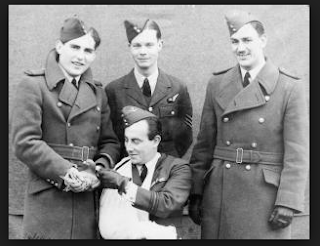
On February 23rd of AD1942, after an aerial mission over Norway, a shot-up and failing Royal Air Force Beaufort Bomber was trying to return home, but was forced to “ditch” at sea.  The North Sea waters were dangerously cold, freezing (although because these were salt-waters they remained liquid).  The 4 floating survivors were more than 100 miles from home, unable to radio their location to their friend back in Scotland.  Would they die, soon, in the frigid North Sea?

Thanks, providentially, to a Carrier Pigeon (a variety of Rock Dove), the 4 airmen were rescued, without the bird carrying a written S.O.S. message  —  but how?

Winkie-Pigeon-and-her-grateful-crew.WWII-rescue

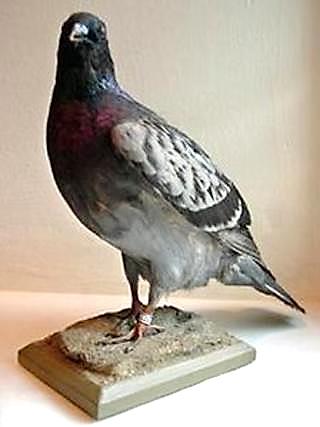
WINKIE,  Royal Air Force pigeon  # NEHU 40 NSL  

and her rescued & grateful WWII Royal Air Force crew

Here is the amazing report, provided by the British Broadcasting Corporation’s Christopher Sleight (in a BBC article titled “The Pigeon that Saved a World War II Bomber Crew” [ posted  AD2012-02-23 at https://www.bbc.com/news/uk-scotland-tayside-central-17138990 ].

Seventy years ago a carrier pigeon performed the act of “heroism” that saw it awarded the animal’s equivalent of the Victoria Cross – the Dickin Medal. It was the first of dozens of animals honoured by veterinary charity PDSA during World War II.

On 23 February 1942, a badly damaged RAF bomber ditched into the North Sea. The crew were returning from a mission over Norway, but their Beaufort Bomber had been hit by enemy fire and crashed into the sea more than 100 miles from home. Struggling in freezing waters – unable to radio an accurate position back to base [because the plane crashed so quickly] – the four men faced a cold and lonely death.

But as the aircraft went down, the crew had managed to salvage their secret weapon – a carrier pigeon. The blue chequered hen bird, called Winkie [“NEHU 40 NSL”], was set free in the hope it could fly home to its loft in Broughty Ferry, near Dundee [on the northern bank of River Tay, which flows from Scotland’s eastern coast into the North Sea], and so alert air base colleagues to their predicament.

But Winkie did make it home, after flying 120 miles [to Broughty Ferry], and was discovered, exhausted and covered in oil, by owner George Ross, who immediately informed RAF Leuchars in Fife.

The pigeon was not carrying a message, but the RAF were able to calculate [i.e., approximate] the position of the downed aircraft, using the time difference between the plane’s ditching and the arrival of the bird [to its loft nest] – taking into account the wind direction and even the impact of the oil [spoilage] on Winkie’s feathers, to her flight speed. A rescue mission was launched and the men were found within 15 minutes.

Elaine Pendlebury, from the PDSA [People’s Dispensary for Sick Animals], said the carrier pigeon had been released as a “last ditch stand” when the crew realised they had no other options. “I find it very, very moving really. These people would have died without this pigeon message coming through,” said Ms Pendlebury.

Winkie became the toast of the air base, with a dinner held in her honour. A year later, she became the first animal to receive the Dickin Medal – named after PDSA’s founder Maria Dickin – for “delivering a message under exceptional difficulties [and so contributing to the rescue of an Air Crew while serving with the RAF in February 1942]”.

During World War II, carrier pigeons were routinely carried by RAF bombers for this very eventuality, though in an era before GPS and satellite locator beacons, rescue was far from certain. More than 60 animals have since received the award, including 18 dogs, three horses and one cat. But pigeons still rule the [Dickin Medal] roost, with 32 being given medals, all between 1943 and 1949.

[Quoting from Corporation’s Christopher Sleight, “The Pigeon that Saved a World War II Bomber Crew” [BBC News (BBC.com, Tayside & Central Scotland column), AD2012-02-23 at https://www.bbc.com/news/uk-scotland-tayside-central-17138990 ].

PigeonService-RAF-WWII.ImperialWarMuseum

Homing Pigeons used by Royal Air Force, WWII   (Imperial War Museum photo)

It is reported that “more than 250,000 carrier pigeons were used [by Great Britain’s military] in World War II. They were called the National Pigeon Service and were relied on heavily to transport secret messages.” [Quoting https://its-interesting.com/2012/11/01/wwii-carrier-pigeon-delivers-message/ .]

WWII-Pigeon-Service-RAF-FeatheryPhotographyBlog

WWII RAF Pigeon Service   (Public Domain / Feathery Photography blog)

But how is it that birds, like the carrier pigeon, can fly so efficiently that humans can predict their flight-path, even without GPS, and can do so with such dependability that such predictions (i.e., calculations that approximate the location where someone can be found) can succeed in 4 saving lives, precariously afloat in wintery North Sea waters, more than 100 miles from Scotland?

In short, God has programmed many types of birds, especially migratory birds, with bioengineering traits that equip it for sophisticated and precise navigation, over lands and oceans.

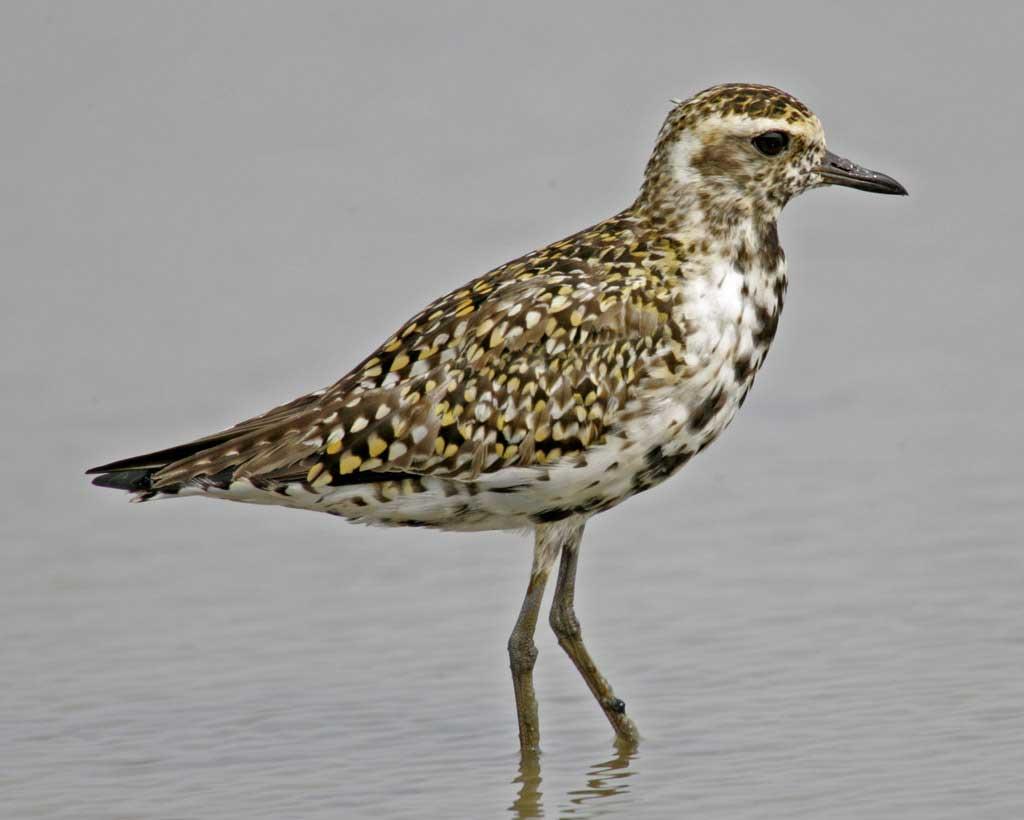
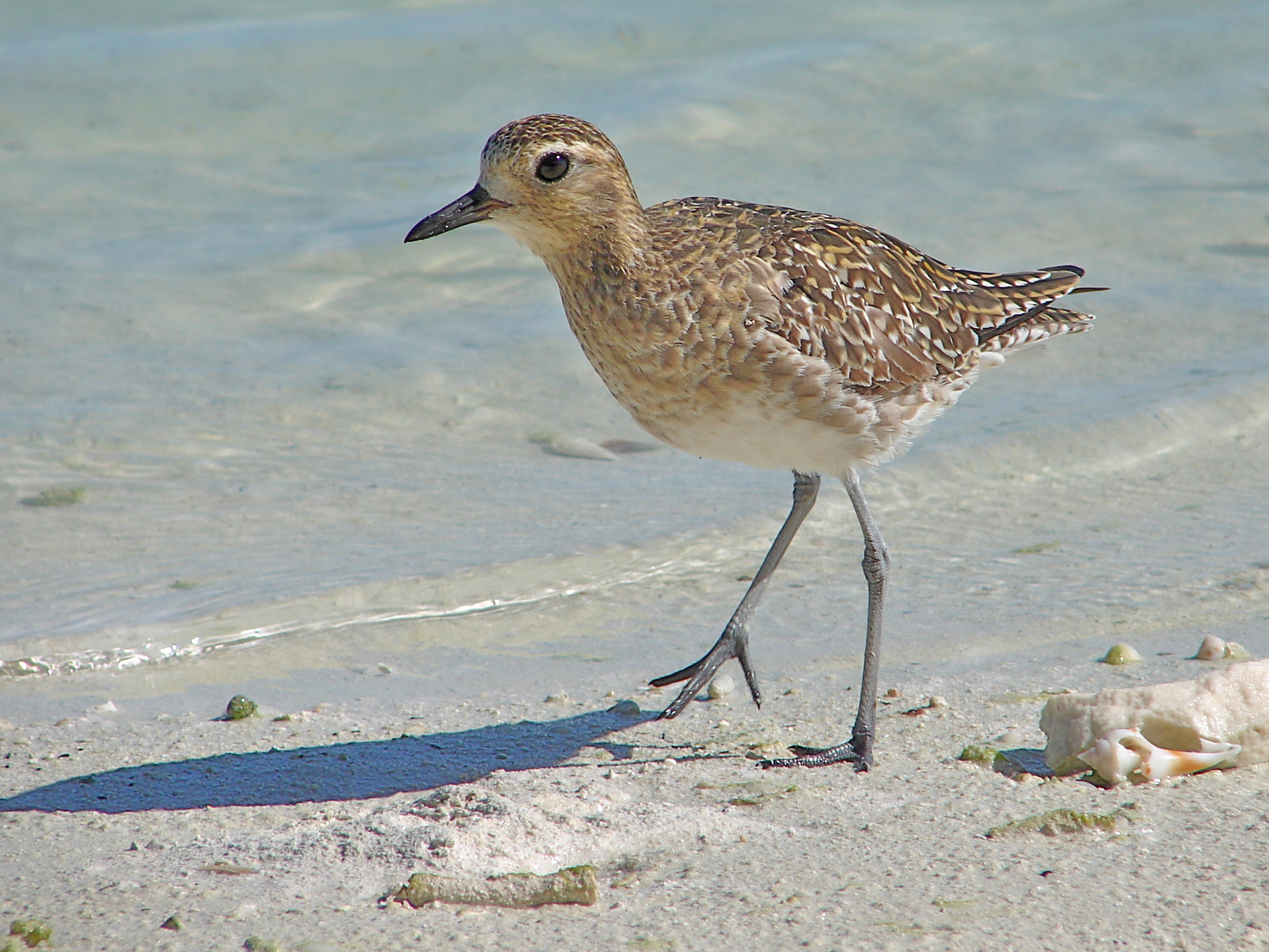
This logistical miracle, of God’s bioengineering providence, has been quantified by Dr. Werner Gitt (in AD1986), in his study of birds such as PLOVERS.

Pacific-Golden-Plover.NationalAudubonSociety

Pacific Golden Plover   (Nat’l Audubon Society photo)

After quoting Psalm 104:24, Dr. Gitt indicates that he will illustrate one of God’s creative works of wisdom, the flight of migratory birds.

If we take a closer look at this phenomenon, we encounter two miracles: energy and navigation.

 The miracle of energy

Every process, whether in physics, technology or biology, adheres strictly to the law of conservation of energy; that is to say, any work to be done requires a certain amount of energy supplied. The problem facing the migratory bird is that of taking with it sufficient fuel (= fat) to complete its journey. To ensure the necessary flying capacity, the bird must be of as light a build as possible. Excess weight is to be avoided at all costs. Likewise, use of fuel has to be as efficient as possible. How, then, did the Creator make the fuel last so long without refilling? The first step is choosing the most economical cruising speed. Should the bird fly too slowly, it would consume too much fuel simply to stay airborne. If it flies too quickly, it wastes too much energy in overcoming air resistance. Thus we see that there is a definite minimum for the consumption of fuel. If the bird knew about this speed, it would be able to fly as efficiently as possible. Depending on the aerodynamic construction of the rump and wings, the optimal speed is different for each bird (e.g. laughing gull 45 kilometers per hour, budgerigar 41.6 km/h). It is a known fact that birds gear themselves exactly to this energy-saving speed. How do they know? It is one of many unsolved ornithological puzzles.

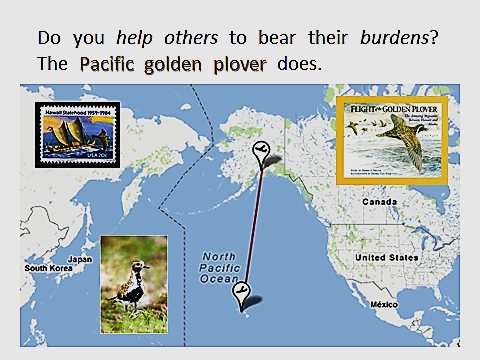
We want to examine more closely the energy problem of the golden plover (Pluvialis dominica fulva). This bird migrates from Alaska to Hawaii for the winter. Its nonstop flight takes it across the open sea where there is no island en route; in addition, the bird cannot swim, so that a stop for rest is impossible. This flight of over 4000 km (depending on its starting point) involves an incredible 250,000 consecutive wing beats and lasts 88 hours. The bird’s starting weight is G0 = 200 grams, of which 70 grams are stored as layers of fat to be used as fuel. It is known that the golden plover converts 0.6% per hour of its current body weight (p= 0.006/h) into kinetic energy and heat.

For the first hour of flight, it therefore needs x1 = G0 p = 200 (0.006) = 1.2 grams of fat.

Thus, at the beginning of the second hour, it weighs only
G0 x1 = 200 – 1.2 = 198.8 g, so that it uses slightly less fat for the second hour:
x2 = (G0 – x1) p = G1 (p) = (198.8) (0.006) = 1.193 g
x3 = (G0 – x1 – x2) = G2 (p) = (197.6) (0.006) = 1.186 g
and for the 88th hour of flight the fuel consumption has fallen to
x88 = (G0 – x1 – x2 – x3 . . . x87) p = G87 (p)

Now we will calculate how much the bird weighs at the end of the flight. Its body weight at the end of each hour is given by the reduction due to the fat consumption:
1st hour: G1 = G0 – x1 = G0 – G0 p = G0 (1 – p)
2nd hour: G2 = G1 – x2 = G1 – G1 p = G1 (1 – p) = G0 (1 – p)2
3rd hour: G3 = G2 – x3 = G2 – G2 p = G2 (1 – p) = G0 (1 – p)3
and so on. Finally at the 88th hr: G88 = G0 (1 – p)88

For the sake of simplicity, we have performed the above calculation in steps of 1 hour. We could have used a more accurate differential equation, but the result would have differed only negligibly from the above solution. Using the simpler method, and putting in the proper values in Equation (8), the bird’s weight after the 88th hour is given by G88 = 200 (1 – 0.006)88 = 117.8 grams.

The total fuel consumption is then the difference from the initial weight:

G0 – G88 = 200 -117.8 = 82.2 grams.

This value is distinctly more than the available 70 grams! The bird may not go below the limit of 130 g (Fig. 1). In spite of flying at the speed which minimizes his fuel consumption, the bird has not enough fuel to reach Hawaii. To find the number of hours that the fuel is sufficient for, we find using GZ = G0 (1 – p)Z = 200 – 70 = 130 g that the 70 g of fat are used up after Z = 72 hours, which means that after 81% of the projected time (i.e. a good 800 km before the end) the bird crashes into the sea.

Have we miscalculated, or has the Creator not, as we thought, designed and equipped the bird properly? Neither: the Creator’s work leaves us amazed. The clue is the motto: “optimal use of energy through information.” He gave the bird an important piece of information as well:

“Do not fly singly (curve GE) but in V-formation (curve GK).  In V-formation you will save 23% of your energy and reach your winter quarters safely.”

Fig. 1 also shows the curve GK, the rate of weight loss when flying in V-formation.

After 88 hours this would normally leave 6.8 g of fat in hand. This remaining fuel reserve is not superfluous, however, but has been included by the Creator so that the bird reaches its goal even with a contrary wind. The extremely low fuel consumption of p = 0.6% of the total weight per hour is even more astonishing when one considers that the corresponding values for man-made mechanical flying machines are many times larger (helicopter p = 4 to 5%, jet p = 12%). For anyone who does not regard these finely adjusted processes as the work of a Creator, the following questions remain unanswered:

  • How does the bird know how much fat is necessary?

  • How does it arrange to have this amount just before the journey?

  • How does the bird know the distance and the specific rate of fuel consumption?

  • How does the bird know the way?

  • How does it navigate?

[Quoting Werner Gitt, “The Flight of Migratory Birds”, Acts & Facts, volume 15, (Sept. 1986).   NOTE:  Figure 1, not shown here, is an illustration of the flight of the golden plover from Alaska to Hawaii (geographical route, curves of the fuel consumption during the bird’s flight.]

Pacific-Golden-Plover.PPT-migration-map

The analysis by Dr. Werner Gitt, of the plover’s amazing migratory flight, continues.

As well as the aforementioned (East Siberian) golden plover, there is also the North American golden plover. This bird also flies in a dazzling nonstop performance straight across the Atlantic Ocean from the coasts of Labrador to North Brazil. Whereas the western breed flies the same course for both journeys, the North American golden plover chooses different routes for Autumn and Spring. The return flight from the pampas of South America crosses Central America and the United States to Canada. The following equally incredible flight performances are recorded for:

  • the Japanese snipe (Capella hardtwickii): 5,000 km flight from Japan to Tasmania
  • the needle-tailed swift of Eastern Siberia (Chaetura caudacuta): flight from Siberia to Tasmania
  • the American sandpipers (e.g. Calidris melanotos = pectoral sandpiper): 16,000 km flight from Alaska to Tierra del Fuego.

The navigational miracle

The famous Danish ornithologist, Finn Salomonsen, has this to say about a bird’s orientation during migration: “The bird’s ability to find its way during migration is surely the greatest mystery. Seldom has another question given so much cause for theorizing and speculation as this one.”

Indeed, this navigational achievement, performed without complex boards of instruments, compass and map and under constantly changing conditions, including sun position, wind direction, cloud cover and the diurnal cycle is an incomparable miracle.

Even a slight diversion off course whilst crossing the ocean would mean certain death in the open sea for migrating land birds, as we discovered in the case of the golden plover. Keeping exactly on course is not a question of trial and error.

The vast majority of migrating birds would never reach their destination without navigational methods, and no species could survive such an overwhelming loss rate; thus any suggestion that evolution has played a part here must be totally dismissed. Also the suggestion that young birds learn the way flying with their parents carries little weight, as many species fly solo. It is thought, then, that migratory birds have an instinctive sense of direction like a compass, which makes it possible for them to orientate themselves and thus keep flying in a certain direction. Salomonsen bases his theory about the sense of direction on his study of two kinds of small birds from West Greenland, both of which fly south in autumn. The stonechat(Saxicola torquata) and the snow bunting (Plectrophenox nivalis) share a common homeground and often begin their southward journey at the same time. Once the south of Greenland is reached, however, their ways separate: whereas the snow bunting continues his journey southward to winter in America, the stonechat turns southeast to follow a course over the Atlantic to Western Europe and North Africa. Each bird has a specific sense of direction which determines its migration pattern. Displacement experiments have been carried out with various migratory birds which showed detailed results about the precision of their navigational capabilities: a most remarkable test involving two species of tern (Sterna fuscata and Anous stolidus) and their nesting places in the Tortugas Islands in the Gulf of Mexico, was one such experiment. The birds were shipped in different directions and set free on the open sea. Although they were freed at distances ranging from 832 to 1368 km from their nests over parts of the sea which were completely unfamiliar to them, within a few days, most of the terns returned almost directly to their eggs and young on the Tortugas Islands. The longest disorientation experiment carried out to date was probably one involving a Manx shearwater (Peffinus puffinus) which was taken from its nest on Skokholm Island in Wales to Boston, USA. It arrived back at its nest in 12 days, 12 hours and 31 minutes after a 5,000 km nonstop transatlantic flight. A large number of disorientation experiments has been carried out on homing pigeons, in particular, and it is their navigational achievements which have been most thoroughly researched and documented. Salomonsen, writing about this breathtaking navigational feat, says:

“Even when birds were anaesthetised for the outward journey, or if their cages were made to rotate continuously so that their orientation was constantly changing, they were just as able to find their way home as were the control birds. Therefore there can be no doubt that birds have a special sense of geographical position, i.e. a real navigational sense. The nature of this instinct remains a mystery; even more so, the location of the relevant sense organ.”

The birds’ capabilities extend beyond the bounds of our imagination. They can determine their homeward course over long distances, even when all possible aids to orientation have been removed during the disorientation journey. They possess the extraordinary faculty of being able, wherever they are, to determine their position relative to their home territory from their immediate surroundings. And this method of determining location, itself not understood even today, is only the beginning; then comes the real problem, namely flight navigation: mere sense of direction is not enough for this.

During flight over wide, windswept stretches of ocean, a tendency to drift off course cannot be avoided. Such drift must be continually compensated for, as in a feedback system in control technology, in order to avoid losing energy by flying a longer route. The Creator equipped the birds with a precise ‘autopilot,’ which apparently is constantly measuring its geographical position and comparing the data with its individually “programmed” destination. In this way an economical, energy-saving and direct flight is guaranteed. Just where this vital system is to be found and how this operating information is coded is known by no one today except the Creator, who made it.

[Quoting Werner Gitt, “The Flight of Migratory Birds”, Acts & Facts, vol. 15, (Sept. 1986).]

Pacific-Golden-Plover.NZ-Birds-Online

Pacific Golden Plover   (NZ Birds Online photo credit)

Dr. Jobe Martin, one the most knowledgeable (and reverent) animal experts alive today,  echoes his own appreciation for the God-given navigational skills displayed by the Pacific Golden Plover’s migration.

Scientists are not certain how the plovers navigate from Alaska to Hawaii and back, since there is no land under their flight path.   Utilization of earth’s magnetic field seems to be the best solution at this point.  Some have suggested that they use the sun and stars.

And how do the young birds find their way to Hawaii [since the first-year plovers migrate to Hawaii weeks after the adults depart south] without an experienced adult guide, weeks after their parents have already flown back to Hawaii?

A one degree mistake in navigation over the more than 4,000 kilometer flight and the birds miss Hawaii completely!  But they never miss!

[Quoting Jobe Martin, THE EVOLUTION OF A CREATIONIST, rev. ed. (Rockwall, TX: Biblical Discipleship Publishers, 2004), page 203, emphasis added.]

More examples of avian navigation genius could be given, e.g., the famous circumpolar migrations of the Arctic Tern.  [See, accord, JJSJ, “Survival of the Fitted:  God’s Providential Programming”, Acts & Facts, 39(10):17-18 (October 2010), posted at https://www.icr.org/article/5663 .]

However, the plumed pilots noted above suffice to illustrate the main idea here: God has given birds navigational programming and skills and physiologies that are providential miracles – which we can see year-round, if we take the time to watch these feathered fliers. They are marvelous miracles in motion, “hidden in plain sight”.  And these birds certainly know where their “home” nests are!

Winkie-carrier-pigeon-WWII.PublicDomainWINKIE, Royal Air Force pigeon # NEHU 40 NSL   (public domain)

><> JJSJ profjjsj@aol.com 


Different Habitats Fit Different Birds

Different Habitats Fit Different Birds

Dr. James J. S. Johnson

I know all the fowls [i.e., birds] of the mountains; and the wild beasts of the field are Mine.    (Psalm 50:11)

And Jesus said unto him, Foxes have holes, and birds of the air have nests; but the Son of man hath not where to lay His head.   (Luke 9:58)

Western-Tanager.WildBirdsUnlimited

WESTERN TANAGER perching   (Wild Birds Unlimited photo)

God loves variety, including variety in bird life. In order to facilitate bird variety, unsurprisingly (to creationists), God has provided a variety of avian habitats.

Just as humans have different preferences, for where they choose to live – whether that may be a neighborhood that is urban, suburban, or rural, or even in a wilderness – birds have preferences regarding which “neighborhoods” they prefer to call home.

In fact, this ecological reality is not limited to birds – habitats are diverse for animals in general, just as animals themselves display God-designed biodiversity.

God chose to fill the earth with different kinds of life. All over the world, we see His providence demonstrated in ecological systems. Different creatures live in a variety of habitats, interacting with one another and a mix of geophysical factors—like rain, rocks, soil, wind, and sunlight.

But why does this happen? And how does it happen? These two questions are at the heart of ecology science—the empirical study of creatures interactively living in diverse “homes” all over the world.

Why did God design earth’s biodiversity the way that He did? Two words summarize the answer: life and variety. Even in this after-Eden world, cursed and groaning as it is under the weight of sin and death, we still see a prolific and diversified creation.

God loves life. God is the essence and ultimate origin of all forms and levels of life.

God loves variety. God’s nature is plural, yet one, and He is the Creator of all biological diversity anywhere and everywhere on earth.

Because God loves life and variety, we can understand why God favors different kinds of life forms, causing them to be fruitful—increasing their populations generation after generation.  . . . .

For creatures to successfully “fill the earth,” there must be both population growth and creature diversity within a geographical context—the earth. . . . .

Different Homes for Different Folks

Different types of habitats all over the planet collectively host an ecological smörgåsbord of alternative habitat opportunities. Consider how [countless] examples of very different habitats are filled by aptly “fitted” creatures—providentially prepared creatures living in providentially prepared places. . . . .

Some ecological conditions might work for a world full of just a few kinds of animals and/or plants, but God did not want a monotonous planet. So He designed an earth that could and would host a huge variety of life-form kinds.

Befitting God’s own divine essence—the ultimate source of (and ultimate logic for) all created life and variety—God’s panoramic plan was for many different kinds of creatures to populate and fill His earth.

And because God loves beauty, God even chose to integrate His eye-pleasing artistry into the variety of His creatures and the wide array of their respective habitats.

[Quoting JJSJ, “God Fitted Habitats for Biodiversity”, ACTS & FACTS, 42 (3): 10-12 (March 2013), at https://www.icr.org/article/god-fitted-habitats-for-biodiversity  .]

Northern-Flicker-redshafted.Evergreen-edu

NORTHERN FLICKER  (Red-shafted variety)   —   Evergreen.edu photo credit

For an example of bird with a montane habitat, consider the Northern Flicker, reported in “Want a Home in the Mountains?  Some Birds have One!” [at https://leesbird.com/2015/09/24/want-a-home-in-the-mountains-some-birds-have-one/ ].

Or, for an example of a bird with an https://leesbird.com/2015/09/24/want-a-home-in-the-mountains-some-birds-have-one/, notice the Green Heron, reported in “Flag that Green Heron Nest!” [at https://leesbird.com/2019/02/01/flag-that-green-heron-nest/ ].

Many more examples could be given — see generally www.leesbird.com !

WillowPtarmigan-Alaska-variety.Wikipedia

WILLOW PTARMIGAN  (Alaska variety)   —   Wikipedia photo credit

Scripture alludes to this reality of avian ecology: birds live in different habitats.

Of course, every bird needs to live near a source of freshwater, so brooks and streams, as well as lakes and ponds, are good places to look for birds (1st Kings 17:4).

Some birds prefer mountain habitats (Psalm 50:11; 1st Samuel 26:20; Isaiah 18:6; Ezekiel 39:14; Psalm 11:1).  Other birds prefer the valleys or open fields, including farmlands (Proverbs 30:17; Ezekiel 32:4; Matthew 13:4 & 13:32; Mark 4:4; Luke 8:5).

Ground fowl, such as partridges, live in scrublands, sometimes near bushes that fit their camouflage plumage (Deuteronomy 22:6-7; 1st Samuel 26:20).

Some birds prefer desert wilderness habitats (Psalm 102:6; Isaiah 13:21 & 34:11-15), including rocky places like crags atop high rocky cliffs or in desolate canyons (Jeremiah 48:28 & 49:6; Obadiah 1:3-4; Song of Solomon 2:14; Job 39:27).

Birds are famous for appreciating trees, dwelling in and/or under trees branches (Psalm 104:17; Ezekiel 17:23 & 31:13; Daniel 4:12-14 & 4:21; Luke 13:19).

WesternScrubJay-PinyonPine-Snow.RonDudley

WESTERN SCRUB JAY in snow-adorned evergreen   (Ron Dudley photo)

Some birds seem to prefer to build nests in and around houses and other buildings made by humans (Psalm 84:3 & 102:7), while other birds, such as poultry, live lives of domestication (Numbers 6:10; Proverbs 30:31; 1st Kings 4:23; Nehemiah 5:18; John 2:11-16).

Of course, migratory birds are famous for having a “summer home” and a “winter home”, traveling to and fro twice a year (Jeremiah 8:7; Song of Solomon 2:12).

What variety! With these thoughts in mind, therefore, we can better appreciate the diversity of bird habitats, as we watch (and value) the fine-feathered residents and migrants that frequent our own home neighborhoods.

In other words, we not only identify (and appreciate) birds according to their physical appearances, we can also match their physical needs to their habitats.

Black Skimmer (Rynchops niger niger), Northern subspecies
BLACK SKIMMER with young   (Michael Stubblefield photo)

Accordingly, consider what Dr. Bette J. Schardien Jackson (ornithologist of Mississippi State University, also president of the Mississippi Ornithological Society) says, about differences in avian habitats.

HABITATS. A [bird’s] habitat is an environment – a portion of an ecosystem – that fulfills a bird’s needs for food, water, shelter, and nesting.  If a species habitually chooses a particular habitat – and many do – it is known as a habitat specialist.  Even widespread species may be extremely narrow in their choice of habitat.  For example, the Killdeer is common through most of North America, but within the varied ecosystems of the species’ range it specializes in [i.e., tends to prefer] one habitat:  open areas with patches of bare ground. The Killdeer particularly favors habitats close to bodies of water.  The widespread Blue Jay, in contrast, always requires groves of trees.

Plants are often the most important element in any habitat. Fruit, berries, nuts, sap, and nectar completely satisfy the dietary needs of some birds.  Because plants provide nourishment for insects, they [i.e., the insect-hosting plants] are also essential to insect-eating birds.  Additionally, plants provide various nest sites and shelter from weather and enemies.  In arid environments, plants are an important source of moisture.

Some species are intimately associated with a particular plant. The Kirtland’s Warbler, for example, nests only in young jack pine trees that spring up after a fire.  When the trees grow large enough to shade the scrubby growth beneath, the warblers will no longer use them.  This specific habitat requirement is one reason why the Kirtland’s Warbler is now [i.e., as of AD1988] an endangered species – probably fewer than a thousand remain [in America].  They live on Michigan’s lower peninsula where the U.S. Forest Service periodically burns jack-pine forest to provide the young trees that the birds need.  . . . .

A [bird] species’ habitat is predictable because it has traditionally provided food, nest sites, defendable territories, and conditions conducive to attracting mates [and successfully raising young]. Through our efforts to find birds, we learn about their habitats; we learn both quality and quantity are important.  Pileated Woodpeckers, for example, may require 200 acres of mature forest.  . . . .

In central Wyoming, for example, Western Meadowlarks often place their nests in the midst of a dense patch of prickly-pear cactus where the [cactus] pads are spread close to the ground.  Once you have found one [such] nest, the mental image of that nest helps you to find a dozen more in a short time.  But that [mental] image would be of little help in searching for Western Meadowlark nests in a Nebraska prairie, where there are no cacti, but where the species is just as common.  There each nest is a little tent of grass, often with an opening to the south.

[Quoting Jerome A. Jackson & Bette J. Schardien Jackson, “Avian Ecology”, THE BIRDS AROUND US (Ortho Books, 1986, edited by Robert J. Dolezal),  pages 91 & 93.]

NorthernShoveler.male-and-female
NORTHERN SHOVELER male & female, in wetland waters   (Wikipedia photo)

So, when it comes to choosing a neighborhood, to live in, even the birds have their own preferences!