Ian’s Bird of the Week – Powerful Owl

Powerful Owl (Ninox strenua) by Ian 1

Powerful Owl (Ninox strenua) by Ian 1

Ian’s Bird of the Week – Powerful Owl  ~ by Ian Montgomery

Newsletter – 12/9/2012

My apologies again for a tardy bird of the week, so here is something special. Well, special for me, anyway, as it has been a serious bogey bird for me. All addicted birders and bird photographers have their bogeys, in the sense of ‘an evil or mischievous spirit, a cause of annoyance or harassment’ usually a species that is invisible to the victim or hides whenever the victim is around.

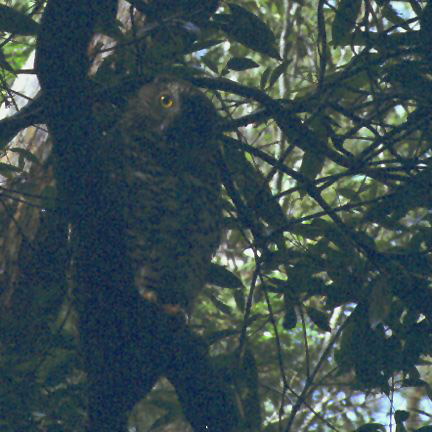
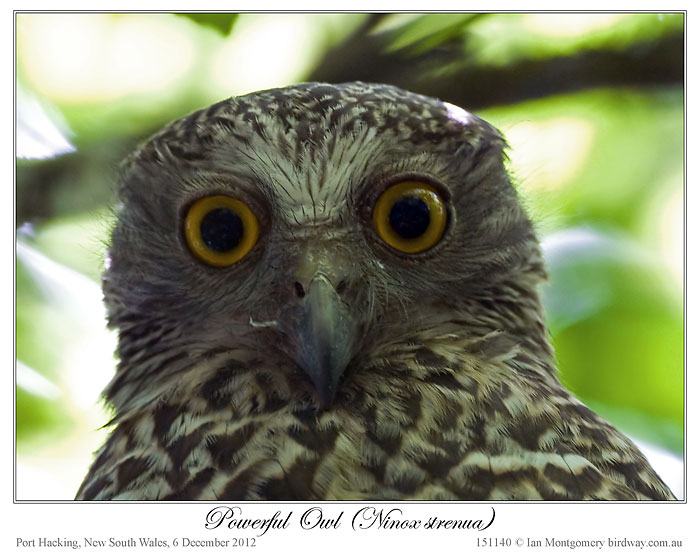
Powerful Owls first cast an evil spell on me on 11 February 1999 when one in Pennant Hills Park made my film camera malfunction so that the entire film was hopelessly underexposed – you can see the wicked gleam in its eye below. As soon as I picked up the film from the chemist the following day, I went back to Pennant Hills Park but the owl was no longer there or no longer visible.
Powerful Owl (Ninox strenua) by Ian 2

Powerful Owl (Ninox strenua) by Ian 2

Shortly after that I moved from Sydney and switched to digital photography (nowadays we take instant photographic feedback for granted). Since then, whenever I’ve visited Sydney I’ve looked for Powerful Owls in all their usual haunts – Pennant Hills Park, Mitchell Park, Beecroft, Warriewood, Royal Botanic Gardens, Royal National Park, etc. – without success.

Powerful Owl (Ninox strenua) by Ian 3

Powerful Owl (Ninox strenua) by Ian 3

Last Tuesday I gave a talk on parrots to Birding NSW in Sydney and inquired about POs. Yes, one had been seen in its favourite tree, the White Fig, near the entrance to Government House the previous Saturday. I went there on Wednesday and searched the tree for at least 20 minutes but the owl remained invisible until I decided to leave. Delighted with its success, it let its guard down, the spell weakened and I got the briefest visual sensation, like a shimmering mirage, of a barred tail. Powerful Owls are big 60-65cm/24-26in in length, it was then quite visible from the ground and not very high up, so a spell is the only explanation.
Powerful Owl (Ninox strenua) by Ian 4

Powerful Owl (Ninox strenua) by Ian 4

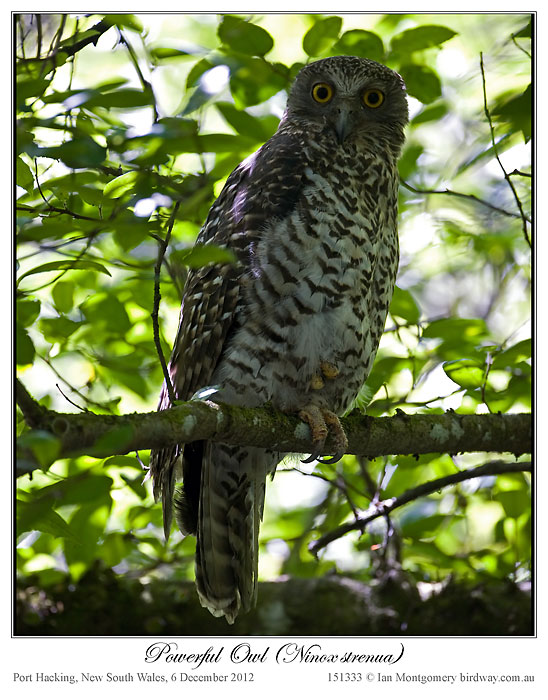
The next day, I went birding with Madeleine Murray and we abandoned plans to look for the owl (they’re quite visible to her) and went instead to Port Hacking, south of Sydney, where, lo and behold, we found another one, or to be more accurate Mad found it after I’d walked straight past it as the spell hadn’t entirely dissipated – it normally does so quite quickly after it has been broken once.
Powerful Owl (Ninox strenua) by Ian 5

Powerful Owl (Ninox strenua) by Ian 5

The Powerful Owl is the largest of the Hawk Owls (genus Ninox) and exceeded in size only by the world’s largest owls such as the Grey Grey and the larger Eagle Owls. It is found in eastern and southeastern Australia usually within 200km of the coast from central Queensland to eastern South Australia. It has large territories ranging in size from 3-15 square kilometres so it is nowhere common and is listed as Vulnerable. However, it seems to be quite tolerant of selective logging and can survive in patchy forests. It feeds mainly on arboreal mammals such as possums, but will also take flying foxes (fruit bats) and roosting birds.

Best wishes
Ian

**************************************************
Ian Montgomery, Birdway Pty Ltd,
454 Forestry Road, Bluewater, Qld 4818
Tel 0411 602 737 ian@birdway.com.au
Check the latest website updates:
http://www.birdway.com.au/#updates
**************************************************
Lee’s Addition:

Glad you sent us a Bird of the Week, Ian. I was starting to worry about you, that maybe you were sick or something. The wait was worth it because this is a beautiful Owl. I am glad you are no longer under this bird’s “evil spell on” you.

The Powerful Owl is part of the Strigidae – Owl Family. To see more photos of them, check out Ian’s photos and our Family page here:

Typical or Hawk Owls – Ian’s Birdway

Strigidae – Owl Family

*

Ian’s Bird of the Week – (Southern Cassowary) and Solar Eclipse

Southern Cassowary and Solar Eclipse by Ian 1

Southern Cassowary and Solar Eclipse by Ian 1

Ian’s Bird of the Week – (Southern Cassowary) and Solar Eclipse

by Ian Montgomery

Newsletter 11-14-12

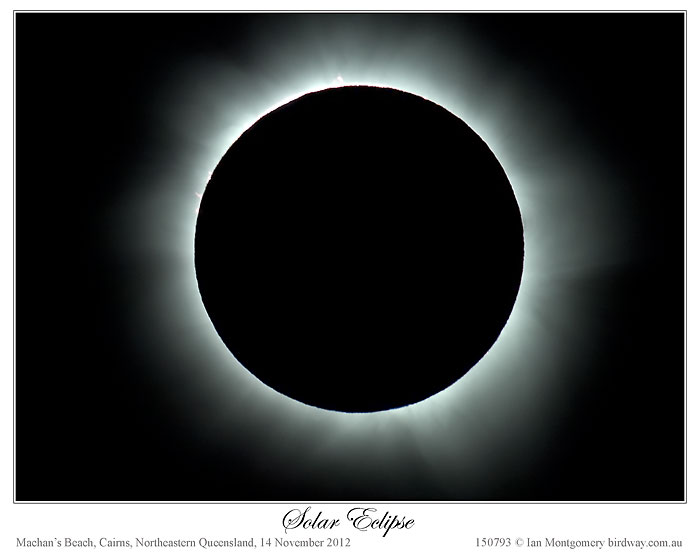
It’s unusual for my primary photographic goal on a trip to be other than a bird, but birds this week in northern Queensland have been overshadowed – pun intended – by yesterday’s solar eclipse. Residents of the Townsville district had to face the difficult decision on whether to remain here where the probability of clear skies was great but be satisfied with a 96% eclipse or travel to Cairns where the weather forecast was cloudy but the eclipse was total.

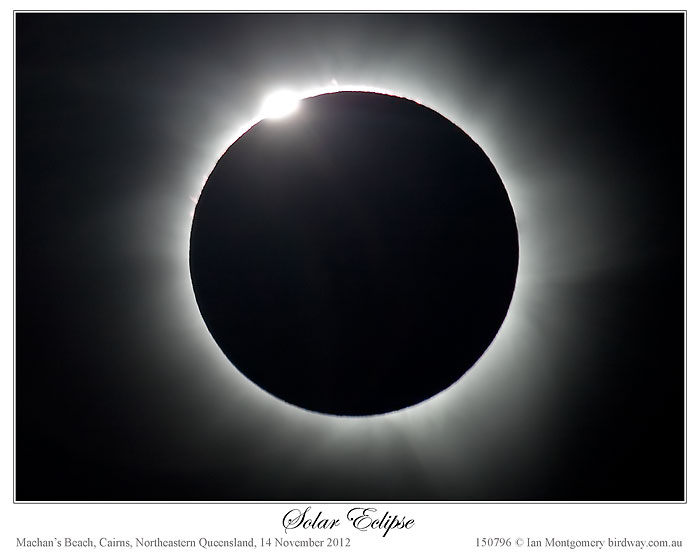
Despite misgivings about the weather, we went to Cairns and in the end it was a close call. We awoke at 5:30am – totality was due at 6:38 – to an unpromising looking sunrise followed by a shower of rain and then headed off to the beach, equipped with solar spectacles and umbrellas. Just before totality, a cloud obscured the sun and the first photo was taken seconds before it was due, at 6:37’37”, according to my iPhone. The suspense was riveting until the cloud moved aside like a slow theatre curtain to reveal a total eclipse in all its glory and all the onlookers cheered. The second photo was taken, not with the iPhone, exactly 40 seconds later.

Southern Cassowary and Solar Eclipse by Ian 2

Southern Cassowary and Solar Eclipse by Ian 2

As well as the corona surrounding the sun, only ever visible from earth during total eclipse, you can see several solar flares between 9 and 10 o’clock and near 12 o’clock. The third photo was taken another 7 seconds later, at 8:38’24”, and the sun is already reappearing producing the ‘diamond ring’ effect. This happens when a relatively tiny portion of the sun – a Baily’s bead – is visible through an irregularity on the surface of the moon – a mountain valley or a crater.

Southern Cassowary and Solar Eclipse by Ian 3

Southern Cassowary and Solar Eclipse by Ian 3

For the photographically-minded, I was unsure what exposure to use and whether automatic exposure would be correct, so I used ‘bracketing’, taking 3 photos with exposures ranging from 1 stop below to 1 above the set exposure and adjusting the set exposure based on the results of the first photos. I got the best results at -2.7 stops, f5.6 at 1/100 and 1/125sec at ISO 100. I used a tripod.

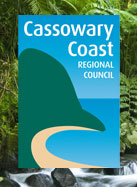
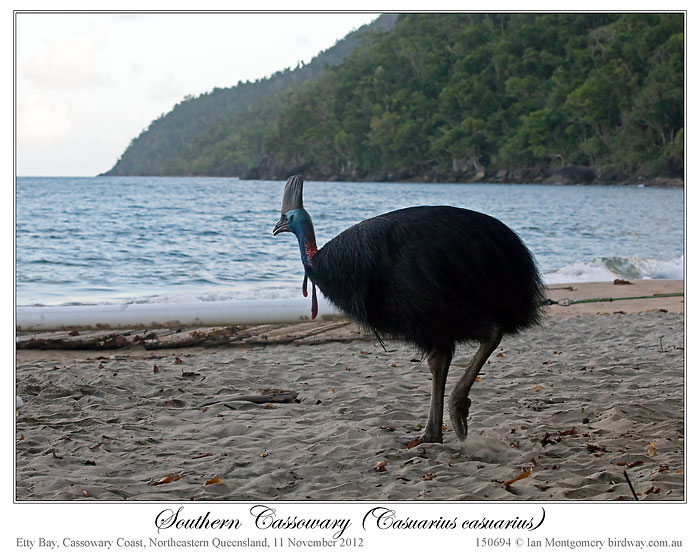
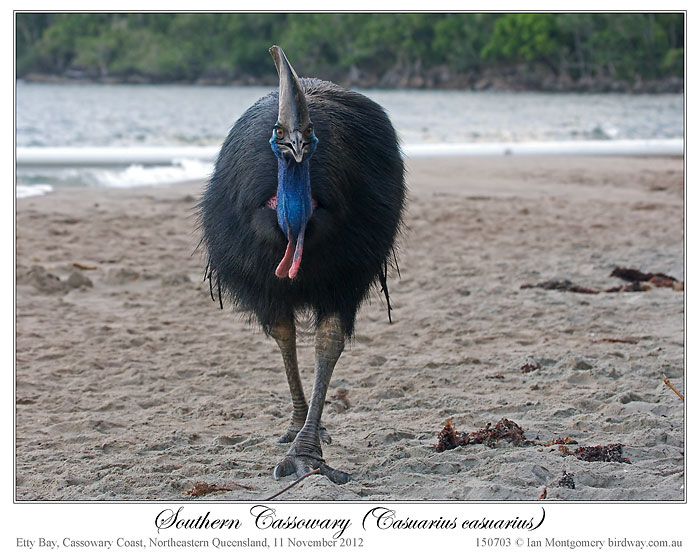
On the way to Cairns we spent a night at Etty Bay on the ‘Cassowary Coast’, the name of the local government region that covers Mission Beach and Innisfail. Etty Bay is, I think, the best place to see Cassowaries, as at least one regular patrols the camping and picnic area looking for scraps of food. The Cassowary Coast has the following logo, and I wanted to take a photo of a Cassowary that emulated the sign (which emulates a Cassowary).

Southern Cassowary and Solar Eclipse by Ian 4

Southern Cassowary and Solar Eclipse by Ian 4

Cassowaries don’t normally frequent beaches, but this one has clearly found that it’s worth checking for scraps.

Southern Cassowary and Solar Eclipse by Ian 5

Southern Cassowary and Solar Eclipse by Ian 5

The one in the second photo might make a good poster for a qualified welcome to the Cassowary Coast!

Southern Cassowary and Solar Eclipse by Ian 6

Southern Cassowary and Solar Eclipse by Ian 6

The Southern Cassowary featured as bird of the week in 2006. Here is one of the photos that I used then, also taken at Etty Bay, for those of you who have joined the list since then.

Southern Cassowary and Solar Eclipse by Ian 7

Southern Cassowary and Solar Eclipse by Ian 7

Best wishes
Ian

**************************************************
Ian Montgomery, Birdway Pty Ltd,
454 Forestry Road, Bluewater, Qld 4818
Tel 0411 602 737 ian@birdway.com.au
Check the latest website updates:
http://www.birdway.com.au/#updates


Lee’s Addition:

What great photos of the eclipse and the Cassowary to add to the delight. Thanks, Ian.

That second photo is a perfect catch of the Solar Eclipse. Wow!

He appointed the moon for seasons; The sun knows its going down. (Psalms 104:19 NKJV)

See:

Ian’s Southern Cassowary page for more of his great photos.

Casuariidae – Cassowaries Family

Cassowary – Wikipedia

*

Ian’s Bird of the Week – Sooty Oystercatcher

Sooty Oystercatcher (Haematopus fuliginosus fuliginosus) by Ian 1

Sooty Oystercatcher (Haematopus fuliginosus fuliginosus) by Ian 1

Ian’s Bird of the Week – Sooty Oystercatcher ~ by Ian Montgomery

Newsletter – 8-16-12
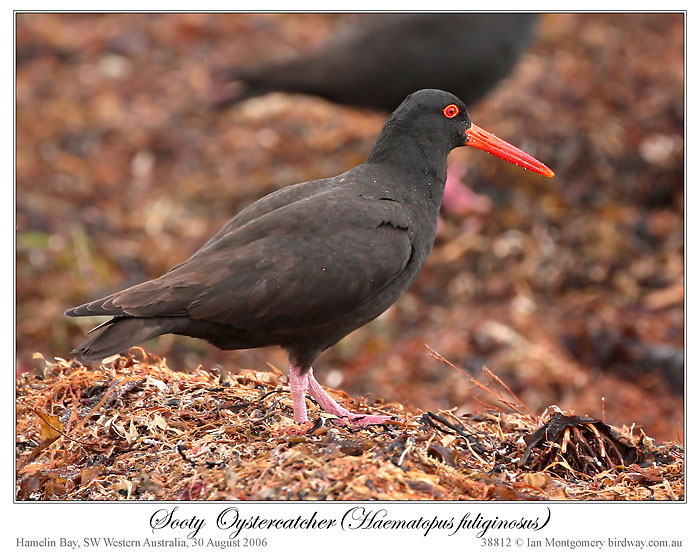
Back to Australia for this week’s bird, the Sooty Oystercatcher. Oystercatchers are large, conspicuous, noisy and mostly popular waders, though not greatly loved by those who harvest shellfish such as mussels. There are about a dozen closely-related species worldwide, two of which are resident in Australia, the Pied and the Sooty. Both occur right around the coasts of Australia and Tasmania, with the Sooty being the less common. It is primarily an inhabitant of rocky shores, first photo, while the Pied is found mainly in sandy habitats. At 46-49cm/18-19in the Sooty is slightly shorter on average than the Pied 48-51cm and distinguished by its all black plumage.

Two races are recognised, though their status and range are uncertain. The nominate race (fuliginosus) occurs in southern Australia and is characterised by the narrower red eye-ring and finer bill like the bird in the first photo, taken near Sydney. The northern race (opthalmicus) has a fleshier, more orange eye-ring and a thicker bill. It is supposed to occur from Shark Bay in Western Australia to Lady Elliot Island at the southern end of the Great Barrier Reef in Queensland, but the bird in the second photo taken near Lennox Head in northern NSW fits this description. There is disagreement in the field guides about whether opthalmicus has a longer or shorter bill.

Sooty Oystercatcher (Haematopus fuliginosus opthalmicus) by Ian 2

Sooty Oystercatcher (Haematopus fuliginosus opthalmicus) by Ian 2

The diets of the two species differ. The Pied feeds mainly by probing sand and soil for worm and other burrowing invertebrates. The Sooty feeds mainly on intertidal invertebrates on rocks such as gastropods (third photo), limpets, crustaceans, echinoderms and ascidians.

Sooty Oystercatcher (Haematopus fuliginosus fuliginosus) by Ian 3

Sooty Oystercatcher (Haematopus fuliginosus fuliginosus) by Ian 3

They will also feed on beaches near rocky headlands and the one in the fourth photo is part of a small flock probing through piles of washed-up seaweed.

Sooty Oystercatcher (Haematopus fuliginosus fuliginosus) by Ian 4

Sooty Oystercatcher (Haematopus fuliginosus fuliginosus) by Ian 4

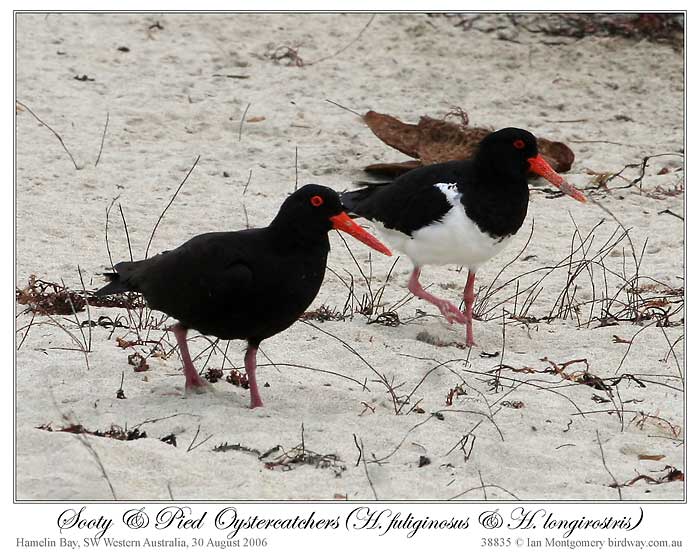
There is some overlap in the habitats of the two species, so they are occasionally found together. The fifth photo show two walking in step along a beach at the end of August and look like more than just good friends. The breeding season of southern Sooties starts in September and the two species have been known to hybridise, so draw your own conclusions.

Sooty Oystercatcher (H fuliginosus) and Pied (H longirostris) by Ian 5

Sooty Oystercatcher (H fuliginosus) and Pied (H longirostris) by Ian 5

A third species, the South Island Pied Oystercatcher of New Zealand, sometimes turns up on the east coast sometimes and more frequently on Lord Howe and Norfolk Islands. This is subtly different from the Pied Oystercatcher and a challenge for enthusiastic birders to identify.

Best wishes

Ian

**************************************************
Ian Montgomery, Birdway Pty Ltd,
454 Forestry Road, Bluewater, Qld 4818
Tel 0411 602 737 ian@birdway.com.au
Check the latest website updates:
http://www.birdway.com.au/#updates


Lee’s Addition:

Thanks again, Ian, for sharing your birds with us. We always learn something neat about birds and their behaviors. I have seen our two Oystercatchers, the Black and the American. That Sooty seem similar to our Black.

Oystercatchers belong to the Haematopodidae – Oystercatchers Family. There are 12 members in the family, one of which is extinct.

Who, when he had found one pearl of great price, went and sold all that he had, and bought it. (Matthew 13:46 KJV)

Ian said, “not greatly loved by those who harvest shellfish such as mussels.” Maybe that is because they are looking for those pearls of great price and the Oystercatchers are beating them to it. Humm!

Check out:

Ian’s Oystercatcher pages and then

The Haematopodidae – Oystercatchers Family here

*