For as the rain comes down, and the snow from heaven, and returns not there, but waters the earth, and makes it bring forth and bud, that it may give seed to the sower, and bread to the eater, so shall My Word be, that goes forth out of My mouth; it shall not return unto Me void, but it shall accomplish that which I please, and it shall prosper in the thing to which I sent it. (Isaiah 55:10-11)
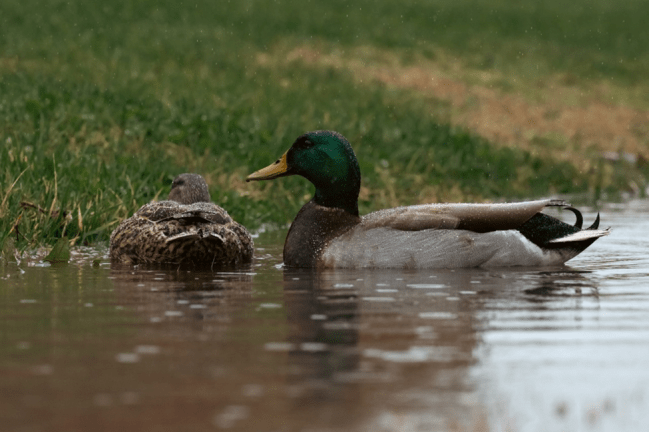
MALLARDS in rain-filled drainage ditch (Ian Sullens / U.S. Air Force photo credit)
Mallards like to float about in rainwater-runoff puddles and pools—in fact, a group of Mallards is sometimes called a “puddle” of Mallards. Mostly unnoticed by humans (even though Mallards are the world’s most ubiquitous duck), these delightful ducks serenely enjoy their own small part of God’s great global water cycle.
At my home, our front yard is bounded by roadside drainage ditches—so, when it rains a lot, those drainage ditches become brook-like pools of flooded rainwater.
Year after year after year, during the colder months (such as December), migratory Mallards (Anas platyrhynchos) seasonally seek out southern ponds and lakes, for over-wintering, yet they also frequent shallow rainwater-filled drainage ditches and rain-pooled puddles.
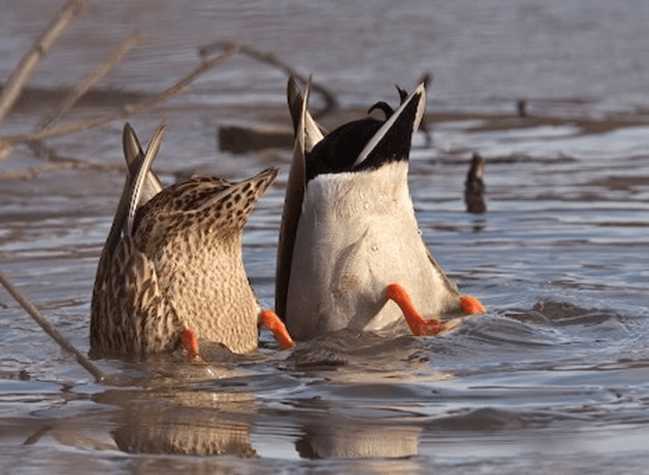
As dabbling ducks (a/k/a “puddle ducks”), they often “upend” in water, thus grazing on water-covered plants that they easily reach by flipping upside-down at the pooled water’s surface.
Dabbling ducks feed by straining food from the water’s surface or by submerging their heads while their tails remain out of the water. Male dabblers are usually brightly colored while females are drab. Plants make up most dabblers’ diets. Their method of taking flight is a sort of leap from the water’s surface. Look for them on rivers and close to shorelines. The most widely known dabbler duck is the mallard. The male has a dark green head while the female is dusky brown. Another dabbler species is the American black duck. Both male and female American black ducks look similar to mallard hens, only darker. Other dabblers include the American wigeon, green-winged teal, northern pintail (the male has long black tail feathers), and northern shoveler (named for its large, spatula-like bill). [Quoting CHESAPEAKE BAY JOURNAL, 33(9):40 (December 2023), posted at www.BayJournal.com ]
Since dabblers don’t dive into deep water, they don’t need large paddle-like feet for underwater propulsion mobility. So, it makes sense that God did not design dabbling ducks to have the larger paddle-shaped feet that diving ducks have. Also, it makes sense that dabbling ducks have legs (and feet) positioned near the middle of their bellies, for balancing themselves as they tread water, upside-down in shallow puddle-water, while the dabblers are grasping water-covered (and water-softened) acorns, nuts, seeds, and underwater plants.
God, in His providential care for the ducks He created, fitted His ducks with appropriate anatomies for the places they “fill” on Earth. Likewise, their behaviors fit their family life roles and territorial needs.
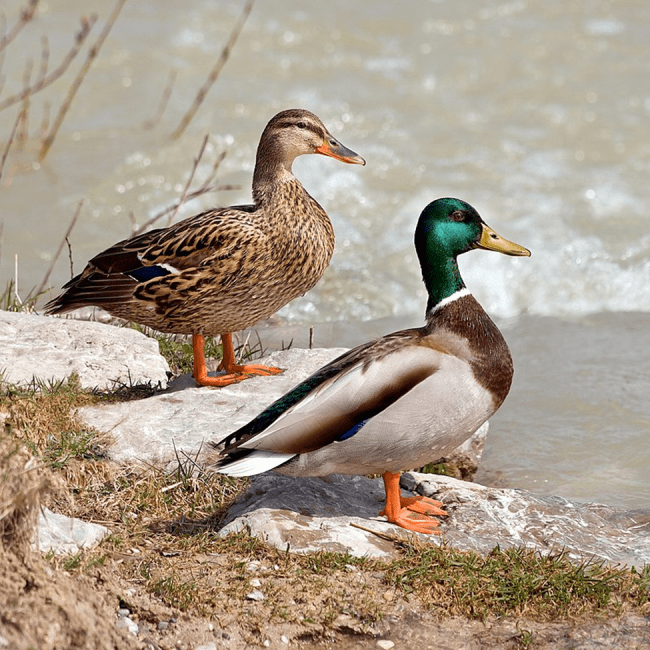
MALLARD male (R) & female (L) (Richard Bartz / Wikipedia photo credit)
Ornithologist Donald Stokes informs us that Mallards not only display sexual dimorphism (i.e., the 2 sexes have very different plumage, with the male being the distinctive “greenhead”), their vocalizations differ based upon sex:
When I first started studying Mallards I was surprised to find that the males and females make entirely different sounds. The quacking sound, which I had assumed all Ducks make, can be made only by the female. The male has two other calls of his own—a nasal rhaeb sound and a short Whistle-call. . . . An added advantage to knowing Mallard displays is that closely related species of Ducks such as Black Ducks, Gadwalls, Pintails, Widgeons and Teals have similar displays. Therefore, once you learn some of the patterns of Mallard behavior you will have a good start on being able to understand the behavior of these other Ducks as well. The Black Duck is particularly close in this respect, having nearly the same display repertoire as the Mallard. [Quoting Donald Stokes, GUIDE TO BIRD BEHAVIOR: VOLUME ONE (Boston, MA: Little, Brown & Company, 1979), pages 31-32]
Of course, hybrid ducks are common, proving that such hybridizing ducks really belong to the same created kind. For example, ornithologist Eugene McCarthy has documented that the Common Pintail (Anas acuata) is known to hybridize with the Mallard, as well as with American Black Duck (Anas rubripes), various pochards, various widgeons, various teals, Gadwall (Anas strepera), Northern Shoveler (Anas clypeata), and more. [See Eugene M. McCarthy, HANDBOOK OF AVIAN HYBRIDS OF THE WORLD (Oxford, UK: Oxford Univ. Press, 2006), pages 71-73.]
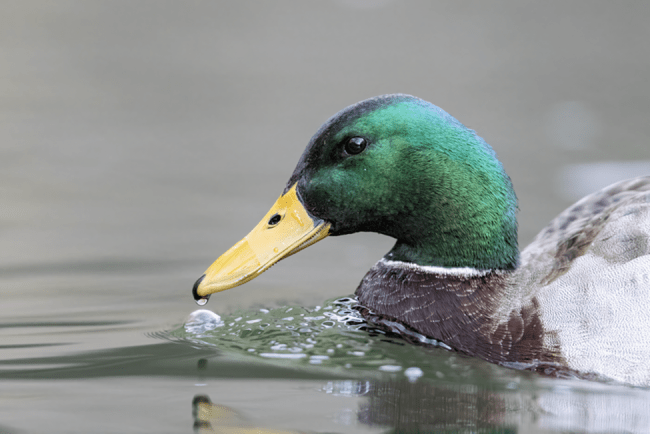
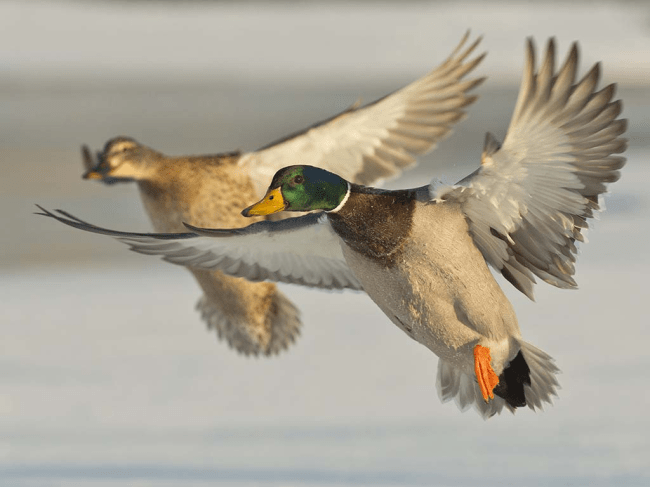
MALLARD MALE close-up (Chuck Homler / Wikipedia photo credit)
Interestingly, Mallards can be permanent (i.e., “year-round”) residents or migrants.
One of the reasons why mallard ducks are so plentiful is because they’re highly adaptable to climate, geography, temperature and diet. Particularly, they love shallow ponds, marshes and wetlands, as those calmer waters tend to produce the most aquatic bugs and plants—more so than fast moving rivers or deeper lakes. Mallards mate in pairs, and while some migrate to warmer temperatures, many are permanent residents in their nested homes throughout the United States. [Quoting Camo Trading, at www.camotrading.com/resources/the-upside-down-life-of-dabbling-ducks/ ]
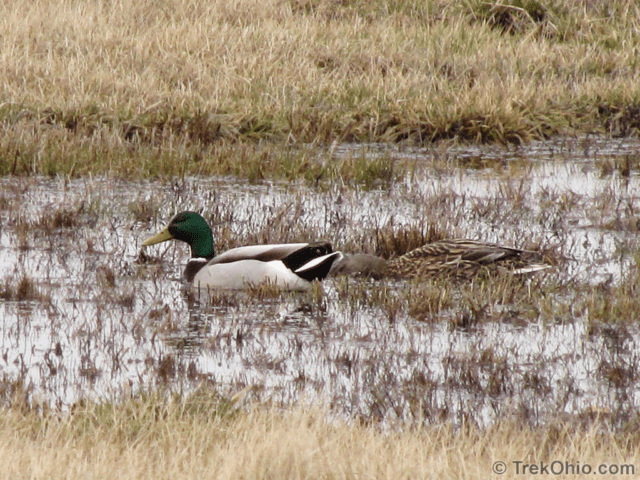
MALLARD male & female, in shallow wetland pool (TrekOhio.com photo credit)
In other words, God gave ducks what they need, anatomically and genetically (and even behaviorally)—for building families where they live—so that God’s ducks can be fruitful, multiply, and “fill” parts of Earth that God providentially prepared for their homes.
 Lee's Birdwatching Adventures Plus