Dr. James J. S. Johnson
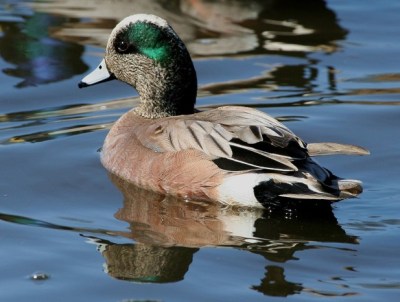
American Wigeon – Male by Ray
As we reflect on this year’s celebration of Resurrection Day (i.e., Easter), Luke 10:20 reminds us of the best reason for rejoicing.
Notwithstanding in this rejoice not, that the spirits are subject unto you; but rather rejoice, because your names are written in heaven.
And the unending joy that is noted in Luke 10:20 is built upon the forever-firm fact of Christ’s historic prophecy-fulfilling resurrection, which we can analyze in 1st Corinthians 15.
However, as many birdwatchers (even unbelievers) know, viewing birds can be an earthly joy, too, albeit a much lesser and temporal one – yet good enow to put a joint replacement surgery (such as a hip replacement or a knee replacement) into a more satisfactory perspective. This is demonstrated by Mike Burt’s “American Wigeon Remind Us to Look for Joy, Even in Storms”, published in Chesapeake Bay Journal, 30(10):47 (January-February 2021), posted at American Wigeon Remind Us To Look For Joy Even In Storms . After some birdwatching at the Blackwater National Wildlife Refuge (near Cambridge, Maryland), birdwatcher Mike Burke chose to visit the Choptank River (the Delmarva Peninsula’s largest riverine tributary of the Chesapeake Bay), in order to see the wintering waterfowl there.

American Wigeon (Anas americana) by Daves BirdingPix
The snow was quickening as we got out, binoculars in gloved hands. Before us were rafts of gorgeous ducks bobbing on the windswept waters. I glanced up. The opposite shore, more than a mile away, was lost in the snow. We could still see the ducks in the middle of the broad, tidal river. . . [including the] big white spots on the black heads of the buffleheads and the picturesque black-and-white patterns of a few long-tailed ducks. Just a few feet away, though, sloshing alongside the jersey barrier, was the real object of our pursuit: scores of winter ducks. The raft included plenty of canvasbacks, a handful of redheads and scaup, and a good number of American wigeon. . . .
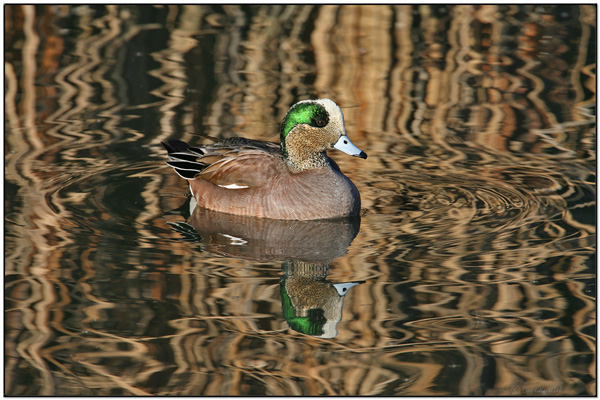
Wigeon are often called “bald pates” for the white forehead and crown that gives the male the look of a bald man. A dramatic green eye patch reaches toward the back of the head, just like a green-winged teal. The male wigeon has a gray face and neck and a pale blue bill that is rather short and narrow and ends in black. The wigeon is a dabbler, like a mallard, feeding on duckweed, milfoil and especially widgeon grass. But they also feed alongside geese in fields as they use that short, tough bill to rip vegetation free. The back and sides of wigeon are a sinuous rosy brown down to the waterline. In males, a white spot occurs right in front of the black tail. Elegant, elongated black feathers lined in white lay on his rear when he’s at rest. I had a big smile as I admired this handsome drake.

American Wigeon (Anas americana) by Ray
The female is a beauty in her own right. There’s no arresting green eye swoosh or bald pate. Instead, her head is a series of wavy brown and white feathers, except for black smudges around her eyes. The hen is a bit browner overall than the drake, but she has the same lovely lines. In flight, the birds show mostly white underneath. The male also has a big white panel on its upper wing, just above a bright green speculum (wing feathers that are close to the body). The female has a simple white line above her speculum, which is black.
While most birds enter their breeding plumage in the spring and raise their broods in the summer, ducks put on their breeding feathers in the winter. Here in the Chesapeake region, we get to see the birds at their most colorful. This is also when pair bonds are established. By early spring, wigeon will have left the Bay heading toward their breeding territory. Most will go all the way to the boreal forests of Alaska and western Canada. A moderate number will stop in the upper Midwest “prairie pothole” region. Nests are built near ponds and lakes. The hen lays a single clutch of three to 13 eggs. The eggs need to incubate for almost a month, but when they hatch, the chicks are quick to leave the nest, heading to water to evade land predators. Even on water, though, they will face mortal danger from hungry fish and turtles. The bird’s first year of life is full of peril. As winter approaches, these ducks disperse down both coasts. On the Pacific Coast, American wigeon winter from Alaska south to Central America. On the Atlantic, you’ll find them from Massachusetts south through the Caribbean and into northern South America. Wigeon can also be found in all of the Eastern states south of Pennsylvania, especially throughout the Chesapeake [Bay region].

American Wigeon (Anas americana) brood ©USFWS
[Quoting Mike Burke, posted at American Wigeon Remind Us To Look For Joy Even In Storms.] Watching American Wigeons (and other ducks, such as Mallards, Lesser Scaups, and Northern Shovelers), wintering at Furneaux Creek (in Carrollton, part of Denton County, Texas) during the A.D.1990s, are happy memories — form years gone by, back when I taught Ornithology and Avian Conservation for Dallas Christian College (in Farmers Branch, Texas). God gives us so many richer-than-money blessings over the years, including privileged opportunities to observe His avian wonders — in bushes and woods, at ponds and creeks, etc.
Of course, compared to the truth of 1st Corinthians 15 – the completed redemptive work of our Lord Jesus Christ – the transitory joys of this life, even birding, pale and disappear.
Turn your eyes upon Jesus;
Look full in His wonderful face,
And the things of earth will grow strangely dim,
In the light of His glory and grace.
[Quoting song-writer Helen Howarth Lemmel, “Turn Your Eyes Upon Jesus”.]
Even so, come Lord Jesus, our risen-from-the-dead Redeemer!
CHRIST IS RISEN! HE IS RISEN INDEED!
Other Articles by Dr. James J. S. Johnson (JJSJ)
James J. S. Johnson
What Will You Do With Jesus?




 Lee's Birdwatching Adventures Plus