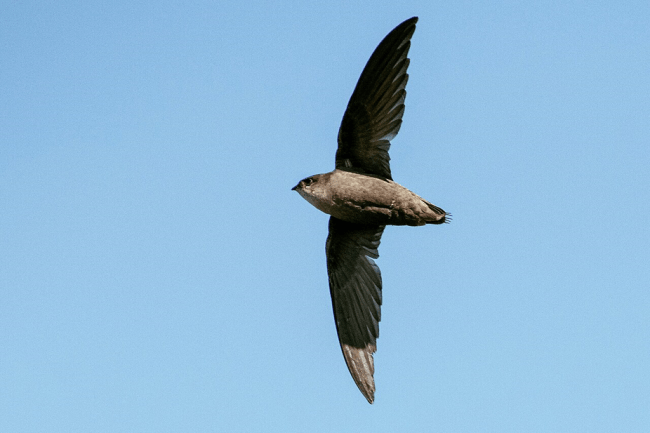
CHIMNEY SWIFT near Cleveland, Ohio, by Lake Erie (Adam Jackson / Wikipedia photo credit)
Make a joyful noise unto the LORD, all ye lands. (Psalm 100:1)
SWIFT is a fitting name for the swallow-like birds that swiftly dart, here-and-there, zigzagging and zipping and catching flying fast-food on the wing. Also, they are known for nesting inside traditional chimneys.
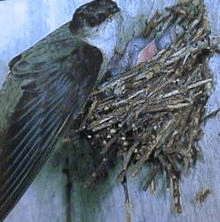
CHIMNEY SWIFT nesting (Wikipedia photo)
One of the well-known varieties of swifts are the Chimney Swifts (Chaetura pelagica), whose breeding ranges fill America’s eastern half plus some of the central prairie states. Swifts resemble swallows so closely, in morphology and in behavior, that swifts were originally categorized as swallows, e.g., by Carl Linnaeus, and later by ornithologists Mark Catesby and John James Audubon.
AMERICAN SWIFT by John James Audubon
Alonso Abugattas, on behalf of the CHESAPEAKE BAY JOURNAL, has recently reported on the Eastern seaboard’s Chimney Swifts, noting that these insectivorous birds are, as their name suggests, swift:
The twittering, darting flight of the chimney swift is a common sight in the skies of cities and towns in the Chesapeake Bay region during the warmer months. These birds are often best identified by their peculiar silhouettes even when they are high up in the air — looking like a “cigar with wings,” to borrow the description given to them by famed birding writer Roger Tory Peterson.
Male and female chimney swifts are identical in coloration, though the males may be slightly larger. These 5.5-inch birds are dark brownish gray with pale throats, short necks and round heads. Their tails are short, usually tucked to a point when in flight but sometimes spread out and square-ended. Their curved, scimitar-like wings extend far from the cigar-shaped body, giving them a wingspan more than twice their head-to-tail length. Surprisingly, swifts are not closely related to swallows, appearances notwithstanding.
Chimney swifts are true to their name, being very fast in the air, and their flight is fairly distinctive with rapid wing beats followed by a short glide. They are built to be aerial acrobats, rarely touching down except to nest and roost. They do every-thing else airborne. They feed, mate, drink, bathe and even snooze on the wing. Feeding is easy, because 95% of their diet is flying insects, using their short but wide bills to capture prey. They skim across water to drink and sometimes scoop up aquatic bugs the same way. . . . .
The chimney swift (Chaetura pelagica) is part of the swift family Apodidae, meaning “without feet.” They do have feet, of course, but very short and inept ones, making them clumsy on land and unable to land adroitly on branches. They are built to hang vertically inside hollow trees, chimneys and confined walls (sometimes even upside down, giving them the nickname “chimney bat”).
[Quoting Alonso Abugattas, “Roosting of Flying, the Chimney Swift Lives Up to its Name”, CHESAPEAKE BAY JOURNAL, 34(7):39 (October 2024).]
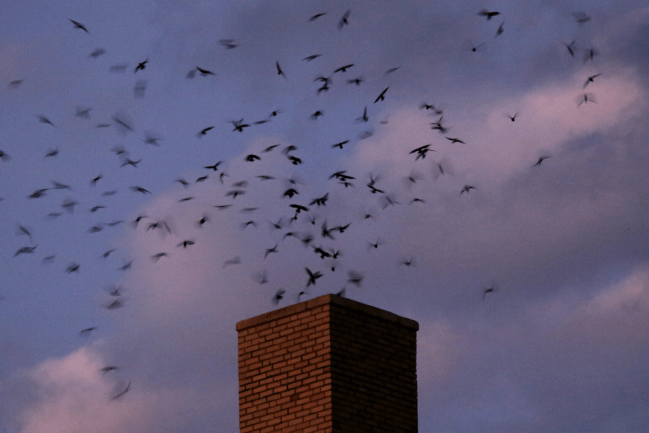
CHIMNEY SWIFTS flying over brick-and-mortar chimney (Ben Cvengros / Travis Audubon Society photo credit)
Thus, the Chimney Swift is at home in the air, winging it—rather than casually perching somewhere, waiting for the next crawling bug to creep by—and so they are easily seen when they perform their aerial acrobatics.
Make a joyful noise unto the LORD, all ye lands. (Psalm 100:1)
What is making a “joyful noise”? It is commanded is Scripture, whatever it is – see Psalm 66:1; 81:1; 95:1-2; 98:4; 98:4; 100:1.
To many, the noise of circuitous swifts is just that, a screeching-like screaming noise — not the kind of “music” that King David would have included in his orchestra-supported choir (1st Chronicles 15:16). But to a bird-lover, the aerial call of this air-zooming insectivore is a “joyful noise”, installed and directed by the Composer and Giver of all birdsong (and other avian vocalizations). Yes, as others ignore them, I enjoy hearing the energetic calls of Common Swifts (Apus apus), as they zip around, in hunting packs, de-bugging the lower airspace during the bug-filled days of summer.
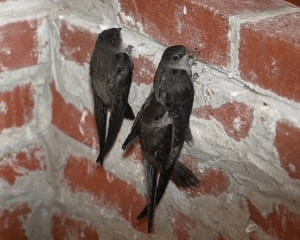
CHIMNEY SWIFT (Greg Harber / Alabama Birding Trails photo credit)
The Chimney Swift’s migratory behavior, as well as their propensity for flying (rather than perching) is described by ornithologist Donald Stokes:
The arrival of swifts in late spring is an exciting moment. You will probably first hear their chittering calls, then look up and see their small bodies and curved, bladelike wings slicing through the air in graceful arcs. Their constant flight throughout the day makes them both physically and experientially remote from our earthbound living. But even so, bending back your neck to see only sky and these streamlined birds gliding about can draw you into their world of flight—so much so that when you again look down it may take you a moment to reorient yourself to the world of the flightless.
More than any of our other common birds, the Swift’s life is lived on the wing. As migration gets under way, large flocks can be seen in the early morning flying in formation over possible roosting sites and calling loudly all the time. Then, as it starts to get dark, they begin to dive into the roost, sometimes forming a steady stream out of the airborne flock.
[quoting Donald W. Stokes, STOKES NATURE GUIDES (A GUIDE TO BIRD BEHAVIOR), volume I (Boston, MA: Little Brown & Company, 1979), page 85.]
So, like busy Chimney Swifts, we should be busy at our daily activities, making a joyful noise –whistling (or singing)—while we work.
Make a joyful noise unto the Lord, all the earth: make a loud noise, and rejoice, and sing praise. (Psalm 98:4)
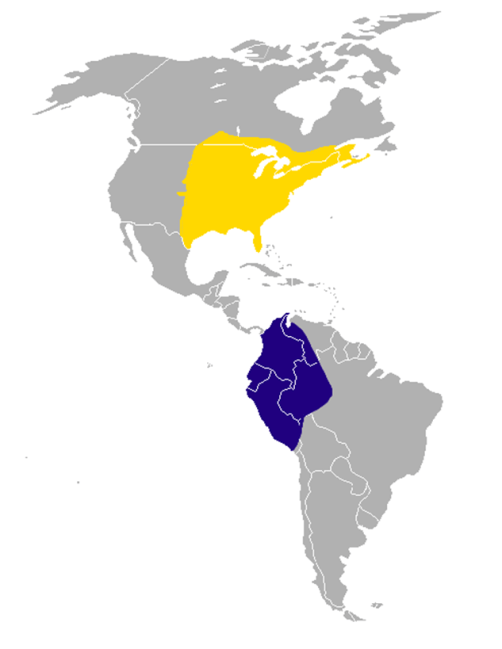
As a range map (see below, from Wikipedia) shows, Chimney Swifts are migratory birds, using the eastern half of America’s Lower 48 as their summer breeding grounds – yet where do they go for over-wintering?
By the fall, the swifts are in migration. For years, it was a mystery where they went — until 1943, when 13 leg bands were turned in by [native] people in eastern Peru, with eight of them having been banded in Tennessee. Since then, they have been found to overwinter in parts of Ecuador, Chile, Brazil and recently in Colombia.
[Quoting Alonso Abugattas, “Roosting of Flying, the Chimney Swift Lives Up to its Name”, CHESAPEAKE BAY JOURNAL, 34(7):39 (October 2024).]
RANGE MAP of CHIMNEY SWIFTS (Wikipedia map)
So, there! Chimney Swifts are long-distance migrants, geographically resourceful in accordance with the providential phenology that God designed and installed into their software/hardware systems, fitting them to fill and flourish the habitats of God’s design.
What a wonder! Think of that, and how swarms of swifts silently glorify God, the next time that you see a brick-and-mortar chimney. Who knows? Maybe you are looking at a chimney that houses the nest of a Chimney Swift family.


 Lee's Birdwatching Adventures Plus