“And the stork, the heron after her kind, and the lapwing, and the bat.” (Leviticus 11:19)
This is just a quick note, from my part of Texas, to report seeing some white egrets lately.
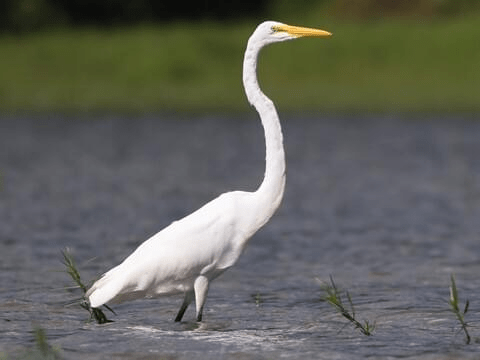
GREAT WHITE EGRET, wading in pond-water (Cornell Lab of Ornithology photo credit)
So much of (our part of) Texas is urbanizing–and suburbanizing. So, frequenting a rural area, where birdwatching is convenient, is like hunting for an endangered species.
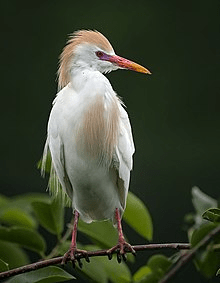
Last Sunday, in a journey that included driving through parts of Denton County and Tarrant County (Texas), my wife drove our car, as I looked out my car window–for birds in pastures and ponds. Ponds attract heron-like birds, such as foraging Great White Egrets (a/k/a “Great White Heron”). Likewise, pastures (with bovine cattle grazing), attract foraging Cattle Egrets.
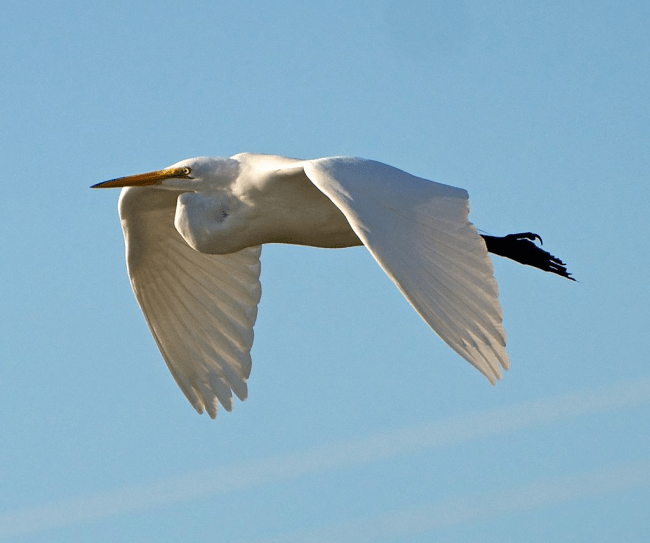
GREAT WHITE EGRET in flight (Wikipedia photo credit)
Thankfully, I saw several kinds of birds, from place to place, in field and trees, and besides ponds and drainage ditches. Among those birds, observed that day, were two kinds of heron-like wading birds–Great White Egret and Cattle Egret. Which led to composing this limerick:
GREAT WHITE & CATTLE EGRETS, OBSERVED WHILE TRAVELLING
Cute critters—some are wild, some are pets;
Yesterday, I observed white egrets!
Standing, beside a pond;
Others, in grass beyond …
Go birding—you’ll have no regrets!
It’s good to know that, so far, there are still some pastures and ponds, where we can still view egrets.
Yes, we can all thank the Lord for making and sustaining these oft-ignored (yet magnificent) wild white wonders (Job 9:10).
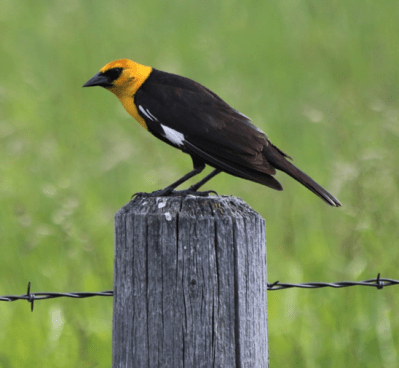
Yellow-headed Blackbirds [Xanthocephalus xanthocephalus] remind me of our need to stay close to God. That takes a bit of explaining, but there is actually a simple connection between staying close to God and the behavior of Yellow-headed Blackbirds (when then gather on the edge of a cattail-encompassed pond).
Yellow-headed Blackbirds are found in marshy areas west of the Mississippi River.
Male much larger than the female; head, neck, and upper breast bright yellow, blackish elsewhere; and conspicuous white markings on the wings. Female duller and lighter, yellow on the chest, throat, and face, no white marks. … Visiting a [yellow-headed blackbird] colony in a marsh or slough in spring is an exciting experience. Some males are always in display flight, with head stooped, feet and tail drooped, wings beating in a slow accentuated way. Some quarrel with neighbors over boundaries while others fly out to feed.
[William A. Niering, WETLANDS (New York, NY: Chanticleer Press / National Audubon Society Nature Guides, 1998), page 600.]
The first time, that I saw Yellow-headed Blackbirds, was in Jackson Hole, Wyoming — near the base of the Grand Teton Mountains, not far from the Snake River (and also not far from Yellowstone National Park). It was summer, yet the temperatures were mild — even relatively cool — especially if compared to the scorching hot summers of Texas.
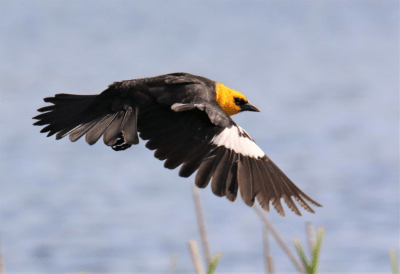
YELLOW-HEADED BLACKBIRD in flight (photo credit: Bryce Gaudian)
Thus, as part of a working/family vacation — that combined family vacation time (in Grand Teton National Park and Yellowstone National Park) with attending a Continuing Legal Education seminar for federal bankruptcy litigators — I was able to enjoy many hours of wildlife viewing (including wonderful birdwatching, plus bull moose — but that’s another story!) in that beautiful part of western Wyoming.
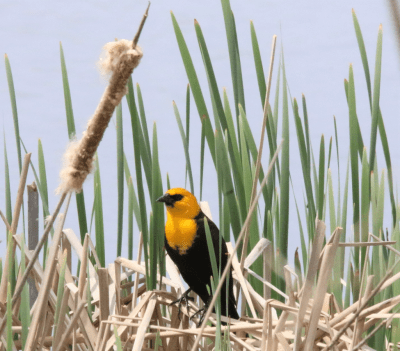
YELLOW-HEADED BLACKBIRD in cattails (photo credit: Bryce Gaudian)
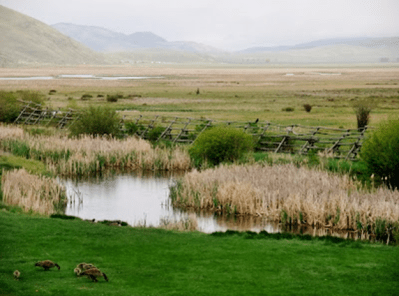
There was a ponded area near the Jackson Hole visitors’ center, and the ponded area featured flourishing cattails (a wetland plant mentioned in a previous blogpost, “Red-winged Blackbirds: Marsh-loving Icterids”, posted at https://leesbird.com/2023/07/28/red-winged-blackbirds-marsh-loving-icterids/ ). Interestingly the cattail-fringed pond-shore had many perching blackbird “neighbors”; some were red-winged and others were yellow-headed.
Pond-marsh near Jackson Hole visitors’ center (photo credit: Lee & Mary Benfield / Gypsies @ Heart)
Yet there was a noticeable pattern — most of the perching blackbirds, closer into the pond-marsh waters, were yellow-headed, in contrast to the redwings who perched farther away from the wetland pond-shoreline, on the shallower sides of the pond-marsh waters.
This group behavior observation is corroborated by a report posted on the National Wildlife Federation (NWF) website:
The yellow-headed blackbird and red-winged blackbird are often found in the same habitat in the western United States, but yellow-headed blackbirds [being robin-sized] are the larger, more dominant species. They generally nest in deeper water near the center of larger wetlands, while red-winged blackbirds nest along the edges in shallower water.
So, reconsider the observation made by the NWF author, above: Yellowheads “generally nest in deeper water near the center of larger wetlands”, while redwings “nest along the edges of shallower [i.e., more peripheral] water”. In other words, Yellow-headed Blackbirds congregate closer in, while Red-winged Blackbirds settle farther out.
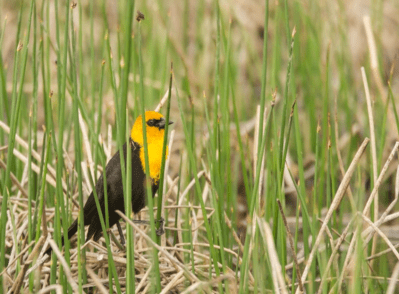
YELLOW-HEADED BLACKBIRD in marsh vegetation (photo credit: Roads End Naturalist)
Ornithologist Ellen Horowitz, of the Flathead Audubon Society, gives a more detailed description of this habitat-sharing dynamic, between Yellow-headed blackbirds and their redwing cousins:
Yellow-headed Blackbirds, larger than their red-winged cousins, dominate in areas where both are present. Redwing Blackbirds appear early in spring and exploit all areas of a marsh until the yellow-heads arrive. Territorial interactions between the two are an easily observed bird behavior that is part of the springtime ritual at a marsh. Yellow-headed Blackbirds take over the prime real estate, often located near the center of large wetlands, and oust the redwings to shallower water near the edges.
Nesting colonies of Yellow-headed Blackbirds are found where dense cattails and bulrushes grow in two to four feet of water and where insect life is rich. Some colonies contain as many as 25 to 30 nests within a 15 square foot area. Each adult male stakes his claim within the larger framework of the colony. A polygynous breeder, he mates with several females who nest within his defended territory. The female weaves long strands of wet vegetation around cattails or other tall aquatic plants to form her nest. As the basket-like structure dries, it pulls the supports taught. The location of a nest ranges from 10 to 30 inches above the water. Deep water protects the nest and its occupants from prowling predators — skunks, raccoons and foxes. Tall, thick vegetation hides them from northern harriers and other birds of prey.
During the breeding season, the diet of yellow-headed blackbirds consists primarily of insects and spiders. The birds glean them from the ground, plants, or hawk them from the air. Seeds, including grain, form a major portion of their diet during the rest of the year. Like all Icterids, the yellow-head has a strong, straight, pointed bill and powerful muscles that control its opening and closing. After inserting its bill into the ground or matted vegetation, the yellow-head spreads its bill, which presses against the surrounding substrate to form a cavity. The behavior, known as “gaping,” allows access to hidden food sources.
Yellow-headed blackbirds feed in freshly plowed lands, cultivated fields and pastures during migration. Although they cause some damage to agricultural crops by pulling up seedlings and eating grain, the insects and weed seeds they consume prove more beneficial than harmful.
Now, with those background facts in mind, consider who some Christians try—in their daily walking through this earthly life—to stay close to God. Think of how the Lord Jesus Christ spoke to multitudes, yet He had only a dozen close disciples (Matthew 10:1-4; Mark 3:13-19; Luke 6:12-16), and even one of those was a money-embezzling fake! (John 6:70), — and, from among those 12 disciples, Christ had 3 who were closest to Him: Peter and 2 sons of Zebedee, James and John (Matthew 17:1).
YELLOW-HEADED BLACKBIRD in cattails (photo credit: Bryce Gaudian)
Yet many Christians are satisfied with rather worldly lives, not trying very seriously to walk through life close to God. That’s like living at a distance, spiritually speaking, on the “shallow” side, so to speak — like Red-winged Blackbirds who settle for settling in cattails of the shallower pond-marsh waters.
RED-WINGED BLACKBIRD perching on cattail (photo credit: Bryce Gaudian)
Just as Yellow-headed Blackbirds prefer to be closer to the center of a Jackson Hole pond-marsh, I prefer to live closer to the Lord Jesus Christ–Who is my revered and appreciated Creator, Redeemer, and Shepherd. Reminds me of an old Fanny Crosby hymn:
Draw nigh to God, and He will draw nigh to you.
(James 4:8a)
How about you?
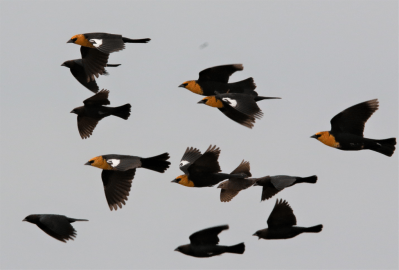
YELLOW-HEADED BLACKBIRDS, with other blackbirds, in flight (photo credit: Bryce Gaudian)
God … is wise in heart, and mighty in strength: … [and He] doeth great things past finding out; yea, and wonders without number.
[Job 9:2 & 9:4 & 9:10]
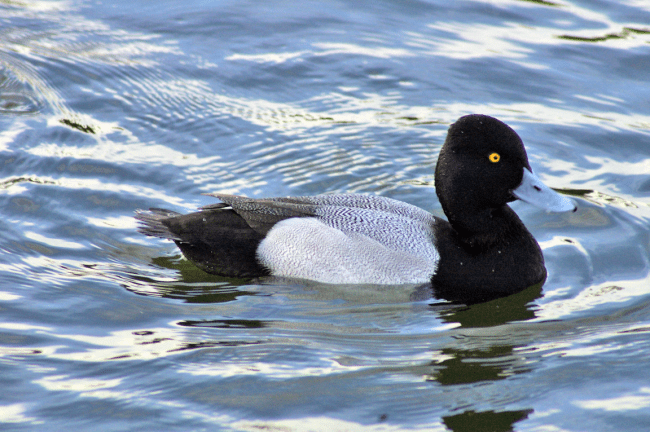
LESSER SCAUP male (photo credit: National Audubon Society)
Last Saturday (February 18th of A.D.2023), as I was birdwatching inside my wife’s car — while she was driving, so it’s okay that I was birdwatching! — I saw a lone Lesser Scaup (Aythya affinis, a/k/a “Little Bluebill”) floating in the middle of a favorite pond (where I have often seen grackles in the past — see http://www.icr.org/article/grackles-gratitude/ — and appreciated that God could have made me a grackle!).
As I thought about this Lesser Scaup, and how I’ve often seen such scaups (and other ducks) on Texas ponds during winter, it seems that the occasion deserves a poetic memorial of some kind, such as a limerick.
Now, a few days later, here is that limerick, although admittedly the limerick calls the pond a “lake” (which some ponds are called, anyway, by Floridians), because it’s easier to rhyme “lake” than “pond” when composing limericks.
Apparently, the anatid name “scaup” derives from a European word referring to shellfish (e.g., Noah Webster’s 1828 AMERICAN DICTIONARY OF THE ENGLISH LANGUAGE notes that “scalp” comes from the Dutch schelp meaning “shell”), alluding to coastal bivalves (such as clams, mussels, and oysters), which are often eaten by these diving ducks. These wetland-frequenting ducks also eat shoreline vegetation, such as pondweeds, widgeon-grass, sedges, bulrushes, wild rice, wild celery, and other hydrophilic plants.
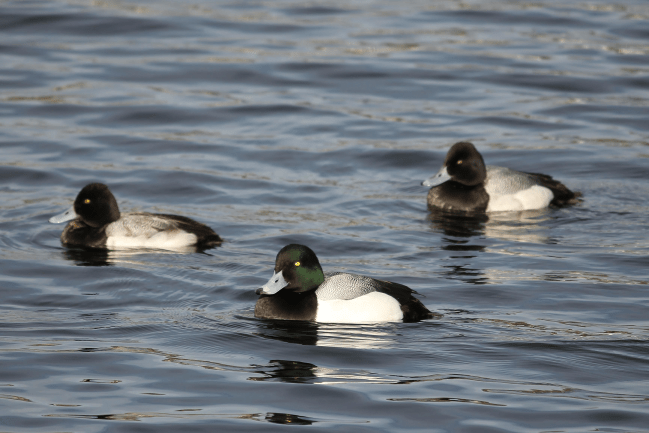
Generally speaking, scaups are migratory birds, so we Texans see them during the cold months of the year — however, there are some parts of North America where Lesser Scaups are seen year-round. Sometimes it’s hard to distinguish a Lesser Scaup from a Greater Scaup (Aythya marila, a/k/a “Common Scaup” or “Bluebill”), from a distance — plus, to confuse identifications further, these scaups can hybridize with each other, as well as with the American Redhead (Aythya americana), Ring-necked Duck (Aythya collaris), European Pochard (Aythya ferina), and Canvasback (Aythya valisineria). [See Eugene M. McCarthy, HANDBOOK OF AVIAN HYBRIDS OF THE WORLD (Oxford, UK: Oxford Univ. Press, 2006), page 90.] But they are all diving ducks!
Greater Scaup between Lesseer Scaups (photo credit: reddit.com / birdpics)
So, as noted above (in the above limerick that is just “ducky”), I’m glad that, such ducks, God did make!
Again He turneth the wilderness into pools of water, and the dry land into water springs. (Psalm 107:35, Geneva Bible)
Water is a universal magnet for birds and other animals, so “pools” (or “ponds” or “lakes”) attract wildlife. So having a pond (or a “lake”) in one’s backyard is good for birdwatching — as well as for watching other kinds of wildlife.
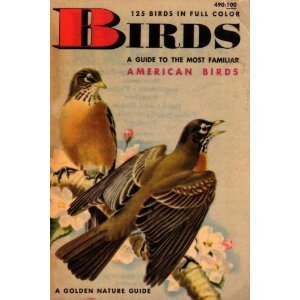
JJSJ’s first bird-book (from 2nd grade)
During the latter part of this month, for a couple days (May 20th through 22nd), I once again had the memorable privilege of birdwatching in St. Petersburg, at the hospitable home of Chaplain Bob and Marcia Webel. [Regarding this favorite backyard birdwatching site, see “Appreciating White Ibises (and Other Birds in Florida)”, posted at https://leesbird.com/2016/12/06/appreciating-white-ibises-as-well-as-dozens-of-other-birds-in-florida/ .] On Monday (May 21st), on or near that lacustrine shoreline, in addition to feeding some large turtles and a hungry alligator (about 4 feet long! — who stayed on the other side of a metal fence), we saw a lot of birds – osprey (a/k/a “fish hawk”), great blue heron, Louisiana heron (a/k/a “tri-colored heron”), white ibis, wood stork, mallard, Muscovy duck, snowy egret , great white egret, boat-tailed grackles, anhinga (a/k/a “snake-bird”), etc. – and we heard the eerie calls of limpkins (a/k/a “crying bird”). Onshore we also saw birds in the trees, including blue jay and some variety of sparrows, as well as frenetic grey squirrels. [Regarding Florida’s shellfish-snacking limpkins, see Lee Dusing’s “The Disappearing Limpkin”, posted at https://leesbird.com/2017/11/04/the-disappearing-limpkin/ .]
COMMON MOORHEN (a/k/a Florida Gallinule, a/k/a Marsh Hen) — photo credit: Shantanu Kuveskar / Wikipedia
In error, then, I thought I saw a Purple Gallinules family, but Bob correctly identified these candy-corn-billed rail-fowl as Common Moorhen (a/k/a “marsh hen” and “Florida gallinule”), and Bob’s bird-book confirmed Bob’s identification. Meanwhile, at one point, amidst a lot of tossing pieces of bread unto the birds and turtles (and alligator), Marcia tossed some less-than-fresh tuna fish salad upon the shore – and the tuna was quickly gobbled up by a Louisiana Heron! (Louisiana herons are birds that I don’t often see – I first saw one at Aransas Bay, in Aransas National Wildlife Refuge, on March 11th of AD1996, and I have rarely seen any since then.) It rained quite a bit, later (on Monday and Tuesday), so I was very glad that we did our backyard birdwatching when we did — here is a limerick to remember that time by!










 Lee's Birdwatching Adventures Plus