ROADRUNNERS: Made for Running!

Roadrunners: Made for Running!

Dr. James J. S. Johnson

But they that wait upon the LORD shall renew their strength; they shall mount up with wings as eagles; they shall run, and not be weary; and they shall walk, and not faint.

( Isaiah 40:31)

Therefore, seeing we also are compassed about with so great a cloud of testifying-witnesses [μαρτυρων ], let us lay aside every weight, and the sin which doth so easily beset us, and let us run with patience the race that is set before us.

( Hebrews 12:1 )
GREATER ROADRUNNER (Wikipedia / PhreddieH3 photo credit)

Seeing a Greater Roadrunner (Geococcyx californianus, a/k/a Chaparral Bird) scampering about in the grass, near the east side of my lawn, last Friday (12 May, A.D.2023), reminded me of the hidden-in-plain-view miracle of running. Roadrunners are cuckoo-like birds, capable of flight yet more famous for on-the-ground running (including chasing and catching insects and reptilian prey), easily recognizable by their skinny-chicken-looking bodies, sporting long tails, scissors-like beak, and prominent crest feathers.

ROADRUNNER EATING SNAKE
( photo credit: MSN.com News / Bonnie Blink )

And Roadrunners are quick! (See, e.g., “Sneaky Roadrunner”, posted at https://leesbird.com/2014/07/09/sneaky-roadrunner/ — and also see “Dueling with a Diamondback i the Desert: ROADRUNNER vs. RATTLESNAKE!”, posted at https://leesbird.com/2017/05/23/dueling-with-a-diamondback-in-the-desert-roadrunner-vs-rattlesnake/ .)

For a recent news report on a snake-eating roadrunner, see Robyn White’s “Hungry Bird Takes on Venomous Snake—and Wins””, posted at http://www.msn.com/en-us/news/us/hungry-bird-takes-on-venomous-snake-and-wins/ar-AA1bcKQQ?ocid=msedgntp&cvid=e9fb24f6a0bc45f8b2e00754820428c0&ei=14 .

GREATER ROADRUNNER in Mojave Desert, California
( photo credit: Wikipedia / Jessie Eastland )

Running is an astounding activity, although we rarely think of running that way. (And chasing is even more amazing, because it involves 2 creatures running at the same time, with one trying to catch while the other tries to escape!). However, if we only saw an animal–or a human–running once in a lifetime we might recognize the physiology of running as the God-given miracle that is. But, because we see creatures run about, frequently, we lose sight of how astonishing the action of running really is.

Running requires coordinated and energetic movement, integrating purpose, distance, and body parts and systems working together with teamwork (see 1st Corinthians chapter 12), so the bioengineering needed to enable running is an energetic and ongoing exhibit of the Lord Jesus Christ’s empowering genius and wisdom. (See, accord, Randy J. Guliuzza, “Made in His Image: Beauty in Motion”, posted at http://www.icr.org/article/beauty-motion# .)

Children assume that running is normal; grandparents watch runners with nostalgia, remembering when sprinting felt effortless. Running, if and when it is accomplished with ease, is a blessing–the ability to run is a marvelous gift from our God Who invented the ability to run. In fact, the Lord gave the gift of running to more than just human children, and athletes who are older than children–He gave the gift of running to many of the animal He created.

CHEETAH running (Answers in Genesis photo credit)

Among mammal s, notable runners include feline family (such as cheetah, jaguar, and cougar, sprinting at speeds near 70 mph!), antelope-like beasts (such as pronghorn, springbok antelope, and Indian blackbuck antelope, reaching speeds of 50 to 60 mph), wildebeest (running at 50 mph), and even bats (such as free-tailed bat, flying at 60 mph!). Other fast-footed mammals include the African lion and the hare (both climaxing at almost 50 mph, and running longer distances at lesser speeds), as well as the African wild dog and Australia’s kangaroo (both climaxing at almost 45 mph).

But, what about birds? Many birds move at speeds that are mind-boggling, such as the figure-eight wing-beating of hummingbirds, which appear as blurs to the watching eyes of human spectators–some capable of speeds above 40 mph!)..

Likewise, birds can fly at high speeds, both horizontally and especially when “dive-bombing” (a/k/a stoop diving) downward—think of falcons (e.g., Peregrine Falcon, with horizontal speeds up to almost 70 mph, and diving speed above 240 mph!). Likewise, eagles are famous for their speed (e.g., Golden eagle, with horizontal speed near 30 mph, and diving speed near 200 mph).
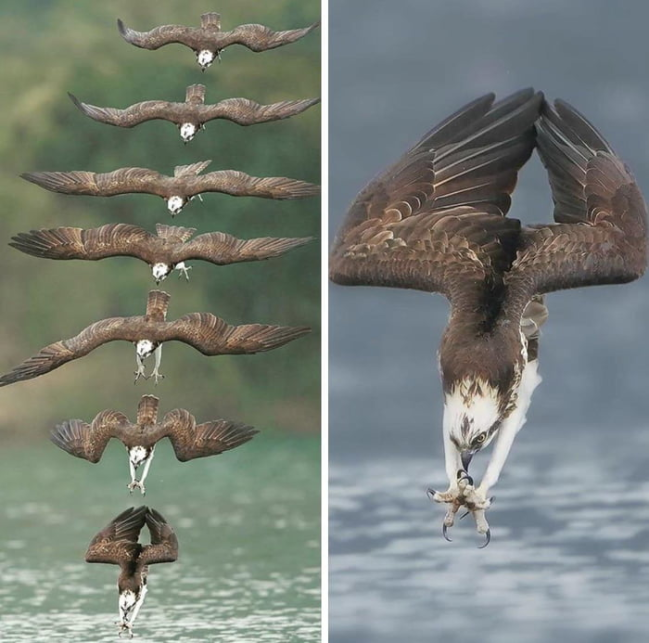
EAGLE diving down! ( photo credit: 9gag.com )

Indeed, the Holy Bible refers to the eagle’s speedy flight more than once.

Saul and Jonathan were lovely and pleasant in their lives, and in their death they were not divided: they were swifter than eagles, they were stronger than lions.

( 2nd Samuel 1:23 )

Our persecutors are swifter than the eagles of the heaven: they pursued us upon the mountains, they laid wait for us in the wilderness.

( Lamentations 4:19 )

Yet birds can be rapid runners on ground, too–with the Roadrunner being the classic example of a bird famous for running.
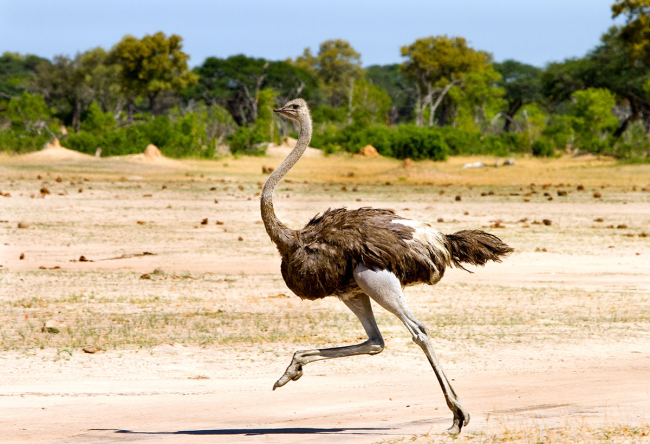
OSTRICH running ( photo credit: Thomson Safaris )

Actually, Africa’s Ostrich runs faster, achieving speeds up to 43 mph (with some reports of quick sprint-bursts up to 60 mph!), qualifying the Ostrich as the fleetest terrestrial runner among birds! Ostriches have stamina, too, so they can sustain speeds above 30 mph for a half-hour or even longer–no human can do that! Behind the Ostrich, Australia’s Emu (a smaller ratite) zooms by, racing at speeds above 30 mph.

ROADRUNNER with prey (photo credit: Nature Picture Library)

Yet the Greater Roadrunner, a much smaller bird, can dart about at speeds above 25 mph–faster than even fleet-footed children.

So, you get the picture–running is a big deal! On that note I’ll quit–i.e., rest–because I ‘got tired” just thinking about all of those creatures running to and fro. Actually, to be frank, I NEVER GET TIRED! Why? I don’t “get tired” because I stay tired.

:)

GREATER ROADRUNNER at Caprock Canyons State Park in West Texas
( photo credit: Wikipedia / drumguy8800 xvisionx.com )

Having arrived at this blogpost’s “finish line”, I’ll contribute this limerick:

STARTLED BY A ROADRUNNER ZIGZAGGING IN THE GRASS

After filling my mower with gas,

I was cutting my east lawn’s grass;

Whoa! — it gave me a start!

‘Twas a bird that did dart!

Wow! Texas roadrunners run fast!

ROADRUNNER, on the run!
(photo credit: Wikipedia / El Brujo+ )

Shake a Leg (or 2 or 3 or 4), Crab-Eater!

Shake a Leg (or 2 or 3 or 4), Crab-Eater!

Dr. James J. S. Johnson

YellowCrowned-NightHeron-eating-crab.BioWeb-photo

Yellow-crowned Night Heron eating crab in marshy grass (BioWeb photo credit)

He sends forth His commandment upon earth; His word runs very swiftly.  (Psalm 147:15)

Do you usually think of God’s Word as “running very swiftly”? Maybe not, but the psalmist portrays God’s commandment as being sent forth with a speed that is so fast it is comparable to someone running.  In fact, God rules the world’s weather by issuing meteorological mandates that are executed with lightning-like rapidity:

He gives snow like wool; He scatters the hoarfrost like ashes. He casts forth His ice like morsels; who can stand before His cold?  He sends out His word, and melts them; He causes His wind to blow, and the waters flow. (Psalm 147:16-18)

When we think of running, we think of fast motion. Young children and young adults run; old folks like to walk (Isaiah 40:31).  Of course, lots of animals move pretty quickly, too.  Legs are pretty important, if you want to do any serious running around!

The fastest-footed bird of Africa is the Ostrich, a running ratite with a galloping gait. Here in Texas (where I live), we have a much smaller bird, nonetheless swift-legged, the Greater Roadrunner.  Earlier this evening I saw two Roadrunners scooting around by the east side of my house – may God bless them as they hunt snakes and other varmints!

Speaking of varmints, there are varieties of rodents that run around quite nimbly – mice, rats, squirrels (which I don’t really consider “varmints” unless they are chewing electrical system components), voles, prairie dogs, etc.  Rabbits (and other lagomorphs, like the Pikas of the Rocky Mountains) can move with serious speed, especially when fleeing in fear when chased by a predator.

Many of the larger mammals can hoof it – pronto! — such as the fleet-footed pronghorn of the prairie plains (or its antelope-like “cousins”, Africa’s gnu and India’s blackbuck) or feral felines like North America’s cougars (or Africa’s lions and cheetahs).  Even Australia’s kangaroos can hop at speeds over 40 m.p.h., like race-horses.  Actually, as goofy as moose sometimes look, don’t casually assume that you can outrun them  —  especially if turf-defending attitude is an issue (and I recall that cautionary caveat as one once nicknamed “Dances with Moose”).

Yes, even at tidal beaches there are a lot of God’s creatures that can scurry furtively about. Consider, for a moment, the decapod crustaceans we call “crabs”. There are many different varieties of crabs (Ghost Crabs, Chesapeake Bay Blue Crabs, Fiddler Crabs, Dungeness Crabs, Tanner Crabs, King Crabs, etc.) – and they have nimble legs for swift and purposeful maneuvering, both on land or in water!

Yet what if those crab legs are rudely amputated?   –  the crab becomes near-hopelessly vulnerable to a quick end, inside a decapod-dining predator.  No running away then!

Which leads us (“finally”, you say) to our featured bird of the day, the YELLOW-CROWNED NIGHT HERON, because it is known to seize upon and amputate crab legs, prior to consuming its hapless crustacean prey.

Although night-herons are named for their habit of hunting from dusk until dawn, the Yellow-crowned Night-Heron quite commonly also hunts through daylight hours [if it’s not sleeping!], particularly when there are hungry mouths to feed [sound familiar, parents?].  Its secretive habits, choice of dense, concealing habitats and nearly motionless hunting strategy combine to make this bird a challenge to locate and observe.  The Yellow-crowned Night-Heron’s partiality for crustaceans has earned it the name “Crab-Eater in some parts of its [almost exclusively coastal] range.  It will typically grab a crab by its legs or pinchers [!] and shake vigorously until these fall off, making the crab more manageable.   [Quoting Wayne R. Petersen& Rogers Burrows, BIRDS OF NEW ENGLAND (Lone Pine Publishing, 2004), page 100, emphasis added.]

YellowCrowned-NightHeron-eating-crab.BioWeb-closeup

Yellow-crowned Night Heron eating crab (BioWeb photo credit)

So, if the caught crab is too big to swallow, shedding a few appendages might reduce it to an ingestible size – and then “down the hatch” it goes!  Also, if the seized crab were to fall out of the heron’s beak-grasp (onto the beach), while the bird was trying to position the struggling crab for swallowing it, a legless or crippled crab (if dropped) will have quite a challenging time trying to make a successful getaway!

Wow! That gives a new twist to the phrase “shake a leg!”

By the way, how did the Yellow-crowned Night-Heron know that thrashing and breaking off crab legs was a good strategy to reduce a crab in size, for more-manageable swallowing?  — or a good strategy for preventing the crustacean prey from escaping if dropped?  — or a good strategy to diminish a crab’s ability to resisting being eaten?  The night heron’s targeted practice of immobilizing the crab is not just behavioral “dumb luck”!  God designed the bio-machinery and behavioral abilities of the bird.  God taught (i.e., programmed the “software” that drives the “hardware” of) the heron how to quickly catch, keep, and consume its shellfish snack.  Crunch! Crunch!  Crunch! GULP!

Just another eye-catching example of God’s creation in action, appreciating a few small details within a super-complicated-and-interactive coastal food web  —   with all of these interactive details, both  separately and together, exhibiting our great God’s ecological and bioengineering genius, as His critters live to be “fruitful, multiply, and fill the earth”. God is really, really clever!

That’s it for now  –  gotta “run”!

YellowCrowned-NightHeron-eating-FiddlerCrab.10000Birds-photo

Yellow-crowned Night Heron eating Fiddler Crab (10,000 Birds photo credit)