Merlin, the Squealing-Laughter Falcon of Saskatchewan
Dr. James J. S. Johnson
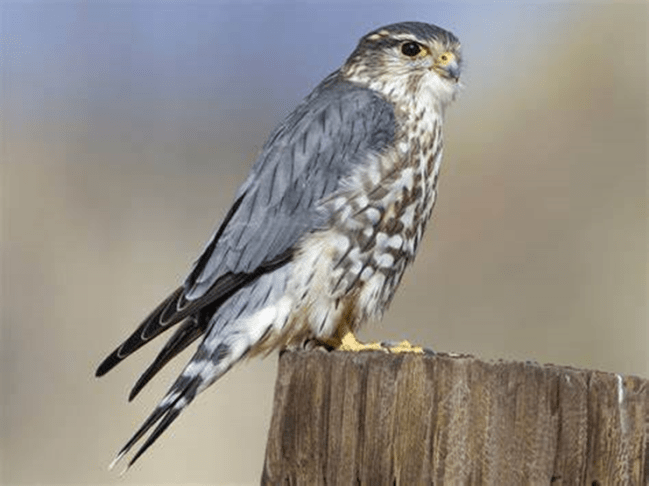
MERLIN perching (Animalia-life.club photo credit)
These things be of (the) fowls which ye shall not eat, and shall be eschewed of you (and shall be shunned by you); an eagle, and a gripe [i.e., gryphon], [and] an aliet [or “merlyon”, as in some early Wycliffite Bible copies of the late AD1380s]… (Leviticus 11:13)
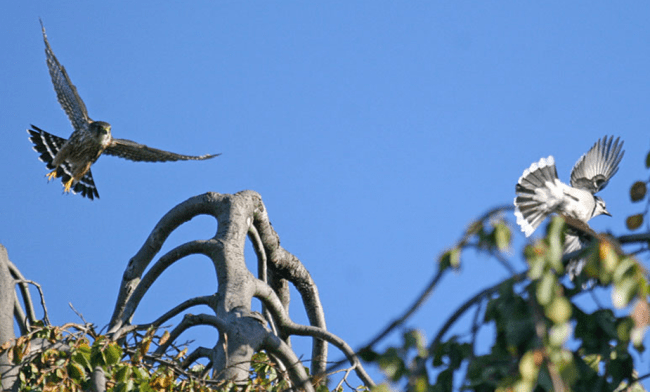
Merlin chasing Blue Jay (Wikipedia/John Harrison photo credit)
Saskatchewan (an interior province of Canada) is mostly a grassland, prairies (dominated by agriculture) with occasional hills and trees, here and there punctuated by lakes, ponds, and rivers – a wonderful habitat for birds — such as falcons.
Earlier this month (August 2-7th AD2024), by God’s grace, my wife and I attended a Christian family camp in Saskatchewan (near Fort Qu’Appelle), and the most memorable bird that I observed (on the 6th of August, AD2024), there, was a Merlin (Falco columbarius), a resident falcon also known as the Pigeon Hawk, who was circuitously flying near the lakeshore; it eventually landed upon a shoreline tree’s branch, conveniently perching there for me to see it, almost as if it was politely and patiently posing for me (as I compared its shape and plumage to my Saskatchewan bird chart).
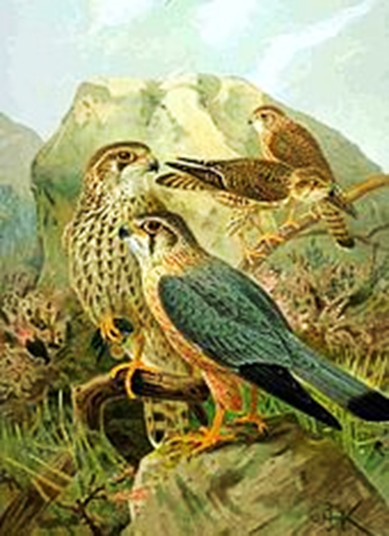
MERLINS portrayed in the wild (public domain image)
The merlin’s squeaking laughter-like call, which I heard on multiple days at that family camp property in Saskatchewan, reminded me of seagull laughter, although the Merlin’s calls seemed more repetitive – a staccato laughter — almost like rhythmic squealing.
The fancy scientific name for the Merlin is Falco columbarius, meaning “dove falcon” – perhaps because the Merlin is a falcon shaped (and colored) somewhat like an over-sized mourning dove or pigeon. The males have wingspans almost 2 feet wide; the females are slightly larger.
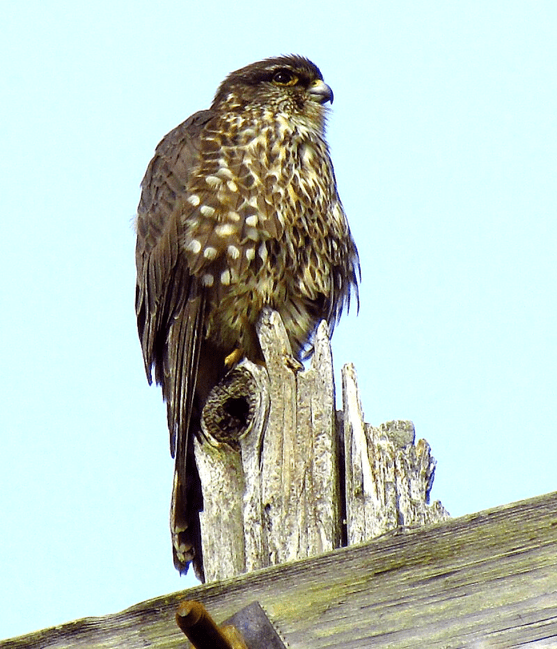
MERLIN juvenile (Wikipedia image credit)
But, from the perspective of prey seized by this falcon’s sickle-shaped talons, the Merlin is no laughing matter.
Merlins — like other falcons (e.g., peregrines), hawks, and kites — are feathered predators, zooming down upon their next meal with sudden bursts of aerial speed. Like “sparrow-hawks” (i.e., kestrels, which are also a type of falcon), merlins ambush and seize smaller birds, for food, some as little as sparrows and others as large as grouse. In the same cluster of trees, by the lakeside where the Merlin was perching, I repeatedly saw an American Robin, as well as several gulls (perhaps they were Ring-billed Gulls?). Hopefully that robin escaped the merlin’s hungry hunting.
Merlins are flexible in adapting to various ranges, with different biome habitats.
Merlins are often found in northern forests and grasslands, including birch scrubland country (e.g., in Saskatchewan’s birch-studded prairies) and willow-prominent wet woods, from sea level to timberline. Many of their summer breeding ranges are in North America’s boreal forests and prairies, as well as in Eurasia’s taiga forests and steppes. Most merlins migrate, seasonally, with warm winter ranges in mild grasslands, woodlands, and coastlands.
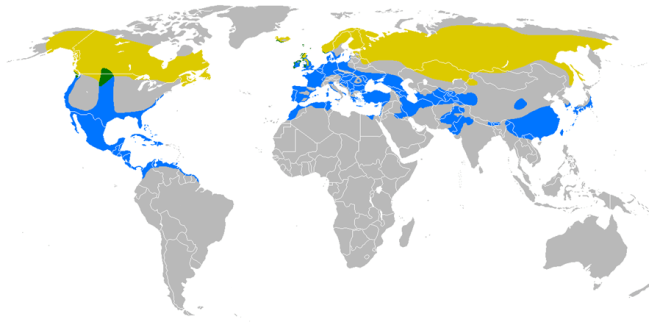
SUMMER & WINTER RANGES of Merlin migrants.
Laughter makes life more livable. And seeing a squealing-laughter-calling Merlin, as a “lifer”, while attending a precious Christian family camp in rural Saskatchewan, was an unexpected blessing, to say the least. (So was visiting the fish hatchery that serves Fort Qu’Appelle – but I digress.)
The Lord has many beautiful places on earth, plus many beautiful birds therein – and Saskatchewan’s Merlin illustrates that beauty. No surprise, because the ultimate source of all beauty is God Himself (Psalm 27:4).
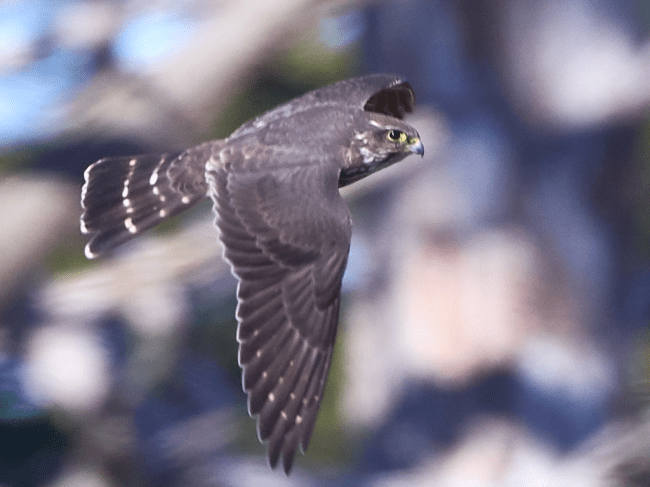
MERLIN in flight (U.S. National Park Service photo credit)
 Lee's Birdwatching Adventures Plus