I couldn’t resist posting this video. It shows the Bird of Paradise “displaying” better than any picture ever could.
This is the second video of birds displaying.
I couldn’t resist posting this video. It shows the Bird of Paradise “displaying” better than any picture ever could.
This is the second video of birds displaying.
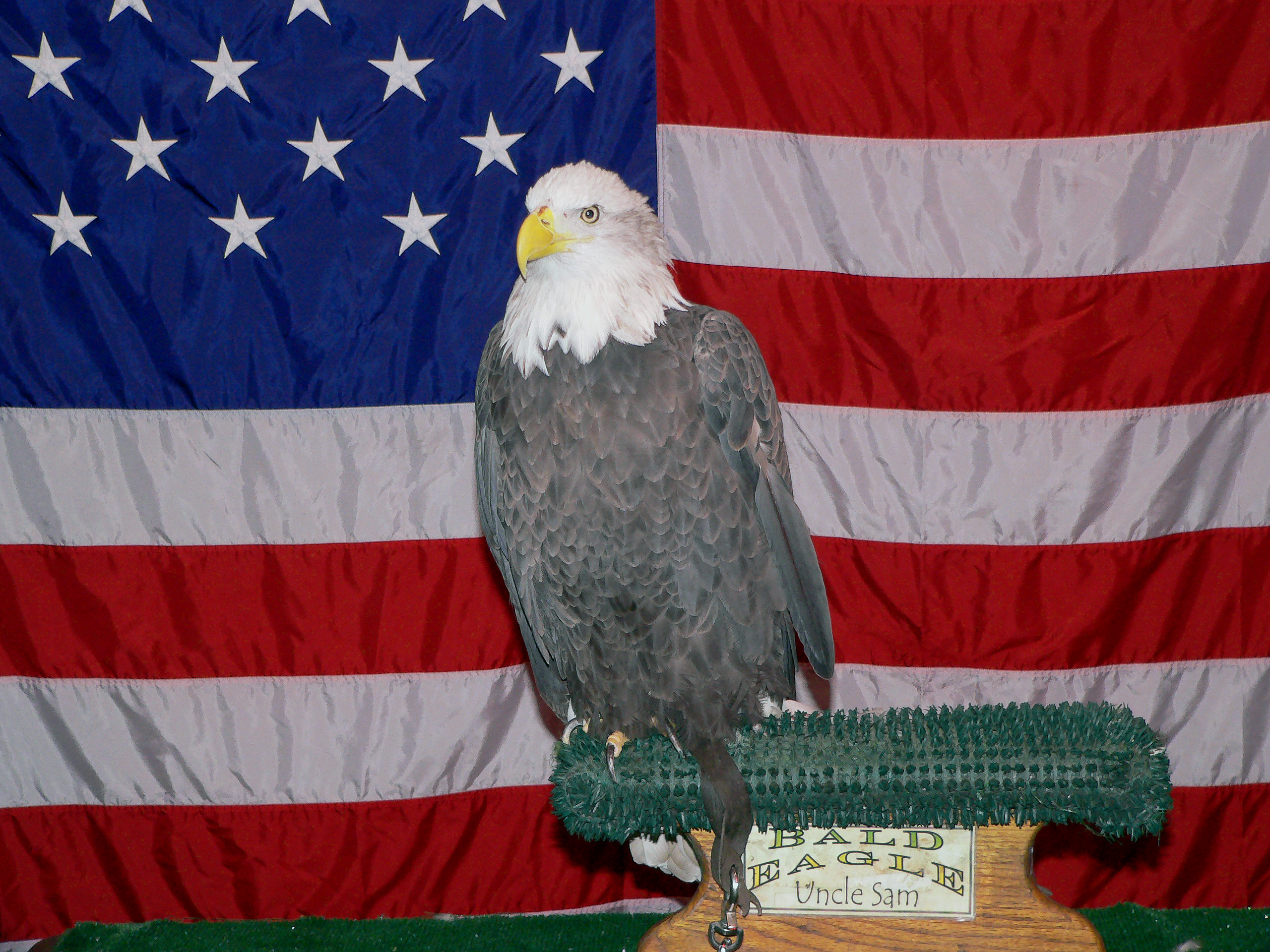
Uncle Sam – Bald Eagle taken at Titusville Birding Festival
Since today is the Fourth of July, what better bird to feature than our Bald Eagle. I have decided to re-post the Birds of the Bible-Eagles, with a few updates. Here in North America we have the Bald Eagle (our National symbol) and the Golden Eagle. The Bald Eagle’s “bald spot” doesn’t appear until they are 4 or 5 years old and develop a white head and tail. The Bald Eagle is only in North America. In Israel you might see a Short-toed Eagle, Great or Lesser Spotted Eagle, Steppe, Imperial, Golden, Booted, or Bonelli’s Eagle.
I love to watch an eagle flying; it stops me in my tracks. We are lucky here in Polk County to have many this time of the year. (Update: It’s now Summer and most have gone north until Fall.) Stay alert and also visit the South Lake Howard Nature Center to see a pair sitting either on the tower or at the nest. Ask most anyone there and they will point out the nest. (Update: They did not produce any eaglets this spring, but the nest is still there.)
 Eagle on Tower Near Lake Howard and Eagle in Nest at Lake Howard Nature Park.
An African Eagle
“Birds display a wide range of patterns in flight. Swifts and swallows use a fast, gliding motion. Ducks and geese have sustained, powerful flight. Birds of prey such as eagles and falcons usually catch their targets by swooping from high in the sky, capturing their victims after a swift dive—which may reach speeds of 250 kilometers an hour (165 mph). As the bird swoops to the ground, it spreads its powerful wings to act as a brake.” (“Created to fly,” Creation 16(3), June 1994)
Click link to see a Bald eagle hovering and landing on rock.
Bald Eagle hovering and landing
 For those of us in the “older generation,” Job 9:25-26 (NKJV) reminds us that we need to stay active for our Lord because our life passes by swiftly. “Now my days are swifter than a runner; They flee away, they see no good. They pass by like swift ships, Like an eagle swooping on its prey.”
A few more facts about eagles:
Today may be Independence Day here in the United States, but there is One we should never declare our Independence from, because:
Have you not known? Have you not heard? The everlasting God, the LORD, The Creator of the ends of the earth, Neither faints nor is weary. His understanding is unsearchable. He gives power to the weak, And to those who have no might He increases strength. Even the youths shall faint and be weary, And the young men shall utterly fall, But those who wait on the LORD Shall renew their strength; They shall mount up with wings like eagles, They shall run and not be weary, They shall walk and not faint. (Isaiah 40:28-31 NKJV)

Double-crested Cormorants, by Dan, Lake John Rockery in Lakeland
Last week’s Bittern blog mentioned Isaiah 34:11,
“But the cormorant and the bittern shall possess it; the owl also and the raven shall dwell in it: and he shall stretch out upon it the line of confusion, and the stones of emptiness.”
That verse, along with Leviticus 11:17 and Zephaniah 2:14, put the cormorant on the “unclean” list and predicts of the destruction of Nineveh, where only the animals and birds will inhabit the city. Again, God has created and provided for another interesting bird kind.
We have the Double-crested Cormorant in this area at our many lakes. Here in North America, we have the Brandt’s, Neotropic, Great, Red-faced and Pelagic Cormorants. Worldwide there are 36 species. A very close relative see here is the Anhinga. Many of the cormorants live and fly over the oceans.
An interesting article from Institute for Creation Research, “Water, Water Everywhere … And Not A Drop To Drink,” by Donna L. O’Daniel, mentions the Double-Crested Cormorant in, “Avian Salt Glands”
“But seabirds have their own desalinization systems to deal with excess salt taken in by drinking seawater and feeding in the ocean, in the form of glands that lie inshallow depressions in or above the eye sockets….
The avian salt gland has made it possible for seabirds not only to exist but to maintain homeostasis in an otherwise hostile environment. Truly, ‘the salt gland is one of the most effective ion transport systems known.’ But how did such a system arise? There are only two possible explanations for the origin of avian salt glands: Either they evolved along with the birds themselves, or they were created within the birds by God as He spoke the feathered creatures into existence (Genesis 1:21).”

Double-crested Cormorants, by Dan, Lake John Rockery in Lakeland
Another article From Creation Matters – Volume 8, Number 1 January / February 2003 states:
Let the Birds of the Heavens Tell You
“Domesticated cormorants have been used for centuries in the Orient to catch fish for human consumption (Hoh and Leachman, 1998). Several families in China, carry out a brisk fishing business by letting these highly skilled, winged fishers do their work for them. With a wood block on a long bamboo pole, the human fisherman brings back his cormorant from the water as it delivers a freshly caught fish in its beak. Such fishing was better years ago, but recently one of the fishermen reported catching anywhere between 10 pounds and 100 pounds in a day by using cormorants.”
Back to Birds of the Bible


The Lyre Bird is one cool bird. Came across this on YouTube and couldn’t resist replaying it here. I thought the Northern Mockingbird was quite a mimic, but this one takes the prize. You decide.
The 15 species of Cranes worldwide are: Black Crowned, Black-necked, Brolga, Demoiselle, Eurasian, Grey Crowned, Hooded, Red-Crowned, Sandhill, Sarus(tallest flying bird-6’ tall), Siberian, Wattled, White-naped, and the Whooping Crane(tallest N. American flying bird-5’ tall). A link to pictures and information about these cranes is at: International Crane Foundation
Cranes are tall birds from 3 to 6 feet tall, with wingspans over 6 feet. They fly with their neck straight out and their long legs trailing. They chatter and call when flying. We have plenty of Sandhill Cranes here in Central Florida walking around the neighborhoods. They seem pretty tame sometimes and will eat out of your hand. They have been bringing a small flock of Whooping Cranes to Florida every fall that follow an Ultra Light Aircraft from Wisconsin. We have a few non-migratory Whooping Cranes in the area that I have seen in a cow field off US 27.
 Sandhill Cranes and Babies in our yard
Like a crane or a swallow, so did I chatter: I did mourn as a dove: mine eyes fail with looking upward: O LORD, I am oppressed; undertake for me. (Isaiah 38:14 KJV)
Yea, the stork in the heaven knoweth her appointed times; and the turtle and the crane and the swallow observe the time of their coming; but my people know not the judgment of the LORD. (Jeremiah 8:7 KJV)
“The instinct of the migratory birds leads them with unfailing regularity to return every spring from their winter abodes in summer climes (Son_2:12); but God’s people will not return to Him even when the winter of His wrath is past, and He invites them back to the spring of His favor.”
Jameison, Faussett, and Brown Commentary


Psalms 84:1-4 KJV
(1) How amiable are thy tabernacles, O LORD of hosts!
(2) My soul longeth, yea even fainteth for the courts of the LORD: my heart and my flesh crieth out for the living God.
(3) Yea, the sparrow hath found a house, and the swallow a nest for herself, where she may lay her young, even thine altars, O LORD of hosts, my King, and my God.
(4) Blessed are they that dwell in thy house: they will be still praising thee. Selah.

Vesper Sparrow
The commentaries have different views, but many agree that the sparrow has made her nest in the Tabernacle and is close to the altars. David’s soul is longing to be in the courts of the Lord and near the Lord. The sparrow is there, has moved in and is even raising her family there. I think he is envious of the birds because they get to spend so much time there and also they sing so often, praising God.
Do we yearn and long to spend time with the Lord, our Savior? Do we seek to be as close as we can get? Do we enjoy reading His Word, praying to Him, and attending church where we can learn, sing and praise, and have fellowship with other believers? I trust you can say a mighty, Amen!
Field Sparrow Singing
Again we have a bird that is in a list of “unclean” birds. This time we will look at the Cuckoo. No. This is not the bird that pops out of your clock on the hour and sings. Let’s find out about the real Cuckoos. 
And the owl, and the night hawk, and the cuckoo, and the hawk after his kind, (Deuteronomy 14:15 KJV)
And the owl, and the night hawk, and the cuckoo, and the hawk after his kind, (Leviticus 11:16 KJV)
Here in the U. S. we have a Black-billed, Common, Mangrove, Yellow-billed and Oriental, Cuckoos. The Common and Oriental Cuckoos have only been seen in Alaska. The Mangrove is seen along the mangroves of southern Florida and the other two like dense thickets, woodlands, orchards and along streams. Worldwide there are close to 100 species of Cuckoos. Our Roadrunner is the same family – cuculidae.

The cuckoos have a slender body with a downcurved bill and a long tail. Most of them have spots on the underside of their tails and the sexes are similiar. Many species of cuckoos have a habit of laying their eggs in another’s kind of bird’s nest and letting those parent raise the bird. The chick seems to hatch first and then either knock the other eggs out of the nest or harm the new chicks. Other cuckoos raise their own babies.
*
*
Back to Birds of the Bible – Cuckoos
*
The Lapwing is only mentioned twice in scripture and both times in a list of “unclean” birds. “But these are they of which ye shall not eat,” says Deuteronomy 14:12.
And the stork, the heron after her kind, and the lapwing, and the bat. (Leviticus 11:19 KJV)
And the stork, and the heron after her kind, and the lapwing, and the bat. (Deuteronomy 14:18 KJV)
The only Lapwing in North America is the Northern Lapwing and then that has only been seen in isolated sightings. They are on the List of Birds of Florida. They are found in Europe and Asia near wetlands, coastal pastures and short-grass meadows or fields. They are in the same Order as Gulls, Terns and Plovers. In Europe there is also a Sociable Lapwing and a White-tailed Lapwing. “Most of the  Lapwings seem to feed on insects and small prey from grasslands. They lay their eggs in nest on the ground and very protective of their young. They feign injury or will lead intruders away. If that doesn’t work, they are known to attack, even humans. They are medium sized about 12-13 inches with long legs. Their heads have a striking pattern with a wispy crest. Their behavior reminds me of a Killdeer.
Apparently the Lapwing was mentioned in three of Shakespeare’s plays: Comedy of Errors, Much Ado About Nothing and Measure for Measure
Return to Birds of the Bible Index
*
 The Peacock is the male and the Peahen is the female in the pheasant family, Phasianidae (order Galliformes), that consists of the blue or Indian peacock and the green or Javanese peacock which is quite aggressive. More recently they discovered a Congo peacock. Peacocks and peahens are not native to North America, but are found in many zoos here.
The males have a body that is 35-50 inches with long tail feathers that are about 60 inches and “are coloured a brilliant metallic green. This train is mainly formed of the bird’s upper tail coverts, which are enormously elongated. Each feather is tipped with an iridescent eyespot that is ringed with blue and bronze. In courtship displays, the cock elevates his tail, which lies under the train, thus elevating the  train and bringing it forward. At the climax of this display the tail feathers are vibrated, giving the feathers of the train a shimmering appearance and making a rustling sound. When he is courting, the male lifts his tail feathers up in a beautiful display to attract the female.” From Britannica Online, “Peacock”.
In Job 38, God started answering Job and began asking him questions about many things. By the time we get to Job 39:13, God asks:
Gavest thou the goodly wings unto the peacocks? or wings and feathers unto the ostrich? (Job 39:13 KJV)
When Solomon was the King of Israel, he was very wise and wealthy. One of the things he did was to start a navy of ships. It appears that they would go off and every three years come back with, among other things, peacocks.
For the king had at sea a navy of Tharshish with the navy of Hiram: once in three years came the navy of Tharshish, bringing gold, and silver, ivory, and apes, and peacocks. (1 Kings 10:22 KJV)
For the king’s ships went to Tarshish with the servants of Huram: every three years once came the ships of Tarshish bringing gold, and silver, ivory, and apes, and peacocks. (2 Chronicles 9:21 KJV)
The peacock has been used as an ornamental bird for many centuries. The video below gives a view of his feathers spread out.
Gavest thou the goodly wings unto the peacocks? or wings and feathers unto the ostrich?
See:
Phasianidae Family
*
 Owls are an interesting species. Most of them are nocturnal, so we don’t see them very frequently. At least I don’t see them, but since I like to stay up late, I have heard them at night. Sometimes they are thought of as wise and drawings are made of them with glasses. Maybe that is because they have such huge eyes in respect to their head size. God has given them great ability to see at night with more rods than cones in their eyes that help gather light. They do not move their eyes up and down or side to side as we do, but instead move their head. No, they do not turn it all the way around. They can turn it 270 degrees though.
When owls fly, they are swift and silent as they hunt for prey, such as small animals and rodents. Their wings were designed to give them stealth. Their hearing is very sensitive and they can locate prey even if there is very low light. The sound of an owl can be “eerie” or of a “hoot” or “screech” sound.

Here is an interesting quote from Wayne Blank’s Birds of the Bible. “Some insects and other creatures wear a disguise which actually frightens birds away. Most small birds are afraid of owls, and one insect has a clever way…the owl butterfly has large ‘eyes’ on its wings.”
The destruction of Babylon in Isaiah 13:19-22 mentions the owls that inhabit the deserted or wasted area. In comparing verse 21, it was interesting how the different Bible translations described them. Here are a few examples: “full of doleful creatures” (ASV); “hoot owls” (CEV); “ful of great Owles” (Bishops); “howling creatures” (ESV); the KJV, NASB, and NKJV all call them “owls”; and the MSG has “vacant houses with eerie night sounds.”
Other references to owls are found in Isaiah 34:11-13, Jeremiah 50:39, and Micah 1:8.
In Isaiah 43:20 the beast of the field, dragons, and owls honor the Lord because he has given water in the wilderness and rivers in the desert to provide drink for them. The next verse tells of his people giving praise. This brings to mind the hymn, Fairest Lord Jesus
Two articles from Creation Moments:
Calculating Owls Article – Calculating Owls Audio
*

Observing the Northern Mockingbird must have some lessons we can learn. I can think of two off hand. Well, actually one of them comes from my husband. The song of the mockingbird uses a “vocal mimicry or appropriation” to make “sounds of other species (as well as non-avian sounds such as the barking of dogs, screeching of machinery, or human whistling) sometimes incorporated into a bird’s repertoire.” (“Vocal Copying,” The Birder’s Handbook) They listen, incorporate, and assimilate those songs and produce sounds into a very melodious song. Their song is usually a phrase repeated three times or so, and then a new phrase is sung. This can go on for hours.
Lesson #1: He could be like a person, who hears things and then repeats it three or more time. Sort of like a gossiper.
And besides they learn to be idle, wandering about from house to house, and not only idle but also gossips and busybodies, saying things which they ought not. (1Ti 5:13)
Also
Charge them that are rich in this world, that they be not high-minded; nor trust in uncertain riches, but in the living God, who giveth us richly all things to enjoy; That they do good, that they be rich in good works, ready to distribute, willing to communicate; Laying up in store for themselves a good foundation against the time to come, that they may lay hold on eternal life. (1Ti 6:17-19)
Till I come, give attendance to reading, to exhortation, to doctrine. Neglect not the gift that is in thee, …. Meditate upon these things; give thyself wholly to them; that thy profiting may appear to all. (1Ti 4:13-15)
Update 7/23/08: Check out “Mockingbird Imitates Surprising Sounds“
Many people think of babies being delivered when a Stork is mentioned. I am amazed when I watch the Wood Storks here in Florida. When they are on the ground, they are very unbecoming (aka-ugly), but when they are flying, it is so awesome to see the gracefulness of their flight and how beautiful their wings are.
The Wood Stork is a large bird (35”) that has huge long legs and a wing span of five and a half feet. It is the only stork that breeds here in the U.S. There are 19 species of storks worldwide. It has a long, thick, down-curved bill, and its head is black and un-feathered. The Stork is a wadder and raises its young in late winter in Florida during the dryer season. When the water is lower, the fish concentrate, and the Wood Stork and other birds can find an ample supply to feed their young. When they fly, they hold the neck extended.


Pictures by my friend Reineir Munguia, (Professional Photographer)
The stork is found in the list of unclean birds in Lev 11:19 and in Deu. 14:18
In Psalms the list is repeated with a comment here about the stork.
Where the birds make their nests; The stork has her home in the fir trees. Psa(104:17)

My picture of a Wood Stork in tree and Reinier’s much better one.
Jeremiah refers to the migration of birds and how they know when it’s time to leave. Here is an interesting quote from an article from Israel: The Bird’s Eye View By Sherri Mandell
Israel may be a small country, but thousands of birds annually take advantage of its passage-friendly flyway and the welcoming sanctuaries that dot the country.
The ancients considered Israel the center of the world, and it certainly feels that way if you look up at the sky in the spring and autumn. Half a billion migrating birds, more than 230 species, fly in Israeli air space on annual migrations between Europe, western Asia and Africa.
These journeys were noted long ago: “The stork in the heaven also knows her appointed times; and the turtledove, swift and the crane observe their time of coming” (Jeremiah 8:7).
“Tourists are sometimes afraid to visit here,” observes Alen Kasel, education director of the Jerusalem Bird Observatory, “but [the birds] never abandon us.”
Zechariah alludes to the “wings of a stork”.
Then I raised my eyes and looked, and there were two women, coming with the wind in their wings; for they had wings like the wings of a stork, and they lifted up the basket between earth and heaven. (Zec 5:9)

+Wood+Stork+in+a+tree.jpg)

 Lee's Birdwatching Adventures Plus