Dr. James J. S. Johnson
And they shall take gold, and blue, and purple, and scarlet, and fine linen.
EXODUS 28:5
Cardinal males are red birds, easy to see. Yet cardinal females have a softer-hued beauty of their own.
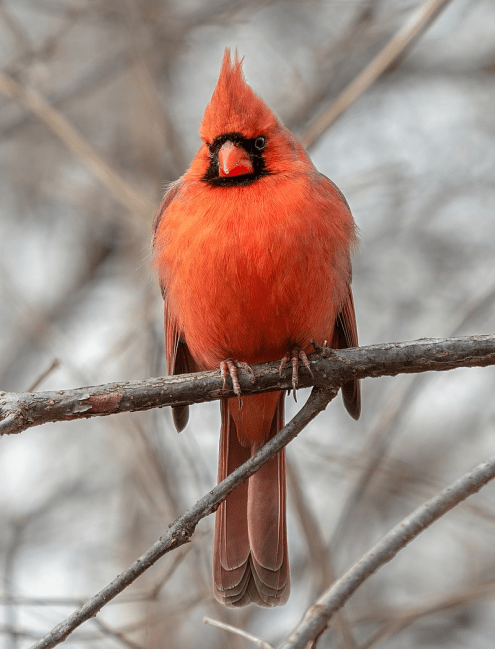
Just as the Old Testament Tabernacle blended theological meaning with aesthetically attractive colors—as exemplified by Exodus 28:5 (quoted above), some birds are gold (e.g., Goldfinch, Yellow Warbler, Evening Grosbeak), or blue (e.g., Mountain Bluebird, Indigo Bunting), or purple (e.g., Purple Starling, Purple Honeycreeper), or scarlet (e.g., Scarlet Tanager, Northern Cardinal), or white as fine linen (e.g., Snowy Egret, White Ibis, Trumpeter Swan).
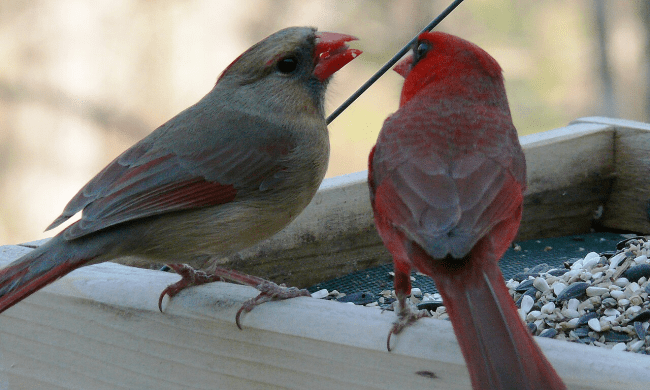
In fact, the Northern Cardinal (Cardinalis cardinalis) is often nicknamed the Redbird, because the male cardinal is almost all-covered in bright red plumage. Male cardinals, being bright red, are conspicuous—so conspicuous that they get noticed! Cardinals are so popular, in fact, that 7 states have officially adopted the Northern Cardinal as their official state bird: Illinois, Indiana, Kentucky, North Carolina, Ohio, Virginia, and West Virginia. (That’s more states than any other bird represents!)
Recently (i.e., during December of A.D.2024), it has been my prized privilege to hear Northern Cardinals chirping happily in and around trees, where I live and also in places that I visit. Perhaps the cardinals are extra talkative at this time of year. Or maybe I am paying better attention to the cardinals’ movements and vocalizations. Sometimes I see a cardinal flitting about, or hopping among leaf litter at the bottom of bushes, shrubs, or tree-trunks. Sometimes I see cardinals perching on tree branches. Then, suddenly, a cardinal might fly off to a nearly spot on the ground–or to a branch of another tree. Also, cardinal chirping–which can be a somewhat squeaky whistle–is often easy to recognize.
What wonderful birds! What beauty the Lord built into these winged wonders!
The Cardinal is a favorite bird of many people and it’s easy to see why. The brilliant scarlet plumage of the male and the subtle shades of the female, combined with their clear melodic song, make them enjoyable to watch in any season. Male and female Cardinals sing equally well, a fact not generally known by those used to the widespread [yet erroneous] assumption that only male birds sing. Song is an important coordinating behavior in the life of a Cardinal. . . . In countersinging, one bird will sing one phrase several times and then the other [cardinal] will match it. Then the leader will sing a new phrase and the other will again match it. This type of countersinging that involves copying [musical] phrases functions to synchronize and unify members fo a pair; and when given between males, helps settle territorial disputes. [Quoting Donald Stokes & Lillian Stokes, “Northern Cardinal”, A GUIDE TO BIRD BEHAVIOR, volume II (Boston, MA: Little, Brown & Company), page 247]
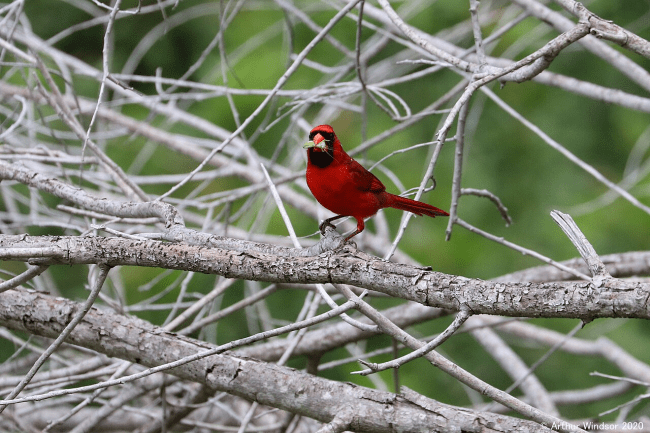
The Cardinal males are so brightly colored, with crimson-red wings and scarlet-red bellies, contrasting with black face-masks that showcase their red beaks. Female cardinals also have bright scarlet-red beaks, yet they are more camouflaged in their plumage hues—soft beige-cream bellies with russet-brown wings and head feathers, accented by reddish crests.
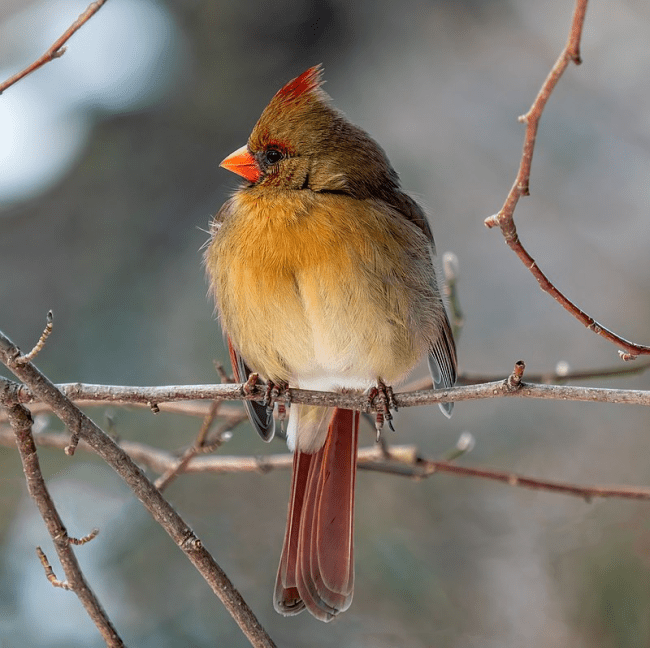
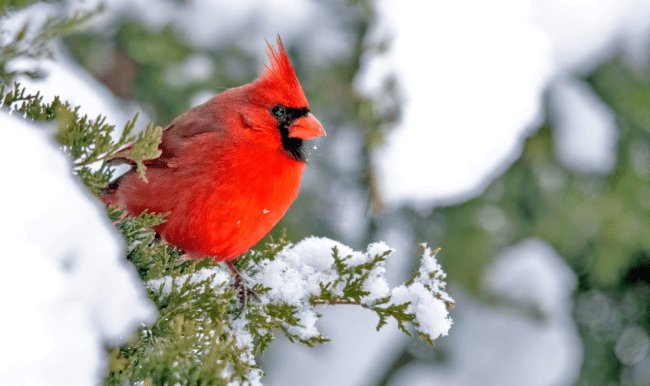
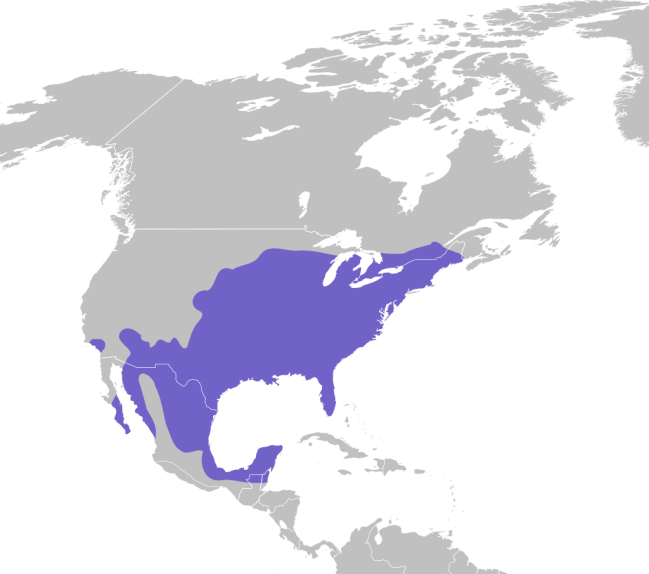
Cardinals are year-round residents—they don’t migrate to avoid cold winters. Rather, cardinals tough out winter weather—hence many scenic photographs display bright-red cardinals perched in tree branches against backdrops of snow-drifts. What beautiful pairs they are, to see in December, braving cold winds and chilly rains or snowfall.
So, as you journey through winter months, remember that there are times when you should stop being so busy, just long enough to gaze upon busy cardinals that flit about, outside, sharing with us overlapping bits of space and winter weather.
Thank You, God, for the cardinals.
 Lee's Birdwatching Adventures Plus
These are beautiful captures. I always love the contrast of Cardinals in the snow!
LikeLike
Oh, I do so appreciate cardinals! They are scarce in our neck of the woods, so it is a real treat to see one.
I’m saving a couple of your pictures on my machine, just to look at sometimes. Thank you.
LikeLiked by 1 person
Yes, cardinals are a true treasure — I hope you get to see many more during the new year.
LikeLiked by 1 person