Ian’s Bird of the Week – Anna’s Hummingbird

Anna's Hummingbird (Calypte anna) by Ian

Anna's Hummingbird (Calypte anna) by Ian

Ian’s Bird of the Week – Anna’s Hummingbird ~ by Ian Montgomery

Newsletter – 09-01-10

As promised last week, here is Anna’s Hummingbird, the common Hummingbird of gardens and parks along the West coast of the United States. Many houses, including the one I am in, have hummingbird feeders to attract these delightful birds.

Anna's Hummingbird (Calypte anna) by Ian

Anna's Hummingbird (Calypte anna) by Ian

They can be quite inconspicuous, despite the striking colours of the male birds. They alternate between hovering and sudden bursts of very rapid flight which makes them appear and disappear with equal facility. The feathers have, in effect, lots of minute mirrors on them and the bright colour is only visible at exactly the right angle to the light. Otherwise, they look quite dark, dare I say drab, like the male in the first photo hovering at the feeder. The second and third photos, also males, show the claret-coloured head and breast quite well, even though the birds are perched in the shade. Young birds and females are mainly green and grey, though adult females have a small red patch on the throat.

At 12.5cm/4in in length Anna’s is quite large by hummingbird standards. Most of the North American hummingbirds are migrants and spend the winters in Mexico and/or Central America, but Anna’s is an exception and is resident in coastal areas of the western states. They are quite aggressive and males chase other males away from feeders. They also seem quite curious and will check you out by hovering quite closely.

Anna's Hummingbird (Calypte anna) by Ian

Anna's Hummingbird (Calypte anna) by Ian

Hummingbirds occur only in the Americas and there are more than 300 species. 27 of these, mostly photographed in Ecuador and Trinidad, are on the website: http://www.birdway.com.au/trochilidae/index.htm .

I went on a successful pelagic boat trip out of Monterey last Sunday, so next week’s bird will feature a wanderer that is also on the Australian list that I haven’t seen before. Sometimes, you have to travel quite far to track down local birds!

Best wishes,
Ian


Ian Montgomery, Birdway Pty Ltd,
454 Forestry Road, Bluewater, Qld 4818
Phone: +61-7 4751 3115
Preferred Email: ian@birdway.com.au
Website: http://birdway.com.au


Lee’s Addition:

I am glad Ian is getting to see the Hummingbirds up close here. Sure he is as thrilled to see them as we would be watching some of those beautiful birds that they have only in Australia. Welcome to America, Ian.

Where we live, there are very few hummers even in the winter. Other area of the state get some, but not this area. The description of the reflection the hummingbird gives when facing the light reminds me of several verses.

Make thy face to shine upon thy servant: save me for thy mercies’ sake. (Psalms 31:16 KJV)

Make thy face to shine upon thy servant; and teach me thy statutes. (Psalms 119:135 KJV)

And they that be wise shall shine as the brightness of the firmament; and they that turn many to righteousness as the stars for ever and ever. (Daniel 12:3 KJV)

Check out his Trochilidae Family pages and also the Trochilidae – Hummingbird Family page here.

*

Ian’s Bird of the Week – Pacific Loon

Pacific Loon(Gavia pacifica) by Ian

Pacific Loon(Gavia pacifica) by Ian

This week’s choice was based on (a) the fact that I promised an American this week and (b) because I ended up travelling a day late on Air Pacific via Fiji as my V Australia flight was cancelled, and wanted to make a horrible pun along the lines of loons and choice of airline and the ‘meals’ that they provide. I’ve decided to spare you that, as we all know that airline food is terrible and I shouldn’t be surprised when it plumbs new depths.

Anyway, it’s lovely to be back in California and I spent some time this morning trying to photograph the Anna’s Hummingbirds in the backyard. They need to be photographed at exactly the right angle to the light to show the magenta on the head. I haven’t yet done that to my satisfaction, so I’ll keep that for another day.

Pacific Loon (Gavia pacifica) by Ian - from his Website

Pacific Loon (Gavia pacifica) by Ian - from his Website

This Pacific Loon I photographed in Barrow in northern Alaska on my last trip 2 years ago when it was swimming among the ice-floes along the beach where there was some open water in the otherwise frozen sea. ‘Loons’ to Americans and ‘Divers’ to the British form a small northern hemisphere family of 5 species – http://www.birdway.com.au/gaviidae/index.htm – all of which are mostly marine fish-eaters except when breeding when they nest beside freshwater lakes, often far inland. They are brilliantly adapted to an aquatic life and prefer to dive than fly. How sensible.

The Pacific Loon is very closely related and similar in appearance to the Arctic Loon/Diver of Eurasia. The bird in the photo is in breeding plumage (it was mid-summer’s day) and all the loons/divers then have strikingly patterns, while the non-breeding plumage is a rather drab grey and white. They’re big birds, with the Pacific having a length of 64cm/25in.

The enforced leisure of my journey gave me ample opportunities to work on the website, and I have made some additions http://www.birdway.com.au/#updates and finally updated Ian’s Picks:

Black Swan
Andean Cock-of-the-Rock
White-throated Dipper
Northern Brown Bandicoot

Australian Wildlife - Ian

Australian Wildlife

Earlier this year, I provided many photos for a new Brandt guide to Australian Wildlife by Stella Martin and received my copy shortly before I left Australia. I think Stella has done a wonderful job in producing a comprehensive but concise introduction across a broad field which is eminently readable. Being a paperback it’s ideal for the visitor to Australia and great value. Amazon now have it in stock: Australian Wildlife and it is becoming available in book stores. I’ve attached a copy of the cover to whet your appetite!

Best wishes,
Ian

Ian Montgomery, Birdway Pty Ltd,
454 Forestry Road, Bluewater, Qld 4818
Phone: +61-7 4751 3115
Preferred Email: ian@birdway.com.au
Website: http://birdway.com.au


Lee’s Addition:

Since Ian is traveling, I went to his website and got the second photo of the Pacific Loon swimming towards the camera. I am sure Ian won’t mind. As Ian said, the Loons are in the Gaviidae Family which is in the Gaviiformes Order. In other words, they are the only family in that Order.

Their sounds are sad and remind me of wailing.

Behold, he cometh with clouds; and every eye shall see him, and they also which pierced him: and all kindreds of the earth shall wail because of him. Even so, Amen. I am Alpha and Omega, the beginning and the ending, saith the Lord, which is, and which was, and which is to come, the Almighty. (Revelation 1:7-8 KJV)

See:

Ian’s Gaviidae Family,

Birds of the World – Gaviidae Family and the Gaviiformes Order.

*

Ian’s Bird of the Week – Tooth-billed Bowerbird

Tooth-billed Bowerbird (Scenopoeetes dentirostris) by Ian

Tooth-billed Bowerbird (Scenopoeetes dentirostris) by Ian

Ian’s Bird of the Week – Tooth-billed Bowerbird ~ by Ian Montgomery

Newsletter 8-20-10

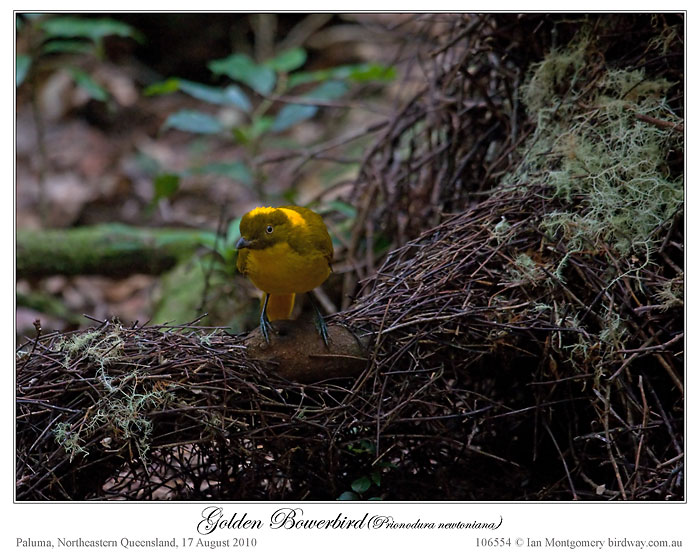
I’m squeezing this bird of the week in between the Birds Australia Congress and Campout, which finished this morning, and my departure for California tomorrow. The Congress and Campout was a great success and ran like clockwork thanks to the preparation, dedication and hard work of our secretary and committee. I had a request from a participant to make the Golden Bowerbird – one of the highlights of the Campout – this week’s bird but this species starred in this role earlier this year. So, instead I’ve chosen the Tooth-billed Bowerbird and included a photo of the Golden Bowerbird, both being endemics of the Queensland wet tropics and inhabiting highland rainforest.

Tooth-billed Bowerbird (Scenopoeetes dentirostris) by Ian

Tooth-billed Bowerbird (Scenopoeetes dentirostris) by Ian

It’s not spectacular in appearance like the Golden Bowerbird, but it’s an interesting bird nevertheless. It doesn’t build a bower; instead it has a display platform consisting of an oval cleared space on the ground around a small tree trunk with a suitable branch used as a perch for singing above the platform. It decorates the platform with large, fresh leaves that the bird collects by using its serrated bill to chew through the leaf stem. The second photo shows a bird in full song and you can see the serrations on the bill, from which it gets the name. Like other bowerbirds, it is an accomplished songster and very good a mimicry. It is also fussy. Most bowerbirds are extraordinarily fussy in their choice of objects and colours to decorate the bowers. Tooth-billed Bowerbirds only use leaves, but the leaves are carefully chosen for appearance and laid upside down, with the paler surface uppermost. Apparently, if you turn them up the other way, the bird will put them back the correct way.

Golden Bowerbird (Prionodura newtoniana) by Ian

Golden Bowerbird (Prionodura newtoniana) by Ian

They usually start attending their display areas in September, so we were a bit early and I don’t think anyone actually saw one, though there were reports of hearing them. There was, however, some early activity and a couple of birds had several leaves in place. At the peak of the season, there may be up to 30 or so leaves, and these are replaced regularly with fresh ones. The Golden Bowerbirds had made an early start to and were decorating their bowers with pieces of lichen. The bird in the third photo, taken last Tuesday, has just added a piece to the bigger pile on the left and he is standing on the display perch between the two piles of twigs – ‘maypoles’ – that make up the typical bower of this species. The display perch is very important as it is where all the real action takes place, and you can see that this one is well worn.

You can expect an American as the next Bird of the Week. I’ve gone right off flying in recent years, so I’m getting the train to Brisbane for my flight to San Francisco. Unfortunately, there isn’t a convenient alternative to flying if you wish to cross the Pacific.

Best wishes,
Ian

Ian Montgomery, Birdway Pty Ltd,
454 Forestry Road, Bluewater, Qld 4818
Phone: +61-7 4751 3115
Preferred Email: ian@birdway.com.au
Website: http://birdway.com.au


Lee’s Addition:

The Bowerbirds are in the Ptilonorhynchidae – Bowerbirds Family. The family has 17 Bowerbirds and 3 Catbirds in it and they are part of the Passeriformes Order (Songbirds).

Previous articles on Bowerbirds:

Ian’s Bird of the Week – Spotted Bowerbird and the Golden Bowerbird

a j mithra’s – Golden Bowerbird


Family#126 – Ptilonorhynchidae
*

Ian’s Bird of the Week – Cape Barren Goose

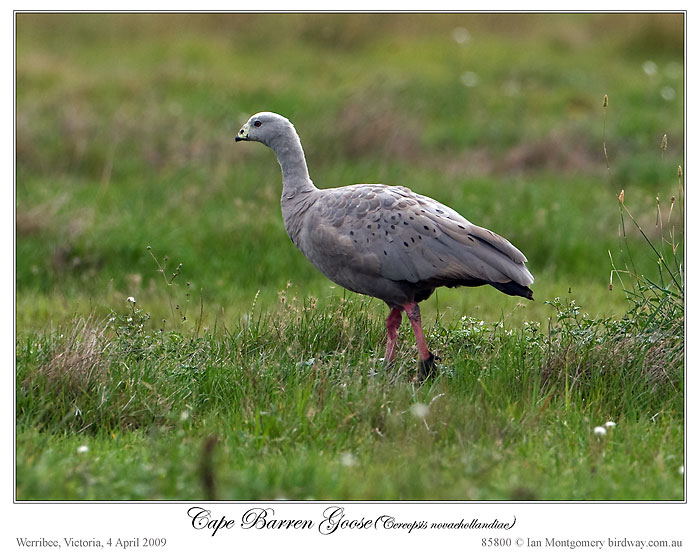
Cape Barren Goose (Cereopsis novaehollandiae) by Ian

Cape Barren Goose (Cereopsis novaehollandiae) by Ian

Ian’s Bird of the Week – Cape Barren Goose ~ by Ian Montgomery

Newsletter 08-14-10

Here’s one, the Cape Barren Goose, from the other end of Australia for a change, taken last year at the euphemistically named Western Treatment Plant at Werribee southwest of Melbourne.

It’s a large goose, to 100cm/40in in length with drooping wing feathers when standing, giving it a slightly 19th Century bustle. It has a large greenish-yellow cere and red legs with black feet. Its range includes Northern Tasmania, the islands of Bass Strait and the south coast of Australia from Victoria in the east to islands near Albany in Western Australia. It’s not particularly common with a population estimated at about 17,000 but the population is stable and it has been introduced to a number of places including Kangaroo Island in South Australia and New Zealand.

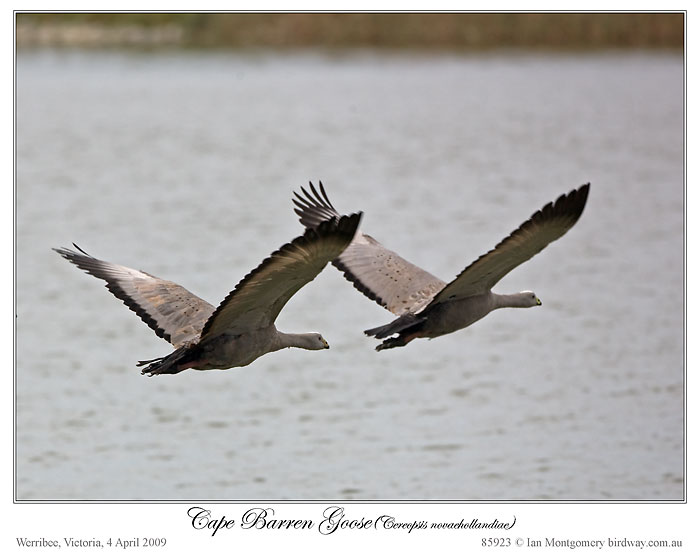
Cape Barren Goose (Cereopsis novaehollandiae) by Ian

Cape Barren Goose (Cereopsis novaehollandiae) by Ian

The birds are grazers and feed on grasslands and cultivated pastures. They are wary, and when they take flight they fly strongly, as in the second photo.

The Birds Australia Congress starts in Townsville this evening and the Campout starts next Monday. So, if you’re attending I’ll look forward to catching up with you. In the meantime, in haste, I haven’t updated Ian’s Picks on the website but will do so when I get a moment and will let you know.

Link: http://www.birdway.com.au/anatidae/cape_barren_goose/index.htm

Best wishes,
Ian


Ian Montgomery, Birdway Pty Ltd,
454 Forestry Road, Bluewater, Qld 4818
Phone: +61-7 4751 3115
Preferred Email: ian@birdway.com.au
Website: http://birdway.com.au


Lee’s Addition:

Looks like Ian is off on another one of his adventures down there in Australia. The Cape Barren Goose is in the Anatidae Family along with Ducks, Teals, Shelducks, Mergansers, Geese, Swans and their allies and are part of the  Anseriformes Order.

And to every beast of the earth and to every bird of the heavens and to everything that creeps on the earth, everything that has the breath of life, I have given every green plant for food.” And it was so. And God saw everything that he had made, and behold, it was very good. And there was evening and there was morning, the sixth day. (Genesis 1:30-31)

*

Ian’s Bird of the Week – Banded Lapwing

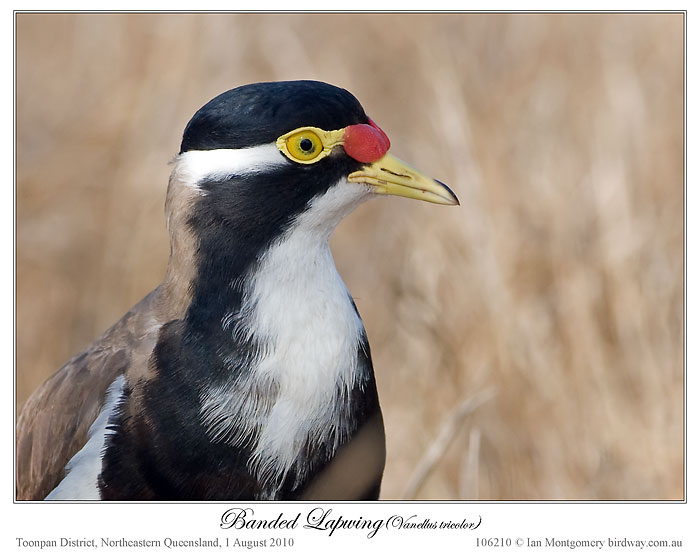
Banded Lapwing (Vanellus tricolor) by Ian

Banded Lapwing (Vanellus tricolor) by Ian

Ian’s Bird of the Week – Banded Lapwing ~ by Ian Montgomery

Newsletter – 08-05-10

Banded Lapwing (Vanellus tricolor) by Ian

Banded Lapwing (Vanellus tricolor) by Ian

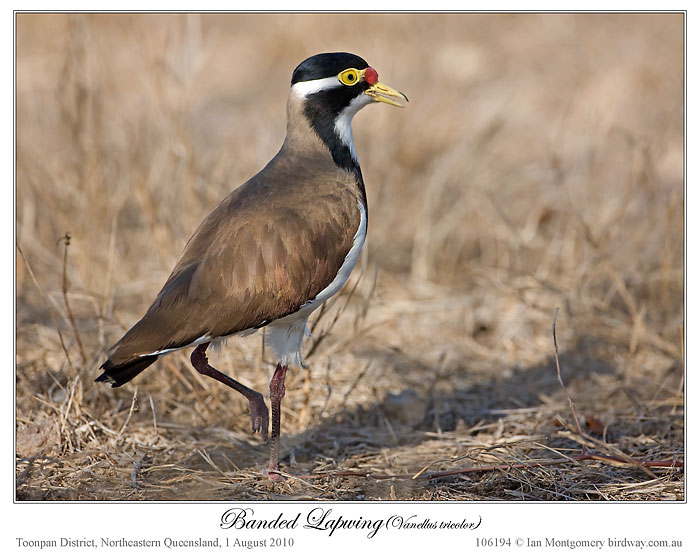
There are two species of Lapwing in Australia. One, the Masked Lapwing, is widespread, common and well-known throughout northern and eastern Australia and Tasmania. It’s familiar because it is at home in populated areas, large, aggressive when nesting, and always noisy when disturbed, even at night, a real larrikin, to use an Australian expression. The other, the Banded Lapwing is the opposite. It’s smaller, quieter, uncommon, not well-known and wary, occurs in drier country away from people, and altogether much more dignified.

Banded Lapwing (Vanellus tricolor) by Ian

Banded Lapwing (Vanellus tricolor) by Ian

It occurs mainly west of the Great Divide and south of the Tropic of the Capricorn, including Tasmania, though there is a small resident population in the dry, cattle-grazing country south of Townsville, north of its usual range. A friend of mine took me there last Sunday so that I could take some photos. Previously, I’d seen them only in Victoria and Western Australia.

Masked Lapwings have large, pendulous, yellow, facial wattles that make them look rather ridiculous, but larrikins don’t worry about appearances. Banded Lapwings have small discreet red wattles, that combine tastefully with the yellow eyes and bills and black, white and tan plumage; presumably the scientific name tricolor refers only to the plumage. The birds – we found about ten – allowed close approach in the car and eventually seemed to get quite used to my presence, though the curious cattle came over too and got in the way a lot.

Banded Lapwing (Vanellus tricolor) by Ian

Banded Lapwing (Vanellus tricolor) by Ian

I concentrated on a group of 5 birds, one of which was a juvenile – the third photo – so the birds had bred recently. Juveniles have small, pale wattles and camouflaged plumage. One pair of adults came quite close to the car and eventually mated. Banded Lapwings are supposedly monogamous and I wondered whether this pair were the parents of the juvenile bird.

Lapwings form a sub-family within the Plover family and there are about 25 species world-wide in every continent except North and Central America. I’ve chose a pair of Yellow-wattled Lapwings – from India as the current Old World pick for comparison. This pair is also mating, so either Lapwings like doing it in public or I like photographing them doing it: the choice is yours.

Other current picks include:
Australia: Red-capped Robin
New World: Blue-footed Booby
Other Wildlife: Koala

Links:
Masked Lapwing
Banded Lapwing

I recently spent a night at a Bed and Breakfast place in Alligator Creek recently opened by friends of mine, Colin and Helen Holmes. Alligator Creek is about 25km south of Townsville and close to the Mount Elliott section of Bowling Green Bay National Park. Their house is set in several acres of land with plenty of trees and shrubs right on the Creek. It’s a delightful place and very comfortable and you’ll be well looked after and supplied with a lavish breakfast. I can recommend it highly, so if you’re looking for somewhere friendly and peaceful to stay near Townsville check out their website: http://www.alligatorcreekbedandbreakfast.com.au/ .

Best wishes,
Ian

Ian Montgomery, Birdway Pty Ltd,
454 Forestry Road, Bluewater, Qld 4818
Phone: +61-7 4751 3115
Preferred Email: ian@birdway.com.au
Website: http://birdway.com.au


Lee’s Addition:

The Banded Lapwing is part of the Charadriidae  Family which includes not only Lapwings but also Plovers, Dotterels and a Wrybill. There are 67 species in the family. They are in the Charadriiformes Order which has 19 families.

The Lapwing is one of the Birds of the Bible. See the Lapwing page.

And the stork, the heron after her kind, and the lapwing, and the bat. (Lev 11:19 KJV)

See all of Ian’s Birds of the Week

*

Ian’s Bird of the Week – Red-necked Stint

Red-necked Stint (Calidris ruficollis) by Ian

Red-necked Stint (Calidris ruficollis) by Ian

Ian’s Bird of the Week – Red-necked Stint ~ by Ian Montgomery

Newsletter – 04-01-09

This time of the year, almost anywhere in the world, is a good time to go looking for waders. Not only does the (northern) Spring migration mean that unusual species can turn up, but many of these migrants are acquiring their breeding plumages. So, if you’ve ever been faced with the daunting challenge of identifying waders in their drab winter plumage, you could be in for some pleasant surprises.

Red-necked Stint (Calidris ruficollis) by Ian in breeding and non-breeding plumage

Red-necked Stint (Calidris ruficollis) by Ian in breeding and non-breeding plumage

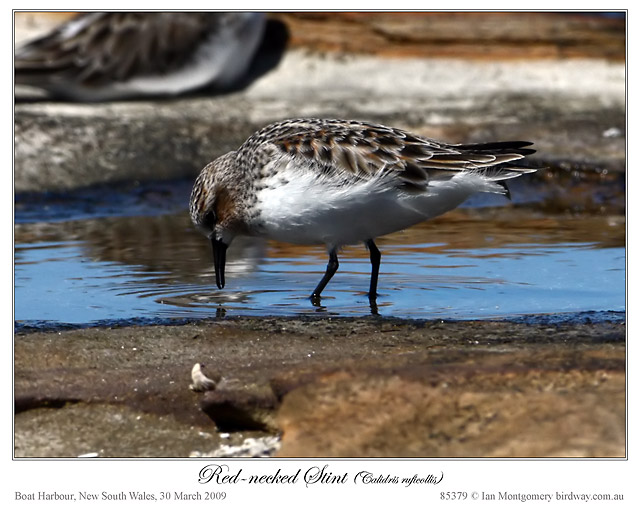
A case in point is the Red-necked Stint, a common non-breeding visitor to Australia, where the plumage is normally anything but red. The bird in the photo is in partial, or ‘pre-breeding’, plumage with the delicate
pinkish-chestnut face and breast and the black and chestnut wing coverts. A dapper little bird by any standards, I think.

‘Little’ is the operative word. Stints – there are 4 species – are the world’s smallest waders and the Red-necked Stint with a length of 13 – 16 cm/5 – 6.3″ is slightly smaller than a House Sparrow (14 – 16 cm). Size doesn’t stop it being one of the champions of migration, breeding in the Arctic tundra of Siberia and northern Alaska and spending the northern winter in Australasia and as far as south as sub-Antarctic islands.

At this time of the year, the birds are feeding madly, building up their fat reserves for the long trip. Apparently, they can lose half of their body weight during the migration.

The sharp-eyed among you will have noticed that the photo was taken at Boat Harbour during a brief visit to the Sydney region earlier this week. It’s tax time and I went to Boat Harbour after a meeting with my accountant in nearby Sutherland. To my friends in Sydney I extend an apology that I didn’t have time to catch up with them.

Best wishes,
Ian

Ian Montgomery, Birdway Pty Ltd,
454 Forestry Road, Bluewater, Qld 4818
Phone: +61-7 4751 3115
Preferred Email: ian@birdway.com.au
Website: http://birdway.com.au


Lee’s Addition:

Storks, doves, swallows, and thrushes all know when it’s time to fly away for the winter and when to come back… (Jer 8:7)

This is one of the catch-up newsletters I am finally finding time to do. Will be releasing several more of these in the next little bit. Finally have some time to work on them. See Ian’s Bird of the Week list to see  Ian’s articles. He will continue to do his current ones also.

The Stint mentioned was getting ready for spring migration, but of course this time of the year, they start preparing for their fall migration. I also went to Ian’s Birdway and found an extra photo. The Stint is in the Scolopacidae Family of Sandpipers and Snipes. The Scolopacidaes are in the Charadriiformes Order which has 19 families.

*

Ian’s Bird of the Week – Red-necked Stint

Ian’s Bird of the Week – White-breasted Woodswallow

White-breasted Woodswallow (Artamus leucorynchus) by Ian

Ian’s Bird of the Week – White-breasted Woodswallow ~ by Ian Montgomery

Newsletter ~ 07-28-10

White-breasted Woodswallow (Artamus leucorynchus) by Ian

White-breasted Woodswallow (Artamus leucorynchus) by Ian

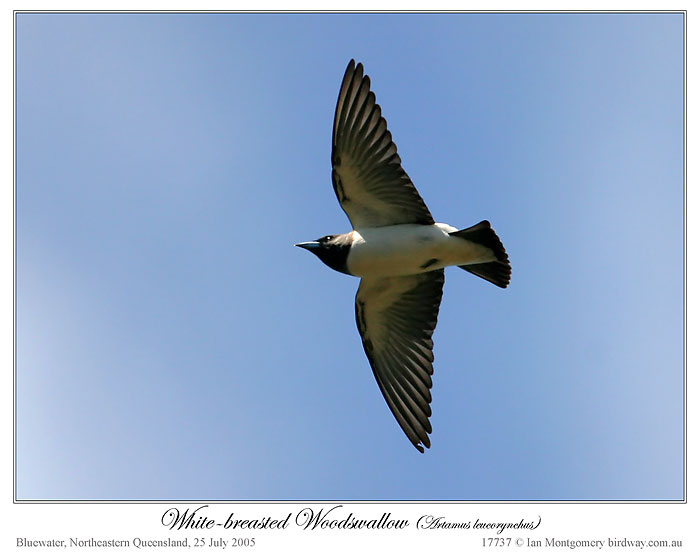
Some species are a source of continual pleasure even when they are very common, such as the White-breasted Woodswallow, which is to be seen daily in Northeastern Queensland, perching conspicuously on power-lines or trees and chasing insects, swallow-like, in small flocks. They are attractive birds, fun to watch and courageous, frequently mobbing raptors.

White-breasted Woodswallow (Artamus leucorynchus) by Ian

White-breasted Woodswallows “hanging out” by Ian

Woodswallows get their name from a superficial similarity to true swallows, though in flight they are stockier and lack forked tails as in the second photo. They aren’t related to swallows and form a family, the Artamidae, with the larger more crow-like Australian Magpie, Butcherbirds and Currawongs. The White-breasted Woodswallow is widespread through eastern and northern Australia and is resident in northern coastal areas but migratory or nomadic in other parts of its range.

They are sociable birds, as can be seen in the third photo, and often roost together in large numbers. The fourth photo shows a roost on power-lines near a set of traffic lights on a busy Townsville intersection. When I took the photo, at dusk, about 200 birds were present and the one looking down towards the camera had just elbowed its way into the middle of the row after landing on birds already in place.

White-breasted Woodswallow (Artamus leucorynchus) by Ian

White-breasted Woodswallow “Squeezed in” by Ian

Back at the website, the ‘Current Picks’ (Australian, New World, Old World and Other Wildlife) are:
Shy Albatross
Purple Honeycreeper
Razorbill
and Platypus

I’ve reformatted the Image Purchases page and published a scale of prices for digital images for the conservation- and/or education-related projects that account for most of the Birdway business: http://www.birdway.com.au/printpurchases.htm

Best wishes,
Ian

Ian Montgomery, Birdway Pty Ltd,
454 Forestry Road, Bluewater, Qld 4818
Phone: +61-7 4751 3115
Preferred Email: ian@birdway.com.au
Website: http://birdway.com.au


Lee’s Addition:

Love that last photo, Ian! Can they breathe?  :)

As Ian said, the Woodswallows belong to the Artamidae Family. There are 11 members and they live mainly in Australia and New Zealand. They are part of the Passeriformes Order and “they are among the very few passerines birds that soar, and can often be seen feeding just above the treetops.”

“The woodswallows have an Australasian distribution, with most species occurring in Australia and New Guinea. The Ashy Woodswallow has an exclusively Asian distribution, ranging from India and Sri Lanka through South East Asia to China, and the most widespread species is the White-breasted Woodswallow, which ranges from Peninsular Malaysia through to Australia in the south and Vanuatu and New Caledonia. The group reaches the easternmost extent of its distribution in Fiji with the endemic Fiji Woodswallow.” (Wikipedia)

Even the sparrow has found a home, And the swallow a nest for herself, Where she may lay her young— Even Your altars, O LORD of hosts, My King and my God. (Psalms 84:3 NKJV)

See:

Ian’s Birds of the Week

*

Ian’s Bird of the Week – Eastern Spinebill

Eastern Spinebill (Acanthorhynchus tenuirostris) male by Ian

Eastern Spinebill (Acanthorhynchus tenuirostris) male by Ian

Ian’s Bird of the Week – Eastern Spinebill by Ian Montgomery

Newsletter 07-21-10

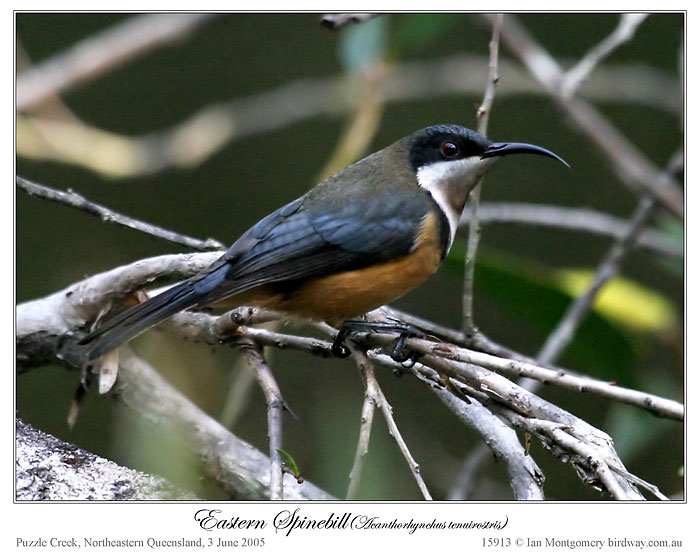
The Spinebills, Eastern and Western, are in my opinion the most elegant of the Honeyeaters so here is the Eastern Spinebill – I haven’t yet managed to photograph the Western Spinebill of SW Western Australia – with the winning combination of tasteful colours and long, fine, curved bill. The bill is adapted to probing for nectar in the flowers of Bottlebrushes, as in the first photo, or Grevilleas and they also feed on insects.

Eastern Spinebill (Acanthorhynchus tenuirostris) female by Ian

Eastern Spinebill (Acanthorhynchus tenuirostris) female by Ian

Males and females are subtly different as the male has a black crown with a sharp transition to the rufous nape while the female has a greyish crown with a gradual transition to the rufous nape. The bird in the first photo is a male, while the one in the second, coming down to drink in a creek, is a female.

Both these birds were photographed in the highlands around Paluma, not far from Townsville. The Eastern Spinebill is found in Tasmania and coastal southeastern and eastern Australia from the Mount Lofty Ranges in South Australia to Fraser Island in SE Queensland and there is an isolated population in the highlands of northeastern Queensland from Eungella near Mackay to Cooktown north of Cairns. This is perhaps a separate race, named cairnsensis.

I am keen to get feedback on recent changes to the website from visitors with slower, e.g. dial-up, connections. The inclusion of thumbnails to all the 142 bird families represented in the site means that the homepage – http://birdway.com.au/index.htm – has a lot of stuff on it to download. If you have found this a problem, please let me know ian@birdway.com.au as I can easily move the ‘Instant Guide to Bird Families’ to a separate page. This would make the homepage faster and make viewing all the thumbnails optional with a link from the homepage.

Best wishes,
Ian

Ian Montgomery, Birdway Pty Ltd,
454 Forestry Road, Bluewater, Qld 4818
Phone: +61-7 4751 3115
Preferred Email: ian@birdway.com.au
Website: http://birdway.com.au


Lee’s Addition:

I don’t know about going to Ian’s site with a slow connection, but I sure do enjoy his new layout. I can jump right to the family I am looking for. I really appreciate your hard work on the front page, Ian. Click to see more of Ian’s photos of Eastern Spinebills.

Spinebills are in the Meliphagidae – Honeyeaters Family which 182 species and is in the Passeriformes Order.

13–16 cm (5–6 in) long, the male Eastern Spinebill has a long thin downcurved black bill with a black head, white throat with a reddish patch and red iris. It has a brownish-red nape, a grey brown back and pale cinnamon underparts. The dark tail is tipped with white laterally. Females and juveniles are smaller and duller. The call is a rapid piping.

The Eastern Spinebill feeds on nectar from many plants, including the blooms of gum trees, mistletoes Amyema spp., Epacris longiflora, Epacris impressa(common heath), Correa reflexa, and various members of the Proteaceae such as Banksia ericifolia, Banksia integrifolia, Lambertia formosa and Grevillea speciosa, as well as small insects and other invertebrates. A 1982 study in the New England National Park in North-eastern New South Wales found that there was a large influx of birds coinciding with the start of flowering of Banksia spinulosa there. They have been known to feed from exotic plants such as Fuchsias.

My son, eat honey because it is good, And the honeycomb which is sweet to your taste; So shall the knowledge of wisdom be to your soul; If you have found it, there is a prospect, And your hope will not be cut off. (Proverbs 24:13-14 NKJV)

Ian’s Bird of the Week – Magpie Goose

Magpie Goose (Anseranas semipalmata) by Ian

Magpie Goose (Anseranas semipalmata) by Ian

Ian’s Bird of the Week – Magpie Goose by Ian Montgomery

Newsletter 7-14-10

Here’s another large species characteristic of northern Australia, particular northern Queensland and the top-end of the Northern Territory, that had so far avoided the Bird of the Week net. It is found in quite large numbers around Townsville in wetland such as the Town Common, where the first photo was taken, and grazing in the stubble left after harvesting sugar cane. It’s a sedentary species and nests here in the wet season during the first four months of the year.

Magpie Goose (Anseranas semipalmata) by Ian

Magpie Goose (Anseranas semipalmata) by Ian

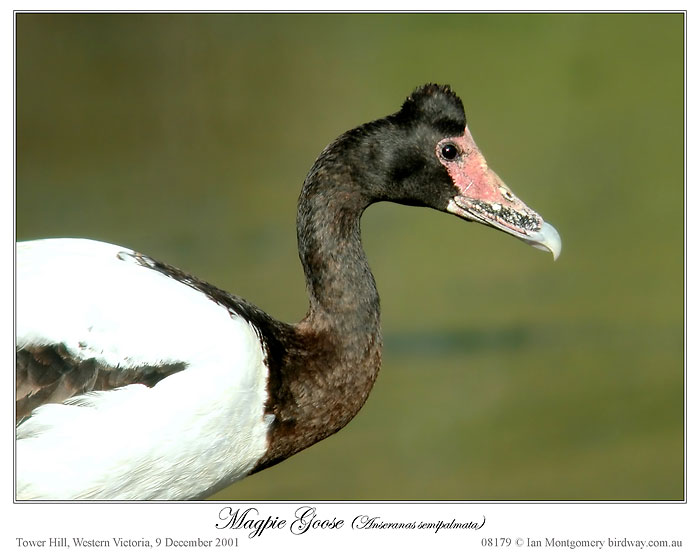
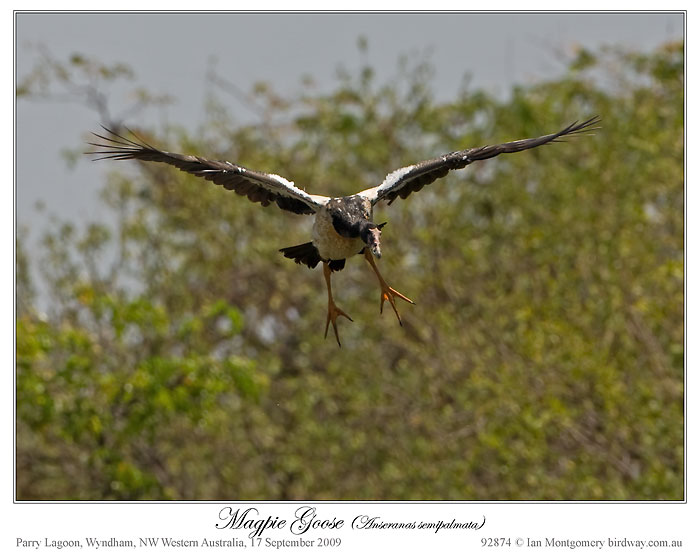
They have a pre-historic look about them and have some unusual features for a goose, or more correctly, goose-like bird. Not only the knobbed head, larger in males like the bird in the foreground in the first photo, but also the hooked beak. Both these features are more visible in the second photo. The third photo of the bird landing shows yet another oddity: the feet are only partially webbed and hence the specific name of semipalmata.

You’d be right in deducing that the Magpie Goose is only distantly related to other ducks and geese (family Anatidae) and is in fact the sole surviving member of a different lineage the family Anserantidae. These two families, along with another odd lineage the three species of Screamer in South America (Anhimidae), comprise the waterfowl order, the Anseriformes.

Magpie Goose (Anseranas semipalmata) by Ian

Magpie Goose (Anseranas semipalmata) by Ian

Magpie Geese were once common and widespread throughout northern, eastern and southeastern Australia but were hunted to extinction in the southeast and occur naturally now only from Broome in northern Western Australia to about Brisbane in southeast Queensland. Following reintroduction it is now getting re-established in some parts of New South Wales such as the Hunter Valley and of Victoria. The second photo was taken at Tower Hill in Western Victoria. It also occurs in southern PNG.

Best wishes,
Ian

Links:
Magpie Goose
Anatidae
Recent Additions (to 14 species)
Ian’s Picks:
Australian (a different Pitta)
New World (it only looks like a Glossy Ibis)
Old World (just in case you dismiss starlings)
Other Wildlife (this one isn’t red)

Ian Montgomery, Birdway Pty Ltd,
454 Forestry Road, Bluewater, Qld 4818
Phone: +61-7 4751 3115
Preferred Email: ian@birdway.com.au
Website: http://birdway.com.au


Lee’s Addition:

The three families Ian mentioned above are the Anhimidae – Screamers, the Anseranitidae – Magpie Goose and the Anatidae – Ducks, Geese & Swans. These are all in the Anseriformes Order

Geese are not mentioned by name in the Bible, but watching out for their eggs and hatchlings are mentioned:

If a bird’s nest chance to be before thee in the way in any tree, or on the ground, whether they be young ones, or eggs, and the dam sitting upon the young, or upon the eggs, thou shalt not take the dam with the young: But thou shalt in any wise let the dam go, and take the young to thee; that it may be well with thee, and that thou mayest prolong thy days.
(Deuteronomy 22:6-7 KJV)

*

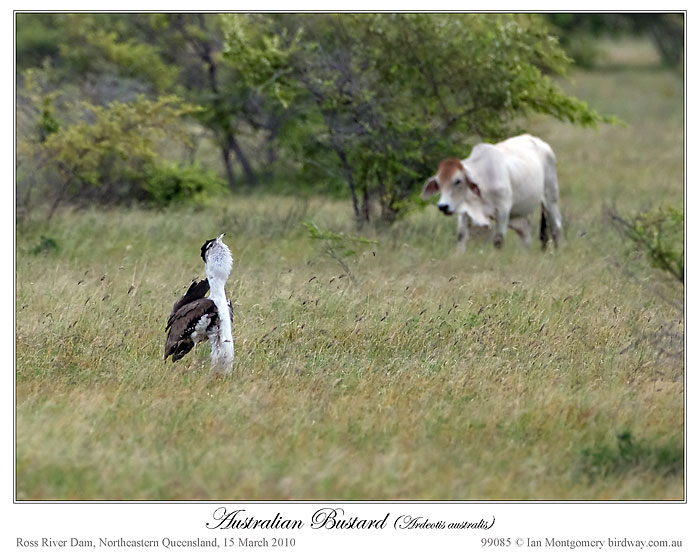
Ian’s Bird of the Week – Australian Bustard

Australian Bustard (Ardeotis australis) by Ian

Australian Bustard (Ardeotis australis) by Ian

I’ve been slow to produce the bird of the week this week as, not having taken many photos recently, I had trouble choosing a suitable candidate. In the end, I did what I have been meaning to do for ages and extended my bird database to include records of all the birds of the week. Now I can easily see what I’ve missed and I’ve found many surprising omissions, including the Australian Bustard. Surprising because it’s a spectacular bird, one of my favourite, fairly easy to find around Townsville and one that I’d never seen before I moved up here in 2002.

Australian Bustard (Ardeotis australis) by Ian

Australian Bustard (Ardeotis australis) by Ian

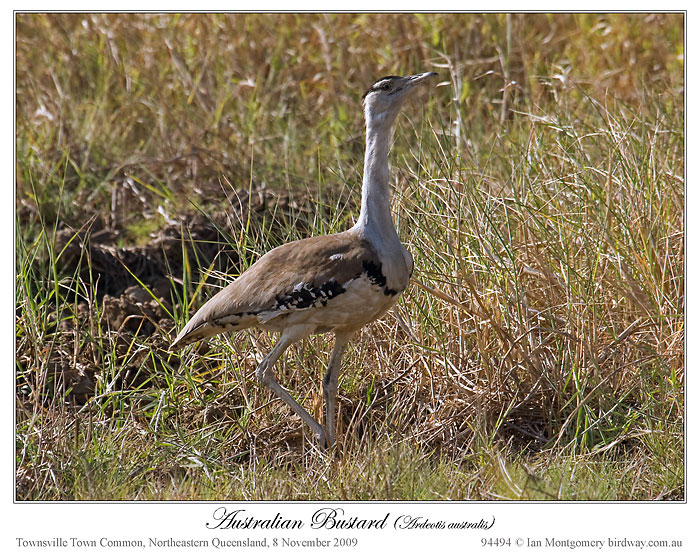
The first photo, taken at the Townsville Town Common, shows a bird in a typical pose, bill held high and looking very dignified. Graham Pizzey uses the appropriate adjectives ‘lordly’ and ‘stately’. When disturbed they walk away at a steady pace, and take flight reluctantly, not surprising given their size and weight: the larger males average 120cm/48in in length and 8kg/18lbs in weight. When airborne, they fly strongly and look unstoppable, like the one in the second photo taken at Toonpan at the southern end of Ross River Dam near Townsville.

The land around the dam provides good, undisturbed bustard habitat and it is possible to see as many as 30 Bustards together, both at Toonpan and near the dam wall itself. The third photo, taken near the dam wall, shows a male displaying to the understandable astonishment of an unsuspecting cow. The display is quite extraordinary, with the bird extending the breast sac to the ground, drooping the wings, holding the tail erect against the back of the neck and puffing out the feathers of the neck. The bird walks slowly around making the sac swing, and, for a final touch, makes a roaring sound.

Australian Bustard (Ardeotis australis) by Ian

Australian Bustard (Ardeotis australis) by Ian

Bustards, apparently, make very good eating, reflected in the common name ‘Plains-Turkey’. So, worldwide (there are about 25 species) they have suffered seriously from hunting, loss of habitat and land use changes. The Australian Bustard is now rare in or absent from settled areas but still holds on in more remote areas. Most of the 25 or so species are smaller African ones, but there are 5 large species including the Great Bustard of Eurasia, the Arabian, the Kori Bustard of Africa and the endangered Great Indian Bustard. The latter two are closely related to the Australian Bustard and the three have in the past been treated as a single species.

On the website, I’ve finished updating the family thumbnail pages, so all now have the same format, the common background colours to distinguish regional thumbnails (Australian, New World, Old World), and labeled previous and next family buttons in the regional as well as the global pages. On the home page, I’ve added 4 ‘Ian’s Picks’ (Australian, New World, Old World and Other Wildlife) to share interesting photos which will be changed regularly. Currently, they are:

Red-tailed Tropicbird
Western Meadowlark
Buffy Fish-Owl
Black Flying-fox

Best wishes,
Ian

Other links:
Australian Bustard
Kori Bustard

Ian Montgomery, Birdway Pty Ltd,
454 Forestry Road, Bluewater, Qld 4818
Phone: +61-7 4751 3115
Preferred Email: ian@birdway.com.au
Website: http://birdway.com.au


Lee’s Addition:

The Australian Bustard is in the Otididae Family which has 27 members and they are the only family in the Otidiformes Order. The family includes Bustards, 7 Korhaans and 2 Floricans. The Bustards like to “move with a slow, deliberate, sedate walk, holding their head high and gently rocking backward and forward.” (National Geographic) After watching several videos of the different species, that is a very good description.

Nothing wrong with being stately or having a good bearing, but we should never act proud or think we are better than others. These birds are behaving the way the Lord created them to act and part of their behavior is to attract a mate.

For all that is in the world, the lust of the flesh, and the lust of the eyes, and the pride of life, is not of the Father, but is of the world. (1 John 2:16 KJV)

Keith has a video of two Australian Bustards walking.

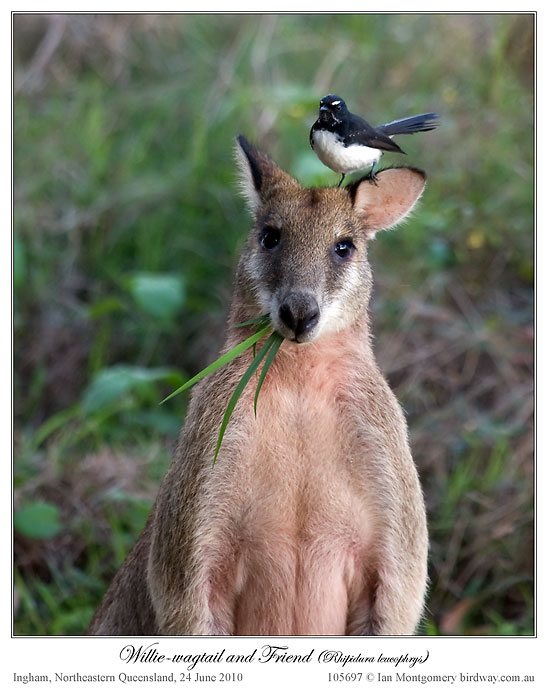
Ian’s Bird of the Week – Willie Wagtail

Willie Wagtail (Rhipidura leucophrys) on Wallaby by Ian Montgomery

Willie Wagtail (Rhipidura leucophrys) on Wallaby by Ian

Ian’s Bird of the Week – Willie Wagtail ~ Ian Montgomery

Newsletter – 06-30-10

Very common birds like Willie-wagtails often get overlooked in the Bird of the Week in the pursuit of the rare and exotic. It takes the unusual antics of a particular individual to get noticed, such as this Willie-wagtail, perched cheekily on the head of an Agile Wallaby at Tyto Wetlands near Ingham last week.

Perhaps ‘unusual’ isn’t strictly true, as Graham Pizzey’s Field Guide to the Birds of Australia describes the behaviour of this species as: ‘bold, perky; watches from low branches, fence-posts … backs of farm-animals’. The wallaby might be offended at being described as a mere farm-animal, though this one seems to be doing its best to imitate a country yokel by chewing grass and assuming a dopey expression.

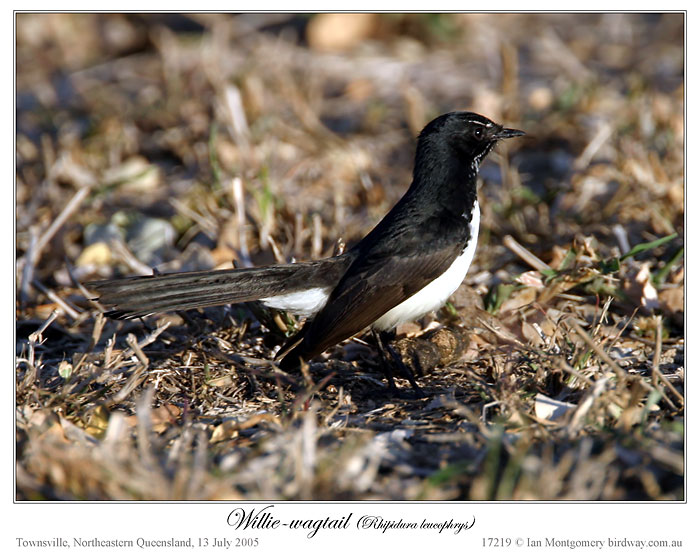
Willie Wagtail (Rhipidura leucophrys) on Wallaby by Ian Montgomery

Willie Wagtail (Rhipidura leucophrys) on Wallaby by Ian

The Willie-wagtail is a popular and widespread species, occurring in a very wide range of habitats throughout Australia. It is absent from southern Tasmania and, for reasons not understood, curiously uncommon in the Townsville district, where the second photo was taken. It gets its name from its habit of fanning its tail and swinging it from side to side, (and spreading its wings) apparently to disturb the insects on which it feeds.

Back at the website, I’m continuing the task of updating all the family thumbnail pages. I’ve finished the first 100 families with only about 40 of the Passerine (perching bird) families to complete. Along the way, I’ve also added some new photos including ones of the following species:

Tawny Frogmouth
Burrowing Owl
Dollarbird
Red-backed Kingfisher
Yellow-billed Kingfisher

Best wishes,
Ian

Ian Montgomery, Birdway Pty Ltd,
454 Forestry Road, Bluewater, Qld 4818
Phone: +61-7 4751 3115
Preferred Email: ian@birdway.com.au
Website: http://birdway.com.au


Lee’s Addition:

I see Ian has a nice sense of humor. Love his description of the Wallaby. Neat little bird, thanks, Ian, for another great Bird of the Week.

Ian mentioned the birds as being “bold, perky; watches.” That brought to mind a few verses:

In the day when I cried out, You answered me, And made me bold with strength in my soul. (Psalms 138:3 NKJV)
The wicked flee when no one pursues, But the righteous are bold as a lion. (Proverbs 28:1 NKJV)
The eyes of the LORD are in every place, Keeping watch on the evil and the good. (Proverbs 15:3 NKJV)
Watch, stand fast in the faith, be brave, be strong. (1 Corinthians 16:13 NKJV)

The Wagtail is in the Rhipiduridae Family which includes all the Fantails, one Wagtail and one Silktail. The Order is the Passeriformes.

Below is a video of a Willie Wagtail on a rock, calling and waging tail, by Nick Talbot.

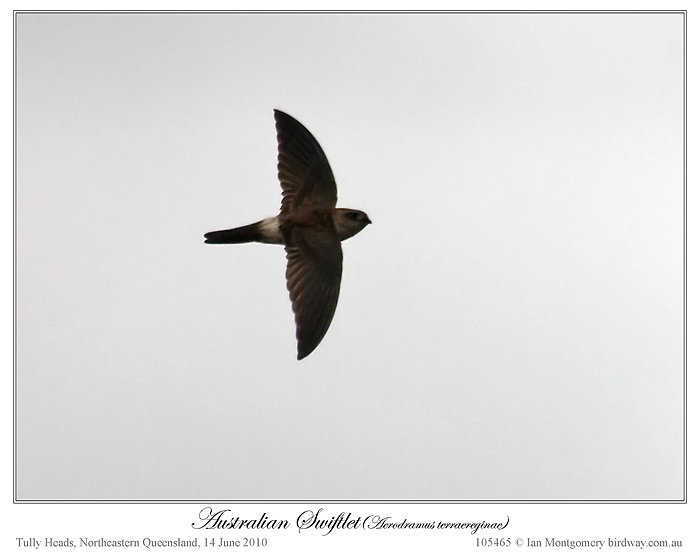
Ian’s Bird of the Week – White-rumped/Australian Swiftlet

White-rumped Swiftlet (Aerodramus spodiopygius) by Ian Montgomery

White-rumped Swiftlet (Aerodramus spodiopygius) by Ian

Ian’s Bird of the Week – White-rumped/Australian Swiftlet ~ by Ian Montgomery

Newsletter ~ 6-22-10

Swifts, true to their name, are a challenge to photograph but these White-rumped/Australian Swiftlets (more about names later) were feeding low over of a group of smallish trees, which helped.

These tiny birds (11-12cm/4.3-4.7in in length) are resident in Australia unlike their larger cousins, the Fork-tailed Swift and White-throated Needletail, and usually remain fairly close to their breeding caves. They are reasonably common in their restricted range of coastal northeastern Australia from the far north of New South Wales to Cape York in northern Queensland. Their sedentary nature is reflected in the existence of a paler race in the Chillagoe region of northeastern Queensland, only 130 km from the coast as the swift flies and much closer to the Atherton Tableland, where the nominate race is found.

Some species of swiftlet, including this one, use echo-location like bats to find their way around in caves, emitting a metallic clicking noise. There are about 26 species of swiftlet in Asia and Oceania, but only some if these echo-locate. Originally, they were (nearly) all put in the same genus Collocalia but in 1970, those species that use echo-location were moved to a separate genus Aerodramus. The White-rumped Swiftlet, Collocalia spodiopygius, was renamed Aerodramus spodiopygius.

White-rumped Swiftlet (Aerodramus spodiopygius) by Ian Montgomery

White-rumped Swiftlet (Aerodramus spodiopygius) by Ian

This was the start of a bumpy ride in the naming of these Australian swiftlets, which were then considered the same species as similar birds found in Micronesia and Polynesia. Recent DNA analysis supported the split into Aerodramus, but also suggested that the Australian birds (races terraereginae and chillagoensis) were sufficiently different to be treated as a separate species. Christidis and Boles (2008) support this recognition of the Australian Swiftlet, now named Aerodramus terraereginae. Meanwhile, Birdlife International has adopted neither the original split of Collocalia nor the recognition of the new species. So, we now have the confusion situation where both the English and Scientific names differ. So you could have someone from Birdlife International birdwatching in Queensland and saying ‘there is a White-rumped Swiftlet, Collocalia spodiopygius’ to Les Christidis who might respond, ‘looks like an Australian Swiftlet, Aerodramus terraereginae, to me!’.

And while we’re at it, terraereginae isn’t such a great name anyway, as It, whatever ‘It’ is, also occurs in northern New South Wales. Let me quote from an article in Wikipedia discussing the strengths of Linnaean taxonomy: ‘it can be used to organize the different kinds of living organisms, simply and practically. Every species can be given a unique (and hopefully stable) name, as compared with common names that are often neither unique nor consistent from place to place and language to language’. Hmmmm.

Back at the website, I hope I’ve finally reformatted all the pages that were causing problems in early versions of Internet Explorer. If you come across any that I’ve missed, please let me know (gently). I’ve resumed updating the family index pages and species galleries.

Best wishes,
Ian

Links:
White-rumped Swiftlet
Fork-tailed Swift
White-throated Needletail

Ian Montgomery, Birdway Pty Ltd,
454 Forestry Road, Bluewater, Qld 4818
Phone: +61-7 4751 3115
Preferred Email: ian@birdway.com.au
Website: http://birdway.com.au


Lee’s Addition:

Ian is having the same problems I am trying to keep up with the renaming and splitting and lumping of species. Keeps you busy when you have a website. Anyway, it is always interesting to see what bird Ian is going to expose us to each week. Hope you enjoy his newsletters as well as I do.

Even the stork in the heavens Knows her appointed times; And the turtledove, the swift, and the swallow Observe the time of their coming. But My people do not know the judgment of the LORD. (Jeremiah 8:7 NKJV)

The White-rumped (ex-Australian) Swiftlet (Aerodramus spodiopygius) is in the Apodidae Family. The Swiftlets, Swifts, Spinetails, Needletails, and Palm Swifts make up the family.

The Apodiformes Order includes the Aegothelidaes (Owlet-nightjars), Hemiprocnidaes (Treesifts), Apodidaes (Swifts), and the Trochilidaes (Hummingbirds).

So then, my beloved brethren, let every man be swift to hear, slow to speak, slow to wrath; (James 1:19 NKJV)

*