In Psalm 84:3 the sparrows are mentioned again, this time they are found making a home (nest) in the Tabernacle area. As mentioned in the first Sparrow article, they are known to make nest in many kinds of places. Let’s look at this verse in its context to understand a great blessing found here.
Psalms 84:1-4 KJV
(1) How amiable are thy tabernacles, O LORD of hosts!
(2) My soul longeth, yea even fainteth for the courts of the LORD: my heart and my flesh crieth out for the living God.
(3) Yea, the sparrow hath found a house, and the swallow a nest for herself, where she may lay her young, even thine altars, O LORD of hosts, my King, and my God.
(4) Blessed are they that dwell in thy house: they will be still praising thee. Selah.
Vesper Sparrow
The commentaries have different views, but many agree that the sparrow has made her nest in the Tabernacle and is close to the altars. David’s soul is longing to be in the courts of the Lord and near the Lord. The sparrow is there, has moved in and is even raising her family there. I think he is envious of the birds because they get to spend so much time there and also they sing so often, praising God.
Do we yearn and long to spend time with the Lord, our Savior? Do we seek to be as close as we can get? Do we enjoy reading His Word, praying to Him, and attending church where we can learn, sing and praise, and have fellowship with other believers? I trust you can say a mighty, Amen!
Again we have a bird that is in a list of “unclean” birds. This time we will look at the Cuckoo. No. This is not the bird that pops out of your clock on the hour and sings. Let’s find out about the real Cuckoos.
And the owl, and the night hawk, and the cuckoo, and the hawk after his kind, (Deuteronomy 14:15 KJV)
And the owl, and the night hawk, and the cuckoo, and the hawk after his kind, (Leviticus 11:16 KJV)
Here in the U. S. we have a Black-billed, Common, Mangrove, Yellow-billed and Oriental, Cuckoos. The Common and Oriental Cuckoos have only been seen in Alaska. The Mangrove is seen along the mangroves of southern Florida and the other two like dense thickets, woodlands, orchards and along streams. Worldwide there are close to 100 species of Cuckoos. Our Roadrunner is the same family – cuculidae.
The cuckoos have a slender body with a downcurved bill and a long tail. Most of them have spots on the underside of their tails and the sexes are similiar. Many species of cuckoos have a habit of laying their eggs in another’s kind of bird’s nest and letting those parent raise the bird. The chick seems to hatch first and then either knock the other eggs out of the nest or harm the new chicks. Other cuckoos raise their own babies.
You-Tube of Cuckoo Sound with pictures and one showing warbler feeding baby. (from Poland)
(Updated 2/3/2009 – Video of Cuckoo laying egg in other nest and of a Cuckoo Duck
The Lapwing is only mentioned twice in scripture and both times in a list of “unclean” birds. “But these are they of which ye shall not eat,” says Deuteronomy 14:12.
And the stork, the heron after her kind, and the lapwing, and the bat. (Leviticus 11:19 KJV)
And the stork, and the heron after her kind, and the lapwing, and the bat. (Deuteronomy 14:18 KJV)
The only Lapwing in North America is the Northern Lapwing and then that has only been seen in isolated sightings. They are on the List of Birds of Florida. They are found in Europe and Asia near wetlands, coastal pastures and short-grass meadows or fields. They are in the same Order as Gulls, Terns and Plovers. In Europe there is also a Sociable Lapwing and a White-tailed Lapwing. “Most of the Lapwings seem to feed on insects and small prey from grasslands. They lay their eggs in nest on the ground and very protective of their young. They feign injury or will lead intruders away. If that doesn’t work, they are known to attack, even humans. They are medium sized about 12-13 inches with long legs. Their heads have a striking pattern with a wispy crest. Their behavior reminds me of a Killdeer.
Apparently the Lapwing was mentioned in three of Shakespeare’s plays: Comedy of Errors, Much Ado About Nothing and Measure for Measure
Most people are familiar with the Ostrich, but let’s find out some details about them. The Bible verses that refer to them, caused me to want to find out about them. For instance, in Job 39:13-18 KJV
(13)Gavest thou the goodly wings unto the peacocks? or wings and feathers unto the ostrich?
Here the wings of an ostrich are mentioned, but they are very small. Huh! It seems that those little wings help with balance when running, are used for mating rituals, to scare off predators, to control their temperature, and they help shelter the young (when they stick around). “The feathers were very popular for ornamentation in fashionable clothing (such as hats during the 19th century).” “The original South African ostrich feather dusters were invented in Johannesburg, South Africa by missionary, broom factory manager, Harry S. Beckner in 1903.”, Wikipedia
(14) Which leaveth her eggs in the earth, and warmeth them in dust,
The nest is made by the male who digs an indentation 12-24 inches deep and all his females lay the eggs in the communal nest (up to 60 eggs). The females share sitting on them in the daytime and the male sits at night. Females are a light color whereas the male has a black coloring. Creation at work.
(15) And forgetteth that the foot may crush them, or that the wild beast may break them.
They seem to desert the nest alot and then when they are there their foot can cause damage to the eggs. By the way, the eggs are the largest of the living birds and weigh as much as 2 dozen eggs (3 lbs).
(16) She is hardened against her young ones, as though they were not hers: her labor is in vain without fear; (17) Because God hath deprived her of wisdom, neither hath he imparted to her understanding.
Because not all the chicks in the nest are hers, she doesn’t seem too concerned even about her own. Maybe the Lord has spared her from fret by making her not too smart.
(18 ) What time she lifteth up herself on high, she scorneth the horse and his rider.
This was interesting in that ostriches have been clocked at 55 mph. They can run that fast in a spurt, but can maintain speeds of 30 mph which out lasts a horse. They stand up to 8 feet tall.
The Ostrich can also be found in Lam_4:3; Isa_13:21; Isa_34:13; and Isa_43:20.
In our study on the Birds of the Bible, it has been mentioned whether a bird is “clean” or “unclean.” As I have prepared the blogs, I have been considering why a bird is on the clean or unclean list. I had been saving this blog for later, but due to unexpected travel, I’ll do it now.
In Genesis 9:3 it is stated that “every moving thing that liveth shall be meat for you.” So, of course, the birds would be included in this as well. In Deuteronomy 14:11-20, a list of birds is given to signify which birds are unclean and not eaten; basically, all the rest can be consumed. But why are some birds unclean: Looking at the list, the eagle, ossifrage, kite, glede, vulture, and the hawk are known to eat dead animals (carrion). It would not be very healthy to eat them. The other birds on the list are all meat eaters, and maybe that has something to do with their being placed on the unclean list. Are the birds bad because of what they eat? No. Each one was created exactly for the purpose God intended. The carrion eaters help keep the land clean. Another passage mentions the list of unclean birds in Lev 11:13-20.
Some of the other birds on the list are a mystery to me. For instance the Cormorant, Swan, Pelican, Heron, and the Stork are birds I watch here in Florida, and they all seem to be fish eaters. One article mentions that the Heron used to be eaten, but they were fishy tasting and they stopped eating them. Why is it that no matter how many things we are given with only a few put off limits, that someone always has to try the few. Does that not sound like what happened in the garden of Eden when Eve just had to try the tree of knowledge of good and evil. When God puts something off-limits or says it is “unclean,” there is a good reason for it. Most times it is for our benefit because God loves us and doesn’t want us harmed. The “clean” birds mostly have a diet of grain, fruits, and vegetation. Could that be why they are okay to eat? With all the good birds available like chicken, turkey, quail, duck, etc., I’d much rather sit down to a Thanksgiving meal of turkey than vulture.
The birds used for the sacrifices were all clean birds.
Then the #1 reason to eat or not eat a bird according to the list is: AND GOD SAID
The Peacock is the male and the Peahen is the female in the pheasant family, Phasianidae (order Galliformes), that consists of the blue or Indian peacock and the green or Javanese peacock which is quite aggressive. More recently they discovered a Congo peacock. Peacocks and peahens are not native to North America, but are found in many zoos here.
The males have a body that is 35-50 inches with long tail feathers that are about 60 inches and “are coloured a brilliant metallic green. This train is mainly formed of the bird’s upper tail coverts, which are enormously elongated. Each feather is tipped with an iridescent eyespot that is ringed with blue and bronze. In courtship displays, the cock elevates his tail, which lies under the train, thus elevating the train and bringing it forward. At the climax of this display the tail feathers are vibrated, giving the feathers of the train a shimmering appearance and making a rustling sound. When he is courting, the male lifts his tail feathers up in a beautiful display to attract the female.” From Britannica Online, “Peacock”.
In Job 38, God started answering Job and began asking him questions about many things. By the time we get to Job 39:13, God asks:
Gavest thou the goodly wings unto the peacocks? or wings and feathers unto the ostrich? (Job 39:13 KJV)
When Solomon was the King of Israel, he was very wise and wealthy. One of the things he did was to start a navy of ships. It appears that they would go off and every three years come back with, among other things, peacocks.
For the king had at sea a navy of Tharshish with the navy of Hiram: once in three years came the navy of Tharshish, bringing gold, and silver, ivory, and apes, and peacocks. (1 Kings 10:22 KJV) For the king’s ships went to Tarshish with the servants of Huram: every three years once came the ships of Tarshish bringing gold, and silver, ivory, and apes, and peacocks. (2 Chronicles 9:21 KJV)
The peacock has been used as an ornamental bird for many centuries. The video below gives a view of his feathers spread out.
Gavest thou the goodly wings unto the peacocks? or wings and feathers unto the ostrich?
Making List of Your Birdwatching Adventures
Many people keep list of the things they see and hear while out birdwatching. There are several kinds of list you might want to consider starting.
Life List This is a list of all the birds species you have seen or heard. The sound of a bird you heard is acceptable in lists (if you can figure out what you heard or recorded.) It is good to get a date and location of the first sighting of each new bird.
Trip Lists
I also keep a birding list when I go birdwatching. If we go to Lake Hollingsworth or Merritt Island NWR, I keep a list of that outing. I list all the birds I see or hear at that place. Like the other lists given here, I put the date, location, weather condition (sunny, overcast, windy, etc) time and whatever else is important. Sort of like a combined list and field note. It is my way of doing it. I then enter each trips list at ebird.com. (I’ll explain that in another blog post.)
Keeping Field Notes
These are your impressions of the bird as you observe it. You could describe it in words, sketches, colored pens, etc. to help identify the bird later. When you are at home with your reference guides, these notes will help to figure out which bird you saw and nail the ID.Your first impression of the bird’s size, proportions, colors and markings, bills, leg color, what the bird is doing, song or sounds, and the habitat, plus a sketch can all be helpful later. Keeping a Bird-Watching Journal
The Journal differs from Field Notes in that it is less technical and more your impressions of the whole experience of watching the birds. Along with the date and location, you can detail the weather, the surroundings, what you think the bird is doing in more personal terms, how that makes you feel, etc. Keeping a Birds of the Bible List or Journal
Study to show thyself approved unto God, a workman that needeth not to be ashamed, rightly dividing the word of truth. (2 Timothy 2:15 KJV)
Do your best to present yourself to God as one approved, a worker who has no need to be ashamed, rightly handling the word of truth. (2 Timothy 2:15 ESV)
So, why not have a list or journal of the birds you come across as you read the Bible. All of us come across the name of a bird or general reference to birds. Put the name down and the reference and come back later and dig a little deeper.
How to dig deeper?
Read the context of the verse. How is it being used?
Is it just in a list or is it the object of a lesson?
What is that lesson and how does it apply to me?
Is the bird mentioned elsewhere in scripture? Use a concordance or Bible software like e-Sword.
Use Naves Topical Bible or similar help to find out about birds.
Look up the bird online and in Bird guides.
More ideas could be mentioned, but you be creative and do what helps and motivates you to find out more about the Birds of the Bible. Later, drop a comment or email and we can share your ideas on this.
Owls are an interesting species. Most of them are nocturnal, so we don’t see them very frequently. At least I don’t see them, but since I like to stay up late, I have heard them at night. Sometimes they are thought of as wise and drawings are made of them with glasses. Maybe that is because they have such huge eyes in respect to their head size. God has given them great ability to see at night with more rods than cones in their eyes that help gather light. They do not move their eyes up and down or side to side as we do, but instead move their head. No, they do not turn it all the way around. They can turn it 270 degrees though.
When owls fly, they are swift and silent as they hunt for prey, such as small animals and rodents. Their wings were designed to give them stealth. Their hearing is very sensitive and they can locate prey even if there is very low light. The sound of an owl can be “eerie” or of a “hoot” or “screech” sound.
There are at least 222 owl species worldwide.
There are 19 species here in the continental U.S.
The Elf Owl is the smallest in the world. It is 5.75 inches and likes the desert.
The Great Horned Owl is our largest in the US. It is 22 inches. They are also the only known predator of the Bald Eagle.
The little owl, owl, and big owl are mentioned in scripture.
The owls are in the “unclean” list. Lev 11:16-17, Deut 14:15-16
Here is an interesting quote from Wayne Blank’s Birds of the Bible. “Some insects and other creatures wear a disguise which actually frightens birds away. Most small birds are afraid of owls, and one insect has a clever way…the owl butterfly has large ‘eyes’ on its wings.”
The destruction of Babylon in Isaiah 13:19-22 mentions the owls that inhabit the deserted or wasted area. In comparing verse 21, it was interesting how the different Bible translations described them. Here are a few examples: “full of doleful creatures” (ASV); “hoot owls” (CEV); “ful of great Owles” (Bishops); “howling creatures” (ESV); the KJV, NASB, and NKJV all call them “owls”; and the MSG has “vacant houses with eerie night sounds.”
Other references to owls are found in Isaiah 34:11-13, Jeremiah 50:39, and Micah 1:8.
In Isaiah 43:20 the beast of the field, dragons, and owls honor the Lord because he has given water in the wilderness and rivers in the desert to provide drink for them. The next verse tells of his people giving praise. This brings to mind the hymn, Fairest Lord Jesus
Fairest Lord Jesus! Ruler of all nature!
O Thou of God and man the Son!
Thee will I cherish, Thee will I honor,
Thou, my soul’s glory, joy, and crown!
Fair are the meadows, Fairer still the woodlands,
Robed in the blooming garb of spring:
Jesus is fairer, Jesus is purer,
Who makes the woeful heart to sing.
Fair is the sunshine, Fairer still the moonlight,
And all the twinkling starry host:
Jesus shines brighter, Jesus shines purer,
Than all the angels heav’n can boast.
Beautiful Saviour! Lord of the nations!
Son of God and Son of Man!
Glory and honor, Praise, adoration,
Now and forevermore be Thine!
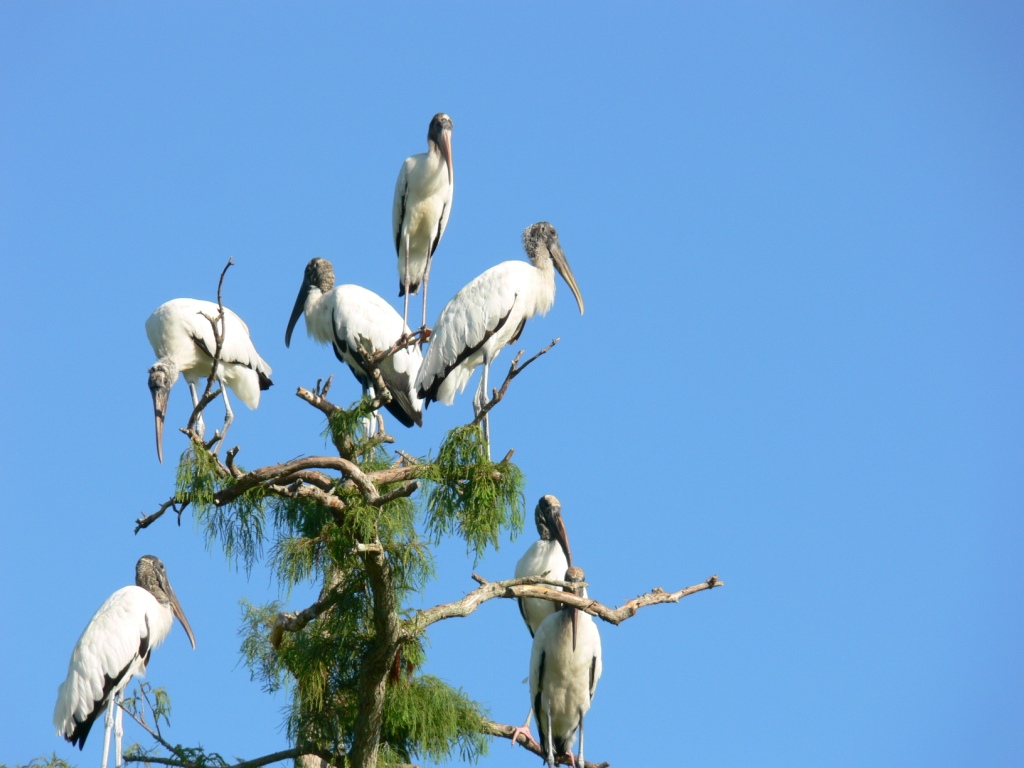
Many people think of babies being delivered when a Stork is mentioned. I am amazed when I watch the Wood Storks here in Florida. When they are on the ground, they are very unbecoming (aka-ugly), but when they are flying, it is so awesome to see the gracefulness of their flight and how beautiful their wings are.
The Wood Stork is a large bird (35”) that has huge long legs and a wing span of five and a half feet. It is the only stork that breeds here in the U.S. There are 19 species of storks worldwide. It has a long, thick, down-curved bill, and its head is black and un-feathered. The Stork is a wadder and raises its young in late winter in Florida during the dryer season. When the water is lower, the fish concentrate, and the Wood Stork and other birds can find an ample supply to feed their young. When they fly, they hold the neck extended. Pictures by my friend Reineir Munguia, (Professional Photographer) The stork is found in the list of unclean birds in Lev 11:19 and in Deu. 14:18
In Psalms the list is repeated with a comment here about the stork.
Where the birds make their nests; The stork has her home in the fir trees. Psa(104:17)
My picture of a Wood Stork in tree and Reinier’s much better one.
Jeremiah refers to the migration of birds and how they know when it’s time to leave. Here is an interesting quote from an article from Israel: The Bird’s Eye View By Sherri Mandell
Israel may be a small country, but thousands of birds annually take advantage of its passage-friendly flyway and the welcoming sanctuaries that dot the country.
The ancients considered Israel the center of the world, and it certainly feels that way if you look up at the sky in the spring and autumn. Half a billion migrating birds, more than 230 species, fly in Israeli air space on annual migrations between Europe, western Asia and Africa.
These journeys were noted long ago: “The stork in the heaven also knows her appointed times; and the turtledove, swift and the crane observe their time of coming” (Jeremiah 8:7).
“Tourists are sometimes afraid to visit here,” observes Alen Kasel, education director of the Jerusalem Bird Observatory, “but [the birds] never abandon us.”
Zechariah alludes to the “wings of a stork”.
Then I raised my eyes and looked, and there were two women, coming with the wind in their wings; for they had wings like the wings of a stork, and they lifted up the basket between earth and heaven. (Zec 5:9)
California Quail sometimes called California Partridge
Chukar Partridge (Alectoris chukar) by Ian
Partridges, which number 39, are part of the Phasiaidae family which has 155 species worldwide (only 16 in North America) that includes Chukar, Francolin, Quail, Pheasants, Junglefowl, Peafowl, and Peacocks. The Grouse and Wild Turkey are also related to them.
The Phasaidae family has a “chicken-like” appearance. These are medium-sized birds intermediate between the larger pheasants and the smaller quails.
The Partridges are native to Europe, Asia, North Africa, and the Middle East. They are ground-nesting seed-eaters. Their diet consists of mostly grains, fruits and some insects.
Many species are hunted for sport or game.
Eggs: from 5-20 in nests. “…20 or more often represents laying of more than one gray partridge hen in same nest; ring-necked pheasant also known to lay eggs in nest of gray partridge.” (The Audubon Encyclopedia of North American Birds, pg. 690) It appears some lay eggs, but get others to do the hatching.
The partridge is a “clean” bird.
The Partridge is only mentioned twice in Scripture. In Jeremiah, the fact is that other birds put their eggs in the nest of a partridge and then expect the nesting bird to do all the work, sitting, feeding, and fledging the chicks.
I, the LORD, search the heart, I test the mind, Even to give every man according to his ways, According to the fruit of his doings. “As a partridge that broods but does not hatch, So is he who gets riches, but not by right; It will leave him in the midst of his days, And at his end he will be a fool.” (Jer 17:10-11)
We find the second reference to a partridge in I Samuel. David is being hunted by Saul.
So now, do not let my blood fall to the earth before the face of the LORD. For the king of Israel has come out to seek a flea, as when one hunts a partridge in the mountains.” (1Sa 26:20)
I promised to present the birds, not explain all the verses. I’ll leave that for our pastors.
The Eye of the Beholder series will be about how a bird’s habits or mannerisms are viewed. That in turn brings to mind an application and scripture that can be a lesson or encouragement for others. If you have an idea for an article, of that theme, then send me the article and you can be one of my guest authors.
My Birdwatching Adventures is a “work in progress” and I am still developing ideas and am willing to have others involved with me. I already have my husband helping me by providing some editing, photos, and moral support.
If you would like to author some blog articles, please leave a comment with an email address or send an email to: lee@leesbird.com.
Thank you for visiting and hopefully enjoying Lee’s Birdwatching Adventures Plus.
Lee
The House Sparrow is the first bird in a new series (Eye of the Beholder) of how I or others see birds . In last week’s Birds of the Bible – Sparrow I blog, attention was drawn to how it is many times mentioned as a “pest.” The reason for this reference is the House Sparrow has taken over many other bird’s nests, houses, cavities, etc. They hog food from the “prettier and more desirable” birds.
Let’s look at the other side of the coin. The House Sparrow has learned to adapt to whatever is given it. They make do with whatever living space they can find (Did you ever notice how many letters of signs have nests in them?), and are able to eat what’s available (even at McDonald’s and Burger King). Many birds are so specialized in their diets and where they live, that as man or birds encroach in their area, they cannot adapt to the new situation. Many birds have become extinct over the years, not being able to cope. You have to give Sparrows credit for surviving after having been uprooted from their homeland. God has allowed this little brown bird, the House Sparrow, to be content and make do with what is provided.
To me, the sparrow reminds us of what the Bible says about being able to adapt and accept what the Lord allows to come into our lives. The Bible says,
“Not that I speak in regard to need, for I have learned in whatever state I am, to be content: I know how to be abased, and I know how to abound. Everywhere and in all things I have learned both to be full and to be hungry, both to abound and to suffer need. I can do all things through Christ who strengthens me.” (Php 4:11-13)




+Wood+Stork+in+a+tree.jpg)




 Lee's Birdwatching Adventures Plus