White-eyes – Zosteropidae Family

Silvereye (Zosterops lateralis) by Ian

Silvereye (Zosterops lateralis) by Ian

I find the White-eyes fascinating little birds that have such a neat visible eye. The Lord has created another bird kind that has been obeying the command that it was given.

So God created great sea creatures and every living thing that moves, with which the waters abounded, according to their kind, and every winged bird according to its kind. And God saw that it was good. And God blessed them, saying, “Be fruitful and multiply, and fill the waters in the seas, and let birds multiply on the earth.” (Genesis 1:21-22 NKJV)

Cape White-eye (Zosterops pallidus) by Ian

Cape White-eye (Zosterops pallidus) by Ian

The white-eyes are small passerine birds native to tropical, subtropical and temperate Sub-Saharan Africa, southern and eastern Asia, and Australasia. White-eyes inhabit most tropical islands in the Indian Ocean, the western Pacific Ocean, and the Gulf of Guinea. Discounting some widespread members of the genus Zosterops, most species are endemic to single islands or archipelagos. The Silvereye, Zosterops lateralis, naturally colonised New Zealand, where it is known as the “Wax-eye” or Tauhau (“stranger”), from 1855. The Silvereye has also been introduced to Hawaii as well as the Society Islands in French Polynesia.

White-eyes are mostly of undistinguished appearance, the plumage being generally greenish olive above, and pale grey below. Some species have a white or bright yellow throat, breast or lower parts, and several have buff flanks. As their common name implies, many species have a conspicuous ring of tiny white feathers around their eyes. The scientific name of the group also reflects this latter feature, being derived from the Ancient Greek for “girdle-eye”. They have rounded wings and strong legs. Like many other nectivorous birds, they have slender, pointed bills, and brush-tipped tongues. The size ranges up to 15 cm (6 in.) in length.

Matthew 6:26 says, “…yet your heavenly Father feeds them.” He has made a special tongue for them to accomplish this feat.

(YouTube by Ichiro0402Nakano)

All the species of white-eyes are sociable, forming large flocks which only separate on the approach of the breeding season. They build tree nests and lay 2-4 unspotted pale blue eggs. Though mainly insectivorous, they eat nectar and fruits of various kinds. The Silvereye can be a problem in Australian vineyards, through piercing the grape allowing infection or insect damage to follow.

The White-eyes were in the Timaliidae (Babblers) Family but now are in the Zosteropidae (White-eyes) Family. (They are  constantly shuffling the families around and it is hard to maintain the web pages.) At the present time the Yuhinas and Babblers are not in with them. One thing that has kept this busy is that the White-eyes have been diversifying with rapid speciation.

“…the scientists suggest, white-eyes form new species rapidly because of their sociability, ability to survive in a variety of habitats, and a short time between generations relative to other birds. Some white-eye species may also have minimized further dispersal and gene flow by becoming sedentary over the course of evolution, similar to historically dispersive human populations that ‘settled down,’ the researchers said. “Our results indicate that high rates of diversification may have as much to do with a species’ ‘personality’ as they have to do with more classical geographic or geological drivers of ‘speciation,’ Filardi said.” (From National Geographic)

According to National Geographic’s Complete Birds of the World, the Silver-eye has migrated across 1,250 miles of open sea from between southeast Australia to Tasmania, New Zealand. That is quite a feat for birds that are only 3-6 inches long. Again, God has created much ability in these little birds.

Behold, the eye of the LORD is on those who fear Him, On those who hope in His mercy, (Psalms 33:18 NKJV)

Below is a video by Keith Blomerley of a Cape White-eye.

Birds of the World – Zosteropidae Family

*

Interesting Birds – Fairywrens of Australia & New Guinea

Variegated Fairywren (Malurus lamberti) by Ian

Variegated Fairywren (Malurus lamberti) by Ian

Thinking

I know all the birds of the mountains, and the wild beasts of the field are Mine. (Psalm 50:11)

To listen – Fairywrens by Creation Moments

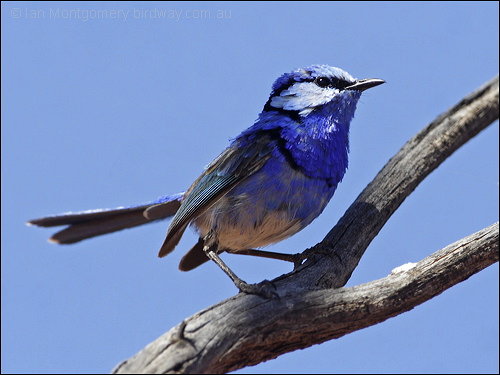
Splendid Fairywren (Malurus splendens) by Ian

Splendid Fairywren (Malurus splendens) by Ian

There are 13 species of a brightly plumed little songbird known as the fairy wren. The birds are found in Australia and New Guinea. So colorful are their feathers that the various species go by names like “superb,” “splendid” and “lovely.” However, even more noteworthy is the birds’ unusual behavior.

A male courting a female will bring her a flower petal. The petal usually matches his color or is a deeply contrasting color. Normally a perky little bird with an upright tail, when courting he lowers his tail and creeps around close to the ground. As he twists his body back and forth, he puffs out his cheek feathers. If the female accepts his courting, she builds their nest alone, lining it with bright parrot feathers. While they mate for life, they are not known for fidelity to their mates. When mature, females will go off on their own, but males may stay with their parents for a year or more. Their main duty is to guard the family nest. If danger approaches the nest, the guard will puff up his wings, lower his tail and scuttle through dry grass, pretending to be a mouse. The idea is to lure the predator away from the nest.

Lovely Fairywren (Malurus amabilis) by Ian

Lovely Fairywren (Malurus amabilis) by Ian

The beauty and unusual behavior of these little birds testifies to more than God’s creativity and love for beauty. They remind us of the beauty that was lost to God’s creation when it was tainted by man’s sin. Thankfully, some of that beauty that was lost can return to our lives through the forgiveness of sins that is found in Jesus Christ.

Prayer: Dear Father, I thank You for the beauty of Your creation and for giving me the forgiveness of sins in Jesus Christ. Amen.

References: Natural History, 11/94, pp. 56-62, “Faithful Philanderers

Copyright © 2010 Creation Moments, Inc., PO Box 839, Foley, MN  56329, www.creationmoments.com.


The Fairywrens are in the Maluridae – Australasian Wrens Family which is part of the Passeriforms Order. They are like in the true wrens (Troglodytidae family) in their shape and the way they cock their long tail. The Maluridae family not only includes the Fairywren, but also the Emu-wren and Grasswren. They range from 5-7.5 in (12-19 cm) to 8-8.5 in (20-22 cm). Most have a short, fine bill, while the Grasswren’s is a little thicker.

Superb Fairywren by Keith Blomerly

Shoebill – Balaenicipitadae Page Updated

Shoebill by Dan

Shoebill by Dan

We went to the Lowry Park Zoo this week and were able to get some photos of the Shoebill. What an interesting bird. I was amazed at how large they really are. My shots were through a fence, but Keith’s video was taken in a swamp.

Shoebills are in the Balaenicipitadae Family of the Pelicaniformes Order.

“The Shoebill, Balaeniceps rex, also known as Whalehead, is a very large stork-like bird. It derives its name from its massive shoe-shaped bill.

The Shoebill is a very large bird. The adult is 115-150 cm (45-64 in) tall, 100-140 cm (40-60in) long, 230-260 cm (91-125 in) across the wings and weighs 4 to 7 kg (8.8-15.5 lbs). The adult is mainly grey while the juveniles are browner. It lives in tropical east Africa in large swamps from Sudan to Zambia.”

Interesting Articles about the Shoebill

Shoebill by African Bird Club

Shoebill – Wikipedia

Updated the Alcidae – Auks Family Page

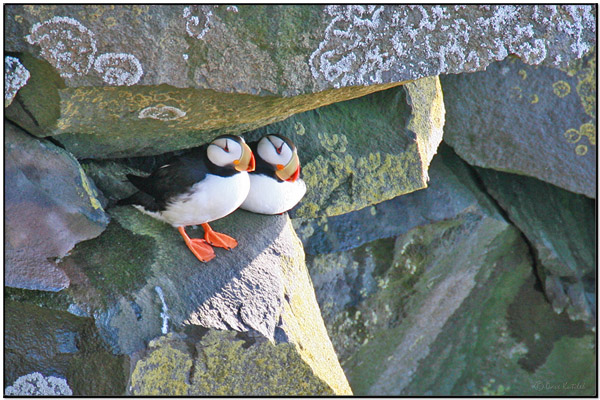
Horned Puffin (Fratercula corniculata) by Daves BirdingPix

Horned Puffin (Fratercula corniculata) by Daves BirdingPix

I have just update the Alcidae – Auks Family page in Lee’s Birds of the World section. The family includes Auks, Murres, Razorbill, Guillemots, Murrelets, Auklets, and Puffins.

The Alcidae family is in the Charadriiiformes Order

Limpkin Page Updated 10-13-09

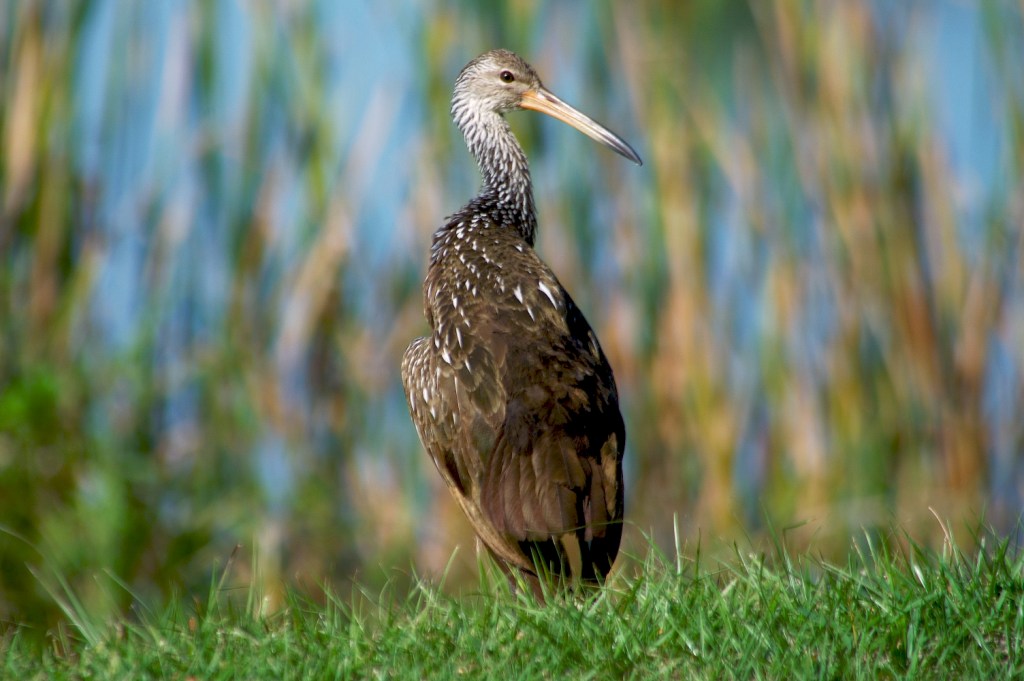
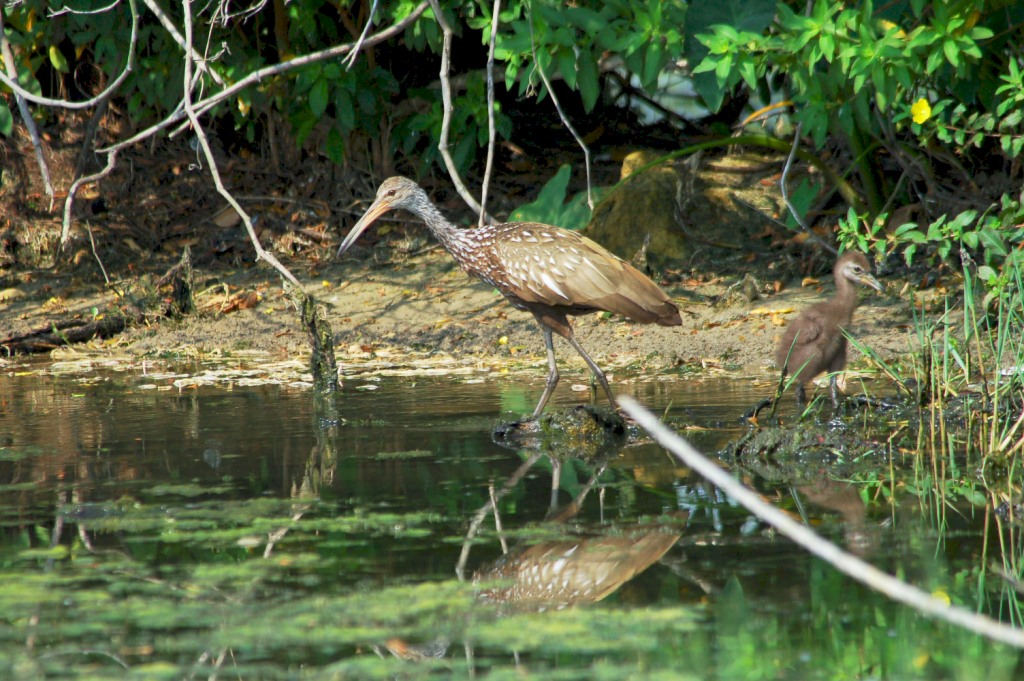
Limpkin (Aramus guarauna)II at Saddle Creek By Dan'sPix

Limpkin (Aramus guarauna)II at Saddle Creek By Dan'sPix

Let everything that has breath praise the LORD. Praise the LORD! (Psalms 150:6)

CLASS – AVES, Order – GRUIFORMES, Family – Aramidae – Limpkin


Limpkin Family Aramidae
Limpkin Aramus guarauna

Finding Photos for Limpkins was not a problem for us. That is one of the birds we see very frequently in this area.

*

This slideshow requires JavaScript.


Information from Wikipedia with editing

“The Limpkin (also called “carrao”, “courlan”, “crying bird”), Aramus guarauna, is a bird that looks like a large rail but is skeletally closer to cranes. They are in the GRUIFORMES family. It is found mostly in wetlands in warm parts of the Americas, where it feeds primarily on apple snails of the genus Pomacea. Its name derives from its seeming limp when it walks.”

Range and habitat
The Limpkin occurs from peninsular Florida (and formerly the Okefenokee Swamp in southern Georgia) and southern Mexico through the Caribbean and Central America to northern Argentina. In South America it occurs widely east of the Andes; west of them its range extends only to the Equator.

Limpkin & Baby at Saddle Creek By Dan'sPix

Limpkin & Baby at Saddle Creek By Dan'sPix

It inhabits freshwater marshes and swamps, often with tall reeds, as well as mangroves. In the Caribbean, it also inhabits dry brushland. In Mexico and northern Central America, it occurs at altitudes up to 1,500 m (4,900 ft).

Description
The Limpkin is a somewhat large bird, 66 cm (26 in) long, with a wingspan of about 102 cm (40 in) and a weight of about 1.1 kg (2.4 lb). Its plumage is drab—dark brown with an olive luster above. The feathers of the head, neck, wing coverts, and much of the back and underparts (except the rear) are marked with white, making the body look streaked and the head and neck light gray. It has long, dark-gray legs and a long neck. Its bill is long, heavy, and downcurved, yellowish bill with a darker tip. The bill is slightly open near but not at the end to give it a tweezers-like action in removing snails from their shells, and in many individuals the tip curves slightly to the right, like the apple snails’ shells. The white markings are slightly less conspicuous in first-year birds. Its wings are broad and rounded and its tail is short. It is often confused with the immature White Ibis.

This bird is easier to hear than see. Its common vocalization is a loud wild wail or scream[4][5] with some rattling quality, represented as “kwEEEeeer or klAAAar.” This call is most often given at night[4] and at dawn and dusk. It has been used for jungle sound effects in Tarzan films and for the hippogriff in the film Harry Potter and the Prisoner of Azkaban. Other calls include “wooden clicking”, clucks, and in alarm, a “piercing bihk, bihk…”.
Sound provided by xeno-canto.org
Behavior and feeding
Limpkins are largely nocturnal and crepuscular, except that in Florida refuges, where they do not fear people, they are active during the day. Even so, they are usually found near cover.

Because of their long toes, they can stand on floating water plants; they also swim well. They fly strongly, the neck projecting forward and the legs backward, the wings beating shallowly and stiffly, with a jerky upstroke, above the horizontal most of the time.

Snail remains at Lake Hollingsworth by Lee

Snail remains at Lake Hollingsworth by Lee

forage primarily in shallow water and on floating vegetation such as water hyacinth and water lettuce They walk slowly with a gait described as “slightly undulating” and “giving the impression of lameness or limping”, “high-stepping”, or “strolling”, looking for food if the water is clear or probing with the bill. They feed on small aquatic life, principally apple snails. The availability of this one mollusk has a significant effect on the local distribution of the Limpkin. When a Limpkin finds an apple snail, it carries it to land or very shallow water and places it in mud, the opening facing up. It deftly removes the operculum or “lid” and extracts the snail, seldom breaking the shell. The extraction takes 10 to 20 seconds. It often leaves piles of empty shells at favored spots.

Freshwater mussels are a secondary food source. Less important prey items are land snails, insects, frogs, and lizards.

Reproduction
Males have territories of several hectares, where they call loudly and chase other males away. Nests are built on the ground, in dense floating vegetation, in bushes, or at any height in trees. They are bulky structures of rushes, sticks or other materials. The clutch consists of 5 to 7 eggs, averaging 6, which measure 6.0 cm × 4.4 cm (2.4 in × 1.7 in). Their background color ranges from gray-white through buff to deep olive, and they are marked with light-brown and sometimes purplish-gray blotches and speckles. Both parents incubate for about 27 days. The young hatch covered with down, capable of walking, running, and swimming. They follow their parents to a platform of aquatic vegetation where they will be brooded. They are fed by both parents; they reach adult size at 7 weeks and leave their parents at about 16 weeks.

Meliphagidae – Honeyeaters

White-eared Honeyeater (Lichenostomus leucotis) by Ian at Birdway

White-eared Honeyeater (Lichenostomus leucotis) by Ian at Birdway

Meliphagidae – Honeyeaters Family Information

Pleasant words are as an honeycomb, sweet to the soul, and health to the bones. (Proverbs 16:24 KJV)

The honeyeaters are a large and diverse family of small to medium sized birds most common in Australia and New Guinea, but also found in New Zealand, the Pacific islands as far east as Hawaii, and the islands to the north and west of New Guinea known as Wallacea. Bali, on the other side of the Wallace Line, has a single species.

Honeyeaters and the closely related Australian chats make up the family Meliphagidae. In total there are 182 species in 42 genera, roughly half of them native to Australia, many of the remainder occupying New Guinea. Like their closest relatives, the Maluridae (Australian wrens), Pardalotidae (pardalotes and thornbills), and Petroicidae (Australian robins), they originated as part of the great corvid radiation in Australia-New Guinea (which were joined in a single landmass until quite recent geological times).

Although honeyeaters look and behave very much like other nectar-feeding passerines around the world (such as the sunbirds and flowerpeckers), they are unrelated, and the similarities are the consequence of variation.

Unlike the hummingbirds of America, honeyeaters do not have extensive adaptations for hovering flight, though smaller members of the family do hover hummingbird-style to collect nectar from time to time. In general, honeyeaters prefer to flit quickly from perch to perch in the outer foliage, stretching up or sideways or hanging upside down at need. All genera have a highly developed brush-tipped tongue, longer in some species than others, frayed and fringed with bristles which soak up liquids readily. The tongue is flicked rapidly and repeatedly into a flower, the upper mandible then compressing any liquid out when the bill is closed.

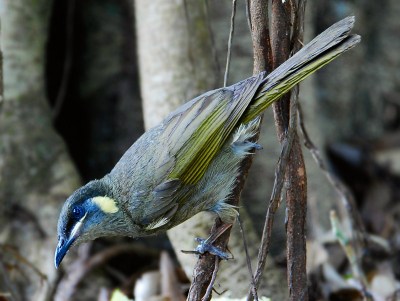
Bridled Honeyeater (Lichenostomus frenatus) by Ian at Birdway

Bridled Honeyeater (Lichenostomus frenatus) by Ian at Birdway

The extent of the partnership between honeyeaters and Australasian flowering plants is unknown, but probably substantial. A great many Australian plants are fertilised by honeyeaters, particularly the Proteacae, Myrtaceae, and Epacridacae. It is known that the honeyeaters are important in New Zealand as well, and assumed that the same applies in other areas.

In addition to nectar, all or nearly all honeyeaters take insects and other small creatures, usually by hawking, sometimes by gleaning. A few of the larger species, notably the White-eared Honeyeater, and the Strong-billed Honeyeater of Tasmania, probe under bark for insects and other morsels. Many species supplement their diets with a little fruit, and a small number eat considerable amounts of fruit, particularly in tropical rainforests and, oddly, in semi-arid scrubland. The Painted Honeyeater is a mistletoe specialist. Most, however, exist on a diet of nectar supplemented by varing quantities of insects. In general, the honeyeaters with long, fine bills are more nectarivous, the shorter-billed species less so, but even specialised nectar eaters like the spinebills take extra insects to add protein to their diet when they are breeding.

Lewin's Honeyeater (Meliphaga lewinii) by W Kwong

Lewin’s Honeyeater (Meliphaga lewinii) by W Kwong

The movements of honeyeaters are poorly understood. Most are at least partially mobile but many movements seem to be local, possibly between favorite haunts as the conditions change. Fluctuations in local abundance are common, but the small number of definitely migratory honeyeater species aside, the reasons are yet to be discovered. Many follow the flowering of favorable food plants. Arid zone species appear to travel further and less predictably than those of the more fertile areas. It seems probable that no single explanation will emerge: the general rule for honeyeater movements is that there is no general rule.

The genus Apalopteron (Bonin Honeyeater), formerly treated in the Meliphagidae, has recently been transferred to the Zosteropidae on genetic evidence.

A new taxon of honeyeater, not yet described but apparently close to the Smoky Honeyeater, has been discovered in December 2005 in the Foja Mountains of Papua, Indonesia.

From Wikipedia, the free encyclopedia with editing


See also:

Meliphagidae – Honeyeaters page

HONEYEATERS Meliphagidae by Bird Families of the World

*

Jacanas – Jacanidae Family

Comb-crested Jacana (Irediparra gallinacea) by Ian's Birdway

Comb-crested Jacana (Irediparra gallinacea) by Ian's Birdway

Jacanas or Jaçana are in the Jacanidae family of the CHARADRIIFORMES order. Their family is unique in that the Lord especially adapted them to feed among lily pads of the shallow freshwater wetlands throughout the tropical zone. They have long toes and claws that help distribute their weight over the lily pads. As they walk around on the pads, they look like they are “walking on water.” “They are found around the world, with two in the New World (Northern and Wattled), two in Africa (Africa and Lesser), the Madagascar in Madagascar, two in Asia (Pheasant-tailed and Bronze Winged) and the Comb-crested in Australasia. They are sometimes known as a “lily-trotter” or “Jesus birds.”

The females are larger that the males and the males take responsibility of the incubation of the eggs. Some of the Jacana females mate with up to 4 males and then leave them to sit on the eggs. She does help in the feeding of the newbies.

Their diets consist mainly of insects, other invertebrates and seeds picked from the floating vegetation or the water’s surface. Most do not migrate except the Pheasant-tailed Jacana which travels from the north of its range into peninsular India and southeast Asia.

I was surprised that the Purple Gallinule was not in the same Order, but they are in the GRUIFORMES order, not the CHARADRIIFORMES order. We watch the Purple Gallinules often here and they also have big feet like the Jacana’s.

Check out A Noisy, Bird-Brained Harem from Creation Moments. It tells how one of the four males tries to get attention for himself.

Of old hast thou laid the foundation of the earth: and the heavens are the work of thy hands. (Psalms 102:25 KJV)

*

This slideshow requires JavaScript.

*

Lee’s Birds of the World

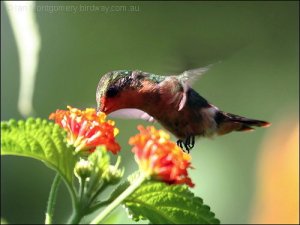
Tufted Coquette (Lophornis ornatus) by Birdway

Tufted Coquette (Lophornis ornatus) by Birdway

Lee’s Birds of the World, is based on the I.O.C., 2.1 version of 2009. It lists 39 Orders, 224 Families, and 10,340 individual Species. This is new and still being developed. All the ORDERs and the Families are listed. More indexes, photos, links, and Scriptures are still being added. These pages are under the Birds-World Tab above.  Please enjoy looking around at the references to the numerous birds that the Lord has created. It appears by the numbers of the birds that they have done as the verses below declare.

So God created great sea creatures and every living thing that moves, with which the waters abounded, according to their kind, and every winged bird according to its kind. And God saw that it was good. And God blessed them, saying, “Be fruitful and multiply, and fill the waters in the seas, and let birds multiply on the earth. (Genesis 1:21-22 NKJV)

All photographs have been used with the permission of the photographers listed or are in the public domain. Please honor their copyrights.