Birds of the Bible – Ossifrage

Lammergeier

This week’s bird is only mentioned twice in the Bible and is in the list of “unclean birds.” Mainly the King James Version (KJV DBY WBS YLT) mentions it, most other versions call it a bearded vulture, vulture, or a variety of other birds. What is an Ossifrage anyway. Here is what I found out.

And these are they which ye shall have in abomination among the fowls; they shall not be eaten, they are an abomination: the eagle, and the ossifrage, and the osprey, (Leviticus 11:13 KJV)

But these are they of which ye shall not eat: the eagle, and the ossifrage, and the osprey, (Deuteronomy 14:12 KJV)

Here is what Nave’s Topical Bible has to say about a Vulture:
  • A carnivorous bird Lev_11:14; Deu_14:13
  • Sometimes translated Falcon Job_28:7
  • Sometimes translated Kite Isa_34:15
From the Holman Bible Dictionary (Online) – OSSIFRAGE
“(ahss ssi frayge) English applies ossifrage to three birds: the bearded vulture; the osprey; and the giant petrel. Other translations identify the bird as a black vulture (REB) or vulture (NAS, NIV, NRSV).
Compact Oxford English Dictionary (New Edition) calls it a
1. lammergeier. or 2. Archaic An osprey.”

From Wikipedia

“Unlike most vultures, the Lammergeier does not have a bald head. This huge bird is 95-125 cm (37-49 inches) long with a 235-280 cm (91-110 inches) wingspan, and is quite unlike most other vultures in flight due to its large, narrow wings and long, wedge-shaped tail. It weighs between 5 and 7 kg (11 and 15 lbs).”

“The Bearded vulture is the only animal that feeds almost exclusively on bone (70-90%). In Crete, the shepherds call it the “Bone-eater”, as they have watched the bird breaking bones in a very characteristic way, since the old times.
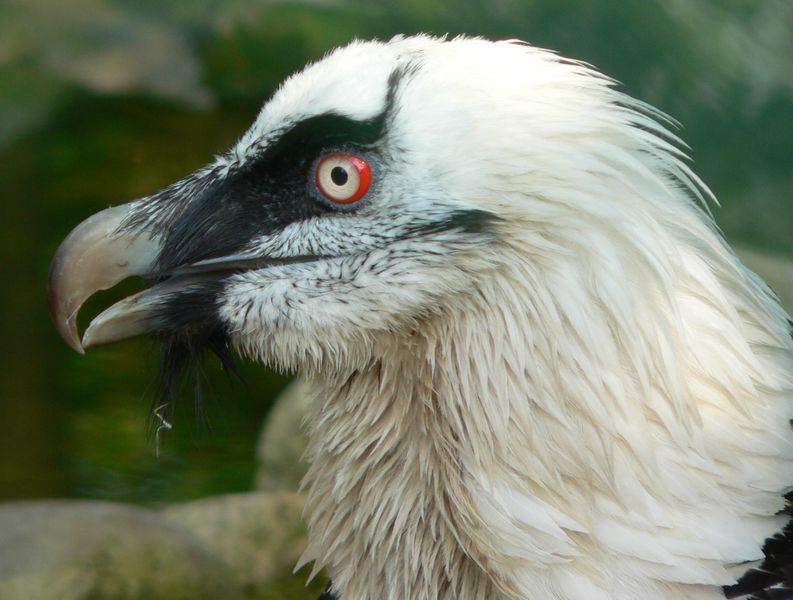
The bird throws the larger bones from a height on to rocky slopes in order to break them, and immediately descends after them in a characteristic spiral way. If the bone does not break the first time, the method is repeated many times until the bone finally breaks.
The bird then eats the bone pieces starting with the bone marrow. The smaller bones are swallowed whole, as the birds gastric fluids are so strong that they can digest bone easily.
This dietary habit seems odd, but once bones have been digested, they are a nutritious and easily storable type of food; in addition, the bird faces minimal competition for this type of food.“ The full article can be found at: Bearded vulture (Gypaetus barbatus)
Ossifrage - Lammergier

Ossifrage – Lammergier

Pictures are of Bartgeier and a Lammergeier by Anthony S
Birds of the Bible – Eagles II

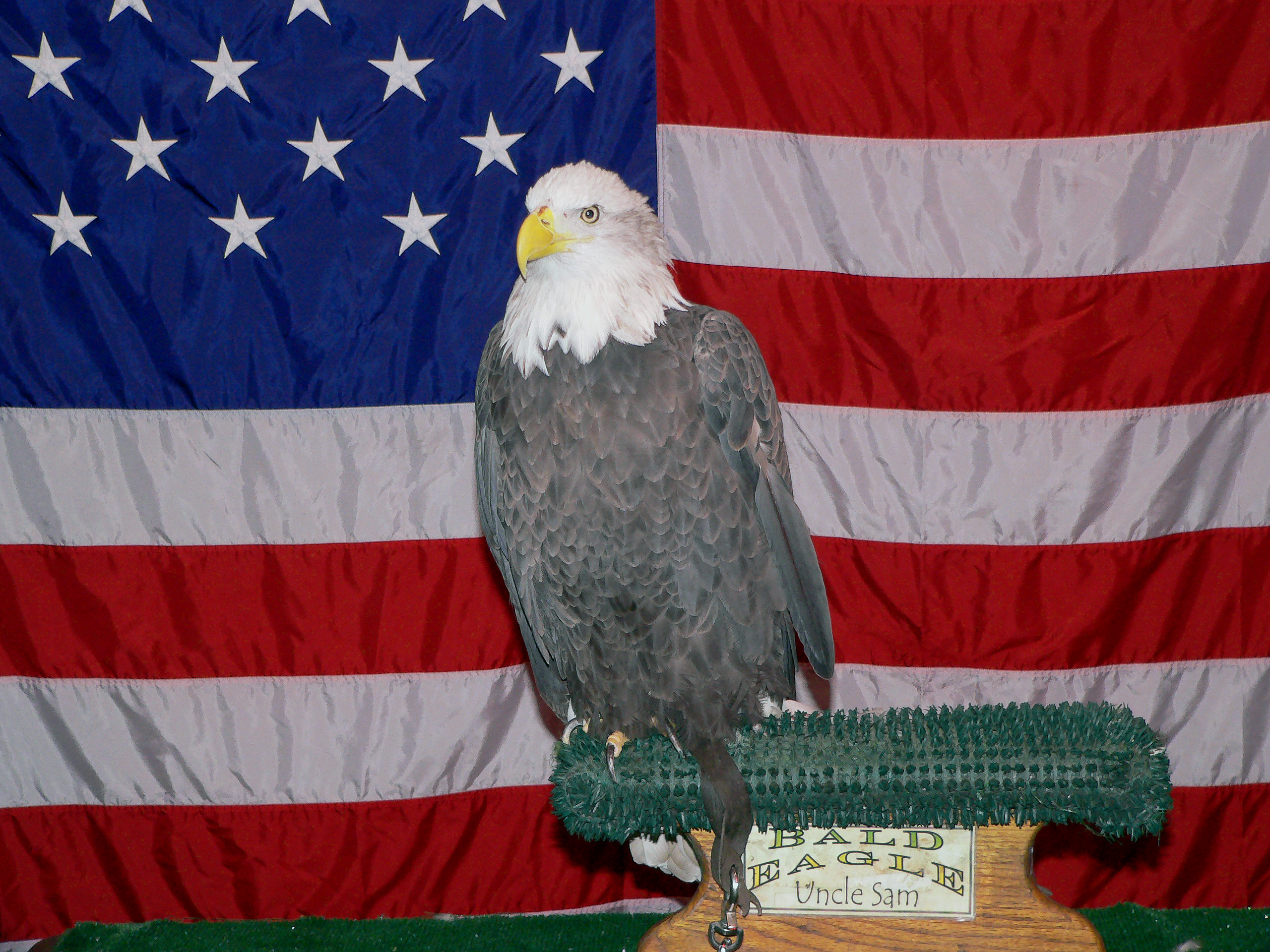
Uncle Sam - Bald Eagle taken at Titusville Birding Festival

Uncle Sam – Bald Eagle taken at Titusville Birding Festival

Since today is the Fourth of July, what better bird to feature than our Bald Eagle. I have decided to re-post the Birds of the Bible-Eagles, with a few updates. Here in North America we have the Bald Eagle (our National symbol) and the Golden Eagle. The Bald Eagle’s “bald spot” doesn’t appear until they are 4 or 5 years old and develop a white head and tail. The Bald Eagle is only in North America. In Israel you might see a Short-toed Eagle, Great or Lesser Spotted Eagle, Steppe, Imperial, Golden, Booted, or Bonelli’s Eagle.

I love to watch an eagle flying; it stops me in my tracks. We are lucky here in Polk County to have many this time of the year. (Update: It’s now Summer and most have gone north until Fall.) Stay alert and also visit the South Lake Howard Nature Center to see a pair sitting either on the tower or at the nest. Ask most anyone there and they will point out the nest. (Update: They did not produce any eaglets this spring, but the nest is still there.)

Eagle on Tower Near Lake Howard and Eagle in Nest at Lake Howard Nature Park.

  • Job 9:26 – “Like an eagle swooping on its prey.”
  • Pro 30:19 – “The way of an eagle in the air”
  • Jer 49:22 – “fly like the eagle, and shall spread his wings”
  • Hab 1:8 – “They fly as the eagle that hastens to eat.”
  • Pro 23:5 –“They fly away like an eagle toward heaven.”
  • A great eagle with great wings, long-winged, full of feathers
  • As an eagle stirreth up her nest, fluttereth over her young, spreadeth her wings, taketh them, beareth them on her wings
  • From thence she seeketh the prey, and her eyes behold afar off

An African Eagle

“Birds display a wide range of patterns in flight. Swifts and swallows use a fast, gliding motion. Ducks and geese have sustained, powerful flight. Birds of prey such as eagles and falcons usually catch their targets by swooping from high in the sky, capturing their victims after a swift dive—which may reach speeds of 250 kilometers an hour (165 mph). As the bird swoops to the ground, it spreads its powerful wings to act as a brake.” (“Created to fly,” Creation 16(3), June 1994)

Click link to see a Bald eagle hovering and landing on rock.
Bald Eagle hovering and landing

For those of us in the “older generation,” Job 9:25-26 (NKJV) reminds us that we need to stay active for our Lord because our life passes by swiftly. “Now my days are swifter than a runner; They flee away, they see no good. They pass by like swift ships, Like an eagle swooping on its prey.”

A few more facts about eagles:

  • Eagles are mentioned in hymns such as:
    They That Wait Upon the Lord –“They shall mount up with wings as eagles:”
    The Mercy Seat – “Ah, there on eagle wings we soar,”
    Art Thou Afraid? – “On eagles’ wings they mount, they soar, Their wings are faith and love,”
  • In Israel, the eagle is the largest bird and has an eight foot wing span.
  • There are at least 25 verses in the Bible that mention the eagle.
  • The eagle is an “unclean” bird.

Today may be Independence Day here in the United States, but there is One we should never declare our Independence from, because:

Have you not known? Have you not heard? The everlasting God, the LORD, The Creator of the ends of the earth, Neither faints nor is weary. His understanding is unsearchable. He gives power to the weak, And to those who have no might He increases strength. Even the youths shall faint and be weary, And the young men shall utterly fall, But those who wait on the LORD Shall renew their strength; They shall mount up with wings like eagles, They shall run and not be weary, They shall walk and not faint. (Isaiah 40:28-31 NKJV)

Birds of the Bible – Cormorant

Double-crested Cormorants, by Dan, Lake John Rockery in Lakeland

Last week’s Bittern blog mentioned Isaiah 34:11,

“But the cormorant and the bittern shall possess it; the owl also and the raven shall dwell in it: and he shall stretch out upon it the line of confusion, and the stones of emptiness.”

That verse, along with Leviticus 11:17 and Zephaniah 2:14, put the cormorant on the “unclean” list and predicts of the destruction of Nineveh, where only the animals and birds will inhabit the city. Again, God has created and provided for another interesting bird kind.
We have the Double-crested Cormorant in this area at our many lakes. Here in North America, we have the Brandt’s, Neotropic, Great, Red-faced and Pelagic Cormorants. Worldwide there are 36 species. A very close relative see here is the Anhinga. Many of the cormorants live and fly over the oceans.
An interesting article from Institute for Creation Research, “Water, Water Everywhere … And Not A Drop To Drink,” by Donna L. O’Daniel, mentions the Double-Crested Cormorant in, “Avian Salt Glands

“But seabirds have their own desalinization systems to deal with excess salt taken in by drinking seawater and feeding in the ocean, in the form of glands that lie inshallow depressions in or above the eye sockets….
The avian salt gland has made it possible for seabirds not only to exist but to maintain homeostasis in an otherwise hostile environment. Truly, ‘the salt gland is one of the most effective ion transport systems known.’ But how did such a system arise? There are only two possible explanations for the origin of avian salt glands: Either they evolved along with the birds themselves, or they were created within the birds by God as He spoke the feathered creatures into existence (Genesis 1:21).”

Double-crested Cormorants, by Dan, Lake John Rockery in Lakeland

Another article From Creation Matters – Volume 8, Number 1 January / February 2003 states:
Let the Birds of the Heavens Tell You
“Domesticated cormorants have been used for centuries in the Orient to catch fish for human consumption (Hoh and Leachman, 1998). Several families in China, carry out a brisk fishing business by letting these highly skilled, winged fishers do their work for them. With a wood block on a long bamboo pole, the human fisherman brings back his cormorant from the water as it delivers a freshly caught fish in its beak. Such fishing was better years ago, but recently one of the fishermen reported catching anywhere between 10 pounds and 100 pounds in a day by using cormorants.”


Back to Birds of the Bible

Birds of the Bible – Bittern


CLASS – AVES, Order –PELECANIFORMES, Family – Ardeidae – Herons, Bitterns


In North America we have theAmerican (23” with a 42-50” wingspan) and Least Bittern (11-14” with a 16-18” wingspan). Both dwell in marsh or wetland habitats and are very difficult to find. God has designed them with plumage and behavior (standing very still with the head pointing up) that helps camouflage them. They eat frogs, small fish, snakes and bugs, etc.
The bittern is an interesting find in the Bible.

I will also make it a possession for the bittern, and pools of water: and I will sweep it with the besom of destruction, saith the LORD of hosts. (Isa 14:23)

Again judgment is being given and the names of the new inhabitants are given. Only the birds will dwell there.

But the cormorant and the bittern shall possess it; the owl also and the raven shall dwell in it: and he shall stretch out upon it the line of confusion, and the stones of emptiness. (Isa 34:11)
Ninevah will be barren and the bittern and pelican will be singing from the vacant windows. The herds shall lie down in her midst, Every beast of the nation. Both the pelican and the bittern Shall lodge on the capitals of her pillars; Their voice shall sing in the windows; Desolation shall be at the threshold; For He will lay bare the cedar work. (Zep 2:14)

American Bittern Picture with permission from Gramps (Les)
A YouTube of a Bittern. I do not know the language, but it shows how the Bittern is camouflaged so well.

Family#26 – Ardeidae

*

Birds of the Bible – Under His Wing

This week’s Birds of the Bible will divert from the introduction of a specific bird to a part of the bird. We had the privilege several weeks ago to visit a “rookery,” (a place where many birds have nests and raise their young. The Wood Storks had their wings spread out to keep the sun off of their young, which is a common behavior of birds. Birds also use their wings to protect them when danger is nearby and for warmth. It reminded me of the many Scripture references and songs about the protection or shadow of the wings.
Psalms 61:3-4 (KJV), says, “For thou hast been a shelter for me, and a strong tower from the enemy. I will abide in thy tabernacle forever: I will trust in the covert of thy wings. Selah. “
Covert as defined by the Dictionary.com Unabridged (v 1.1)
–adjective
concealed; secret; disguised; covered; sheltered.

–noun
a covering;
cover; a shelter or hiding place; concealment or disguise
Also called tectrix one of the small feathers that cover the bases of the large feathers of the wings and tail.

Just a few of the Scriptures are:

Keep me as the apple of Your eye; Hide me under the shadow of Your wings, From the wicked who oppress me, From my deadly enemies who surround me. (Psalms 17:8-9 NKJV)
How precious is Your lovingkindness, O God! Therefore the children of men put their trust under the shadow of Your wings. (Psalms 36:7 NKJV)
To the Chief Musician. Set to “Do Not Destroy.” a Michtam of David When He Fled from Saul into the Cave. Be merciful to me, O God, be merciful to me! For my soul trusts in You; And in the shadow of Your wings I will make my refuge, Until these calamities have passed by. (Psalms 57:1 NKJV)
Because You have been my help, Therefore in the shadow of Your wings I will rejoice. (Psalms 63:7 NKJV)
He shall cover you with His feathers, And under His wings you shall take refuge; His truth shall be your shield and buckler.(Psalms 91:3 NKJV)

The wing has been mentioned in many hymns such as:
God Will Take Care of You – ( by Civilla D. Martin, 1869-1948 )
God Will Take Care of You

Be not dismayed whate’er betide,
God will take care of you;
Beneath His wings of love abide,
God will take care of you.

Refrain:
God will take care of you,
Thro’ ev’ry day, O’er all the way;
He will take care of you,
God will take care of you

Under His Wings (by William O. Cushing, 1823-1902)
Under His wings I am safely abiding;
Tho’ the night deepens and tempests are wild.
Still I can trust Him; I know He will keep me;
He has redeemed me, and I am His child.

Refrain:
Under His wings, under His wings,
Who from His love can sever?
Under His wings my soul shall abide,
Safely abide forever.

Under His wings, what a refuge in sorrow!
How the heart yearningly turns to His rest!
Often when earth has no balm for my healing,
There I find comfort, and there I am blest.

Under His wings, O what precious enjoyment!
There will I hide till life’s trials are o’er;
Sheltered, protected, no evil can harm me;
Resting in Jesus I’m safe evermore.

Two other hymns that mention the wings are:
Praise Ye the Lord!
Praise ye the Lord, who o’er all things so wondrously reigneth,
Shelters thee under His wings, yea, so gently sustaineth!
Hast thou not seen How thy desires e’er have been
Granted in what He ordaineth?
And,
God Be with You Till We Meet Again
God be with you till we meet again;
‘Neath His wings protecting hide you,
Daily manna still provide you;
God be with you till we we meet again.

Most information from The Cyber Hymnal

See ~ Wordless Birds

More ~ Birds in Hymns

*

Birds of the Bible – Glede and Kite

This week I am presenting two species, mainly because of the similarity between them. Again, these birds are from the lists of “unclean” birds. The Glede mentioned in Deut. 14:13 is interpreted as Glede, Red Kite, or Vulture, depending on which copy of the Bible you use. When “Googling”, most articles list the Glede as extinct or a Kite.

Red Kite

(KJV) And the glede, and the kite, and the vulture after his kind,
(NASB) and the red kite, the falcon, and the kite in their kinds,
(NKJV) the red kite, the falcon, and the kite after their kinds;

The Kite is also mentioned in:

Leviticus 11:14 KJV) And the vulture, and the kite after his kind;

That said, the Glede and Kite:

  • In the “Acciptiformes Order” which includes Hawks, Eagles, Falcons, Kites, etc.
  • Have large hooked bills
  • Very good eyesight used for finding prey while soaring
  • Are known to eat carrion

“The kite is a migratory bird that stays in Israel during the summer, especially in the mountains of southern Judea, in the trackless wasted west of the Dead Sea, and in the wilderness of Beersheba.
The red kite or glede is a medium-sized bird of prey. The edges of the upper part of the bill overlap with the lower one, forming sharp scissors. The tail is forked or cleft like that of a fish. Its loud cry often includes sharp whistling notes. Other Holy Land species include the black kite and the black-winged kite.” Tyndall Bible Dictionary

In Central Florida, we see the Swallow-tailed Kite.

See Birds of the Bible

*


Birds of the Bible – Swan

Swans are birds of the family Anatidae, which also includes geese and ducks. Swans usually mate for life. The number of eggs in each clutch ranges from three to eight.In North America we have at least four swans: Mute (60”), Trumpeter (60”), Tundra (52”), and Whooper (60”). There is also a Black Swan of Australia and a Black-necked Swan in South America. Swans are large, long-necked waterbirds that have a short duck-like bill and short legs. Many are seen on ponds, lakes, reservoirs and coastal bays. The Mute Swans are semi-domesticated. The Tundra Swan is sometime split into two species, Bewick’s and Whistling Swans.
The Swan is listed in Leviticus and Deuteronomy in the list of “unclean” birds.

And the swan, and the pelican, and the gier-eagle, (Leviticus 11:18 KJV)
The little owl, and the great owl, and the swan, (Deuteronomy 14:16 KJV)

Mute Swan pictures (click on for larger view) taken at Bok Sanctuary in Lake Wales. They were irritated because the worker was mowing the grass beside the water and they kept following him back and forth. They had their wings arched back in frustration, but we thought they were beautiful like what I think “angel’s wings” might look like.

*

Birds of the Bible – Cranes

The 15 species of Cranes worldwide are: Black Crowned, Black-necked, Brolga, Demoiselle, Eurasian, Grey Crowned, Hooded, Red-Crowned, Sandhill, Sarus(tallest flying bird-6’ tall), Siberian, Wattled, White-naped, and the Whooping Crane(tallest N. American flying bird-5’ tall). A link to pictures and information about these cranes is at: International Crane Foundation

Cranes are tall birds from 3 to 6 feet tall, with wingspans over 6 feet. They fly with their neck straight out and their long legs trailing. They chatter and call when flying. We have plenty of Sandhill Cranes here in Central Florida walking around the neighborhoods. They seem pretty tame sometimes and will eat out of your hand. They have been bringing a small flock of Whooping Cranes to Florida every fall that follow an Ultra Light Aircraft from Wisconsin. We have a few non-migratory Whooping Cranes in the area that I have seen in a cow field off US 27.

Sandhill Cranes and Babies in our yard
Cranes migrate by following known paths taught them by their parents, or substitutes. Migrating birds know when and where to go and when to come. When God created them, He put that information in them. Plans are for a future blog about migration.

Like a crane or a swallow, so did I chatter: I did mourn as a dove: mine eyes fail with looking upward: O LORD, I am oppressed; undertake for me. (Isaiah 38:14 KJV)

“So did I chatter – … The idea here is doubtless that of pain that was expressed in sounds resembling that made by birds – a broken, unmeaning unintelligible sighing; or quick breathing, and moaning. ” Barnes Commentary

Yea, the stork in the heaven knoweth her appointed times; and the turtle and the crane and the swallow observe the time of their coming; but my people know not the judgment of the LORD. (Jeremiah 8:7 KJV)

“The instinct of the migratory birds leads them with unfailing regularity to return every spring from their winter abodes in summer climes (Son_2:12); but God’s people will not return to Him even when the winter of His wrath is past, and He invites them back to the spring of His favor.”
Jameison, Faussett, and Brown Commentary

Sandhill Cranes(grey) at the Plate River and some Whooping Cranes(white)
See:
Birds of the Bible – Cranes II
*

Birds of the Bible – Dove and Turtle-Dove

The Dove is probably recognized by most people, even though they may not know which specific kind they are viewing. White doves are released at weddings and other special occasions. The symbol for the dove is displayed many times. The coo of the mourning dove is heard and most recognize a Rock Pigeon (formerly a Rock Dove). We do not have Turtle-Doves here in America; they are in the Orient, Asia, Africa and Europe.
The dove family (Columbidae) ranges from about 6.5” to 12” and seem to be gentle. Doves tend to be monogamous and both male and female produce a “crop milk” to feed their young the first few days. Most birds regurgitate food for the young from the beginning. Doves do not make the most elabroate nests, often they are on the ground and flimsy. Many were domesticated and were used for sacrifices. They are considered “clean” birds in the Bible. There are at least twenty references to doves in the Word of God.

  • The first mention of the Dove is in Genesis 8:8-13 when Noah released her from the ark. She was released three times, but came back two times because she “found no rest for the sole of her foot.” They do not eat carrion as the raven does. Most are ground feeders and she had nowhere to feed that was dry. The second time she came back with an olive leaf, and then never returned the last time.
  • (Genesis 15:9, Leviticus 5:7 and 12:6-8, Luke 2:22-24) all refer the Dove and Turtle dove being used for sacrifices.
  • David was distressed and wrote “…Oh that I had wings like a dove! for then would I fly away, and be at rest. (Psalms 55:6 KJV)
  • Isaiah 38:14 says, “I did mourn as a dove…” We have a Mourning Dove.
    The Lord used the dove when he told His Apostles, “Behold, I send you forth as sheep in the midst of wolves: be ye therefore wise as serpents, and harmless as doves.” (Matt.10:16)
  • The dove became a symbol of The Holy Spirit at Jesus’ Baptism (Mat 3:16; Luk 3:22; John 1:32).

There is more to be said, but when you find the Dove in your Scripture reading, you will have a mental picture of them. The Hymn writers have used the dove in songs like:
Sunshine in My Soul – Eliza E. Hewitt, 1851-1920
There is springtime in my soul today,
For when the Lord is near,
The dove of peace sings in my heart,
The flow’rs of grace appear. Come, Holy Spirit, Heavenly Dove – Isaac Watts, 1674-1748
Come, Holy Spirit, heav’nly Dove,
With all Thy quick’ning pow’rs;
Kindle a flame of sacred love
In these cold hearts of ours.

Pictures are (In Order-Mourning, Eurasian Collared, Ground, and White-winged Doves) Reinier Munguia at Wildstock Photography)

See our Doves and Pigeon page

Birds of the Bible – Sparrow II

White Crown and American Tree Sparrows
In Psalm 84:3 the sparrows are mentioned again, this time they are found making a home (nest) in the Tabernacle area. As mentioned in the first Sparrow article, they are known to make nest in many kinds of places. Let’s look at this verse in its context to understand a great blessing found here.

Psalms 84:1-4 KJV
(1) How amiable are thy tabernacles, O LORD of hosts!
(2) My soul longeth, yea even fainteth for the courts of the LORD: my heart and my flesh crieth out for the living God.
(3) Yea, the sparrow hath found a house, and the swallow a nest for herself, where she may lay her young, even thine altars, O LORD of hosts, my King, and my God.
(4) Blessed are they that dwell in thy house: they will be still praising thee. Selah.

Vesper Sparrow

The commentaries have different views, but many agree that the sparrow has made her nest in the Tabernacle and is close to the altars. David’s soul is longing to be in the courts of the Lord and near the Lord. The sparrow is there, has moved in and is even raising her family there. I think he is envious of the birds because they get to spend so much time there and also they sing so often, praising God.
Do we yearn and long to spend time with the Lord, our Savior? Do we seek to be as close as we can get? Do we enjoy reading His Word, praying to Him, and attending church where we can learn, sing and praise, and have fellowship with other believers? I trust you can say a mighty, Amen!

Field Sparrow Singing

Birds of the Bible – Cuckoo

Again we have a bird that is in a list of “unclean” birds. This time we will look at the Cuckoo. No. This is not the bird that pops out of your clock on the hour and sings. Let’s find out about the real Cuckoos.

And the owl, and the night hawk, and the cuckoo, and the hawk after his kind, (Deuteronomy 14:15 KJV)
And the owl, and the night hawk, and the cuckoo, and the hawk after his kind, (Leviticus 11:16 KJV)

Here in the U. S. we have a Black-billed, Common, Mangrove, Yellow-billed and Oriental, Cuckoos. The Common and Oriental Cuckoos have only been seen in Alaska. The Mangrove is seen along the mangroves of southern Florida and the other two like dense thickets, woodlands, orchards and along streams. Worldwide there are close to 100 species of Cuckoos. Our Roadrunner is the same family – cuculidae.

The cuckoos have a slender body with a downcurved bill and a long tail. Most of them have spots on the underside of their tails and the sexes are similiar. Many species of cuckoos have a habit of laying their eggs in another’s kind of bird’s nest and letting those parent raise the bird. The chick seems to hatch first and then either knock the other eggs out of the nest or harm the new chicks. Other cuckoos raise their own babies.

You-Tube of Cuckoo Sound with pictures and one showing warbler feeding baby. (from Poland)
(Updated 2/3/2009 – Video of Cuckoo laying egg in other nest and of a Cuckoo Duck
*

*

*

Back to Birds of the Bible – Cuckoos

*

Birds of the Bible – Lapwing

The Lapwing is only mentioned twice in scripture and both times in a list of “unclean” birds. “But these are they of which ye shall not eat,” says Deuteronomy 14:12.

And the stork, the heron after her kind, and the lapwing, and the bat. (Leviticus 11:19 KJV)
And the stork, and the heron after her kind, and the lapwing, and the bat. (Deuteronomy 14:18 KJV)

The only Lapwing in North America is the Northern Lapwing and then that has only been seen in isolated sightings. They are on the List of Birds of Florida. They are found in Europe and Asia near wetlands, coastal pastures and short-grass meadows or fields. They are in the same Order as Gulls, Terns and Plovers. In Europe there is also a Sociable Lapwing and a White-tailed Lapwing. “Most of the Lapwings seem to feed on insects and small prey from grasslands. They lay their eggs in nest on the ground and very protective of their young. They feign injury or will lead intruders away. If that doesn’t work, they are known to attack, even humans. They are medium sized about 12-13 inches with long legs. Their heads have a striking pattern with a wispy crest. Their behavior reminds me of a Killdeer.

Apparently the Lapwing was mentioned in three of Shakespeare’s plays: Comedy of Errors, Much Ado About Nothing and Measure for Measure

Return to Birds of the Bible Index

*