Ian’s Bird of the Week – European Honey Buzzard

Ian’s Bird of the Week – European Honey Buzzard ~ by Ian Montgomery

Newsletter – 10-14-12

I had a welcome email a couple of weeks ago pointing out an identification error on the Birdway website, thank you Tom of Luxembourg, pointing out that the photos I’d taken of a Buzzard in Alderney in the Channel Islands in 2005 was not a mere Common Buzzard but a much more interesting juvenile European Honey Buzzard. By way of excuses, they do look rather similar and at the time I had Common Buzzards on the brain as I had just been trying unsuccessfully to photograph Common Buzzards in Ireland.

Honey Buzzards are very rare nesting birds in Britain (30-50 pairs) but reasonably common in continental Europe. They are summer visitors, wintering in sub-Saharan Africa and often seen on passage and I was in Alderney in September, a good site for migrating birds including raptors. Both species have very variable plumage, but the Honey Buzzard is slightly larger, longer-necked, longer-tailed and has a slim neck and holds it head forward giving the bird a more cuckoo-like silhouette. It also supposed to hold its wings differently when gliding, second photo, but the subtlety of soaring on ‘smoothly down-curved flattish wings lacking an obvious bend at the carpal joints’ rather evades me.

They get their name from their preferred food, the larvae of bees and (mainly) wasps though they eat a more varied diet when these are not available. The specific name apivorus means ‘bee-eating’ – more accurate than ‘honey’ – and has the same Latin roots as the ‘vore’ part of carnivore and the ‘api’ part of apiarist. The generic Pernis comes from the Greek for ‘hawk’, but taxonomists are not too neurotic about combining different languages.

I saw very few raptors in Finland this year, but I did see several Honey Buzzards including this distant, slightly moth-eaten adult in the third photo. At least I identified this one correctly, though I was unjustifiably pleased in thinking I’d photographed a new species.

Back home in North Queensland, I’m working on the final revisions to the photographs for the digital version of the Pizzey and Knight Field Guide to the Birds of Australia which should be published soon – you may have seen the full page advertisement for it from Gibbon Multimedia Australia http://www.gibbonmm.com.au in the September issue of Birdlife Australia. I’ve recently received the mobile version of the equivalent South African product Roberts VII Multimedia Birds of Southern Africa http://www.sabirding.co.za. It’s a splendid product, a veritable encylopaedia, brilliantly organised and available across many platforms (iPad, iPhone, Android, Windows) so don’t go to Southern Africa without it. It augurs very well for the Australian product, but naturally I keep you posted on its progress.

Best wishes

Ian

******************************

********************
Ian Montgomery, Birdway Pty Ltd,
454 Forestry Road, Bluewater, Qld 4818
Tel 0411 602 737 ian@birdway.com.au
Check the latest website updates:
http://www.birdway.com.au/#updates


Lee’s Addition:

After some time, when he returned to get her, he turned aside to see the carcass of the lion. And behold, a swarm of bees and honey were in the carcass of the lion. (Jdg 14:8)

Thanks, Ian, for the correction. Most of us have not seen either bird, so were upset by correction. It is also good to know that even you, whom I consider an expert, makes mistakes. Makes us feel better.

That aside, that is an neat looking bird. I like the third photo showing up under its wings. These Buzzards are part of the Accipitridae – Kites, Hawks and Eagles Family. There are six Honey Buzzards; the European, plus the Long-tailed, Black, Crested, Barred and Philippine.

See Ian’s Buzzards at his:

Accipitridae Family

European Honey Buzzard

Oriental Honey Buzzard

Also:

Accipitridae – Kites, Hawks and Eagles Family

European Honey Buzzard – Wikipedia

*

Ian’s Bird of the Week – Brent/Brant Goose

Brent/Brant Goose (Branta bernicla) by Ian 1

Brent/Brant Goose (Branta bernicla) by Ian 1

Ian’s Bird of the Week – Brent/Brant Goose ~ by Ian Montgomery

Newsletter – 9-27-12

My apologies for the long delay since the past posting on the Barnacle Goose. I’m now back home in North Queensland after the unplanned trip to Ireland following the death of my brother in law Gerald and resuming my normal life.

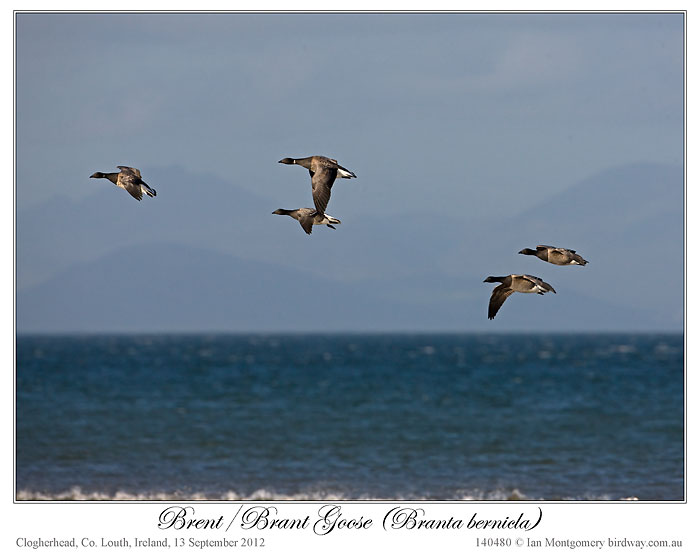
On 6 September we took the dogs for a walk along the strand at the Bull Island in Dublin Bay. As we were leaving, I was surprised to see a flock of Brent Geese, close relatives of the Barnacle Goose so early in the season. Brent Geese are common winter visitors to Ireland but do not usually arrive until much later in September or early October. A week later we visited a strand just north of Clogherhead in Co. Louth and there was another, more accessible flock there and the first photo shows three adults feeding on ‘sea lettuce’, a green alga of the genus Ulva which, along with the sea grass Zostera, often called eel grass, is the main food of Brent Geese in winter.

These are adults, recognisable by the white ‘necklaces’ and the dark, unstriped wings. Different races of Brent/Brant Geese – ‘Brent’ in the British Islands, ‘Brant’ in North America – vary mainly in the colour of the breast. These are Pale-bellied Brent Geese – race hrota – and most of these nest in Greenland and winter in Ireland, one of few species with a transatlantic migration. The nominate Dark-bellied Brent Goose (bernicla) breeds mainly in Russia and winters in northeastern Europe, including Great Britain, and is rare in Ireland. Just after seeing these birds, I read an online newspaper article about the early arrival of Brent Geese in Strangford Lough in Co. Down, Northern Ireland and the writer suggested that favourable tail winds during migration had maybe caused the birds to skip their normal stopover in Iceland, and fly straight to their wintering grounds.

Brent/Brant Goose (Branta bernicla) by Ian 2

Brent/Brant Goose (Branta bernicla) by Ian 2

Among the 70 or so birds in the flock, there were several juveniles including a party of 2 adults and 3 juveniles that stayed together and were maybe a family. The second photo shows three of these birds. The one on the right in the foreground is an adult with dark wings, even though its necklace is rather indistinct. The other two lack the necklace (or are just beginning to acquire one), have stripy wings and have darker mottled rather than scaly breasts. At this age, the juveniles are indistinguishable from Dark-bellied Brent Geese and I initially mistakenly identified them as Dark-bellied. The third photo shows this party coming in to land, looking for all the world like a Peter Scott painting. The mountains in the near background on the left are the Cooley Mountains in northern Co. Louth with the Mourne Mountains in Co. Down in the background.

Brent/Brant Goose (Branta bernicla) by Ian 3

Brent/Brant Goose (Branta bernicla) by Ian 3

With a length of 55-62cm/22-24in, these are smaller than Barnacle Geese and comparable in size to Mallard. Juvenile birds acquire the necklace and breast colour of the adult birds in late September or October, but retain the white wing stripes and are referred to as first winter birds. The fourth photo, taken a few years ago on a wintry January day, shows a first winter bird, complete with necklace and and striped wings being followed by two dark-winged adults.

Brent/Brant Goose (Branta bernicla) by Ian 4

Brent/Brant Goose (Branta bernicla) by Ian 4

I’ve never seen Dark-bellied Brent Geese, but in northern Alaska in June 2008 I came across the western North American race, the Black Brant (nigricans) on its breeding ground on the tundra, fifth photo. The Brent Goose breeds as far north as any bird species in the world at locations such as Ellesmere Island, the northernmost in Canada, and in Spitsbergen, only 10º or 11º from the Arctic Pole.

Brent/Brant Goose (Branta bernicla) by Ian 5

Brent/Brant Goose (Branta bernicla) by Ian 5

This has a very broad necklace and dark brown breast almost merging with the dark brown neck. This is easier to see in the sixth photo. This has sometimes been treated as a separate species.

Brent/Brant Goose (Branta bernicla) by Ian 6

Brent/Brant Goose (Branta bernicla) by Ian 6

In recent decades the populations of Brent Geese have increased greatly. There are about 115,000 Black Brants and about 40,000 Pale-bellied winter in Ireland and 90,000 Dark-bellied winter in Britain.

Best wishes
Ian

**************************************************
Ian Montgomery, Birdway Pty Ltd,
454 Forestry Road, Bluewater, Qld 4818
Tel 0411 602 737 ian@birdway.com.au
Check the latest website updates:
http://www.birdway.com.au/#updates


Lee’s Addition:

And God said, “Let the waters swarm with swarms of living creatures, and let birds fly above the earth across the expanse of the heavens.” (Genesis 1:20 ESV)

Again, Ian, Our deepest sympathy over your loss. We are glad you are back safely at home.

These geese and all the information about them is very interesting and informative. See all of Ian’s Anseranatidae & Anatidae Family. He has quite a selection of them that he has photographed over time.

See also the Anatidae Family here.

*

Ian’s Bird of the Week – Barnacle Goose

Barnacle Goose (Branta leucopsis) by Ian 1

Barnacle Goose (Branta leucopsis) by Ian 1

Ian’s Bird of the Week – Barnacle Goose ~ by Ian Montgomery

Newsletter – 9-10-12

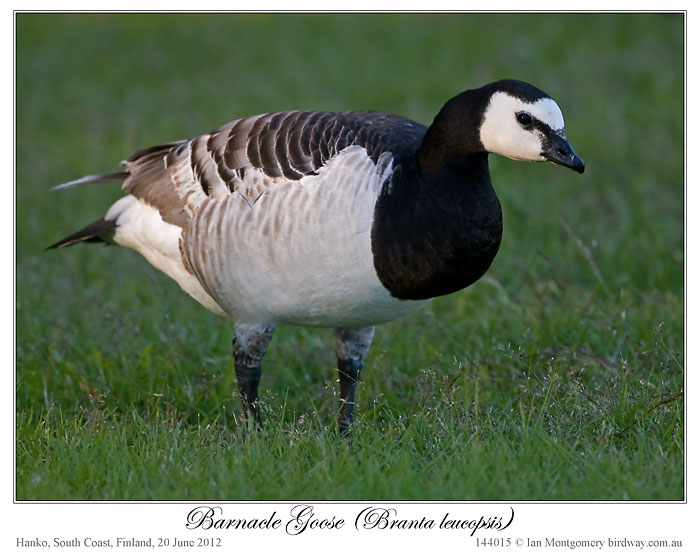
I’m back in Dublin after the sad and sudden death of my brother-in-law Gerald, so I’ve chosen a soberly dressed and elegant bird with, for me, an Irish connection, the Barnacle Goose. Barnacle Goose nest in the arctic and winter the more remote areas in Western Europe including the West of Ireland. During a particular severe winter in the 1960s I once saw a flock on the Bull Island in Dublin Bay, a place better known for as a winter haunt of the closely related Brent (British Isles) or Brant (North America) Goose.

On the last day of my trip to Finland in June, I came across a flock grazing near the beach in Hanko on the south east coast. I assumed that it was a feral flock as they were very approachable and I discovered only later that Barnacle Geese have been nesting on islands in the Baltic for the past 40 years.

They are relatively small with a length of 55-70cm/22-28in and, I think, very beautiful. The specific name leucopsis means ‘white-faced’ and the genus Branta comprises the mainly black and white geese including the Brant/Brent and the Canadian.

Barnacle Goose (Branta leucopsis) by Ian 2

Barnacle Goose (Branta leucopsis) by Ian 2

The name ‘Barnacle’ was originally applied to the goose not the crustacean and the two are linked by a strange myth that developed in the middle ages when the nesting sites of the goose were unknown and the nature of bird migration was not understood. To explain the mysterious appearance of these geese, it was proposed that they hatched from the goose-liked stalk barnacles Lepas anserifera (‘goose-bearing’) which grows on drift wood. The confusion was confounded by the notion that the goose barnacle was actually a plant and sometimes called the goose tree, below, reproduced from Wikipedia.

Barnacle Goose (Branta leucopsis) by Ian 3

Barnacle Goose (Branta leucopsis) by Ian 3

The myth naturally had religious consequences as it was argued that the Barnacle Geese were not of animal origin or not really fowl. So, eating the goose on meat-less fast days was considered by some Christians to be acceptable. The Jewish faith took a different approach and ruled that they were kosher and must be slaughtered appropriately.

Best wishes
Ian

**************************************************
Ian Montgomery, Birdway Pty Ltd,
454 Forestry Road, Bluewater, Qld 4818
Tel 0411 602 737 ian@birdway.com.au
Check the latest website updates:
http://www.birdway.com.au/#updates


Lee’s Addition:

and the peace of God, which surpasses all understanding, will guard your hearts and minds through Christ Jesus. (Philippians 4:7 NKJV)

Thanks, Ian. Sorry to hear about Gerald. We will keep you and your sister’s family in our prayers. That is an interesting myth.

See more of Ian’s Bird of the Week.

Ian’s Birdway – Ducks & Allies.

*

Bird of the Week – Antarctic Tern

Antarctic Tern (Sterna vittata) by Ian (1)

Antarctic Tern (Sterna vittata) by Ian (1)

Bird of the Week – Antarctic Tern ~ by Ian Montgomery

Newsletter – 8-28-12

I’ve been adding photos from the recent Hong Kong, Finland, Ireland trip to the website and have encountered a few that are also on the Australian list such as the Arctic Tern. That was my initial choice for this week’s bird until I changed it to the closely related but lesser known Antarctic Tern as I took some photos of it on the Sub-Antarctic Islands trip last November that I would like to share. It is also on the Australian list and breeds at Macquarie and Heard Islands, though it is regarded as a very rare vagrant to the mainland.

We first encountered them at Snares, on the day after leaving Dunedin, first photo. Snares is a nature reserve and we weren’t allowed to land there but, as you can judge from the photo, weather conditions were good and we could get very close to some of the birds and mammals in the Zodiacs. This bird is in breeding plumage and the coral red bill and leg colour is sufficient to distinguish it from the similar breeding Common and Arctic Terns, both of which spend the northern winter in the southern hemisphere. These two breed in the northern hemisphere in the northern summer and both the time of the year and the location are also sufficient circumstantial evidence to eliminate birds of those species in breeding plumage. Apart from that, there are other subtler differences relating to size, plumage and proportions with the Antarctic Tern being both larger and stockier than the other two.

Antarctic Tern (Sterna vittata) by Ian (2)

Antarctic Tern (Sterna vittata) by Ian (2)

Some of these difference, such as the extent of transparency and dark webs in the flight feathers can only be seen in flight, second photo. If you’re not too worried about identification, then you can appreciate the beauty of all these elegant mid-sized terns and, given their graceful flight and forked tails, it’s no wonder that they have been called Sea Swallows. This photo was taken the following day at Enderby Island, one of the Auckland Islands. We were allowed to land there and it proved to be a fascinating place. At a small colony of nesting Antarctic Terns the bird in the third photo is just landing at its neat grassy nest to incubate the two eggs.

Antarctic Tern (Sterna vittata) by Ian (3)

Antarctic Tern (Sterna vittata) by Ian (3)

Both at Snares and on Enderby, there were other similar terns in non-breeding plumage, fourth photo, hanging around the edges of the breeding colony. This is where separation of the three species gets tough and is either a fascinating challenge or a nightmare for keen birders – depending on one’s attitude – and it’s no surprise that in the British Isles Common and Arctic Terns are collectively and wryly referred to as ‘Comic’ Terns. Birders have it fairly easy there and don’t have to worry about Antarctic Terns (we won’t even discuss the South American and Kerguelen Terns which complete the quintet). At Snares, we were tempted to identify this as an Arctic Tern. Arctic Terns, incidentally, easily win the prize for migration, breeding in the higher latitudes of the northern hemisphere and wintering on the coast of Antarctica.

Antarctic Tern (Sterna vittata) by Ian (4)

Antarctic Tern (Sterna vittata) by Ian (4)

It wasn’t until we got to Enderby and found more of these non-breeding birds in close proximity to breeding Antarctic Terns that we could compare the two sorts side by side and conclude that they were non-breeding Antarctic Terns. When I got home, the Handbook of Birds of the World, confirmed that in some places one year old birds, not old enough to breed, do occur at colonies. It may well be that the few records of Antarctic Terns for mainland Australia is more a reflection of the difficulties of separating non-breeding birds, that their actual rarity.

Back at the website, recent additional species from the trip that might be of interest include:

Best wishes
Ian

**************************************************
Ian Montgomery, Birdway Pty Ltd,
454 Forestry Road, Bluewater, Qld 4818
Tel 0411 602 737 ian@birdway.com.au
Check the latest website updates:
http://www.birdway.com.au/#updates


Lee’s Addition:

and let birds fly above the earth across the expanse of the heavens. (Genesis 1:20 ESV)

I am glad Ian figures these birds out for us. I have a real challenge just with the Terns I see at our shores. Like Ian tells us, the real ID problem comes when they are in their non-breeding plumages.

Thanks again, Ian, for sharing your birdwatching adventures with us.

Terns are put of the Laridae Family. Check out all of Ian’s Laridae – Sternini & Rynchopin Genus photos, then check out the Laridae – Gulls, Terns and Skimmers Family here.

*

Ian’s Bird of the Week – Sooty Oystercatcher

Sooty Oystercatcher (Haematopus fuliginosus fuliginosus) by Ian 1

Sooty Oystercatcher (Haematopus fuliginosus fuliginosus) by Ian 1

Ian’s Bird of the Week – Sooty Oystercatcher ~ by Ian Montgomery

Newsletter – 8-16-12
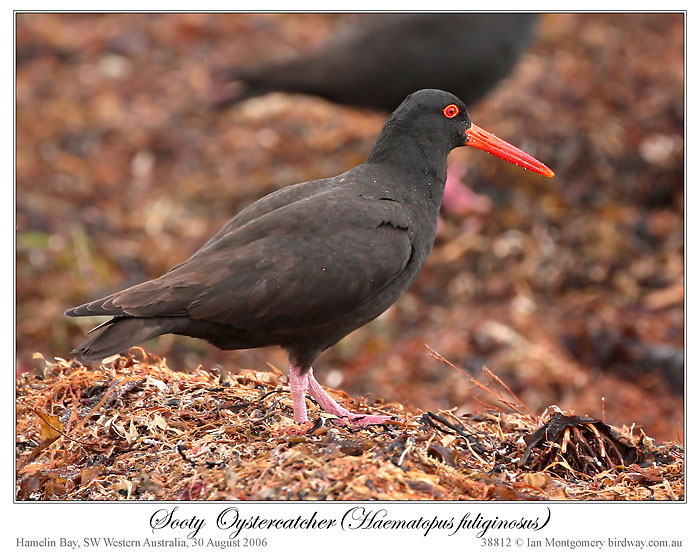
Back to Australia for this week’s bird, the Sooty Oystercatcher. Oystercatchers are large, conspicuous, noisy and mostly popular waders, though not greatly loved by those who harvest shellfish such as mussels. There are about a dozen closely-related species worldwide, two of which are resident in Australia, the Pied and the Sooty. Both occur right around the coasts of Australia and Tasmania, with the Sooty being the less common. It is primarily an inhabitant of rocky shores, first photo, while the Pied is found mainly in sandy habitats. At 46-49cm/18-19in the Sooty is slightly shorter on average than the Pied 48-51cm and distinguished by its all black plumage.

Two races are recognised, though their status and range are uncertain. The nominate race (fuliginosus) occurs in southern Australia and is characterised by the narrower red eye-ring and finer bill like the bird in the first photo, taken near Sydney. The northern race (opthalmicus) has a fleshier, more orange eye-ring and a thicker bill. It is supposed to occur from Shark Bay in Western Australia to Lady Elliot Island at the southern end of the Great Barrier Reef in Queensland, but the bird in the second photo taken near Lennox Head in northern NSW fits this description. There is disagreement in the field guides about whether opthalmicus has a longer or shorter bill.

Sooty Oystercatcher (Haematopus fuliginosus opthalmicus) by Ian 2

Sooty Oystercatcher (Haematopus fuliginosus opthalmicus) by Ian 2

The diets of the two species differ. The Pied feeds mainly by probing sand and soil for worm and other burrowing invertebrates. The Sooty feeds mainly on intertidal invertebrates on rocks such as gastropods (third photo), limpets, crustaceans, echinoderms and ascidians.

Sooty Oystercatcher (Haematopus fuliginosus fuliginosus) by Ian 3

Sooty Oystercatcher (Haematopus fuliginosus fuliginosus) by Ian 3

They will also feed on beaches near rocky headlands and the one in the fourth photo is part of a small flock probing through piles of washed-up seaweed.

Sooty Oystercatcher (Haematopus fuliginosus fuliginosus) by Ian 4

Sooty Oystercatcher (Haematopus fuliginosus fuliginosus) by Ian 4

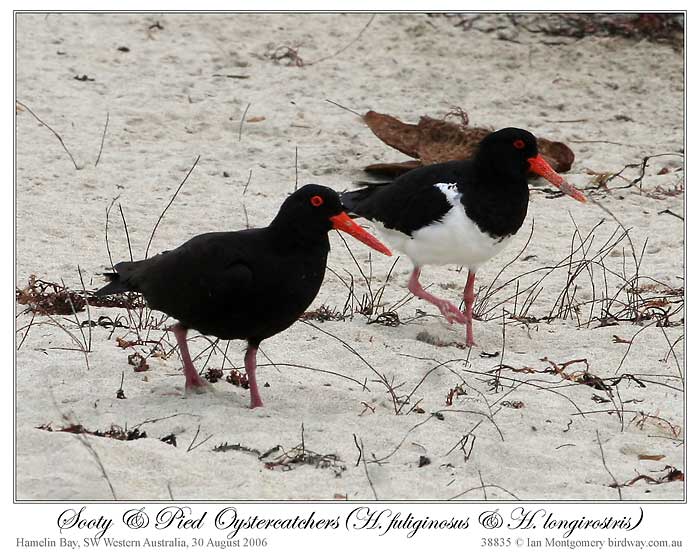
There is some overlap in the habitats of the two species, so they are occasionally found together. The fifth photo show two walking in step along a beach at the end of August and look like more than just good friends. The breeding season of southern Sooties starts in September and the two species have been known to hybridise, so draw your own conclusions.

Sooty Oystercatcher (H fuliginosus) and Pied (H longirostris) by Ian 5

Sooty Oystercatcher (H fuliginosus) and Pied (H longirostris) by Ian 5

A third species, the South Island Pied Oystercatcher of New Zealand, sometimes turns up on the east coast sometimes and more frequently on Lord Howe and Norfolk Islands. This is subtly different from the Pied Oystercatcher and a challenge for enthusiastic birders to identify.

Best wishes

Ian

**************************************************
Ian Montgomery, Birdway Pty Ltd,
454 Forestry Road, Bluewater, Qld 4818
Tel 0411 602 737 ian@birdway.com.au
Check the latest website updates:
http://www.birdway.com.au/#updates


Lee’s Addition:

Thanks again, Ian, for sharing your birds with us. We always learn something neat about birds and their behaviors. I have seen our two Oystercatchers, the Black and the American. That Sooty seem similar to our Black.

Oystercatchers belong to the Haematopodidae – Oystercatchers Family. There are 12 members in the family, one of which is extinct.

Who, when he had found one pearl of great price, went and sold all that he had, and bought it. (Matthew 13:46 KJV)

Ian said, “not greatly loved by those who harvest shellfish such as mussels.” Maybe that is because they are looking for those pearls of great price and the Oystercatchers are beating them to it. Humm!

Check out:

Ian’s Oystercatcher pages and then

The Haematopodidae – Oystercatchers Family here

*

Ian’s Bird of the Week – White-throated Dipper

Ian’s Bird of the Week – White-throated Dipper  ~ by Ian Montgomery

Newsletter – 8-5-12

Here’s another species from Bushy Park in Dublin, the White-throated Dipper, this time on the River Dodder. This featured as bird of the week 5 years ago, so please forgive the repetition but I have some nice photos to share. Dippers – there are 6 species world-wide – are rather special in that they are the only truly aquatic Passerines (song birds), living exclusively on and in fast flowing streams and rivers and getting all their food from the water. They are dumpy, short-tailed, starling-sized birds and, as they often cock their tails, look a bit like giant (Winter) Wrens.

White-throated Dipper (Cinclus cinclus) by Ian 1

White-throated Dipper (Cinclus cinclus) by Ian 1

They also build domed nests but the resemblance to wrens ends there, though, and they are unrelated belonging to their own family, the Cinclidae. They feed on aquatic larvae, such as Caddis Fly larvae, and other invertebrates such as freshwater crustaceans and molluscs.

White-throated Dipper (Cinclus cinclus) by Ian 2

White-throated Dipper (Cinclus cinclus) by Ian 2

Not only do they wade and swim with ease, they will also walk along the bottom of the stream gripping onto stones with their strong feet and even dive, using their wings to propel themselves under water.

White-throated Dipper (Cinclus cinclus) by Ian 3

White-throated Dipper (Cinclus cinclus) by Ian 3

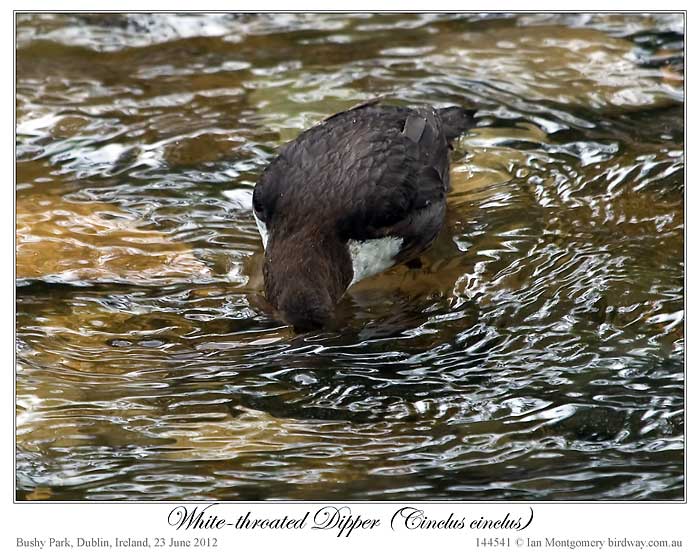
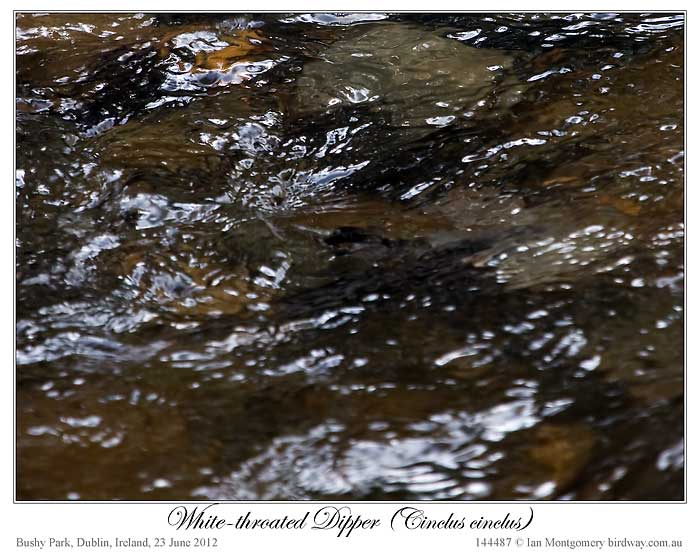
The bird in the third photo is almost completely submerged, and if you look carefully at the fourth photo, the brown shape in the centre is a completely submerged one with only a little eddy to show where it went under the surface.

White-throated Dipper (Cinclus cinclus) by Ian 4

White-throated Dipper (Cinclus cinclus) by Ian 4

They use their slightly upturned bill to probe for food under rocks and stones. The one in the fifth photo has just surfaced with a tasty grub.

White-throated Dipper (Cinclus cinclus) by Ian 5

White-throated Dipper (Cinclus cinclus) by Ian 5

This same bird only moments before had appeared with a Caddis Fly larva in its characteristic tube, made out of spun silk and often camouflaged with attached sand, sixth photo. The presence of Caddis Fly larvae is supposed to indicated a healthy river system, though the depressing amount of water-borne litter in the River Dodder makes it look otherwise.

White-throated Dipper (Cinclus cinclus) by Ian 6

White-throated Dipper (Cinclus cinclus) by Ian 6

We saw Dippers on most occasions when we took the dogs for a walk. It’s popular jogging and dog-walking spot and the Dippers are used to disturbance and are remarkably approachable, being usually rather shy. They nest here too, and the slight bemused looking individual in the seventh photo is a recently-fledged juvenile, distinguishable by the scaly pattern on the chest, the overall grey colour and the pale legs.

White-throated Dipper (Cinclus cinclus) by Ian 7

White-throated Dipper (Cinclus cinclus) by Ian 7

I’ve seen Brown Dippers in the Himalayas in Sikkim, White-capped Dippers in the Andes in Ecuador and American Dippers in the Cascade Mountains of Northeastern California. The White-throated Dipper is a bird of mainly and often icy, highland streams in Europe, North Africa and the Middle East. Seeing them so easily in suburban Dublin, between Terenure and Rathfarnham 6 km from the city centre (take the 15B bus) is truly wonderful.

Best wishes
Ian
**************************************************
Ian Montgomery, Birdway Pty Ltd,
454 Forestry Road, Bluewater, Qld 4818
Tel 0411 602 737 ian@birdway.com.au
Check the latest website updates:
http://www.birdway.com.au/#updates


Lee’s Addition:

Let the rivers clap their hands; Let the hills be joyful together before the LORD, (Psalms 98:8 NKJV)

What an amazing little bird. Its ability to swim and walk underwater is very interesting. Thanks again, Ian, for sharing another of your adventures.

As Ian mentioned they are in the Cinclidae family. There are five species in that family. After checking out his photos, check the Birds of the World page here.

Ian’s Cinclidae Family page.

Cinclidae – Dipper Family

Dippers – Wikipedia

Dippers – IBC

*

Ian’s Bird of the Week – Little Grebe

Little Grebe (Tachybaptus ruficollis) by Ian 1

Little Grebe (Tachybaptus ruficollis) by Ian 1

Ian’s Bird of the Week – Little Grebe ~ by Ian Montgomery

Newsletter – 7/22/12

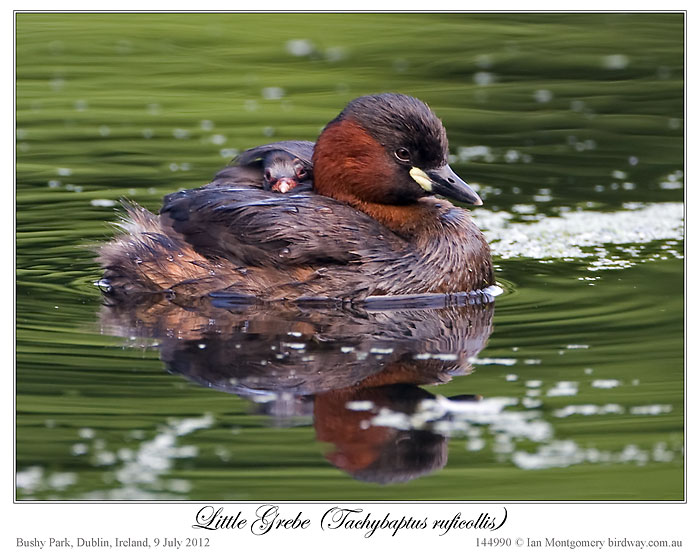
When I was in Dublin – I’m now back home in North Queensland – and we were waiting for the arrival of my niece’s baby, we used to take the dogs for a walk in nearby Bushy Park along the River Dodder. In the park, there is a large artificial pond with an island and I soon found this Little Grebe or ‘Dabchick’ patiently incubating eggs on her nest.

Grebes are usually fairly shy, so a nesting one is a good photo opportunity as they build their floating nests in the open in shallow water. The nest is anchored to submerged vegetation and branches and the fact that it is floating gives it some protection from changing water levels after rain, for example. The second photo was taken on the 26 June, the day when my niece’s daughter finally arrived.

Little Grebe (Tachybaptus ruficollis) by Ian 2

Little Grebe (Tachybaptus ruficollis) by Ian 2

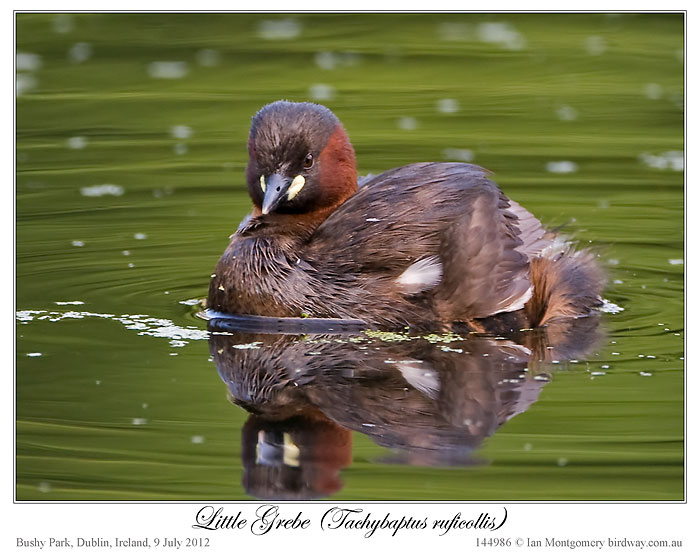
It was a while before I could check the progress of the Little Grebe again and when we returned on the 9th June, third photo, the nest had vanished and, as there had been some bad weather in the meantime, I feared the worst. Both adults were still present but there was no obvious sign of any chicks. However, if you look carefully at this bird, you’ll see that the left wing is slightly raised and not folded flat.

Little Grebe (Tachybaptus ruficollis) by Ian 3

Little Grebe (Tachybaptus ruficollis) by Ian 3

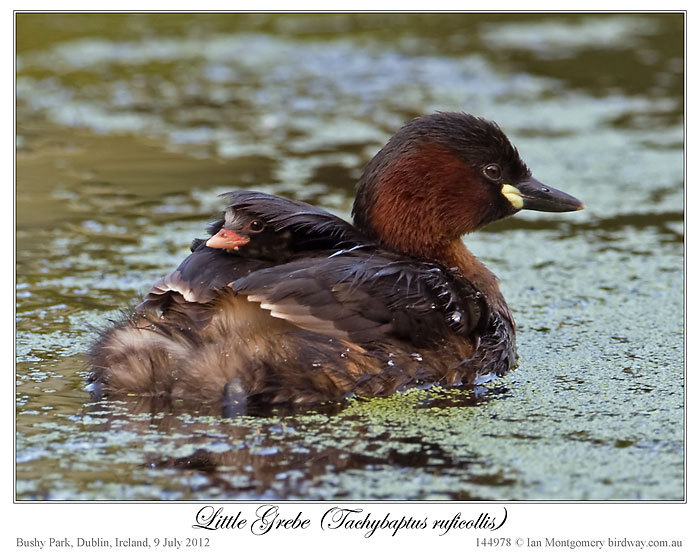
The reason for this became clear when the bird turned around, revealing a chick carefully tucked away under the wing.

Little Grebe (Tachybaptus ruficollis) by Ian 4 with chick

Little Grebe (Tachybaptus ruficollis) by Ian 4

The fourth photo was taken on the same day. We returned again 4 days later and I saw only the one adult and no chick but there is plenty of cover around the island and I may have missed it.

Little Grebe (Tachybaptus ruficollis) by Ian 5 with chick

Little Grebe (Tachybaptus ruficollis) by Ian 5

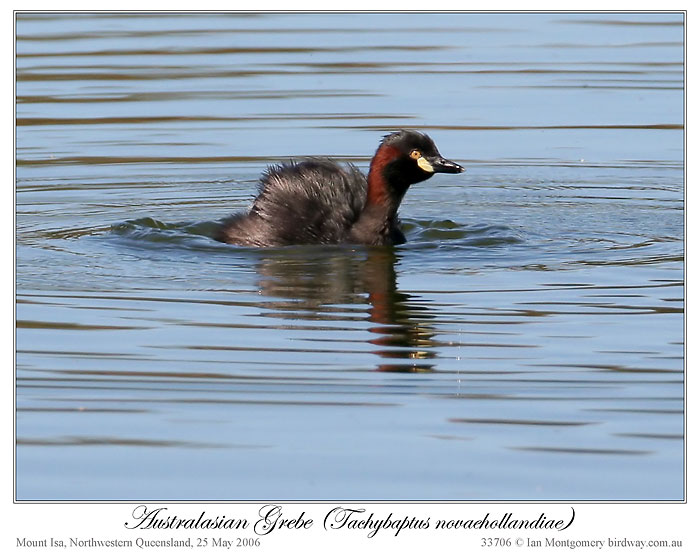
Any Australian birders would immediately notice the similarity between the Eurasian Little Grebe and the Australasian Grebe. They can be distinguished in breeding plumage by the amount of rufous on the neck, throat and breast. These are rufous in the Little Grebe (hence the specific name ruficollis) but the throat and breast of the Australasian Grebe are black as in the fifth photo. Other distinguishing field marks are the yellow, rather than reddish-brown, iris and the greater amount of white under the tail of the Australasian Grebe, though the latter is not evident in this photo.

Australasian Grebe (Tachybaptus novaehollandiae) by Ian

Australasian Grebe (Tachybaptus novaehollandiae) by Ian

These are fairly trivial differences and for a long time the two were treated as conspecific. However, the ranges of the two overlap in New Guinea (are ‘sympatric’) and it is usual to treat them as separate species with the Little Grebe being widespread throughout Eurasia and Africa and the Australasian Grebe occurring in New Guinea, Australia and New Zealand.

Best wishes

Ian
**************************************************
Ian Montgomery, Birdway Pty Ltd,
454 Forestry Road, Bluewater, Qld 4818
Tel 0411 602 737 ian@birdway.com.au
Check the latest website updates:
http://www.birdway.com.au/#updates
**************************************************


Lee’s Addition:

I love the photos of the little one riding under the wing of the parent. Of course that brings to mind several verses.

Keep me as the apple of the eye, hide me under the shadow of thy wings, (Psalms 17:8 KJV)

How excellent is thy lovingkindness, O God! therefore the children of men put their trust under the shadow of thy wings. (Psalms 36:7 KJV)

He shall cover you with His feathers, And under His wings you shall take refuge; His truth shall be your shield and buckler. (Psalms 91:4 NKJV)

We see the Pied-billed Grebe and the Horned Grebe here. It would be neat to see those two that Ian had the privilege of seeing. The Grebes belong to the Podicipedidae family. There are 23 Grebes worldwide.

See more:

Ian’s Bird of the Week articles.

Podicipedidae – Grebes Family

*

Ian’s Bird of the Week – Bohemian Waxwing

Bohemian Waxwing (Bombycilla garrulus) by Ian 1

Bohemian Waxwing by Ian 1

Bird of the Week – Bohemian Waxwing ~ by Ian Montgomery

Newsletter – 7/5/12

Following on from the Black Woodpecker, here is the (Bohemian) Waxwing another unusual northern European species that has a 50 year connection for me.

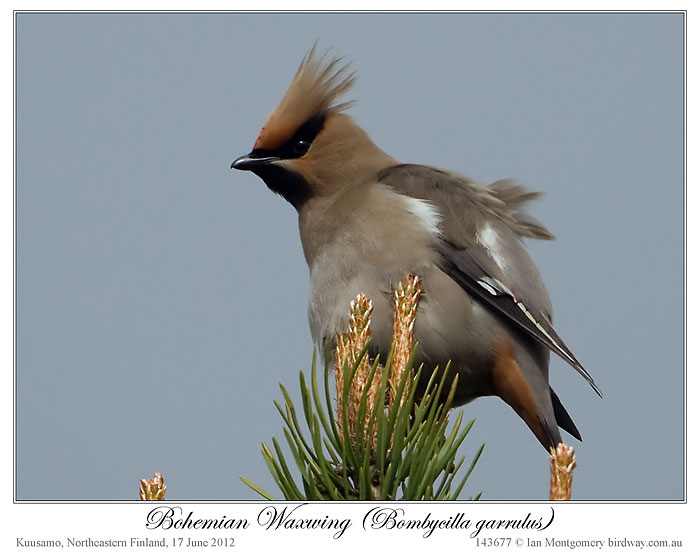
The Bohemian Waxwing breeds across northern Eurasian and North America and moves southwards in winter in search of its staple winter food, berries. In Western Europe, it usually goes only as far as Germany and northern France, but in some years, driven by food shortages, it makes its way as far west as Britain and, more rarely, Ireland. That happened in the early 1960s when I was a schoolboy in Ireland, and I once saw several feeding on berries in a suburban street in Dublin (Eglington Road). I hadn’t seen them again since until my trip to Finland two weeks ago and I drove down that street a few days ago.

Bohemian Waxwing (Bombycilla garrulus) by Ian 2

Bohemian Waxwing by Ian 2

These starling-sized birds are exotic by European standards and beautiful by any, so you can imagine my excitement all those years ago. It was good to catch up with them again in Finland, and this female, perched on top of a conifer, allowed me to approach fairly closely. They get their name from the red waxy-looking tips to some of the wing feathers, which you can see if you look carefully at the photos. These are more obvious in males, and the whitish stripes below the red spot are much yellower in males.

Bohemian Waxwing (Bombycilla garrulus) by Ian 3

Bohemian Waxwing by Ian 3

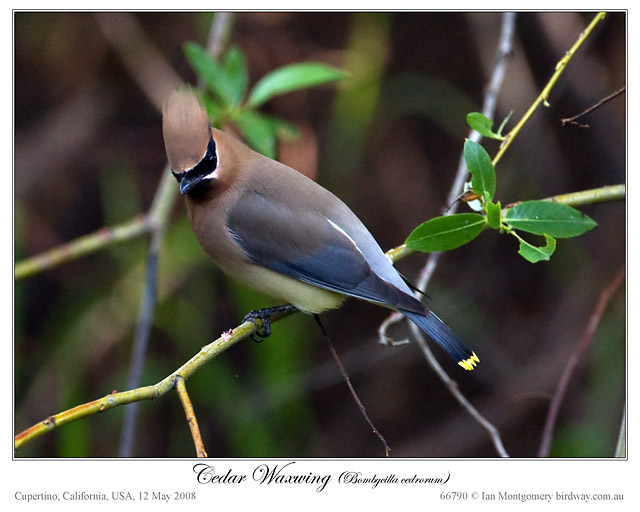
In Europe, these birds are just called Waxwings, but in North America there are two species and this one is qualified with the Bohemian tag to separate it from the slightly smaller but otherwise rather similar Cedar Waxwing. This featured as Bird of the Week three years ago and here it is again:

Bohemian Waxwing (Bombycilla garrulus) by Ian 4

Bohemian Waxwing by Ian 4

Waxwings have silky feathers, and the generic name Bombycilla means, in pigeon Latin, ‘silky tail’. There are only 3 species – the third being the Japanese Waxwing – and they were originally the only members of the family Bombycillidae. Recent genetic studies have shown that several other species are related to them and have been moved into the family. Interestingly, these include the three species of aptly-named Silky-Flycatchers (the ‘silky’ being apt, not the greatly overused ‘flycatcher’), such as the Long-tailed Silky-Flycatcher and you’ll see the family resemblance if you follow the link.

Meanwhile in Dublin, my niece has given birth to a delightful baby girl, Aoibhinn, and both mother and child are doing well. Ancient Irish names are very fashionable here and ‘bh’ in Irish has a ‘v’ sound (strictly speaking it’s an aspirated ‘b’, traditionally represented by a dot over the ‘b’) so the name is pronounced something like ‘eaveen’. Aiobhinn timed her arrival well and waited until all the immediate members of the family were in Dublin, including my other niece who came over from Strasbourg with her husband.

Best wishes
Ian

**************************************************
Ian Montgomery, Birdway Pty Ltd, to a
454 Forestry Road, Bluewater, Qld 4818
Tel 0411 602 737 ian@birdway.com.au
Check the latest website updates:
http://www.birdway.com.au/#updates


Lee’s Addition:

She maketh herself coverings of tapestry; her clothing is silk and purple. (Proverbs 31:22 KJV)

What a gorgeous bird and I am thankful that Ian met up with an old friend from years ago. Seeing her must have brought back memories. Thanks again for sharing your birding adventures with us, Ian.

See these other articles about the Waxwings:

Ian’s Bird of the Week – Cedar Waxwing

See all of Ian’s Bird of the Week articles

Birds Vol 1 #4 – The Bohemian Wax-Wing

Waxwings – Bombycillidae family

Cedar Waxwing – Fruit Passer…

*

Ian’s Bird of the Week – Black Woodpecker

Black Woodpecker (Dryocopus martius) by Ian 1

Black Woodpecker (Dryocopus martius) by Ian 1

Ian’s Bird of the Week – Black Woodpecker ~ by Ian Montgomery

Newsletter – 6/26/12

I said last week that my main target in Finland the Black Woodpecker was another story. It’s a story that started 50 years ago when I started bird watching in Ireland as a teenager and received, as a Christmas present in 1962, the classic Guy Mountfort Field Guide to the Birds of Britain and Europe. It had, for its time, superb colour plates of all the European bird species by Roger Peterson. Some of these birds were to this Irish teenager unbelievably exotic and, living on a woodpecker-free island, I was struck by the woodpecker page in general and the huge Black Woodpecker in particular (I still have the field guide):

The concept of a bucket list (things to do before you ‘kick the bucket’) hadn’t been articulated then, but the Black Woodpecker went straight onto mine. So, when the only route that Qantas could offer me a few months ago for a frequent-flyer ticket in the general direction of Ireland was on Finnair via Helsinki, I immediately thought ‘Black Woodpecker’ (and ‘owls’, another great page in the field guide).

In fact finding birds such as woodpeckers and owls in the endless forests of Finland proved very difficult, so eventually I went out with an excellent Finnature guide, Antti (Finnish for Andrew) and a delightful English birding couple in the Kuusamo region. It was a very bad year for owls (owl years are very dependent on cycles in the vole population) but Antti did eventually find us a distant Pygmy Owl and, last bird of all, showed us the nesting site of a pair of Black Woodpeckers.

Black Woodpecker (Dryocopus martius) by Ian 2

Black Woodpecker (Dryocopus martius) by Ian 2

We were treated to a view of the male – the female lacks the red crown, having on a small red patch on the back of the head – arriving to feed the young, but there then followed a long period without any activity and, as it was time to return to the hotel for breakfast, I returned later on my own so that I could photograph them at my leisure. Again, the male arrived (second photo) and three hungry chicks appeared at the nest entrance. The male then fed them, presumably by regurgitation – third photo – as he didn’t appear to be carrying any food when he arrived.

Black Woodpecker (Dryocopus martius) by Ian 3

Black Woodpecker (Dryocopus martius) by Ian 3

At 45-50cm/18-20in in length, these are crow-sized birds are the largest Eurasian Woodpecker and comparable in size to the related Pileated Woodpecker of North America. Their white bill is 5cm/2in in length and an impressive implement. They usually dig a new nest hollow each year, but Antti told us that this pair had used the same one for two years running. The Black Woodpecker is quite widespread in mature forest in Eurasia and is expanding its range.

Black Woodpecker (Dryocopus martius) by Ian 4

Black Woodpecker (Dryocopus martius) by Ian 4

After feeding the young, the male left the nest for several minutes and then returned and entered the hollow. Nothing further happened for over half an hour until the female, who had been in the nest all along, emerged and flew off (fourth photo). The nest was in a tree on a quiet road outside a house, so I was able to watch it in comfort from my rental car (fifth photo), the red arrow indicating the location of the nest.

Black Woodpecker (Dryocopus martius) by Ian 5

Black Woodpecker (Dryocopus martius) by Ian 5

So, my visit to Finland reached a satisfactory conclusion and the Black Woodpecker lived up to expectations. Three days later I flew to Dublin, where I am now to join the rest of the family and await the arrival of the first member of the next generation. My niece went into hospital yesterday and the arrival of the baby, ten days overdue, is anticipated either tonight or tomorrow.

Best wishes,

Ian
**************************************************
Ian Montgomery, Birdway Pty Ltd,
454 Forestry Road, Bluewater, Qld 4818
Tel 0411 602 737 ian@birdway.com.au
Check the latest website updates:
http://www.birdway.com.au/#updates
**************************************************


Lee’s Addition:

The trees of the LORD are full of sap; the cedars of Lebanon, which he hath planted; Where the birds make their nests: as for the stork, the fir trees are her house. (Psalms 104:16-17 KJV)

Congratulations on a new generation beginning. Also obtaining another of your bucket list birds. What a neat bird. That camera lens is something else!

Thanks again, Ian, for sharing your birdwatching photography with us. We await your next adventure in to the domain of the birds.

The Woodpeckers are in the Picidae – Woodpeckers Family of the Piciformes Order. Check out Ian’s many Woodpecker photos.

*

Ian’s Bird of the Week – Ruff

Ruff (Philomachus pugnax) by Ian 1

Ruff (Philomachus pugnax) by Ian 1

Ian’s Bird of the Week – Ruff ~ by Ian Montgomery

Newsletter ~ 6/19/12

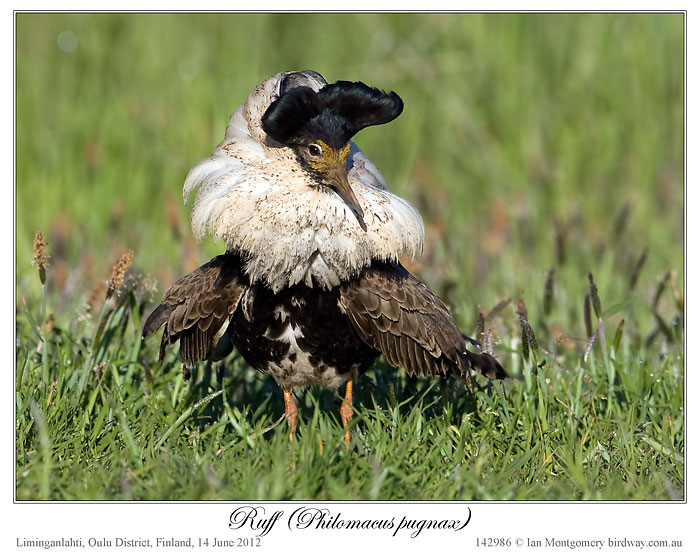
This week we have nothing short of a fashion parade, male Ruffs at a communal display ground or lek in eastern Finland. Finland is my second stop-over on the way to Ireland to visit my family and I am spending a week in the northern part of the country in search of some unusual northern European birds. I spent a couple of nights in Oulo on the west coast, a 1 hour flight north of Helsinki and then drove north west to Kuusamo near the Russian border where I am now.

In Oulu, the birding and wildlife tour company Finnature put me very early in the morning in a hide that they had set up near the lek. I settled down to watch a rather unpromising-looking piece of raised ground in a meadow, having been assured that, though it was late in the season, a couple of birds had been seen at the lek on the previous morning.

Ruff (Philomachus pugnax) by Ian 2

Ruff (Philomachus pugnax) by Ian 2

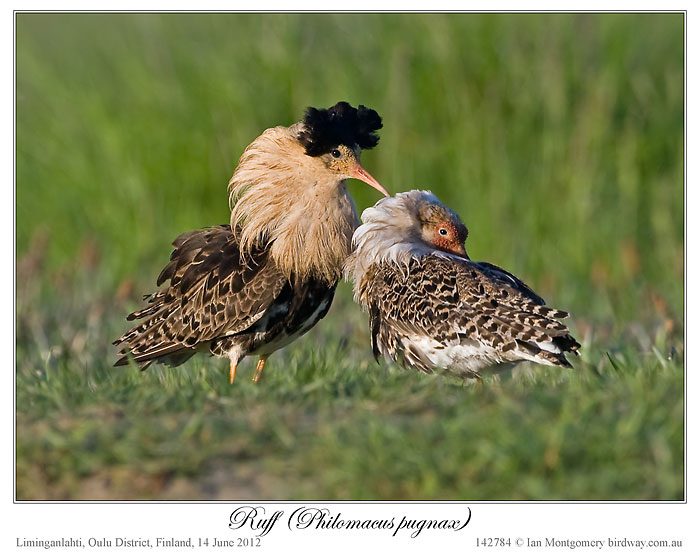
After about half an hour and shortly before 4:00am the black-ruffed bird in the second photo arrived but flew off when I moved the camera. Happily, it soon returned and this time the second white-ruffed bird arrived too and the pair started their extraordinary display, spreading their ruffs and wings apparently to make themselves appear as intimidating as possible. Sometimes, they jumped vertically in the air and at other times they crouched low on the ground in submissive looking postures.

Ruff (Philomachus pugnax) by Ian 3

Ruff (Philomachus pugnax) by Ian 3

Although the birds often came into close physical contact, there was no actual fighting and no physical damage. These black- and white-ruffed birds were the main performers during the 4 hours that I remained in the hide, but other birds joined in and at one stage there were about 10 birds on the lek. The colours of the ruffs and the erectile feathers on the head were varied. Here is a buff and black one with the white bird.

Ruff (Philomachus pugnax) by Ian 4

Ruff (Philomachus pugnax) by Ian 4

The colour of the bare wattled skin on the face varied too, being sometimes yellow and sometimes red, though it was my impression that this colour wan’t permanent and the red flush was associated with more intense display. This non-displaying one with a chestnut cap, piebald ruff has yellow facial skin.

Ruff (Philomachus pugnax) by Ian 5

Ruff (Philomachus pugnax) by Ian 5

This one is mainly chestnut.

Ruff (Philomachus pugnax) by Ian 6

Ruff (Philomachus pugnax) by Ian 6

While this one with an ermine ruff look suitably regal.

Ruff (Philomachus pugnax) by Ian 7

Ruff (Philomachus pugnax) by Ian 7

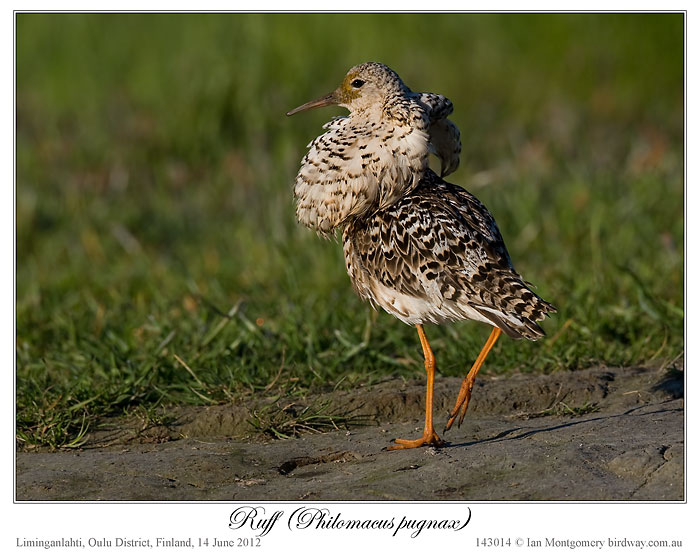
Ruffs are unusual among lekking birds in that the display is aimed mainly at other males to establish dominance, rather than at attracting females. Females may mate with multiple males producing young with different fathers and homosexual mating also occurs. The different ruff colours are apparently significant and white-ruffed males are smaller and less dominant and called satellite males.

Ruff (Philomachus pugnax) by Ian 8

Ruff (Philomachus pugnax) by Ian 8

The females, called Reeves, are quite plain and look rather like other sandpipers such as Sharp-tailed and Pectoral. In non-breeding plumage, the males resemble the females but are larger and longer-necked. Ruffs breed across northern Eurasia from Scandinavia to Siberia and winter in Africa, Asia and, in small numbers, Australia. You can see a female and ruff-less male, photographed in India, here: http://www.birdway.com.au/scolopacidae/ruff/index.htm.

Who said waders are plain and boring? I had a wonderful time at this lek. The Ruffs wasn’t one of my target species in Finland but an unexpected bonus, thank you Finnature. My main target was the largest Woodpecker in Europe, the Black Woodpecker, but that’s another story.

Best wishes
Ian

**************************************************
Ian Montgomery, Birdway Pty Ltd,
454 Forestry Road, Bluewater, Qld 4818
Tel 0411 602 737 ian@birdway.com.au
Check the latest website updates:
http://www.birdway.com.au/#updates
**************************************************


Lee’s Addition:

What a group of “show offs.” I find these birds amazing. Never thought of this family as having leks like the pheasants and those in that order. Just goes to show you that the birds are doing what they are suppose to and that is reproducing. What a show for the females to get to watch.

Bring out with you every living thing of all flesh that is with you: birds and cattle and every creeping thing that creeps on the earth, so that they may abound on the earth, and be fruitful and multiply on the earth.”
(Genesis 8:17 NKJV)

The Ruff is in the Scolopacidae – Sandpipers, Snipes Family in the Charadriiformes Order.

*

Ian’s Bird of the Week – Chinese Pond Heron

Chinese Pond Heron (Ardeola bacchus) by Ian 1

Chinese Pond Heron (Ardeola bacchus) by Ian 1

Ian’s Bird of the Week – Chinese Pond Heron ~ by Ian Montgomery

Newsletter ~ 6-11-12

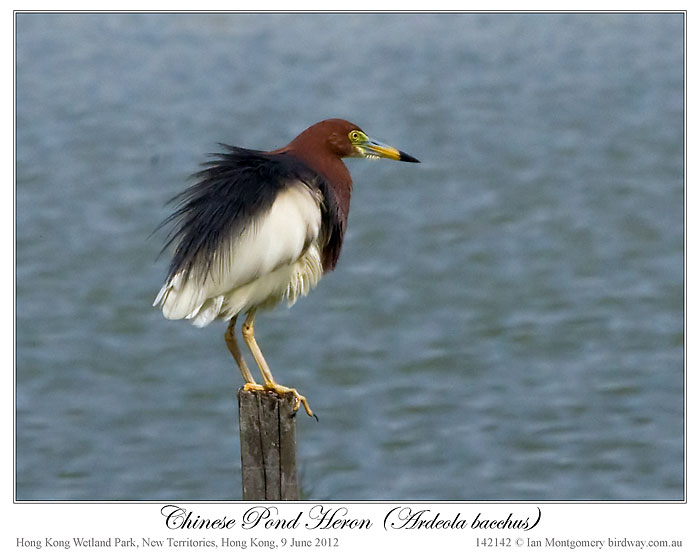
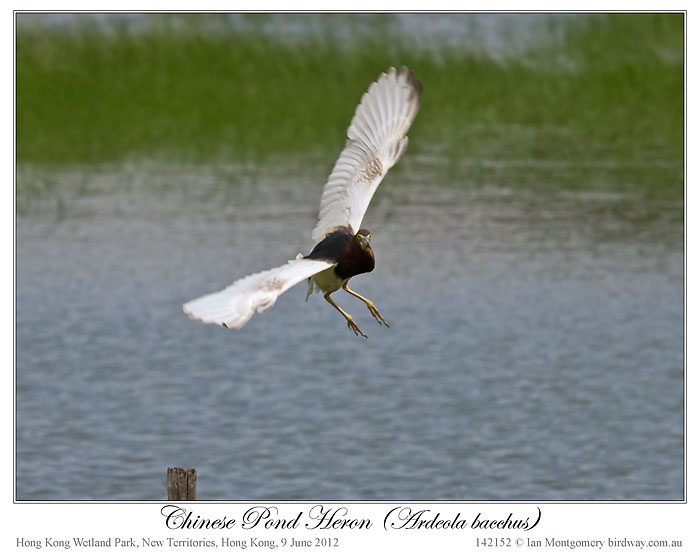
I’m stopping over for a few days in Hong Kong. It’s not the best time of the year for birding here – the northern spring and autumn/fall are good for migrants and the northern winter is good for waders and waterbirds – but we did go out to the Hong Kong Wetland Park near Mai Po reserve in the New Territories on Saturday. One of the species I was keen to see was the Chinese Pond Heron and this one in breeding plumage landed on a post near the hide/blind we were in.

This was of interest to me as it’s on the Australian list as a rare vagrant and I’d seen only non-breeding birds before (in Malaysia). The non-breeding plumage is streaky brown and white and not very distinguished, but when breeding the birds acquire striking black, white and chestnut plumage with a multi-coloured bill. This bird fluffed out its feathers, preened itself a bit and settled down for a few seconds, second photo.

Chinese Pond Heron (Ardeola bacchus) by Ian 2

Chinese Pond Heron (Ardeola bacchus) by Ian 2

These are stocky, mid-sized (47cm/19in in length) herons that feed on fish and invertebrates. Their breeding range includes China and northern Japan. In the northern winter some migrate south to Malaysia and Indonesia, including Java, and sometimes they overshoot and end up in the Australian territories of Christmas and Cocos (Keeling) Islands and on the Australian mainland. This particular one hung around for thirty seconds and then took off, third photo, showing how high they can jump when taking off – they need to be able to do this to take off from reed beds.

Chinese Pond Heron (Ardeola bacchus) by Ian 3

Chinese Pond Heron (Ardeola bacchus) by Ian 3

In flight, fourth photo, the bird displays the striking white wing characteristic of all six species of Pond Herons (genus Ardeola). These are mainly Asian and African species, though the Squacco Heron occurs in southern Europe. The Chinese Pond Heron is closely related to the rather similar Indian Pond Heron (this one was photographed behind the Taj Mahal.

Chinese Pond Heron (Ardeola bacchus) by Ian 4

Chinese Pond Heron (Ardeola bacchus) by Ian 4

Only 30 seconds elapsed between the first and last photos, so we were lucky to have this encounter and it was the only one we saw. The Hong Kong Government is making admirable efforts, through Mai Po Reserved and the restored Hong Kong Wetland Park, to conserve wildlife, but the area is very close to the densely populated and heavily industrialised areas of southern China and the local population of Chinese Pond Herons is suffering from the effects of water pollution on their prey (mud skippers and crustaceans).

Best wishes
Ian

**************************************************
Ian Montgomery, Birdway Pty Ltd,
454 Forestry Road, Bluewater, Qld 4818
Tel 0411 602 737 ian@birdway.com.au
Check the latest website updates:
http://www.birdway.com.au/#updates
**************************************************


Lee’s Addition:

Ian, you sure get around. What a beautiful bird all decked out to “woo” its mate.

Ian has a photo of Chinese Pond Herons on his Birdway website that are in normal plumage. Not as impressive as the one above, but more normal. These herons belong to the Ardeidae – Herons and Allies Family. See a list and photos of the whole 72 species of  Herons, Bitterns and Egrets.

The stork, the heron of any variety, the hoopoe, … (Deuteronomy 14:18 AMP)

See all of Ian’s Birds of the Week articles.

*

Ian’s Bird of the Week – Royal Albatross

Southern Royal Albatross (Diomedea epomophora) by Ian 1

Southern Royal Albatross (Diomedea epomophora) by Ian 1

Ian’s Bird of the Week – Royal Albatross ~ by Ian Montgomery

Newsletter ~ 6-3-12

It seems only fitting to celebrate the Diamond Jubilee of Queen Elizabeth with something appropriate, so here is the Royal Albatross, or Royal Albatrosses if you accept, as most now do, the split into Northern and Southern species. Apart from just the Royal title, these birds are also very long lived (up to 60 years) and travel huge distances, routinely circumnavigating Antarctica. It has been estimated that a 50 year old Albatross has travelled 2.8 million miles which compares quite well with the Queen’s 261 official overseas visits and 96 state visits to 116 countries.

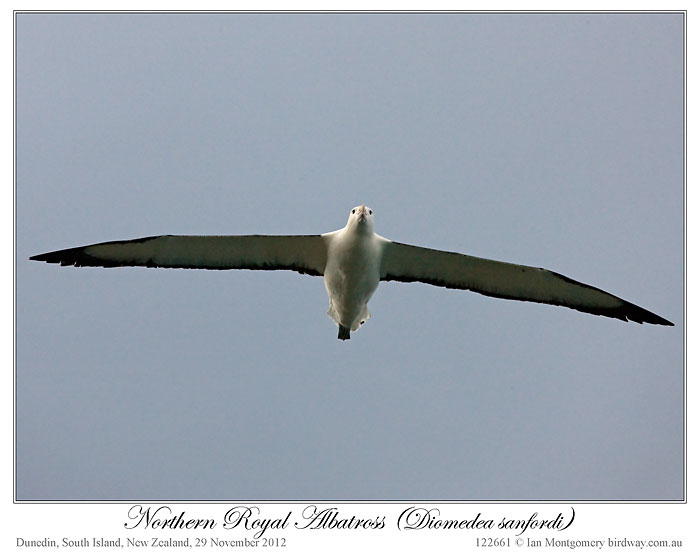
On the Sub-Antarctic trip last November, Royal Albatrosses, mainly Southern like the one in the first photo, were regular and very welcome companions in the Southern Ocean. It was always a thrill to see these huge birds completely at home in the wildest weather that the Ocean could throw at them and soaring apparently effortlessly in gale-force winds. If you look carefully at the first photo, you can see the dark (bluish) line along the upper mandible which distinguishes it from the similar Wandering Albatrosses. The other feature of note is the white leading edge to the dorsal surface of the wing. As Southern Royal Albatrosses age, the amount of leading white increases and this distinguishes it from both the Wandering Albatrosses, where the amount of white increases along the centre of the wing, and the Northern Royal Albatross where the wings remain black, as shown in the second photo.

Northern Royal Albatross (Diomedea sanfordi) by Ian2

Northern Royal Albatross (Diomedea sanfordi) by Ian 2

With a little practice, it wasn’t too difficult to distinguish between Northern and Southern birds. What helped was the fact that Royal Albatrosses do not have a confusing array of juvenile plumages, unlike their cousins the Wandering Albatrosses. The juveniles have black tips to the tale and blackish scalloping on the back (the mantle) between the wings but are otherwise similar to the adults.

Southern Royal Albatross (Diomedea epomophora) by Ian 3

Southern Royal Albatross (Diomedea epomophora) by Ian 3

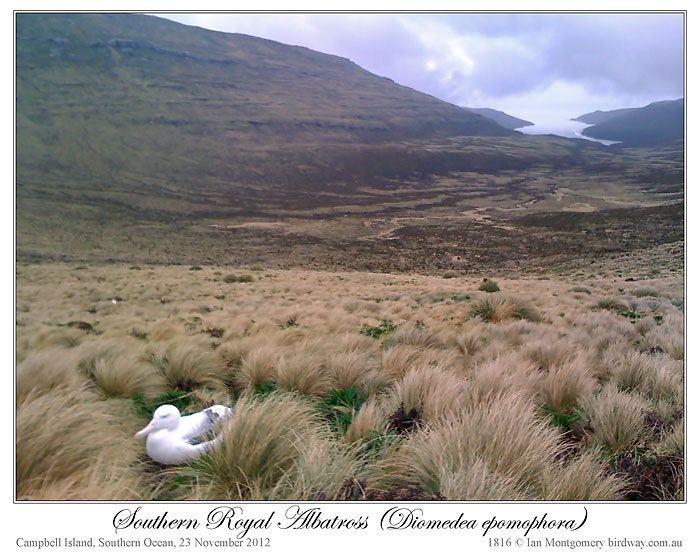
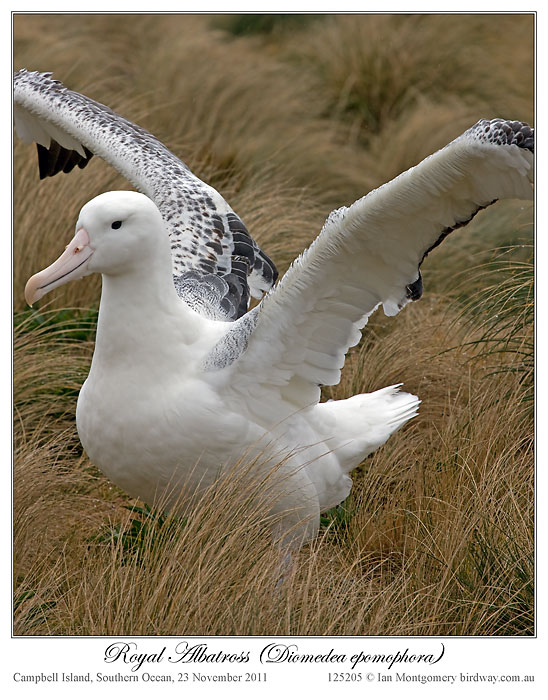
On Campbell Island, we had the opportunity to hike up path to a Southern Royal Albatross colony on a bleak, tussocky moorland. As you can see in the the third photo, things were fairly quiet when we got up there in the morning. They got busier in the afternoon when more birds arrived and some people saw greeting ceremonies, but by then, rather wet and cold, I had returned to the ship for a comforting coffee. There were strict rules about where we could leave the designated path and how close we could approach wildlife, but the albatross in the fourth photo stretching its wings flouted the rules and wandered, or blundered – they’re ungainly on land – right past me.

Southern Royal Albatross (Diomedea epomophora) by Ian 4

Southern Royal Albatross (Diomedea epomophora) by Ian 4

Albatrosses have deceptively gull-like proportions so it is a shock to realise, up-close, just how huge they are. The size record goes to the exulans race/species of the Wandering Albatross, but the Royals are not far behind and an apt comparison is with swans rather than other seabirds, ignoring length where swans have an unfair neck advantage. Southern Royal Albatrosses weight between 6.5 and 10.3kg/14.3 and 22.7lb while the heaviest flying bird, the Mute Swan, ranges between 9kg and 12kg/20 and 33lb. However Royal Albatrosses have a maximum wingspan of up to 3.5m/138in while Mute Swans range up to a mere 2.4m/94in. Just enormous in other words. The contrasting delicacy of the lacy pattern on the back is striking, and the fifth photo shows the tubular nostrils and the dark line along the mandible.

Southern Royal Albatross (Diomedea epomophora) by Ian 5

Southern Royal Albatross (Diomedea epomophora) by Ian 5

Happily, you don’t have to go Campbell Island to see these wonderful birds. Taiaroa Head, a mere 30km from the centre of Dunedin on the South Island of New Zealand, has the only mainland colony of albatrosses in the world. These are Northern Royal Albatrosses and, although I got there too late in the day to gain entry to the Royal Albatross Centre – I gave the local Yellow-eyed Penguins a higher priority – the one in the last photo flew right over me as I stood in the car park.

Northern Royal Albatross (Diomedea sanfordi) by Ian 6

Northern Royal Albatross (Diomedea sanfordi) by Ian 6

Enjoy the Jubilee!

Ian

**************************************************
Ian Montgomery, Birdway Pty Ltd,
454 Forestry Road, Bluewater, Qld 4818
Tel 0411 602 737 ian@birdway.com.au
Check the latest website updates:
http://www.birdway.com.au/#updates
**************************************************


Lee’s Addition:

Wow! Did you read the wingspan on those Albatrosses? 138 inches is 11 1/2 feet. That is amazing! I still just sit back in awe when I hear about these wonderfully created birds.

Check out Ian’s Albatrosses on his site and then check the whole family – Diomedeidae – Albatrosses

Keep me as the apple of Your eye; Hide me under the shadow of Your wings, (Psalms 17:8 NKJV)

Because You have been my help, Therefore in the shadow of Your wings I will rejoice. (Psalms 63:7 NKJV)

*