GO, FLY — A KITE !

GO, FLY — A KITE!

Dr. James J. S. Johnson

And the vulture, and the kite after his kind…. (Leviticus 11:14)

And the glede, and the kite, and the vulture after his kind …. (Deuteronomy 14:13)

Flies (and other flying insects) better flee, whenever a hungry Mississippi Kite flies by!

MISSISSIPPI KITE (Dick Daniels / Wikipedia photo credit)

Perhaps the term “kite”, translating the Hebrew noun אַיָּה [’ayyâh] in Leviticus 11:14, and in Deuteronomy 14:13, refers to the Black Kite (Milvus migrans) that currently dwells in the Holy Land – as well as in several parts of Eurasia, Australia, and Africa.

Once, recently, while I was gazing at tree-perching cardinals and mockingbirds, a Mississippi Kite (Ictinia mississippiensis) landed on a tree-branch near my house, recently (Wednesday, May 7th, A.D.2025), letting me to see its magnificent movements and eye-catching plumage. 

During springtime, here in North Texas, local insect populations are booming – and this busy bonanza is an insectivore’s smörgåsbord for Mississippi Kites, who love to eat flying and crawling insects (bees, cicadas, dragonflies, grasshoppers, and more!). 

MISSISSIPPI KITE hunting dragonfly (Matthew B. Furst image credit)

Also, these diurnal raptors (i.e., daytime hunters) employ their short hooked beaks to eat other small animals, e.g., small snakes, lizards, frogs, mice, bats, and even small birds.  If cicadas are abundant, as they periodically are, kites may feast on them beyond other foods.  [See Stan Tekiela, “Mississippi Kite”, BIRDS OF TEXAS FIELD GUIDE (Adventure Publications, 2020), pages 326-327.]

This mostly grey-colored maneuvering marvel has a black tail, dark-red eyes (surrounded by black “blackeye-like eyepatches), red-to-yellow legs, charcoal-grey (with some russet-brown) plumage on the wings, and whitish-grey “ashy” underside and head; the kite’s head is such a pale grey that it is almost white, similar to a Scissor-tailed Flycatcher’s head. It is easy to remember a Mississippi Kite when you see one – what a beautifully bioengineered and impeccably constructed bird it is! 

Mississippi Kite parent, feeding a dragonfly to its young chick
(Ozark Bill Duncan photo credit)

In fact, the Mississippi Ornithological Society (which, as its name indicates, is an ornithological society that focuses on Mississippi birds) has named its semiannual journal for this marvelous bird (see https://missbird.org/kite/ ).

Smaller than eagles, vultures, and most hawks, these aerial acrobats are migratory accipiters, i.e., smaller hawks with short, broad wings, plus relatively long legs (with precision-designed talons!), often found flying fastly in wooded habitats that include riparian edges.  Since my neighborhood has several ponds and drainage ditches, it’s no surprise that kites visit occasionally – this is not the first time that I’ve seen a kite on my homeplace.

MISSISSIPPI KITE (Cornell Lab of Ornithology photo credit)

Unsurprisingly, this Mississippi Kite visited my Texas homestead in springtime. These kites routinely winter in Central or South America, yet sometimes they winter within the Rio Grande Valley of South Texas.  During spring they migrate northward, to their summer nesting-and-breeding grounds; besides Mississippi (where they are famous for dwelling near the Mississippi River), they migrate to breeding ranges north of Mexico, including Arizona, New Mexico, Oklahoma, Louisiana, Colorado, Kansas, Missouri, and much of northern Texas.  Some are even known to have migrated as far north as South Dakota, or as far east as Florida!  [See, accord, David E. Fantina, “Mississippi Kite”, THE TEXAS BREEDING BIRD ATLAS (posted at Texas A&M AgriLife Research, at https://txtbba.tamu.edu/species-accounts/mississippi-kite/ .]

MISSISSIPPI KITE (J. J. Audubon image credit / public domain)

According to Texas Parks & Wildlife Department, kites are social creatures:

Mississippi kites are very social in all activities. They do not maintain territories and they congregate at roosts in late summer. . . . . Kites have been known to fly about cattle and horsemen in order to catch insects that are stirred up from the grass [acting as the airborne equivalent to pasture-strolling Cattle Egrets!].. . . .

Paired kites generally begin nesting soon after their arrival in their old nests or in newly constructed ones. In late May or early June, kites breed and both sexes will incubate usually two bluish-white eggs until they hatch 31 to 32 days later.

Mississippi kites, at times, cause problems for unsuspecting individuals. Kites, like many other birds, will dive at animals and people that venture too closely to their nests. This diving behavior is simply an attempt to ward off potential threats to the nest and young. Once the young leave the nest some 30 to 34 days after hatching, kites will stop their protective behavior. Kites normally may live to seven years of age in the wild.

[Quoting TP&WD,  https://tpwd.texas.gov/huntwild/wild/species/kites/ .]

Mississippi Kite perching
(Jeff Tibbits / Oklahoma Dep’t of Wildlife Conservation photo credit)

Kites are a lot like falcons, they are small birds of prey with streamlined and quick-darting maneuverability in flight.  They prefer to nest in habitats of tall trees – “near water, in open woodlands, savannahs, and rangelands  … [and sometimes] in urban settings” – according to Texas Parks & Wildlife Department (see  https://tpwd.texas.gov/huntwild/wild/species/kites/ ). 

What an unexpected privilege it was, a few days ago, when I spotted that Mississippi Kite landing upon that tree-branch – perhaps that tree had some insects that the kite spotted, and quickly consumed.  In any case, it’s a beautiful bird to which God gave admirable mobility.

Mississippi Kite parent, feeding cicada to its young chick
(Vincent Fouchi, Jr. photo credit)

So, here is a limerick to remind us of how the Mississippi Kite is an aerial hunter of insects:

MISSISSIPPI KITE, AERIAL HUNTER OF INSECTS

Eyes dark red, and head greyish-white,

Pointed wings, for quick-turning flight —

Its curled beak grabs a bee;

Insects, you better flee!

Beware the Mississippi Kite!

:)
SWIFTS, UNSURPRISINGLY, ARE SWIFT! (AND THEY MAKE A JOYFUL NOISE)

Dr. James J. S. Johnson

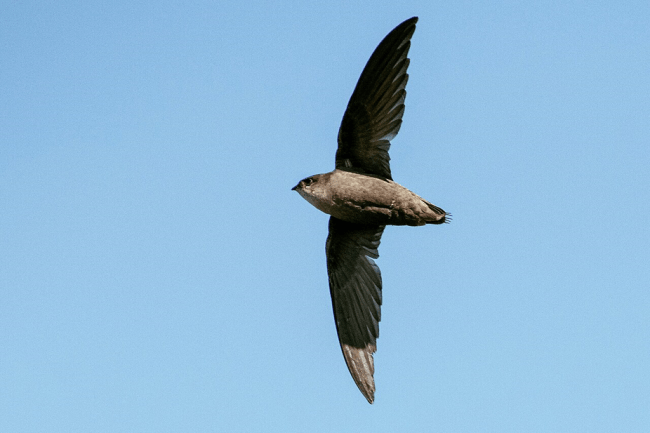
CHIMNEY SWIFT near Cleveland, Ohio, by Lake Erie
(Adam Jackson / Wikipedia photo credit) 

Make a joyful noise unto the LORD, all ye lands.   (Psalm 100:1) 

SWIFT is a fitting name for the swallow-like birds that swiftly dart, here-and-there, zigzagging and zipping and catching flying fast-food on the wing.  Also, they are known for nesting inside traditional chimneys.

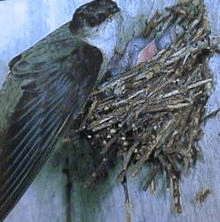
CHIMNEY SWIFT nesting (Wikipedia photo)

One of the well-known varieties of swifts are the Chimney Swifts (Chaetura pelagica), whose breeding ranges fill America’s eastern half plus some of the central prairie states. Swifts resemble swallows so closely, in morphology and in behavior, that swifts were originally categorized as swallows, e.g., by Carl Linnaeus, and later by ornithologists Mark Catesby and John James Audubon.

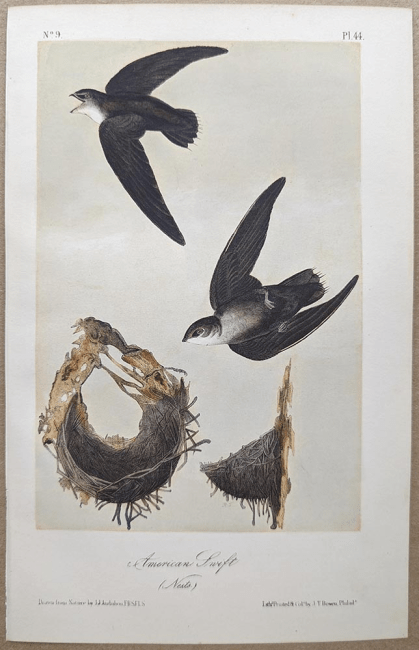
AMERICAN SWIFT by John James Audubon

Alonso Abugattas, on behalf of the CHESAPEAKE BAY JOURNAL, has recently reported on the Eastern seaboard’s Chimney Swifts, noting that these insectivorous birds are, as their name suggests, swift:

The twittering, darting flight of the chimney swift is a common sight in the skies of cities and towns in the Chesapeake Bay region during the warmer months. These birds are often best identified by their peculiar silhouettes even when they are high up in the air — looking like a “cigar with wings,” to borrow the description given to them by famed birding writer Roger Tory Peterson.

Male and female chimney swifts are identical in coloration, though the males may be slightly larger. These 5.5-inch birds are dark brownish gray with pale throats, short necks and round heads. Their tails are short, usually tucked to a point when in flight but sometimes spread out and square-ended. Their curved, scimitar-like wings extend far from the cigar-shaped body, giving them a wingspan more than twice their head-to-tail length. Surprisingly, swifts are not closely related to swallows, appearances notwithstanding.

Chimney swifts are true to their name, being very fast in the air, and their flight is fairly distinctive with rapid wing beats followed by a short glide. They are built to be aerial acrobats, rarely touching down except to nest and roost. They do every-thing else airborne. They feed, mate, drink, bathe and even snooze on the wing. Feeding is easy, because 95% of their diet is flying insects, using their short but wide bills to capture prey. They skim across water to drink and sometimes scoop up aquatic bugs the same way.  . . . .

The chimney swift (Chaetura pelagica) is part of the swift family Apodidae, meaning “without feet.” They do have feet, of course, but very short and inept ones, making them clumsy on land and unable to land adroitly on branches. They are built to hang vertically inside hollow trees, chimneys and confined walls (sometimes even upside down, giving them the nickname “chimney bat”).

[Quoting Alonso Abugattas, “Roosting of Flying, the Chimney Swift Lives Up to its Name”, CHESAPEAKE BAY JOURNAL, 34(7):39 (October 2024).]

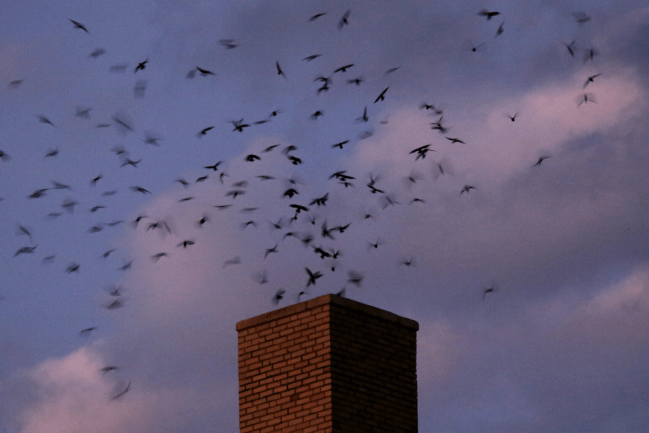
CHIMNEY SWIFTS flying over brick-and-mortar chimney
(Ben Cvengros / Travis Audubon Society photo credit)

Thus, the Chimney Swift is at home in the air, winging it—rather than casually perching somewhere, waiting for the next crawling bug to creep by—and so they are easily seen when they perform their aerial acrobatics.

Make a joyful noise unto the LORD, all ye lands.   (Psalm 100:1) 

What is making a “joyful noise”?  It is commanded is Scripture, whatever it is – see Psalm 66:1; 81:1; 95:1-2; 98:4; 98:4; 100:1.

To many, the noise of circuitous swifts is just that, a screeching-like screaming noise — not the kind of “music” that King David would have included in his orchestra-supported choir (1st Chronicles 15:16). But to a bird-lover, the aerial call of this air-zooming insectivore is a “joyful noise”, installed and directed by the Composer and Giver of all birdsong (and other avian vocalizations).  Yes, as others ignore them, I enjoy hearing the energetic calls of Common Swifts (Apus apus), as they zip around, in hunting packs, de-bugging the lower airspace during the bug-filled days of summer.

(Quoting JJSJ, “Making a Joyful Noise in Estonia’s Tallinn:   A Quick Memoir of Common Swifts”, posted at https://leesbird.com/2016/10/04/making-a-joyful-noise-in-estonias-tallinn-a-quick-memoir-of-common-swifts/ .)

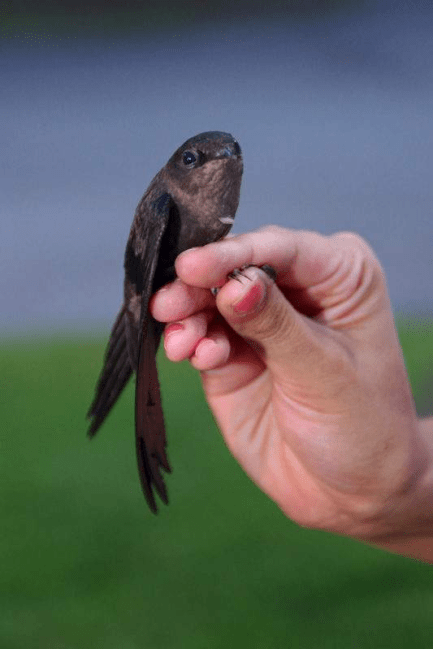
CHIMNEY SWIFT (Greg Harber / Alabama Birding Trails photo credit)

The Chimney Swift’s migratory behavior, as well as their propensity for flying (rather than perching) is described by ornithologist Donald Stokes:

The arrival of swifts in late spring is an exciting moment.  You will probably first hear their chittering calls, then look up and see their small bodies and curved, bladelike wings slicing through the air in graceful arcs. Their constant flight throughout the day makes them both physically and experientially remote from our earthbound living.  But even so, bending back your neck to see only sky and these streamlined birds gliding about can draw you into their world of flight—so much so that when you again look down it may take you a moment to reorient yourself to the world of the flightless.

More than any of our other common birds, the Swift’s life is lived on the wing.  As migration gets under way, large flocks can be seen in the early morning flying in formation over possible roosting sites and calling loudly all the time. Then, as it starts to get dark, they begin to dive into the roost, sometimes forming a steady stream out of the airborne flock.

[quoting Donald W. Stokes, STOKES NATURE GUIDES (A GUIDE TO BIRD BEHAVIOR), volume I (Boston, MA: Little Brown & Company, 1979), page 85.]

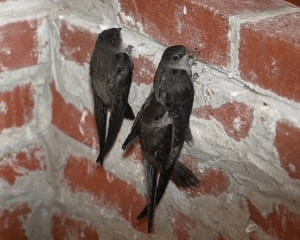
CHIMNEY SWIFTS on masonry wall (John Schwarz / Birdspix photo credit)

So, like busy Chimney Swifts, we should be busy at our daily activities, making a joyful noise –whistling (or singing)—while we work.

Make a joyful noise unto the Lord, all the earth: make a loud noise, and rejoice, and sing praise. (Psalm 98:4

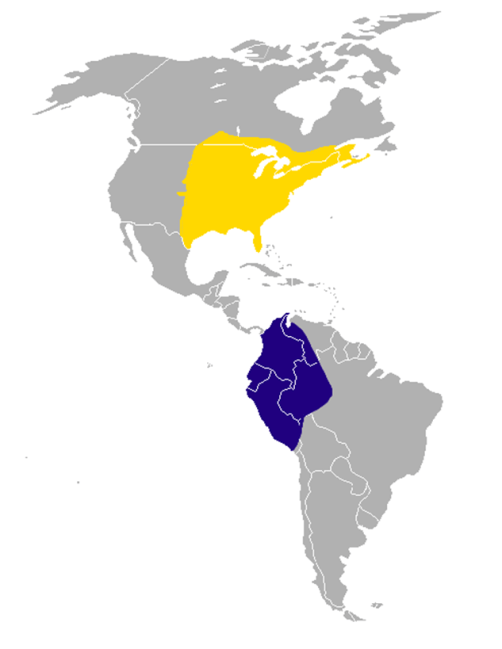
As a range map (see below, from Wikipedia) shows, Chimney Swifts are migratory birds, using the eastern half of America’s Lower 48 as their summer breeding grounds – yet where do they go for over-wintering?

By the fall, the swifts are in migration. For years, it was a mystery where they went — until 1943, when 13 leg bands were turned in by [native] people in eastern Peru, with eight of them having been banded in Tennessee. Since then, they have been found to overwinter in parts of Ecuador, Chile, Brazil and recently in Colombia.

[Quoting Alonso Abugattas, “Roosting of Flying, the Chimney Swift Lives Up to its Name”, CHESAPEAKE BAY JOURNAL, 34(7):39 (October 2024).]  

RANGE MAP of CHIMNEY SWIFTS   (Wikipedia map)

So, there!  Chimney Swifts are long-distance migrants, geographically resourceful in accordance with the providential phenology that God designed and installed into their software/hardware systems, fitting them to fill and flourish the habitats of God’s design. 

What a wonder!  Think of that, and how swarms of swifts silently glorify God, the next time that you see a brick-and-mortar chimney.  Who knows? Maybe you are looking at a chimney that houses the nest of a Chimney Swift family.

><> JJSJ  profjjsj@aol.com 

SCISSOR-TAILED FLYCATCHER: the Texas Bird of Paradise

SCISSOR-TAILED FLYCATCHER: the Texas Bird of Paradise

Dr. James J. S. Johnson

And the LORD shall make thee the head, and not the tail [zânâb]; and thou shalt be above only, and thou shalt not be beneath; if that thou hearken unto the commandments of the LORD thy God, which I command thee this day, to observe and to do them.

(Deuteronomy 28:13)

Usually we think of “head” as being valuable and important, but “tail” not so much. Being a “head” is desirable; being a “tail” not so — as Moses indicated in Deuteronomy 28:13, quoted above. (See also, indicating likewise, Deuteronomy 28:44 & Isaiah 9:15.) However, when God made birds, on Day #5 of Creation Week (Genesis 1: 20-23), God made them with feathered tails that blend practical traits (such as aerodynamic rudder functionality) with beauty (such as the extravagant tail of a peacock).

Among the “tyrant” flycatchers, certainly there is no better example of this blending, of beauty and bioengineering, than the Scissor-tailed Flycatcher, famous for eating flies on the fly.

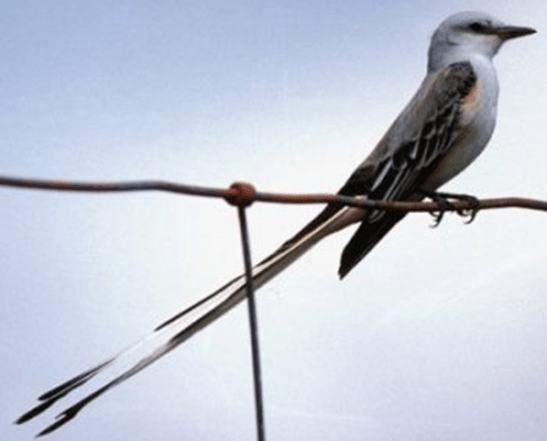
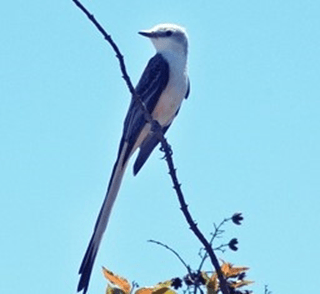
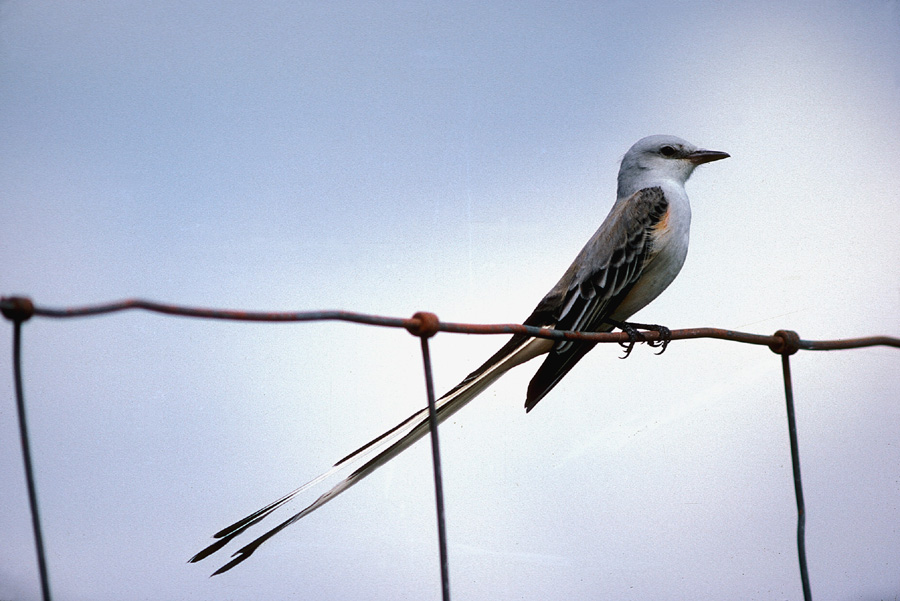
SCISSOR-TAILED FLYCATCHER perching on fence
Texas Parks & Wildlife Dep’t photo credit

Earlier this month [June A.D.2022], on 2 different occasions, I saw Scissor-tailed Flycatchers (Tyrannus forficatus) in my neighborhood.  One was larger than the other, so those must have been different Scissortails, because the size difference would not have occurred in just 3 days’ time! 

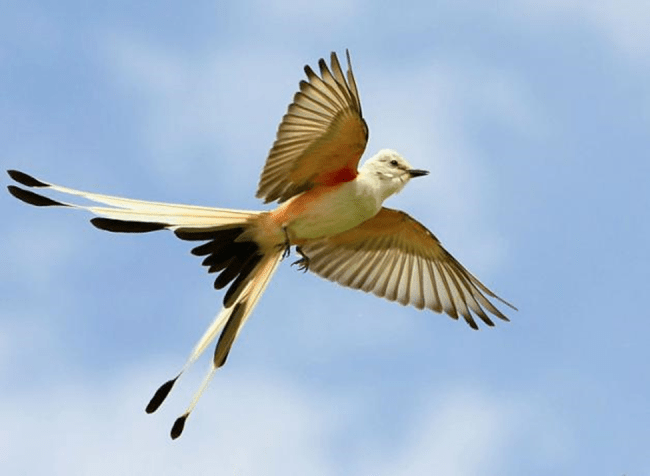
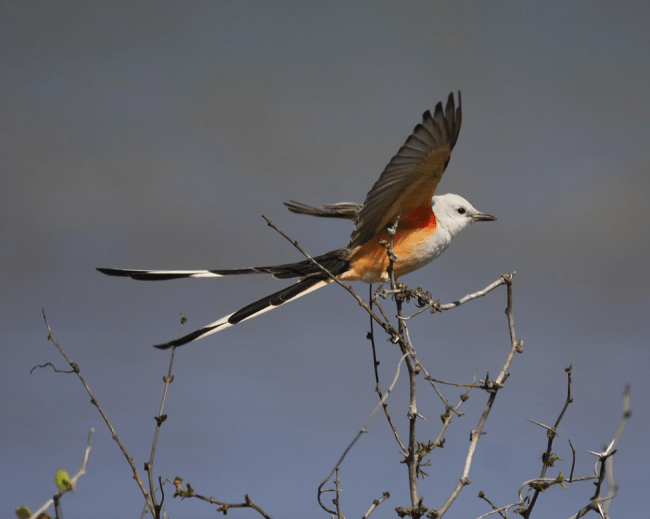
SCISSOR-TAILED FLYCATCHER flying
Ken Slade / BirdNote.org photo credit

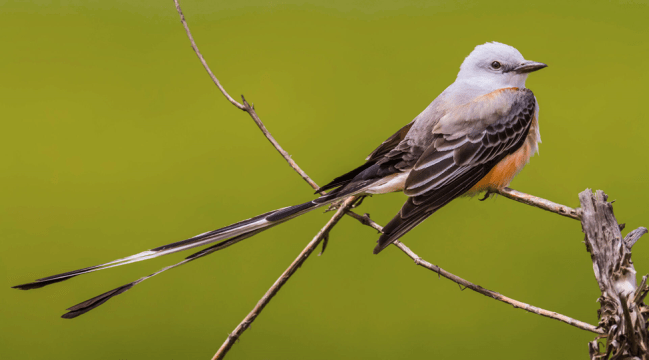
Scissor-tailed Flycatchers are beautiful squeaky-voiced birds with long-streaming split tail plumage that looks like long scissor blades. The Scissortail’s head and most of their plumage (neck, upper back, and breast) is soft-looking ivory-white (to very light grey), plus white-edged black on wings and tail feathers, with sides (flanks) and underwings that feature salmon-like orange-pink.

14” [long, including tail feathers.]  Very long split tail; pale gray body; pinkish wash on flanks.  In flight: Underwings bright pinkish orange.  …  Feeding: Flies from perch to catch insects on the ground [such as grasshoppers or beetles] or in the air [such as flies and dragonflies].

[Quoting from Donald Stokes & Lillian Stokes, “Scissor-tailed Flycatcher (Tyrannus forficatus)”, STOKES FIELD GUIDE TO BIRDS: WESTERN REGION (Boston: Little, Brown & Company, 1996), page 312.

This flycatcher (which also eats lots of grasshoppers) is well established throughout Texas, the Lone Star State, which is itself quite a range.  The Scissortail’s breeding range also includes Oklahoma (where it is the official state bird — a fact that I learned from Christian attorney Don Totusek!), as well as large parts of Kansas, Missouri, western Arkansas, western Louisiana, and small parts of eastern Colorado and Nebraska.  Probably the best places to see them during breeding season are Texas, Oklahoma, and Kansas.  As migrants, these kingbirds fly south of the USA for the winter, e.g., into Mexico—although some are observed over-wintering in southern Florida. [See, accord, Robert C. Tweit, “Scissor-tailed Flycatcher”, in Texas A&M AgriLife Research’s TEXAS BREEDING BIRD ATLAS, posted at https://txtbba.tamu.edu/species-accounts/scissor-tailed-flycatcher/ .]

SCISSOR-TAILED FLYCATCHER perching
Texas A&G AgriLife.org photo credit

If you have ever seen a Scissor-tailed Flycatcher you won’t forget it—Scissortails are unlike any bird you have ever seen, unless you have seen their shorter-tailed cousin called Mexico’s Fork-tailed Flycatcher (Tyrannus savanna, known in French as le tyran á queue fourchue = “the tyrant of the fork-tail”), with whom Scissortails can mate.  In fact, Scissortails are also known to hybridize with Couch’s Kingbird (Tyrannus couchii), as well as with Western Kingbirds (Tyrannus verticalis), which themselves hybridize with Eastern Kingbirds (Tyrannus tyrannus) — so there are many “cousins” within the greater kind-family of aggressive insectivores we call “tyrant kingbirds”. [See Eugene M. McCarthy, HANDBOOK OF AVIAN HYBRIDS OF THE WORLD (Oxford, U.K.: Oxford University Press, 2006), pages 203-204; see also Alexander J. Worm, Diane V. Roeder, Michael S. Husak, Brook L. Fluker, & Than J. Boves, “Characterizing Patterns of Introgressive Hybridization Between Two Species of Tyrannus Following Concurrent Range Expansion”, IBIS (International Journal of Avian Science), 161(4):770-780 (October 2019).]

SCISSOR-TAILED FLYCATCHER flying
eBird.org photo credit

One Scissortail (that I saw recently) was flying between trees on the side of a golf course.  The other Scissortail was flying from a residential lawn, that had a few trees and bushes, to another residential lawn, that also had a few trees and bushes. 

No surprise there, because Scissortails prefer to hunt insects in areas that mix open fields with trees and shrub cover, such as the semi-open country of grassy prairies, farm fields, suburb clearings, and ranchlands sporadically dotted with honey mesquite (Prosopis glandulosa) trees.

Scissor-tailed Flycatchers (Tyrannus forficatus) are Neotropical migrants that breed throughout the south-central United States with the highest breeding densities in southern Oklahoma and northern Texas, corresponding to the core of the breeding range …  In their breeding range, they occupy open areas that provide adequate hunting perches and nesting sites including savannahs, prairies, brush patches, agricultural fields and pastures. … Scissor-tailed Flycatchers require trees for nesting and hunting perches to support their foraging strategy given that they are sit-and-scan foragers that utilize perches such as shrubs, trees, utility wires and fences, while they scan for insect prey …. Most prey are captured in the air [“hawking”] a short distance from the perch [citation omitted] which further indicates the need for open habitat to facilitate foraging.

[Quoting from Erin E. Feichtinger & Joseph A. Veech, “Association of Scissor-Tailed Flycatchers (Tyrannus forficatus) with Specific Land-Cover Types in South-Central Texas”, WILSON JOURNAL OF ORNITHOLOGY, 125(2):314-321 (2013), at page 314.]

In other words, Scissortails prefer habitats with ecotones where open-field and forest-cover micro-habitats overlap, i.e., preferring to nest and hunt “in landscapes (linear transects 0.8-40.2 km in length and 2.4 km wide) with a mix of “open country” and “closed forest” than in landscapes comprise mostly of either of these two general cover types.” [Quoting from Feichtinger & Veech, page 314.]

SCISSORTAILED FLYCATACHER perching
Bird-Sounds.net photo credit

Scissortails perch and wait, watching for their next prey to move into capture range. Their method of hunting, called “hawking”, involves an aerial dash (with a sudden spurt of speed) toward a soon-to-be-seized target.  In more casual flight, however, this beautiful kingbird is easier to see and to appreciate.

The scissor-tailed flycatcher, with its namesake long, forked tails, is one of the most recognizable bird species on the Katy Prairie and throughout southeast Texas’s coastal prairie ecosystem. The male’s tail can reach up to 15 inches long while the female’s tail can reach about 10.5 inches, making the scissor-tailed flycatcher a spectacular sight to see.  The species name forficata, not surprising, derives from the Latin word for ‘scissors’ (forfex). The scissortail is a member of the Tyrannus, or ‘tyrant-like’ genus. This genus earned its name because several of its species are extremely aggressive on their breeding territories, where they will attack larger birds such as crows, hawks, and owls.

During the reproduction season between April and August, the male [Scissortail] performs a spectacular aerial display during courtship, sharply rising and descending in flight, its long tail streamers opening and closing, while the bird gives sharp calls. He may even perform backwards somersaults in the air.

[Quoting from Andy Goerdel, “State of the Species: Scissor-tailed Flycatcher (Tyrannus forficatus)”, COASTAL PRAIRIE CONSERVANCY (January 31, A.D.2022), posted at www.coastalprairieconservancy.org/blog/state-of-the-species-scissor-tailed-flycatcher .]

“Somersaults in the air”?  That reminds me of when I did flips, in the air, on a neighbor’s trampoline, more than a half-century ago.  But those days are over.  (At least I hope they are!) 

Nowadays I’d be happy to see a Scissor-tailed Flycatcher do aerial somersaults, as I sit comfortably in an Adirondack chair.  A glass of iced tea would help the birdwatching experience. Maybe, too, I could better appreciate looking, at a Scissortail’s salmon-colored underwings and flanks, as I snack on some smoked salmon.

But I digress.

SCISSOR-TAILED FLYCATCHER perching
National Audubon Society photo credit


Vermilion Flycatchers: Watching from Above

Vermilion Flycatchers: Watching from Above

Dr. James J. S. Johnson

For the ways of man are before the eyes of the Lord, and He pondereth all his goings.  (Proverbs 5:21)

The eyes of the Lord are in every place, beholding the evil and the good  (Proverbs 15:3)

Vermillion-Flycatcher-on-thistle.Links-of-Utopia

As our providence-giving Creator, God surveys (and interacts with) all of the world, watching from above. Yet many small parts of the earth are also “watched from above”, by many of the smallest creatures that God made on Day #5 –  the birds of the air, such as the Vermillion Flycatcher.

If you catch flies (or dragonflies!) for a living, you must fly yourself – quickly, darting here and there. Also, before nabbing an airborne lunch, you must perch and wait  —  attentively watch for it to appear within snatching distance, then go get it! In other words, before you catch, you need to “watch from above” – and that is what wary Vermilion (also spelled “Vermillion”) Flycatchers do.

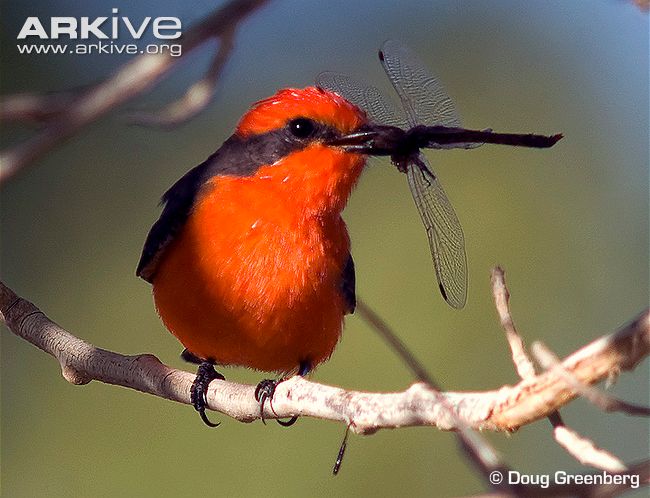
“Catching flies” is a feat that many outfielders perform in baseball parks, but the real flycatchers (i.e., the tyrant flycatcher family of perching birds, known as Tyrrannidae) rely on snatching their aerial insect prey as their primary dietary habit  —  and the colorful Vermilion Flycatcher (Pyrocephalus rubinus) is no exception.  In addition to flying insects (such as flies, wasps, honeybees, damselflies, and dragonflies), this tyrant flycatcher happily eats jumping insects (such as grasshoppers and crickets) and crawling bugs (such as beetles, spiders, and termites).

Vermilion-Flycatcher-male-with-dragonfly-prey.DougGreenberg-Arkive-photo

Typically, though, these acrobats nest in tree canopies, feeding in-flight. [Janine M. Benyus, THE FIELD GUIDE TO WILDLIFE HABITATS OF THE WESTERN UNITED STATES (New York: Simon & Schuster/Fireside Books), page 169.]

http://www.hbw.com/sites/default/files/ibc/v/converted/551596/vermilion_flycatcher_0_mp4_sd_1488396039.mp4 

https://www.youtube.com/watch?v=l3HyWMnvPk0  

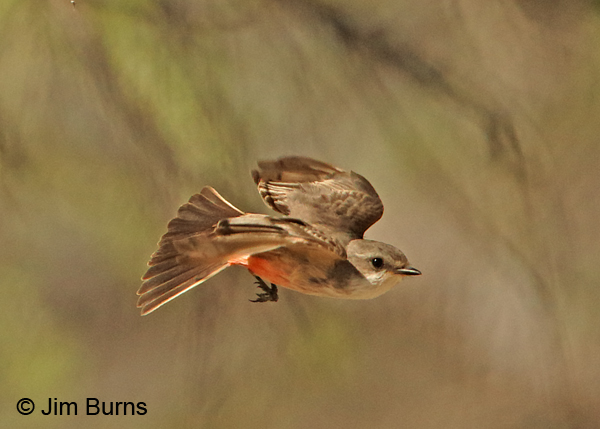
Vermilion-Flycatcher-female-flying.JimBurns

The ability of birds to watch “from above” is well-known. In fact, a 8-year-old poet (Sydney) recently alluded to that trait, in her succinct free verse:

     Birds:

     Fun colors, flying, watching from above.

     Birds.

[Poem “BIRDS” by Sydney Ledbetter, 5-27-AD2017.]

Sydney.earrings

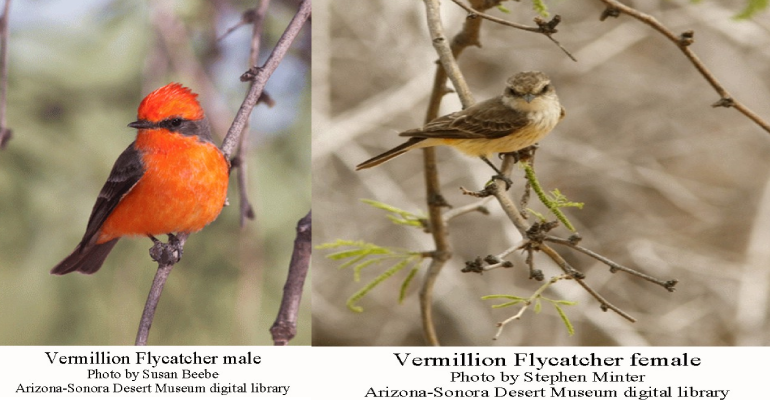
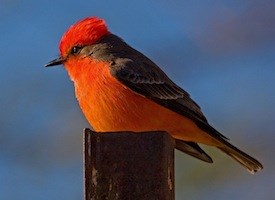
Actually, it is the male of the species that is so strikingly colorful —  with its bright scarlet head crest (which matches its technical name, meaning “fiery-head”), forehead, and neck, and its belly’s stark vermilion plumage  —  contrasted against its dark UPS-truck-brown eye-shadow “mask”, wings and tail.  (Vermilion, as a color, is a synonym for scarlet, perhaps connoting a hint of cinnamon-like orange shading, as in the mercury sulfide-dominated cinnabar pigment historically used by painters  —  see Jeremiah 22:14 & Ezekiel 23:14, KJV, referring to vermillion as a bright pigment painted on paneling).

Vermillion-Flycatcher-pair.Arizona-SonoranDesertMuseum

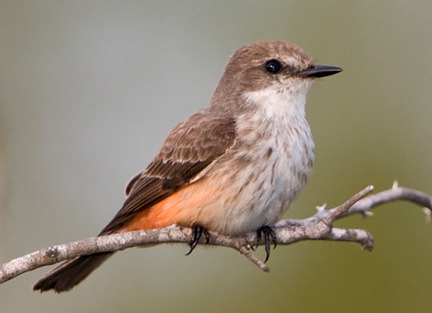
In drab contrast, the females have brown-grey plumage atop, with a whitish underside, featuring a whitish breast with mottled grey streaks, down to a lower belly of pinkish-peach plumage – somewhat like a juvenile Scissor-tailed Flycatcher, except the female Vermilion Flycatcher’s head is dark brown-grey. [See Roger Tory Peterson & Virginia Marie Peterson, A FIELD GUIDE TO WESTERN BIRDS (Boston: Houghton Mifflin, 1990), pages 230-231 and map M251.]  The Vermilion Flycatchers are relatively small birds, being only a fraction longer than 5 inches, and typically weighing less than a half-ounce!

Vermillion Flycatcher

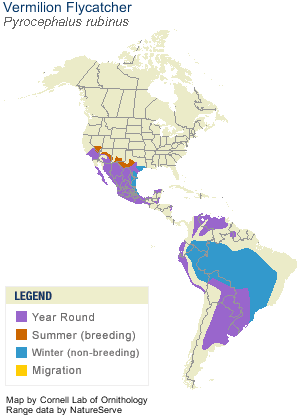
So where do Vermilion Flycatchers live? These aerial insectivores range widely in America’s Southwest  (mostly in the southern parts of California, Arizona, New Mexico, and Texas) and almost all of Mexico, plus southward into Central America (and even a few parts of South America).  Thus, the Vermilion Flycatcher is a year-round resident of the Chihuahuan, Sonoran, and Mojave Deserts.  Although the Vermilion Flycatchers generally prefer warm desert and semi-desert climes, they sometimes breed a bit north of their usual range, during spring-summer  —  such as in southern Nevada, where a pair was observed in the Great Basin scrubland near Reno, during mid-May of AD1981.  [See Fred A. Ryser, Jr., BIRDS OF THE GREAT BASIN (Reno: University of Nevada Press, 1985), page 346.]

A wide-ranging bird, this usually warm-climate passerine has even been observed crossing America’s northern border, up into Canada — and now there is even a webcam-verified report (4-17-AD2017) of a stray in Maine, on Hog Island [ see http://www.audubon.org/news/maines-first-verified-vermilion-flycatcher-captured-live-hog-island-web-cam ]!

Vermillion-Flycatcher-Range-MAP.Cornell

Geographically, speaking, what kind of habitats can be settled as “home” by Vermilion Flycatchers? Most places with adequate room for flying, and spying flies, will suffice, such as open meadows, farmland, ranchland, semiarid prairies, sagebrush-sprinkled scrublands, and brushy areas near water, such as desert streambanks, pond-edges, and mud-puddles  — i.e., wherever insects often congregate.  Their nests are known be constructed in cottonwoods, mesquites, oaks, sycamores, willows, especially alongside streambanks.

Although many birds of the desert and semi-desert scrublands are drab, including the Vermilion Flycatcher female, the Vermilion Flycatcher male is anything but drab! Its “fiery head” matches its scientific genus name, Pyrocephalus, and its species name, rubinus, reminds us of its ruby-like plumage.

Accordingly, as Pyrocephalus rubinus “watches from above” (with its “fun colors”, like the bright vermillion mentioned in Jeremiah 22:14),  we are reminded of how God Himself watches us from above,  providentially providing our lives with color and action and beauty,   —  maybe someday even including an opportunity to view a pair of Vermilion Flycatchers in America’s Great Southwest.      ><>  JJSJ

Vermillion-Flycatcher-on-post.LoisManowitz

FAIR USE IMAGE CREDITS:

Vermilion Flycatcher male perched on post: Lois Manowitz / Cornell

Vermilion Flycatcher atop thistle: Links of Utopia

Vermilion Flycatcher female flying:  Brent Paull

Vermilion Flycatcher male with dragonfly prey: Doug Greenberg / Arkive.org

Vermilion Flycatcher female perching: BirdFellow Productions

Vermilion Flycatcher female flying:  Jim Burns

Vermilion Flycatcher range map: Cornell Lab of Ornithology

Vermilion Flycatcher male & female: Arizona-Sonora Desert Museum

Sydney, wearing pierced-ear cross: Krista Ledbetter

s