Interesting Birds – Fairywrens of Australia & New Guinea

Variegated Fairywren (Malurus lamberti) by Ian

Variegated Fairywren (Malurus lamberti) by Ian

Thinking

I know all the birds of the mountains, and the wild beasts of the field are Mine. (Psalm 50:11)

To listen – Fairywrens by Creation Moments
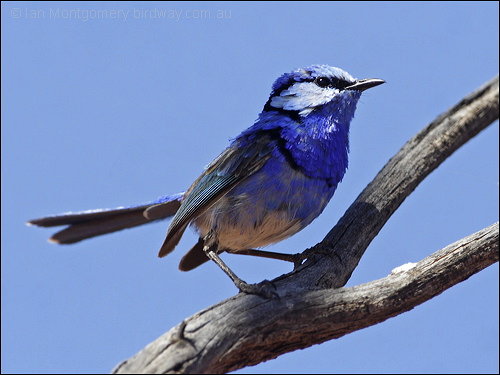
Splendid Fairywren (Malurus splendens) by Ian

Splendid Fairywren (Malurus splendens) by Ian

There are 13 species of a brightly plumed little songbird known as the fairy wren. The birds are found in Australia and New Guinea. So colorful are their feathers that the various species go by names like “superb,” “splendid” and “lovely.” However, even more noteworthy is the birds’ unusual behavior.

A male courting a female will bring her a flower petal. The petal usually matches his color or is a deeply contrasting color. Normally a perky little bird with an upright tail, when courting he lowers his tail and creeps around close to the ground. As he twists his body back and forth, he puffs out his cheek feathers. If the female accepts his courting, she builds their nest alone, lining it with bright parrot feathers. While they mate for life, they are not known for fidelity to their mates. When mature, females will go off on their own, but males may stay with their parents for a year or more. Their main duty is to guard the family nest. If danger approaches the nest, the guard will puff up his wings, lower his tail and scuttle through dry grass, pretending to be a mouse. The idea is to lure the predator away from the nest.

Lovely Fairywren (Malurus amabilis) by Ian

Lovely Fairywren (Malurus amabilis) by Ian

The beauty and unusual behavior of these little birds testifies to more than God’s creativity and love for beauty. They remind us of the beauty that was lost to God’s creation when it was tainted by man’s sin. Thankfully, some of that beauty that was lost can return to our lives through the forgiveness of sins that is found in Jesus Christ.

Prayer: Dear Father, I thank You for the beauty of Your creation and for giving me the forgiveness of sins in Jesus Christ. Amen.

References: Natural History, 11/94, pp. 56-62, “Faithful Philanderers

Copyright © 2010 Creation Moments, Inc., PO Box 839, Foley, MN  56329, www.creationmoments.com.


The Fairywrens are in the Maluridae – Australasian Wrens Family which is part of the Passeriforms Order. They are like in the true wrens (Troglodytidae family) in their shape and the way they cock their long tail. The Maluridae family not only includes the Fairywren, but also the Emu-wren and Grasswren. They range from 5-7.5 in (12-19 cm) to 8-8.5 in (20-22 cm). Most have a short, fine bill, while the Grasswren’s is a little thicker.

Superb Fairywren by Keith Blomerly

Interesting Birds – Hoatzin

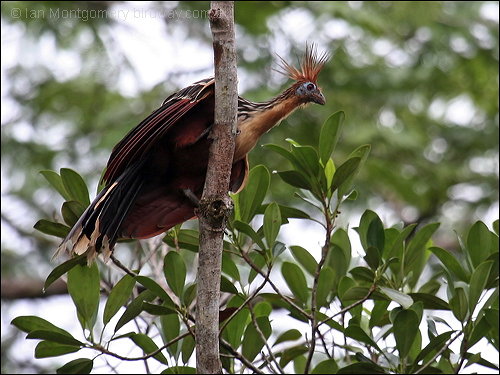
Hoatzin by Birdway

Hoatzin by Birdway

The Birds of the Bible usually cover the birds specifically mentioned by name in the Bible, but because of variation within the “kinds”, I decided to start covering some of their “Relatives.” The latest DNA-DNA and other testing have put the Hoatzin in the Cuckoo (Cuculiformes-cuckoos and relatives) family, but that data is being questioned at at present, they aren’t sure where to place it. For now, I stuck it with the Cuckoos. See Birds of the Bible – Cuckoo. (In IOC status it is in the Opisthocomidae Family)

The South American Hoatzin (pronunced hoh-AT-sin), is another of the Lord’s birds that keep evolutionist confused. Most birds eat berries or insects, but the Hoatzin, eats like a cow!

Is anything too hard for the LORD? (Gen 18:14 NKJV)

“The Hoatzin has one more odd characteristic that scientists find the most puzzling of all. Ninety five percent of its diet is leaves. It’s the only bird known to digest its food the same way cows and other ruminants do. Just like ruminants, the Hoatzin uses bacteria to break down the plant material it eats in a special chamber above its stomach.

Hoatzin by Birdway's Ian Montgomery

Hoatzin by Birdway’s Ian Montgomery

How do evolutionists explain this oddity? As one evolutionary scientist who has studied the Hoatzin for decades said, “Hoatzins don’t seem to follow the rules of evolution.” While he admitted to being creative in being able to come up with evolutionary explanations for creatures, he said that he was never able to arrive
at an evolutionary explanation for the Hoatzin’s digestive arrangement.

This leads us to glorify God for one more aspect of His creative work. In creating the Hoatzin, He was able to design a creature that defies any explanation humans might try to invent to deny that He is the Creator. Truly the creation declares His handiwork! (from Creation Moments, World’s Strangest Bird)

“The Hoatzin live in the backwater swamps of the Amazon and Orinco basins in South America.” They eat flowers, fruits, leaves of many marshland plants. The vegetable matter is fermented in their foregut like a cow, sheep, kangaroos and deer, while they sit around digesting their food.

“The Hoatzin chick features a rare anatomical feature — two claws on each budding wing which help it grip branches and clamber about awkwardly. This feature has been compared to Archaeopteryx, the fossil proto-bird, and lend a antediluvian background to what is already a really weird bird. Hoatzins live in family groups and small aggregations (up to 40 birds) and are social throughout the year.
During breeding birds occupy densely packed exclusive territories, sometimes up to 28 nests in one tree. They are noisy and often vocalize in unison with a collection of hoarse cries, grunts, growls and hisses. ” (from Hoatzin, Bird families of the World, see below)

Hoatzin by Ian

Hoatzin by Ian

The birds are pheasant-sized at about 25 inches with a long neck and small head. It’s face is unfeathered with maroon eyes, and its head is topped by a spiky, rufous crest. The bird is also called “stickbird” because of the bird’s manure-like odor, caused by the digestive system.

Though conspicuous, even attractive, at close range due to its bizarre shape and striking colors, unwary and a poor flier, it is not considered endangered. In fact, its survival seems to be more assured than that of many other endemics of its range. In Brazil, tribal people sometimes collect the eggs for food, and the adults are occasionally hunted, but in general this is rare, as it is reputed to have a bad taste. While its preferred habitats, mangrove and riverine forest, are disappearing fast in some regions, it is less threatened than terra firme forest, which is the primary target for deforestation in the Amazon. The Hoatzin therefore remains fairly common in a large part of its range.

Links about the Hoatzin:
Bird eats like a cow!
Hoatzin at Wikipedia
Hoatzin at Bird Families of the World

Hoatzins, Guyana’s National Bird aka the Stink Bird

Updated 12/17/09

From BereanBeacon