“Praise the LORD from the earth … fruitful trees and all cedars … and flying fowl.” (from Psalm 148:7-10)
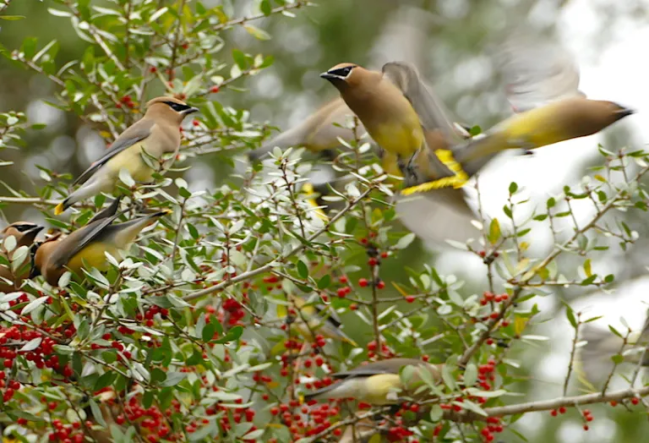
CEDAR WAXWINGS EATING BERRIES [photo credit: Wild Birds Unlimited]
Each spring gregarious flocks of Cedar Waxwings pass through my part of Texas, as they migrate northward toward their breeding grounds. No “lone rangers” here! Cedar Waxwings travel in flocks of many dozens–sometimes even hundreds–synchronizing their fast-food stopovers along the way, to refuel for the next aerial leg of their migratory trek. And trees or bushes with red berries are a particular favorite of Cedar Waxwings. Although the nutritional details are a bit technical — as noted below* — waxwings need to balance their sour berry intake with protein-rich pollen, both of which are available during mid-April in my part of Texas, as the flocks of Cedar Waxwings pass through in their flights northward.
So, when these large flocks of colorful waxwings make a “pit stop” for fast-food they often fill the branches of trees as they hastily consume red berries (and other edible nutrients), just before resuming their northbound flights to their spring-through-summer breeding ranges.
On April 7th A.D.2023, a Friday morning, as I observed this hastily convened arboreal assembly of avian migrants, I thought of the traditional assemblies (“things”) of the Vikings — such as those Nordic congregants convened annually in Iceland (Thingvellir’s “Althing”) and on the Isle of Man (at the Manx “Tynwald”), to conduct the serious business of life. Could it be that these Cedar Waxwings were having their own version of an Althing assembly, as they refueled (and rested briefly) during their stopover in the branches of my trees and bushes? Since I cannot understand the language of Cedar Waxwings I cannot know what they conversed about — but I knew that they would vacate northward soon enough, so I would not see them again until the next seasonal migratory pass-through, as they live out the providential phenology of their migratory lifestyle.
What a privilege it was to see God’s Cedar Waxwings–scores of them (perhaps more than a hundred!) as a flock in transit–quickly visiting the trees and bushes on the south side of my home. Surely God’s birds will remind us of His care for us, if we take the time to think about it–and have eyes to see (Matthew 6:26; Luke 12:24).
In fact, that faith lesson (which is was taught, in ancient times, to the patriarch Job, by God Himself (in Job 38:41), as is noted in the first of the 3 apologetics lectures (shown below) that I gave recently, to a Swedish theology school (Skandinavisk Teologisk Högskola):
CEDAR WAXWINGS [photo credit: Museum of Life & Science, Durham, N.C.]
So, now for a limerick, that memorializes my observations of the flock of Cedar Waxwings that briefly visited my frontyard earlier this month:
FAST-FOOD/FLY-THRU ALTHING OF MIGRATORY CEDAR WAXWINGS
A flock-full of birds, in my trees,
Gulped down every berry they’d seize;
This arboreal Althing
of the Cedar Waxwing
Soon adjourned—dispersed with the breeze!
CEDAR WAXWINGS photo credit: Mary Anne Borge / The Natural Web
[*For technical information, befitting Cornell University, about the diet of Cedar Waxwings, see Mark C. Witmer’s “Nutritional Interactions and Fruit Removal: Cedar Waxwing Consumption of Viburnum opulus Fruits in Spring”, ECOLOGY, 82(11):3120-3130 (November 2001).]
FOREST RAVEN (Corvus tasmanicus): eBird.org / David Irving photo credit
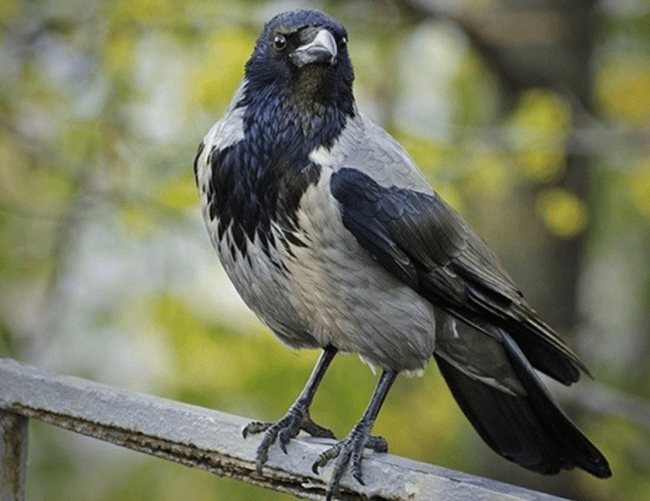
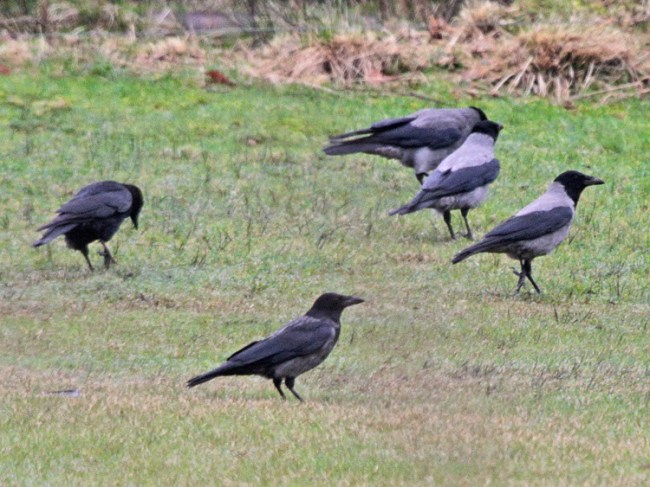
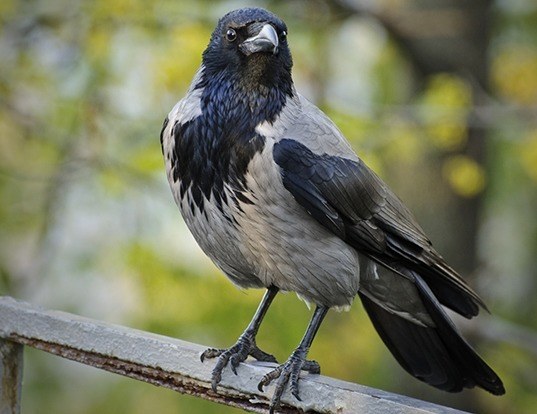
HOODED CROW (World Life Expectancy photo)
“Every raven after his kind” (Leviticus 11:15)
Who provides for the raven his food? When his young ones cry unto God, they wander for lack of food. (Job 38:41)
Consider the ravens: for they neither sow nor reap; they neither have storehouse nor barn, yet God feeds them; how much more are ye better than birds? (Luke 12:24)
[quoting from the HOLY BIBLE]
There is, as Moses noted, a “kind” (i.e., genetically related family) of birds that we call “corvids”, crow-like birds, including ravens. [In the English Bible (KJV), these birds are always called “ravens”.]
These black (or mostly black – see Song of Solomon 5:11) omnivores are known to “crow”, often calling out a harsh KAWWWW! Also famous for their “ravenous”appetites and eating habits, it is no wonder that the English labeled many varieties of these corvid birds as “ravens”.
The HOODED CROW (Corvus cornix) lives and thrives in the Great North – including Sweden, Finland, and Russia. This I learned firsthand, on July 6th of AD2006, while visiting a grassy park near the Vasa Museum of Stockholm, Sweden. The next day (July 7th of AD2006), it was my privilege to see another Hooded Crow in a heavily treed park in Helsinki, Finland. Again, two days later (i.e., the 9th of July, AD2006), while visiting Pushkin (near St. Petersburg, Russia), I saw a Hooded Crow, in one of the “garden” parks of Catherine’s Palace. Obviously, Hooded Crows appreciate high-quality parks of northern Europe!
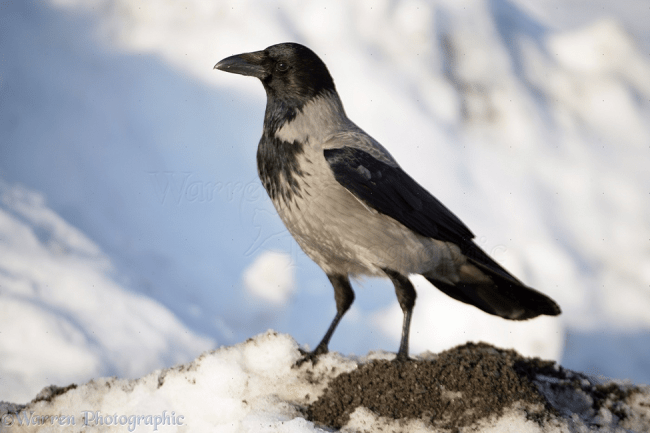
HOODED CROW (Warren Photographic photo credit)
The physical appearance of a Hooded Crow is, as one bird-book describes, “unmistakable”.
Unmistakable. Head, wings and tail black, but body grey (can show pinkish cast in fresh plumage).
[Quoting Chris Kightley, Steve Madge, & Dave Nurney, POCKET GUIDE TO THE BIRDS OF BRITAIN AND NORTH-WEST EUROPE (Yale University Press / British Trust for Ornithology, 1998), page 271.]
Like most large corvids, the Hood Crow is quite versatile in filling various habitats.
Wary, aggressive scavenger found in all habitats from city centre to tideline, forest to mountain top. Generally seen in ones and twos, but the adage ‘crows alone, rooks in a flock’ unreliable; often accompanies other crows, and hundreds may gather at favoured feeding spots and roosts. Watch for crow’s frequent nervy wing flicks whenever on ground or perched. Calls varied. Typically a loud, angry kraa, usually given in series of 2—6 calls. Unlike Rook, pairs nest alone (usually in tree).
[Again quoting Kightley, et al., POCKET GUIDE TO THE BIRDS OF BRITAIN AND NORTH-WEST EUROPE, page 271.]
CARRION CROW (Ouiseaux-Birds photo)
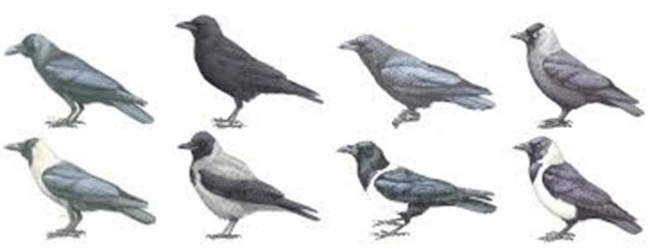
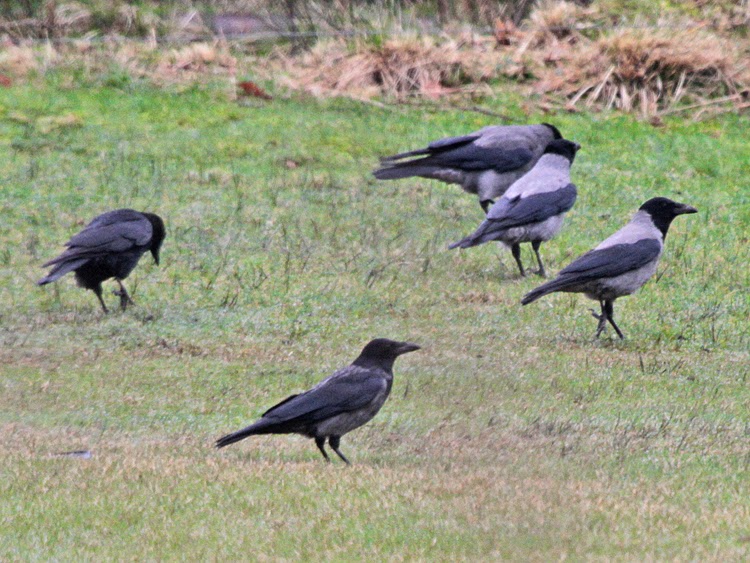
Yet the HOODED CROW is not a genetically self-contained “species”, regardless of what taxonomists might wish about them. They happily hybridize with other crows, especially the CARRION CROW [Corvus corone], whose international range the Hooded Crow overlaps.
CARRION AND HOODED CROWS. The familiar crow. Two distinct races occur … [In the]British Isles and western Europe, Carrion Crow (Corvus corone) is common everywhere except north and west Scotland, Ireland, Isle of Man and Europe east of Denmark, where it is replaced by Hooded (Corvus cornix). Where breeding ranges overlap hybrids are frequent [emphasis added by JJSJ].
[Again quoting Kightley et al., page 271.]
The Carrion-Hooded Crow hybrids are also noted within a larger discussion (i.e., pages 224-228) of Corvid family hybrids, in Eugene M. McCarthy, HANDBOOK OF AVIAN HYBRIDS OF THE WORLD (Oxford University Press, 2006), at page 227.
CORVIDS (Jelmer Poelstra / Uppsala University image credit)
Dr. McCarthy, an avian geneticist, has accumulated and summarized genetic research on Carrion-Hooded hybrids, especially examples observed in Eurasia:
Because the Carrion Crow has a split range … with the Hooded Crow intervening … there are two long contact zones, one extending from N. Ireland, through N. Scotland, to N.W. Germany, then S to N Italy, and another stretching from the Gulf of Ob (N Russia) to the Aral Sea. … Even in the center of the [overlap] zone, only 30% of [these corvid] birds are obviously intermediate. Due to hybridization these [corvid] birds are now sometimes lumped, but Parkin et al. (2003) recommend against this treatment since the two have obvious differences in plumage, as well as in vocalizations and ecology, and because hybrids have lower reproductive success than either parental type. Hybrid young are less viable, too, than young produced from unmixed mating (Saino and Villa 1992). Genetic variability increases within the hybrid zone (as has been observed in many other types of crossings). Occasional mixed pairs occur well outside [the overlap range] zones (e.g., Schlyter reports one from Sweden).
[Quoting Eugene M. McCarthy, HANDBOOK OF AVIAN HYBRIDS OF THE WORLD (Oxford Univ. Press, 2006), at page 227.]
Dr. McCarthy, on pages 224-228, lists several other examples of documented corvid hybridizations, including: Corvus capellanus [Mesopotamian Crow] X Corvus corone [Carrion Crow]; Corvus cornix [Hooded Crow] X Pica pica [Black-billed Magpie]; Corvus albus [Pied Crow] X Corvus albicollis [White-necked Raven]; Corvus albus [Pied Crow] X Corvus ruficollis [Brown-necked Raven]; Corvus albus [Pied Crow] X Corvus splendens [House Crow]; Corvus brachyrhynchos [American Crow] X Corvus caurinus [Northwestern Crow]; Corvus corax [Common Raven] X Corvus brachyrhynchos [American Crow]; Corvus corax [Common Raven] X Corvus corone [Carrion Crow]; Corvus corax [Common Raven] X Corvus cryptoleucus [Chihuahuan Raven]; Corvus corax [Common Raven] X Corvus levaillantii [Jungle Crow]; Corvus corax [Common Raven] X Corvus macrorhynchos [Large-billed Crow]; Corvus corax [Common Raven] X Corvus ruficollis [Brown-necked Raven]; Corvus corone [Carrion Crow] X Corvus macrorhynchos [Large-billed Crow]; Corvus daururicus [Jackdaw, a/k/a “Coloeus dauuricus”] X Corvus monedula [Jackdaw, a/k/a “Coloeus mondela”]; Corvus levaillantii [Jungle Crow] X Corvus macrorhynchos [Large-billed Crow]; Pica nuttalli [Yellow-billed Magpie] X Pica pica [Black-billed Magpie]; plus it looks like an occasional Rook [Corvus frugilegus] joins the “mixer”, etc. Looks like a good mix or corvids!
Avian hybrids, of course, often surprise and puzzle evolutionist taxonomists, due to their faulty assumptions and speculations about so-called “speciation” – as was illustrated, during AD2013, in the discovery of Norway’s “Redchat” — see “Whinchat, Redstart, & Redchat: Debunking the ‘Speciation’ Myth Again”, posted at https://leesbird.com/2017/12/12/whinchat-redstart-redchat-debunking-the-speciation-myth-again/ .
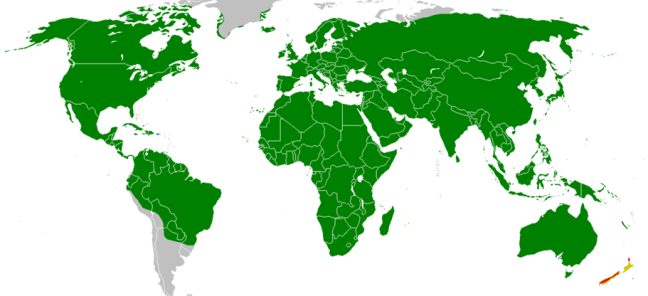
CORVID RANGES of the world (Wikipedia image credit)
Meanwhile, as the listed examples (of corvid hybridizations) above show, corvid hybrids are doing their part to “fill the earth”, includingHooded-Carrion Crows.
Now that is are something to crow about! ><> JJSJ profjjsj@aol.com
AUSTRALIAN MAGPIE (Gymnorhina tibicen) swooping to attack / CSIROscope photo credit
APPENDIX: CROWS & OTHER CORVIDS ARE REALLY SMART BIRDS!
Crows, as well as other corvid birds (i.e., members of the Crow-Raven family), fascinate children. They should amaze adults, too, yet often we are too busy to take time to ponder and appreciate the God-given traits of the creatures who share our world. Why should these birds capture our attention? They are alive!
Unlike plants, which are like biological machines (having no self-consciousness), higher-order animals like mammals and birds are truly alive, often displaying what might be called personalities. Although qualitatively distinct from humans—who are made in God’s image (Genesis 1:27)—animals have what Scripture calls a “soul” (the Biblical Hebrew noun is nephesh—see Genesis 1:20-21; 1:24; 2:19; 9:10; 9:12; 9:15-16 & Leviticus 11:46. ) This “soul” (nephesh)—is something more than the bird’s (or other animal’s) physical body. A bird’s nephesh-lifedeparts at death, yet its physical body remains. Thus, there is a difference between a bird’s immaterial life and its material body, just as we humans have physical bodies distinct from our own immaterial selves. The bird’s “soul” is revealed by how he or she intelligently thinks, communicates, learns, and makes decisions—including problem-solving choices.
Although many avian (and other animal) behaviors exhibit preprogrammed responses to outside world conditions, not all such behaviors are instinctive. Some such behaviors reveal that God chose to give these creatures real intelligence, real cleverness—demonstrated by abilities to learn new ideas, to fit new situations, and to solve practical problems of daily living.
As [Benjamin] Beck tells us in his book Animal Tool Behavior, [a crow] was fed partly on dried mash, which its keepers were supposed to moisten. But sometimes (being merely human) they forgot. The crow, undaunted, would then pick up a small plastic cup that had been provided as a toy, dip it into a water trough, carry the filled cup across the room to the food, and empty the water onto the mash. “If the water was spilled accidently,” Beck writes, “the crow would return to the trough for a refill rather than proceed to the food pan with an empty cup.” The bird was not taught to do this. “The [problem-solving] behavior appeared spontaneously,” Beck reports
[Quoting from Candace Savage, Bird Brains: The Intelligence of Crows, Ravens, Magpies, and Jays (San Francisco: Sierra Club, 1997), pages 2-4.]
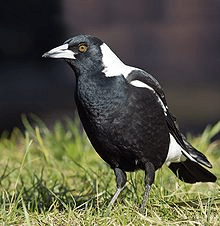
Australian Magpie (Wikipedia photo)
For another example of a corvid bird—in this case a magpie—demonstrating problem-solving intelligence, consider how Australian magpies deal with the unforeseeable problem of a human-imposed GPS “backpack”, which hinders its avian wearer similar to the inconvenience of a human wearing an “ankle bracelet”:
Here, we describe one such study trialling [i.e., trial-experimenting] a novel harness design for GPS tracking devices on Australian Magpies Gymnorhina tibicen. Despite previous testing demonstrating the strength and durability of the harness, devices were removed within minutes to hours of initial fitting. Notably, removal was observed to involve one bird snapping another bird’s harness at the only weak point, such that the tracker was released.
[Quoting from Joel Crampton, Celine H. Frère, & Dominique A. Potvin, “Australian Magpies Gymnorhina tibicen Cooperate to Remove Tracking Devices”, Australian Field Ornithology, 39:7-11 (2022).]
Likewise, some corvid birds (such as scrub jays)—acting like helpful “first responders”—are known to rescue distressed “birds of [the same] feather”, when a predator is threatening one of their own kind.
What if a large predatory bird attacks a small bird (or its nest of hatchlings)? Oftentimes, in such situations, the imperiled bird’s alarm-cry is followed by a “mob” attack. In effect, a vigilante-like “posse” of small birds chase and peck the predator, so the predator quickly flees to avoid the group counter-attack. This has often been observed in corvid birds—the family of crows—such as Eurasia’s Siberian jay.
Jays sometimes gang up on owls and hawks, their primary predators, in an activity called “mobbing.” Uppsala University research [in Sweden] on Siberian jays, slated to appear in the Proceedings of the Royal Society Biological Sciences, investigated the specifics of how jays communicate when mobbing predators. The study found that these birds have “over 25 different vocalisations” which combine to form “over a dozen different calls [while mobbing], some of which are specific for owls and other [sic] for hawks.”
[Quoting from Brian Thomas, “Jay Talking”, Creation Science Update (June 29, 2009), posted at www.icr.org/article/jay-talking — quoting from a Uppsala University press release, “Siberian Jays Use Complex Communication to Mob Predators”, dated June 8, 2009]
Many other examples of problem solving by resourceful animals could be given. Domesticated livestock, family pets, wildlife, and laboratory-tested animals come up with clever solutions to the challenges of daily living to secure food, water, air, shelter, rest, information, and reproductive success. But the resourcefulness of animals should not surprise us.
Proverbs informs us that God wisely installed wisdom into the minds of corvid birds, as well as many other animals—even small creatures like ants, conies, locusts, and lizards. To literally translate what Proverbs 30:24 [chakâmîm mechukkâmîm] says about such animals, they are “wise from receiving [God’s] wisdom.” Truly amazing display — of God’s creativity and love for life !
><> JJSJ profjjsj@aol.com
father Australian Magpie (Corvus tibicen) feeding juvenile magpie (Wikipedia / Toby Hudson photo credit)
[P.S.: this blogpost updates and expands upon an earlier post on November 7th A.D.2018.]
Who provides for the raven his food? When his young ones cry unto God, they wander for lack of food. (Job 38:41)
Consider the ravens: for they neither sow nor reap; they neither have storehouse nor barn, yet God feeds them; how much more are ye better than birds? (Luke 12:24)
There is, as Moses noted, a “kind” (i.e., genetically related family) of birds that we call “corvids”, crow-like birds, including ravens. [In the English Bible (KJV), these birds are always called “ravens”.]
These black (or mostly black – see Song of Solomon 5:11) omnivores are known to “crow”, often calling out a harsh KAWWWW! Also famous for their “ravenous” appetites and eating habits, it is no wonder that the English labeled many varieties of these corvid birds as “ravens”.
The HOODED CROW (Corvus cornix) lives and thrives in the Great North – including Sweden, Finland, and Russia. This I learned firsthand, on July 6th of AD2006, while visiting a grassy park near the Vasa Museum of Stockholm, Sweden. The next day (July 7th of AD2006), it was my privilege to see another Hooded Crow in a heavily treed park in Helsinki, Finland. Again, two days later (i.e., the 9th of July, AD2006), while visiting Pushkin (near St. Petersburg, Russia), I saw a Hooded Crow, in one of the “garden” parks of Catherine’s Palace. Obviously, Hooded Crows appreciate high-quality parks of northern Europe!
HOODED CROW (photo credit: Warren Photographic)
The physical appearance of a Hooded Crow is, as one bird-book describes, “unmistakable”.
Unmistakable. Head, wings and tail black, but body grey (can show pinkish cast in fresh plumage).
[Quoting Chris Kightley, Steve Madge, & Dave Nurney, POCKET GUIDE TO THE BIRDS OF BRITAIN AND NORTH-WEST EUROPE (Yale University Press / British Trust for Ornithology, 1998), page 271.]
Like most large corvids, the Hood Crow is quite versatile in filling various habitats.
Wary, aggressive scavenger found in all habitats from city centre to tideline, forest to mountain top. Generally seen in ones and twos, but the adage ‘crows alone, rooks in a flock’ unreliable; often accompanies other crows, and hundreds may gather at favoured feeding spots and roosts. Watch for crow’s frequent nervy wing flicks whenever on ground or perched. Calls varied. Typically a loud, angry kraa, usually given in series of 2—6 calls. Unlike Rook, pairs nest alone (usually in tree).
[Again quoting Kightley, Madge, & Nurney, POCKET GUIDE TO THE BIRDS OF BRITAIN AND NORTH-WEST EUROPE, page 271.]
Yet the HOODED CROW is not a genetically self-contained “species”, regardless of what taxonomists might wish about them. They happily hybridize with other crows, especially the CARRION CROW [Corvus corone], whose international range the Hooded Crow overlaps.
CARRION AND HOODED CROWS. The familiar crow. Two distinct races occur … [In the]British Isles and western Europe, Carrion Crow (Corvus corone) is common everywhere except north and west Scotland, Ireland, Isle of Man and Europe east of Denmark, where it is replaced by Hooded (Corvus cornix). Where breeding ranges overlap hybrids are frequent [emphasis added by JJSJ].
[Again quoting Kightley, Madge, & Nurney, POCKET GUIDE TO THE BIRDS OF BRITAIN AND NORTH-WEST EUROPE, page 271.]
The Carrion-Hooded Crow hybrids are also noted within a larger discussion (i.e., pages 224-228) of Corvid family hybrids, in Eugene M. McCarthy, HANDBOOK OF AVIAN HYBRIDS OF THE WORLD (Oxford University Press, 2006), at page 227.
CORVIDS Jelmer Poelstra / Uppsala Univ. image
Dr. McCarthy, an avian geneticist, has accumulated and summarized genetic research on Carrion-Hooded hybrids, especially examples observed in Eurasia:
Because the Carrion Crow has a split range … with the Hooded Crow intervening … there are two long contact zones, one extending from N. Ireland, through N. Scotland, to N.W. Germany, then S to N Italy, and another stretching from the Gulf of Ob (N Russia) to the Aral Sea. … Even in the center of the [overlap] zone, only 30% of [these corvid] birds are obviously intermediate. Due to hybridization these [corvid] birds are now sometimes lumped, but Parkin et al. (2003) recommend against this treatment since the two have obvious differences in plumage, as well as in vocalizations and ecology, and because hybrids have lower reproductive success than either parental type. Hybrid young are less viable, too, than young produced from unmixed mating (Saino and Villa 1992). Genetic variability increases within the hybrid zone (as has been observed in many other types of crossings). Occasional mixed pairs occur well outside [the overlap range] zones (e.g., Schlyter reports one from Sweden).
[Quoting Eugene M. McCarthy, HANDBOOK OF AVIAN HYBRIDS OF THE WORLD (Oxford University Press, 2006), at page 227.]
Dr. McCarthy, on pages 224-228, lists several other examples of documented corvid hybridizations, including: Corvus capellanus [Mesopotamian Crow] X Corvus corone [Carrion Crow]; Corvus cornix [Hooded Crow] X Pica pica [Black-billed Magpie]; Corvus albus [Pied Crow] X Corvus albicollis [White-necked Raven]; Corvus albus [Pied Crow] X Corvus ruficollis [Brown-necked Raven]; Corvus albus [Pied Crow] X Corvus splendens [House Crow]; Corvus brachyrhynchos [American Crow] X Corvus caurinus [Northwestern Crow]; Corvus corax [Common Raven] X Corvus brachyrhynchos [American Crow]; Corvus corax [Common Raven] X Corvus corone [Carrion Crow]; Corvus corax [Common Raven] X Corvus cryptoleucus [Chihuahuan Raven]; Corvus corax [Common Raven] X Corvus levaillantii [Jungle Crow]; Corvus corax [Common Raven] X Corvus macrorhynchos [Large-billed Crow]; Corvus corax [Common Raven] X Corvus ruficollis [Brown-necked Raven]; Corvus corone [Carrion Crow] X Corvus macrorhynchos [Large-billed Crow]; Corvus daururicus [Jackdaw, a/k/a “Coloeus dauuricus”] X Corvus monedula [Jackdaw, a/k/a “Coloeus mondela”]; Corvus levaillantii [Jungle Crow] X Corvus macrorhynchos [Large-billed Crow]; Pica nuttalli [Yellow-billed Magpie] X Pica pica [Black-billed Magpie]; plus it looks like an occasional Rook [Corvus frugilegus] joins the “mixer”, etc. Looks like a good mix or corvids!
Avian hybrids, of course, often surprise and puzzle evolutionist taxonomists, due to their faulty assumptions and speculations about so-called “speciation” – as was illustrated, during AD2013, in the discovery of Norway’s “Redchat” — see “Whinchat, Redstart, & Redchat: Debunking the ‘Speciation’ Myth Again”, posted at https://leesbird.com/2017/12/12/whinchat-redstart-redchat-debunking-the-speciation-myth-again/ .
CORVID RANGES of the world (Wikipedia map)
Meanwhile, as the listed examples (of corvid hybridizations) above show, corvid hybrids are doing their part to “fill the earth”, includingHooded-Carrion Crows.
Now that is are something to crow about! ><> JJSJ profjjsj@aol.com






 HOODED CROW (World Life Expectancy photo)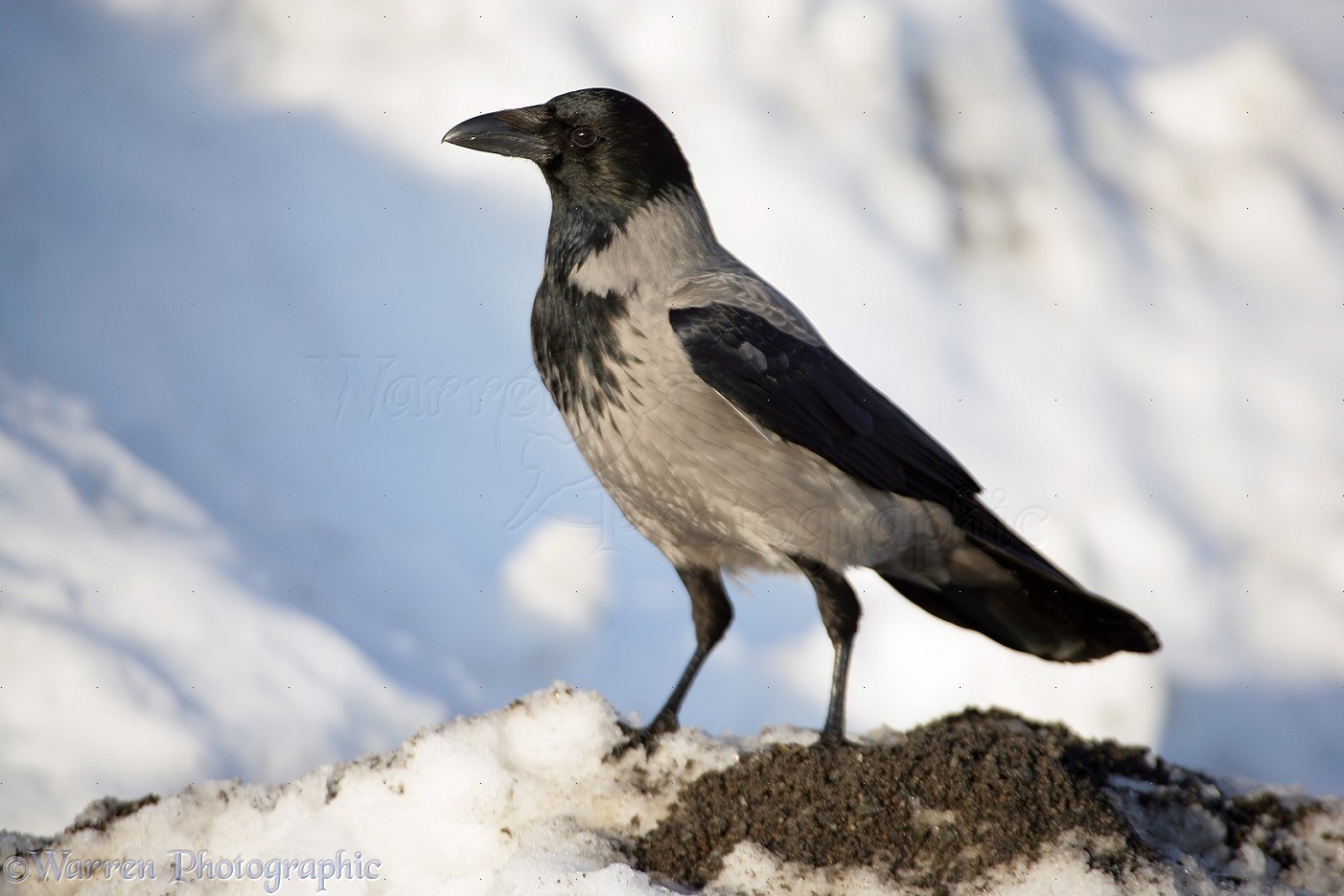



 Lee's Birdwatching Adventures Plus