White-eared Honeyeater (Lichenostomus leucotis) by Ian at Birdway
Meliphagidae – Honeyeaters Family Information
Pleasant words are as an honeycomb, sweet to the soul, and health to the bones. (Proverbs 16:24 KJV)
The honeyeaters are a large and diverse family of small to medium sized birds most common in Australia and New Guinea, but also found in New Zealand, the Pacific islands as far east as Hawaii, and the islands to the north and west of New Guinea known as Wallacea. Bali, on the other side of the Wallace Line, has a single species.
Honeyeaters and the closely related Australian chats make up the family Meliphagidae. In total there are 182 species in 42 genera, roughly half of them native to Australia, many of the remainder occupying New Guinea. Like their closest relatives, the Maluridae (Australian wrens), Pardalotidae (pardalotes and thornbills), and Petroicidae (Australian robins), they originated as part of the great corvid radiation in Australia-New Guinea (which were joined in a single landmass until quite recent geological times).
Although honeyeaters look and behave very much like other nectar-feeding passerines around the world (such as the sunbirds and flowerpeckers), they are unrelated, and the similarities are the consequence of variation.
Unlike the hummingbirds of America, honeyeaters do not have extensive adaptations for hovering flight, though smaller members of the family do hover hummingbird-style to collect nectar from time to time. In general, honeyeaters prefer to flit quickly from perch to perch in the outer foliage, stretching up or sideways or hanging upside down at need. All genera have a highly developed brush-tipped tongue, longer in some species than others, frayed and fringed with bristles which soak up liquids readily. The tongue is flicked rapidly and repeatedly into a flower, the upper mandible then compressing any liquid out when the bill is closed.

Bridled Honeyeater (Lichenostomus frenatus) by Ian at Birdway
The extent of the partnership between honeyeaters and Australasian flowering plants is unknown, but probably substantial. A great many Australian plants are fertilised by honeyeaters, particularly the Proteacae, Myrtaceae, and Epacridacae. It is known that the honeyeaters are important in New Zealand as well, and assumed that the same applies in other areas.
In addition to nectar, all or nearly all honeyeaters take insects and other small creatures, usually by hawking, sometimes by gleaning. A few of the larger species, notably the White-eared Honeyeater, and the Strong-billed Honeyeater of Tasmania, probe under bark for insects and other morsels. Many species supplement their diets with a little fruit, and a small number eat considerable amounts of fruit, particularly in tropical rainforests and, oddly, in semi-arid scrubland. The Painted Honeyeater is a mistletoe specialist. Most, however, exist on a diet of nectar supplemented by varing quantities of insects. In general, the honeyeaters with long, fine bills are more nectarivous, the shorter-billed species less so, but even specialised nectar eaters like the spinebills take extra insects to add protein to their diet when they are breeding.
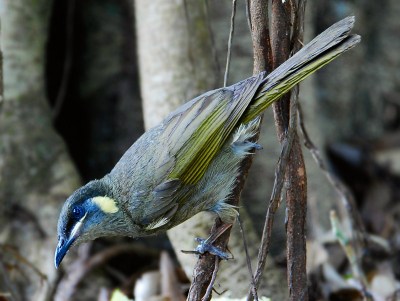
Lewin’s Honeyeater (Meliphaga lewinii) by W Kwong
The movements of honeyeaters are poorly understood. Most are at least partially mobile but many movements seem to be local, possibly between favorite haunts as the conditions change. Fluctuations in local abundance are common, but the small number of definitely migratory honeyeater species aside, the reasons are yet to be discovered. Many follow the flowering of favorable food plants. Arid zone species appear to travel further and less predictably than those of the more fertile areas. It seems probable that no single explanation will emerge: the general rule for honeyeater movements is that there is no general rule.
The genus Apalopteron (Bonin Honeyeater), formerly treated in the Meliphagidae, has recently been transferred to the Zosteropidae on genetic evidence.
A new taxon of honeyeater, not yet described but apparently close to the Smoky Honeyeater, has been discovered in December 2005 in the Foja Mountains of Papua, Indonesia.
From Wikipedia, the free encyclopedia with editing
See also:
Meliphagidae – Honeyeaters page
HONEYEATERS Meliphagidae by Bird Families of the World
*

 Lee's Birdwatching Adventures Plus