BOBOLINKS: GRAIN-LOVING GRASSLANDERS

SEED-LOVING BOBOLINKS, GROUND-NESTING IN GRASSLANDS

Dr. James J. S. Johnson
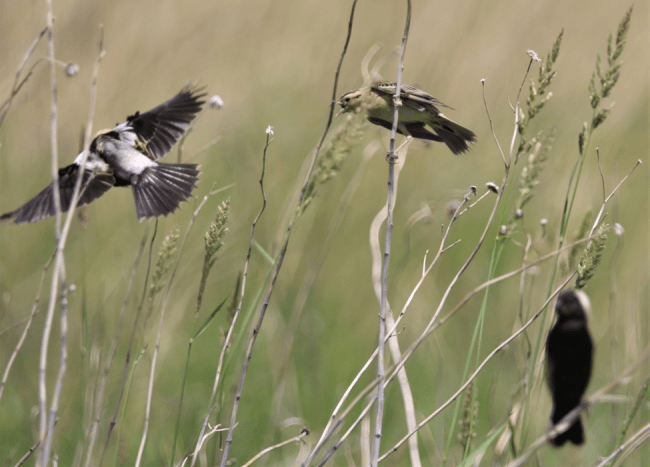
BOBOLINKS in grassland habitat, Minnesota 
(photo credit: Bryce Gaudian)

If a bird’s nest chance to be before thee in the way in any tree, or on the ground, whether they be young ones, or eggs, and the mother sitting upon the young, or upon the eggs, thou shalt not take the mother with the young. 

(Deuteronomy 22:6)

Moses noted that some wild birds build their nests upon the ground; Bobolinks do just that.

Years ago, I reported on the Black-capped Chickadee, noting that I first saw one at Gilsland Farm Sanctuary, while attending a wetland ecologists’ meeting: “Decades ago, I saw Black-capped Chickadees, for the first time, in Falmouth (near Portland), Maine – at the Gilsland Farm Sanctuary (now called “Gilsland Farm Audubon Center”), on May 31st of AD1995, while attending the annual national meeting of the Society of Wetlands Scientists.” [Quoting from “Tiny Yet Tough: Chickadees Hunker Down for Winter”, posted at https://leesbird.com/2016/11/18/tiny-yet-tough-chickadees-hunker-down-for-winter/ .]

Another “lifer” that I then observed that day, at Gilsland Farm Sanctuary, was the BOBOLINK.  And what a striking plumage the male Bobolink has, during breeding season! 
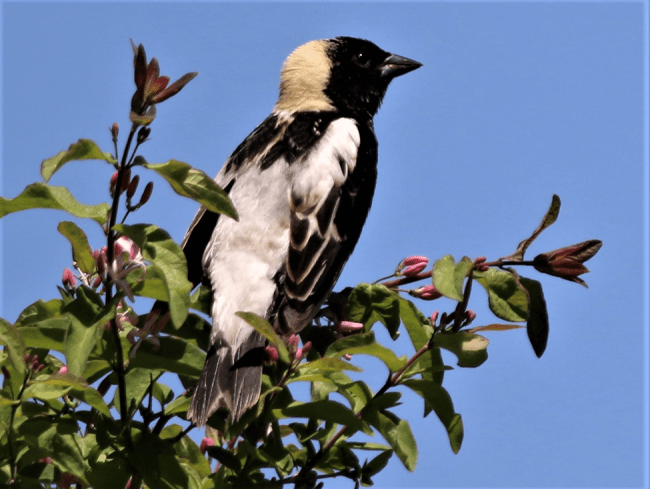
BOBOLINK MALE in breeding plumage, Minnesota 
(photo credit: Bryce Gaudian)

Bobolinks (Dolichonyx oryzivorus) are icterids (blackbirds of the Western Hemisphere), dwelling in America’s prairie and pasture grasslands and marshy wetlands during the warm months of the year.  Bobolinks were nicknamed “rice birds” (which matches their species name, oryzivorus, meaning “rice-eating”), due to their dining habits, especially during autumn migrations.  

The Bobolink genus name, Dolichonyx, means “long claw”, matching its prehensile perching “fingers”.

BOBOLINK MALE, perching with “long claws”, Minnesota 
(photo credit: Bryce Gaudian)

During such migrations Bobolinks frequently feed in farmed fields of rice and other grains (such as oats, sorghum, maize corn, and hayseed), at energy-packing refueling stopovers (e.g., in South Carolina and the Gulf states), on their aerial journeys southward, via Caribbean islands, en route to South American over-wintering range destinations.

Bobolinks feed on (or near) the ground, eating various seeds, insects, spiders, and even snails—especially during breeding seasons.  Both larvae and adults of insects (especially armyworm moths) are protein-rich, much needed for growing Bobolink juveniles.

Also, during breeding seasons, Bobolinks depend upon available hay for nest-building, on the ground, in vegetated areas. 

Bobolinks are quite specific in their breeding habitat needs.  Open hay fields are a must, and so as farming is some regions of the country diminishes, so do populations of bobolinks.  Where colonies of bobolinks have traditionally bred, it is important to preserve their habitat with regular mowing practices.  Unfortunately, the right time to mow a field for hay is often just when the young are fledging[!].  Careful observation of the behavior of a [bobolink] colony and delaying of mowing until one or two weeks after fledging, a time when the young can fly fairly well, will keep a colony producing and ensure its [multi-generational] survival. 

[Quoting Donald W. Stokes & Lillian Q. Stokes, A GUIDE TO BIRD BEHAVIOR, Volume III (Boston: Little, Brown & Company/Stokes Nature Guides, 1989), pages 351-352.]
BOBOLINK MALE in grassland habitat, Minnesota 
(photo credit: Bryce Gaudian)

Consequently, Bobolinks are easier to find in habitats where their needs for food and nesting are plentiful.
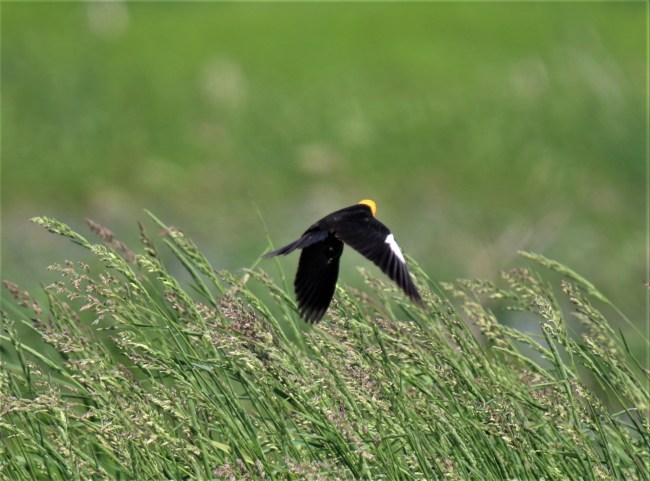
BOBOLINK male in flight, prairie habitat, Minnesota
(photo credit: Bryce Gaudian)

The males have easily seen plumages—like reverse tuxedos (white upon black) in spring and summer, during breeding months.
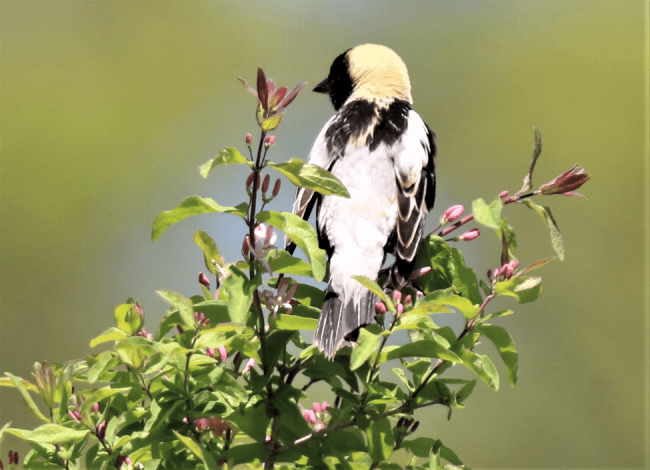
BOBOLINK male, displaying yellow nape-hood, Minnesota
(photo credit: Bryce Gaudian)

Male and female bobolinks are easily distinguished during the breeding season.  Males have a black head, belly, and wings, with a buff-gold nape and white patches on the back.  The female is buff [and brown] colored all over with dark streaks on her back, wings, and sides.

[Quoting Donald W. Stokes & Lillian Q. Stokes, A GUIDE TO BIRD BEHAVIOR, Volume III (Boston: Little, Brown & Company/Stokes Nature Guides, 1989), pages 364.]

During non-breeding months, however, Bobolink males shift to duller hues of dark and light browns, similar to the year-round plumage of Bobolink females and juveniles.

BOBOLINK female perching near prairie flower
(Mircea Costina / Shutterstock / ABCbirds.org photo credit)

Of course, these tweety-chirpy icterids breed elsewhere in spring – in most of the upper half of America’s Lower 48, from the Northeast’s coastlines almost as far wet as the coasts of Washington and Oregon. Accordingly, the Bobolink migrates about 6,000 miles southward or northward, so it accrues about 12,000 miles per year, in air miles.
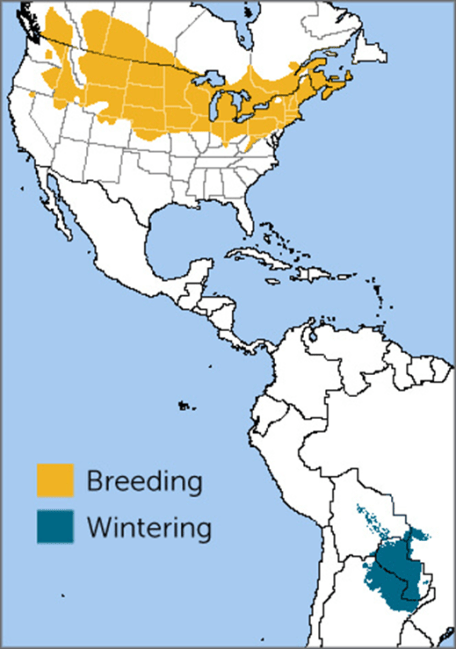
American Bird Conservancy range map

It was a privilege to see Bobolinks, back in AD1995, at the Gilsland Farm Sanctuary, as part of my time attending the Society of Wetlands Scientists’ meeting.

Likewise, it’s a privilege, now, to be permitted to share some of the wonderful Bobolink photographs taken in Minnesota, by Christian/creationist photographer BRYCE GAUDIAN — thanks, Bryce!

And now, it’s time for a limerick, about Bobolinks.

In Appreciation of the Bobolink, a/k/a Rice Bird

There’s an icterid feathered quite nice,

Whose fast-food oft includes rice;

It makes a chirp-sound,

As it nests on the ground,

And it’s photo’d quite well, by Bryce!


Fly-thru “Althing” of Migratory Cedar Waxwings

Dr. James J. S. Johnson

“Praise the LORD from the earth … fruitful trees and all cedars … and flying fowl.” (from Psalm 148:7-10)

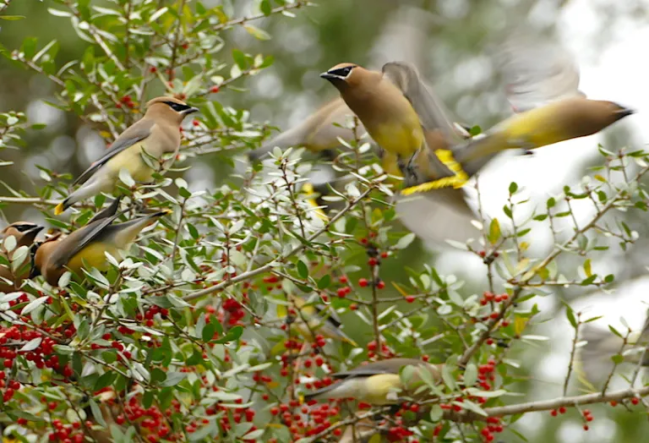
CEDAR WAXWINGS EATING BERRIES [photo credit: Wild Birds Unlimited]

Each spring gregarious flocks of Cedar Waxwings pass through my part of Texas, as they migrate northward toward their breeding grounds. No “lone rangers” here! Cedar Waxwings travel in flocks of many dozens–sometimes even hundreds–synchronizing their fast-food stopovers along the way, to refuel for the next aerial leg of their migratory trek. And trees or bushes with red berries are a particular favorite of Cedar Waxwings. Although the nutritional details are a bit technical — as noted below* — waxwings need to balance their sour berry intake with protein-rich pollen, both of which are available during mid-April in my part of Texas, as the flocks of Cedar Waxwings pass through in their flights northward.

So, when these large flocks of colorful waxwings make a “pit stop” for fast-food they often fill the branches of trees as they hastily consume red berries (and other edible nutrients), just before resuming their northbound flights to their spring-through-summer breeding ranges.

On April 7th A.D.2023, a Friday morning, as I observed this hastily convened arboreal assembly of avian migrants, I thought of the traditional assemblies (“things”) of the Vikings — such as those Nordic congregants convened annually in Iceland (Thingvellir’s “Althing”) and on the Isle of Man (at the Manx “Tynwald”), to conduct the serious business of life. Could it be that these Cedar Waxwings were having their own version of an Althing assembly, as they refueled (and rested briefly) during their stopover in the branches of my trees and bushes? Since I cannot understand the language of Cedar Waxwings I cannot know what they conversed about — but I knew that they would vacate northward soon enough, so I would not see them again until the next seasonal migratory pass-through, as they live out the providential phenology of their migratory lifestyle.

What a privilege it was to see God’s Cedar Waxwings–scores of them (perhaps more than a hundred!) as a flock in transit–quickly visiting the trees and bushes on the south side of my home. Surely God’s birds will remind us of His care for us, if we take the time to think about it–and have eyes to see (Matthew 6:26; Luke 12:24).

In fact, that faith lesson (which is was taught, in ancient times, to the patriarch Job, by God Himself (in Job 38:41), as is noted in the first of the 3 apologetics lectures (shown below) that I gave recently, to a Swedish theology school (Skandinavisk Teologisk Högskola):

God’s Creation Sermon in Job 39: Learning from God’s Animals: https://youtu.be/_ydP8vCTBAY

Viking Skeletons Embarrass Carbon 14 Radiometric Dating: https://youtu.be/Bx40cjdodRM

Why Study Grass and Flowers? Learning from God’s Plants: https://youtu.be/-4SMgqq2waU

CEDAR WAXWINGS [photo credit: Museum of Life & Science, Durham, N.C.]

So, now for a limerick, that memorializes my observations of the flock of Cedar Waxwings that briefly visited my frontyard earlier this month:

FAST-FOOD/FLY-THRU ALTHING OF MIGRATORY CEDAR WAXWINGS

A flock-full of birds, in my trees,

Gulped down every berry they’d seize;

This arboreal Althing

of the Cedar Waxwing

Soon adjourned—dispersed with the breeze!

CEDAR WAXWINGS photo credit: Mary Anne Borge / The Natural Web

[*For technical information, befitting Cornell University, about the diet of Cedar Waxwings, see Mark C. Witmer’s “Nutritional Interactions and Fruit Removal: Cedar Waxwing Consumption of Viburnum opulus Fruits in Spring”, ECOLOGY, 82(11):3120-3130 (November 2001).]

Eggs Taste Better if Salted

Eggs  Taste  Better  if  Salted

Dr. James J. S. Johnson

Can that which is unsavory be eaten without salt? Or is there any taste in the white of an egg?  (Job 6:6)

eggs-neptune-crabcake.TripAdvisor

EGGS NEPTUNE (eggs Benedict with crab — Trip Advisor photo)

Although we Americans sometimes over-salt our food,  it is nonetheless true  that it is perfectly Biblical  to salt poultry eggs  before you eat them  —  but what about crab eggs?

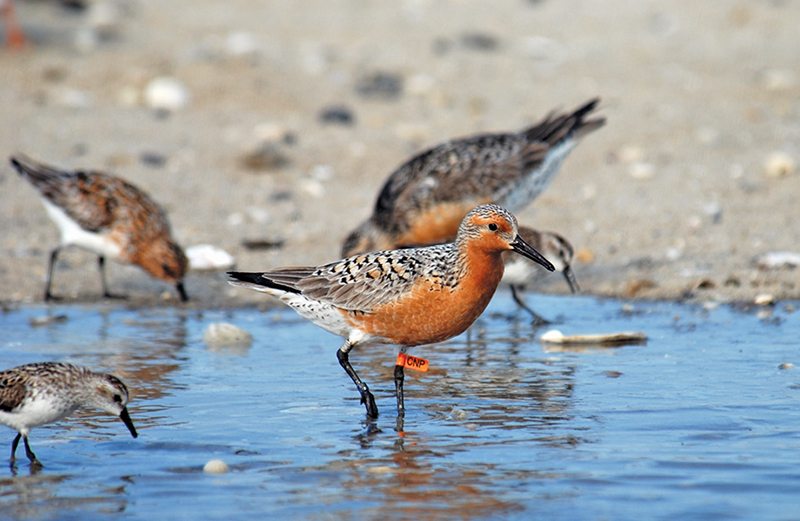
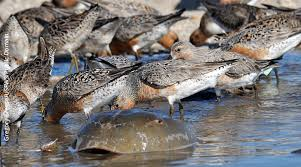
Since, during spring stopovers, Red Knots eat lots of Horseshoe Crab eggs on the beaches of Delaware Bay,  —  and the crabs who deposited those eggs just came from the salty seawater of the Atlantic Ocean,  —  it’s unlikely that the voracious Red Knots need to add salt, to flavor those crab eggs for eating.

As an illustration of Genesis 8:22, this bird-blog has already reported on the magnificent migration of the Red Knot, which mileage-marathon marvel annually feasts on beach-buried Horseshoe Crab eggs during its yearly stopover at Delaware Bay, before the refueled shorebird continues its migration northward (toward its breeding grounds in Canada) during the spring.  [See “Shorebirds Looney about Horseshoe Crabs”, at https://leesbird.com/2017/08/11/shorebirds-looney-about-horseshoe-crab-eggs/ .]

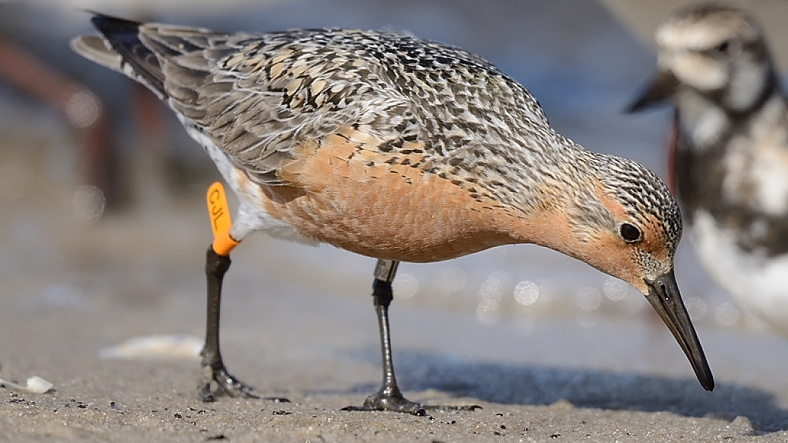
RedKnot-DelawareBay-beach.GregoryBreese-USFWS

RED KNOT at Delaware Bay beach (USFWS photo / public domain)

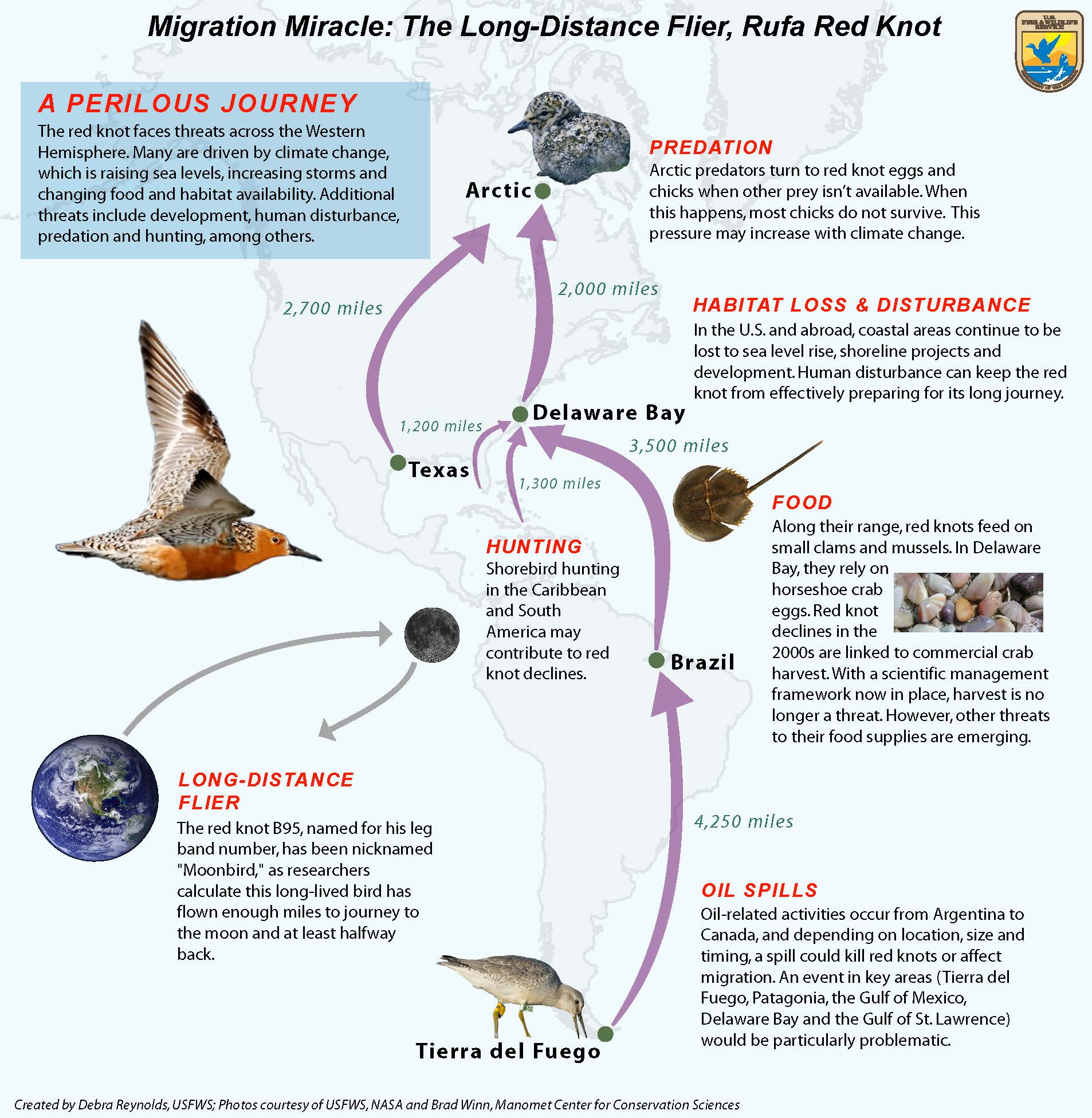
As this USFWS chart (created by Debra Reynolds) shows, the long-distance adventures of the Rufa Red Knot are, in their repeated successes, providential miracles of populational migration.  

In other words, when we think about how this works out, during each migratory cycle, our minds should automatically think about how amazingly clever and capable God is, to have arranged all of the Red Knot’s long-distance (and metabolic) bioengineering to work.  The Red Knot is providentially programmed (“fitted”) to survive and thrive like this[This can be compared to the providential programming that God has installed into the Arctic Tern   —   see “Survival of the Fitted:  God’s Providential Programming”, ACTS & FACTS, 39(10):17-18 (October 2010), posted at http://www.icr.org/article/survival-fitted-gods-providential-programming/ .]

RedKnot-migration-infochart.USFWS

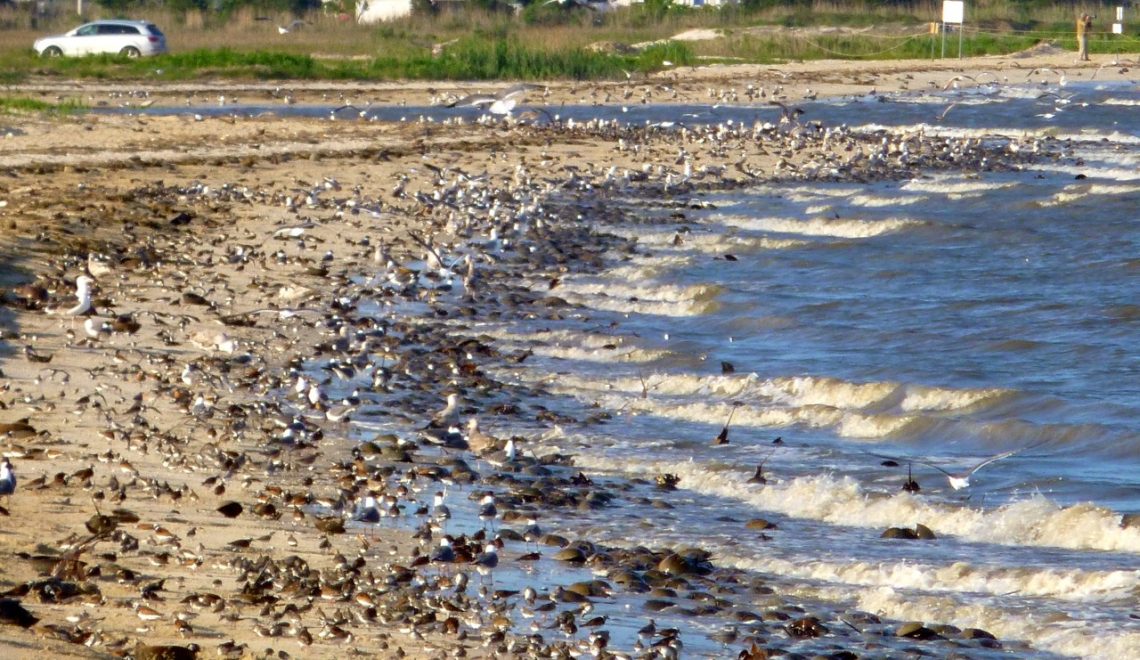
Of course, the hungry Red Knot is not alone in this all-you-can-eat “fast-food” fiesta – because the Red Knot is joined, at Delaware Bay beaches, by oövorous (i.e., egg-eating) “tablemates” including turnstones and sandpipers.   [See Delaware Bay beach photographs below:  left, USF&W / public domain;  right, Larry Niles.]

All of which leads us to today’s limerick:

CONVERTING  CRAB  EGGS  INTO  MIGRATORY  BIRD  FUEL

Red Knots scoot about, on thin legs;

First come, first serve! — no one begs;

Horseshoe crab eggs, the treat

And it’s “all-you-can-eat“!

Watch the shorebirds gulp down the crab eggs!

RedKnots-eating-crab-eggs.NJEnvtNews

RED KNOTS eating crab eggs (N.J. Environment News photo)

Hmm, now I’m hungry!  —  it’s time to eat a couple of poached eggs, that my gourmet-whiz wife prepared for me this morning.   (Of course, those eggs are slightly salted!)


Shorebirds Looney about Horseshoe Crab Eggs

RedKnot-DelawareBay-beach.GregoryBreese-USFWS

Red Knot Eating Crab Eggs at Delaware Bay Beach

Photo by Gregory Breese / USF&WS

Thankfully, the rhythms of our world are fairly predictable. Although the details differ, the overall cycles are regular:

While the earth remains, seedtimes and harvest, and cold and heat, and summer and winter, and day and night shall not cease. (Genesis 8:22)

Because of these recurring patterns migratory birds can depend on food being conveniently available when they migrate northward in the spring. In effect,  “fast food” on the beach is a “convenience store” for famished feathered fliers.

For example, consider how the annual egg-laying (and egg-burying) activities of horseshoe crabs perfectly synchronize with the hunger of migratory shorebirds (e.g., red knots, turnstones, and sandpipers) that stopover on bayside beaches, for “fast food”, right where huge piles of crab eggs have just been deposited (and where some have been uncovered by tidewaters).

HorseshoeCrabs-DelawareBay-beach.GregoryBreese-USFWS

Horseshoe Crabs on Delaware Bay Beach

Photo by Gregory Breese / USF&WS

No need to worry about the birds eating too many crab eggs! – the egg-laying is so prolific (i.e., about 100,000 eggs per mother) that many horseshoe crab eggs are missed by the migratory birds, thus becoming the next generation of horseshoe crabs, plus the birds mostly eat the prematurely  surfacing eggs that are less likely to succeed in life anyway!)

Timing is everything. Each spring, shorebirds migrate from wintering grounds in South America to breeding grounds in the Arctic. These birds have some of the longest migrations known. Delaware Bay is the prime stopover site and the birds’ stop coincides with horseshoe crab spawning. Shorebirds like the red knot, ruddy turnstone and semipalmated sandpiper, as well as many others, rely on horseshoe crab eggs to replenish their energy reserves before heading to their Arctic nesting grounds.  The birds arrive in the Arctic before insects emerge. This means that they must leave Delaware Bay with enough energy reserves to make the trip to the Arctic and survive without food until well after they have laid their eggs. If they have not accumulated enough fat reserves at the bay, they may not be able to breed.

The world’s largest spawning population of horseshoe crabs occurs in Delaware Bay. During high tide, horseshoe crabs migrate from deep water to beaches to spawn. The female digs a nest in the sand and deposits between 4,000 and 30,000 eggs that the male will fertilize with sperm. A single crab may lay 100,000 eggs or more during a season. Horseshoe crab spawning begins in late April and runs through mid-August, although peak spawning in the mid-Atlantic takes place May 1 through the first week of June.

At low tide, adult crabs go back into the water but may return at the next high tide. Horseshoe crab spawning increases on nights with a full or new moon, when gravity is stronger and high tides are even higher. At the same time that migrating shorebirds arrive to rest and feed along Delaware Bay, horseshoe crab activity is high. While the crab buries its eggs deeper than shorebirds can reach, waves and other horseshoe crabs expose large numbers of eggs. These surface eggs will not survive, but they provide food for many animals. The shorebirds can easily feed on eggs that have surfaced prematurely.

Quoting Kathy Reshetiloff, “Migratory Birds Shore Up Appetites on Horseshoe Crab Eggs”, THE CHESAPEAKE BAY JOURNAL, 27(3):40 (May 2017).

Shorebirds-HorseshoeCrabs-DelawareBay.LarryNiles

Shorebirds and Horseshoe Crabs on Delaware Bay Beach

Photo by Larry Niles

Notice how it is the gravitational pull of the moon, as the moon goes through its periodic cycle, that causes the high and low tides – which facilitate the uncovering of enough horseshoe crab eggs to satisfy the needs of the migratory stopover shorebirds that pass through Delaware Bay.  Notice how the moon provides a phenological “regulation” (i.e., the moon is physically ruling and correlating the interaction of the horseshoe crabs, the migratory shorebirds, and the bay’s tidewaters – in accordance with and illustrating Genesis 1:16-18).

At low tide, adult crabs go back into the water but may return at the next high tide. Horseshoe crab spawning increases on nights with a full or new moon, when gravity is stronger and high tides are even higher. At the same time that migrating shorebirds arrive to rest and feed along Delaware Bay, horseshoe crab activity is high.

Again quoting Kathy Reshetiloff, “Migratory Birds Shore Up Appetites on Horseshoe Crab Eggs”, THE CHESAPEAKE BAY JOURNAL, 27(3):40 (May 2017).

RedKnot-MigrationMap.NatureConservancy
Map of Red Knot Winter Ranges, Summer Breeding Range, & Migratory Stopovers
Map by The Nature Conservancy, adapted from USF&WS map

So, you might say that these reproducing Horseshoe Crabs, and the myriads of migratory shorebirds, share phenological calendars because they’re all looney.

RedKnot-onshore.NatureConservancy-MJKilpatrick

Red Knot on Beach, during Migratory Stopover
photo by The Nature Conservancy / M J Kilpatrick