And God blessed them, saying, Be fruitful, and multiply, and fill the waters in the seas, and let fowl multiply in the earth. (Genesis 1:22)
The Weaver Bird from Creation Moments

Speke's Weaver
Weaver bird name for the Ploceidae, a family of Old World seed-eating birds closely resembling finches (hence the alternate name weaver finch). It includes a number of so-called goldfinches and waxbill finches that are actually weaver birds, rather than true finches of the family Fringillidae. The weavers are named for the highly complex woven nests built by many species, though others build only crude nests, and the parasitic widow weavers build no nests at all. Most weavers are sedentary, noisy, gregarious, and polygynous, with elaborate courtship rituals. Most weavers use grasses for the weaving of the nests which have an entry at the bottom.
The weaver group is divided into the buffalo, sparrow, typical, and widow weavers.
Buffalo-weavers -The African buffalo weavers are black-and-brown birds 8 to 10 in. (20.3-25.4 cm) long, that travel in small flocks and build bulky compartmented nests with separate chambers for two or more pairs.
Red-billed Buffalo-weaver
White-billed Buffalo-weaver
White-headed Buffalo Weaver

Red-billed Quelea
Sparrow-weavers – Of the 35 sparrow weavers the best known, and in fact one of the most widely distributed and familiar small birds in the world, is the English sparrow native to Europe, W Asia, and N Africa. It is the most successful town and city dweller among birds, and has followed European civilization wherever it has gone; it was introduced to North America in 1852. As common in Asia is the Eurasian tree sparrow (also introduced in the United States), a nuisance in rice fields and sold in great quantities for food. These birds build untidy domed nests with side entrances. Most specialized of the sparrow weavers is the
White-browed Sparrow-weaver
Chestnet-crowned Sparrow-weaver
Chestnut-backed Sparrow-weaver
Donaldson-Smith’s Sparrow-weaver
Social-weaver of Africa, famous for its apartment-house nest, in which 100 to 300 pairs have separate flask-shaped chambers entered by tubes at the bottom. They build these structures, which may be 10 ft (3 m) high and 15 ft (4.5 m) across, high in a sturdy tree, beginning with a roof of straw thatch. Of the 100 or more African and Asian typical weavers, the small quelea, only 5 in. (12.7 cm) long, sometimes causes huge crop losses in Africa by feeding on grain in flocks numbering as many as one million birds.
Grey-headed Social-weaver
Black-capped Social-weaver
Widow-weavers – The African widow weavers (named for the long, drooping black tail plumes of the breeding male), or whydahs, are notable for their selective parasitic nesting habits; they lay their eggs in the nests of waxbills, and their eggs are white, as are those of the waxbill, rather than spotted, as are those of all other weavers.
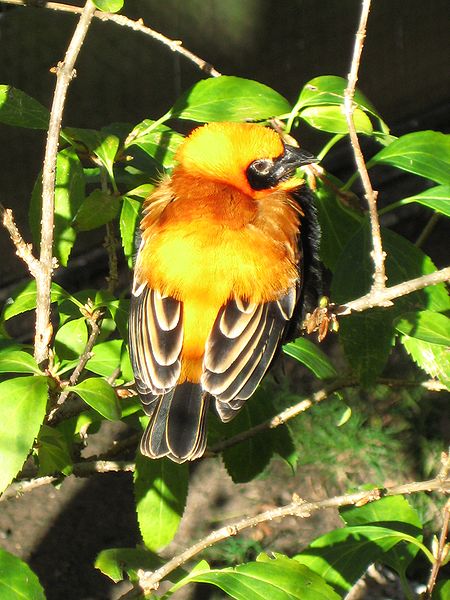
Black-winged Red Bishop
Fan-tailed Widowbird
Yellow-shouldered Widowbird
Red-collared Widowbird
Marsh Widowbird
Buff-shouldered Widowbird
Long-tailed Widowbird
Jackson’s Widowbird
Many of the weaver family are kept as cage birds, especially the colorful waxbills (e.g., the Java sparrow, mannikin, munia, grenadier, cutthroat, and cordon-bleu, locust, parrot, Gouldian, and fire finches). Weaver birds are classified in the phylum Chordata , subphylum Vertebrata, class Aves, order Passeriformes.
Other Weaver Bird families are the:
Just plain Weavers, the Malimbe family, Quelea family, Fody family, and the Bishop family.
From:
The Columbia Encyclopedia, Sixth Edition. 2008. Encyclopedia.com. 21 Apr. 2009, Answers.com Ploceidae, and other internet sources.
Check out the Weaver Bird Videos
 Lee's Birdwatching Adventures Plus
1
LikeLike
This is wonderful!
LikeLike