New Species?

While working on the Orders of the Birds and finding so many species of birds worldwide, I went looking for more information about them. I came across this interesting article at the ICR.org website. The bolding is mine. I trust you will find it worth the reading.

Cormorant Tree by Dan

Cormorant Tree by Dan

Do ‘New Species’ Demonstrate Darwinism?
by Various Authors
Frank Sherwin, M.A., and Brian Thomas, M.S.*

“That species undergo change in this grand system called earth is apparent, but those changes do not occur the way Charles Darwin envisioned. Living things do shift behaviors and physiologies in response to environmental (and other) pressures, but can these minor changes completely rework a creature’s essential form (a concept referred to as “macroevolution”)? Decades of research emphatically say no.

Often, small changes within a kind are referred to as “microevolution,” which has been defined as “evolution resulting from a succession of relatively small genetic variations that often cause the formation of new subspecies.”1 Creation scientists agree that small variations occur, both because they can be observed, and because it is reasonable that a wise Creator would equip His creatures with survival-enhancing capabilities. But these variations do not lead to large-scale changes between kinds. Indeed, “there is no agreement [among evolutionists] as to whether macroevolution results from the accumulation of small changes due to microevolution, or whether macroevolution is uncoupled from microevolution.”2

The confusing array of definitions for the word “species” can obscure deficiencies in Darwinian evolution. As leading scientists have admitted, “The very term ‘species’ is deeply ambiguous.”3 Harvard’s Steven Palumbi said in 1994 that “the formation of species has long represented one of the most central, yet also one of the most elusive, subjects in evolutionary biology.”4

If different species are described as essentially those forms which cannot interbreed, then new species do arise, a process called “speciation.” They do so, however, because of a loss of information–the opposite direction to what Darwinian evolution requires. “…..

To see the complete article – CLICK HERE

World Bird Lists on the Internet

There is plenty of data about the birds of the world on the internet. This site is not competing with them, but just trying to use the pages here to introduce the birds and have links to our articles and links to great pages about them on the internet.

Our emphasis is “Birdwatching from a Christian Perspective”, so, we may see things a little different from time to time. When I read so many of the articles, they tell of the birds evolving, whereas, I believe God created them and told them to go multiply and cover the earth. There has been lots of variation going on, but no “evolution” from one kind to another. So, I just read around their remarks about evolution and enjoy the information about the actual birds.

Here are some links for information on the birds of the world.

IOC World Bird List ver 2.1 – Where I got the data for my list.

Bird Families of the World, 9th edition – Used many times for references

Bird Families of the World, Allen Chartier’s photographs – Newly found

Birdingonthe.net – Lots of links for birding the internet

Checklist of the World – Many interesting links

Avibase -“Avibase is an extensive database information system about all birds of the world”

Handbook of the Birds of the World – Wikipedia’s extensive information on the birds.

Eye of the Beholder – Bird Names

Mom and Baby at Lake Hollingsworth

Mom and Baby at Lake Hollingsworth

Last week, Dan and I went to Lake Hollingsworth in Lakeland, our favorite place to go birding when we don’t have a lot of time, my legs aren’t working well, or Dan has a new, used camera to check out. That was the case, I was just checking out the normal birds for this time of the year and photographed this female mallard and her chick. In other words, there aren’t many. Most of them have gone back north to do what God commanded them to do when they came off the ark.

Then God spoke to Noah, saying, “Go out of the ark, you and your wife, and your sons and your sons’ wives with you. Bring out with you every living thing of all flesh that is with you: birds and cattle and every creeping thing that creeps on the earth, so that they may abound on the earth, and be fruitful and multiply on the earth.” So Noah went out, and his sons and his wife and his sons’ wives with him. Every animal, every creeping thing, every bird, and whatever creeps on the earth, according to their families, went out of the ark. (Genesis 8:15-19 NKJV)

So, the birds have been reproducing and reproducing and reproducing. I have been working on a project for this blog behind the scenes and it has to do with the bird families of the world. The numbers keep changing, but the count is over 10,000 species (living) worldwide. All the Birding committees work hard on putting them into Order, Families, Genus, and then giving them a  Scientific name and an English name. As I have been working on this project, I couldn’t help but think about how well the birds have obeyed.

What amazes me, is how they (Birding committees) decide how to classify them. I have a hard enough time, getting some birds just into the right family, let alone figuring them all out. Warblers being the hardest for me. Here is my idea of this whole process, from a human classification.

Smith Family:
Dad – Black hair, blue eyes, normal ears, round eyes
Mom – blond hair, green eyes, normal ears, slant eyes
Child #1 – Black hair, green eyes, ears stick out, round eyes
Child #2 – Blond hair, blue eyes, long ear lobes, slant eyes
Child #3 – Brown hair, blue eyes, normal ears, beady eyes
Child #4 – Red hair, black eyes, pointed ears, bushy eyebrows
The children grow up and each find a mate with similar characteristics, they move away and continue to have children with their same characteristics and some more variations show up. Etc, etc.

Now along come the classifying committees! Can you imagine how they would try to classify the human race?
I’ll leave that to your imagination.

To get a glimpse of my project, click List of ORDERS of the Birds in Taxonomic Order Just realize, this is a work in progress.

And Can It Be?

I couldn’t resist posting this devotional from the Institute For Creation Research for Aug 3, 2009.
“And Can It Be!” is my most favorite hymn and I have told Dan, that it is to be sung when I go “home to glory.” This does not have all the stanzas, but here is the full hymn.

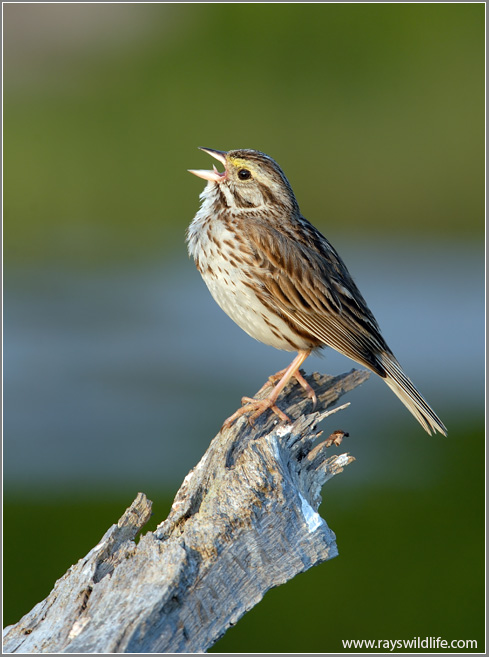
Savannah Sparrow singing by Ray

Savannah Sparrow singing by Ray

And can it be that I should gain,
An interest in the Savior’s blood?
Died He for me, who caused His pain?
For me, who Him, to death pursued?

Amazing love! How can it be,
That thou, my God, should’st die for me?

He left His Father’s throne above,
So free, so infinite His Grace!
Emptied Himself of all but love,
And bled for Adam’s helpless race.

No condemnation now I dread,
I am my Lord’s and He is mine;
Alive in Him, my living Head,
And clothed in righteous divine.

What a powerful message that song has. How could God, so love us, (me, Lee) so much that He would come and die for me? A sinner, saved only by the grace of God, by the death of the Lord Jesus Christ on the cross. Amazing Love! How Can It Be?

Can It Be?

by John D. Morris, Ph.D.

“Christ also suffered for us. . . . Who his own self bare our sins in his own body on the tree, that we, being dead to sins, should live unto righteousness: by whose stripes ye were healed.” (1 Peter 2:21-24)

Those who love good church music have come to love Charles Wesley’s commitment to and knowledge of his Savior and the Scriptures, for he wove into his music and poetry deep insights which challenge and thrill us even today. One of his hymns, “And Can It Be That I Should Gain?,” has unfortunately been abridged in modern hymnals. The original five verses are expressed:

And can it be that I should gain,
An interest in the Savior’s blood?
Died He for me, who caused His pain?
For me, who Him, to death pursued?
Amazing love! How can it be,
That thou, my God, should’st die for me?

Even the Old Testament saints wondered why God loves man so. “What is man, that thou shouldest magnify him? and that thou shouldest set thine heart upon him?” (Job 7:17). The New Testament contains many similar expressions of wonder. “Behold, what manner of love |literally ‘what a different kind of love’| the Father hath bestowed upon us, that we should be called the sons of God” (1 John 3:1). “God commendeth his love toward us, in that, while we were yet sinners, Christ died for us. . . . And not only so, but we also joy in God through our Lord Jesus Christ, by whom we have now received the atonement” (Romans 5:8-11).

The point is we were desperate sinners deserving His wrath. “But God, who is rich in mercy, for his great love |i.e., ‘amazing love’| wherewith he loved us, Even when we were dead in sins, hath quickened us together with Christ, (by grace ye are saved)” (Ephesians 2:4-5). JDM

This article was originally published August, 2009. Can It Be?”, Institute for Creation Research, http://www.icr.org/article/4710/ (accessed August 02, 2009).

Update 8/8/09
Days of Praise went on to do each verse on the proceeding days. Here are the links to the rest of the song:
The Immortal Dies – verse 2
His Mercy Found Me – verse 3
My Chains Fell Off – verse 4
Alive in Him – verse 5