
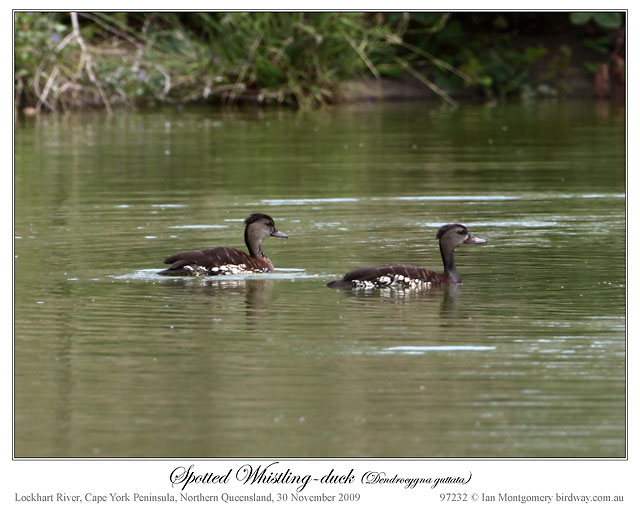
Spotted Whistling Duck (Dendrocygna guttata) by Ian
Newsletter – 12/3/2009
Another late bird of the week, I regret, as I’ve just returned from a ten day trip to Cape York, not famous for its internet facilities, or any facilities for that matter. I’m home now and will play catch-up with another bird of (this) week over the next few days.
Australia is rather isolated geographically, so colonisation by a new species of bird is an unusual event. Such an event is most likely to occur on Cape York Peninsula, which is within island-hopping distance of New Guinea. The Spotted Whistling Duck, a common bird in New Guinea, was first recorded at Weipa on the western side of the peninsula in 14 years ago. It now occurs also in the Lockhart River district on the eastern side at about the same latitude as Weipa and this is where we came across a party of 4 last Monday. It will be interesting to see if it gets more widely established in Northern Australia.
Unlike the other two Australian Whistling-Ducks (Plumed and Wandering), the Spotted lacks side plumes and is easily recognisable by conspicuous white spots with black borders on the flanks. Globally, there are eight species of Whistling Ducks, all belonging to the genus Dendrocygna, with tropical and sub-tropical ranges in Australia, Asia, Africa and the Americas. The Plumed is endemic to Australia, while the Wandering also occurs in New Guinea, Indonesia, Borneo and the Philippines.
Website links:
Plumed Whistling-Duck
Wandering Whistling-Duck
Best wishes,
Ian
—
Ian Montgomery, Birdway Pty Ltd,
454 Forestry Road, Bluewater, Qld 4818
Phone: +61-7 4751 3115
Preferred Email: ian@birdway.com.au
Website: http://birdway.com.au
Lee’s Addition:
Thanks, Ian, those Whistling Ducks are neat. We don’t get to see those here in Florida, of course, but we do get to see lots of Black-bellied and Fulvous Whistling Ducks. The other three Whistlers are the White-faced, West Indian and the Lesser Whistling Ducks.
I will whistle for them and gather them, For I will redeem them; And they shall increase as they once increased. (Zechariah 10:8 NKJV)
The Whistling Ducks are part of the Anatidae Family within the Anseriformes Order.
Here are photos of all eight Whistling Ducks
*
This slideshow requires JavaScript.
*


 Lee's Birdwatching Adventures Plus