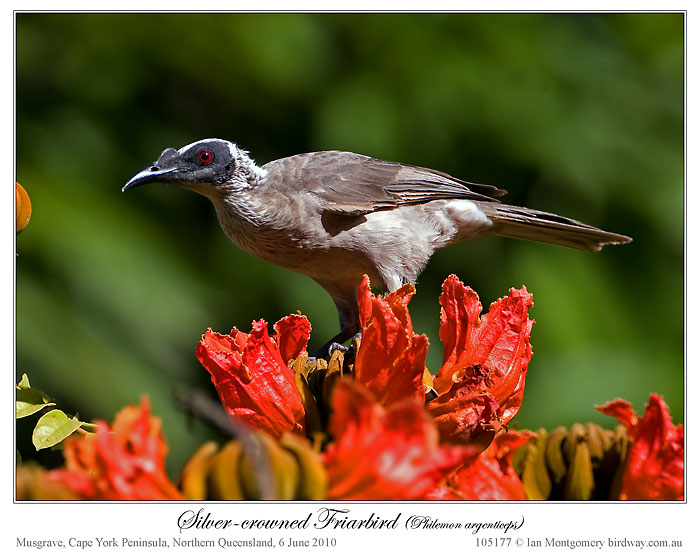
Ian’s Bird of the Week – Silver-crowned Friarbird

Silver-crowned Friarbird (Philemon argenticeps) by Ian

Silver-crowned Friarbird (Philemon argenticeps) by Ian

Ian’s Bird of the Week – Silver-crowned Friarbird ~ by Ian Montgomery

Last week, we had the splendid Palm Cockatoo at Mungkan Kandju National Park. On the way home, I spent the night at Musgrave, Cape York Peninsula, so that I could look for Golden-shouldered Parrots at Artemis Station where the owners, the Shephards, have worked tirelessly to save this utterly beautiful but endangered parrot. This featured as Bird of the Week last December, so I’ve chosen the Silver-crowned Friarbird as the main species this week.

Silver-crowned Friarbird (Philemon argenticeps) by Ian

Silver-crowned Friarbird (Philemon argenticeps) by Ian

At Musgrave, I camped under an African tulip tree, a popular ornamental introduction in northern Australia but now branded as a Class 3 weed in Queensland (may not be supplied or sold and removal may be required from environmentally sensitive areas). It is, however, very popular with the larger honeyeaters and after returning from Artemis, I noticed a smallish Friarbird feeding in the tree and making unfamiliar sounds, this Silver-crowned Friarbird, a species I’ve seen in the Northern Territory but not previously in northern Queensland, where the similar Helmeted Friarbird is much commoner.

The north Queensland race of the Helmeted Friarbird (yorki) also has a silver crown and frequently mid-identified. The Silver-crowned is better identified by its smaller size (27-32cm/11-12.6in compared with 32.5-37cm/12.8-14.6in), the shape of the bare patch on the cheek and the shape of the bill-knob. In the Silver-crowned Friarbird the black facial skin forms an angular point behind the eye but is rounded in the Helmeted. This isn’t always easy to see, so I have included the second photo which shows it better. The Silver-crowned has a more prominent bill-knob, but the knob is less obvious in juvenile birds of both species and variable in shape in the races of the Helmeted. The call is perhaps more reliable as the tone of the Silver-crowned is noticeably more nasal, sometimes described as ‘cat-like’ and also likened to the calls of the Koel. I’m rather deaf, but even I noticed the difference.
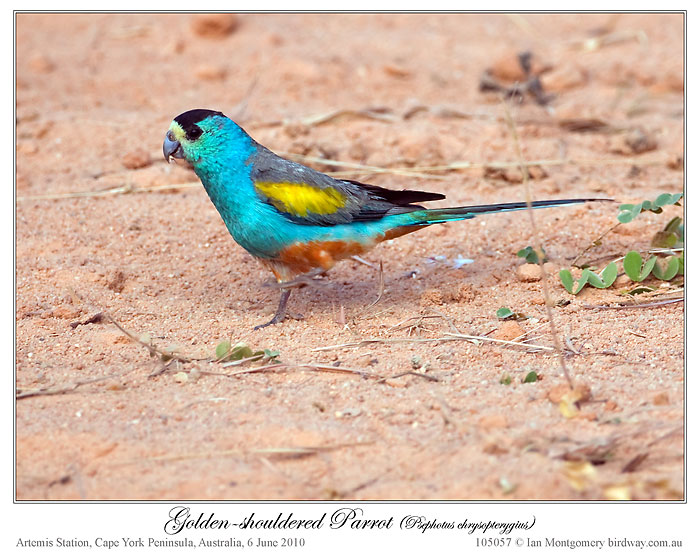
Golden-shouldered Parrot (Psephotus chrysopterygius) by Ian

Golden-shouldered Parrot (Psephotus chrysopterygius) by Ian

Sue Shephard found me a pair of Golden-shouldered Parrots feeding on the roadside and the male was quite approachable, so I’ve included a photo of this amazing parrot.

Back at the website, I’ve been labouring to fix the formatting problems discovered with old versions of Internet Explorer. I’ve fixed the home page and all the new format family index pages and am now updating the actual photo galleries. I’ve started with the galleries birds that appear at the top of the home page as ‘Ian’s Picks’, normally updated weekly, though I’ll leave the current crop for a few days longer.

As part of the reformatting, I’m adding a few refinements. In the family index pages, I’ve included ‘place-holders’ for regional thumbnail links that don’t apply (eg Australian Thumbnails for Woodpeckers) so that the regional thumbnail links always appear in the same location in both the family index pages and the species galleries and I’m including the other applicable regional thumbnail links in the regional index pages so that, for example, you can go straight from the Old World Woodpecker thumbnails to the New World Woodpecker thumbnails without having to go through the Global thumbnails.

I’ve also including the previous and next family pointers (and the names of the families) in the regional index pages so that, again, you don’t have to go to the Global level of thumbnails to get to the next or previous family. This all sounds more complicated that it actually is, so, if you are interested, have a look at the Woodpeckers: http://www.birdway.com.au/picidae/index.htm .

Best wishes,
Ian


Ian Montgomery, Birdway Pty Ltd,
454 Forestry Road, Bluewater, Qld 4818
Phone: +61-7 4751 3115

Preferred Email: ian@birdway.com.au
Website: http://birdway.com.au


Lee’s Addition:

Again, Ian has captured some fantastic photos of the birds. He has such a talent for his photography. Thanks again, Ian.

The Friarbirds are in the Meliphagidae Family of the Passeriformes Order.

The crown of the wise is their riches: but the foolishness of fools is folly. (Proverbs 14:24 KJV)

See also:
Ian’s Bird of the Week – Helmeted Friarbird

*
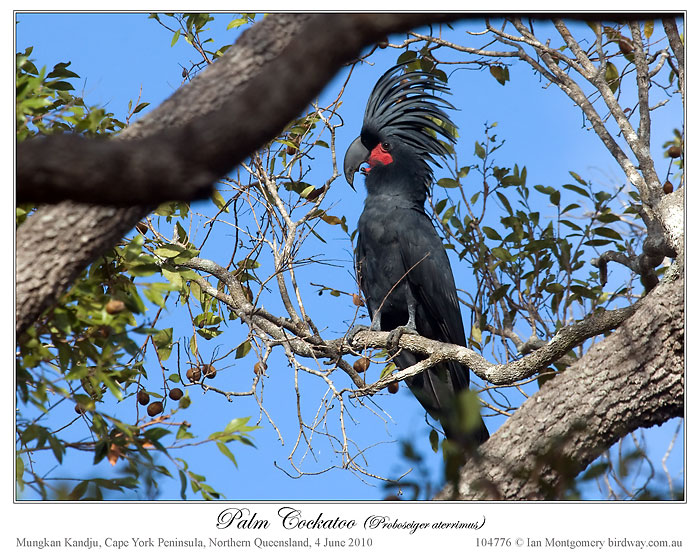
Ian’s Bird of the Week – Palm Cockatoo

Palm Cockatoo (Probosciger aterrimus) by Ian

Palm Cockatoo (Probosciger aterrimus) by Ian Montgomery

Ian’s Bird of the Week – Palm Cockatoo ~ Ian Montgomery

I’ve just returned from Mungkan Kandju National Park between Coen and Weipa on Cape York Peninsula where I took part in the second of a series of Qld Parks and Wildlife surveys to measure the effect of feral animals on the park. It wasn’t all hard work, though, and during one of the surveys I got the opportunity to photograph a couple of Palm Cockatoos, my most ‘wanted’ bird on the Peninsula since I took some poor photos of them in early 2004 and again during the first Mungkan Kandju survey last November.

Palm Cockatoo (Probosciger aterrimus) by Ian

Palm Cockatoo (Probosciger aterrimus) by Ian

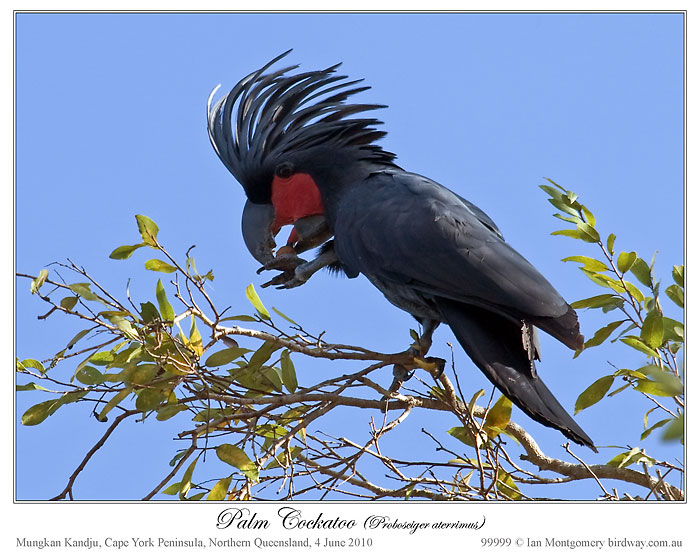
The first two photos show an adult Palm Cockatoo in a fruiting tree (Nonda Plum). Previously I’d found these birds rather shy, but the adult bird was prepared to tolerate me below the tree while it had breakfast. Palm Cockatoos are spectacular birds by any criterion,up to 64cm/24in in length, and unlike some cockatoos are not at all coy about displaying their huge crests. They have massive bills and in the second photo you can see the bird has evolved to be a huge nutcracker with wings. The lower bill is broad to prevent the fruit rolling out sideways while the upper bill has a big notch to hold the fruit in place and is slim and sharp like a blade. The tongue has a pad on the end used to manipulate the fruit, and if that isn’t enough the bird balances casually on one foot to leave the other free to use as a hand.

Palm Cockatoo (Probosciger aterrimus) by Ian

Palm Cockatoo (Probosciger aterrimus) by Ian

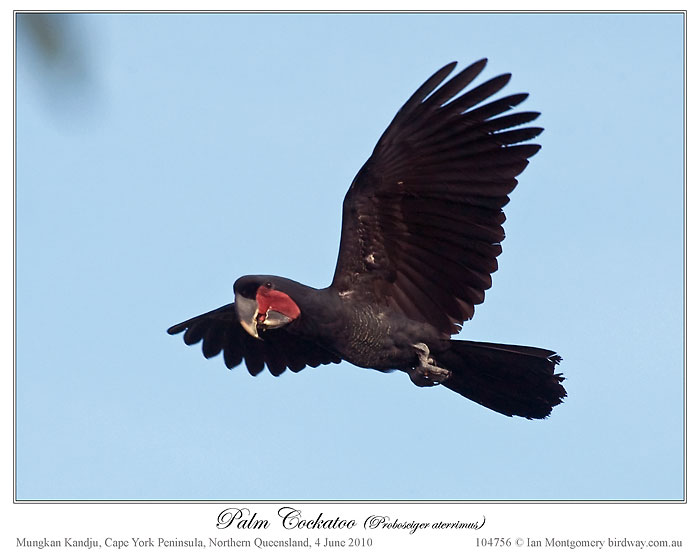
The third photos shows the other bird in flight. This is an immature bird, distinguishable by the barring on the chest, so I suppose that the adult bird was one of its parents. The young bird flew away when we approached and wasn’t seen again, but the adult seemed to think food was more important than parental care. Very young birds have a greyish rather than red face, so this one was old enough to look after itself.

Palm Cockatoos occur in Papua New Guinea and the Aru Islands but in Australia their range is restricted to the northern part of Cape York south to the Archer and Coen Rivers and Princess Charlotte Bay, so Mungkan Kandju is at the southern limit of their distribution. Within this range they are reasonably common on the edges of rainforest and in eucalyptus forest and they call loudly in flight.

I’m just about to post other photos of these birds to the website, so you can check them out at http://www.birdway.com.au/cacatuinae/palm_cockatoo/index.htm .

Best wishes,
Ian

Ian Montgomery, Birdway Pty Ltd,
454 Forestry Road, Bluewater, Qld 4818
Phone: +61-7 4751 3115
Preferred Email: ian@birdway.com.au
Website: http://birdway.com.au


Lee’s Addition:
The Palm Cockatoo is part of the Cockatoos & Allies – Cacatuidae Family in the Psittaciformes Order. This Order includes not only the Cockatoos, but also the New Zealand Parrot (Strigopidae) and Parrot (Psittacidae) families.

What magnificent birds the Lord has created in this Order.  Many of these have been captured and tamed, but is is nice to see these photos of the birds out in the wild.

For every kind of beasts, and of birds, and of serpents, and of things in the sea, is tamed, and hath been tamed of mankind: (James 3:7 KJV)

*

Ian’s Bird of the Week – Whistling Kite

Whistling Kite (Haliastur sphenurus) by Ian

Whistling Kite (Haliastur sphenurus) by Ian

Ian’s Bird of the Week – Whistling Kite  ~ by Ian Montgomery

I’ve just revised the eagle, hawk and allies galleries (Acciptridae http://www.birdway.com.au/accipitridae/index.htm ) on the website with the new format, larger image sizes and regional indices with different background colours. Eagles and hawks attract great interest generally and are the most popular targets for internet searches on the website. They’re also popular with birders and are a challenge to identify in flight, so a good place to start is the widespread and common Whistling Kite – the one we probably check most often to make sure it isn’t something more unusual like a Square-tailed Kite or Little Eagle.

Whistling Kite (Haliastur sphenurus) by Ian

Whistling Kite (Haliastur sphenurus) by Ian

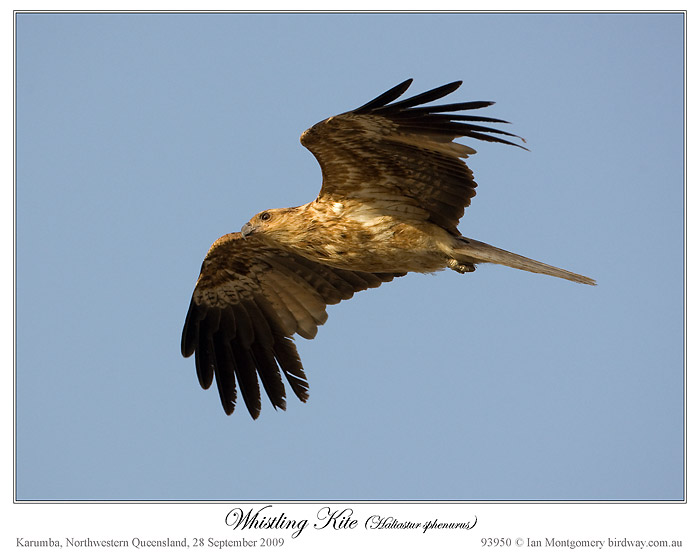
At 50-60cm/20-24in in length and with a wingspan of about 1.2m/47in, the Whistling Kite is just one of about a dozen Australian species of raptors in this size range and with colours in varying shades of coffee. So, leaving size and beverages aside, identification relies on other features particular underwing pattern, relative sizes and shapes of wings and tail and style of flight. As you can see in the first two photos, Whistling Kites have distinctive wing patterns, with the most notable feature being the contrasting outer very dark primaries*, very pale 3 or 4 inner primaries and very dark secondaries. The resulting pattern is a white spot on the trailing edge of the wing and a pale right-angle formed by the leading under-wing coverts and the pale primaries. This is diagnostic: other raptors have pale patches – windows or bull-eyes – but usually in the ‘palm’ of the hand or the leading edge and lack an abrupt right-angle.

Whistling Kite (Haliastur sphenurus) by Ian

Whistling Kite (Haliastur sphenurus) by Ian

*The primary flight feathers, usually numbering 9 -11 inmost species of birds (except Grebes, Storks and Flamingos – 12 –  and Ostriches – 16) and are attached to the ‘hand’ part of the wing (metacarpals and phalanges of the large second digit). The secondaries, very variable in number, are attached to the ulna of the ‘forearm’ between the ‘elbow’ (not obvious in birds as the humerus is short and thick for attachment of the large pectoral muscle) and the ‘wrist’ – the forward-pointing angle in the middle of the leading edge.

Whistling Kite (Haliastur sphenurus) by Ian

Whistling Kite (Haliastur sphenurus) by Ian

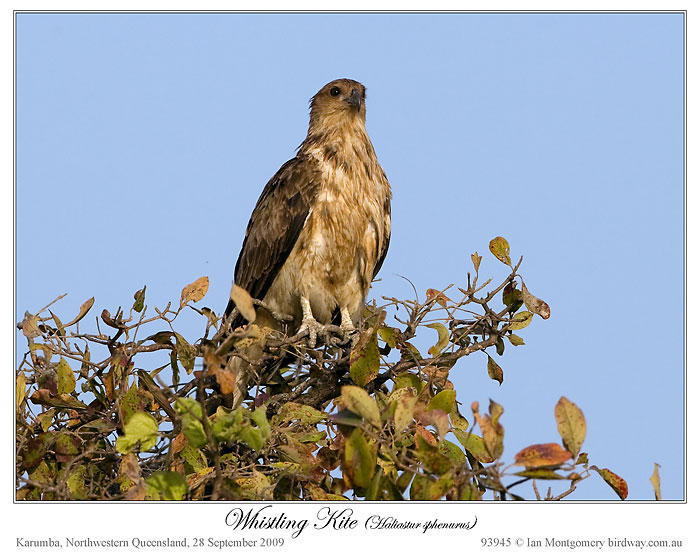
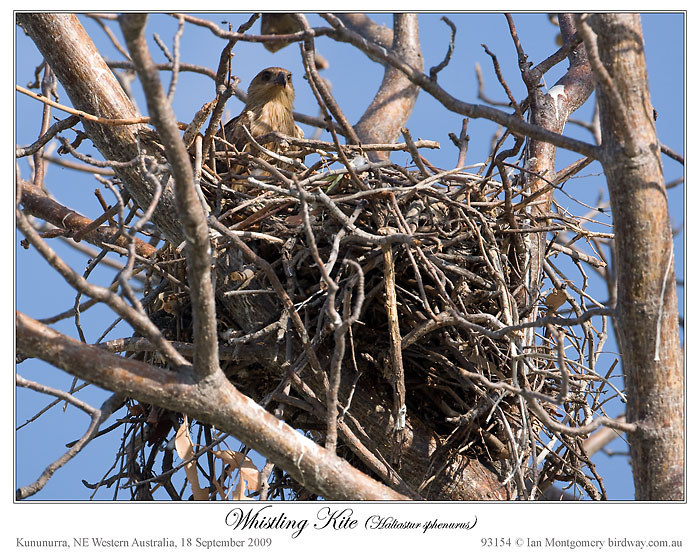
The tail of the Whistling Kite is characteristic too: long, latte coloured and paddle-shaped with a rounded and you can see in the first that the Whistling Kites swivel the tail like a paddle for steering. Most other raptors have darker tails with barring – the Whistling Kite has faint, barely visible bars. Whistling Kites glide with horizontally curved – rather than flat or angled wings – a bit like seagulls one draws as a kid and have a rather floppy untidy flight. When perched, they usually do so in an upright stance, rather like a Brown Falcon, as in the third photo. They build a typical raptor nest – bulky, with large sticks – high in a tree and re-used so that it gets very large after a number of years.

The Whistling Kite gets its name from its distinctively un-raptor-like call. Its is common throughout Australia except in the driest areas of western South Australia and eastern Western Australia. They take live prey including fish, so they are frequenty found near both fresh and salt water, but also feed on carrion and are often seen cruising along highways, along with Black Kites, Brahminy Kites and Wedge-tailed Eagles, looking for road-kills. Their only close relative is the Brahminy Kite, and these two species comprise (globally) the genus Haliastur.

Back at the website, I’ve applied the new format to the Cockatoos and Estrildid Finches, both also popular targets:
Best wishes,
Ian

Ian Montgomery, Birdway Pty Ltd,
454 Forestry Road, Bluewater, Qld 4818
Phone: +61-7 4751 3115
Preferred Email: ian@birdway.com.au
Website: http://birdway.com.au

Lee’s Addition:
Ian has been working hard on his website and it is really looking good. Ian, I like the new format. Click on his links for some really nice photographs of birds and other critters. Birdway.com.au
From his site, “28 May 2010: this site contains more than 5,000 photos of 1,234 bird species in the wild – 596 of these are on the main Australian list of Christidis & Boles, 2008 – and 83 photos of 23 species of reptiles and Australian mammals.”

And the vulture, and the kite after his kind; (Leviticus 11:14 KJV)

The Kite is a member of the Accipitridae Family and has 250 members. They are in the Accipitriformes Order. The family has Kites, Hawks, Eagles, and their allies. The Kite is also one of the Birds of the Bible and is in the “unclean” list of birds not to be eaten.

*

Ian’s Bird of the Week – Splendid Fairy-wren

Splendid Fairywren (Malurus splendens) by Ian Montgomery


Ian’s Bird of the Week – Splendid Fairy-wren  ~  Ian Montgomery

Newsletter – 5/25/10

It has been about 4 years since a Fairy-wren featured as Bird of the Week. It’s not for nothing that the Superb Fairy-wren made the list (No. 78) in David Chandler and Dominic Couzens’s ‘100 Birds to See before You Die’, so let’s rectify that with the Splendid Fairy-wren.

Splendid Fairywren (Malurus splendens) by Ian Montgomery

Splendid Fairywren (Malurus splendens) by Ian

All the male Fairy-wrens are stunningly beautiful and some of their names reflect that: Superb, Splendid and Lovely before getting to more prosaic names like Purple-crowned and Variegated. Maybe the bird-namers should have consulted the thesaurus. Mine includes (under splendid): spiffy, ritzy, glorious, lavish, swanky and sublime; ‘imperial’ might fit the Purple-crowned well. Anyway, the Splendid lives up to its name, as you can see in the first photo, even if ‘splendid’ has connotations of grand, perhaps inappropriate for a tiny bird 14cm/5.5in in length, much of which is tail.

It’s not as well known as the Superb, which occurs in all the southeastern Australia capitals from Brisbane to Adelaide via Hobart, but the Splendid rules supreme in Perth. As addition, it has wide range throughout Australia east of the Great Divide with three distinct races in eastern, central and western Australia. The one in the first and second photos is the eastern race melanotus, photographed in southwestern Queensland, identifiable by it cobalt- rather than violet-blue colour, paler cheek patch, narrow breast band and black back – visible in the second photo – with the latter giving this race its other name of Black-backed Fairy-wren. Incidentally, Fairy-wrens are unrelated to Northern Hemisphere wrens and together with the grasswren and emu-wrens comprise the Australo-Papuan family Maluridae.
Splendid Fairywren (Malurus splendens) by Ian Montgomery

Splendid Fairywren (Malurus splendens) by Ian

The third photo shows a male of the nominate western race in transition from non-breeding to breeding plumage. Fairy-wrens, like some very colourful ducks such as the Mallard, shed their bright colours in the non-breeding plumage and acquire the ‘eclipse’ plumage. This is similar to that of the female, though eclipse male fairy-wrens are often subtly different from females and young birds. In the case of Splendid Fairy-wrens, the eclipse male is distinguishable from the female by having a dark rather than tan bill, greyish rather than tan eye-ring, dark lores (between the eye and the bill) and blue wings.

Best wishes,
Ian

Links: Fairywrens


Ian Montgomery, Birdway Pty Ltd,
454 Forestry Road, Bluewater, Qld 4818
Phone: +61-7 4751 3115
Preferred Email: ian@birdway.com.au
Website: http://birdway.com.au


Lee’s Addition:The Splendid Fairywren is in the Maluridae Family which includes the 29 Australasian Wrens (Fairywren, Emu-wren, and Grasswren). They are in the Passeriformes Order.

Great are the works of the LORD; They are studied by all who delight in them. Splendid and majestic is His work, And His righteousness endures forever. He has made His wonders to be remembered; The LORD is gracious and compassionate. (Psalms 111:2-4 NASB)

Ian’s Bird of the Week – Cattle Egret

Western Cattle Egret (Bubulcus ibis) by Ian Montgomery

Eastern Cattle Egret (Bubulcus coromandus) by Ian Montgomery

Ian’s Bird of the Week – Cattle Egret   by Ian Montgomery

Eastern Cattle Egret (Bubulcus coromandus)2 by Ian Montgomery

Eastern Cattle Egret (Bubulcus coromandus)2 by Ian Montgomery

At a time when wildlife populations are generally under pressure, here is a success story about a species of bird, the Cattle Egret, that has undergone a spectacular world-wide expansion in range over the past century of or so.

In the 19th century, the Cattle Egret occurred only in tropical and subtropical Africa, southwestern Europe (the nominate race, Ardea ibis ibis) and in southern and southeastern Asia (the distinctive race Ardea ibis coromandus). Now, it breeds in every continent except Antarctica, though it turns up as a vagrant on sub-antarctic islands such as South Georgia and the South Orkney Island. Originally adapted to feeding with large herbivores, its expansion has followed the of spread humans with their livestock.

The expansion started in southern Africa with breeding first recorded in Cape Province in 1908. At about the same time, vagrants started crossing the Atlantic to eastern South America, where it probably became established in the 1930s but breeding was not proven until 1950 in Surinam and British Guiana. Some birds were reported in Florida in the 1940s and breeding was recorded in 1953. Since then, the species has spread all over South and Central America, much of the United States into Canada and has simultaneously expanded its range in southern Europe and the Middle East.

Eastern Cattle Egret (Bubulcus coromandus)3 by Ian Montgomery

Eastern Cattle Egret (Bubulcus coromandus)3 by Ian Montgomery

Concurrently, the Asian race was extending its range southeastwards and arrived in the Northern Territory in the 1940s. Cattle Egrets were first record in Victoria in 1949, southwestern Western Australia in 1959, South Australia in 1964, Tasmania in 1965 and started breeding in Queensland in 1963, the same year in which they were first recorded in New Zealand. Now, it is an abundant breeding bird in the warmer parts of Australia and mainly a winter and spring visitor to southern Australia, Tasmania and New Zealand.

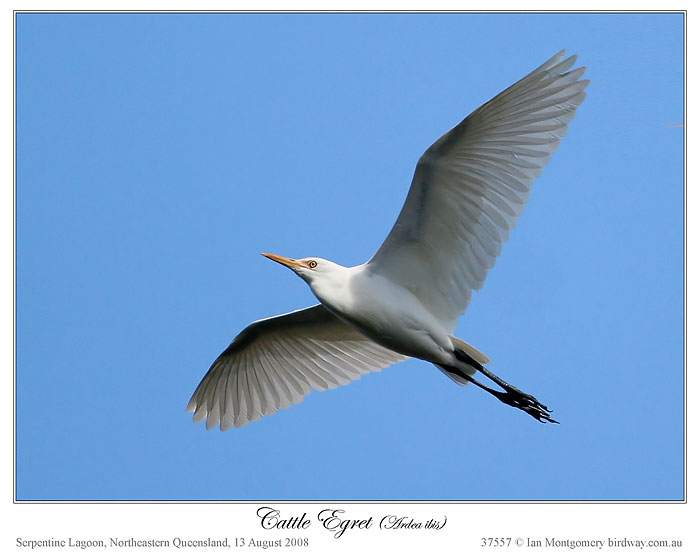
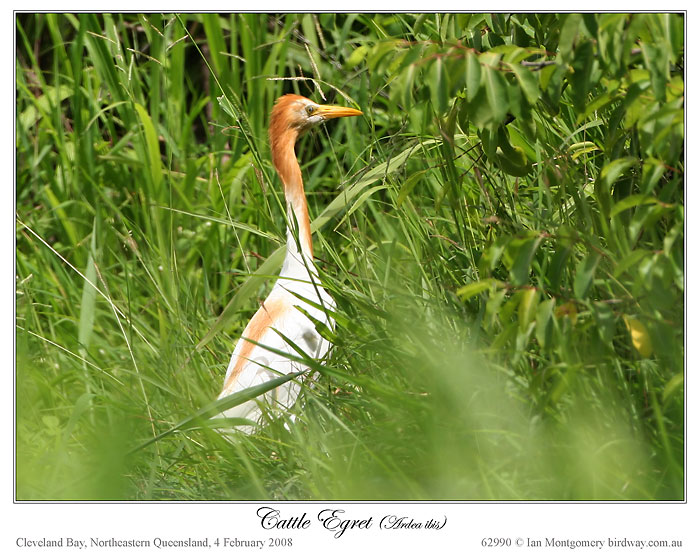
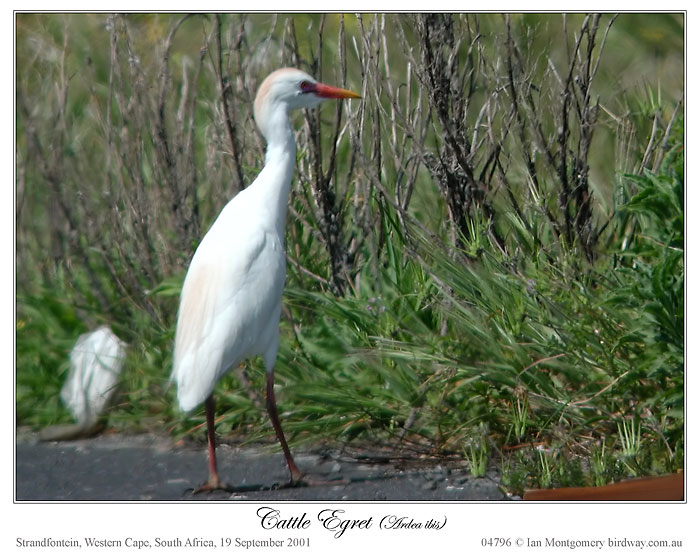
In non-breeding plumage, the feathers are almost entirely white (first photo, bird in flight) apart from traces of buff on the crown and looks like a dumpy version of the Intermediate Egret. When breeding the Asian/Australian race has extensive gold on the head, back and breast (second photo) and looks quite different from the much paler eastern race (third photo). The bird in the latter photo is perhaps atypically pale for an eastern bird, but it has the reddish bill, legs and iris that are the courtship colours of both races.

Eastern Cattle Egret (Bubulcus coromandus)4 by Ian Montgomery

Eastern Cattle Egret (Bubulcus coromandus)4 by Ian Montgomery

The fourth photo shows several Cattle Egrets standing guard in a proprietary manner around some young Brahmins at the Orient Wetland north of Townsville last Friday. Although they are very gregarious, the dominant birds exclude other birds from the favoured feeding spots just behind grazing animals. They feed mainly on grasshopper and other invertebrates disturbed by herbivores but are flexible and will eat a wide variety of other food including young birds. So, the global expansion has a dark side and I recently read an article, thank you Jeri, expressing concern about predation by Cattle Egrets on the nesting colonies of the Red-winged Blackbird in California (http://tricolor.ice.ucdavis.edu/ ).

Meanwhile back at the website, following last week’s release of the revised home page, I’ve been working on redesigning the family pages and species galleries to make them neater and easier to use. It will take time before the revisions get generally applied but you might like to check out the Crane family thumbnails(http://www.birdway.com.au/gruidae/index.htm ), colour-coded by region, and the Brolga gallery with larger images (http://www.birdway.com.au/gruidae/brolga/index.htm ). I’ve also increased the size of the photos in this week’s bird of the week. This will mean that I’ll probably often exceed the intended limit of 200KB for the weekly posting. Let me know if this is going to be a problem, but I suppose most of us now have broadband internet.

Best wishes,
Ian

Ian Montgomery, Birdway Pty Ltd,
454 Forestry Road, Bluewater, Qld 4818
Phone: +61-7 4751 3115
Preferred Email: ian@birdway.com.au
Website: http://birdway.com.au


Lee’s Addition:

The Cattle Egret is now, according to the I.O.C., divided into 2 species. The Eastern Cattle Egret (Bubulcus coromandus) and the Western Cattle Egret (Bubulcus ibis). The Eastern breeds in Asia and Australasia, and the western nominate form occupies the rest of the species’s range. Here in the United States, we have the Western Cattle Egret. Those of us who live here in Florida see them all the time, just like in Ian’s forth picture. You will see one or more per cattle. They love to stand right by them and look for bugs or whatever as the cows pull up the grass to eat. They seem to get along and the cattle don’t seem to mind them standing there, almost in their face sometimes. Thanks, Ian, for more great photos and information.

The Cattle Egrets are part of the Ardeidae Family which has Herons, Egrets and Bitterns. They are in the Pelicaniformes Order.

Now behold, I Myself do establish My covenant with you, and with your descendants after you; and with every living creature that is with you, the birds, the cattle, and every beast of the earth with you; of all that comes out of the ark, even every beast of the earth. (Genesis 9:9-10 NASB)


Family#26 – Ardeidae
*

Ian’s Bird of the Week – Striped Honeyeater

Striped Honeyeater (Plectorhyncha lanceolata) by Ian

Striped Honeyeater (Plectorhyncha lanceolata) by Ian

Ian’s Bird of the Week – Striped Honeyeater – by Ian Montgomery

I’ve been slow to produce this week’s bird as I’ve been burning the midnight oil rewriting the home page of the website – more about that later.

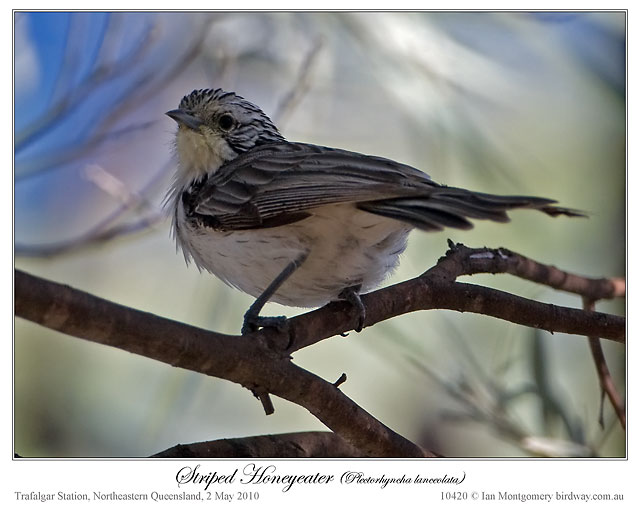
Last week we had the Southern Bookbook from a rewarding evening of spotlighting at Trafalgar Station south of Charters Towers. Daytime birding there produced some interesting birds, notably a Pictorella Mannikin among some Plum-headed Finches and pair of Striped Honeyeaters. this is an uncommon Honeyeater with some unusual features and, being in its genus, is not closely related to other Honeyeaters.

Striped Honeyeater (Plectorhyncha lanceolata) by Ian

Striped Honeyeater (Plectorhyncha lanceolata) by Ian

One such feature is a very un-honeyeater-like call that first attracted our attention. The field guides agree that it is mellow, rollicking or rolling, and rising and falling. To me it sounded like a loud gerygone, the rusty bicycle wheel of a Mangrove or Large-billed maybe, but I’m a bit deaf and you mightn’t agree. In appearance it is rather dapper, and seems formally dressed for the drier, fairly casual areas of eastern Australia in which it occurs, from the Spencer Gulf in South Australia to Cooktown in NE Queensland.

It shows its affinity with honeyeaters by having a brush tongue for nectar, but the narrow, pointed bill, shown in the second photo is in fact adapted to supplementing a sugary diet by probing for insects and orther invertebrates as illustrated by the bird in the third photo, which has just found a spider in some mistletoe. The trees are mulga, a dry country acacia, and typical habitat for Striped Honeyeaters, I included the second photo, as it isn’t often one gets to photograph birds from above, a bird’s eye view so to speak, unless they are acrobatic like these in search of food.

Striped Honeyeater (Plectorhyncha lanceolata) by Ian

Striped Honeyeater (Plectorhyncha lanceolata) by Ian

I’ve redone the home page to make it easier to find photos of the more than 1,200 species in the 142 families now represented. The main change is the inclusion of a set of 142 family thumbnails – called Instant Links to Bird Families – in taxonomic sequence to take you directly to the species thumbnails for each family. The family thumbnails have been selected to show a typical member of the family, and each one has a list of the included species which will appear if you hold the cursor over the thumbnail. If you know or can guess in which family to look, you can find out, without leaving the home page, whether a particular species is present in the website.

Having clicked on a family thumbnail, the species thumbnails then allow you to go directly to view the first photo of a particular species and the thumbnails of other photos of that species. You can therefore find and view any of the now more than 5,000 photos in just three clicks. All the 5,000 photos have both family thumbnail button(s) for global and regional thumbnails and home page buttons, so you can then move back up to the family level or return directly to the home page to repeat the process for an unrelated species.

To make room for the new Instant Links, I’ve moved the ‘Recent Additions’ to a horizontal, scrollable row of (currently more than 70) thumbnails. The most recent additions are visible on the left, older ones are revealed by scrolling to the right. Future thumbnails will include a message – viewable in the same way as the family thumbnail list by holding the cursor over the thumbnail – about the date of the addition and the number of new photos; current ones just have a message to the effect ‘Click here to go to the gallery of  . . ‘.
Links:
Instant Links to Bird Families http://www.birdway.com.au/#families
Recent Additions http://www.birdway.com.au/#updates
Southern Boobook http://www.birdway.com.au/strigidae/southern_boobook/index.htm
Pictorella Mannikin http://www.birdway.com.au/estrildidae/pictorella_mannikin/index.htm
Plum-headed Finch http://www.birdway.com.au/estrildidae/plum_headed_finch/index.htm
Best wishes,
Ian

Ian Montgomery, Birdway Pty Ltd,
454 Forestry Road, Bluewater, Qld 4818
Phone: +61-7 4751 3115
Preferred Email: ian@birdway.com.au
Website: http://birdway.com.au


Lee’s Addition:

Striped Honeyeaters are in the Meliphagidae – Honeyeaters Family of the Passeriformes Order. There are 142 members in that family.
*

Ian’s Bird of the Week – Southern Boobook

Southern Boobook (Ninox boobook) by Ian Montgomery

Southern Boobook ( Ninox boobook) by Ian Montgomery

Newsletter  5-4-2010

Here’s one for the lovers of owls – which, I imagine, includes almost everybody. This is the commonest and most widespread owl in Australia, and its plaintive ‘boobook’ or ‘morepork’ call is a familiar sound in a huge range of habitats from tropical rainforest, through leafy suburbs and city parks to almost treeless regions of the dry interior. Despite both its abundance and lots of effort on my part, it has eluded my camera since, as a graduate student, I took some slide photos of one through a window of the Zoology Department of Sydney University in the mid 1970s.

Southern Boobook (Ninox boobook) by Ian Montgomery

Southern Boobook (Ninox boobook) by Ian Montgomery

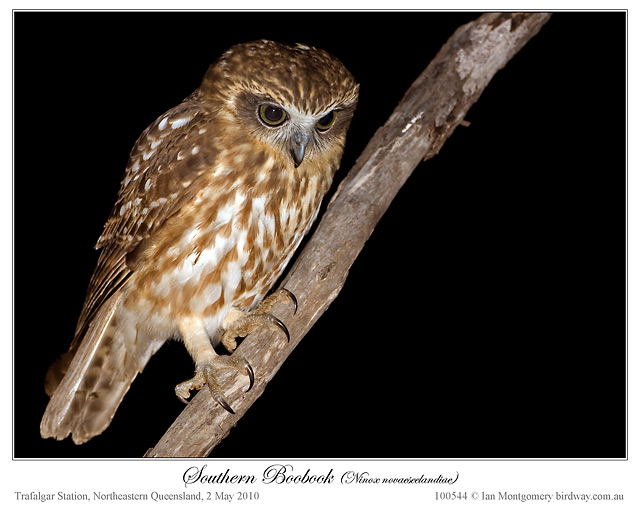
This weekend just past was the occasion of the AGM of Birds Australia North Queensland and it was held at a large cattle station (property) called Trafalgar about 50km southwest of Charters Towers outside Townsville. We went spotlighting in the station truck, ideally equipped for birding safari-style with two bench seats placed longitudinally back-to-back on the rear, on a clear Sunday night and after finding a rather flighty barn owl, we encountered a Boobook in a tree beside the road that was much more cooperative. Having photographed it from the truck, I eventually got down and set up the tripod much closer to the the owl. It stayed put, despite my flash and 3 spotlights and when we finally left, it was still there. The portrait in the first photo is in fact cropped from a photo that includes the whole bird, so you can appreciate that the conditions for photography were excellent.

Later we found a Tawny Frogmouth, also a willing subject, and on the road itself, a suicidal young Owlet-Nightjar – nearly got run over – which let me approach it so closely that I could no longer focus with my 500mm lens (minimum focusing distance 4.5m/15ft). The consensus seemed to be that it was the best night’s spotlighting ever. The clear sky with no light pollution meant that we could see both the Southern Cross and the Big Dipper/Plough simultaneously, and on the way back a just-past-full moon rose in the east.
The Boobook is a smallish owl ranging in size from 25-28cm/10-11in for males and 30-36cm/12-14in for females. This one seemed relatively large to me, so it was probably female. The current taxonomic treatment is to treat as a single species the various boobooks in Australia, New Zealand, southern New Guinea, Timor and some islands of eastern Indonesia. This leaves only the Sumba Boobook (Sumba is west of Timor) as a separate species, so there isn’t a ‘Northern’ Boobook as such.
Best wishes,
Ian
Links:

Barn Owl
Tawny Frogmouth
Australian Owlet-nightjar

Ian Montgomery, Birdway Pty Ltd,
454 Forestry Road, Bluewater, Qld 4818
Phone: +61-7 4751 3115
Preferred Email: ian@birdway.com.au
Website: http://birdway.com.au


Lee’s Addition:

Boobooks are in the Strigidae Family of the Strigiformes Order. I love that name. Not sure how it got it other than it’s sound.

Southern Boobook Audio from xeno-canto.org by Pakihi Okarito

But the cormorant and the bittern shall possess it; the owl also and the raven shall dwell in it: (Isa 34:11a)

Ian’s Bird of the Week – White-winged (Black) Tern

White-winged Tern (Chlidonias leucopterus) by Ian

White-winged Tern (Chlidonias leucopterus) by Ian

Newsletter – 4/25/2010

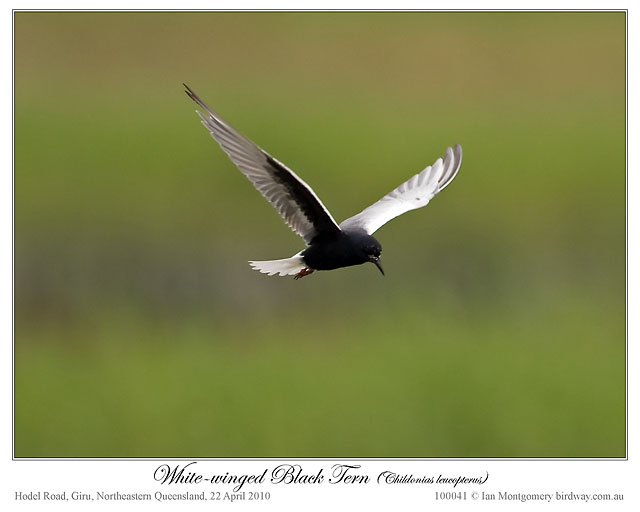
The weather is improving here, so I went birding a couple of times last week. The first time I went to Hodel Road, Giru, just south of Townsville, which goes through an area of marshy coastal grassland that can turn up interesting birds. At this time of the year, it can be good for White-winged (Black) Terns starting the migration back to the northern hemisphere and some, like the one in the first photo, may be in the unmistakable breeding plumage, with black bodies and pale wings. I’ve bracketed (Black) as this qualifier is usually added in Australia, while Birdlife International calls it just ‘White-winged Tern’.

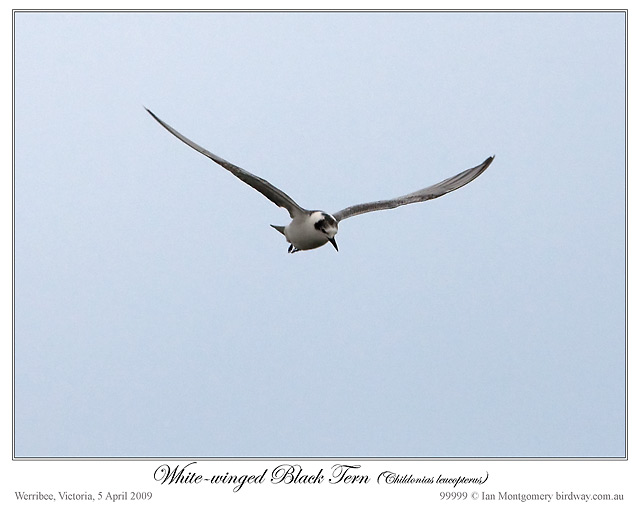
More usually in Australia, we see White-winged Black Terns in non-breeding plumage – like the one in the second photo – and care needs to be taken to distinguish them from the related, slightly larger, Whiskered Tern in the same plumage. Perhaps the best field mark is the shape of the black band on the head. In the White-winged Tern it forms a vertical hoop over the crown of the head; in the Whiskered Tern it forms a horizontal hoop around the nape and the crown is whitish. There are also differences in the patterns of the upper wing. In the White-winged the dark leading edge (visible in the second photo) and the whitish rump gives the bird a patchier appearance than that of the more homogeneous Whiskered.

White-winged Tern (Chlidonias leucopterus) by Ian

White-winged Tern (Chlidonias leucopterus) by Ian

Some points that may be of interested to bird photographers relate to birds in flight coming towards the camera and to backgrounds. Telephoto lenses have very a shallow field of view, particularly at the high shutter speed/large aperture combination necessary to freeze the motion of the bird. This means that even if the auto-focus has operated correctly, the bird may have moved out of focus during the lag while the photo is taken. Some cameras have an autofocus option to compensate for constant movement, called ‘AI-Servo’ on Canon SLRs, and this is the occasion to use it.

The problem with backgrounds is that the autofocus may miss the bird and grab the background instead. Birds against the sky are easier than against the ground – unless there are clouds with high contrast. Practicing tracking birds in flight is the solution here, and I use a single focus point in the centre of the viewfinder. This gives much more control over auto-focusing and not only with birds in flight but also in spatially complex shots such as a bird in a tree with branches around it.

On the website, I’ve been experimenting with changes to the layout of bird photos. The changes involve technical aspects such as getting rid of frames, but the advantages from a user’s point of view include being able to bookmark individual photos (rather than just species), and scroll bars to prevent thumbnails extending way below the window. If you’re interested, have a look at http://www.birdway.com.au/otididae/australian_bustard/source/australian_bustard_99577.htm – I’d welcome your feedback.

The other birding outing last week was to get photos of nesting Chowchillas at Paluma (this gallery uses the new layout and has 600px-wide images instead of 500)

Best wishes,
Ian

Ian Montgomery, Birdway Pty Ltd,
454 Forestry Road, Bluewater, Qld 4818
Phone: +61-7 4751 3115 begin_of_the_skype_highlighting              +61-7 4751 3115      end_of_the_skype_highlighting
Preferred Email: ian@birdway.com.au
Website: http://birdway.com.au


Lee’s Addition:

The White-winged (Black) Tern is in the Laridae Family of the Charadriiformes Order. There are 102 members of the family. Only 39 of those are Terns, the rest are Gulls, Noddy, Skimmers, and Kittiwakes. They are small terns generally found in or near bodies of fresh water across from Southeastern Europe east to Australia.

Their behavior like the other “marsh” terns (Chlidonias), and unlike the “white” (Sterna) terns, these birds do not dive for fish, but fly slowly over the water to surface-pick items on the surface and catch insects in flight. They mainly eat insects and small fish. In flight, the build appears thick-set. The wing-beats are shallow and leisurely.

Their breeding habitat is freshwater marshes across from southeast Europe to central Asia. They usually nest either on floating vegetation in a marsh or on the ground very close to water, laying 2-4 eggs in a nest built of small reed stems and other vegetation. In winter, they migrate to Africa, southern Asia and Australia. It is a scarce vagrant in North America, mainly on the Atlantic coast, but a few records on the Pacific coast and inland in the Great Lakes area.

The White-winged (Black) Tern is another of the neatly created birds which shows the Handiwork of God.

Then God said, “Let the waters abound with an abundance of living creatures, and let birds fly above the earth across the face of the firmament of the heavens.” (Genesis 1:20 NKJV)

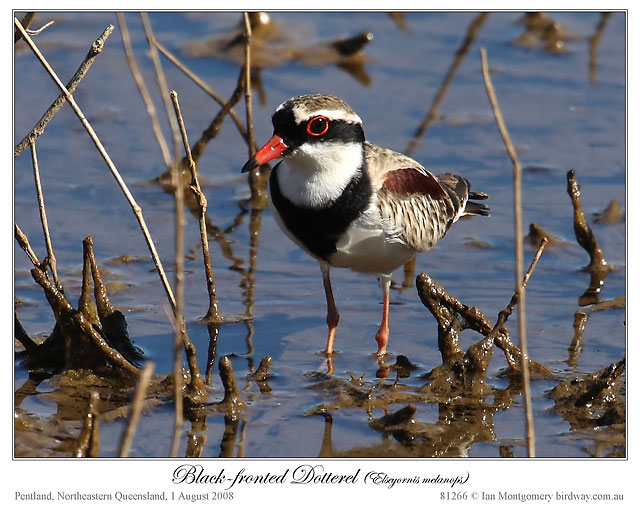
Ian’s Bird of the Week – Black-fronted Dotterel

Black-fronted Dotterel (Elseyornis melanops) by Ian

Black-fronted Dotterel (Elseyornis melanops) by Ian

Ian’s Bird of the Week – Black-fronted Dotterel ~ by Ian Montgomery

It is easy to think of waders, such as sandpipers and plovers, in terms of challenges – both the survival challenges that long distant migrants face and the identification challenges that these migrants, usually in non-breeding plumage, pose for birders. So, it’s easy to overlook the unchallenging ones – distinctive native species, easy on the eye and easy to identify that are delightful members of the Australian countryside such as the Black-fronted Dotterel.

The Black-fronted Dotterel is a small plover: at 16-18cm/6-7in in isn’t much longer than the proverbial sparrow (14-16cm). It shows a marked preference for shallow fresh water, only rarely occurring in saline environments, and can manage with quite small and transient pools. It is widespread throughout Australia and Tasmania, absent only from the most arid regions of western central Australia, and also resident in New Zealand. The first photo shows a bird – males and females are identical – on the wetland in Pentland on the Flinders Highway west of Townsville, a popular drop-in spot for passing birders. The second photo was taken at sunset at Bowra, a wonderful property near Cunnamulla in southwestern Queensland, long managed in a bird-friendly way by the McLaren family and now being purchased by the Australian Wildlife Conservancy ( http://www.australianwildlife.org/Bowra.aspx ).

Black-fronted Dotterel (Elseyornis melanops) by Ian

Black-fronted Dotterel (Elseyornis melanops) by Ian

Unlike the migrants, residents such as the Black-fronted Dotterel, don’t have a separate breeding and (drab) non-breeding plumages. Because of irregular rainfall patterns, they can breed at any time of the year and need to be able to respond quickly and attract mates at short notice. They nest in exposed positions on the ground, so they compromise by having bold patterns with small splashes of colour on the bill and eye-ring that break up the outline of the bird, rather than blend into the background, and can be surprisingly difficult to see when crouched motionless.

On the related subject of migrant plovers, this is a good time of the year to look for birds in, or acquiring, breeding plumage. We did one of our regular wader counts at Lucinda, near Ingham north of Townsville, last week and there were still numbers of Lesser and Greater Sand Plovers around. I’ve posted photos of these – and a Grey-tailed Tattler – in breeding plumage to the website:
Lesser Sand Plover
Greater Sand Plover
Grey-tailed Tattler

Best wishes,
Ian

Ian Montgomery, Birdway Pty Ltd,
454 Forestry Road, Bluewater, Qld 4818
Phone: +61-7 4751 3115
Preferred Email: ian@birdway.com.au
Website: http://birdway.com.au


Lee’s Addition:

I always enjoy finding out about Ian’s Birds of the Week. Never know what he will show us. I trust you enjoy finding out about birds in other parts of our fantastic world as well.
The Dotterels are in the Charadriidae Family of the Charadriiformes Order. There are 67 birds in the family that includes Plovers, Lapwings, Killdeer, Wrybill, and the Dotterels. There are only 6 Dotterels; Red-kneed, Eurasian, Hooded, Shore, Black-fronted, and Tawny-throated. The Inland Plover was the Inland Dotterel

I will open rivers in high places, and fountains in the midst of the valleys: I will make the wilderness a pool of water, and the dry land springs of water. (Isaiah 41:18 KJV)

Ian’s Bird of the Week – Christmas Imperial Pigeon

Christmas Imperial Pigeon (Ducula whartoni) by Ian Montgomery

Christmas Imperial Pigeon (Ducula whartoni) by Ian Montgomery

Bird of the Week: Christmas Imperial Pigeon by Ian Montgomery
Newsletter: 04/13/10

We are, we hope, near the end of a persistent wet season, during which I haven’t taken many photos. So, here is an attractive bird from the archives, photographed on a trip to Christmas Island in 2006, the Christmas Island Imperial Pigeon. It’s comparable in size (length 38-40cm/15-16in) to the Pied Imperial-Pigeon of northern Australia, but quite different in colour, much darker with strikingly iridescent plumage. In the first photo, the sunlight highlights the green iridescence of the back and wing feathers, while the second photo shows the purplish-grey and rufous-brown plumage of the underside.

Christmas Imperial Pigeon (Ducula whartoni) by Ian Montgomery

Christmas Imperial Pigeon (Ducula whartoni) by Ian Montgomery

It’s endemic to Christmas Island, a mere speck – area 140 sq km – in the Indian Ocean 500 km south of Java. Because of its small range and therefore limited population, it is classified as Vulnerable on the IUCN Red List. It seemed to be quite common on the island and the population is thought to be stable, though there are concerns that it could be affected by an infestation of yellow crazy ants on Christmas Island. Control measures have reduced the ant infestation, but eliminating them has proved difficult and the baits used also affect other invertebrates such as the famous terrestrial red crabs.

It’s closest relative is the Pink-headed Imperial-Pigeon (Ducula rosacea) which is widespread but rather rare in the islands of Indonesia and East Timor. It has suffered from both habitat destruction and hunting. Some authorities consider that the Christmas Island Imperial-Pigeon may be a race of the Pink-headed.

I’ve added photos of three more Australian mammals to the website: the Euro (a blackish kangaroo), Bush Rat and Fawn-footed Melomys (also a rodent). The latter two obliged us with good view coming into feed on grain at Kingfisher Park over Easter, undeterred by the rain.

Best wishes,
Ian

Links:
Christmas Imperial Pigeon
Pied Imperial-Pigeon
Euro
Bush Rat
Fawn-footed Melomys

Ian Montgomery, Birdway Pty Ltd,
454 Forestry Road, Bluewater, Qld 4818
Phone: +61-7 4751 3115
Preferred

Email: ian@birdway.com.au
Website: http://birdway.com.au


Lee’s Addition:
The Christmas Island Imperial-Pigeon has recently been changed to the Christmas Imperial Pigeon. It is in the Columbidae Family of the Columbiformes Order. There are 321 birds in the family of various Doves and Pigeons, plus Bronzewings and Bleeding Hearts.

Check out the Doves and Pigeon page. Doves and Pigeons are mentioned many times in the Bible.

So I said, “Oh, that I had wings like a dove! I would fly away and be at rest. (Psalms 55:6 NKJV)

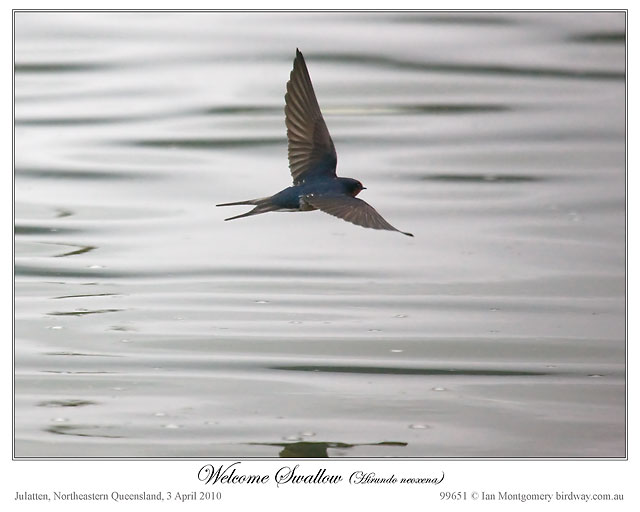
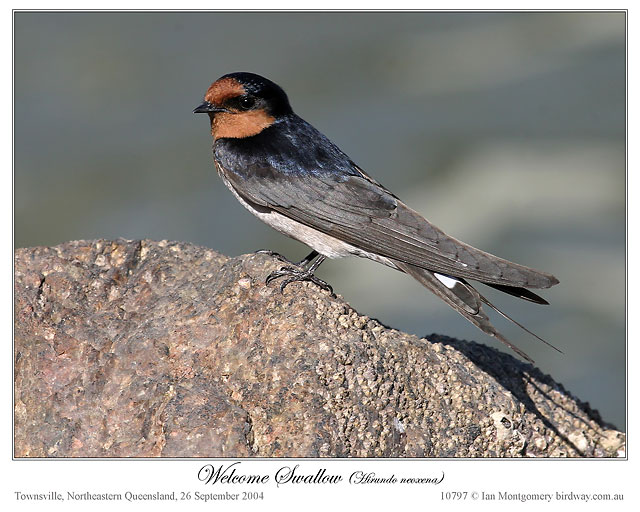
Ian’s Bird of the Week – Welcome Swallow

Welcome Swallow (Hirundo neoxena) by Ian

Welcome Swallow (Hirundo neoxena) by Ian

Newsletter: 4-6-10

Birds Australia North Queensland had planned to visit Cooktown for Easter, which turned out to be very wet throughout northeastern Queensland. A few intrepid souls, presumably not camping, made it there, but a friend and I spent a few days at Kingfisher Park in Julatten near Mossman before returning home. We did manage to get out birding a few times between showers and one afternoon I spent an hour or two trying to photograph birds hawking for insects over the fish ponds of a nearby Barramundi farm. As is often the case, the poor weather brought both the insects and their avian predators down to low levels – poor light but good practice.

Welcome Swallow (Hirundo neoxena) by Ian

Welcome Swallow (Hirundo neoxena) by Ian

The birds consisted of a mixture of Welcome Swallows, Tree Martins and White-rumped Swiftlets, and I’ve posted images of all three to the website, though I’ve chosen the Welcome Swallow here as being the most photogenic. This is a familiar and widespread bird in Australia, though it is absent from the the arid centre and northern Western Australia and much of the Northern Territory. It is similar in appearance and habits to the Barn Swallow of the northern hemisphere, and like it builds a cup-shaped nest in sheltered sites, particularly buildings.

Welcome Swallow (Hirundo noexena) by Ian

Welcome Swallow (Hirundo noexena) by Ian

The first photo shows a bird hawking low over grass and obligingly spreading all its tail feathers to brake or turn. The second one is flying over the fish pond and the third is a photo taken some time ago of a bird perched beside Ross River in Townsville.

The name ‘Welcome’ emphasizes its familiarity, but it also suggests to me migration and a harbinger of Spring. In fact, unlike the Barn Swallow, it is resident over much of its range and only in Tasmania and southeastern Australia does it migrate for the southern winter but only as far as Queensland and Torres Strait. The Barn Swallow is a famous migrant traveling from Europe to Africa, North to South America and Northern to Southern Asia. Some even get as far as Australia and turn up annually in small numbers in northern coastal areas.

Best wishes,
Ian

Links:
Welcome Swallow
Barn Swallow
Tree Martin
White-rumped Swiftlet

Kingfisher Park
Birds Australia North Queensland

Ian Montgomery, Birdway Pty Ltd,
454 Forestry Road, Bluewater, Qld 4818
Phone: +61-7 4751 3115
Preferred Email: ian@birdway.com.au
Website: http://birdway.com.au


Lee’s Addition:

The Welcome Swallow is in the Hirundinidae Family of the Passeriformes Order. What a shot, Ian, of that Swallow flying with wings and tail out. I hardly get to see our swallows, they fly so fast.

The Welcome Swallow is metallic blue-black above, light grey below on the breast and belly, and rusty on the forehead, throat and upper breast. It has a long forked tail, with a row of white spots on the individual feathers. These birds are about 15 cm long, including the outer tail feathers which are slightly shorter in the female. The call is a mixture of twittering and soft warbling notes, and a sharp whistle in alarm.

Young Welcome Swallows are buffy white, instead of rufous, on the forehead and throat, and have shorter tail streamers.

The winter range in northern Australia overlaps with that of wintering Barn Swallow (Hirundo rustica), but the latter is readily separable by its blue breast band.[5] Welcome Swallows readily breed close to human habitation. The nest is an open cup of mud and grass, made by both sexes, and is attached to a suitable structure, such as a vertical rock wall or building. It is lined with feathers and fur, and three to five eggs are laid. Two broods are often raised in a season.

The female alone incubates the eggs, which hatch after two to three weeks. The young are fed by both parents, and leave the nest after a further two to three weeks.

These birds are extremely agile fliers, which feed on insects while in flight. They often fly fast and low to the ground on open fields in large circles or figure 8 patterns. They will often swoop around animals or people in the open.

An immature Welcome Swallow preening by Nick Talbot

(Info from Wikipedia)

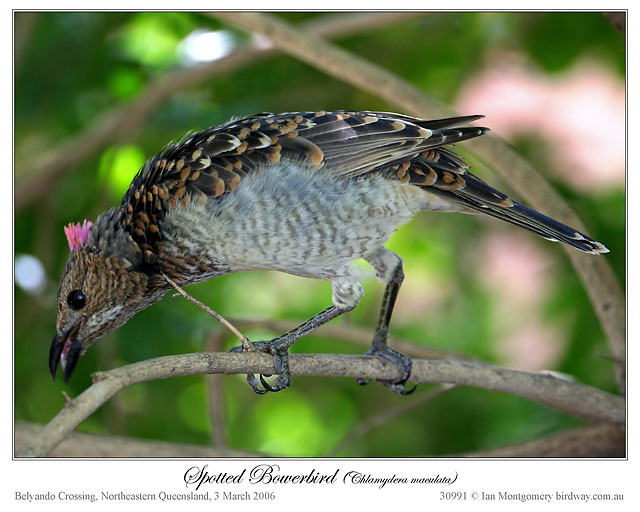
Ian’s Bird of the Week – Spotted Bowerbird

Spotted Bowerbird (Chlamydera maculata) by Ian

Spotted Bowerbird (Chlamydera maculata) by Ian

Bird of the Week: Spotted Bowerbird
Newsletter: 3/30/2010

I’ve recently been updating the Bowerbird galleries on the website, including those of the Satin, Great Bowerbirds and Spotted. Both the Satin and Great have featured as bird of the week in the past, so here is the Spotted Bowerbird. It is closely related to the similar Great Bowerbird, but is smaller (to 30cm/12in in length compared with 38cm/15in) and much more richly coloured, buff and brown, rather than fawn and greyish-brown. It also has a pink erectile crest on the nape used in display, more prominent on the male but smaller or absent in females and young birds.

Spotted Bowerbird (Chlamydera maculata) by Ian

Spotted Bowerbird (Chlamydera maculata) by Ian

Both the photos were taken near the roadhouse at Belyando Crossing, the only place where you can get petrol and food on the 400km stretch between Charters Towers and Clermont on the inland route south of Townsville, and a reliable spot for this species. In the first photo, the bowerbird is showing interest in the mango, remains of my breakfast, currently being commandeered by a Blue-faced Honeyeater. If you look carefully, you can see the crest, but it is more obvious in the second bird which is displaying to another one, out of sight below.

Spotted Bowerbird (Chlamydera maculata) by Ian

Spotted Bowerbird (Chlamydera maculata) by Ian

The Spotted Bowerbird is a bird of mainly inland eastern Australia, though it reaches the coast in central Queensland. It occurs widely in Queensland, though absent from the north where it is replaced by the Great, and in New South Wales as far south as the border with Victoria and southeastern South Australia. It is common in the northern part of its range, but rarer in the south. It is replaced in central western regions of Australia (southern Northern Territory, central Western Australia and northwestern South Australia by the similar but darker Western Bowerbird. These three all belong to the genus Chlamydera, and in northern Cape York and Papua New Guinea there is a fourth species, the Fawn-breasted Bowerbird, while a fifth species, the Yellow-breasted Bowerbird, is found in New Guinea but not in Australia.

The males of all these bowerbirds build avenue bowers consisting of two parallel walls, like that of the Satin Bowerbird but unlike the maypole bower of the Golden Bowerbird that was illustrated 4 weeks ago when it featured as bird of the week. All five species collect white and green objects, and seem to show an almost fetishistic preference for shiny objects – stones and shells, historically, but nowadays glass and metal. Only the three southern species have pink crests and these three all collect red objects; the Fawn- and Yellow-breasted Bowerbirds lack the crests and I cannot find any reference to their collecting red objects. Young birds, presumably males, also collect objects in juvenile display areas that lack a proper bower. The third photo, shows one of these, playing with a blue plastic bottle ring, perhaps an indiscriminate choice of exuberant youth!

Golden Bowerbird (Prionodura newtoniana) by Ian

Golden Bowerbird (Prionodura newtoniana) by Ian

On the subject of bowerbirds, the attached photo of a Golden Bowerbird has been chosen as the icon for the upcoming Birds Australia Congress and Campout in Townsville in August;  .

Links:
Photos of Satin, Golden, Great, Spotted and Fawn-breasted (but not Western) Bowerbirds: http://www.birdway.com.au/ptilonorhynchidae/index.htm.

Best wishes
Ian

Ian Montgomery, Birdway Pty Ltd,
454 Forestry Road, Bluewater, Qld 4818
Phone: +61-7 4751 3115
Preferred Email: ian@birdway.com.au
Website: http://birdway.com.au


Lee’s Addition:

Ian’s Bird of the Week – Golden Bowerbird

Golden Bowerbird by A. J. Mithra

Spotted Bowerbird is part of the Ptilonorhynchidae – Bowerbirds Family in the Passeriformes Order

If a bird’s nest chance to be before thee in the way in any tree, or on the ground, whether they be young ones, or eggs, and the dam sitting upon the young, or upon the eggs, thou shalt not take the dam with the young: But thou shalt in any wise let the dam go, and take the young to thee; that it may be well with thee, and that thou mayest prolong thy days. (Deuteronomy 22:6-7 KJV)


Family#126 – Ptilonorhynchidae
*