Ian’s Bird of the Week – Frill-necked Monarch

Frill-necked Monarch (Arses lorealis) by Ian

Frill-necked Monarch (Arses lorealis) by Ian

Newsletter – 12/16/2009

Frill-necked Monarch (Arses lorealis) by Ian

Frill-necked Monarch (Arses lorealis) by Ian

On our recent trip to Cape York Peninsula, we came across several Frill(-neck)ed Monarchs in the Lockhart River – Iron Range district. This is quite similar to the Pied Monarch of the wet tropics of northeastern Queensland, but lacks the black breast band and has a more extensive frill and broader blue eye-rings. I’ve qualified the name as the original Frilled Monarch of northern Cape York Peninsula, Torres Strait and Papua New Guinea (Arses telescopthalmus) has recently been split into the Frilled Monarch of Torres Strait and PNG and the new Frill-necked Monarch (Arses lorealis) of northern Cape York Peninsula.
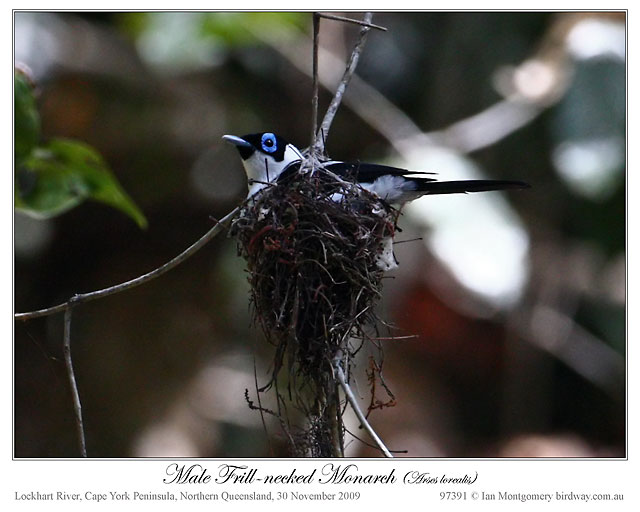
The bird in the first photo is a male, distinguishable by having black lores and a black bib, or maybe goatee would be more appropriate. It’s doing something with either the white honeydew on the flower stalk or the insects (aphids or scale insects) responsible for the honeydew. More about the ‘something’ in a moment.

Earlier the same day, another Frill-necked Monarch carrying nesting material revealed the location of her nest, hanging, hammock- or swing-like, from a long vine over a creek, a typical location thought to discourage predation by animals such as arboreal snakes. This bird stayed in the nest for a few minutes, left and then, I thought, returned. It was only later, when examining the photos that it I realised that the second bird was her mate. If you look carefully, you can see the white chin (and maybe the pale lores) of the female in the second photo and the black goatee and lores of the male in the third photo.

Frill-necked Monarch

Frill-necked Monarch

The fourth photo was intended to show how precariously the nest was built at the end of at least 3 metres of vine, and, again, it was only later that I noticed that one branch of the vine was broken (in the centre of the photo). It’s still attached above the nest to the other strand of the vine and I wondered whether this attachment was serendipitous or had been done as a repair by the birds. Monarchs are supposed to use cobwebs to glue their nests together. I then wondered whether the bird in the first photograph was feeding on the aphids/scale insects, feeding on the honeydew (as some birds do such as the New Zealand Honeyeater the Tui) or collecting the honeydew as glue – it’s very sticky – for nest construction.

Back at the website, I’ve added photos of:
the Cape York race of the Masked Finch
the northern race of the Black-throated Finch
Wandering Whistling-Duck
White-bellied Sea-Eagle being fed on garfish by the Ferryman at Karumba
Golden-shouldered Parrot
White-faced Robin
Yellow-legged Flycatcher/Flyrobin
So it’s no wonder I’m late with my Christmas cards yet again!

I wish you all a safe and happy Christmas and best wishes for the New Year,
Ian

Ian Montgomery, Birdway Pty Ltd,
454 Forestry Road, Bluewater, Qld 4818
Phone: +61-7 4751 3115
Preferred Email: ian@birdway.com.au
Website: http://birdway.com.au


Lee’s Addition:

And God blessed them, saying, “Be fruitful and multiply, and fill the waters in the seas, and let birds multiply on the earth. (Genesis 1:22 NKJV)

The Frill-necked Monarch (Arses lorealis) is a species of songbird in the Monarchidae family. It is endemic to the rainforests of the northern Cape York Peninsula. It was considered a subspecies of the related Frilled Monarch (Arses telescophthalmus) for many years before being reclassified as a separate species in 1999.

The Frill-necked Monarch is a member of a group of birds termed monarch flycatchers. This group is considered either as a subfamily Monarchinae, together with the fantails as part of the drongo family Dicruridae, or as a family Monarchidae in its own right. Molecular research in the late 1980s and early 1990s revealed the monarchs belong to a large group of mainly Australasian birds known as the Corvida parvorder comprising many tropical and Australian passerines. More recently, the grouping has been refined somewhat as the monarchs have been classified in a ‘Core corvine’ group with the crows and ravens, shrikes, birds of paradise, fantails, drongos and mudnest builders.

Alternative common names include Australian Frilled Monarch, and White-lored Flycatcher.

The Frill-necked Monarch measures around 14 cm (5.5 in) in length, and the neck feathers can become erect into a small frill; the male is predominantly black and white, and can be distinguished from the similar and more common Pied Monarch by its all-white breast-the latter species having a broad black breast band. The throat, nape, shoulders, and rump are white while the wings and head are black. It has a eye-ring of bare skin, and a bright blue wattle. The bill is pale blue-grey and the eyes are dark. The female is similar but lacks the eye-ring and has white lores and a brownish tinged chest.

Breeding season is November to February with one brood raised. The nest is a shallow cup made of vines and sticks, woven together with spider webs and shredded plant material, and decorated with lichen. It is generally sited on a hanging loop of vine well away from the trunk or foliage of a sizeable tree about 2–10 metres (6.6–33 ft) above the ground. Two pink-tinged oval white eggs splotched with lavender and reddish-brown are laid measuring 19 mm x 14 mm.

Video of a Frilled Monarch (Arses telescopthalmus) by Keith.
Error
This video doesn’t exist

Ian’s Bird of the Week – Golden-shouldered Parrot

Golden-shouldered Parrot (Psephotus chrysopterygius) by Ian

Golden-shouldered Parrot (Psephotus chrysopterygius) by Ian

Newsletter: 12/8/2009

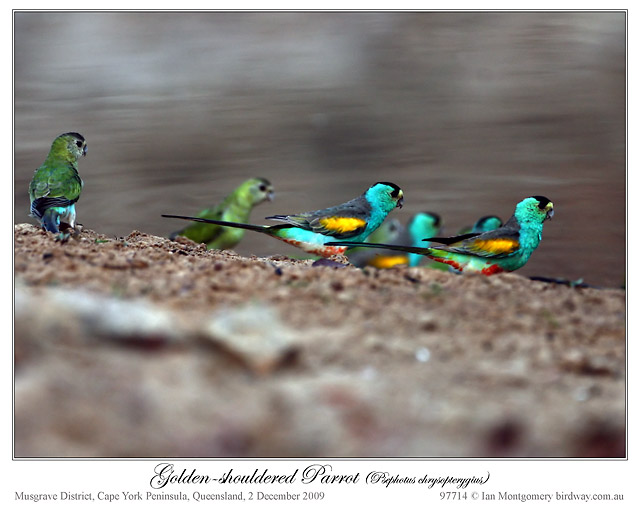
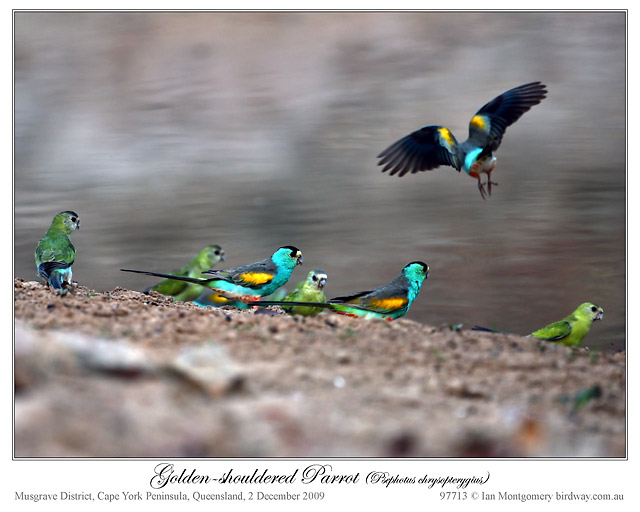
The Hooded Parrot featured as bird of the week at the end September following our encounter with some at Pine Creek in the Northern Territory. This week we have its rarer, and just as beautiful, close relative the Golden-shouldered Parrot of Cape York Peninsula, which we saw last week on our way back from Iron Range. We were shown them coming in to drink at a dam at sunrise by Sue Shephard of Artemis Station south of Musgrave.

Golden-shouldered Parrot (Psephotus chrysopterygius) by Ian

Golden-shouldered Parrot (Psephotus chrysopterygius) by Ian

The two species look very similar. Male Golden-shouldered Parrots have narrower black caps, not extending past the eye, a yellowish forehead and, despite their name, a smaller golden patch on the wing. These shoulder patches are very obvious in flight, as in the bird top right in the first photo, and presumably act, along with the turquoise rump, as signals to other members of the species. At about 26cm/10in in length, these are both quite small parrots. Like the extinct, closely related, Paradise Parrot of southeastern Queensland, all three species nest, or nested, in terrestrial termite mounds.

The Golden-shouldered Parrot used to be quite widespread on Cape York Peninsula. It is now found only in two areas: in the Morehead River catchment south of Musgrave (where we saw them) and in Staaten River National Park farther to the southwest. Population estimates range up to 1,000 pairs and the species, classified as endangered, is now the subject of a national recovery plan. The good news is that in the last decade the contraction of the range appears to have stopped and the population stabilized, owing to active conservation measures being taken by the holders of grazing properties in the Morehead River catchment, notably Tom and Sue Shephard of Artemis Station. Staaten River National Park is inaccessible by road, so monitoring and conservation there pose particular challenges.

Links:
Hooded Parrot
Golden-shouldered Parrot Recovery Plan

Best wishes,
Ian

Ian Montgomery, Birdway Pty Ltd,
454 Forestry Road, Bluewater, Qld 4818
Phone: +61-7 4751 3115
Preferred Email: ian@birdway.com.au
Website: http://birdway.com.au


Lee’s Addition:
Another neat bird that Ian has captured in photos for us to enjoy. Thanks again, Ian.

He comes from the north as golden splendor; With God is awesome majesty. (Job 37:22 NKJV)

The Golden-shouldered Parrot is in the Psittacidae Family (Parrots) of the Psittaciformes Order (New Zealand Parrots, Cockatoos, and Parrots).

The adult male is mainly blue and has a characteristic yellow over the shoulder area. It has a black cap and pale yellow frontal band. It has a pinkish lower belly, thighs and undertail-coverts. It has a Grey-brown lower back. Adult female are mainly dull greenish-yellow, and have a broad cream bar on the underside of the wings. Juveniles are similar to the adult female. (Wikipedia)

To see more about the Golden-shouldered Parrot:
Nice Video at Internet Bird Collection
By Wikipedia
By Bird Life International

Ian’s Bird of the Week – Black-winged Monarch

Black-winged Monarch (Monarcha frater) by Ian

Black-winged Monarch (Monarcha frater) by Ian

From: Ian Montgomery
Newsletter 12/7/2009

Subject: Bird of the Week: Black-winged Monarch

Black-winged Monarch (Monarcha frater) by Ian

Black-winged Monarch (Monarcha frater) by Ian

If you live on the east coast of Australia, you may be familiar with the very similar Black-faced Monarch. The Black-winged Monarch, distinguishable by paler grey upper parts and contrasting black wings, is, however, a Cape York specialty migrating from PNG in the southern summer to breed along the northeast coast of the Peninsula south to about the McIlwraith Ranges north of Coen.

It’s not a well-known species, and until fairly recently hadn’t been photographed. That, I’m sure, has all changed now with a steady stream of digitally armed birders making the pilgrimage to Lockhart River, where these photos were taken, and the nearby Iron Range National Park. Anyway, I was glad of the opportunity last week to improve on the two mediocre shots on the Birdway website taken on my first visit there almost 6 years ago.

Links:
Black-winged Monarch (the original photos)
Black-faced Monarch

Best wishes,
Ian

Ian Montgomery, Birdway Pty Ltd,
454 Forestry Road, Bluewater, Qld 4818
Phone: +61-7 4751 3115
Preferred Email: ian@birdway.com.au
Website: http://birdway.com.au


Lee’s Addition:

When I think of the Monarch, my first thoughts are of a Monarch Butterfly, but the Monarch birds are very interesting. There are 47 Monarchs in Monarchidae Family of the Passeriformes Order. Also included in the family are Paradise and Crested Flycatchers, an Elepaio, Shrikebills, a Silktail, Magpielark, Torrentlark, and the Myiagra genus of Flycatchers. (Total of 93)
Here are some more of Ian’s Photos from the Monarchidae Family:
Broad-billed Flycatcher
Leaden Flycatcher
Shining Flycatcher
Restless Flycatcher
White-eared Monarch
Spectacled Monarch
Magpielark
Frilled Monarch
Pied Monarch

Another parable He put forth to them, saying: “The kingdom of heaven is like a mustard seed, which a man took and sowed in his field, which indeed is the least of all the seeds; but when it is grown it is greater than the herbs and becomes a tree, so that the birds of the air come and nest in its branches. (Matthew 13:31-32 NKJV)

Black-faced Monarch by Nick Talbot

Also see:

Monarch Flycatchers – Wikipedia

Ian’s Bird of the Week – Spotted Whistling Duck

Spotted Whistling Duck (Dendrocygna guttata) by Ian

Spotted Whistling Duck (Dendrocygna guttata) by Ian

Newsletter – 12/3/2009

Another late bird of the week, I regret, as I’ve just returned from a ten day trip to Cape York, not famous for its internet facilities, or any facilities for that matter. I’m home now and will play catch-up with another bird of (this) week over the next few days.

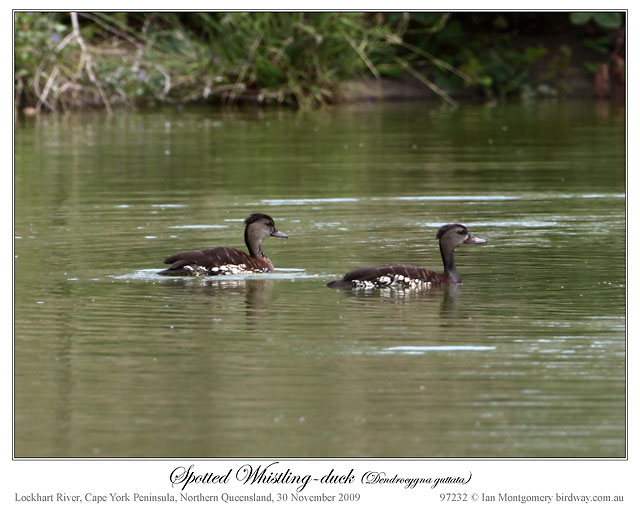
Australia is rather isolated geographically, so colonisation by a new species of bird is an unusual event. Such an event is most likely to occur on Cape York Peninsula, which is within island-hopping distance of New Guinea. The Spotted Whistling Duck, a common bird in New Guinea, was first recorded at Weipa on the western side of the peninsula in 14 years ago. It now occurs also in the Lockhart River district on the eastern side at about the same latitude as Weipa and this is where we came across a party of 4 last Monday. It will be interesting to see if it gets more widely established in Northern Australia.

Unlike the other two Australian Whistling-Ducks (Plumed and Wandering), the Spotted lacks side plumes and is easily recognisable by conspicuous white spots with black borders on the flanks. Globally, there are eight species of Whistling Ducks, all belonging to the genus Dendrocygna, with tropical and sub-tropical ranges in Australia, Asia, Africa and the Americas. The Plumed is endemic to Australia, while the Wandering also occurs in New Guinea, Indonesia, Borneo and the Philippines.

Website links:
Plumed Whistling-Duck
Wandering Whistling-Duck

Best wishes,
Ian

Ian Montgomery, Birdway Pty Ltd,
454 Forestry Road, Bluewater, Qld 4818
Phone: +61-7 4751 3115
Preferred Email: ian@birdway.com.au
Website: http://birdway.com.au


Lee’s Addition:
Thanks, Ian, those Whistling Ducks are neat. We don’t get to see those here in Florida, of course, but we do get to see lots of Black-bellied and Fulvous Whistling Ducks. The other three Whistlers are the White-faced, West Indian and the Lesser Whistling Ducks.

I will whistle for them and gather them, For I will redeem them; And they shall increase as they once increased. (Zechariah 10:8 NKJV)

The Whistling Ducks are part of the Anatidae Family within the Anseriformes Order.

Here are photos of all eight Whistling Ducks
*

This slideshow requires JavaScript.

*

Ian’s Bird of the Week – Rufous-banded Honeyeater

Rufous-banded Honeyeater (Conopophila albogularis) by Ian

Rufous-banded Honeyeater (Conopophila albogularis) by Ian

Here’s a small tropical Honeyeater that we encountered frequently in the Top End of the Northern Territory in September: the Rufous-banded. It’s appeal is subtle rather than spectacular, but I think it looks rather smart with its grey head, white-throat, rufous breast band and brown and yellow wings and tail.

Rufous-banded Honeyeater (Conopophila albogularis) by Ian

Rufous-banded Honeyeater (Conopophila albogularis) by Ian

It has a restricted range, being confined to the Top End of the Northern Territory and the northern half of Cape York in Queensland. It is rather similar to its close relative the Rufous-throated Honeyeater, which, in addition to the different throat colour of adult, lacks the rufous band and has a brownish head. The difference in head colour is diagnostic, as juveniles of the Rufous-banded and Rufous-throated lack the rufous band and throat respectively. Rufous would seem to be important in signalling sexual maturity, though the sexes are identical. The ranges of the two species overlap, with the Rufous-throated extending farther south in the tropics to include the Kimberley in Western Australia, the centre of the Northern Territory and Northern Queensland as far south as Townsville.

I’m in Mission Beach for the annual Pied Imperial Pigeon count http://www.birdsaustralianq.org/projects.htm and the BANQ Christmas get-together en route to Cape York to help in a survey in Mungkan Kandju national park between Coen and Arthur River. The survey will take several days and I plan to stay on for a few extra days to chase a few Cape York specialties.

Best wishes,
Ian

Ian Montgomery, Birdway Pty Ltd,
454 Forestry Road, Bluewater, Qld 4818
Phone: +61-7 4751 3115 Mobile +61-411 602 737
Preferred Email: ian@birdway.com.au
Website: http://birdway.com.au


Lee’s Addition:

Pleasant words are as an honeycomb, sweet to the soul, and health to the bones. (Proverbs 16:24 KJV)

The Rufous-banded Honeyeater is in the Passeriformes order and the Meliphagidae – Honeyeaters Family. Ian has great photos for 59 members of the Meliphagidae family.

“The honeyeaters are a large and diverse family of small to medium sized birds most common in Australia and New Guinea, but also found in New Zealand, the Pacific islands as far east as Hawaii, and the islands to the north and west of New Guinea known as Wallacea. Bali, on the other side of the Wallace Line, has a single species.

Honeyeaters and the closely related Australian chats make up the family Meliphagidae. In total there are 182 species in 42 genera, roughly half of them native to Australia, many of the remainder occupying New Guinea. Like their closest relatives, the Maluridae (Australian wrens), Pardalotidae (pardalotes and thornbills), and Petroicidae (Australian robins), they originated as part of the great corvid radiation in Australia-New Guinea (which were joined in a single landmass until quite recent geological times).” From “Honeyeaters” by AvianWeb

Interesting Links about this Family:
HONEYEATERS Meliphagidae by Bird Families of the World
Honeyeaters by AvianWeb.com

Ian’s Bird of the Week – White-throated Needletail

White-throated Needletail (Hirundapus caudacutus) by Ian

White-throated Needletail (Hirundapus caudacutus) by Ian

My (Ian’s) apologies for a late bird of the week – this should have gone out last week.

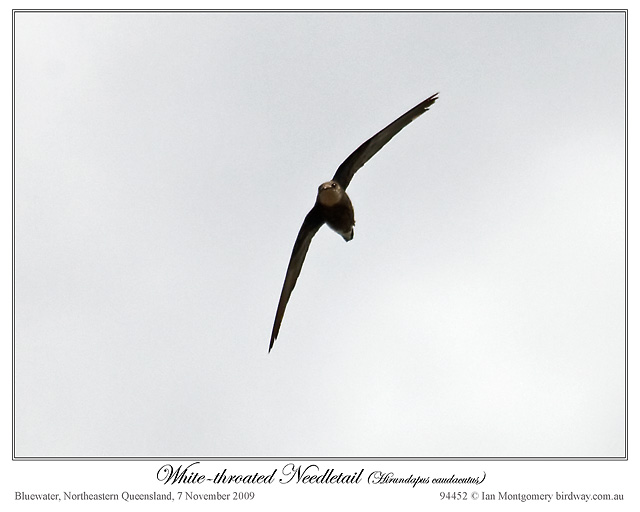
The White-throated Needletail is a large swift, length 20cm/8in, that visits eastern Australia in the southern summer. It’s main claim to fame is that, in level flight, it is one of the fastest, perhaps the fastest, bird in the world with a claimed top speed of 170km/105miles per hour. (The Peregrine Falcon can reach supposedly 300km/200miles per hour in a dive, but that’s a different event in the avian Olympics.)

Swifts are the most aerial of birds and feed, drink and maybe even sleep on the wing. It used to be thought that White-throated Needletails never landed in Australia, but recent studies with radio-tracking show that they can roost in trees, though it is uncertain how predominate this is. They follow weather systems and are often associated with stormy weather. The ones in the photographs appeared near my house last week during showery weather and the birds appeared to be feeding over trees.

White-throated Needletail (Hirundapus caudacutus) by Ian

White-throated Needletail (Hirundapus caudacutus) by Ian

The White-throated Needletail has a barrel-shaped body and a blunt tail, distinguishing it from the slimmer Fork-tailed Swift which also migrates to Australia. The name ‘needletail’ refers to short spiny ends to the tail feathers, just visible if you look carefully at the first photo.

Fast fliers are naturally a challenge to photograph. I practice keeping both eyes open so that I can track the bird until it becomes visible in the viewfinder. Camera settings that help are fast shutter speeds – 1/3000 and 1/5000 sec in these photos – obtainable by using maximum aperture with manual settings and aperture priority and/or high ISO film speed. Some telephoto lenses permit distant settings (eg > 5.6m) to aid automatic focusing and I use a single focusing point in the center of the field of view.

Recent additions to the website include photos of Black-necked Stork/Jabiru and the elusive Black Falcon .


Ian Montgomery, Birdway Pty Ltd,
454 Forestry Road, Bluewater, Qld 4818
Phone: +61-7 4751 3115
Preferred Email: ian@birdway.com.au
Website: http://birdway.com.au


Lee’s Addition:

Even the stork in the heavens Knows her appointed times; And the turtledove, the swift, and the swallow Observe the time of their coming. But My people do not know the judgment of the LORD.
(Jeremiah 8:7 NKJV)

Here’s some additional information about these birds:

“These birds have very short legs which they use only for clinging to vertical surfaces. They build their nests in rock crevices in cliffs or hollow trees. They never settle voluntarily on the ground and spend most of their lives in the air, living on the insects they catch in their beaks.

These swifts breed in rocky hills in central Asia and southern Siberia. This species is migratory, wintering south to Australia. It is a rare vagrant in western Europe, but has been recorded as far west as Norway, Sweden and Great Britain.

The White-throated Needletail is a large bird, similar in size to Alpine Swift, but a quite different build, with a heavier barrel-like body. They are black except for a white throat, white undertail, which extends on to the flanks, and a somewhat paler brown back.

The Hirundapus needletailed swifts get their name from the spiny end to the tail, which is not forked as in the Apus typical swifts. “These are all part of the Apodiformes Order, which includes the Apodidae – Swift Family.

Hirundapus – Genus
White-throated Needletail
Purple Needletail
Silver-backed Needletail
Brown-backed Needletail
Birds of the Bible – Swift
Swift Photos
Swift Videos

Ian’s Bird of the Week – Sulphur-crested Cockatoo

Sulphur-crested Cockatoo (Cacatua galerita) by Ian

Sulphur-crested Cockatoo (Cacatua galerita) by Ian

Newsletter – 11/5/2009

This one should perhaps be called Book of the Week, as my choice of species is to mark the release by Dorling Kindersley Australia of ‘BIRD Australia’ and I’m celebrating because they used more than 200 of my photos. Dorling Kindersley is part of Penguin Group and specializes in richly illustrated reference works. If you were on this list 2 years ago (20 November 2007), you would have received a Gibberbird photo and news of the publication of the original UK edition ‘BIRD The Definitive Visual Guide’, which included more than 100 of my photos.

The first photo of the Sulphur-crested Cockatoo, in light of the setting sun, appears as a double page spread in ‘BIRD Australia’. I’m biased, of course, and think it is a splendid book, so I’ll quote the objective Graeme Hamilton, CEO of Birds Australia (the organization not the book), who says in the foreword: “BIRD Australia superbly illustrates the astonishing diversity of Australian birds . . .”. Christmas is coming so check it out: http://www.penguin.com.au/lookinside/spotlight.cfm?SBN=9781740336994&Page=details .

Sulphur-crested Cockatoo (Cacatua galerita) by Ian

Sulphur-crested Cockatoo (Cacatua galerita) by Ian

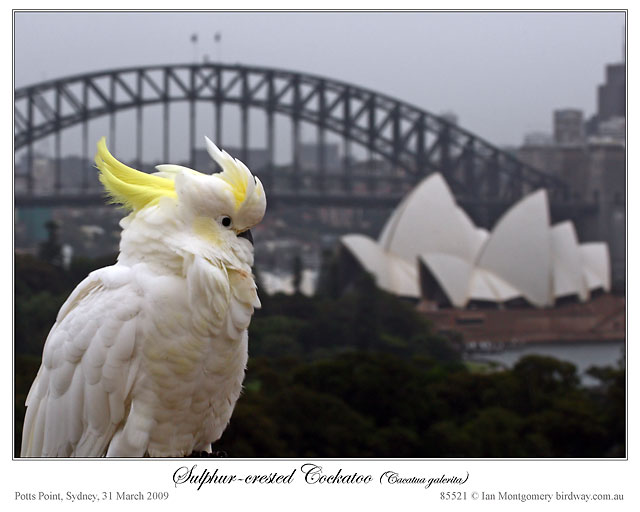
The first photo was taken in December 2005 from an apartment in Potts Point. The apartment belongs to friends of mine and I regularly stay there when visiting Sydney. Sulphur-crested Cockatoos are visitors there too and sometimes come up from the Domain to perch on the balcony.

When I took that photo, I later regretted not using a smaller aperture to improve the depth of field and make the background icons sharper. It’s one of the rules of bird photography that you (almost) never get the same opportunity twice. Rules are made to be broken, and the Cockatoos reappeared when I was visiting Sydney in March of this year. This time it was a wet and windy day, and the ruffled feathers and crest of the Cockatoo in the second photo seemed to me to be mimicking the sails on the Opera House.

Recent additions to the website include more photos from the northern trip:

Black-tailed Treecreeper
Pied Heron
Blue-faced Honeyeater
Red-headed Honeyeater
Bar-breasted Honeyeater
Crested Pigeon
Eastern Osprey

Best wishes,
Ian

Preferred Email: ian@birdway.com.au
Website: http://birdway.com.au


Lee’s Addition:

Talk about a “bad hair day” (feather day in this case)! What a beautiful bird! Many of these birds have been tamed and make nice pets, though I think they should be free to roam. You can enjoy more of Ian’s Sulphur-crested Cockatoo photos (Click here), All photos of Ian’s (Australian) Cockatoos & Allies – [Family: Cacatuidae]

For every kind of beast and bird, of reptile and creature of the sea, is tamed and has been tamed by mankind. (James 3:7 NKJV)

Cockatoos are in the Psittaciformes Order which includes  Cacatuidae family of Cockatoos, the Strigopidae family of New Zealand Parrots and the Psittacidae’s, which are all the rest of the Parrots and their allies.

“A cockatoo is any of the 21 species belonging to the bird family Cacatuidae. Along with the Psittacidae (the true parrots) and the Strigopidae, they make up the order Psittaciformes. The name cockatoo originated from the Malay name for these birds, kaka(k)tua (either from kaka “parrot” + tuwah, or “older sister” from kakak “sister” + tua, “old”). Placement of the cockatoos as a separate family is fairly undisputed, but it is not resolved whether or not other living lineages of parrots (such as the lories and lorikeets) are as distinct as they appear. The family has an Australasian distribution, ranging from the Philippines and the eastern Indonesian islands of Wallacea to New Guinea, the Solomon Islands and Australia.

Cockatoos are, on average, larger than true parrots; however, the Cockatiel, the smallest cockatoo, is a small bird, while the largest cockatoo, the Palm Cockatoo, at 55–60 cm (22–24 in) long is smaller than the larger macaws and several other parrots. Their plumage is generally less colourful than that of other parrots, being mainly white, grey or black with some colour elsewhere. They have strong bills and feet, and are instantly recognisable by their showy crests. The diet of the cockatoos is composed of seeds, tubers, corms, fruit, flowers and insects. They often feed in large flocks, particularly if they feed on the ground. Cockatoos are monogamous and nest in tree hollows.

Cockatoos are popular birds in aviculture, although, for some species, the largely illegal trade in wild-caught parrots has threatened their survival. Some cockatoo species are adversely affected by habitat loss and particularly by the loss of suitable hollows for nesting when large, mature trees are cleared; conversely, some species have adapted well to human changes and are considered agricultural pests.” (From Wikipedia – Cockatoo)

Ian’s Bird of the Week – Raja (Radjah) Shelduck

Raja Shelduck (Tadorna radjah) by IanNewsletter – 10/28/2009

Raja Shelduck by Ian

Raja Shelduck by Ian

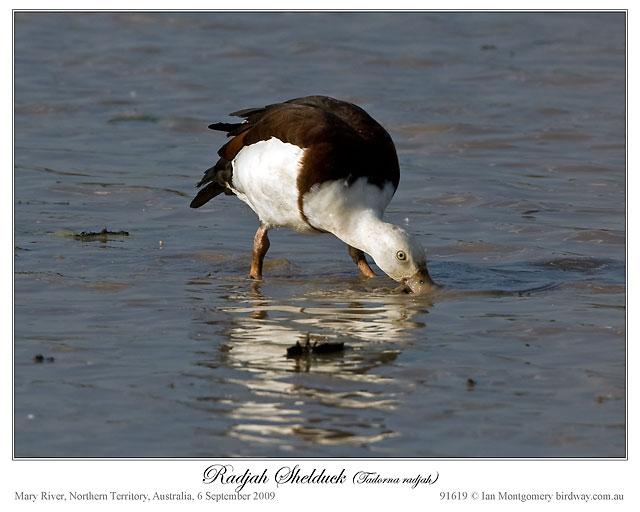
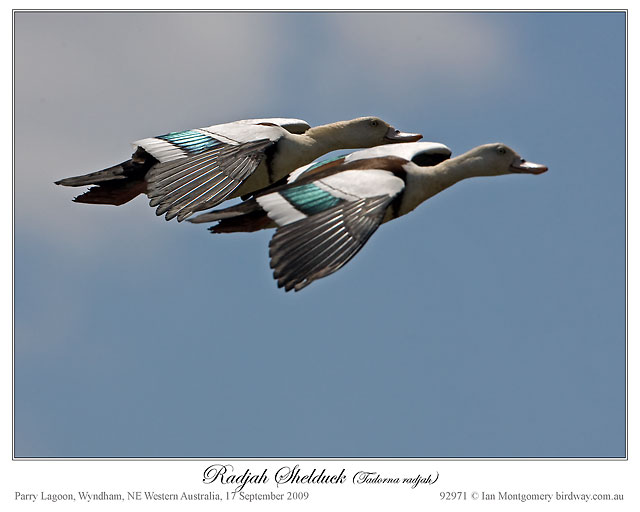
The Radjah Shelduck is a rather handsome duck of coastal tropical Australia. From a distance, the plumage looks black and white, but the dark plumage is actually chestnut. It is often seen feeding by dabbling in shallow water, as in the first photo, working its way around the margins of lagoons and wetlands. Such areas can get very muddy towards the end of the dry season and the white plumage of the birds becomes stained, as in the bird coming in to land in the second photo. In flight the green speculum on the upper surface of the wings is conspicuous as shown in the third photo.

Pair of Raja Shelduck by Ian

Pair of Raja Shelduck by Ian

The range of the Radjah Shelduck currently extends from Broome in the west to Rockhampton in the east, though it is scarce to rare outside the Northern Territory. It also found in New Guinea and eastern Indonesia. It used to occur as far south as northeastern New South Wales. It occurs on both fresh and saltwater,and is usually seen in pairs or small flocks. When resting, it often perches in paperbark trees over water and it nests in tree hollows.

I’m progressively adding photos from the northern trip to the website. Recent additions include:

Brahminy Kite
Azure Kingfisher
Crimson Finch
Rufous-banded Honeyeater
and Silver-crowned, Helmeted and Little Friarbirds

Best wishes,
Ian

Ian Montgomery, Birdway Pty Ltd,
454 Forestry Road, Bluewater, Qld 4818
Phone: +61-7 4751 3115
Preferred Email: ian@birdway.com.au
Website: http://birdway.com.au


Lee’s Addition:


The latest I.O.C. list of bird names lists the Radjah as Raja Shelduck. They keep changing things and it is hard to keep up with them. At least the left the “Shelduck” part alone.

The genus name Tadorna comes from Celtic roots and means “pied waterfowl”, essentially the same as the English “shelduck”.

Raja Shelduck showing collar by Ian

Raja Shelduck showing collar by Ian

Both the male and female of the species are mostly white, with dark wingtips and a distinctive “collar” of dark feathers. Seen from above in flight, the birds have green bands on the tops of their wings. The female has a harsh rattle and the male has a breathy, sore-throat whistle.

The species prefers the brackish waters of mangrove flats and paperbark tree swamps, but will visit freshwater swamps, lagoons, and billabongs further inland during the wet season.

The Raja Shelduck forms long-term pair-bonds, and is usually encountered in lone pairs or small flocks. During the wet season the males commonly become very irritable, and have been observed attacking their mates.

The diet consists mainly of mollusks, insects, sedge materials and algae. Pairs start searching for nesting sites during the months of January and February. They nest close to their primary food source, often in the hollow limbs of trees, which makes habitat destruction a particular issue.

Raja Shelduck does not use nesting materials except for some self-supplied down feathers. Egg-laying is usually done by May or June, but depends on the extent of the wet season. The clutches range from 6 to 12 eggs. Incubation time is about 30 days.

The Raja Shelduck is listed as a protected bird in all states of Australia and penalties exist for harming or disturbing them.

I know every bird of the mountains, And everything that moves in the field is Mine. (Psalms 50:11 NASB)

Information from Wikipedia with editing.

To see more of these Birds of the Week

Ian’s Bird of the Week – Wedge-tailed Eagle

Wedge-tailed Eagles (Aquila audax) by Ian

Wedge-tailed Eagles (Aquila audax) by Ian

Newsletter –  8/13/2009

The choice this week of Wedge-tailed Eagle was inspired by reading about the project to reintroduce Golden Eagles to Ireland, see http://www.goldeneagle.ie/ . There is good news and bad news there, but more about that later.

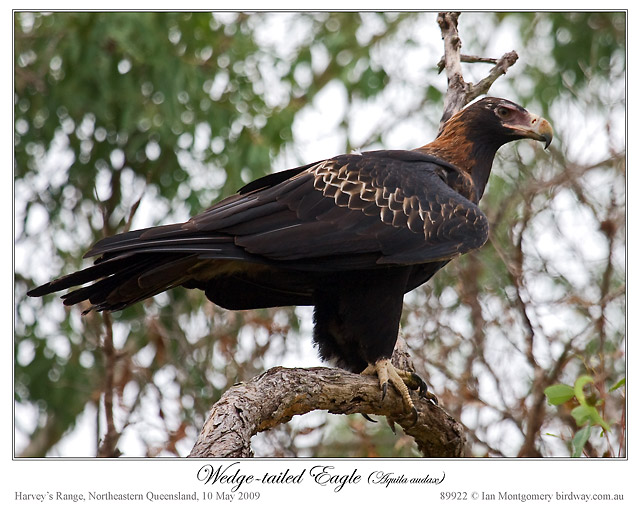
Wedge-tailed Eagles (Aquila audax) and Golden Eagles (Aquila chrysaetos) are very closely related and considered by some to belong to a ‘super-species’. The genus Aquila, the classical eagles, comprises 12 species and all have feathered legs, giving them a trousered appearance as in the first photo. The Wedge-tailed Eagle occurs commonly throughout mainland Australia and southern New Guinea as the nominate race (meaning it bears the same name as the species – audax) and in Tasmania as the endangered race fleayi where only 60 – 80 pairs remain.

Wedge-tailed Eagles (Aquila audax) by Ian

Wedge-tailed Eagles (Aquila audax) by Ian

Eagles have long suffered persecution from landholders by shooting and poisoning because of their supposed predation on livestock, particularly lambs. The Golden Eagle and the White-tailed Sea-Eagle became extinct in Ireland early in the 20th century along with other raptors such as the Red Kite, while the Common Buzzard retained a tenuous toe-hold on Rathlin Island, in Northern Ireland, with about 20 pairs. One of the success stories of conservation in Ireland is that Buzzards have recolonized most of Ireland since the use of Strychnine as a ‘pest’ bait – aimed at foxes and Hooded Crows – was banned in the Irish Republic in 1990. http://www.birdway.com.au/accipitridae/common_buzzard/index.htm

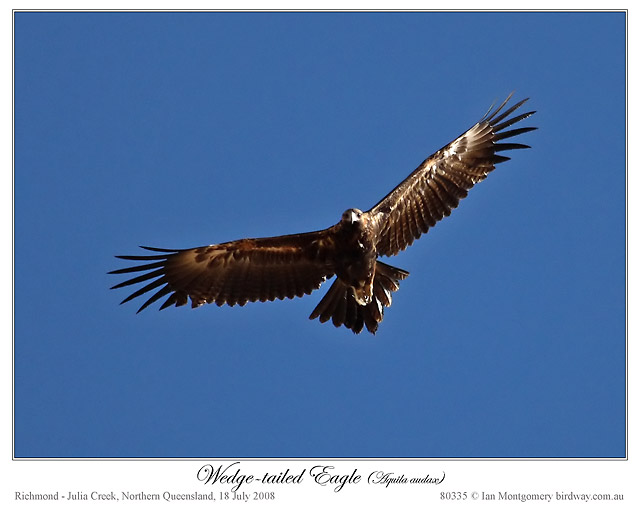
One of my regrets as a youngster in Ireland – even before I became a fanatical birdwatcher – was that the skies of the rugged west coast were empty of large raptors. I felt that a soaring eagle – like the Wedge-tailed in the second photo – was the one thing lacking from such dramatic and romantic landscapes. I have a clear memory of climbing Slievemore (‘big mountain’) in Achill Island, Co Mayo, at the age of 9 or 10 and deliberately misidentifying a kestrel as an eagle and reporting it to my mother. Sensible mothers, like mine (‘yes, dear’), know how to distinguish childish fantasies from deliberate lies. I’ve only just discovered that the name Achill, is though to derive an old Irish word ‘eccuill’ meaning, you’ve guessed it, eagle. http://www.minauncliffcottages.com/achill_island.htm

Back to the present. There was celebration in Ireland in 2007 on the occasion of the first fledging of a (reintroduced) Golden Eagle in the Irish Republic in over a century in Glen Veigh, a national park in Co. Donegal. The 2008 season produced, disappointingly no new recruits, but I read this morning that the same pair has just reared two young (with a bit of help from their friends). Jubilation has been tempered by the poisoning of some of the Golden Eagles in Donegal, some of the reintroduced White-tailed Sea-Eagles in Killarney, Co. Kerry, and Red Kites in Co. Wicklow. Neither of the latter two species have bred yet, so it remains to be seen whether the sheep farmers of Ireland will continue to disappoint romantic kids, young and old, in the 21st century.

If you want to do something, you can add your signature to a petition about these poisonings being organized by the Golden Eagle Trust. As of today, there were nearly 7,000 signatures from 59 countries with Australia coming 9th with 85 signatures.

Best wishes,
Ian

Ian Montgomery, Birdway Pty Ltd,
454 Forestry Road, Bluewater, Qld 4818
Phone: +61-7 4751 3115
Preferred Email: ian@birdway.com.au
Website: http://birdway.com.au


Lee’s Addition:
The eagle is mentioned many times (34 in KJV) in the Bible. They were not to be eaten and I am sure those few remaining pairs are thankful for that. Their strength, rapid and swift flights, gatherings, nests, spreading of wings, and other aspects are mentioned. One of my favorite verses is:

But they that wait upon the LORD shall renew their strength; they shall mount up with wings as eagles; they shall run, and not be weary; and they shall walk, and not faint. (Isaiah 40:31 KJV)

Ian’s Bird of the Week – Spotted Harrier

spotted_harrier_80355

Newsletter: 10-23-09

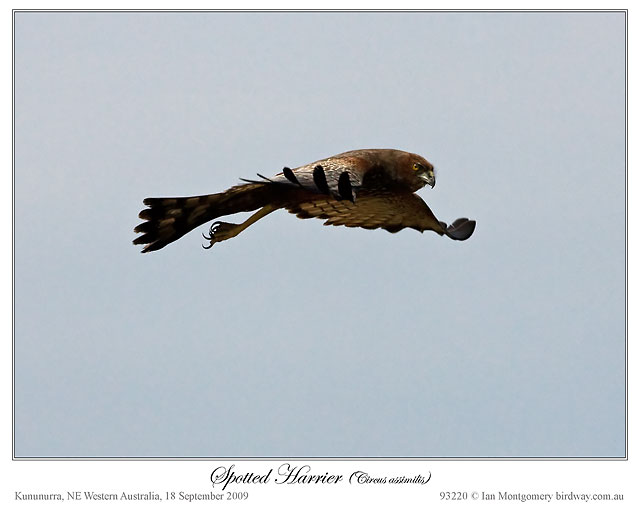
A striking raptor that is encountered regularly in small numbers when travelling through the drier parts of Australia is the Spotted Harrier, and we came across several on the trip to Northern Australia. Harriers hunt by patrolling low over open ground flying buoyantly or gliding with upswept wings, relying on stealth to capture terrestrial prey, such a birds, small mammals and reptiles.

Spotted Harrier (Circus assimilis) by Ian

Spotted Harrier (Circus assimilis) by Ian

Like Grass Owls, they have very long legs for seizing prey in grasslands and they often fly with their legs dangling as in the first two photos. This bird has the characteristic, pale-spotted chestnut underparts of the adult plumage but the upperparts are brownish rather than grey and appears sub-adult. The other bird, taken from below, is an adult and has a grey neck and the chestnut facial disc that gives it a slightly owlish appearance.

The Spotted Harrier has a wide distribution in mainland Australia, but occurs in Tasmania only as a vagrant. In wetter areas such as wetlands, it is replaced by the Swamp Harrier. There are 13 species of Harrier worldwide. All of these nest on the ground, with the exception of the Spotted Harrier which nests in small trees.

Recent additions to the website include:

a distant shot of a Sandstone Shrikethrush
and new photos of:
Golden Bowerbird
Wedge-tailed Eagle
Rainbow Bee-eater
(Far) Eastern Curlew

Spotted Harrier (Circus assimilis) by Ian

Spotted Harrier (Circus assimilis) by Ian

Best wishes,
Ian

Ian Montgomery, Birdway Pty Ltd,
454 Forestry Road, Bluewater, Qld 4818
Phone: +61-7 4751 3115
Preferred Email: ian@birdway.com.au
Website: http://birdway.com.au


Lee’s Addition:

The harrier is not specifically mentioned by name in the Bible, but it is in the same family with the hawks, kites and eagles, which are all mentioned.

Doth the hawk fly by thy wisdom, and stretch her wings toward the south? (Job 39:26)

As Ian said, there are 13 Harriers worldwide. There are also 2 Marsh Harriers and 2 Harrier-Hawks. I have shown all of them in Taxonomic order. There are links to the ones I could find. They are part of the Family Accipitridae, which includes Kites, Hawks & Eagles and all are in the ORDER ACCIPITRIFORMES.

Western Marsh Harrier (Circus aeruginosus) by Nikhil
Eastern Marsh Harrier (Circus spilonotus) ©
Papuan Harrier (Circus spilothorax) ©
Swamp Harrier (Circus approximans) by Ian
African Marsh Harrier (Circus ranivorus) by Africaddict
Reunion Harrier (Circus maillardi) ©
Malagasy Harrier (Circus macrosceles) ©
Long-winged Harrier (Circus buffoni) ©WikiC
Spotted Harrier (Circus assimilis) by Ian
Black Harrier (Circus maurus) Video by Keith
Northern Harrier (Circus cyaneus) by Jim Fenton
Cinereous Harrier (Circus cinereus) ©
Pallid Harrier (Circus macrourus) ©
Pied Harrier (Circus melanoleucos) by Nikhil
Montagu’s Harrier (Circus pygargus) by IanVideo by Keith
African Harrier-Hawk (Polyboroides typus) ©WikiC- Video by Keith
Madagascar Harrier-Hawk (Polyboroides radiatus) ©Wikipedia

Ian’s Bird of the Week – White-breasted Whistler

White-breasted Whistler

White-breasted Whistler

Newsletter: 10/13/2009

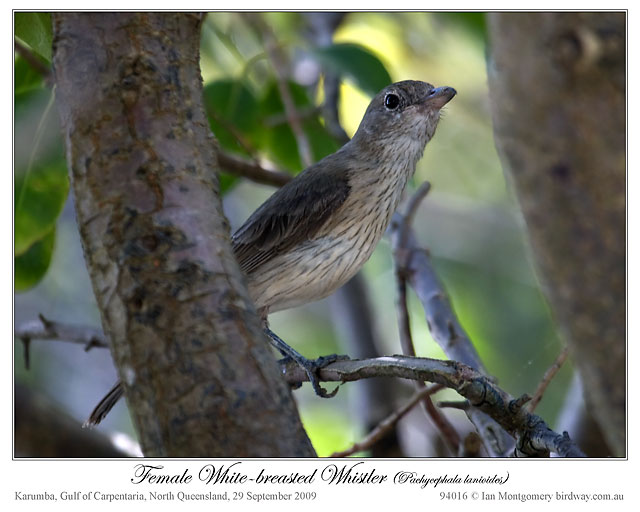
As I was driving south from Katherine, NT, on the first day of my return journey home and faced with the prospect of repeating in reverse the long drive through Mount Isa, Adventure whispered seductively in my ear ‘why not go home via the Gulf of Carpentaria and look for White-breasted Whistlers?’. So, I turned left at Daly Waters and drove to Karumba via Borroloola, NT (first night) and Burketown, QLD (second night). That drive involved about 700 km of gravel road and half a dozen river fords, but I was rewarded on day 2 by great views (no photos though) of a Grey Falcon on the Northern Territory side of the border with Queensland.

Female White-breasted Whistler

Female White-breasted Whistler

I found a female and young White-breasted Whistler – and insufferable numbers of little biting sandflies – in the mangroves at Karumba Point, but no males so I decided to do the sensible thing and go out with Ferryman River Cruises on the Norman River: http://www.ferryman.net.au/ (07) 4745 9155. Not only did Alison and Glen know their birds and where to find them but are also enthusiastic members of the bird of the week list. So, the three of us had a great morning on the river and they found me the White-breasted Whistlers and other good things like Red-headed Honeyeaters. They also have some friendly Black-necked Storks (Jabirus) and various raptors only too ready to put on a good display in return for garfish. So, if you’re ever in Karumba, you know what to do.

White-breasted Whistlers, particularly the females, look like Rufous Whistlers but are much more robust with large, (invariably muddy) hooked bills adapted for feeding in mangroves on invertebrates such as small crabs. The males, first photo, are more distinctive with a completely black head, a rufous collar and a white breast. The large, hooked bill is much more like that of the related Shrike-thrushes and the specific name lanoides refers directly to Lanius, the generic name for (true) Shrikes. The second photo is a young male in the middle of acquiring adult male plumage but still has the streaky buff breast of young birds and females. The third photo shows a female peering coyly through the mangroves. Rufous Whistlers were also present at Karumba Point and the first bird that I got excited about and photographed turned out to be just that. White-breasted Whistlers occur in mangroves in northwestern and northern Australia from Carnarvon in the west to western Cape York in the east.

Recent additions to the website include:
Immature Mangrove Golden Whistler
Additional photos of:
Grey Whistler
Orange-footed Scrubfowl
Hooded Parrot
Red-collared (Rainbow) Lorikeet
Barking Owl

White-breasted Whistler (Immature)

White-breasted Whistler (Immature)

The bushfires in Bluewater are now all under control thanks to the efforts of the fire service and the SES and my house still stands! My thanks to those of you who expressed their concern. I was glad, though, that I cut short my trip to Sydney as the situation was still threatening when I returned.

Best wishes,
Ian

Ian Montgomery, Birdway Pty Ltd,
454 Forestry Road, Bluewater, Qld 4818
Phone: +61-411 602 737
Preferred Email: ian@birdway.com.au
Website: http://birdway.com.au


Lee’s Addition:
Australasian Whistlers make up the bulk of whistlers (Australia with 8 and New Guinea with 15). There are 41 species in 6 genera. They also are found in Southeast Asia and some Pacific Islands. They are known for the melodious songs and I had hoped to find a recording of the bird whistling, but couldn’t find one. Maybe someone can leave a comment with a link to a recording.

I did find a video by Nick Talbot, of a Rufous Whistler singing. It is posted on my Whistlers and Allies page.

They have a head that is rounded and fairly large. “One of their earlier alternative names was ‘thick head’ (from which the Latin family name, Pachycephalidae, is derived).” (From Complete Birds of the World, National Geographic) The birds are between 12-20 cm. or 5-8 in. in length and only weigh .5-1.5 oz. or 13-44 g. Also from the book, “Obvious features are the fairly large, rounded head, short, thick neck, and short, stubby, thick bill. The wings are short and broad, with 10 primaries; in most species the wings are rounded, but in two (including the most migratory), the wing-tips are pointed. Tails vary in length, being longest in the larger species; they have 12 feathers and are squared-ended or slightly notched. The legs and feet are strong, especially in the larger species.”

The whistlers do most of their feeding among the upper foliage of trees and feed on spiders and insects they find on leaves or “hovering in flight.”

Glad he made that different trip home so we can share in his find. I am also glad the fires were in control.

Keep up the great photography and newsletters.

In that day the LORD will whistle for the fly that is in the remotest part of the rivers of Egypt and for the bee that is in the land of Assyria. (Isaiah 7:18 NASB)

See also Ian’s Whistler Pages:
Gilbert’s Whistler
Grey/Brown Whistler
Golden Whistler
Mangrove Golden Whistler
Rufous Whistler
White-Breated Whistlers

Ian’s Bird of the Week – Yellow-rumped Munia/Mannikin

Yellow-rumped Munia by Ian Montgomery

Yellow-rumped Munia by Ian Montgomery

Newsletter – 10/6/2009

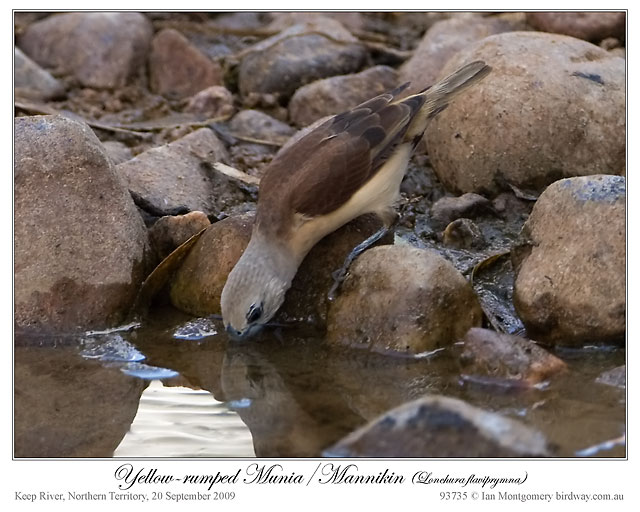
Although last week’s bird, the Gouldian Finch, was a welcome encounter in Wyndham my main target in the Kununurra district of NE Western Australia was another finch, the Yellow-rumped Munia or Mannikin (members of the genus Lonchura are usually called Mannikins in Australia and Munias overseas).

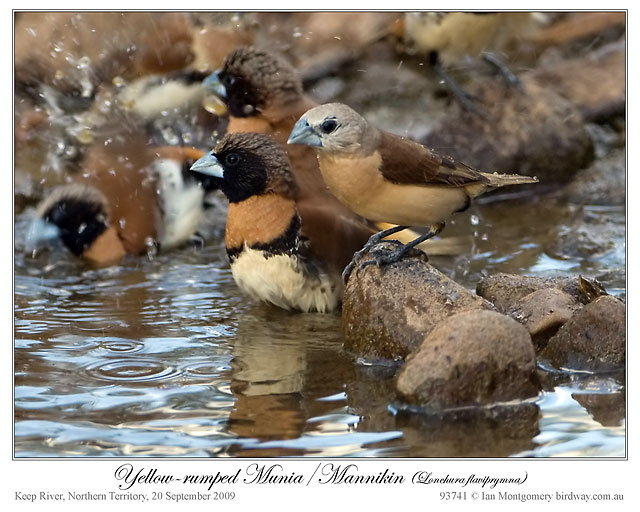
This species has a very restricted distribution, occurring only in the eastern Kimberley and in northwestern Northern Territory. It is supposed to be quite abundant in the Ord River irrigation area near Kununurra. We searched quite diligently in many of its favourite locations without finding any and it wasn’t until, on the return journey, I saw this single bird in the company of Chestnut-breasted Munias/Mannikins at a water hole in the Keep River district on the Northern Territory side of the border.

Yellow-rumped Munia by Ian Montgomery

Yellow-rumped Munia with Chestnut-breasted Munias by Ian Montgomery

Compared with the almost meretricious plumage of the Gouldians and the exuberance of the bathing Chestnut-breasteds, ‘restrained elegance’ comes to mind in both the appearance and behaviour of the Yellow-rumped: tasteful but subtle colours and decidedly demure beside its frolicking companions. Even when drinking, as in the second photo, it sipped delicately from a high perch as if not wanting to spoil its costume. The Yellow-rumped is closely related to the more widespread Chestnut-breasted and, in addition to consorting together, they sometimes interbreed.

I’m in Sydney briefly for last night’s presentation to Birding NSW. It was an enjoyable evening with a delightful group of people but I am returning home prematurely this afternoon. There were several bushfires burning near my house in unseasonably hot and dry weather and I don’t feel comfortable being away longer than necessary.

I’ve posted a dozen photos of the Gouldian Finches at Wyndham to the website to join several that I took at Mornington Station in the Kimberley five years ago: http://www.birdway.com.au/estrildidae/gouldian_finch/index.htm .

Best wishes,
Ian

Ian Montgomery, Birdway Pty Ltd,
454 Forestry Road, Bluewater, Qld 4818
Phone: +61-7 4751 3115
Preferred Email: ian@birdway.com.au
Website: http://birdway.com.au


Lee’s Addition:


Checked out Ian’s Gouldian Finch photos and they are really neat.

The Munia/Mannikins are in the Waxbill Family of Estrilidae. Their genus, Lonchura, consists of the following birds of which I have included links to photos and videos:

Bronze Mannikin –  Video Lonchura cucullata
Black-and-white MannikinVideo Lonchura bicolor
Red-backed Mannikin Lonchura nigriceps
Magpie Mannikin Lonchura fringilloides
White-rumped Munia Nik – Video Lonchura striata
Javan Munia  –  Video Lonchura leucogastroides
Dusky Munia –  Video Lonchura fuscans
Black-faced MuniaVideo Lonchura molucca
Scaly-breasted Munia Ian’s  – Video Lonchura punctulata
Black-throated Munia  –  Video Lonchura kelaarti
White-bellied Munia Lonchura leucogastra
Streak-headed Munia  –  Video Lonchura tristissima
White-spotted Munia Lonchura leucosticta
Five-colored Munia –  Video Lonchura quinticolor
Tricolored Munia Lonchura malacca
Chestnut MuniaVideo Lonchura atricapilla
White-headed Munia –  Video Lonchura maja
Pale-headed Munia  –  Video Lonchura pallida
Great-billed Munia Lonchura grandis
Grey-banded Munia Lonchura vana
Grey-headed Munia Lonchura caniceps
Grey-crowned Munia Lonchura nevermanni
Hooded Munia Lonchura spectabilis
New Ireland Munia Lonchura forbesi
Mottled Munia Lonchura hunsteini
Yellow-rumped Munia Ian’s Lonchura flaviprymna
Chestnut-breasted Munia Ian’s  –  Video Lonchura castaneothorax
Black Munia Lonchura stygia
Black-breasted Munia  –  Video Lonchura teerinki
Eastern Alpine Munia Lonchura monticola
Western Alpine Munia –  Video Lonchura montana
Sooty Munia Lonchura melaena
Timor Sparrow Lonchura fuscata
Java Sparrow Ian’s Lonchura oryzivora
Pictorella Munia Ian’s Heteromunia pectoralis

Two verses come to mind about these birds. While I was looking for extra photos of the birds, I found many of these birds have been kept as pets and also the diet of most of these is grain and seeds.


For every kind of beast and bird, of reptile and creature of the sea, is tamed and has been tamed by mankind. (James 3:7)
And as he sowed, some seed fell by the wayside; and the birds came and devoured them. (Matthew 13:4)