Ian’s Bird of the Week – Yellow Wattlebird

Yellow Wattlebird (Anthochaera paradoxa) by Ian 1

Yellow Wattlebird (Anthochaera paradoxa) by Ian 1

Ian’s Bird of the Week – Yellow Wattlebird ~ by Ian Montgomery

Newsletter ~ 1/31/13

I was going to use some recent photos of the Little Wattlebird as the bird of the week, but then I found that no Wattlebird has featured as BotW so we may as well start with the most spectacular, the Yellow Wattlebird, endemic to Tasmania where it replaces the Red Wattlebird of southern mainland Australia.

Not only is it the largest of the 4 species of Wattlebird but with a length of 37-45cm/14-18in it is the largest member of the Honeyeater family (Meliphagidae) easily out-classing the largest Friarbird the Helmeted (32-37cm). It also has much longer wattles than it cousin the Red Wattlebird. (Neither the Little nor the closely-related Western Wattlebird have wattles.)

Yellow Wattlebird (Anthochaera paradoxa) by Ian 2

Yellow Wattlebird (Anthochaera paradoxa) by Ian 2

It is reasonably common in its native Tasmania, except along the west coast, and also occurs on King Island in Bass Strait. It feeds mainly on nectar but will also take insects and feed on fruit in orchards. The bird in the third photo is probing under bark for insects or grubs.

Yellow Wattlebird (Anthochaera paradoxa) by Ian 3

Yellow Wattlebird (Anthochaera paradoxa) by Ian 3

All the wattlebirds are very noisy and the Yellow is no exception. Pizzey and Knight describe its call as ‘harsh, gurgling, guttural like coughing/vomiting’ and you can’t get much less flattering than that. Some non-birding friends of mine called Wattlebirds near their holiday cottage ‘Yobbo-birds’ (either Red or Little), which appealed to me and, given that two of the species don’t have wattles, seems to me a much better name. So, herewith the Yellow Yobbobird

Best wishes

Ian
**************************************************
Ian Montgomery, Birdway Pty Ltd,
454 Forestry Road, Bluewater, Qld 4818
Tel 0411 602 737 ian@birdway.com.au
Check the latest website updates:
http://www.birdway.com.au/#updates


Lee’s Addition:

I know all the birds of the mountains, And the wild beasts of the field are Mine. (Psalms 50:11 NKJV)

What an interesting looking bird. I love those wattles hanging down. Wonder if they get in the way or he swings them to attract a mate? When you check out Ian’s Meliphagidae family page you will see that he has really been busy photographing those in that family. He has at least 70 birds listed. Wow! At present there are 184 species and he has 70 of them.

See:

More of Ian’s Bird of the Week Newsletters

Meliphagidae – Honeyeaters  – Here

*

Ian’s Bird of the Week – Channel-billed Cuckoo

Channel-billed Cuckoo (Scythrops novaehollandiae) by Ian

Channel-billed Cuckoo (Scythrops novaehollandiae) by Ian 1

Ian’s Bird of the Week – Channel-billed Cuckoo ~ by Ian Montgomery

Newsletter ~ 1-21-13

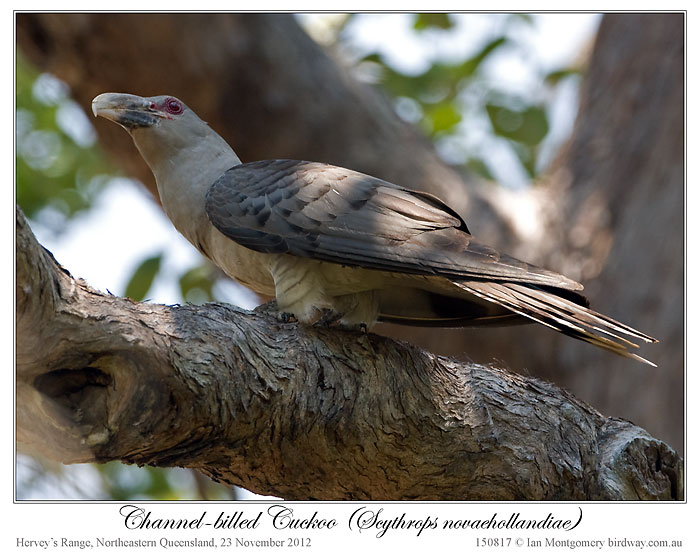
Last week, sorry fortnight, we had the Little Bronze-Cuckoo, the smallest Australian Cuckoo. Here is the Channel-billed Cuckoo, the largest parasitic cuckoo in Australia, and the world for that matter, with a length to 65cm/26in and a weight exceeding 900g/2lbs. (Coucals, such as the Pheasant Coucal , to 75cm, are larger and are now included in the Cuckoo family, but are not parasitic.)

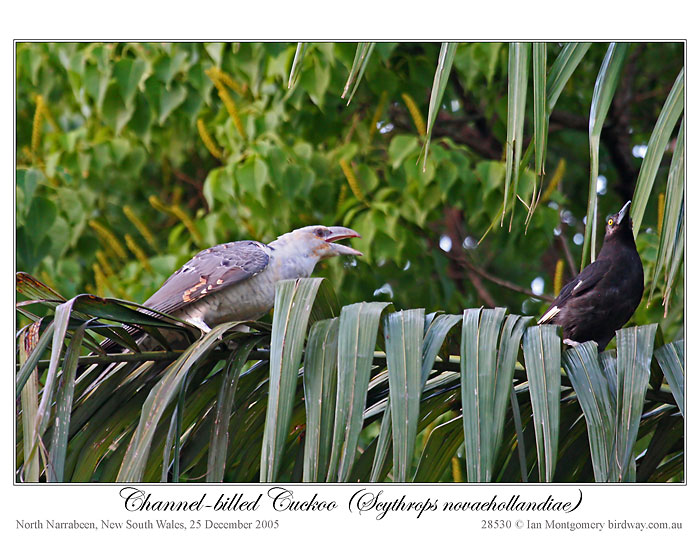
The bird in the first photo is an adult, distinguishable by the grey back (no buff patches) and the red eye and facial skin. The genus name Scythrops means ‘angry eye’ in Greek. The second photo shows a juvenile and you can see the buff patches on the wing, head and throat, though the grey facial skin looks as if it is beginning to acquire the red colour of the adult. This photo was taken in April when the birds would about to migrate to New Guinea.

Channel-billed Cuckoo (Scythrops novaehollandiae) by Ian

Channel-billed Cuckoo (Scythrops novaehollandiae) by Ian 2

Channel-billed Cuckoos lay their large eggs in the nests of Currawongs, Crows, Ravens, Magpies and even Sparrowhawks. The third photo, which appeared as the bird of the week in 2005, shows a very demanding chick with a very nerve-wracked looking foster parent Pied Currawong in the Sydney Metropolitan Area. The adult Cuckoos may break the eggs of the host bird but the chicks do not usually evict the eggs or chicks. Instead they out-compete them for food.

Channel-billed Cuckoo (Scythrops novaehollandiae) by Ian

Channel-billed Cuckoo (Scythrops novaehollandiae) by Ian 3

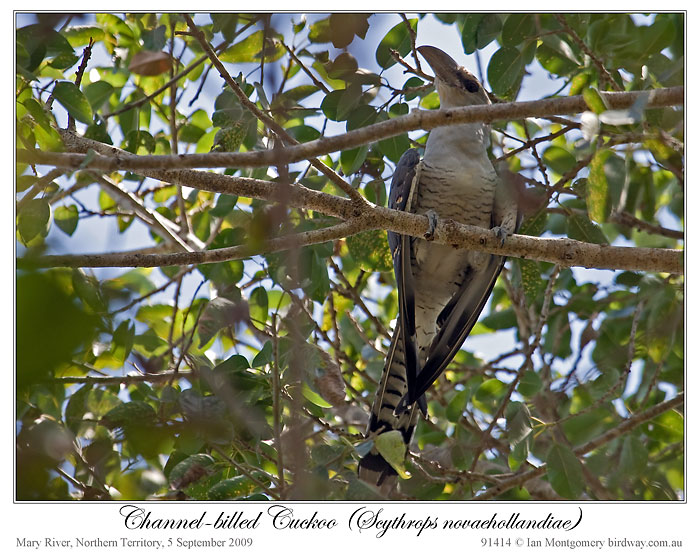
Channel-bills are mainly migratory, though some are though to remain in the Northern Territory throughout the winter. The juvenile in the fourth photo was being fed by Torresian Crow foster parents in the Top End in early September, so it would have hatched in July.

Channel-billed Cuckoo (Scythrops novaehollandiae) by Ian

Channel-billed Cuckoo (Scythrops novaehollandiae) by Ian 4

Typically of Cuckoos, Channel-bills are quite shy and usually remain hidden in foliage but their loud trumpeting calls give them away. They do fly in the open, particular before dusk and look very striking – their long tails and long pointed wings look rather raptor-like, though the large bill doesn’t, and they are often likened to flying crosses.

Best wishes
Ian

**************************************************
Ian Montgomery, Birdway Pty Ltd,
454 Forestry Road, Bluewater, Qld 4818
Tel 0411 602 737 ian@birdway.com.au
Check the latest website updates:
http://www.birdway.com.au/#updates


Lee’s Addition:

And the owl, and the night hawk, and the cuckoo, and the hawk after his kind, (Deuteronomy 14:15 KJV)

The Cuckoos are in the Cucuilidae Family and are also one of the Birds of the Bible, listed in the Unclean Birds.


See:

Ian’s Cuckoos, Coucals & Allies

Cucuilidae – Cuckoo Family

Birds of the Bible – Cuckoo

*

Ian’s Bird of the Week – Mistletoebird

 Mistletoebird (Dicaeum hirundinaceum) by Ian 1

Mistletoebird (Dicaeum hirundinaceum) by Ian 1

Ian’s Bird of the Week – Mistletoebird ~ by Ian Montgomery

Newsletter ~ 12/23/12

As an ex-pat, I’ve never really got used to a hot Christmas in Australia. Here we sing carols about open sleighs, holly and ivy and the shops decorate their windows with fake snow, but it all seems a little contrived when the temperature is 31.4ºC/88.5ºF, the average maximum daily temperature for December in Townsville. We do, however, have mistletoe – lots of of growing on Eucalyptus trees – and, even better, Mistletoebirds, so I’ve chosen it as our Christmas bird of the week. It has featured as bird of the week before (August 2003 and June 2004) but originality is not a conspicuous feature of Christmas.

What were you doing under the Mistletoe on Christmas Day 2007? I was photographing the male Mistletoebird in the first photo gorging on a luscious Christmas lunch of Mistletoe berry. They’re tiny birds (9.5-11cm/3.75-4.3in) but have huge appetites, mistletoe berries not being very nutritious but they do the mistletoe a service by depositing rapidly-digested seed-containing excreta on the branches of the host trees. They’ll also eat the fruit of other plants (the fruits in photos 2 and 3 are not mistletoe), nectar and insects.

Mistletoebird (Dicaeum hirundinaceum) by Ian 2

Mistletoebird (Dicaeum hirundinaceum) by Ian 2

The males are striking with their Christmassy red breasts and vents, and blackish-blue iridescent backs and the specific name hirundinaceum means ‘swallow-like’, Hirunda being the generic name for typical swallows. The females (third photo) are a more subtle grey, but have reddish vents.

Mistletoebird (Dicaeum hirundinaceum) by Ian 3

Mistletoebird (Dicaeum hirundinaceum) by Ian 3

Mistletoebirds build exquisite pouch-shaped hanging nests and the fourth photo shows the young take after their parents in continually wanting food. Their nests are similar to those of Sunbirds and they are often placed in the same family Nectarinidae. Mistletoebirds are actually Flowerpeckers (Dicaeum) and are sometimes put in their own family, the Dicaeidae.

Mistletoebird (Dicaeum hirundinaceum) by Ian 4

Mistletoebird (Dicaeum hirundinaceum) by Ian 4

Being so unChristmassy here, I find that it sneaks up me un-noticed. Last year, all my Christmas cards arrived late, so my New Year Resolution was to not send any more and the money saved is going to the Australian Wildlife Conservancy, which I think has the best record for conservation and reserve management in Australia. So, I wish you an electronic Very Peaceful Christmas and a Lovely New Year. Just remember the Mistletoebird and its appetite when you contemplate the third helping of Christmas pudding tomorrow!

Ian

**************************************************
Ian Montgomery, Birdway Pty Ltd,
454 Forestry Road, Bluewater, Qld 4818
Tel 0411 602 737 ian@birdway.com.au
Check the latest website updates:
http://www.birdway.com.au/#updates


Lee’s Addition:

How appropriate is Ian’s photos of a neat little bird that loves Mistletoe. Thanks, Ian, and Merry Christmas to you also.

The Mistletoebird belongs to the Dicaeidae – Flowerpeckers Family. Also Ian’s Birdway photos for Dicaeidae, Nectariniidae & Promeropidae.

See more Ian’s Bird of the Week articles

*

Ian’s Bird of the Week – Green Catbird

 Green Catbird (Ailuroedus crassirostris) by Ian 1

Green Catbird (Ailuroedus crassirostris) by Ian 1

Ian’s Bird of the Week – Green Catbird ~ by Ian Montgomery

Newsletter – 12/18/12

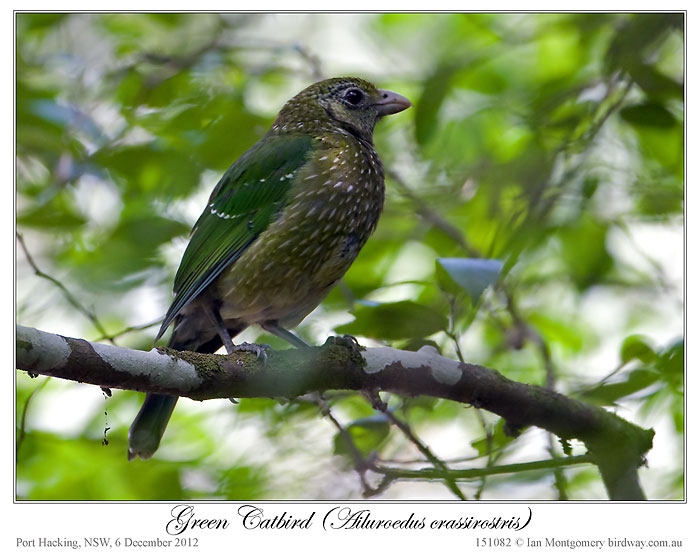
My trip to Sydney produced another bird on my wanted list that I had taken only poor photos of before, the Green Catbird. It’s not rare or, given its calls, hard to find in its favourite habitat of temperate and sub-tropical rainforest, but most birds apart from things like Brush-Turkeys are hard to photograph in rainforest. It’s call is not as one might expect a gentle miaowing but more like a cat being given an injection at the vets or those rude sounds make with balloons and as such, is one of the delights of east coast rainforest.

Australian Catbirds, unrelated to American Catbirds, are members of the Bowerbird family. Unlike their flamboyant cousins, they form pair-bonds and the males help in domestic chores like nest-building. So, eschewing wild mating behaviour, they don’t build wonderful bowers or collect flashy toys. Everything has its price, one supposes, but the call is some compensation. At 24-32cm/10-13in in length, they’re comparable in size to Satin Bowerbirds and, if silent in foliage, can be confused with female or immature members of that species.

Green Catbird (Ailuroedus crassirostris) by Ian 2

Green Catbird (Ailuroedus crassirostris) by Ian 2

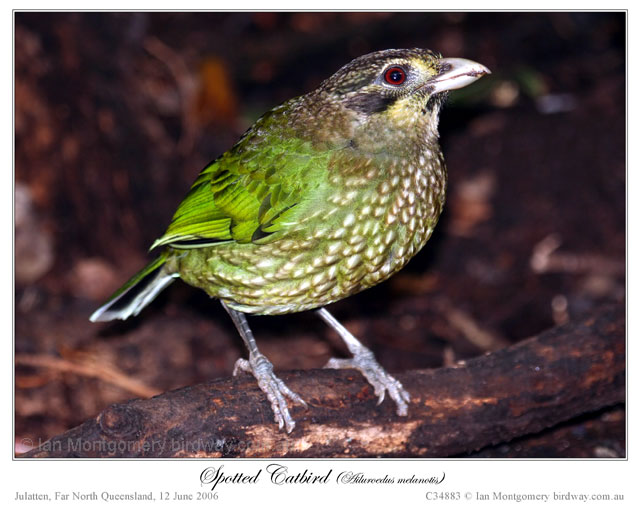
The generic name Ailuroedus comes from the Greek ailouros for cat and odos for a singer, which is stretching the definition of singer slightly, but maybe singing embraces yodelling. The range of the Green Catbird extends from the south coast of New South Wales (Narooma) to near Gladstone on the central coast of Queensland. In tropical Queensland it is replaced by the very similar-looking and similar-sounding Spotted Catbird which featured as Bird of the Week in 2006 (below).

Green Catbird (Ailuroedus crassirostris) by Ian 3

Green Catbird (Ailuroedus crassirostris) by Ian 3

The ‘Spotted’ presumably refers to the stronger markings on the breast as the Green Catbird has more obvious white spots on the back (second photo) but the main difference is the darker markings on the face of the Spotted Catbird. As their ranges don’t overlap, distinguishing between them isn’t an issue. The Spotted Catbird extends from Paluma Range National Park, near Bluewater where I live to Cooktown and there is a separate population, recognised as a different race with darker face markings, on Cape York (e.g. Iron Range). In the past, both Green and Spotted were treated as a single species and some of the splitters would like to make the Cape York race a full species, another tick I suppose. There are other races of the Spotted in New Guinea and another species, the White-eared Catbird, A. buccoides.

Best wishes
Ian

**************************************************
Ian Montgomery, Birdway Pty Ltd,
454 Forestry Road, Bluewater, Qld 4818
Tel 0411 602 737 ian@birdway.com.au
Check the latest website updates:
http://www.birdway.com.au/#updates


Lee’s Addition:

The Green Catbird is part of the Ptilonorhynchidae – Bowerbirds Family which has three Catbirds, the White-eared Catbird (Ailuroedus buccoides), Green Catbird (Ailuroedus crassirostris) and the Spotted Catbird (Ailuroedus melanotis). Ian has the family as Australian Catbirds & Bowerbirds.

Dan and I were able to see a White-eared Catbird (Ailuroedus buccoides) this year at the Zoo Miami. Most of the time when I think of a Grey Catbird (Dumetella carolinensis), it is ours  which is in a completely different family. (Mimidae – Mockingbirds, Thrashers) The Black Catbird (Melanoptila glabrirostris) is also part of that family. The 6th Catbird, Abyssinian Catbird (Parophasma galinieri) is in yet another family (Sylviidae – Sylviid Babblers).

See more of Ian’s Bird of the Week adventures.

*

Ian’s Bird of the Week – Powerful Owl

Powerful Owl (Ninox strenua) by Ian 1

Powerful Owl (Ninox strenua) by Ian 1

Ian’s Bird of the Week – Powerful Owl  ~ by Ian Montgomery

Newsletter – 12/9/2012

My apologies again for a tardy bird of the week, so here is something special. Well, special for me, anyway, as it has been a serious bogey bird for me. All addicted birders and bird photographers have their bogeys, in the sense of ‘an evil or mischievous spirit, a cause of annoyance or harassment’ usually a species that is invisible to the victim or hides whenever the victim is around.

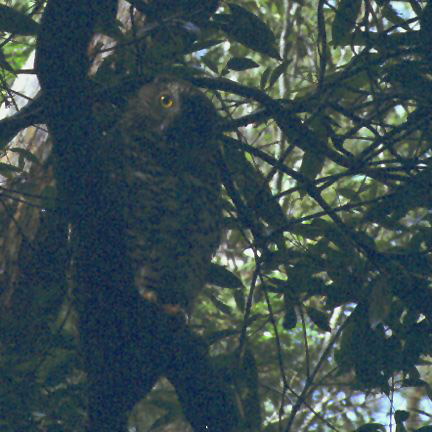
Powerful Owls first cast an evil spell on me on 11 February 1999 when one in Pennant Hills Park made my film camera malfunction so that the entire film was hopelessly underexposed – you can see the wicked gleam in its eye below. As soon as I picked up the film from the chemist the following day, I went back to Pennant Hills Park but the owl was no longer there or no longer visible.

Powerful Owl (Ninox strenua) by Ian 2

Powerful Owl (Ninox strenua) by Ian 2

Shortly after that I moved from Sydney and switched to digital photography (nowadays we take instant photographic feedback for granted). Since then, whenever I’ve visited Sydney I’ve looked for Powerful Owls in all their usual haunts – Pennant Hills Park, Mitchell Park, Beecroft, Warriewood, Royal Botanic Gardens, Royal National Park, etc. – without success.

Powerful Owl (Ninox strenua) by Ian 3

Powerful Owl (Ninox strenua) by Ian 3

Last Tuesday I gave a talk on parrots to Birding NSW in Sydney and inquired about POs. Yes, one had been seen in its favourite tree, the White Fig, near the entrance to Government House the previous Saturday. I went there on Wednesday and searched the tree for at least 20 minutes but the owl remained invisible until I decided to leave. Delighted with its success, it let its guard down, the spell weakened and I got the briefest visual sensation, like a shimmering mirage, of a barred tail. Powerful Owls are big 60-65cm/24-26in in length, it was then quite visible from the ground and not very high up, so a spell is the only explanation.

Powerful Owl (Ninox strenua) by Ian 4

Powerful Owl (Ninox strenua) by Ian 4

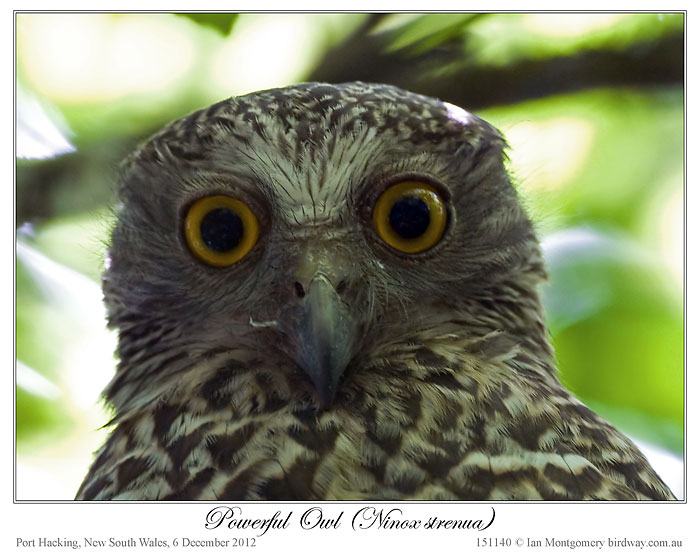
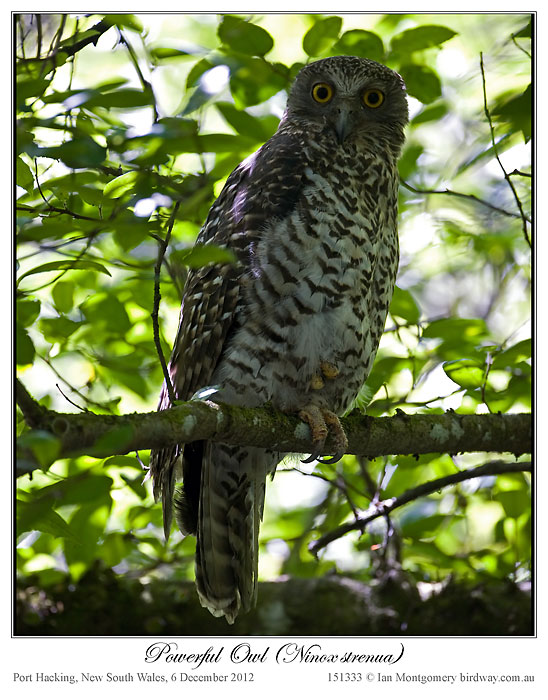
The next day, I went birding with Madeleine Murray and we abandoned plans to look for the owl (they’re quite visible to her) and went instead to Port Hacking, south of Sydney, where, lo and behold, we found another one, or to be more accurate Mad found it after I’d walked straight past it as the spell hadn’t entirely dissipated – it normally does so quite quickly after it has been broken once.

Powerful Owl (Ninox strenua) by Ian 5

Powerful Owl (Ninox strenua) by Ian 5

The Powerful Owl is the largest of the Hawk Owls (genus Ninox) and exceeded in size only by the world’s largest owls such as the Grey Grey and the larger Eagle Owls. It is found in eastern and southeastern Australia usually within 200km of the coast from central Queensland to eastern South Australia. It has large territories ranging in size from 3-15 square kilometres so it is nowhere common and is listed as Vulnerable. However, it seems to be quite tolerant of selective logging and can survive in patchy forests. It feeds mainly on arboreal mammals such as possums, but will also take flying foxes (fruit bats) and roosting birds.

Best wishes
Ian

**************************************************
Ian Montgomery, Birdway Pty Ltd,
454 Forestry Road, Bluewater, Qld 4818
Tel 0411 602 737 ian@birdway.com.au
Check the latest website updates:
http://www.birdway.com.au/#updates
**************************************************
Lee’s Addition:

Glad you sent us a Bird of the Week, Ian. I was starting to worry about you, that maybe you were sick or something. The wait was worth it because this is a beautiful Owl. I am glad you are no longer under this bird’s “evil spell on” you.

The Powerful Owl is part of the Strigidae – Owl Family. To see more photos of them, check out Ian’s photos and our Family page here:

Typical or Hawk Owls – Ian’s Birdway

Strigidae – Owl Family

*

Birds of the Bible – Loading the Ark

Snowy Egret - Wind Blown at Ft DeSoto 11-22-12 Thanksgiving

Snowy Egret – Wind Blown at Ft DeSoto 11-22-12 Thanksgiving

Dan and I just got back from a trip to Tampa for just 2 nights for the Thanksgiving holiday. My brother had a knee replacement on Wednesday (he’s doing fine), so we tied visiting him and doing some birdwatching in that area. Do you know how much we carried with us for just three days? Of course we carried our binoculars, cameras, tripod, laptop, plus clothes. Plus…

I also am starting my reading cycle through the Bible again and just read about Noah and the Ark. Because the earth had become so corrupt and violent, God said He was going to  destroy man, beast, creeping things and birds.

So the LORD said, “I will destroy man whom I have created from the face of the earth, both man and beast, creeping thing and birds of the air, for I am sorry that I have made them.” But Noah found grace in the eyes of the LORD. This is the genealogy of Noah. Noah was a just man, perfect in his generations. Noah walked with God. (Genesis 6:7-9 NKJV)

And God said to Noah, “The end of all flesh has come before Me, for the earth is filled with violence through them; and behold, I will destroy them with the earth. (Genesis 6:13 NKJV)

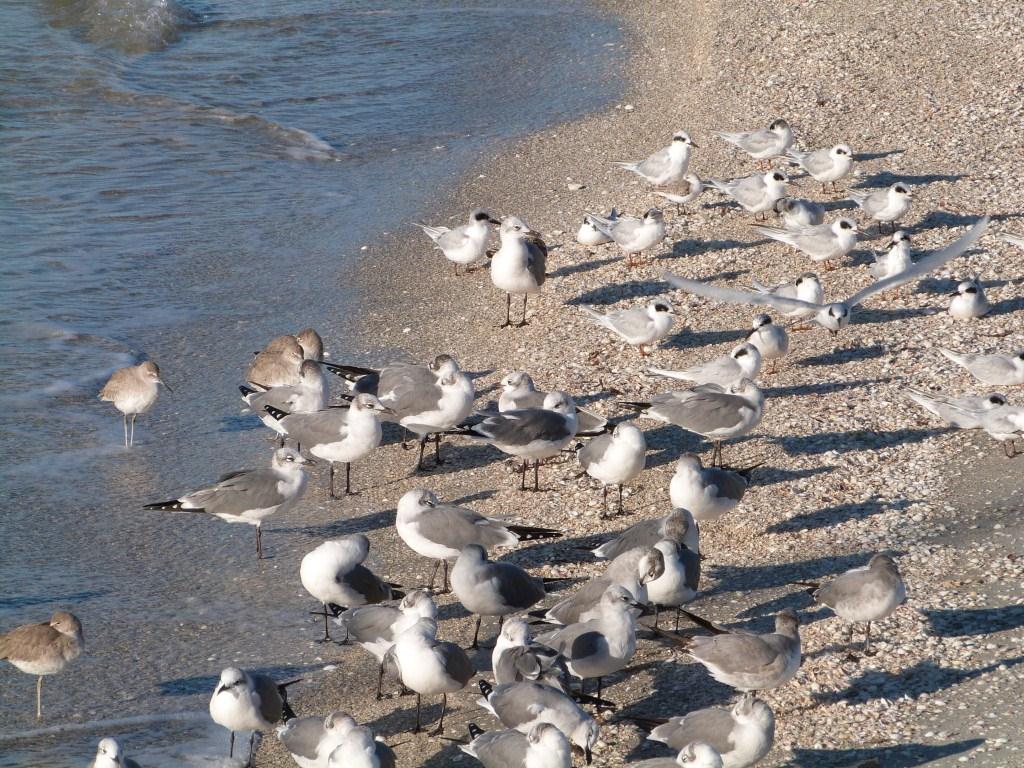
Willit - Laughing Gull - Forster's Tern at Ft DeSoto 11-22-12 Thanksgiving

Willit – Laughing Gull – Forster’s Tern at Ft DeSoto 11-22-12 Thanksgiving

Most of us know this history in the Word. Through Genesis 6, the Ark is built and Noah keeps trying to tell others to repent, but eventually the time comes and it is time to “Load the Ark.”

And of every living thing of all flesh you shall bring two of every sort into the ark, to keep them alive with you; they shall be male and female. Of the birds after their kind, of animals after their kind, and of every creeping thing of the earth after its kind, two of every kind will come to you to keep them alive. And you shall take for yourself of all food that is eaten, and you shall gather it to yourself; and it shall be food for you and for them.” Thus Noah did; according to all that God commanded him, so he did. (Genesis 6:19-22 NKJV)

Noah didn’t need to worry about taking cameras and laptops, but they had a whole lot more to get loaded on the Ark. We have all taken trips and know how long it takes to get everything in the car or van. Can you imagine when the LORD finally said that it was time to “start loading.” Noah and his family had been preparing and gathering the food, water, and supplies. If I read the first few verses of Genesis 7 correctly, they had a week (seven days) to put that in and the animals and birds. Those came to Noah, but they still had to arrange them into the different places on board the Ark. Whew! Some of us have enough trouble just loading the trunk.

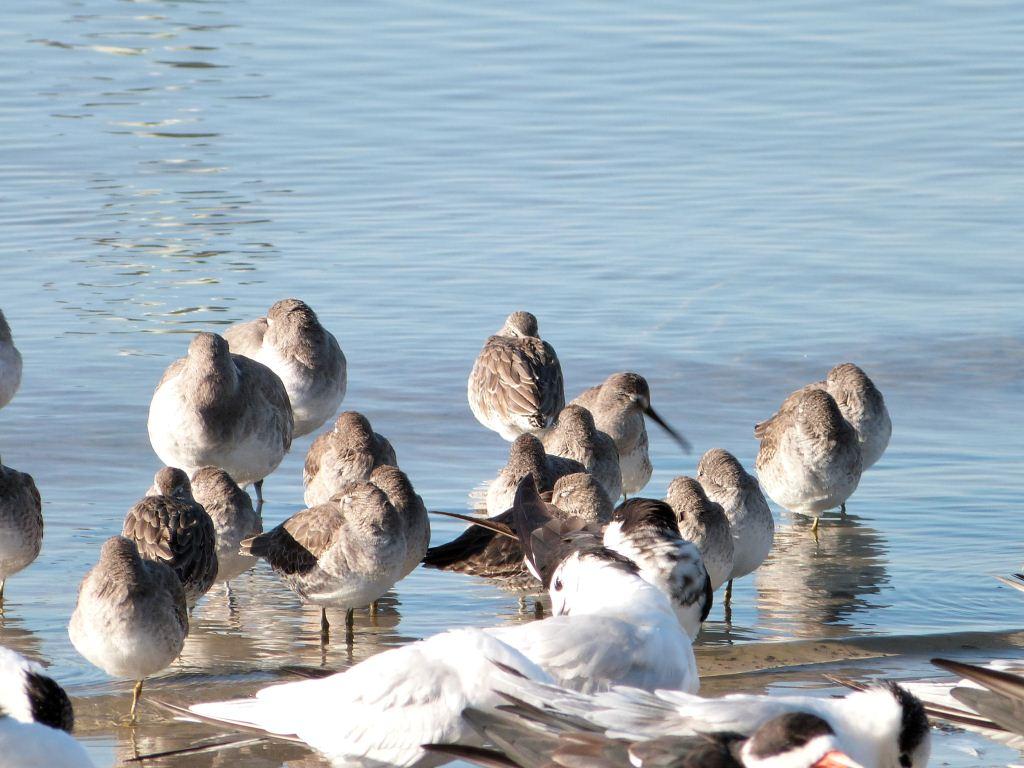
Shorebirds at MacDill AFB shore 11-23-12

Many believe the Critters rested most of the time while on board.

I am thankful that Noah and his family lived righteously and that they found grace. If not, I wouldn’t be writing this blog, nor would I be enjoying all the things the Lord created, especially the birds I love to write about.

Praise the Lord!

*

Other Birds of the Bible articles about this:

The Lord Provides For Them

Seven By Seven

God’s Commands and Promises To Them – Part I

Leaving the Ark

*

Ian’s Bird of the Week – (Southern Cassowary) and Solar Eclipse

Southern Cassowary and Solar Eclipse by Ian 1

Southern Cassowary and Solar Eclipse by Ian 1

Ian’s Bird of the Week – (Southern Cassowary) and Solar Eclipse

by Ian Montgomery

Newsletter 11-14-12

It’s unusual for my primary photographic goal on a trip to be other than a bird, but birds this week in northern Queensland have been overshadowed – pun intended – by yesterday’s solar eclipse. Residents of the Townsville district had to face the difficult decision on whether to remain here where the probability of clear skies was great but be satisfied with a 96% eclipse or travel to Cairns where the weather forecast was cloudy but the eclipse was total.

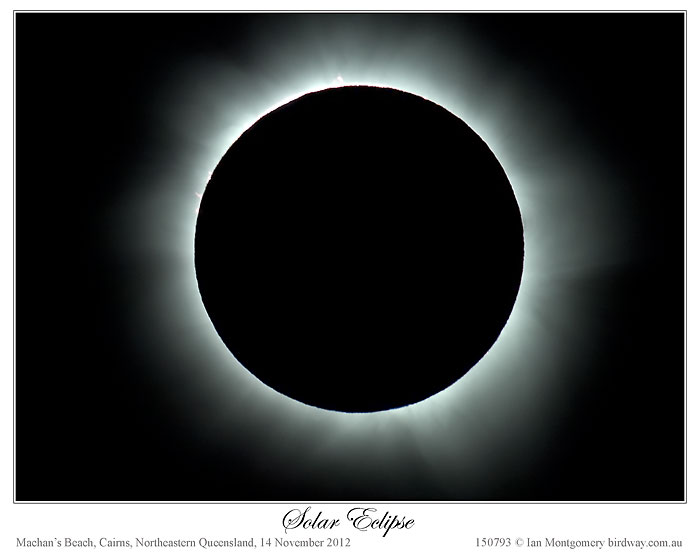
Despite misgivings about the weather, we went to Cairns and in the end it was a close call. We awoke at 5:30am – totality was due at 6:38 – to an unpromising looking sunrise followed by a shower of rain and then headed off to the beach, equipped with solar spectacles and umbrellas. Just before totality, a cloud obscured the sun and the first photo was taken seconds before it was due, at 6:37’37”, according to my iPhone. The suspense was riveting until the cloud moved aside like a slow theatre curtain to reveal a total eclipse in all its glory and all the onlookers cheered. The second photo was taken, not with the iPhone, exactly 40 seconds later.

Southern Cassowary and Solar Eclipse by Ian 2

Southern Cassowary and Solar Eclipse by Ian 2

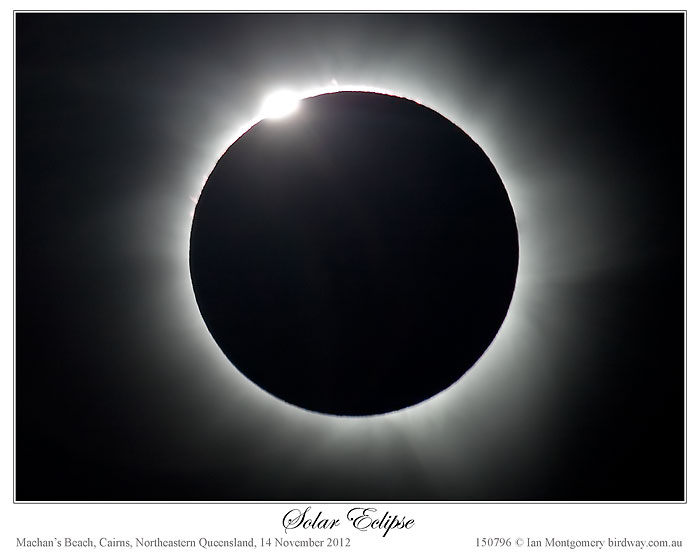
As well as the corona surrounding the sun, only ever visible from earth during total eclipse, you can see several solar flares between 9 and 10 o’clock and near 12 o’clock. The third photo was taken another 7 seconds later, at 8:38’24”, and the sun is already reappearing producing the ‘diamond ring’ effect. This happens when a relatively tiny portion of the sun – a Baily’s bead – is visible through an irregularity on the surface of the moon – a mountain valley or a crater.

Southern Cassowary and Solar Eclipse by Ian 3

Southern Cassowary and Solar Eclipse by Ian 3

For the photographically-minded, I was unsure what exposure to use and whether automatic exposure would be correct, so I used ‘bracketing’, taking 3 photos with exposures ranging from 1 stop below to 1 above the set exposure and adjusting the set exposure based on the results of the first photos. I got the best results at -2.7 stops, f5.6 at 1/100 and 1/125sec at ISO 100. I used a tripod.

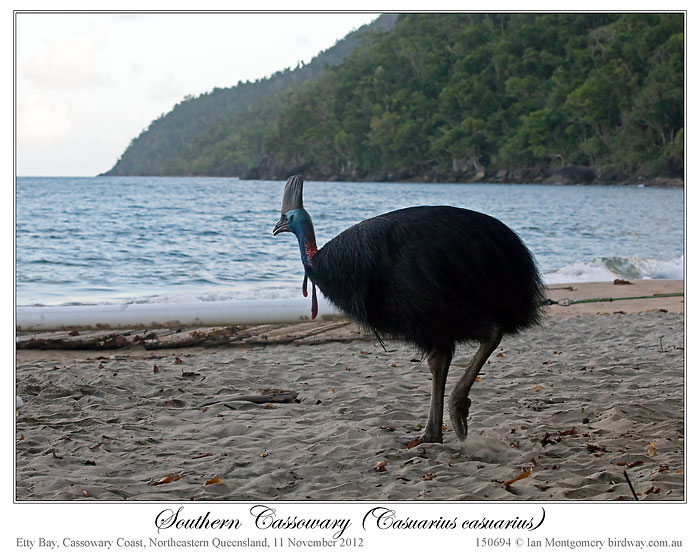
On the way to Cairns we spent a night at Etty Bay on the ‘Cassowary Coast’, the name of the local government region that covers Mission Beach and Innisfail. Etty Bay is, I think, the best place to see Cassowaries, as at least one regular patrols the camping and picnic area looking for scraps of food. The Cassowary Coast has the following logo, and I wanted to take a photo of a Cassowary that emulated the sign (which emulates a Cassowary).

Southern Cassowary and Solar Eclipse by Ian 4

Southern Cassowary and Solar Eclipse by Ian 4

Cassowaries don’t normally frequent beaches, but this one has clearly found that it’s worth checking for scraps.

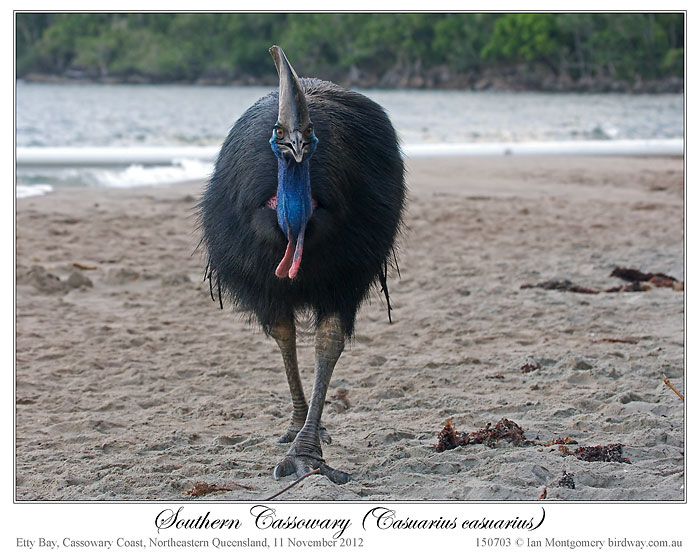
Southern Cassowary and Solar Eclipse by Ian 5

Southern Cassowary and Solar Eclipse by Ian 5

The one in the second photo might make a good poster for a qualified welcome to the Cassowary Coast!

Southern Cassowary and Solar Eclipse by Ian 6

Southern Cassowary and Solar Eclipse by Ian 6

The Southern Cassowary featured as bird of the week in 2006. Here is one of the photos that I used then, also taken at Etty Bay, for those of you who have joined the list since then.

Southern Cassowary and Solar Eclipse by Ian 7

Southern Cassowary and Solar Eclipse by Ian 7

Best wishes
Ian

**************************************************
Ian Montgomery, Birdway Pty Ltd,
454 Forestry Road, Bluewater, Qld 4818
Tel 0411 602 737 ian@birdway.com.au
Check the latest website updates:
http://www.birdway.com.au/#updates


Lee’s Addition:

What great photos of the eclipse and the Cassowary to add to the delight. Thanks, Ian.

That second photo is a perfect catch of the Solar Eclipse. Wow!

He appointed the moon for seasons; The sun knows its going down. (Psalms 104:19 NKJV)

See:

Ian’s Southern Cassowary page for more of his great photos.

Casuariidae – Cassowaries Family

Cassowary – Wikipedia

*

Ian’s Bird of the Week – Common Redshank

Common Redshank (Tringa totanus) by Ian 1

Common Redshank (Tringa totanus) by Ian 1

Ian’s Bird of the Week – Common Redshank ~ by Ian Montgomery

Newsletter – 11-1-12

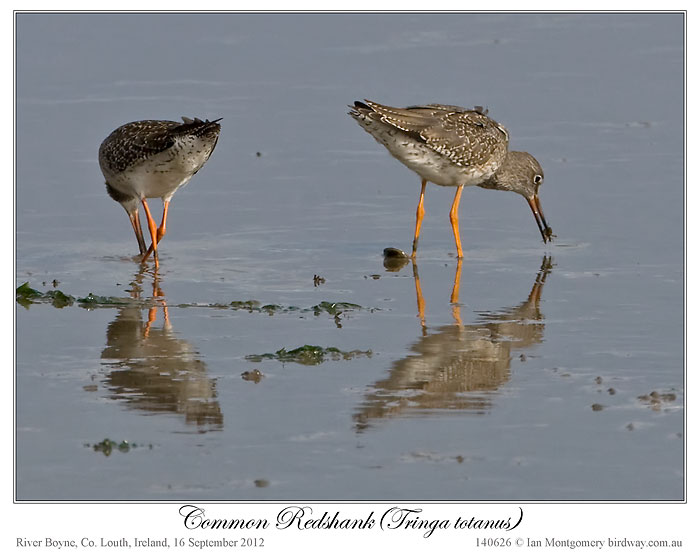
Here’s one for the wader enthusiasts: the Common Redshank, well ‘common’ in Eurasia and rather rare in Australia. It occurred to me when I was photographing these birds in Ireland in September, that, for birders, the appeal of a particular species is very dependent on location. Common Redshanks are noteworthy in Australia (I remember looking quite hard before finding one in Broome) but perhaps a nuisance in Ireland because they’re ubiquitous, nervous and noisy and often put more unusual waders to flight when you least want them to.

The one in the first photo is foraging at low tide in the harbour at Carlingford Lough, an attractive bay between the Republic and Northern Ireland on the east coast and overlooked on the northern side by the Mourne Mountains. The two in the second photo are feeding in the mudflats in the estuary of the River Boyne some distance downstream from where the famous Battle of the Boyne took place in 1690. The bird on the right has just taken a tiny crab.

Common Redshank (Tringa totanus) by Ian 2

Common Redshank (Tringa totanus) by Ian 2

The birds in the first two photos are in non-breeding plumage. Some wader species undergo spectacular colour changes when breeding, but in the Common Redshank the markings just become more pronounced, as in the third photo, taken in Portugal in the month of June some years ago.

Common Redshank (Tringa totanus) by Ian 3

Common Redshank (Tringa totanus) by Ian 3

The bright red legs, or shanks, make this a relatively easy wader to identify. It’s ringing call is also distinctive and it shows a characteristic wing pattern in flight with white panels on the rear edge of the wing, as in the fourth photo, quite different from the wing bar or plain wing of most waders.

Common Redshank (Tringa totanus) by Ian 4

Common Redshank (Tringa totanus) by Ian 4

The generic name Tringa is from the ancient Greek trungas ‘a thrush-sized bird mentioned by Aristotle, not further identified, but taken by later authors to be a sandpiper, a wagtail or a dipper‘. That’s equivalent to saying that this fruit is either an orange, a pineapple or a banana. And totanus comes from the Italian name totano for a Redshank. Sometimes the derivation of scientific names is informative, sometimes less so.

Best wishes
Ian

**************************************************
Ian Montgomery, Birdway Pty Ltd,
454 Forestry Road, Bluewater, Qld 4818
Tel 0411 602 737 ian@birdway.com.au
Check the latest website updates:
http://www.birdway.com.au/#updates


Lee’s Addition:

The birds of the air, And the fish of the sea That pass through the paths of the seas. (Psalms 8:8 NKJV)

What a neat little bird. I especially like the 3rd photo showing the red, hence, Redshank. Thanks again, Ian.

Redshanks do belong to the Scolopacidae – Sandpipers, Snipes Family. See his Scolopacidae family photos also.

Common Redshanks in breeding plumage are a marbled brown color, slightly lighter below. In winter plumage they become somewhat lighter-toned and less patterned, being rather plain greyish-brown above and whitish below. They have red legs and a black-tipped red bill, and show white up the back and on the wings in flight.

(Sound from xeno-canto.org)

See Also:

Ian’s Bird of the Week Newsletters

Common RedshankTringa – ARKive

Common Redshank – Naturia

Common Redshank (Tringa totanus) – Ocean Wanderers Guide

Scolopacidae – Sandpipers, Snipes Family

Scolopacidae – Birdway (Ian’s)

Ian’s Bird of the Week – European Honey Buzzard

Ian’s Bird of the Week – European Honey Buzzard ~ by Ian Montgomery

Newsletter – 10-14-12

I had a welcome email a couple of weeks ago pointing out an identification error on the Birdway website, thank you Tom of Luxembourg, pointing out that the photos I’d taken of a Buzzard in Alderney in the Channel Islands in 2005 was not a mere Common Buzzard but a much more interesting juvenile European Honey Buzzard. By way of excuses, they do look rather similar and at the time I had Common Buzzards on the brain as I had just been trying unsuccessfully to photograph Common Buzzards in Ireland.

Honey Buzzards are very rare nesting birds in Britain (30-50 pairs) but reasonably common in continental Europe. They are summer visitors, wintering in sub-Saharan Africa and often seen on passage and I was in Alderney in September, a good site for migrating birds including raptors. Both species have very variable plumage, but the Honey Buzzard is slightly larger, longer-necked, longer-tailed and has a slim neck and holds it head forward giving the bird a more cuckoo-like silhouette. It also supposed to hold its wings differently when gliding, second photo, but the subtlety of soaring on ‘smoothly down-curved flattish wings lacking an obvious bend at the carpal joints’ rather evades me.

They get their name from their preferred food, the larvae of bees and (mainly) wasps though they eat a more varied diet when these are not available. The specific name apivorus means ‘bee-eating’ – more accurate than ‘honey’ – and has the same Latin roots as the ‘vore’ part of carnivore and the ‘api’ part of apiarist. The generic Pernis comes from the Greek for ‘hawk’, but taxonomists are not too neurotic about combining different languages.

I saw very few raptors in Finland this year, but I did see several Honey Buzzards including this distant, slightly moth-eaten adult in the third photo. At least I identified this one correctly, though I was unjustifiably pleased in thinking I’d photographed a new species.

Back home in North Queensland, I’m working on the final revisions to the photographs for the digital version of the Pizzey and Knight Field Guide to the Birds of Australia which should be published soon – you may have seen the full page advertisement for it from Gibbon Multimedia Australia http://www.gibbonmm.com.au in the September issue of Birdlife Australia. I’ve recently received the mobile version of the equivalent South African product Roberts VII Multimedia Birds of Southern Africa http://www.sabirding.co.za. It’s a splendid product, a veritable encylopaedia, brilliantly organised and available across many platforms (iPad, iPhone, Android, Windows) so don’t go to Southern Africa without it. It augurs very well for the Australian product, but naturally I keep you posted on its progress.

Best wishes

Ian

******************************

********************
Ian Montgomery, Birdway Pty Ltd,
454 Forestry Road, Bluewater, Qld 4818
Tel 0411 602 737 ian@birdway.com.au
Check the latest website updates:
http://www.birdway.com.au/#updates


Lee’s Addition:

After some time, when he returned to get her, he turned aside to see the carcass of the lion. And behold, a swarm of bees and honey were in the carcass of the lion. (Jdg 14:8)

Thanks, Ian, for the correction. Most of us have not seen either bird, so were upset by correction. It is also good to know that even you, whom I consider an expert, makes mistakes. Makes us feel better.

That aside, that is an neat looking bird. I like the third photo showing up under its wings. These Buzzards are part of the Accipitridae – Kites, Hawks and Eagles Family. There are six Honey Buzzards; the European, plus the Long-tailed, Black, Crested, Barred and Philippine.

See Ian’s Buzzards at his:

Accipitridae Family

European Honey Buzzard

Oriental Honey Buzzard

Also:

Accipitridae – Kites, Hawks and Eagles Family

European Honey Buzzard – Wikipedia

*

Ian’s Bird of the Week – Brent/Brant Goose

Brent/Brant Goose (Branta bernicla) by Ian 1

Brent/Brant Goose (Branta bernicla) by Ian 1

Ian’s Bird of the Week – Brent/Brant Goose ~ by Ian Montgomery

Newsletter – 9-27-12

My apologies for the long delay since the past posting on the Barnacle Goose. I’m now back home in North Queensland after the unplanned trip to Ireland following the death of my brother in law Gerald and resuming my normal life.

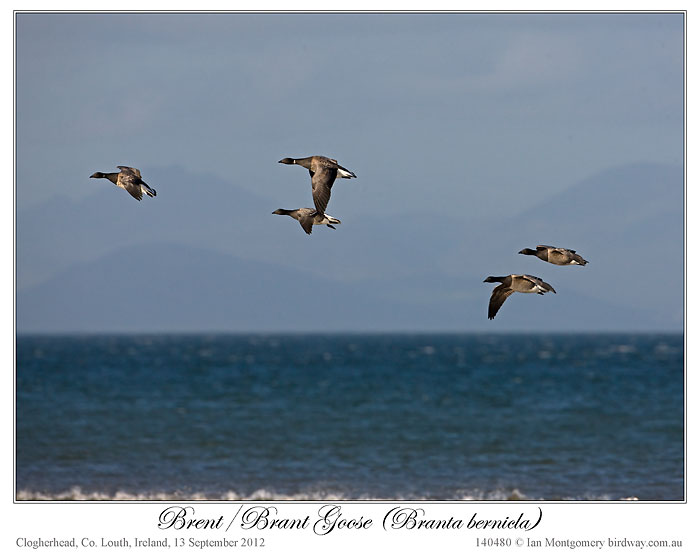
On 6 September we took the dogs for a walk along the strand at the Bull Island in Dublin Bay. As we were leaving, I was surprised to see a flock of Brent Geese, close relatives of the Barnacle Goose so early in the season. Brent Geese are common winter visitors to Ireland but do not usually arrive until much later in September or early October. A week later we visited a strand just north of Clogherhead in Co. Louth and there was another, more accessible flock there and the first photo shows three adults feeding on ‘sea lettuce’, a green alga of the genus Ulva which, along with the sea grass Zostera, often called eel grass, is the main food of Brent Geese in winter.

These are adults, recognisable by the white ‘necklaces’ and the dark, unstriped wings. Different races of Brent/Brant Geese – ‘Brent’ in the British Islands, ‘Brant’ in North America – vary mainly in the colour of the breast. These are Pale-bellied Brent Geese – race hrota – and most of these nest in Greenland and winter in Ireland, one of few species with a transatlantic migration. The nominate Dark-bellied Brent Goose (bernicla) breeds mainly in Russia and winters in northeastern Europe, including Great Britain, and is rare in Ireland. Just after seeing these birds, I read an online newspaper article about the early arrival of Brent Geese in Strangford Lough in Co. Down, Northern Ireland and the writer suggested that favourable tail winds during migration had maybe caused the birds to skip their normal stopover in Iceland, and fly straight to their wintering grounds.
Brent/Brant Goose (Branta bernicla) by Ian 2

Brent/Brant Goose (Branta bernicla) by Ian 2

Among the 70 or so birds in the flock, there were several juveniles including a party of 2 adults and 3 juveniles that stayed together and were maybe a family. The second photo shows three of these birds. The one on the right in the foreground is an adult with dark wings, even though its necklace is rather indistinct. The other two lack the necklace (or are just beginning to acquire one), have stripy wings and have darker mottled rather than scaly breasts. At this age, the juveniles are indistinguishable from Dark-bellied Brent Geese and I initially mistakenly identified them as Dark-bellied. The third photo shows this party coming in to land, looking for all the world like a Peter Scott painting. The mountains in the near background on the left are the Cooley Mountains in northern Co. Louth with the Mourne Mountains in Co. Down in the background.
Brent/Brant Goose (Branta bernicla) by Ian 3

Brent/Brant Goose (Branta bernicla) by Ian 3

With a length of 55-62cm/22-24in, these are smaller than Barnacle Geese and comparable in size to Mallard. Juvenile birds acquire the necklace and breast colour of the adult birds in late September or October, but retain the white wing stripes and are referred to as first winter birds. The fourth photo, taken a few years ago on a wintry January day, shows a first winter bird, complete with necklace and and striped wings being followed by two dark-winged adults.

Brent/Brant Goose (Branta bernicla) by Ian 4

Brent/Brant Goose (Branta bernicla) by Ian 4

I’ve never seen Dark-bellied Brent Geese, but in northern Alaska in June 2008 I came across the western North American race, the Black Brant (nigricans) on its breeding ground on the tundra, fifth photo. The Brent Goose breeds as far north as any bird species in the world at locations such as Ellesmere Island, the northernmost in Canada, and in Spitsbergen, only 10º or 11º from the Arctic Pole.

Brent/Brant Goose (Branta bernicla) by Ian 5

Brent/Brant Goose (Branta bernicla) by Ian 5

This has a very broad necklace and dark brown breast almost merging with the dark brown neck. This is easier to see in the sixth photo. This has sometimes been treated as a separate species.

Brent/Brant Goose (Branta bernicla) by Ian 6

Brent/Brant Goose (Branta bernicla) by Ian 6

In recent decades the populations of Brent Geese have increased greatly. There are about 115,000 Black Brants and about 40,000 Pale-bellied winter in Ireland and 90,000 Dark-bellied winter in Britain.

Best wishes
Ian

**************************************************
Ian Montgomery, Birdway Pty Ltd,
454 Forestry Road, Bluewater, Qld 4818
Tel 0411 602 737 ian@birdway.com.au
Check the latest website updates:
http://www.birdway.com.au/#updates


Lee’s Addition:

And God said, “Let the waters swarm with swarms of living creatures, and let birds fly above the earth across the expanse of the heavens.” (Genesis 1:20 ESV)

Again, Ian, Our deepest sympathy over your loss. We are glad you are back safely at home.

These geese and all the information about them is very interesting and informative. See all of Ian’s Anseranatidae & Anatidae Family. He has quite a selection of them that he has photographed over time.

See also the Anatidae Family here.

*

Ian’s Bird of the Week – Barnacle Goose

Barnacle Goose (Branta leucopsis) by Ian 1

Barnacle Goose (Branta leucopsis) by Ian 1

Ian’s Bird of the Week – Barnacle Goose ~ by Ian Montgomery

Newsletter – 9-10-12

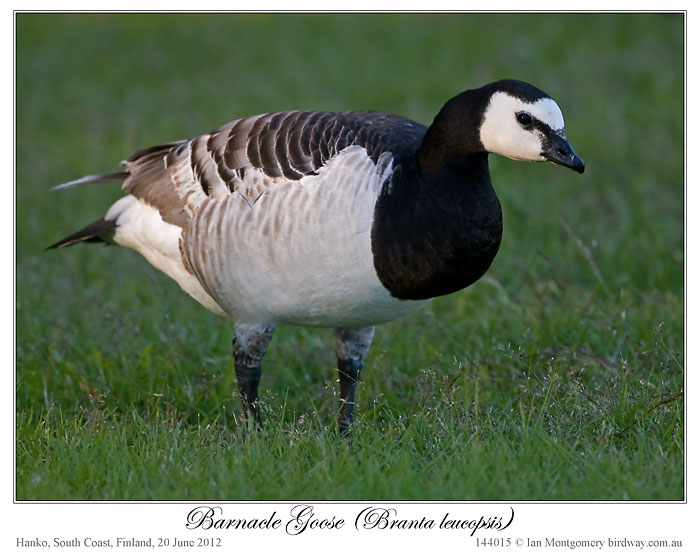
I’m back in Dublin after the sad and sudden death of my brother-in-law Gerald, so I’ve chosen a soberly dressed and elegant bird with, for me, an Irish connection, the Barnacle Goose. Barnacle Goose nest in the arctic and winter the more remote areas in Western Europe including the West of Ireland. During a particular severe winter in the 1960s I once saw a flock on the Bull Island in Dublin Bay, a place better known for as a winter haunt of the closely related Brent (British Isles) or Brant (North America) Goose.

On the last day of my trip to Finland in June, I came across a flock grazing near the beach in Hanko on the south east coast. I assumed that it was a feral flock as they were very approachable and I discovered only later that Barnacle Geese have been nesting on islands in the Baltic for the past 40 years.

They are relatively small with a length of 55-70cm/22-28in and, I think, very beautiful. The specific name leucopsis means ‘white-faced’ and the genus Branta comprises the mainly black and white geese including the Brant/Brent and the Canadian.

Barnacle Goose (Branta leucopsis) by Ian 2

Barnacle Goose (Branta leucopsis) by Ian 2

The name ‘Barnacle’ was originally applied to the goose not the crustacean and the two are linked by a strange myth that developed in the middle ages when the nesting sites of the goose were unknown and the nature of bird migration was not understood. To explain the mysterious appearance of these geese, it was proposed that they hatched from the goose-liked stalk barnacles Lepas anserifera (‘goose-bearing’) which grows on drift wood. The confusion was confounded by the notion that the goose barnacle was actually a plant and sometimes called the goose tree, below, reproduced from Wikipedia.

Barnacle Goose (Branta leucopsis) by Ian 3

Barnacle Goose (Branta leucopsis) by Ian 3

The myth naturally had religious consequences as it was argued that the Barnacle Geese were not of animal origin or not really fowl. So, eating the goose on meat-less fast days was considered by some Christians to be acceptable. The Jewish faith took a different approach and ruled that they were kosher and must be slaughtered appropriately.

Best wishes
Ian

**************************************************
Ian Montgomery, Birdway Pty Ltd,
454 Forestry Road, Bluewater, Qld 4818
Tel 0411 602 737 ian@birdway.com.au
Check the latest website updates:
http://www.birdway.com.au/#updates


Lee’s Addition:

and the peace of God, which surpasses all understanding, will guard your hearts and minds through Christ Jesus. (Philippians 4:7 NKJV)

Thanks, Ian. Sorry to hear about Gerald. We will keep you and your sister’s family in our prayers. That is an interesting myth.

See more of Ian’s Bird of the Week.

Ian’s Birdway – Ducks & Allies.

*

Bird of the Week – Antarctic Tern

Antarctic Tern (Sterna vittata) by Ian (1)

Antarctic Tern (Sterna vittata) by Ian (1)

Bird of the Week – Antarctic Tern ~ by Ian Montgomery

Newsletter – 8-28-12

I’ve been adding photos from the recent Hong Kong, Finland, Ireland trip to the website and have encountered a few that are also on the Australian list such as the Arctic Tern. That was my initial choice for this week’s bird until I changed it to the closely related but lesser known Antarctic Tern as I took some photos of it on the Sub-Antarctic Islands trip last November that I would like to share. It is also on the Australian list and breeds at Macquarie and Heard Islands, though it is regarded as a very rare vagrant to the mainland.

We first encountered them at Snares, on the day after leaving Dunedin, first photo. Snares is a nature reserve and we weren’t allowed to land there but, as you can judge from the photo, weather conditions were good and we could get very close to some of the birds and mammals in the Zodiacs. This bird is in breeding plumage and the coral red bill and leg colour is sufficient to distinguish it from the similar breeding Common and Arctic Terns, both of which spend the northern winter in the southern hemisphere. These two breed in the northern hemisphere in the northern summer and both the time of the year and the location are also sufficient circumstantial evidence to eliminate birds of those species in breeding plumage. Apart from that, there are other subtler differences relating to size, plumage and proportions with the Antarctic Tern being both larger and stockier than the other two.

Antarctic Tern (Sterna vittata) by Ian (2)

Antarctic Tern (Sterna vittata) by Ian (2)

Some of these difference, such as the extent of transparency and dark webs in the flight feathers can only be seen in flight, second photo. If you’re not too worried about identification, then you can appreciate the beauty of all these elegant mid-sized terns and, given their graceful flight and forked tails, it’s no wonder that they have been called Sea Swallows. This photo was taken the following day at Enderby Island, one of the Auckland Islands. We were allowed to land there and it proved to be a fascinating place. At a small colony of nesting Antarctic Terns the bird in the third photo is just landing at its neat grassy nest to incubate the two eggs.

Antarctic Tern (Sterna vittata) by Ian (3)

Antarctic Tern (Sterna vittata) by Ian (3)

Both at Snares and on Enderby, there were other similar terns in non-breeding plumage, fourth photo, hanging around the edges of the breeding colony. This is where separation of the three species gets tough and is either a fascinating challenge or a nightmare for keen birders – depending on one’s attitude – and it’s no surprise that in the British Isles Common and Arctic Terns are collectively and wryly referred to as ‘Comic’ Terns. Birders have it fairly easy there and don’t have to worry about Antarctic Terns (we won’t even discuss the South American and Kerguelen Terns which complete the quintet). At Snares, we were tempted to identify this as an Arctic Tern. Arctic Terns, incidentally, easily win the prize for migration, breeding in the higher latitudes of the northern hemisphere and wintering on the coast of Antarctica.

Antarctic Tern (Sterna vittata) by Ian (4)

Antarctic Tern (Sterna vittata) by Ian (4)

It wasn’t until we got to Enderby and found more of these non-breeding birds in close proximity to breeding Antarctic Terns that we could compare the two sorts side by side and conclude that they were non-breeding Antarctic Terns. When I got home, the Handbook of Birds of the World, confirmed that in some places one year old birds, not old enough to breed, do occur at colonies. It may well be that the few records of Antarctic Terns for mainland Australia is more a reflection of the difficulties of separating non-breeding birds, that their actual rarity.

Back at the website, recent additional species from the trip that might be of interest include:

Best wishes
Ian

**************************************************
Ian Montgomery, Birdway Pty Ltd,
454 Forestry Road, Bluewater, Qld 4818
Tel 0411 602 737 ian@birdway.com.au
Check the latest website updates:
http://www.birdway.com.au/#updates


Lee’s Addition:

and let birds fly above the earth across the expanse of the heavens. (Genesis 1:20 ESV)

I am glad Ian figures these birds out for us. I have a real challenge just with the Terns I see at our shores. Like Ian tells us, the real ID problem comes when they are in their non-breeding plumages.

Thanks again, Ian, for sharing your birdwatching adventures with us.

Terns are put of the Laridae Family. Check out all of Ian’s Laridae – Sternini & Rynchopin Genus photos, then check out the Laridae – Gulls, Terns and Skimmers Family here.

*