Ian’s Bird of the Week – Sooty Oystercatcher

Sooty Oystercatcher (Haematopus fuliginosus fuliginosus) by Ian 1

Sooty Oystercatcher (Haematopus fuliginosus fuliginosus) by Ian 1

Ian’s Bird of the Week – Sooty Oystercatcher ~ by Ian Montgomery

Newsletter – 8-16-12
Back to Australia for this week’s bird, the Sooty Oystercatcher. Oystercatchers are large, conspicuous, noisy and mostly popular waders, though not greatly loved by those who harvest shellfish such as mussels. There are about a dozen closely-related species worldwide, two of which are resident in Australia, the Pied and the Sooty. Both occur right around the coasts of Australia and Tasmania, with the Sooty being the less common. It is primarily an inhabitant of rocky shores, first photo, while the Pied is found mainly in sandy habitats. At 46-49cm/18-19in the Sooty is slightly shorter on average than the Pied 48-51cm and distinguished by its all black plumage.

Two races are recognised, though their status and range are uncertain. The nominate race (fuliginosus) occurs in southern Australia and is characterised by the narrower red eye-ring and finer bill like the bird in the first photo, taken near Sydney. The northern race (opthalmicus) has a fleshier, more orange eye-ring and a thicker bill. It is supposed to occur from Shark Bay in Western Australia to Lady Elliot Island at the southern end of the Great Barrier Reef in Queensland, but the bird in the second photo taken near Lennox Head in northern NSW fits this description. There is disagreement in the field guides about whether opthalmicus has a longer or shorter bill.

Sooty Oystercatcher (Haematopus fuliginosus opthalmicus) by Ian 2

Sooty Oystercatcher (Haematopus fuliginosus opthalmicus) by Ian 2

The diets of the two species differ. The Pied feeds mainly by probing sand and soil for worm and other burrowing invertebrates. The Sooty feeds mainly on intertidal invertebrates on rocks such as gastropods (third photo), limpets, crustaceans, echinoderms and ascidians.

Sooty Oystercatcher (Haematopus fuliginosus fuliginosus) by Ian 3

Sooty Oystercatcher (Haematopus fuliginosus fuliginosus) by Ian 3

They will also feed on beaches near rocky headlands and the one in the fourth photo is part of a small flock probing through piles of washed-up seaweed.
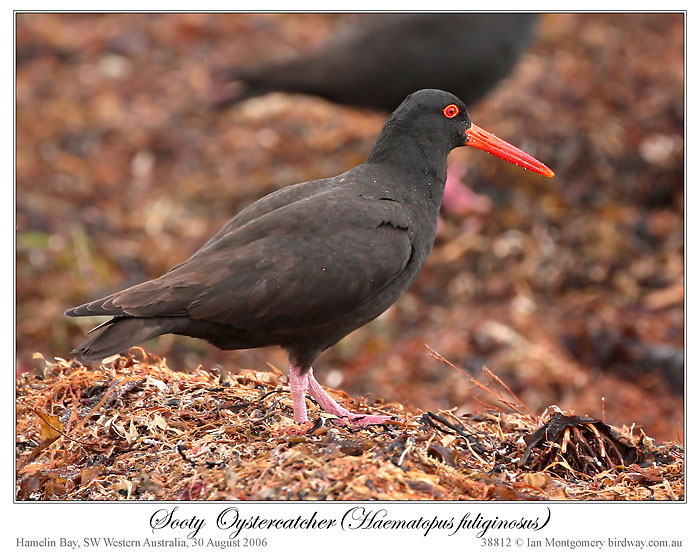
Sooty Oystercatcher (Haematopus fuliginosus fuliginosus) by Ian 4

Sooty Oystercatcher (Haematopus fuliginosus fuliginosus) by Ian 4

There is some overlap in the habitats of the two species, so they are occasionally found together. The fifth photo show two walking in step along a beach at the end of August and look like more than just good friends. The breeding season of southern Sooties starts in September and the two species have been known to hybridise, so draw your own conclusions.
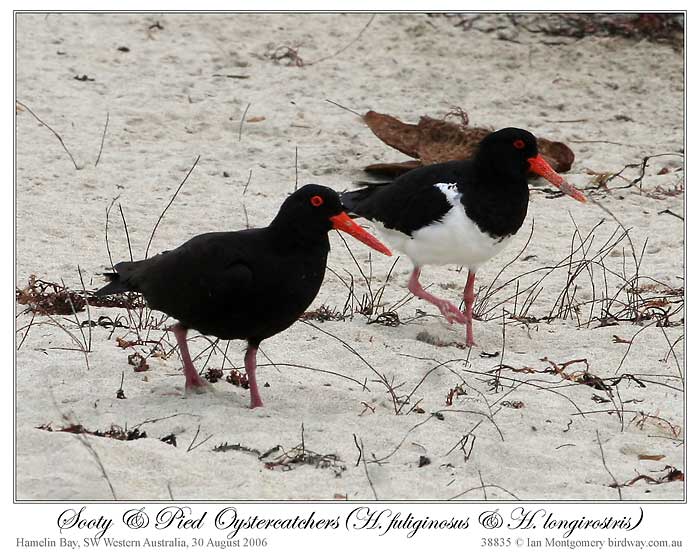
Sooty Oystercatcher (H fuliginosus) and Pied (H longirostris) by Ian 5

Sooty Oystercatcher (H fuliginosus) and Pied (H longirostris) by Ian 5

A third species, the South Island Pied Oystercatcher of New Zealand, sometimes turns up on the east coast sometimes and more frequently on Lord Howe and Norfolk Islands. This is subtly different from the Pied Oystercatcher and a challenge for enthusiastic birders to identify.

Best wishes

Ian

**************************************************
Ian Montgomery, Birdway Pty Ltd,
454 Forestry Road, Bluewater, Qld 4818
Tel 0411 602 737 ian@birdway.com.au
Check the latest website updates:
http://www.birdway.com.au/#updates


Lee’s Addition:

Thanks again, Ian, for sharing your birds with us. We always learn something neat about birds and their behaviors. I have seen our two Oystercatchers, the Black and the American. That Sooty seem similar to our Black.

Oystercatchers belong to the Haematopodidae – Oystercatchers Family. There are 12 members in the family, one of which is extinct.

Who, when he had found one pearl of great price, went and sold all that he had, and bought it. (Matthew 13:46 KJV)

Ian said, “not greatly loved by those who harvest shellfish such as mussels.” Maybe that is because they are looking for those pearls of great price and the Oystercatchers are beating them to it. Humm!

Check out:

Ian’s Oystercatcher pages and then

The Haematopodidae – Oystercatchers Family here

*

Ian’s Bird of the Week – White-throated Dipper

Ian’s Bird of the Week – White-throated Dipper  ~ by Ian Montgomery

Newsletter – 8-5-12

Here’s another species from Bushy Park in Dublin, the White-throated Dipper, this time on the River Dodder. This featured as bird of the week 5 years ago, so please forgive the repetition but I have some nice photos to share. Dippers – there are 6 species world-wide – are rather special in that they are the only truly aquatic Passerines (song birds), living exclusively on and in fast flowing streams and rivers and getting all their food from the water. They are dumpy, short-tailed, starling-sized birds and, as they often cock their tails, look a bit like giant (Winter) Wrens.

White-throated Dipper (Cinclus cinclus) by Ian 1

White-throated Dipper (Cinclus cinclus) by Ian 1

They also build domed nests but the resemblance to wrens ends there, though, and they are unrelated belonging to their own family, the Cinclidae. They feed on aquatic larvae, such as Caddis Fly larvae, and other invertebrates such as freshwater crustaceans and molluscs.

White-throated Dipper (Cinclus cinclus) by Ian 2

White-throated Dipper (Cinclus cinclus) by Ian 2

Not only do they wade and swim with ease, they will also walk along the bottom of the stream gripping onto stones with their strong feet and even dive, using their wings to propel themselves under water.

White-throated Dipper (Cinclus cinclus) by Ian 3

White-throated Dipper (Cinclus cinclus) by Ian 3

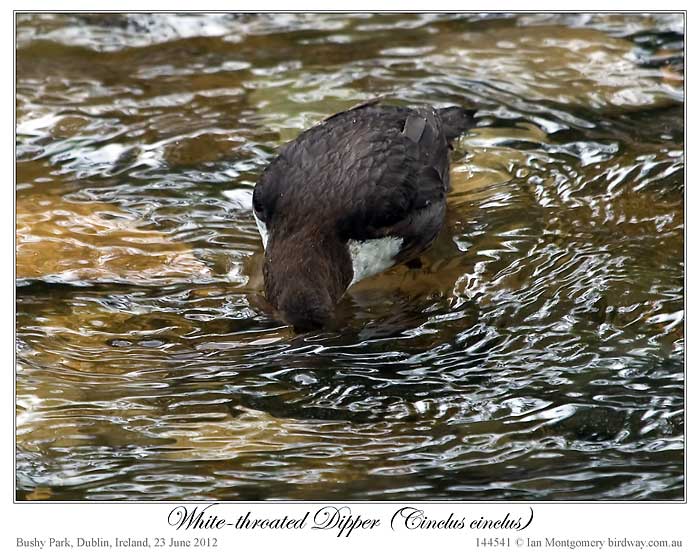
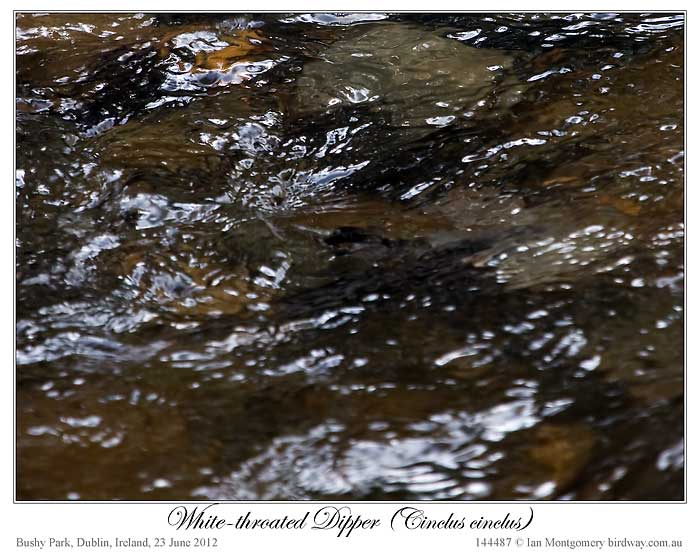
The bird in the third photo is almost completely submerged, and if you look carefully at the fourth photo, the brown shape in the centre is a completely submerged one with only a little eddy to show where it went under the surface.

White-throated Dipper (Cinclus cinclus) by Ian 4

White-throated Dipper (Cinclus cinclus) by Ian 4

They use their slightly upturned bill to probe for food under rocks and stones. The one in the fifth photo has just surfaced with a tasty grub.

White-throated Dipper (Cinclus cinclus) by Ian 5

White-throated Dipper (Cinclus cinclus) by Ian 5

This same bird only moments before had appeared with a Caddis Fly larva in its characteristic tube, made out of spun silk and often camouflaged with attached sand, sixth photo. The presence of Caddis Fly larvae is supposed to indicated a healthy river system, though the depressing amount of water-borne litter in the River Dodder makes it look otherwise.

White-throated Dipper (Cinclus cinclus) by Ian 6

White-throated Dipper (Cinclus cinclus) by Ian 6

We saw Dippers on most occasions when we took the dogs for a walk. It’s popular jogging and dog-walking spot and the Dippers are used to disturbance and are remarkably approachable, being usually rather shy. They nest here too, and the slight bemused looking individual in the seventh photo is a recently-fledged juvenile, distinguishable by the scaly pattern on the chest, the overall grey colour and the pale legs.

White-throated Dipper (Cinclus cinclus) by Ian 7

White-throated Dipper (Cinclus cinclus) by Ian 7

I’ve seen Brown Dippers in the Himalayas in Sikkim, White-capped Dippers in the Andes in Ecuador and American Dippers in the Cascade Mountains of Northeastern California. The White-throated Dipper is a bird of mainly and often icy, highland streams in Europe, North Africa and the Middle East. Seeing them so easily in suburban Dublin, between Terenure and Rathfarnham 6 km from the city centre (take the 15B bus) is truly wonderful.

Best wishes
Ian
**************************************************
Ian Montgomery, Birdway Pty Ltd,
454 Forestry Road, Bluewater, Qld 4818
Tel 0411 602 737 ian@birdway.com.au
Check the latest website updates:
http://www.birdway.com.au/#updates


Lee’s Addition:

Let the rivers clap their hands; Let the hills be joyful together before the LORD, (Psalms 98:8 NKJV)

What an amazing little bird. Its ability to swim and walk underwater is very interesting. Thanks again, Ian, for sharing another of your adventures.

As Ian mentioned they are in the Cinclidae family. There are five species in that family. After checking out his photos, check the Birds of the World page here.

Ian’s Cinclidae Family page.

Cinclidae – Dipper Family

Dippers – Wikipedia

Dippers – IBC

*
Ian’s Bird of the Week – Little Grebe

Little Grebe (Tachybaptus ruficollis) by Ian 1

Little Grebe (Tachybaptus ruficollis) by Ian 1

Ian’s Bird of the Week – Little Grebe ~ by Ian Montgomery

Newsletter – 7/22/12

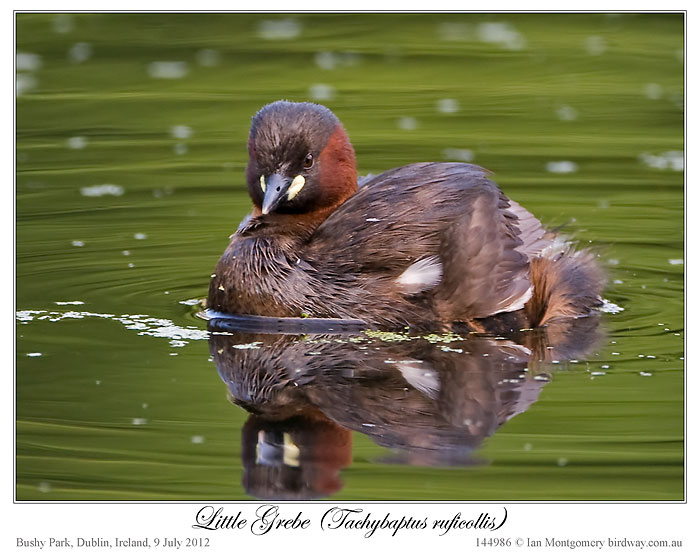
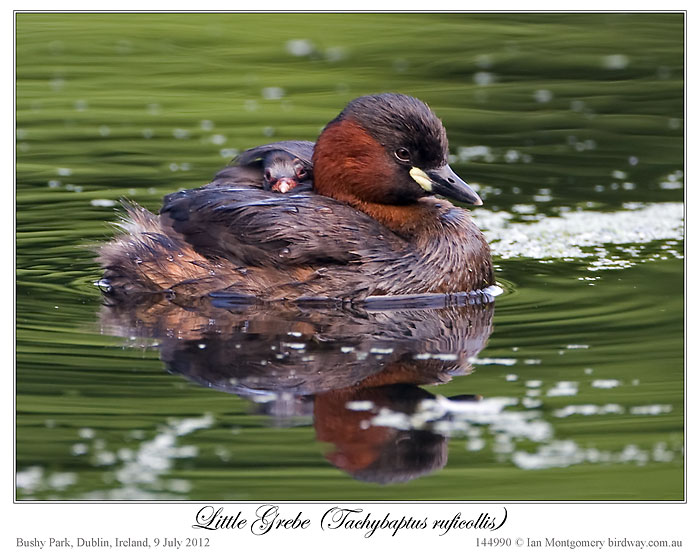
When I was in Dublin – I’m now back home in North Queensland – and we were waiting for the arrival of my niece’s baby, we used to take the dogs for a walk in nearby Bushy Park along the River Dodder. In the park, there is a large artificial pond with an island and I soon found this Little Grebe or ‘Dabchick’ patiently incubating eggs on her nest.

Grebes are usually fairly shy, so a nesting one is a good photo opportunity as they build their floating nests in the open in shallow water. The nest is anchored to submerged vegetation and branches and the fact that it is floating gives it some protection from changing water levels after rain, for example. The second photo was taken on the 26 June, the day when my niece’s daughter finally arrived.

Little Grebe (Tachybaptus ruficollis) by Ian 2

Little Grebe (Tachybaptus ruficollis) by Ian 2

It was a while before I could check the progress of the Little Grebe again and when we returned on the 9th June, third photo, the nest had vanished and, as there had been some bad weather in the meantime, I feared the worst. Both adults were still present but there was no obvious sign of any chicks. However, if you look carefully at this bird, you’ll see that the left wing is slightly raised and not folded flat.

Little Grebe (Tachybaptus ruficollis) by Ian 3

Little Grebe (Tachybaptus ruficollis) by Ian 3

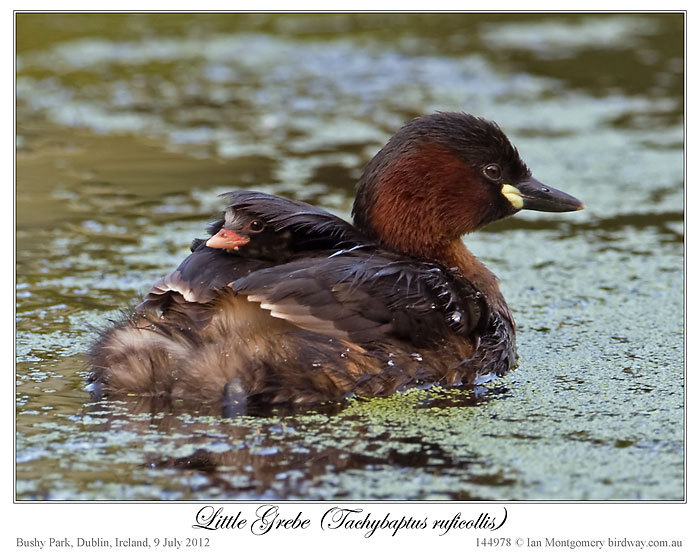
The reason for this became clear when the bird turned around, revealing a chick carefully tucked away under the wing.

Little Grebe (Tachybaptus ruficollis) by Ian 4 with chick

Little Grebe (Tachybaptus ruficollis) by Ian 4

The fourth photo was taken on the same day. We returned again 4 days later and I saw only the one adult and no chick but there is plenty of cover around the island and I may have missed it.

Little Grebe (Tachybaptus ruficollis) by Ian 5 with chick

Little Grebe (Tachybaptus ruficollis) by Ian 5

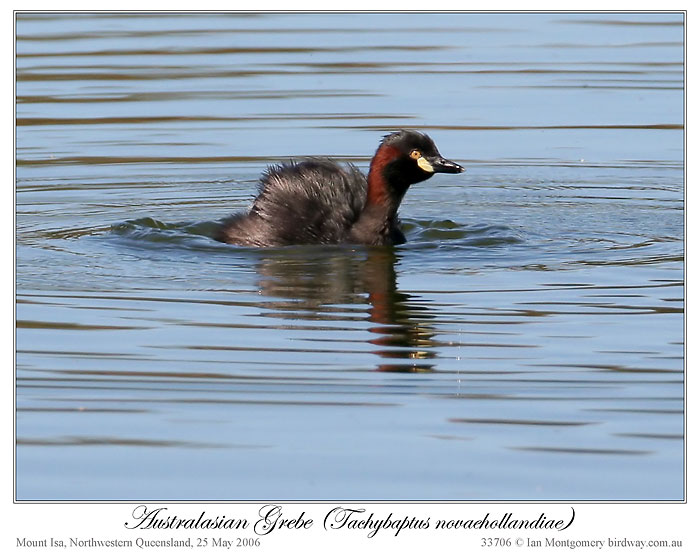
Any Australian birders would immediately notice the similarity between the Eurasian Little Grebe and the Australasian Grebe. They can be distinguished in breeding plumage by the amount of rufous on the neck, throat and breast. These are rufous in the Little Grebe (hence the specific name ruficollis) but the throat and breast of the Australasian Grebe are black as in the fifth photo. Other distinguishing field marks are the yellow, rather than reddish-brown, iris and the greater amount of white under the tail of the Australasian Grebe, though the latter is not evident in this photo.

Australasian Grebe (Tachybaptus novaehollandiae) by Ian

Australasian Grebe (Tachybaptus novaehollandiae) by Ian

These are fairly trivial differences and for a long time the two were treated as conspecific. However, the ranges of the two overlap in New Guinea (are ‘sympatric’) and it is usual to treat them as separate species with the Little Grebe being widespread throughout Eurasia and Africa and the Australasian Grebe occurring in New Guinea, Australia and New Zealand.

Best wishes

Ian
**************************************************
Ian Montgomery, Birdway Pty Ltd,
454 Forestry Road, Bluewater, Qld 4818
Tel 0411 602 737 ian@birdway.com.au
Check the latest website updates:
http://www.birdway.com.au/#updates
**************************************************


Lee’s Addition:

I love the photos of the little one riding under the wing of the parent. Of course that brings to mind several verses.

Keep me as the apple of the eye, hide me under the shadow of thy wings, (Psalms 17:8 KJV)

How excellent is thy lovingkindness, O God! therefore the children of men put their trust under the shadow of thy wings. (Psalms 36:7 KJV)

He shall cover you with His feathers, And under His wings you shall take refuge; His truth shall be your shield and buckler. (Psalms 91:4 NKJV)

We see the Pied-billed Grebe and the Horned Grebe here. It would be neat to see those two that Ian had the privilege of seeing. The Grebes belong to the Podicipedidae family. There are 23 Grebes worldwide.

See more:

Ian’s Bird of the Week articles.

Podicipedidae – Grebes Family

*

Ian’s Bird of the Week – Bohemian Waxwing

Bohemian Waxwing (Bombycilla garrulus) by Ian 1

Bohemian Waxwing by Ian 1

Bird of the Week – Bohemian Waxwing ~ by Ian Montgomery

Newsletter – 7/5/12

Following on from the Black Woodpecker, here is the (Bohemian) Waxwing another unusual northern European species that has a 50 year connection for me.

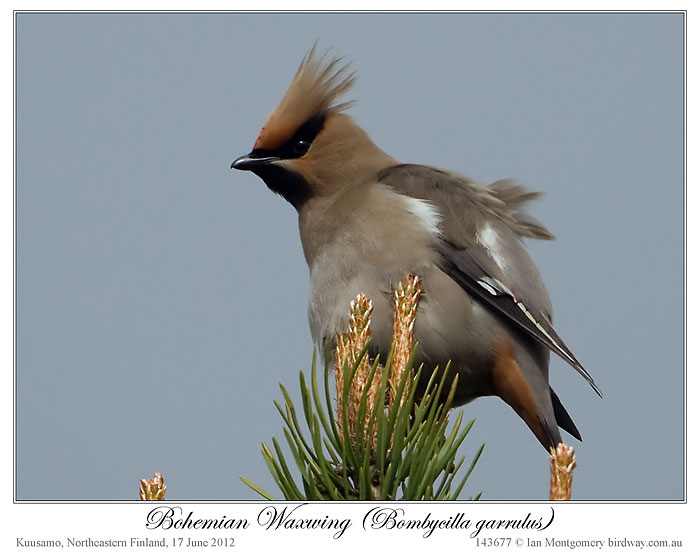
The Bohemian Waxwing breeds across northern Eurasian and North America and moves southwards in winter in search of its staple winter food, berries. In Western Europe, it usually goes only as far as Germany and northern France, but in some years, driven by food shortages, it makes its way as far west as Britain and, more rarely, Ireland. That happened in the early 1960s when I was a schoolboy in Ireland, and I once saw several feeding on berries in a suburban street in Dublin (Eglington Road). I hadn’t seen them again since until my trip to Finland two weeks ago and I drove down that street a few days ago.

Bohemian Waxwing (Bombycilla garrulus) by Ian 2

Bohemian Waxwing by Ian 2

These starling-sized birds are exotic by European standards and beautiful by any, so you can imagine my excitement all those years ago. It was good to catch up with them again in Finland, and this female, perched on top of a conifer, allowed me to approach fairly closely. They get their name from the red waxy-looking tips to some of the wing feathers, which you can see if you look carefully at the photos. These are more obvious in males, and the whitish stripes below the red spot are much yellower in males.

Bohemian Waxwing (Bombycilla garrulus) by Ian 3

Bohemian Waxwing by Ian 3

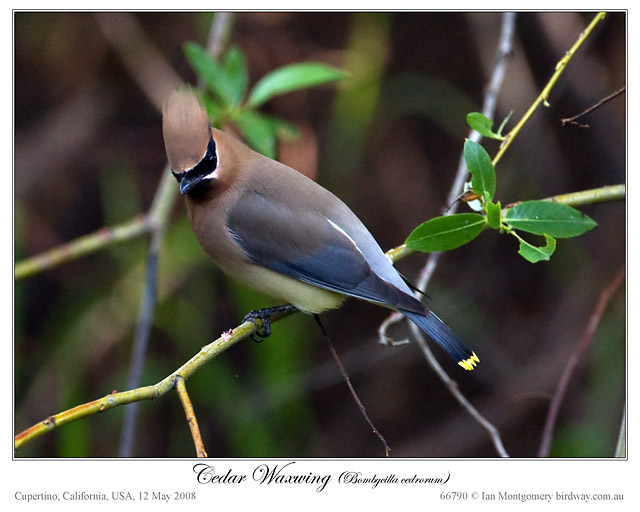
In Europe, these birds are just called Waxwings, but in North America there are two species and this one is qualified with the Bohemian tag to separate it from the slightly smaller but otherwise rather similar Cedar Waxwing. This featured as Bird of the Week three years ago and here it is again:

Bohemian Waxwing (Bombycilla garrulus) by Ian 4

Bohemian Waxwing by Ian 4

Waxwings have silky feathers, and the generic name Bombycilla means, in pigeon Latin, ‘silky tail’. There are only 3 species – the third being the Japanese Waxwing – and they were originally the only members of the family Bombycillidae. Recent genetic studies have shown that several other species are related to them and have been moved into the family. Interestingly, these include the three species of aptly-named Silky-Flycatchers (the ‘silky’ being apt, not the greatly overused ‘flycatcher’), such as the Long-tailed Silky-Flycatcher and you’ll see the family resemblance if you follow the link.

Meanwhile in Dublin, my niece has given birth to a delightful baby girl, Aoibhinn, and both mother and child are doing well. Ancient Irish names are very fashionable here and ‘bh’ in Irish has a ‘v’ sound (strictly speaking it’s an aspirated ‘b’, traditionally represented by a dot over the ‘b’) so the name is pronounced something like ‘eaveen’. Aiobhinn timed her arrival well and waited until all the immediate members of the family were in Dublin, including my other niece who came over from Strasbourg with her husband.

Best wishes
Ian

**************************************************
Ian Montgomery, Birdway Pty Ltd, to a
454 Forestry Road, Bluewater, Qld 4818
Tel 0411 602 737 ian@birdway.com.au
Check the latest website updates:
http://www.birdway.com.au/#updates


Lee’s Addition:

She maketh herself coverings of tapestry; her clothing is silk and purple. (Proverbs 31:22 KJV)

What a gorgeous bird and I am thankful that Ian met up with an old friend from years ago. Seeing her must have brought back memories. Thanks again for sharing your birding adventures with us, Ian.

See these other articles about the Waxwings:

Ian’s Bird of the Week – Cedar Waxwing

See all of Ian’s Bird of the Week articles

Birds Vol 1 #4 – The Bohemian Wax-Wing

Waxwings – Bombycillidae family

Cedar Waxwing – Fruit Passer…

*

Ian’s Bird of the Week – Black Woodpecker

Black Woodpecker (Dryocopus martius) by Ian 1

Black Woodpecker (Dryocopus martius) by Ian 1

Ian’s Bird of the Week – Black Woodpecker ~ by Ian Montgomery

Newsletter – 6/26/12

I said last week that my main target in Finland the Black Woodpecker was another story. It’s a story that started 50 years ago when I started bird watching in Ireland as a teenager and received, as a Christmas present in 1962, the classic Guy Mountfort Field Guide to the Birds of Britain and Europe. It had, for its time, superb colour plates of all the European bird species by Roger Peterson. Some of these birds were to this Irish teenager unbelievably exotic and, living on a woodpecker-free island, I was struck by the woodpecker page in general and the huge Black Woodpecker in particular (I still have the field guide):

The concept of a bucket list (things to do before you ‘kick the bucket’) hadn’t been articulated then, but the Black Woodpecker went straight onto mine. So, when the only route that Qantas could offer me a few months ago for a frequent-flyer ticket in the general direction of Ireland was on Finnair via Helsinki, I immediately thought ‘Black Woodpecker’ (and ‘owls’, another great page in the field guide).

In fact finding birds such as woodpeckers and owls in the endless forests of Finland proved very difficult, so eventually I went out with an excellent Finnature guide, Antti (Finnish for Andrew) and a delightful English birding couple in the Kuusamo region. It was a very bad year for owls (owl years are very dependent on cycles in the vole population) but Antti did eventually find us a distant Pygmy Owl and, last bird of all, showed us the nesting site of a pair of Black Woodpeckers.

Black Woodpecker (Dryocopus martius) by Ian 2

Black Woodpecker (Dryocopus martius) by Ian 2

We were treated to a view of the male – the female lacks the red crown, having on a small red patch on the back of the head – arriving to feed the young, but there then followed a long period without any activity and, as it was time to return to the hotel for breakfast, I returned later on my own so that I could photograph them at my leisure. Again, the male arrived (second photo) and three hungry chicks appeared at the nest entrance. The male then fed them, presumably by regurgitation – third photo – as he didn’t appear to be carrying any food when he arrived.

Black Woodpecker (Dryocopus martius) by Ian 3

Black Woodpecker (Dryocopus martius) by Ian 3

At 45-50cm/18-20in in length, these are crow-sized birds are the largest Eurasian Woodpecker and comparable in size to the related Pileated Woodpecker of North America. Their white bill is 5cm/2in in length and an impressive implement. They usually dig a new nest hollow each year, but Antti told us that this pair had used the same one for two years running. The Black Woodpecker is quite widespread in mature forest in Eurasia and is expanding its range.

Black Woodpecker (Dryocopus martius) by Ian 4

Black Woodpecker (Dryocopus martius) by Ian 4

After feeding the young, the male left the nest for several minutes and then returned and entered the hollow. Nothing further happened for over half an hour until the female, who had been in the nest all along, emerged and flew off (fourth photo). The nest was in a tree on a quiet road outside a house, so I was able to watch it in comfort from my rental car (fifth photo), the red arrow indicating the location of the nest.

Black Woodpecker (Dryocopus martius) by Ian 5

Black Woodpecker (Dryocopus martius) by Ian 5

So, my visit to Finland reached a satisfactory conclusion and the Black Woodpecker lived up to expectations. Three days later I flew to Dublin, where I am now to join the rest of the family and await the arrival of the first member of the next generation. My niece went into hospital yesterday and the arrival of the baby, ten days overdue, is anticipated either tonight or tomorrow.

Best wishes,

Ian
**************************************************
Ian Montgomery, Birdway Pty Ltd,
454 Forestry Road, Bluewater, Qld 4818
Tel 0411 602 737 ian@birdway.com.au
Check the latest website updates:
http://www.birdway.com.au/#updates
**************************************************


Lee’s Addition:

The trees of the LORD are full of sap; the cedars of Lebanon, which he hath planted; Where the birds make their nests: as for the stork, the fir trees are her house. (Psalms 104:16-17 KJV)

Congratulations on a new generation beginning. Also obtaining another of your bucket list birds. What a neat bird. That camera lens is something else!

Thanks again, Ian, for sharing your birdwatching photography with us. We await your next adventure in to the domain of the birds.

The Woodpeckers are in the Picidae – Woodpeckers Family of the Piciformes Order. Check out Ian’s many Woodpecker photos.

*

Ian’s Bird of the Week – Ruff

Ruff (Philomachus pugnax) by Ian 1

Ruff (Philomachus pugnax) by Ian 1

Ian’s Bird of the Week – Ruff ~ by Ian Montgomery

Newsletter ~ 6/19/12

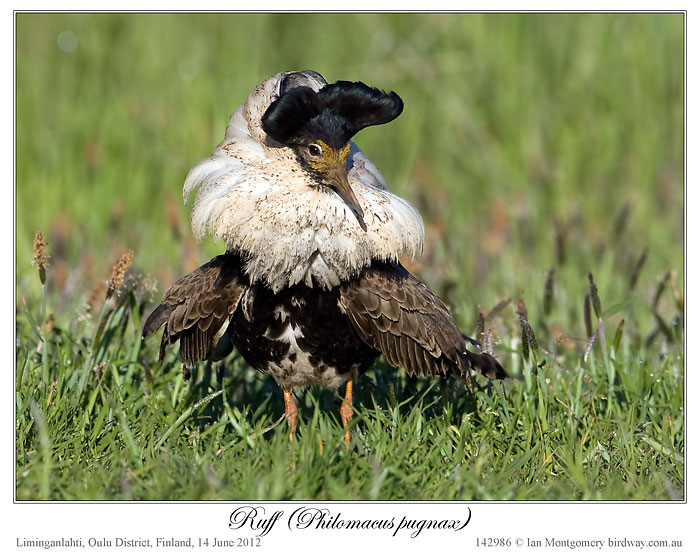
This week we have nothing short of a fashion parade, male Ruffs at a communal display ground or lek in eastern Finland. Finland is my second stop-over on the way to Ireland to visit my family and I am spending a week in the northern part of the country in search of some unusual northern European birds. I spent a couple of nights in Oulo on the west coast, a 1 hour flight north of Helsinki and then drove north west to Kuusamo near the Russian border where I am now.

In Oulu, the birding and wildlife tour company Finnature put me very early in the morning in a hide that they had set up near the lek. I settled down to watch a rather unpromising-looking piece of raised ground in a meadow, having been assured that, though it was late in the season, a couple of birds had been seen at the lek on the previous morning.

Ruff (Philomachus pugnax) by Ian 2

Ruff (Philomachus pugnax) by Ian 2

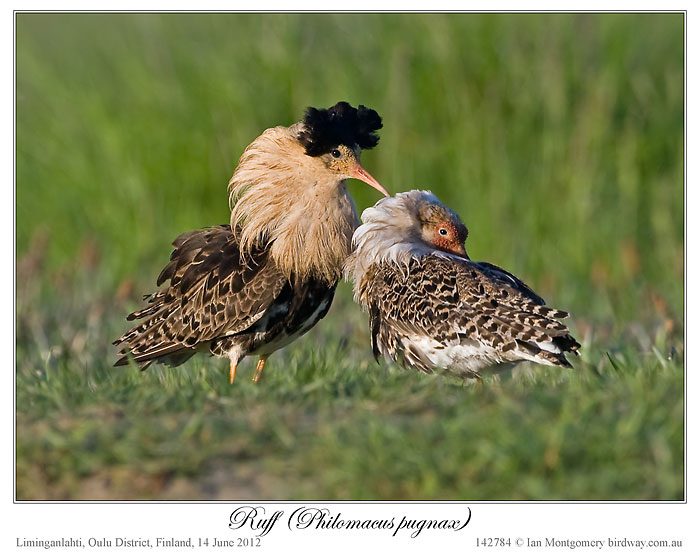
After about half an hour and shortly before 4:00am the black-ruffed bird in the second photo arrived but flew off when I moved the camera. Happily, it soon returned and this time the second white-ruffed bird arrived too and the pair started their extraordinary display, spreading their ruffs and wings apparently to make themselves appear as intimidating as possible. Sometimes, they jumped vertically in the air and at other times they crouched low on the ground in submissive looking postures.

Ruff (Philomachus pugnax) by Ian 3

Ruff (Philomachus pugnax) by Ian 3

Although the birds often came into close physical contact, there was no actual fighting and no physical damage. These black- and white-ruffed birds were the main performers during the 4 hours that I remained in the hide, but other birds joined in and at one stage there were about 10 birds on the lek. The colours of the ruffs and the erectile feathers on the head were varied. Here is a buff and black one with the white bird.

Ruff (Philomachus pugnax) by Ian 4

Ruff (Philomachus pugnax) by Ian 4

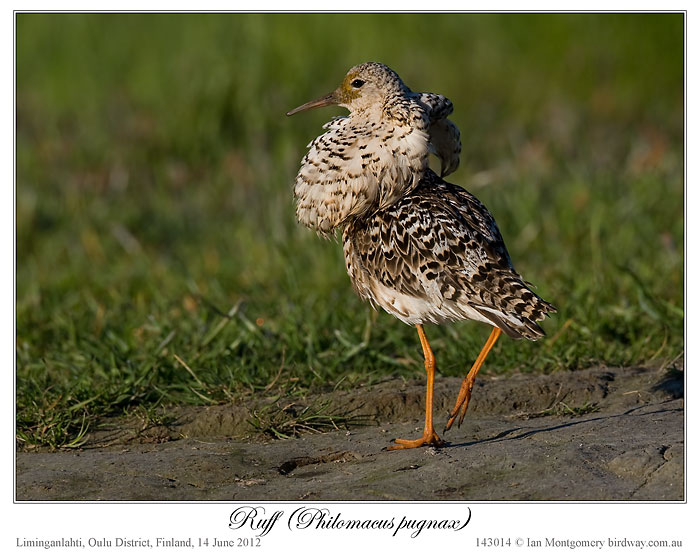
The colour of the bare wattled skin on the face varied too, being sometimes yellow and sometimes red, though it was my impression that this colour wan’t permanent and the red flush was associated with more intense display. This non-displaying one with a chestnut cap, piebald ruff has yellow facial skin.

Ruff (Philomachus pugnax) by Ian 5

Ruff (Philomachus pugnax) by Ian 5

This one is mainly chestnut.

Ruff (Philomachus pugnax) by Ian 6

Ruff (Philomachus pugnax) by Ian 6

While this one with an ermine ruff look suitably regal.

Ruff (Philomachus pugnax) by Ian 7

Ruff (Philomachus pugnax) by Ian 7

Ruffs are unusual among lekking birds in that the display is aimed mainly at other males to establish dominance, rather than at attracting females. Females may mate with multiple males producing young with different fathers and homosexual mating also occurs. The different ruff colours are apparently significant and white-ruffed males are smaller and less dominant and called satellite males.

Ruff (Philomachus pugnax) by Ian 8

Ruff (Philomachus pugnax) by Ian 8

The females, called Reeves, are quite plain and look rather like other sandpipers such as Sharp-tailed and Pectoral. In non-breeding plumage, the males resemble the females but are larger and longer-necked. Ruffs breed across northern Eurasia from Scandinavia to Siberia and winter in Africa, Asia and, in small numbers, Australia. You can see a female and ruff-less male, photographed in India, here: http://www.birdway.com.au/scolopacidae/ruff/index.htm.

Who said waders are plain and boring? I had a wonderful time at this lek. The Ruffs wasn’t one of my target species in Finland but an unexpected bonus, thank you Finnature. My main target was the largest Woodpecker in Europe, the Black Woodpecker, but that’s another story.

Best wishes
Ian

**************************************************
Ian Montgomery, Birdway Pty Ltd,
454 Forestry Road, Bluewater, Qld 4818
Tel 0411 602 737 ian@birdway.com.au
Check the latest website updates:
http://www.birdway.com.au/#updates
**************************************************


Lee’s Addition:

What a group of “show offs.” I find these birds amazing. Never thought of this family as having leks like the pheasants and those in that order. Just goes to show you that the birds are doing what they are suppose to and that is reproducing. What a show for the females to get to watch.

Bring out with you every living thing of all flesh that is with you: birds and cattle and every creeping thing that creeps on the earth, so that they may abound on the earth, and be fruitful and multiply on the earth.”
(Genesis 8:17 NKJV)

The Ruff is in the Scolopacidae – Sandpipers, Snipes Family in the Charadriiformes Order.

*

Ian’s Bird of the Week – Chinese Pond Heron

Chinese Pond Heron (Ardeola bacchus) by Ian 1

Chinese Pond Heron (Ardeola bacchus) by Ian 1

Ian’s Bird of the Week – Chinese Pond Heron ~ by Ian Montgomery

Newsletter ~ 6-11-12

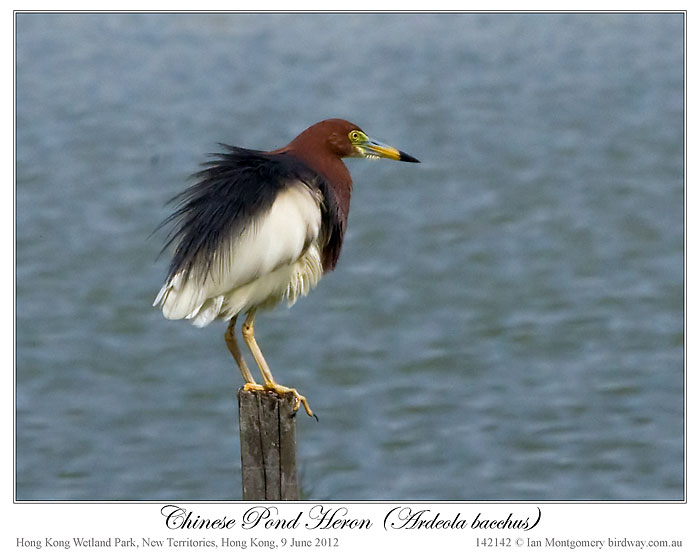
I’m stopping over for a few days in Hong Kong. It’s not the best time of the year for birding here – the northern spring and autumn/fall are good for migrants and the northern winter is good for waders and waterbirds – but we did go out to the Hong Kong Wetland Park near Mai Po reserve in the New Territories on Saturday. One of the species I was keen to see was the Chinese Pond Heron and this one in breeding plumage landed on a post near the hide/blind we were in.

This was of interest to me as it’s on the Australian list as a rare vagrant and I’d seen only non-breeding birds before (in Malaysia). The non-breeding plumage is streaky brown and white and not very distinguished, but when breeding the birds acquire striking black, white and chestnut plumage with a multi-coloured bill. This bird fluffed out its feathers, preened itself a bit and settled down for a few seconds, second photo.

Chinese Pond Heron (Ardeola bacchus) by Ian 2

Chinese Pond Heron (Ardeola bacchus) by Ian 2

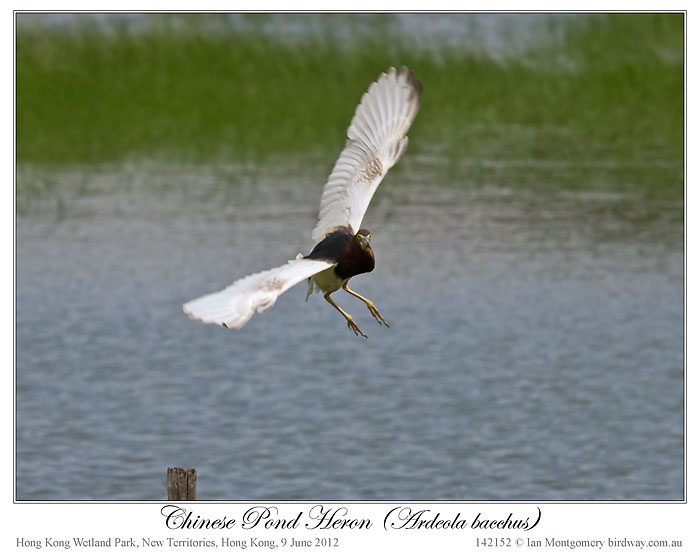
These are stocky, mid-sized (47cm/19in in length) herons that feed on fish and invertebrates. Their breeding range includes China and northern Japan. In the northern winter some migrate south to Malaysia and Indonesia, including Java, and sometimes they overshoot and end up in the Australian territories of Christmas and Cocos (Keeling) Islands and on the Australian mainland. This particular one hung around for thirty seconds and then took off, third photo, showing how high they can jump when taking off – they need to be able to do this to take off from reed beds.

Chinese Pond Heron (Ardeola bacchus) by Ian 3

Chinese Pond Heron (Ardeola bacchus) by Ian 3

In flight, fourth photo, the bird displays the striking white wing characteristic of all six species of Pond Herons (genus Ardeola). These are mainly Asian and African species, though the Squacco Heron occurs in southern Europe. The Chinese Pond Heron is closely related to the rather similar Indian Pond Heron (this one was photographed behind the Taj Mahal.

Chinese Pond Heron (Ardeola bacchus) by Ian 4

Chinese Pond Heron (Ardeola bacchus) by Ian 4

Only 30 seconds elapsed between the first and last photos, so we were lucky to have this encounter and it was the only one we saw. The Hong Kong Government is making admirable efforts, through Mai Po Reserved and the restored Hong Kong Wetland Park, to conserve wildlife, but the area is very close to the densely populated and heavily industrialised areas of southern China and the local population of Chinese Pond Herons is suffering from the effects of water pollution on their prey (mud skippers and crustaceans).

Best wishes
Ian

**************************************************
Ian Montgomery, Birdway Pty Ltd,
454 Forestry Road, Bluewater, Qld 4818
Tel 0411 602 737 ian@birdway.com.au
Check the latest website updates:
http://www.birdway.com.au/#updates
**************************************************


Lee’s Addition:

Ian, you sure get around. What a beautiful bird all decked out to “woo” its mate.

Ian has a photo of Chinese Pond Herons on his Birdway website that are in normal plumage. Not as impressive as the one above, but more normal. These herons belong to the Ardeidae – Herons and Allies Family. See a list and photos of the whole 72 species of  Herons, Bitterns and Egrets.

The stork, the heron of any variety, the hoopoe, … (Deuteronomy 14:18 AMP)

See all of Ian’s Birds of the Week articles.

*

Ian’s Bird of the Week – Royal Albatross

Southern Royal Albatross (Diomedea epomophora) by Ian 1

Southern Royal Albatross (Diomedea epomophora) by Ian 1

Ian’s Bird of the Week – Royal Albatross ~ by Ian Montgomery

Newsletter ~ 6-3-12

It seems only fitting to celebrate the Diamond Jubilee of Queen Elizabeth with something appropriate, so here is the Royal Albatross, or Royal Albatrosses if you accept, as most now do, the split into Northern and Southern species. Apart from just the Royal title, these birds are also very long lived (up to 60 years) and travel huge distances, routinely circumnavigating Antarctica. It has been estimated that a 50 year old Albatross has travelled 2.8 million miles which compares quite well with the Queen’s 261 official overseas visits and 96 state visits to 116 countries.

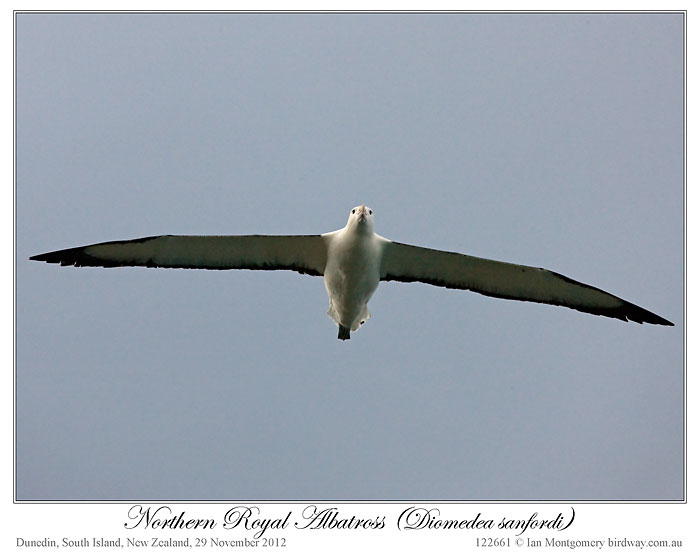
On the Sub-Antarctic trip last November, Royal Albatrosses, mainly Southern like the one in the first photo, were regular and very welcome companions in the Southern Ocean. It was always a thrill to see these huge birds completely at home in the wildest weather that the Ocean could throw at them and soaring apparently effortlessly in gale-force winds. If you look carefully at the first photo, you can see the dark (bluish) line along the upper mandible which distinguishes it from the similar Wandering Albatrosses. The other feature of note is the white leading edge to the dorsal surface of the wing. As Southern Royal Albatrosses age, the amount of leading white increases and this distinguishes it from both the Wandering Albatrosses, where the amount of white increases along the centre of the wing, and the Northern Royal Albatross where the wings remain black, as shown in the second photo.

Northern Royal Albatross (Diomedea sanfordi) by Ian2

Northern Royal Albatross (Diomedea sanfordi) by Ian 2

With a little practice, it wasn’t too difficult to distinguish between Northern and Southern birds. What helped was the fact that Royal Albatrosses do not have a confusing array of juvenile plumages, unlike their cousins the Wandering Albatrosses. The juveniles have black tips to the tale and blackish scalloping on the back (the mantle) between the wings but are otherwise similar to the adults.

Southern Royal Albatross (Diomedea epomophora) by Ian 3

Southern Royal Albatross (Diomedea epomophora) by Ian 3

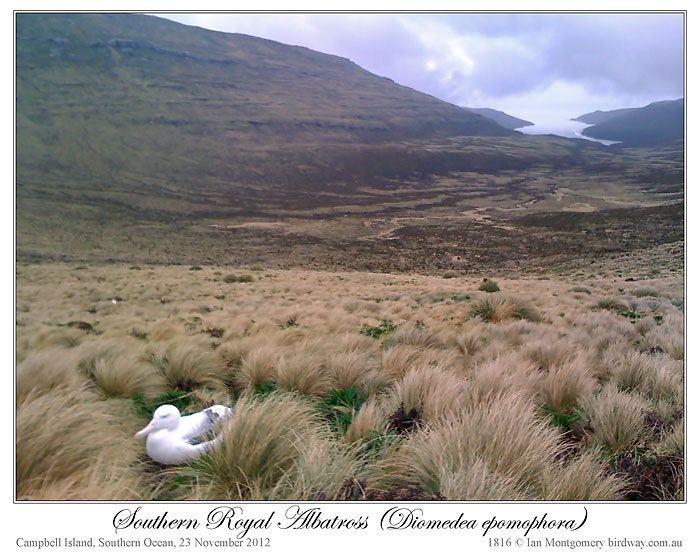
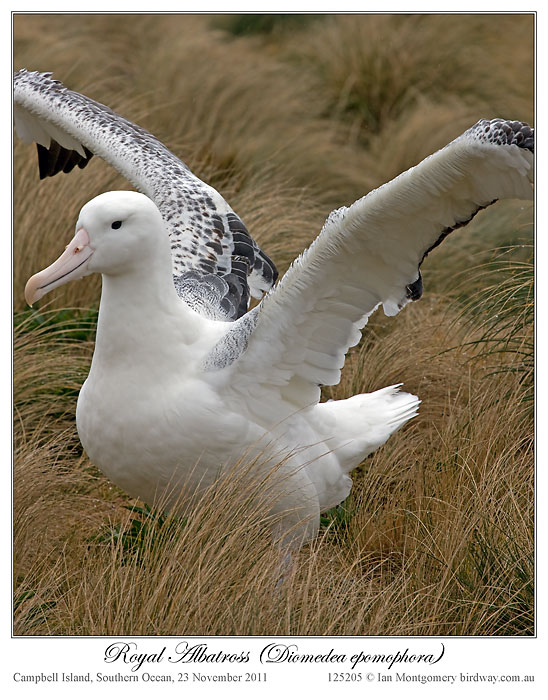
On Campbell Island, we had the opportunity to hike up path to a Southern Royal Albatross colony on a bleak, tussocky moorland. As you can see in the the third photo, things were fairly quiet when we got up there in the morning. They got busier in the afternoon when more birds arrived and some people saw greeting ceremonies, but by then, rather wet and cold, I had returned to the ship for a comforting coffee. There were strict rules about where we could leave the designated path and how close we could approach wildlife, but the albatross in the fourth photo stretching its wings flouted the rules and wandered, or blundered – they’re ungainly on land – right past me.

Southern Royal Albatross (Diomedea epomophora) by Ian 4

Southern Royal Albatross (Diomedea epomophora) by Ian 4

Albatrosses have deceptively gull-like proportions so it is a shock to realise, up-close, just how huge they are. The size record goes to the exulans race/species of the Wandering Albatross, but the Royals are not far behind and an apt comparison is with swans rather than other seabirds, ignoring length where swans have an unfair neck advantage. Southern Royal Albatrosses weight between 6.5 and 10.3kg/14.3 and 22.7lb while the heaviest flying bird, the Mute Swan, ranges between 9kg and 12kg/20 and 33lb. However Royal Albatrosses have a maximum wingspan of up to 3.5m/138in while Mute Swans range up to a mere 2.4m/94in. Just enormous in other words. The contrasting delicacy of the lacy pattern on the back is striking, and the fifth photo shows the tubular nostrils and the dark line along the mandible.

Southern Royal Albatross (Diomedea epomophora) by Ian 5

Southern Royal Albatross (Diomedea epomophora) by Ian 5

Happily, you don’t have to go Campbell Island to see these wonderful birds. Taiaroa Head, a mere 30km from the centre of Dunedin on the South Island of New Zealand, has the only mainland colony of albatrosses in the world. These are Northern Royal Albatrosses and, although I got there too late in the day to gain entry to the Royal Albatross Centre – I gave the local Yellow-eyed Penguins a higher priority – the one in the last photo flew right over me as I stood in the car park.

Northern Royal Albatross (Diomedea sanfordi) by Ian 6

Northern Royal Albatross (Diomedea sanfordi) by Ian 6

Enjoy the Jubilee!

Ian

**************************************************
Ian Montgomery, Birdway Pty Ltd,
454 Forestry Road, Bluewater, Qld 4818
Tel 0411 602 737 ian@birdway.com.au
Check the latest website updates:
http://www.birdway.com.au/#updates
**************************************************


Lee’s Addition:

Wow! Did you read the wingspan on those Albatrosses? 138 inches is 11 1/2 feet. That is amazing! I still just sit back in awe when I hear about these wonderfully created birds.

Check out Ian’s Albatrosses on his site and then check the whole family – Diomedeidae – Albatrosses

Keep me as the apple of Your eye; Hide me under the shadow of Your wings, (Psalms 17:8 NKJV)

Because You have been my help, Therefore in the shadow of Your wings I will rejoice. (Psalms 63:7 NKJV)

*

Ian’s Bird of the Week – Grey Goshawk

Grey Goshawk ( novaehollandiae) by Ian 1

Ian’s Bird of the Week – Grey Goshawk ~ by Ian Montgomery

Newsletter ~ 5-24-12

*
Here is an uncommon and beautiful raptor, the Grey or Variable Goshawk. It is usually called the Grey Goshawk in Australia but the moniker Variable is more accurate as it occurs in both grey and white morphs. The first photo shows a white morph bird perched in a dead tree near mangroves at Bushland Beach near Townsville, photographed in 2002.

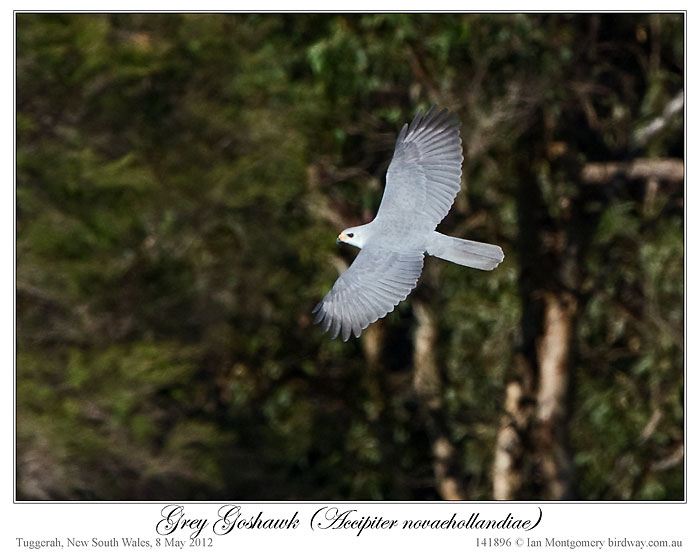
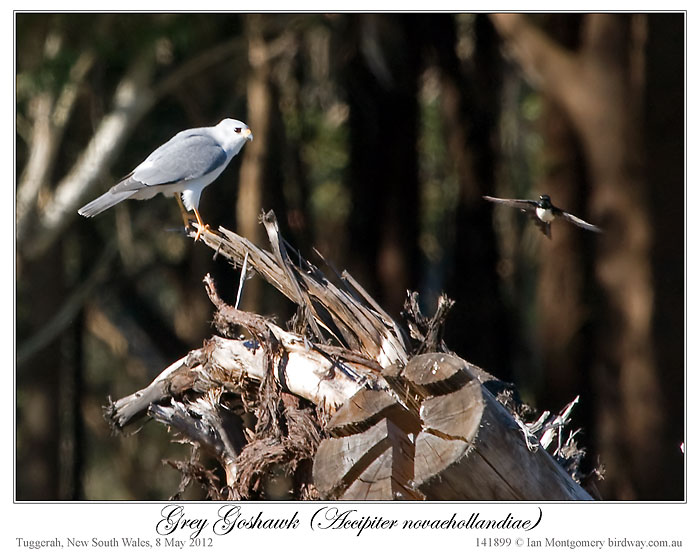
It is the only completely white raptor worldwide, though white morph birds may show some grey on the tail – as this one does – and on the head. These are large hawks, with the females being 50-55cm/20-22in in length with a wingspan to 1.1m/43in. The smaller males are 38-42/15-16.5in. By way of comparison – the choice is deliberate – the Sulphur-crested Cockatoo is 44-51cm with a comparable wingspan of about 1m. Despite their size, they are difficult to see (and to photograph) as they inhabit mainly dense forest, or forest edges and are shy, so it would be another ten years before I got an even vaguely respectable photo of a grey morph bird, second photo.

Grey Goshawk ( novaehollandiae) by Ian 2

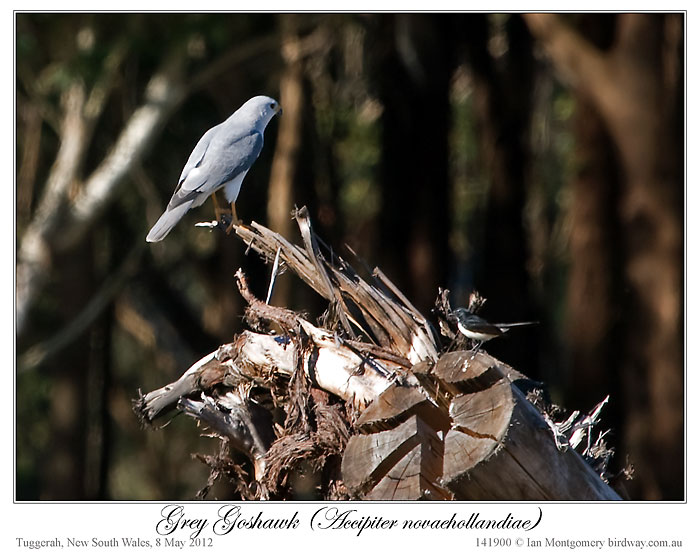
Here you can see how broad and rounded the wings are. This shape is ideal for short glides and rapid braking and is an adaptation for the preferred hunting strategy of this species, called ‘still hunting’ – perching on a well-hidden perch and making short, devastating swoops on unsuspecting prey feeding on the ground or in trees. Prey includes birds, mammals and reptiles and a female can take prey up to the size of herons, rabbits and possums. Goshawks are subject to mobbing by small birds, and the when the individual in the second photo landed on a tree stump several seconds later (12 to be exact) it immediately attracted the attention of a Willie-wagtail visible in flight near the goshawk in the third photo.

Grey Goshawk ( novaehollandiae) by Ian 3

You might recall that pied plumage is often the hallmark of aggressiveness – the reverse of camouflage – and this Willie-wagtail actually landed on the tree stump as in the third photo. The Goshawk gives the appearance of having lost interest in the Willie-wagtail, but I suspect that it was more concerned with preparing to take flight as I approached it trying to get a closer shot, which it did very shortly afterwards.

Grey Goshawk ( novaehollandiae) by Ian 4

I mentioned Sulphur-crested Cockatoos before as it has been suggested that the white morph has evolved to mimic Cockatoos to escape detection, but this theory has never been proven. It is thought that genetically the white morph is simply a single recessive gene, like Mendel’s sweet peas, as white-white mating produces white offspring, while white-grey and grey-grey can produce either. There is supposed to be geographical variation in the proportion of the morphs, with the white one being predominant in northern Australia, Tasmania and western Victoria and the grey morph being predominant in eastern Australia. Despite the specific name novaehollandiae, it isn’t an Australian endemic and also occurs in New Guinea and neighbouring islands, though the island races are sometimes treated as separate species.

Best wishes

Ian

**************************************************
Ian Montgomery, Birdway Pty Ltd,
454 Forestry Road, Bluewater, Qld 4818
Tel 0411 602 737 ian@birdway.com.au
Check the latest website updates:
http://www.birdway.com.au/#updates
**************************************************

Lee’s Addition:

Wow! Another beautiful bird! I really enjoy Ian’s Newsletters. They tell about birds that many of us never see or even hear about. Then again, we tell about American birds and to others, those are probably just as fantastic to hear about. Ian has managed to travel around the world in search of birds to photograph. Check out his website, Birdway, to enjoy his photos.

The Goshawk is one of the Birds of the Bible and was not to be eaten, but this one is such a beauty, I wouldn’t dream of eating it or hurting it anyway.

the ostrich, the short-eared owl, the sea gull, and the hawk after its kind; (Leviticus 11:16 NKJV)

The Goshawks are part of the Accipitridae – Hawks & Allies Family. Check out Ian’s 47 members of the Hawks, Eagles & Allies and then the whole list of 255 species in the family listed here.

*

Ian’s Bird of the Week – Black-winged Petrel

Black-winged Petrel (Pterodroma nigripennis) by Ian Montgomery 1

Black-winged Petrel (Pterodroma nigripennis) by Ian Montgomery 1

Ian’s Bird of the Week – Black-winged Petrel ~ by Ian Montgomery

Newsletter – 5/14/12

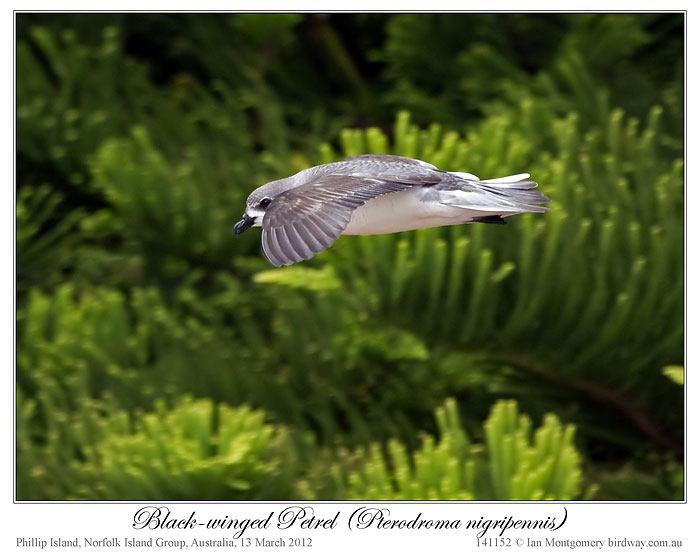
Three weeks ago we had the Cape Petrel. Here is the Black-winged Petrel, another species, like the White Tern and Grey Ternlet, that I had seen twenty years ago on Lord Howe Island and was keen to photograph on Norfolk Island. With a length of 28-30cm/11-12in and a wingspan of 67cm/26in, this is quite a small species with elegant black, grey and white markings and a stubby, hooked bill, visible in the first photo.

It nests on both the main island and Phillip Island – where it was quite abundant – and was easy to find as, unlike most petrels and shearwaters, it is active around the breeding colonies in daylight. Most petrels and shearwaters come ashore under cover of darkness to reduce the risk of avian predators such as raptors and gulls, but the Black-winged has historically nested on predator-free islands. ‘Historically’ here means before human settlers introduced predators such as feral cats.

Black-winged Petrel (Pterodroma nigripennis) by Ian Montgomery 2

Black-winged Petrel (Pterodroma nigripennis) by Ian Montgomery 2

Black-winged Petrels are accomplished fliers and spent much time in aerial acrobatics around and over cliffs. The generic name Pterodroma means ‘winged runner’ and refers to their aerial agility. The one in the second photo is coming in to land near its nesting burrow and passing some Norfolk Island Pines. All petrels and shearwater, except the Giant Petrels, have very weak legs and once on the ground are barely mobile using their wings to drag themselves along on their bellies.

Black-winged Petrel (Pterodroma nigripennis) by Ian Montgomery 3

Black-winged Petrel (Pterodroma nigripennis) by Ian Montgomery 3

Like many island birds, they seemed unafraid and didn’t appear agitated when approached closely to have their photos taken. The fourth photo shows the tubular nostrils characteristic of this family of birds and their close relatives the albatrosses and storm-petrels. All these ‘tube-nosed’ birds are thought to have a strong sense of smell – very unusual for birds – that helps them find both marine prey and their nesting burrows on dark nights, and the birds themselves apparently have a strong musty odour during the breeding season.

Black-winged Petrel (Pterodroma nigripennis) by Ian Montgomery 4

Black-winged Petrel (Pterodroma nigripennis) by Ian Montgomery 4

The hooked bill helps the birds grasp slippery prey – mainly squid and small fish – and the bills have sharp cutting edges. The Black-winged is one of about 36 global species of Pterodroma petrels collectively and, I think unfairly, called Gadfly Petrels, in reference to their erratic flight. As I’m sure you know, Gadflies are nasty blood-sucking insects such as Horse and March Flies, and there must be other more congenial erratic fliers after which they could been named. Anyway, Gadfly Petrels feed on the wing by snatching prey from the surface of the water and rarely alight on the water or dive.

The Black-winged Petrel breeds on islands in the south Pacific including Lord Howe, Norfolk, various islands around New Zealand and on several in French Polynesia. Helped by protection and the removal of predators such as feral cats, its population is increasing and it has bred on Lord Howe only since the 1960s. There are unproven recent reports of it breeding on some islands on the east coast of Australia, where it is generally rare. Outside the breeding season, it is highly pelagic and ranges widely over the Pacific as far as southern Japan and Mexico.

Best wishes
Ian
**************************************************

Ian Montgomery, Birdway Pty Ltd,
454 Forestry Road, Bluewater, Qld 4818
Tel 0411 602 737 ian@birdway.com.au
Check the latest website updates:
http://www.birdway.com.au/#updates
**************************************************


Lee’s Addition:

Thanks, Ian, for another interesting Newsletter. Trust you all are enjoying Ian’s Bird of the Week newsletters as well as I do. They are so informative and he introduces us to such a variety of birds. His photograph is outstanding.

The Black-winged Petrel is a member of the Procellariidae – Petrels, Shearwaters Family which has 87 species. They are in the Procellariiformes Order. The order has 3 other families, the Storm Petrels, Diving Petrels and the Albatrosses.

And God said, “…and let birds fly above the earth across the expanse of the heavens.” (Genesis 1:20 ESV)

See Bird of the Week for more articles by Ian.

*

Ian’s Bird of the Week – (Norfolk Island) Golden Whistler

Ian’s Bird of the Week – (Norfolk Island) Golden Whistler ~ by Ian Montgomery

Newsletter: 5-4-12

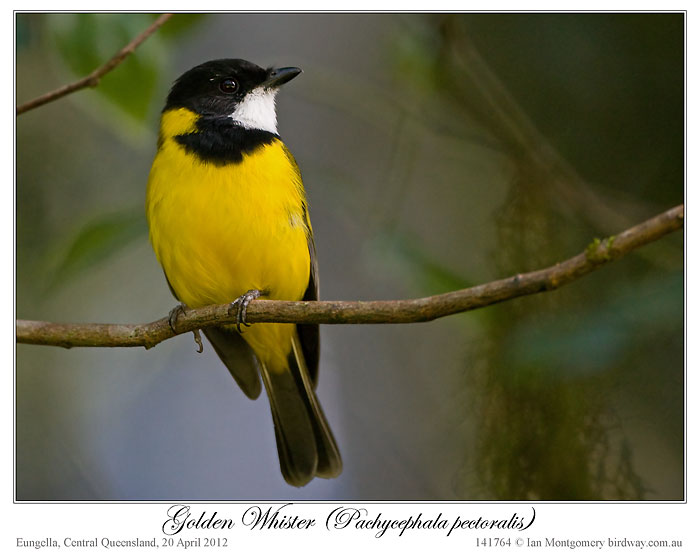
My apologies for a belated bird of the week. When I was in Eungella recently chasing the so-named Honeyeater, I encountered a very obliging male Golden Whistler, below, so I’ve chosen it to introduce this week’s subject.

Australian Golden Whistler (Pachycephala pectoralis) by Ian

It’s one of the most gorgeous of the woodland birds of eastern and southern Australia and one of those unusual birds that, unlike Rainbow Lorikeets for example, both look and sound strikingly beautiful. It featured as bird of the week in January 2005, but I don’t suppose you’ll mind me repeating it and I want to share with you the interestingly different Norfolk Island equivalent.

Australian Golden Whistler (Norfolk Island) (Pachycephala pectoralis xanthoprocta) by Ian

Australian Golden Whistler (Norfolk Island) (Pachycephala pectoralis xanthoprocta) by Ian

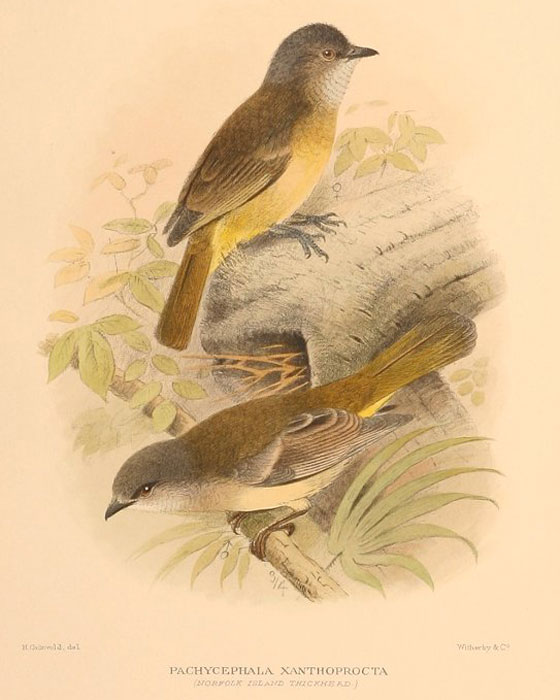
The bird in the second photo, one of a pair we encountered, is, or could be, an adult male Norfolk Island Golden Whistler. I say ‘could be’ because there, the adult males do not develop the striking yellow and black plumage of the mainland races and remain ‘hen-plumaged’, to quote Schodde and Mason. This was recognised early on in the settlement of the island and it was original described as a separate species, the Norfolk Island Thickhead (Pachycephala means ‘thick-head’) P. xanthoprocta, where xanthoprocta refers to the yellow vent. Here is a painting of a pair by John Gould.

Australian Golden Whistler (Norfolk Island) (Pachycephala pectoralis xanthoprocta) by Ian Drawing

Australian Golden Whistler (Norfolk Island) (Pachycephala pectoralis xanthoprocta) by Ian Drawing

He has labelled the bird in the foreground as a male, and the one in the background as a female. There are subtle differences in plumage, with the female being more lemon-yellow underneath and the male being more buffish yellow and. having darker dark lores. I haven’t been able to find whether these differences are consistent, but it seemed to me that the bird in photo above (141464) looks more like the Gouldian male than its partner below (141440).

 Australian Golden Whistler (Norfolk Island) (Pachycephala pectoralis xanthoprocta) by Ian

Australian Golden Whistler (Norfolk Island) (Pachycephala pectoralis xanthoprocta) by Ian

Mainland juvenile Golden Whistlers have rusty margins on the wing feathers and this is the case with the Norfolk Island birds, as shown in the next photo taken on a different occasion when we were hanging around waiting for the Norfolk Island Parakeets to show up.

Australian Golden Whistler (Norfolk Island) (Pachycephala pectoralis xanthoprocta) Juv by Ian

Australian Golden Whistler (Norfolk Island) (Pachycephala pectoralis xanthoprocta) Juv by Ian

To this day, the taxonomic status of the Golden Whistler ‘complex’ remains unresolved. There are different races on the mainland and in neighbouring locations such as New Guinea, New Britain and Fiji. The mangrove-inhabiting Golden Whistler of northern and western Australia has been elevated to specific status but the others have remained in the too-hard basket and are still lumped together as a single species. It seems to me unusual for avian taxonomists to be stumped by a problem like this, but maybe they’ve met their match.

Best wishes

Ian

**************************************************
Ian Montgomery, Birdway Pty Ltd,
454 Forestry Road, Bluewater, Qld 4818
Tel 0411 602 737 ian@birdway.com.au
Check the latest website updates:
http://www.birdway.com.au/#updates
**************************************************
*


Lee’s Addition:

Very interesting and a beautiful bird. I couldn’t resist finding out what this “whistler” sounds like. It is very pretty sounding. Take a listen.

Sound of Golden Whistler

In that day the LORD will whistle for the fly that is at the end of the streams of Egypt, and for the bee that is in the land of Assyria. (Isaiah 7:18 ESV)

The Whistlers are found in the Pachycephalidae – Whistlers and Allies. There are 58 members of the family. This Australian Golden Whistler (Pachycephala pectoralis xanthoprocta) is one of those subspecies; there are at least 7 subspecies. The “Norfolks” are found on the Norfolk Island, as Ian mentioned.

The Norfolk Golden Whistler (P. p. xanthoprocta) declined for many years due to habitat loss and fragmentation and possible due to introduced predators such as the Black Rat. Most of the population is now restricted to the Norfolk Island National Park. This has resulted in it being listed as vulnerable by the Australian Government.

Links:

Check out Ian’s other Whistlers

Australian Golden Whistler – Wikipedia

Pachycephalidae – Whistlers and Allies

*

Ian’s Bird of the Week – Eungella Honeyeater

Ian’s Bird of the Week – Eungella Honeyeater ~ by Ian Montgomery

Newsletter – 4/22/12

Well, team, many thanks, your moral and spiritual support have done it again: here is the Eungella Honeyeater, photographed last Friday after some diligent searching. The field guides say: ‘noisy, wary, elusive’ and that I would agree is a good description. I heard several at the first location (Chelmans Road, Upper Dalrymple) but got only a brief glimpse of one in the rather dense rainforest regrowth. The second location, Digging’s Road near Eungella, proved more productive and, as I walked back to the car, I eventually encountered a flock of ten or so crossing the road and got photos of a couple of them.

Were it not for its distinctive song, rather scratchy like a very loud gerygone I thought, it would be easy to overlook, given its rainforest habitat, and, dare one say, rather drab colours even if tastefully highlighted by blue eyes.

And overlooked it was until 1976. Or more accurately, any earlier records, such as one collected in 1959, of this bird from the little studied Eungella/Clarke Range area were mistakenly assumed to be the closely related wet-tropics endemic, the Bridled Honeyeater, see the third photo.
The Bridled Honeyeater is much larger – 20-22cm/8-8.7in versus 16-18cm/6.3-7.1in – has a yellow base to the bill and rather different head markings. Their songs are quite different, sufficiently so for someone rather deaf like me to distinguish them easily. Early field guides, such as the 1974 Slater’s, shows the range of the Bridled Honeyeater extending the 300km or so from the wet tropics down to the Clarke Range west of Mackay.
In 1975, during a survey by the Australian and Queensland Museums, another specimen was collected and labelled as a Bridled Honeyeater. The following year, Wayne Longmore was working on the Honeyeater collection at the Australian Museum and realised that not only was this bird not a Bridled Honeyeater – based on the colour of the bill – but that it didn’t correspond to any known species. He organised further field trips to the Clarke Range in 1978 and 1980 in search of the mystery bird and found that the species was relatively common in a restricted area of upland rainforest. It was described in 1983 by him and Walter Boles and named Meliphaga hindwoodi (now Lichenstomus hindwoodi) in honour of  Keith Hindwood, ornithologist and Wayne’s mentor. You can read the full story here. The fourth image shows the records from the BirdLife Australia Atlas Project.
So you don’t have to go to the wilds of Irian Jaya to discover new species of birds! What would you like next week?
Best wishes
Ian
**************************************************
Ian Montgomery, Birdway Pty Ltd,
454 Forestry Road, Bluewater, Qld 4818
Tel 0411 602 737 ian@birdway.com.au
Check the latest website updates:
http://www.birdway.com.au/#updates
**************************************************

Lee’s Addition:

I decided to produce this addition of Ian’s Bird of the Week in the exact format that I receive it. I am also happy that our collective prayers were answered for Ian’s latest adventure. The two Honeyeaters do look similar, but there is a difference. Thanks again, Ian, for letting us share in your birdwatching trips.

Then you will call upon Me and go and pray to Me, and I will listen to you. And you will seek Me and find Me, when you search for Me with all your heart. (Jeremiah 29:12-13 NKJV)

See Ian’s other Birds of the Week

*