Ian’s Bird of the Week – Red-crowned Parakeet

Red-crowned Parakeet (Cyanoramphus novaezelandiae) by Ian 1

Red-crowned Parakeet (Cyanoramphus novaezelandiae) by Ian 1

Ian’s Bird of the Week – Red-crowned Parakeet ~ by Ian Montgomery

Newsletter ~ 12/20/11

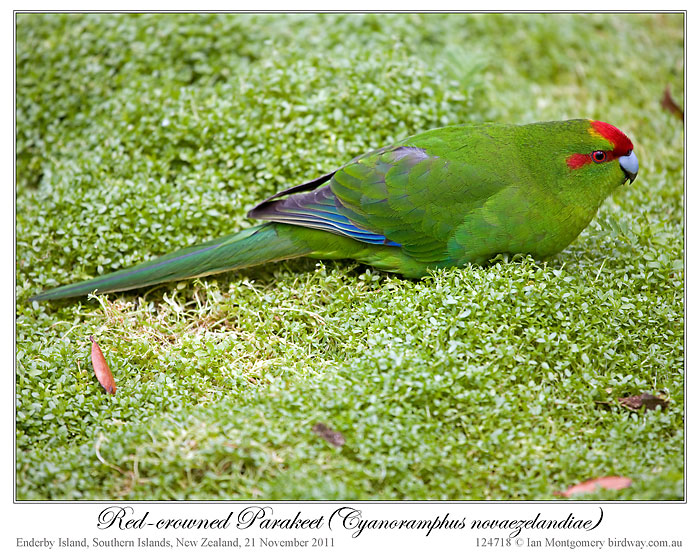
Christmas is nearly on us, so a bird in the Christmas colours of red and green seems appropriate. Here is the Red-crowned Parakeet, one of the relatively few non-seabirds encountered on the trip to the Sub-Antarctic Islands.

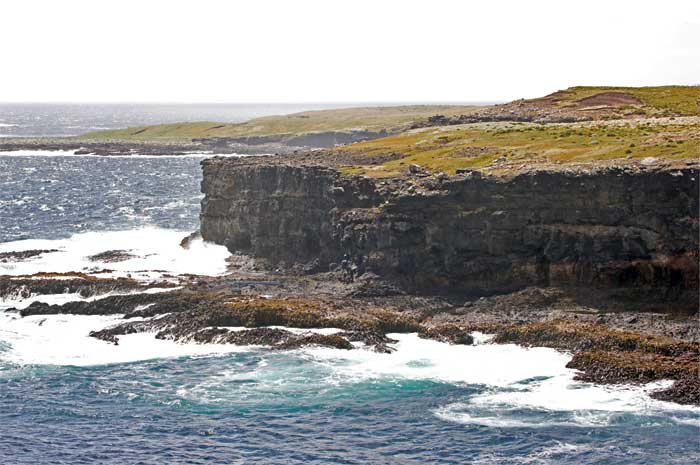
We found these birds at several locations on Enderby Island, one of the smaller of the Auckland Islands and the first site at which we actually landed after leaving Dunedin. Enderby Island is mainly basalt with rocky cliffs, as in the second photo, and it reminded me very much of St Paul Island in the Bering Sea that I visited three years ago. On both the vegetation is mainly tundra, though unlike the treeless St Paul Enderby has patches of very gnarled dwarf rata forest.
Red-crowned Parakeet (Cyanoramphus novaezelandiae) by Ian 2

Enderby Island by Ian 2

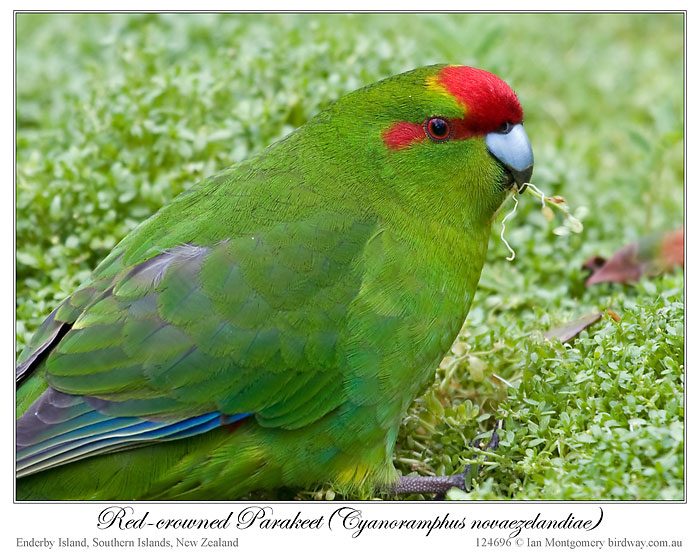
The Parakeets feed mainly on the ground and we found them both on the tundra and in the forest. They are herbivorous, and the bird in the first photo is feeding on the dense understory of the forest – the third photo shows the same bird in close-up eating very fine shoots and leaves.
Red-crowned Parakeet (Cyanoramphus novaezelandiae) by Ian 3

Red-crowned Parakeet (Cyanoramphus novaezelandiae) by Ian 3

The fourth photo shows a different bird feeding on the flower-heads of small herbs growing on the tundra near the beach where we landed.
Red-crowned Parakeet (Cyanoramphus novaezelandiae) by Ian 4

Red-crowned Parakeet (Cyanoramphus novaezelandiae) by Ian 4

I’m used to seeing parrots in more tropical locations, so it was a startling to see these small (25-28cm/10-11in long) elegant parrots in such a cold and rugged environment. They are obvious tough little birds, though their confiding habits, ground-feeding life-style and choice of low nesting sites makes them very vulnerable to introduced predators such as feral cats,rats and, in New Zealand, stoats. The Red-crowned Parakeet used to widespread throughout New Zealand but is now rare or extinct on the two main islands, though it survives well on Stewart and other offshore islands. As you can judge from the photos, the birds are very approachable and took little notice of us.
On the website, there are now nine species of penguins http://www.birdway.com.au/spheniscidae/index.htm and thirteen species of albatrosses http://www.birdway.com.au/diomedeidae/index.htm . The additional species of albatrosses include ones that were treated as sub-species by Christidis and Boles, 2008, but are now recognised as full species by Birdlife International and the IOC.
I wish you a safe and happy Christmas and best wishes
Ian


Ian Montgomery, Birdway Pty Ltd,
454 Forestry Road, Bluewater, Qld 4818
Phone: 0411 602 737 +61-411 602 737
Preferred Email: ian@birdway.com.au
Website: http://birdway.com.au


Lee’s Addition:

Thanks again, Ian, for sharing your great adventures. This parakeet, indeed, looks decked out for the colors of Christmas. Would be pretty to have a flock of them perching on a Christmas Tree. Merry Christmas to you, Ian, and our readers.

Then the angel said to them, “Do not be afraid, for behold, I bring you good tidings of great joy which will be to all people. For there is born to you this day in the city of David a Savior, who is Christ the Lord. (Luke 2:10-11 NKJV)

Check out Ian’s other Parrots and Parakeets at his Parrots & Allies Psittacidae Family page. Our Birds of the World Psittacidae Family page has more Parrot and Parakeet photos.

Ian’s Other Birds of the Week

*

Ian’s Bird of the Week – Royal Penguin

Royal Penguin (Eudyptes schlegeli) by Ian 1

Royal Penguin (Eudyptes schlegeli) by Ian 1

Ian’s Bird of the Week – Royal Penguin ~ by Ian Montgomery

Newsletter – 12/10/11

I think that this should really be the Bird of the Trip, if not the Year. The birders’ table at dinner on the last night on board had a vote for Bird of the Trip, and it was a close contest between the Light-mantled Sooty Albatross, featured last week, and my choice, the Royal Penguin. As I mentioned last week, Macquarie Island was for most of us the highlight of the trip, and the day spent on familiar terms with the penguins was memorably enchanting.

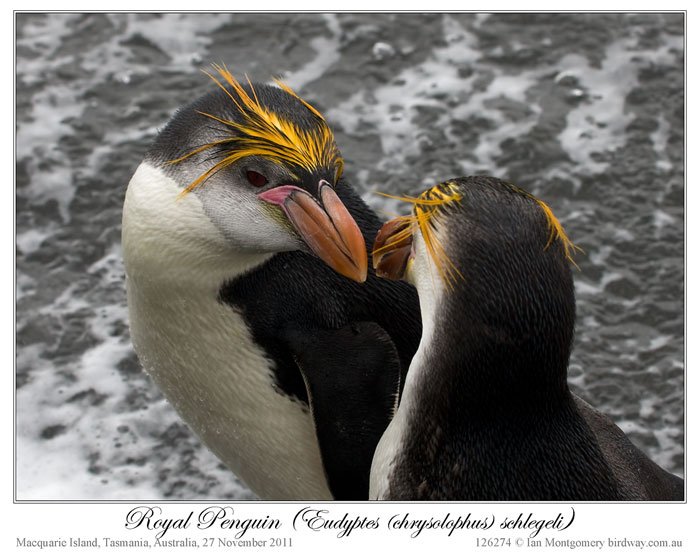
Four species breed there, the commonest being the Royal and King Penguins. The King Penguins are beautiful, very smart, elegant and colourful, but the smaller Royals (up to 75cm/30in in length) won hands down in terms of personality.
Royal Penguin (Eudyptes schlegeli) by Ian 2

Royal Penguin (Eudyptes schlegeli) by Ian 2

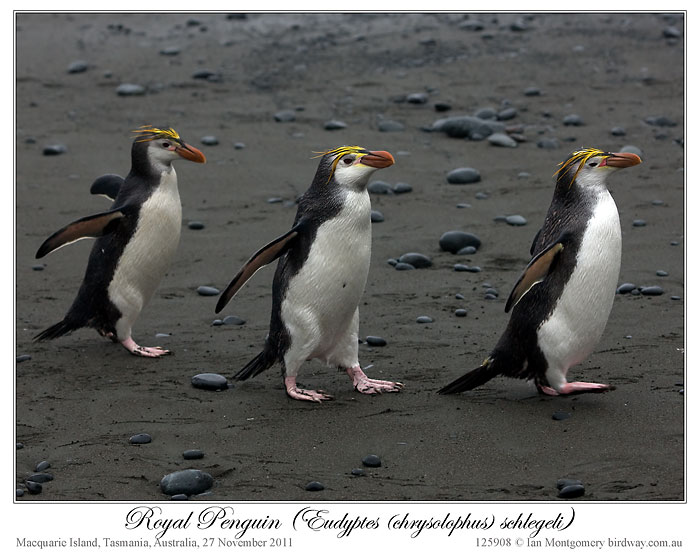
Who could fail to be endeared by the curious attention of the bird in the first photo or by the ones promenading along the beach as in the second photo or by the pair having a deep and meaningful exchange, as in the the third photo?
Royal Penguin (Eudyptes schlegeli) by Ian 3

Royal Penguin (Eudyptes schlegeli) by Ian 3

Apart from curiosity, the penguins appeared little affected by our presence. They would move out of the way if you walked towards them, but if you sat on the beach, they’d come over to check you out and nibble in an exploratory manner on clothing and cameras. The Labrador-eyed baby elephant seals would come over for a cuddle, but that’s another story.
Royal Penguin (Eudyptes schlegeli) by Ian 4

Royal Penguin (Eudyptes schlegeli) by Ian 4

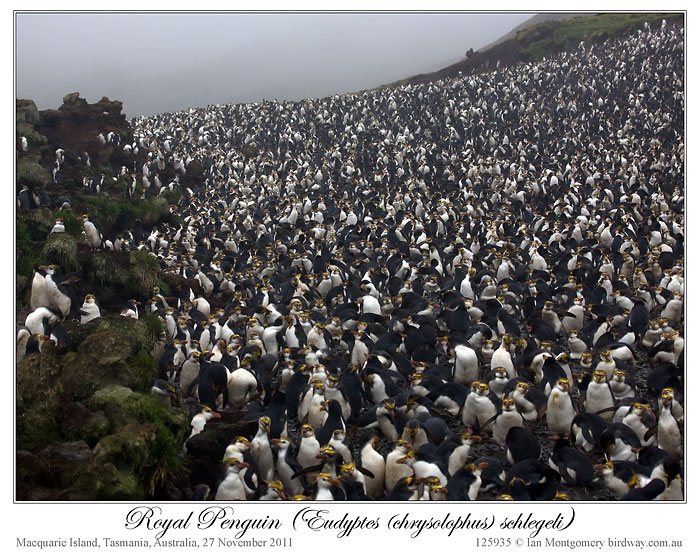
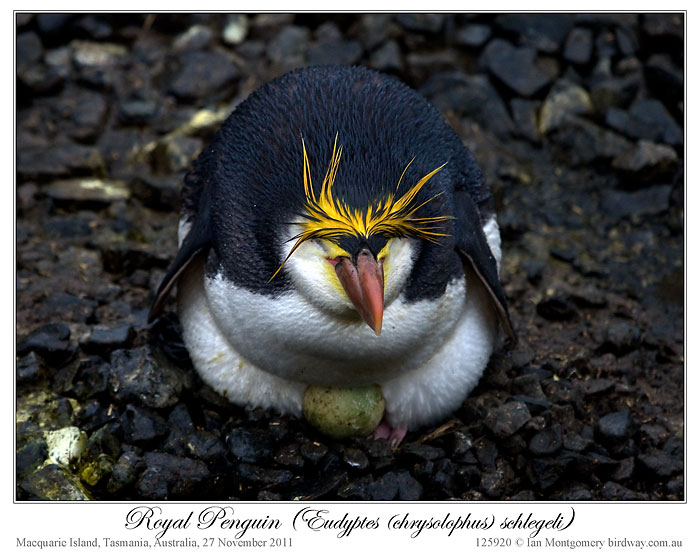
The beach was the promenade area but the real action was taking place at a huge rookery behind the beach, fourth photo. Here, many thousands of Royal Penguins were huddled on uncomfortable-looking stony nests incubating eggs like the long-suffering one having a bad-hair day in the fifth photo.
Royal Penguin (Eudyptes schlegeli) by Ian 5

Royal Penguin (Eudyptes schlegeli) by Ian 5

Woe betide a penguin getting too close to another one’s nest, and an individual moving through the colony was subject to a cacophony of abuse like the one in the sixth photo. The abusers didn’t appeared seriously aggressive, more just letting off steam and complaining about the crowded conditions. They did get serious, however, when the brown skuas attempted to steal their eggs and the area around the rookery was littered with empty egg shells.
Royal Penguin (Eudyptes schlegeli) by Ian 6

Royal Penguin (Eudyptes schlegeli) by Ian 6

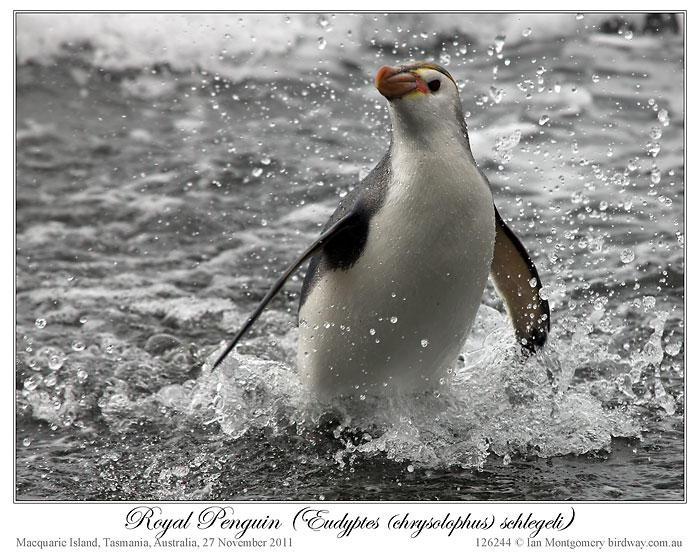
Now generally recognised as a separate species from the closely related Macaroni Penguin, the Royal breeds only on Macquarie Island and the population is estimated at 850,000 pairs. (Macaronis have black chins, Royal have white ones.) ‘Royal’ struck me as a quite inappropriate name: ‘court jester’ would be closer. Maybe that would be underestimating them: the one in the last photo looks like a real champion emerging from the surf, up there with any cross-channel swimmer.
Royal Penguin (Eudyptes schlegeli) by Ian 7

Royal Penguin (Eudyptes schlegeli) by Ian 7

I’m in Sydney now on my way home. The week spent in Tasmania in search of the local endemics was largely successful, despite sometimes miserable weather and I’m looking forward to making many additions to the website.
Best wishes
Ian

Ian Montgomery, Birdway Pty Ltd,
454 Forestry Road, Bluewater, Qld 4818
Phone: 0411 602 737 +61-411 602 737
Preferred Email: ian@birdway.com.au
Website: http://birdway.com.au


Lee’s Addition:

Wow! How do they ever know where their nest is located? That must have been some experience. That second photo looks like they are strutting their stuff.

The Penguins are in the Sphenisciformes Order and they make up the only family, the Spheniscidae Family. See Ian’s photos of the Penguins and then check out our Birds of the WorldSpheniscidae – Penguin family.

He sends out His command to the earth; His word runs very swiftly. He gives snow like wool; He scatters the frost like ashes; He casts out His hail like morsels; Who can stand before His cold? (Psalms 147:15-17 NKJV)

Apparently Penguins were designed to “stand before His cold.”

*

Ian’s Bird of the Week – Light-mantled Albatross

Light-mantled Albatross (Phoebetria palpebrata) by Ian 1

Light-mantled Albatross (Phoebetria palpebrata) by Ian 1

Ian’s Bird of the Week – Light-mantled Albatross ~ by Ian Montgomery

Newsletter ~ 12/1/11

We arrived in Hobart today at the end of successful visit to the Sub-antarctic Islands between New Zealand and Australia. We had a lot of very rough weather in the Southern Ocean but the weather was kinder to us at the various destinations and we managed make all the planned landings (Auckland Islands, Campbell and Macquarie Islands) and view the Snares from the zodiacs (where actual landings are not permitted). I managed to photograph most of the species on my target list and the highlight for most of us was Macquarie Island and its four nesting species of penguin.

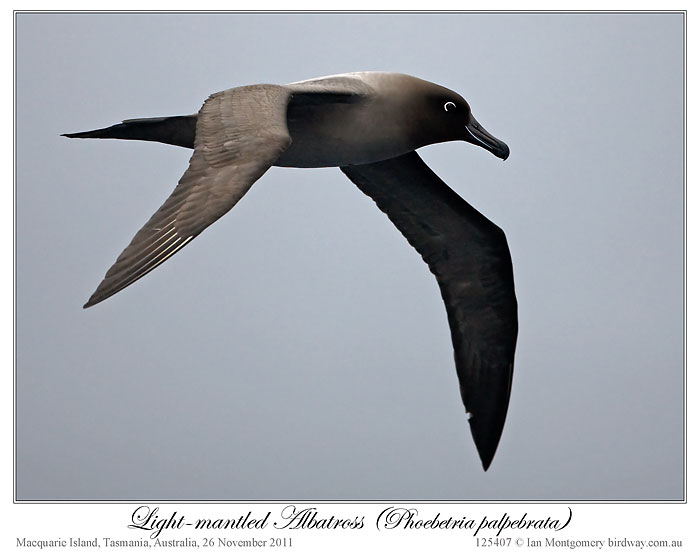
As the last Bird of the Week was the Yellow-eyed Penguin, I’ve chosen an albatross, the Light-mantled (Sooty) Albatross, for this week and will return to penguins later. This was the Albatross that I most wanted to see and also very popular with everyone else. My interest in it had been aroused when I’d heard it likened to a Siamese cat, a seal point in particular. The comparison is apt given the chocolate brown head and latte-coloured body, and the silky texture of the plumage is quite feline in appearance. The white partial eye-ring is striking and sets off the dark head colour very well.
Light-mantled Albatross (Phoebetria palpebrata) by Ian 2

Light-mantled Albatross (Phoebetria palpebrata) by Ian 2

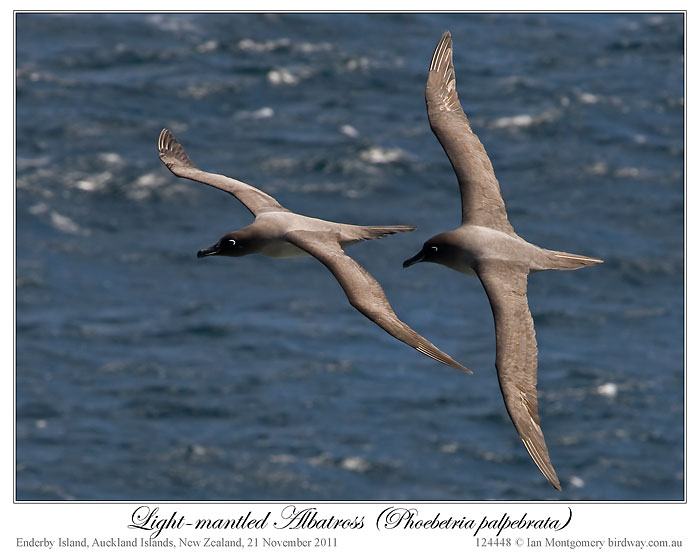
We saw Light-mantled Albatrosses quite frequently until we got close to Tasmania, encountering them first and best on Enderby Island, one of the Auckland Islands, as in the first photo but also at sea and at Macquarie Island as in the second photo. Macquarie Island is administratively part of the State of Tasmania even though it is a long way away and, as one of the Kiwis on board pointed out, geographically part of New Zealand. The Albatrosses were nesting on Enderby Island and it was here that we saw pairs indulging in their beautiful courtship flights, quite an aerial ballet, as in the third photo.
Light-mantled Albatross (Phoebetria palpebrata) by Ian 3

Light-mantled Albatross (Phoebetria palpebrata) by Ian 3

At this point, I though that the comparison with Siamese Cats broke down. I used to have a pair and. when the female was on heat, her behaviour was anything but elegant; demented would have been more like it.
Light-mantled Albatross (Phoebetria palpebrata) by Ian 4

Light-mantled Albatross (Phoebetria palpebrata) by Ian 4

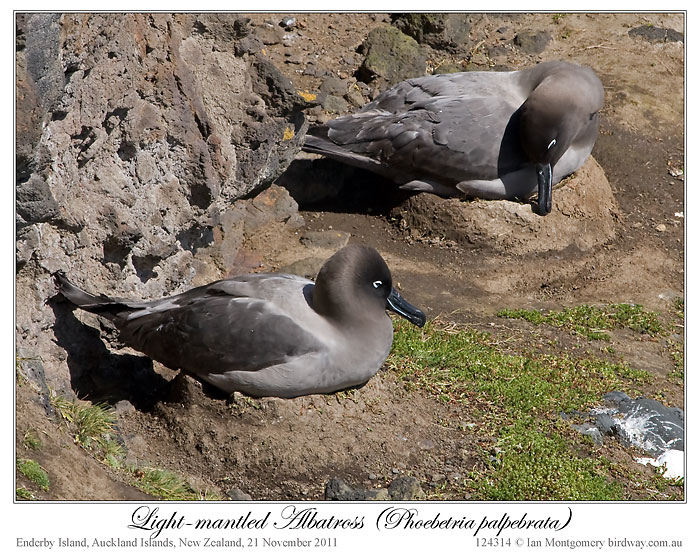
Some pairs were already nesting and incubating eggs. They chose small platforms on quite rocky cliffs and often nested in close proximity to each other, as in the fourth photo. Light-mantled are quite small by albatross standards, measuring about 84cm/33in in length with a wingspan of 215cm/85in. Their range is circumpolar in the colder waters of the Southern Ocean and are seen only rarely in the waters of mainland Australia and Tasmania proper.
Light-mantled Albatross (Phoebetria palpebrata) by Ian 5

Light-mantled Albatross (Phoebetria palpebrata) by Ian 5

On close inspection of the head of a Light-mantled, as in the last photo, the eyes are bluish and, as a final touch, the pale stripe on the bill is also blue. Yes, I know, same colour scheme as a Siamese Cat!
During the rougher parts of the voyage I had the opportunity to work on some of the photos and I have added the following species to the website: Snares, Fiordland and Yellow-eyed Penguins:
Best wishes
Ian

Ian Montgomery, Birdway Pty Ltd,
454 Forestry Road, Bluewater, Qld 4818
Phone: 0411 602 737 +61-411 602 737
Preferred Email: ian@birdway.com.au
Website: http://birdway.com.au


Lee’s Addition:

The hearing ear, and the seeing eye, the LORD hath made even both of them. (Proverbs 20:12 KJV)

What an absolutely neat looking bird. I love that eye ring. Makes the eyes very expressive. Looks like they built nests of mud.

It will be interesting to see what other neat birds that Ian has found on this trip. Not so sure I would have enjoyed those rough seas.

The Albatross are found in the Diomedeidae Family of the Procellariiformes Order. That order includes Petrel, Shearwater, Storm Petrel and Diving Petrel families.

Check out:

Ian’s Albatross Photos

Bird of the Week Newsletters

*

Ian’s Bird of the Week – Yellow-eyed Penguin

Yellow-eyed Penguin (Megadyptes antipodes) by Ian 1

Yellow-eyed Penguin (Megadyptes antipodes) by Ian 1

Ian’s Bird of the Week – Yellow-eyed Penguin ~ by Ian Montgomery

Newsletter – 11/22/11
I had intended the Fiordland Crested Penguin at Milford Sound to be the next bird of the week, but since then I have photographed the unusual and rarer Yellow-eyed Penguin at the well-known colony on the Otago Peninsula near Dunedin and chosen it instead.

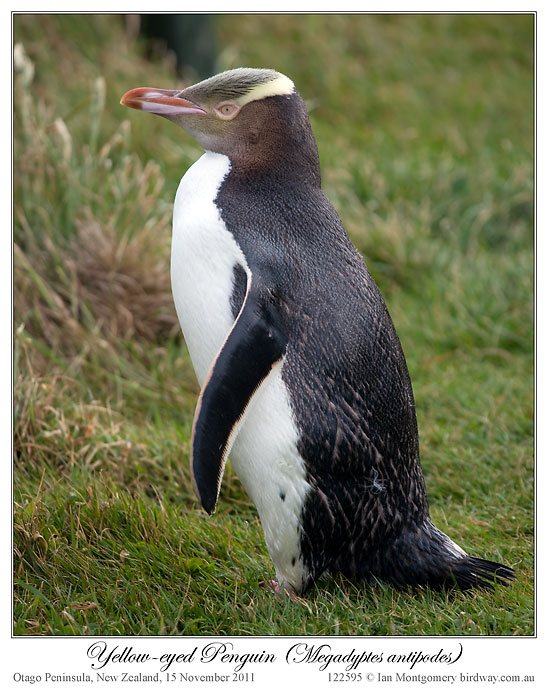
I went there in the evening as this is the time when the fishing member of the breeding pairs returns to relieve the incubating or baby-sitting member. The bird in the first photo is an adult that has just returned to the colony. The adults are distinguishable by having the yellow band joining the eyes around the nape of the head.
Yellow-eyed Penguin (Megadyptes antipodes) by Ian 2

Yellow-eyed Penguin (Megadyptes antipodes) by Ian 2

The bird in the second photo is another adult. Yellow-eyed Penguins are quite large, up to 79cm/31in in length and weighing up to 8kg. The males are larger than the females and penguins in general have heavy bones by bird standards to help them dive. When the pairs are reunited they typically perform mutual preening as in the third photo.
Yellow-eyed Penguin (Megadyptes antipodes) by Ian 3

Yellow-eyed Penguin (Megadyptes antipodes) by Ian 3

The total population of the species is about 2,000 pairs, mainly on Auckland and Campbell Islands, with about 150 pairs on Stewart Island and about 500 on the South Island. It has suffered from loss of coastal forest and still suffers from predation by introduced mammals such as feral cats. It is classified as endangered, but the population has been relatively stable over the last 30 years.
Yellow-eyed Penguin (Megadyptes antipodes) by Ian 4 juvenile

Yellow-eyed Penguin (Megadyptes antipodes) by Ian 4 juvenile

The bird in the fourth photo is a juvenile (they don’t breed until they are 3 or 4 years old) and lacks the yellow band on the back of the head.
More than 20 years ago, when on Stewart Island, I booked to go on a boat trip to an island that had both Yellow-eyed Penguins and Wekas, a large flightless rail. The weather was so bad that the trip was cancelled and both these species had represented unfinished business. On this trip I encountered Wekas at Milford Sound.
I’m in Dunedin for a second time now, having needed to drive to Christchurch to return the camper and then flown back. This produced a strangely disorientating feeling of deja-vu, as you quite reasonably expect to end up somewhere else after a flight, not where you’ve just been the day before. I have met up with my 3 travelling companions from Victoria and we are all excited at the prospect of sailing for the Sub-Antarctic Islands tomorrow. So, don’t expect another bird of the week or any communication for that matter until we reach Hobart where we are due on 1 December. I hope that by then I’ll have many more photos to share with you.
Best wishes
Ian

Ian Montgomery, Birdway Pty Ltd,
454 Forestry Road, Bluewater, Qld 4818
Phone: 0411 602 737 +61-411 602 737
Preferred Email: ian@birdway.com.au
Website: http://birdway.com.au


Lee’s Addition:

Ian has been putting out his newsletters close together lately. Most likely since he knows he will be away from an internet connection for awhile. This newsletter was received several days ago, but decided to space it to fill the gap of time before his next one arrives. I am looking forward to what this next part of his trip produces.

Penguins are in the Sphenisciformes Order. The family, Spheniscidae, is the only one in the order. The 18 Penguins are in 5 genera; Aptenodytes, Pygoscelis, Eudyptes, Megadyptes and Spheniscus. Check out Ian’s Penguins and the the complete Spheniscidae family here.

Let heaven and earth praise Him, The seas and everything that moves in them. (Psalms 69:34 NKJV)

*

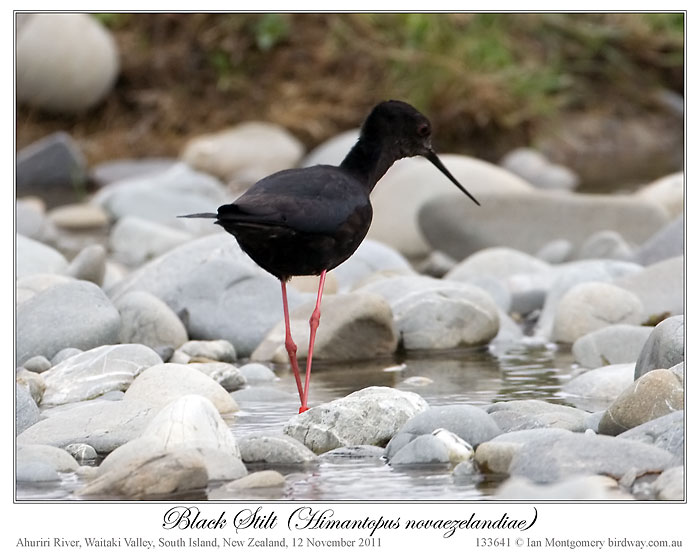
Ian’s Bird of the Week – Black Stilt

Black Stilt (Himantopus novaezelandiae) 1 by Ian

Black Stilt (Himantopus novaezelandiae) 1 by Ian

Ian’s Bird of the Week – Black Stilt ~ by Ian Montgomery

Newsletter – 11/15/11

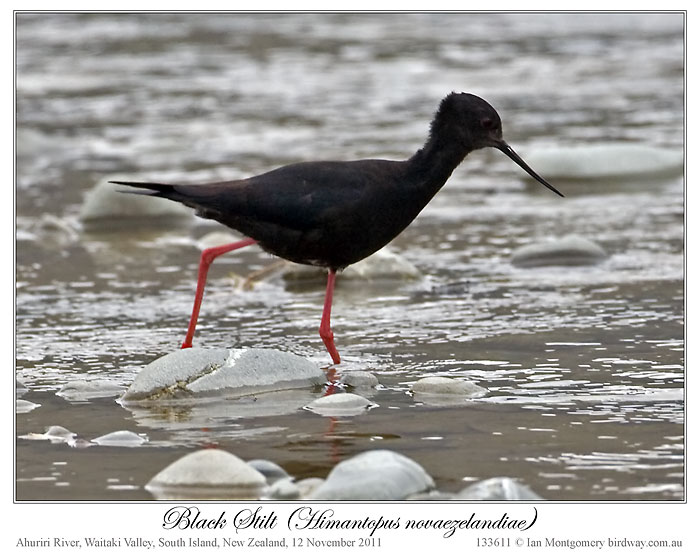
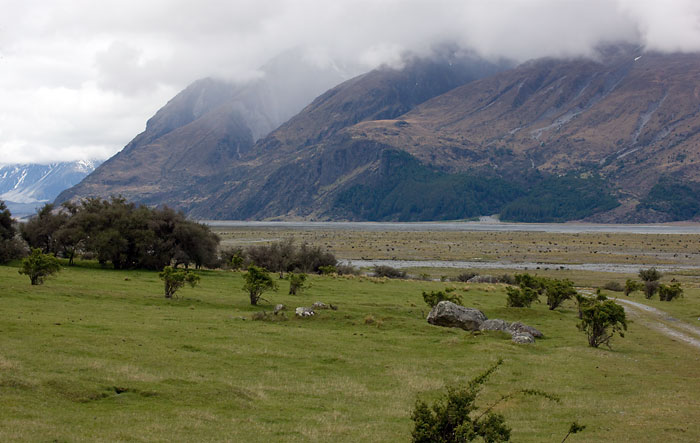
You’ve done it again! Your collective goodwill and spiritual energy have provided yet another special, this time very special bird, the critically endangered and recently saved from extinction Black Stilt. I did have to do a little work as well to find a couple in their favoured habitat of often inaccessible, so-called braided rivers of the South Island. At the second potential site, see photo, the task seemed impossible – that’s all river bed between the foreground and the mountains – and I almost gave up.

Tasman River by Ian

Tasman River by Ian

The third site wasn’t any better, but the fourth and last was a bridge over another river and you could have knocked me over with a feather when, having just stepped onto the bridge, I spotted two Black Stilts feeding a couple of hundred meters away close to the river bank.
One flew away when I approached but the other was much more cooperative and continued feeding.
Black Stilt (Himantopus novaezelandiae) 2 by Ian

Black Stilt (Himantopus novaezelandiae) 2 by Ian

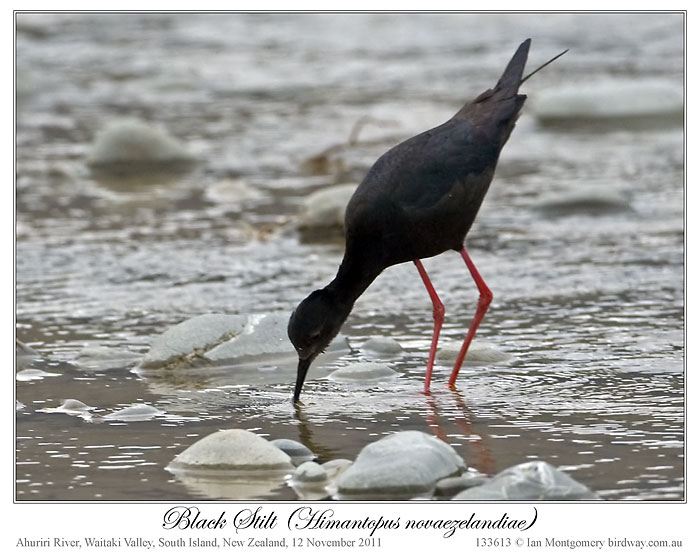
Eventually it flew off too, but it landed not far away, close to a breeding colony of 3 or 4 pairs of Black-fronted Terns, another species on my wanted list.
Black Stilt (Himantopus novaezelandiae) 3 by Ian

Black Stilt (Himantopus novaezelandiae) 3 by Ian

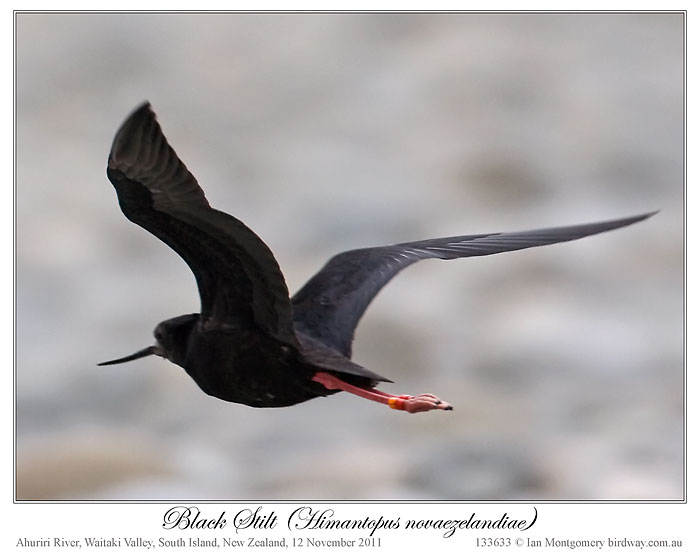
It stayed for a little while longer, until the terns chased it off. If you look carefully in the last photo, you can see a coloured band on the right leg and bird is presumably one of the captive-bred and released birds.
Black Stilt (Himantopus novaezelandiae) 4 by Ian

Black Stilt (Himantopus novaezelandiae) 4 by Ian

The population of Black Stilts in the wild reached a low of 23 adults in 1981 when the program started, making it the rarest wading bird in the world. There are now probably 200 birds in the wild and the program continues. Lets keep our fingers crossed!
I’ve had a great time so far in New Zealand and yesterday I went on a successful boat trip on Milford Sound in lovely weather for another wanted species, another potential bird of the week. I’m now on my way back to Christchurch to return my splendid campervan – I shall be reluctant to return it.
Best wishes
Ian


Ian Montgomery, Birdway Pty Ltd,
454 Forestry Road, Bluewater, Qld 4818
Phone: 0411 602 737 +61-411 602 737
Preferred Email: ian@birdway.com.au
Website: http://birdway.com.au


Lee’s Addition:

Glad to see the Lord answers prayers. (See Addition –  NZ/Australasian Shoveler) What a neat bird, glad you found it and didn’t give up. With them so few in numbers, that is a Great Catch!

I love them that love me; and those that seek me early shall find me. (Proverbs 8:17 KJV)

The Black Stilt is in the Recurviostridae Family of the Charadriiformes Order. There are 6 Stilts and 4 Avocets. Check out Ian’s Recurviostridae photos.

“Avocets and stilts range in length from 30 to 46 centimetres (12 to 18 in) and in weight from 140 to 435 grams (4.9 to 15.3 oz); males are usually slightly bigger than females.[1] All possess long, thin legs, necks, and bills. The bills of avocets are curved upwards, and are swept from side to side when the bird is feeding in the brackish or saline wetlands they prefer. The bills of stilts, in contrast, are straight. The front toes are webbed, partially in most stilts, fully in avocets and the Banded Stilt, which swim more. The majority of species’ plumage has contrasting areas of black and white, with some species having patches of buff or brown on the head or chest. The sexes are similar.” (Wikipedia)

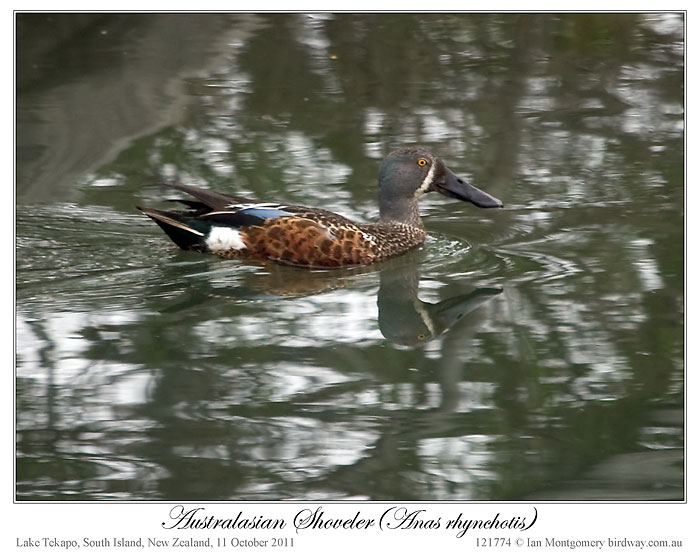
Ian’s Bird of the Week – NZ/Australasian Shoveler

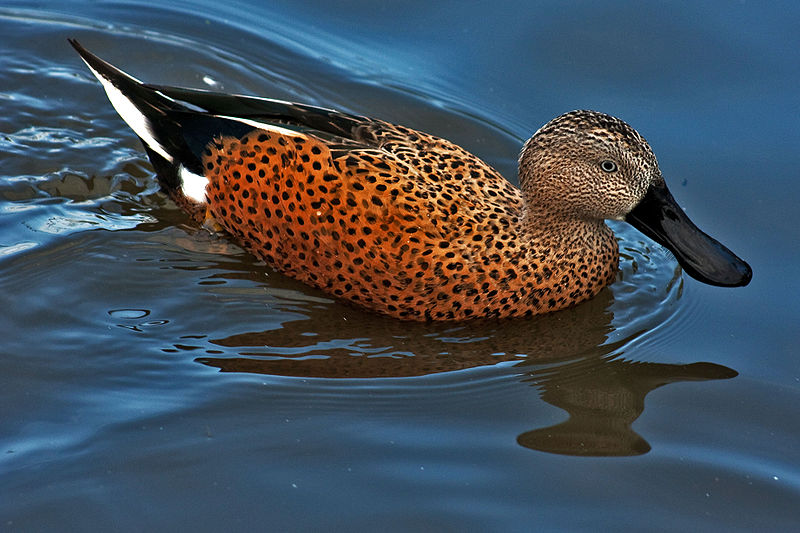
Australasian Shoveler (Anas rhynchotis) by Ian Montgomery

Australasian Shoveler (Anas rhynchotis) by Ian Montgomery

Ian’s Bird of the Week – Australian Shoveler

Newsletter – 11/11/11

This is really just a token bird of the week as an apology for being late, having been busy preparing, packing and travelling. I’m now on the South Island of New Zealand and surrounded by introduced birds such as Eurasian Chaffinches and Blackbirds. I had a look for Black Stilt yesterday without success so here’s a male New Zealand Shoveler instead. At least that’s what they’re called here, even though they are the same species as the Australasian Shoveler. What ever, they’re gorgeous ducks.

Australasian Shoveler (Anas rhynchotis) by Ian

Australasian Shoveler (Anas rhynchotis) by Ian

I’m going to have another try at the Black Stilt today so wish me luck: your collective goodwill has worked in the past! After that, I plan to head south towards Fiordland to see what I can find there.

Best wishes

Ian

Ian Montgomery, Birdway Pty Ltd,
454 Forestry Road, Bluewater, Qld 4818
Phone: 0411 602 737 +61-411 602 737
Preferred Email: ian@birdway.com.au
Website: http://birdway.com.au


Lee’s Addition:

Since Ian wrote a short note, I added a second one of his Australasian Shovelers to the newsletter. Click see his other Australasian Shoveler photos. Ian, will be praying you find your birds and for your safety. Trust you find your Black Stilts so we can have a look at them also.

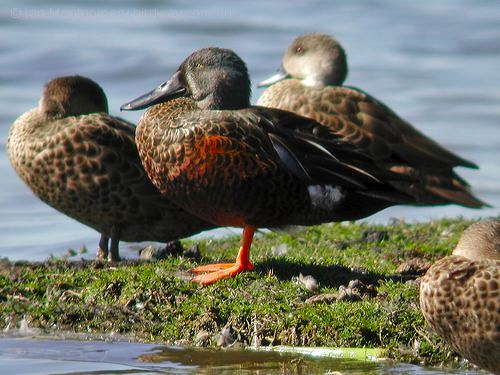
The Shovelers are in the Anas genus of the Anatidae – Ducks, Geese & Swans Family. Ian’s Anatidae Index Page.

Cape Shoveler (Anas smithii) by Ian
Red Shoveler (Anas platalea) ©WikiC
Australasian Shoveler (Anas rhynchotis) by Ian
Northern Shoveler (Anas clypeata) by Ian

Even though these birds could be eaten, many people like duck, I prefer to watch them instead. They are protected by:

If a bird’s nest happens to be before you along the way, in any tree or on the ground, with young ones or eggs, with the mother sitting on the young or on the eggs, you shall not take the mother with the young; you shall surely let the mother go, and take the young for yourself, that it may be well with you and that you may prolong your days. (Deuteronomy 22:6-7 NKJV)

*

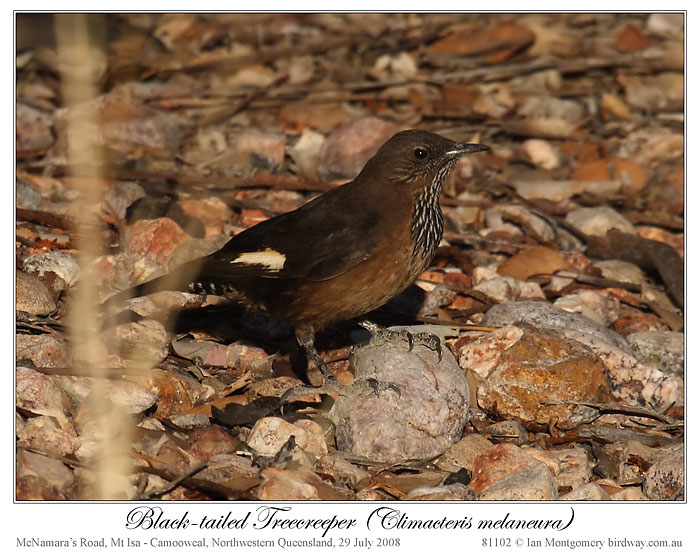
Ian’s Bird of the Week – Black-tailed Treecreeper

Black-tailed Treecreeper (Climacteris melanurus) by Ian

Black-tailed Treecreeper (Climacteris melanurus) by Ian

Ian’s Bird of the Week – Black-tailed Treecreeper ~ by Ian Montgomery

Newsletter – 10/28/11

I hope you like albatrosses and penguins as I leave in less than 2 weeks for a boat-trip to the so-called Sub-Antarctic island south of New Zealand and Australia and seabirds will, I hope, dominate the bird of the week for some time to come. In the meantime, here is a real landlubber, the Black-tailed Treecreeper, from northwestern Australia. It’s range extends from northwestern Queensland (Cloncurry district) through the Top End of the Northern Territory to the Kimberley region of northern Western Australia, with an isolated population of a paler race slightly farther south in the Pilbara region.

Black-tailed Treecreeper (Climacteris melanurus) by Ian

Black-tailed Treecreeper (Climacteris melanurus) by Ian

This bird is a male with a black throat with white streaks and the photo shows well the huge rear claws that it uses to climb trees. The photo also shows that Australo-Papuan Treecreepers (Climacteridae Family) usually don’t rely on their tails as a prop, unlike the unrelated Northern Hemisphere Treecreepers (Certhiidae) and Woodpeckers (Picidae). This photo was taken in tropical forest in Kakadu but this species also occurs in much more arid country with only scattered trees and it will feed on the ground, as in the second photo, taken at McNamara’s Road between Mount Isa and Camooweal. This bird is also a male: females have pale throats, but I haven’t got a good photo of one.

McNamaras Road by Ian

McNamaras Road by Ian

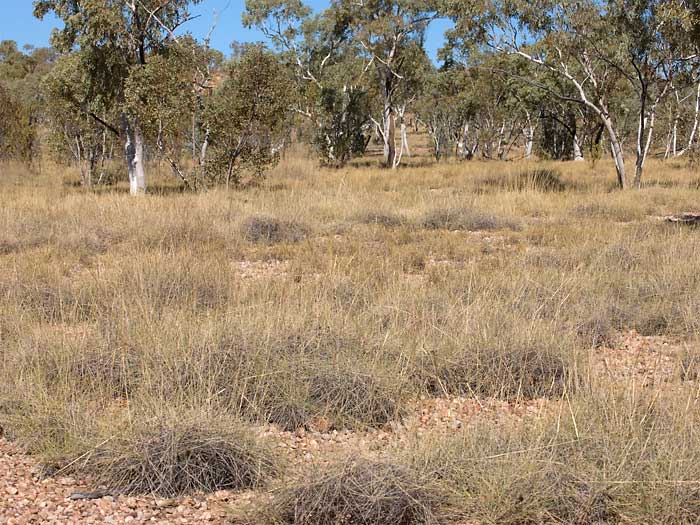
The main ground cover here is a prickly grass usually called spinifex (Triodia) and this site, third photo, is famous for its Carpentarian Grasswrens, but I remember it better for a hard night’s camping with a punctured airbed on this fourth-failed and final foray here in search of these elusive grasswrens – final because I was shown the grasswrens at another site two days later by Brian Venables who has much better hearing than I have! (Carpentarian Grasswren)

Best wishes
Ian

Ian Montgomery, Birdway Pty Ltd,
454 Forestry Road, Bluewater, Qld 4818
Phone: 0411 602 737 +61-411 602 737
Preferred Email: ian@birdway.com.au
Website: http://birdway.com.au


Lee’s Addition:

I am glad Ian is the one camping in an area like that last photo. That prickly grass doesn’t look too inviting. Those neat photos of the Treecreeper are worth it though. Thanks for sacrificing your airbed for them.

In them the birds build their nests; the stork has her home in the fir trees. (Psalms 104:17 ESV)

The Climacteridae- Australian Treecreeper Family and the Certhiidae – Treecreepers Family are in the Passeriformes Order and the Picidae – Woodpeckers Family is in the Piciformes Order.

*

Ian’s Bird of the Week – Red-kneed Dotterel

Red-kneed Dotterel (Erythrogonys cinctus) by Ian 1

Red-kneed Dotterel (Erythrogonys cinctus) by Ian

Ian’s Bird of the Week – Red-kneed Dotterel ~ by Ian Montgomery

Newsletter – 10-17-11

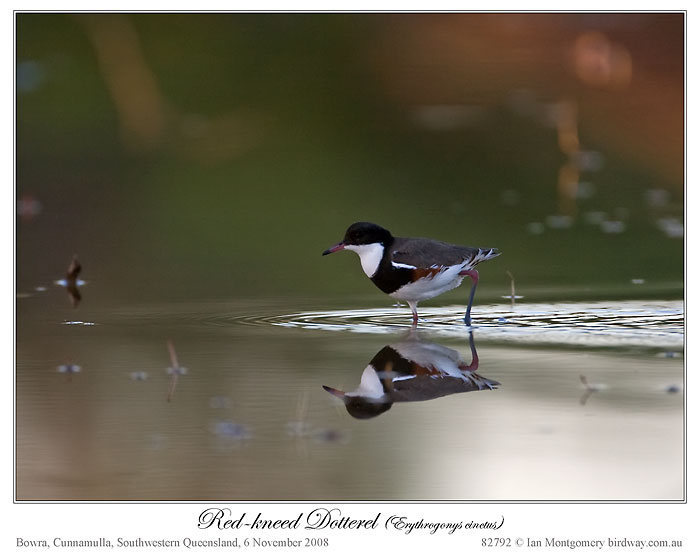
I’d chosen this for last week’s bird until the excitement over the Spotless Crake on Ross River pushed it into the background. Some would argue that the Red-kneed Dotterel is much more beautiful – and is also uncommon in Townsville – but it lacks the mystique of habitual lurkers like crakes that grant audiences only as a special privilege.

Red-kneed Dotterels live almost exclusively near fresh water and are rarely seen in tidal areas. The bird in the first photo was wading at sunset in the shallows of a tranquil pond near a bore at Bowra, an AWC reserve http://www.australianwildlife.org/Bowra.aspx near Cunnamulla in Southwestern Queensland. It was a lovely evening, and I was sitting in a camping chair with camera and tripod and mainly watching parrots and cockatoos coming in to drink: birding in style.
Red-kneed Dotterel (Erythrogonys cinctus) by Ian 2

Red-kneed Dotterel (Erythrogonys cinctus) by Ian

The close-up, second photo was photographed at Melbourne Water’s euphemistically called Western Treatment Plant near Werribee on the shores of Port Phillip Bay, also a famous birding spot but not as pleasant for camping as Bowra. Red-kneed Dotterels (actually red-ankled) are small plovers, length 17-19cm/7-8in, not closely related to other ones such as the Black-fronted Dotterel: both are members of monotypic genera – containing only one species. Recent DNA studies have shown that the Red-kneed shows closer affinity to Lapwings than other plovers, which a certain physical resemblance supports, allowing for small size, a lack of wattles and better manners.
Red-kneed Dotterel (Erythrogonys cinctus) by Ian 3

Red-kneed Dotterel (Erythrogonys cinctus) by Ian 3

Red-kneed Dotterels are adaptable and occur widely through the more arid regions of Australia, apart from deserts. The one in the third photo is a young bird hatched beside a small wetland near Birdsville produced by an overflow from the local geothermal power station that makes electricity from almost boiling water (98ºC) from the Great Artesian Basin http://www.derm.qld.gov.au/register/p00834aa.pdf .

Best wishes
Ian

Ian Montgomery, Birdway Pty Ltd,
454 Forestry Road, Bluewater, Qld 4818
Preferred Email: ian@birdway.com.au
Website: http://www.birdway.com.au/index.php

Lee’s Addition:

What a neat little bird. I love the clean lines and especially it’s knees or ankles. Ian, you captured it well! I am at the variety of birds you have there in Australia.

The Dotterels are in the Charadriidae – Plovers Family of the Charadriiformes Order. That order has 19 families of Shorebirds and their allies. Check out Ian’s Charadriidae Family photos – Click Here.

Thy words have upholden him that was falling, and thou hast strengthened the feeble knees. (Job 4:4 KJV)

More Ian’s Bird of the Week

Ian’s Bird of the Week – Spotless Crake

Spotless Crake (Porzana tabuensis) by Ian

Spotless Crake (Porzana tabuensis) by Ian

Ian’s Bird of the Week – Spotless Crake ~ by Ian Montgomery

Newsletter – 10/11/11

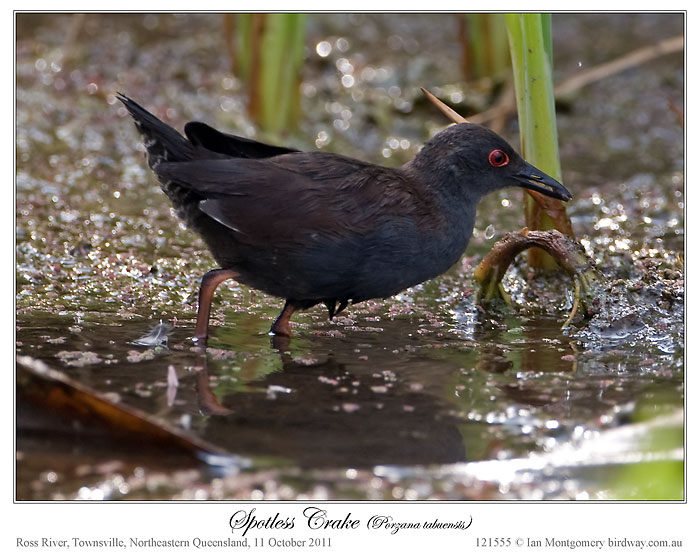
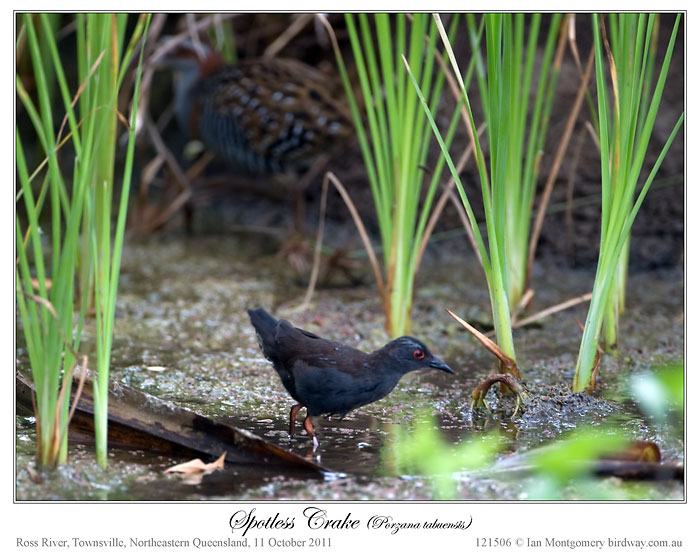
There’s no doubt as to what is currently the Bird of the Week in Townsville: the discovery of this Spotless Crake in a small patch of reedy grass beside Ross River just below Aplin’s Weir is causing great excitement. They’re rare here and the birder who circulated the news, thank you Marlene, could find only 5 records in Townsville since 1994, the last one being in 2000. Not having photographed one before, I got up at 5:40am this morning to have a second attempt at photographing it (it wasn’t very cooperative yesterday afternoon) and there was universal agreement that this was a noteworthy event as I’m famously not an early riser.

Spotless Crake (Porzana tabuensis) by Ian

Spotless Crake (Porzana tabuensis) by Ian

In fact, the Crake wasn’t very cooperative this morning either, making only 3 brief appearances between 6:30 and 9:00am, really brief with the longest period between the first and last photo in a session being 6 seconds. It was definitely a question of using a tripod mounted camera focussed on its chosen spot. If you compare the first and second photos, taken 40 minutes apart, and look for the semicircular reed stem sticking out of the water near its bill, you’ll see that it was in almost exactly the same place on both occasions.
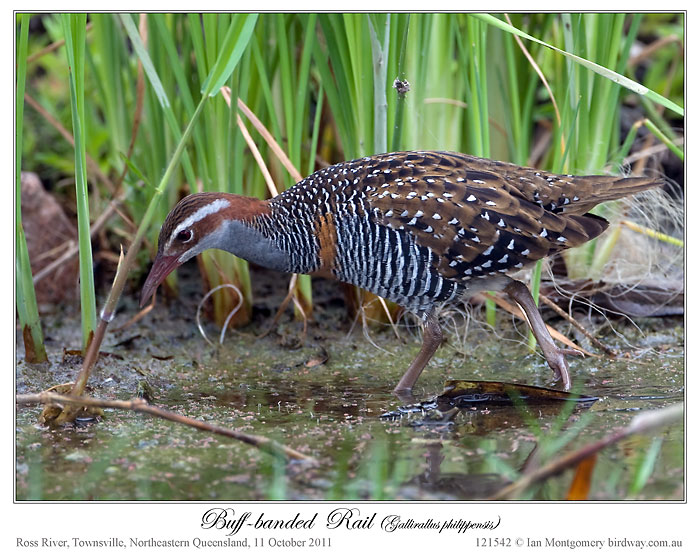
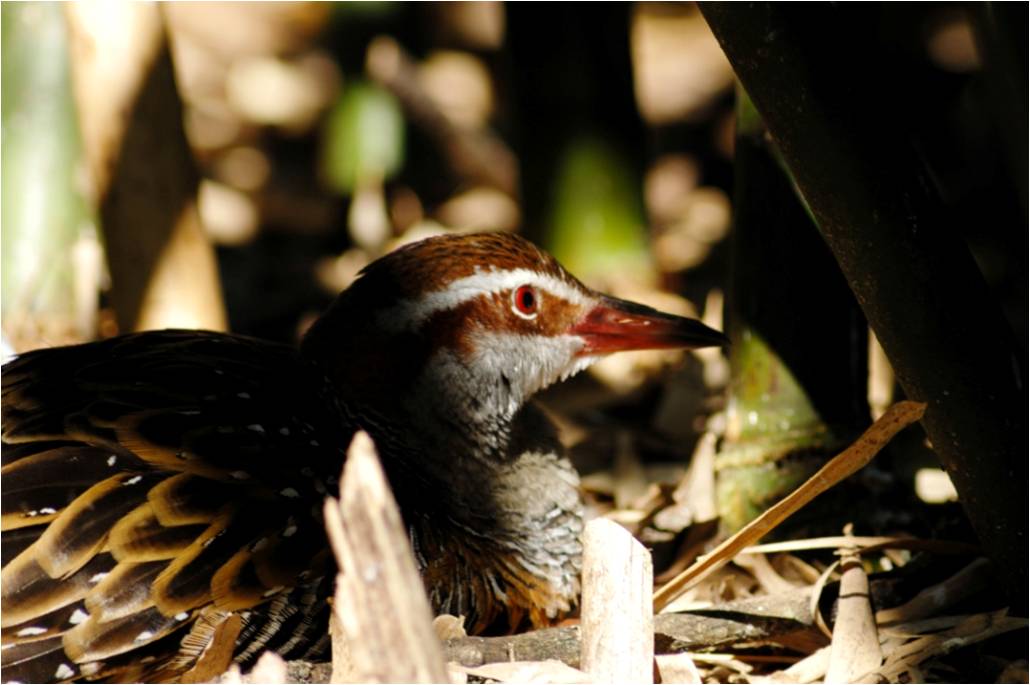
If you look in the background, you can see an out-of-focus and much larger Buff-banded Rail that was around at the same time, but completely overshadowed by its rarer cousin. The rail was much more forthcoming, and regularly paraded in full view to have its photo taken (at the risk of missing an appearance by the real star) as in the third photo.
Buff-banded Rail (Gallirallus philippensis) by Ian

Buff-banded Rail (Gallirallus philippensis) by Ian

For comparison Spotless Crakes are 17-20cm/6.7-8in in length, while Buff-banded Rails are 28-33cm/11-13in. The names ‘crake’ and ‘rail’ are used taxonomically somewhat indiscriminately for these small secretive members of the Rallidae. For example, the Hawaiian and St Helena Rails belong to the same genus as most of the Australian Crakes (Porzanus). Still on names, it’s very unusual for birds to be named after features they lack, such as spots. In the Birdlife International list of birds of the world, about 10,000 species, I could find only 9 that are something-less: 2 are crestless, 3 are flightless, 2 are spotless and, prizewinner for strange names, the Northern and Southern Beardless Tyrannulets. I didn’t count Restless Flycatcher and the other spotless is the Spotless Starling.

Best wishes
Ian


Ian Montgomery, Birdway Pty Ltd,
454 Forestry Road, Bluewater, Qld 4818
Phone: 0411 602 737 +61-411 602 737
Preferred Email: ian@birdway.com.au
Website: http://birdway.com.au


Lee’s Addition:

Sounds like Ian’s Spotless Crake was the talk of the town, at least of the birder’s. I love the way Ian shows so much patience while he is out birdwatching. Most of us would give up and miss these neat photos. Thanks, Ian, for your patience.

That second bird, the Buff-banded Rail, is also a resident at the Lowry Park Zoo. I have been privileged of see it on vary rare occasions. The bird was hidden very well.

But if we hope for that we see not, then do we with patience wait for it. (Romans 8:25 KJV)

Buff-banded Rail (Gallirallus philippensis) by Lee at Lowry Pk Zoo

Buff-banded Rail (Gallirallus philippensis) by Lee at Lowry Pk Zoo

*

Ian’s Bird of the Week – Tropical Scrubwren

Tropical Scrubwren (Sericornis beccarii) Female by Ian

Tropical Scrubwren (Sericornis beccarii) Female by Ian

Ian’s Bird of the Week – Tropical Scrubwren ~ by Ian Montgomery

Newsletter – 9/30/11

Here’s another of my target species on the Cape York trip. It comes from the less spectacular end of the spectrum, far away from the Birds of Paradise, but I’m fond of Scrubwrens in general. They are plucky, vocal little birds with lots of character, so colourful plumage isn’t everything.

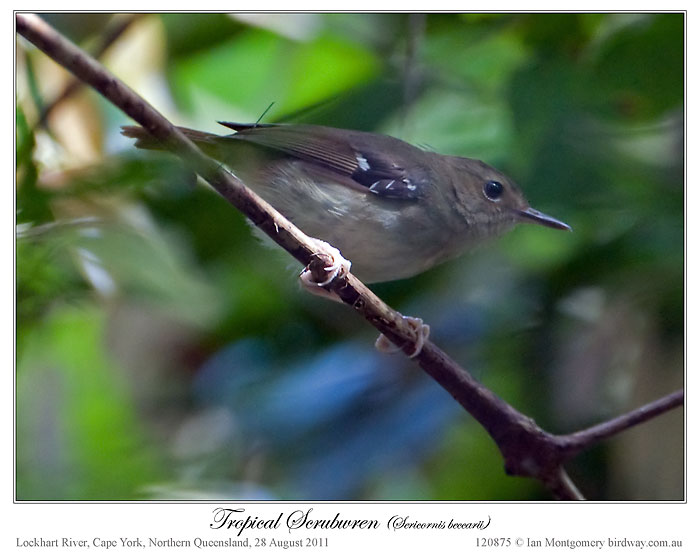
The one in the first photo is a female, distinguishable from the male by a plainer face pattern with lores – the bit between the eye and the bill – much the same colour as the rest of the head. The second photo shows a male and you can see the patterning on the face with dark lores with pale highlights above and below them.
Tropical Scrubwren (Sericornis beccarii) Male by Ian

Tropical Scrubwren (Sericornis beccarii) Male by Ian

The Tropical Scrubwren look like a cross between the Large-billed Scrubwren and the White-browed. It has a long, slightly-upwards pointing bill like the Large-billed but the wing pattern with dark, white-tipped wing-coverts look much more like those of the White-browed (the Large-billed has very plain plumage overall including the wings). In fact, there has been some doubt whether it’s a separate species from the Large-billed, but most authorities now accept that it is.

In Australia it occurs only on Cape York Peninsula from Cooktown northwards. Within its restricted range, it’s quite common and I found several pairs without much difficulty as they are quite vocal. The birds do, however, flit incessantly and almost invisibly through the dense undergrowth and foliage of the rainforest and are not easy to see well or photograph. They have reddish irises, but in the poor light of the rainforest, their pupils are very dilated and look black in most of the photos that I took. This species is widespread in PNG, where it is called Beccari’s Scrubwren.
Best wishes
Ian
Links:


Ian Montgomery, Birdway Pty Ltd,
454 Forestry Road, Bluewater, Qld 4818
Phone: 0411 602 737 +61-411 602 737
Preferred Email: ian@birdway.com.au
Website: http://birdway.com.au


Lee’s Addition:

There are 13 Scrubwrens that make up the Sericornis Genus of the Acanthizidae – Australasian Warblers Family. The Passeriformes Order has the perching birds, of which this family belongs. I think they are cute, even if they are not very colorful. The video at the bottom of the Family link is of a very active Atherton Scrubwren (Sericornis keri) by Keith Blomerley. Those birds sound like the ones that give photographers the fits trying to take their picture.

The birds of the air have their resting-places by them, and make their song among the branches. (Psalms 104:12 BBE)

To see all of the Ian’s Bird of the Week – Click Here

*

Ian’s Bird of the Week – White-streaked Honeyeater

White-streaked Honeyeater (Trichodere cockerelli) by Ian #1

Ian’s Bird of the Week – White-streaked Honeyeater ~ by Ian Montgomery (Australia)

Newsletter ~ 09/23/11

Of the 4 species at the top of my wanted list on the trip to Iron Range, this one, the White-streaked Honeyeater, took the most effort to find and I found it only at the last possible location on the way home. Many Honeyeaters, including this one, are nomadic in search of flowering shrubs and trees so visiting a known site is no guarantee of success.

The White-streaked Honeyeater occurs only on Cape York Peninsula, north of about Cooktown. So, when I left Daintree village, rather than go the usual route via Julatten, I headed north through Cape Tribulation to Cooktown along the 4WD Bloomfield track, spent a couple of nights near Cooktown and then drove to Laura along Battlecamp Road to join the main Peninsula Development Road. Apart from the attraction of of a route I hadn’t travelled on before, both White-streaked Honeyeaters and Tropical Scrubwrens had been seen in July at a couple of river crossings along the way. Near Cooktown, I did a glimpse and an unflattering rear-view shot of the southern race (dubius) of the Tropical Scrubwren, but the Honeyeaters seemed to have moved on.

White-streaked Honeyeater (Trichodere cockerelli) by Ian #2

Their preferred habitats are heathland, open woodland and riverine forest so they don’t occur in the rainforest at Iron Range. A usually reliable site for them is the heathland at Tozer’s Gap on the way in but this time an orange grevillea was flowering everywhere in abundance, so the birds could have been anywhere. Happily, I caught up with some friends of mine who had just seen the honeyeater in paperbarks and bottlebrushes at the Wenlock River crossing on the same road. This is a 4 or 5 hour round trip from Iron Range, so I decided to risk waiting until my final departure and then I stopped for lunch at the crossing.

White-streaked Honeyeater (Trichodere cockerelli) by Ian #3

When I got there, the paperbarks had finished flowering but the bottlebrushes were still putting on a fine display. Even so, it took some diligent searching before I finally found a couple of White-streaked among the commoner Honeyeaters, mainly Dusky and Graceful. They seemed shy and preferred to remain hidden in the foliage, so I sat on a sandy bank in the river until they showed themselves. They are unusual honeyeaters with no close relatives and the sole member of the genus Trichodere (a ‘monotypic’ genus). ‘Trich’ comes from the Greek word for ‘hair’ and refers, as does ‘white-streaked’ to the bristle-like feathers on the breast (cf Trichoglossus – ‘hairy tongue’ – referring to the brush-like, nectar-licking tongues of Rainbow Lorikeets). Adults have yellow lines below the eye, a yellow ear tuft and a blue gape (photos 1 and 2). They also have yellow wings and tail: easier to see in the third photo of a juvenile which lacks the blue gape and has only a single yellow feather on the head but is beginning to develop the bristle-like breast feathers, also characteristic of adults.
In the second photo, the nest-like material below the bird is flood debris – a clear reminder that this part of the Cape York Peninsula is accessible by road only in the dry-season. The photo below shows the crossing at Wenlock River.
Crossing at Wenlock River by Ian #4

Crossing at Wenlock River by Ian #4

Misión completa, as my guide told me when we found the Resplendent Quetzals in Costa Rica.

Best wishes
Ian


Ian Montgomery, Birdway Pty Ltd,
454 Forestry Road, Bluewater, Qld 4818
Phone: 0411 602 737 +61-411 602 737
Preferred Email: ian@birdway.com.au
Website: http://birdway.com.au


Lee’s Addition:

My son, eat thou honey, because it is good; and the honeycomb, which is sweet to thy taste: (Proverbs 24:13 KJV)

Ian sure has persistence and patience. Ian, thanks again for sharing your birding trips with us.

As Ian mentioned, the Honeyeater is in a genus, Trichodere of the Meliphagidae – Honeyeaters Family. That family has 183 members at present. The family has not only Honeyeaters, but also Friarbirds, Wattlebirds, Bellbirds, Melidectes, Myzas, Myzomela, Straighbills, Spinebills, Chats, and a Gibberbird and others. Roughly half of the family live in Australia.

All 170 species of honeyeaters have a unique adaptation:  a long tongue with a brush-like tip that they use to get nectar from flowers. The tongue can be extended into the nectar about 10 times per second!

See also:
Formed By Him – Plants and Pollinator Birds
Ian’s bird of the Week:
Yellow-spotted Honeyeater
Striped Honeyeater
Banded Honeyeater
Eastern Spinebill
Silver-crowned Friarbird
Helmeted Friarbird
Bar-breasted Honeyeater
Rufous-banded Honeyeater
*

Ian’s Bird of the Week – Magnificent Riflebird

Magnificent Riflebird (Ptiloris magnificus) by Ian

Magnificent Riflebird (Ptiloris magnificus) by Ian

Ian’s Bird of the Week – Magnificent Riflebird ~ by Ian Montgomery

Newsletter – 9/12/11

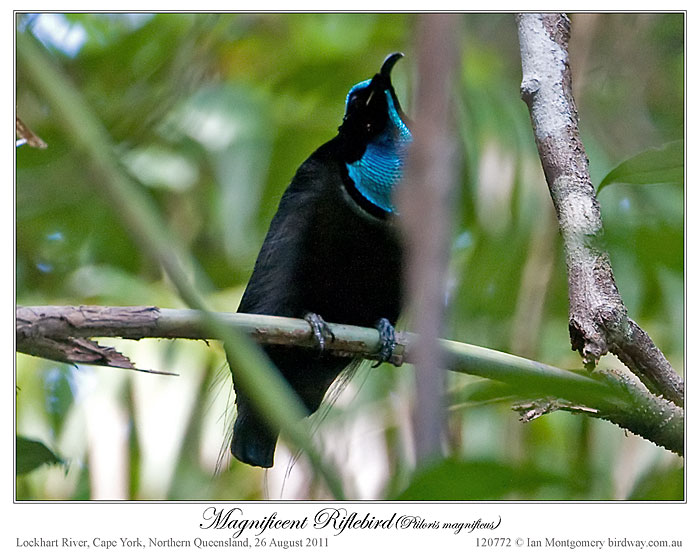
We’ve been dealing with Birds of Paradise for the last couple of birds of the week, so here’s another one from Iron Range, the Magnificent Riflebird. This, like the Trumpet Manucode is easier to hear than see as it spends most of its time in the tall trees of the rainforest and on my previous two visits to this part of Cape York I’d seen only a few females. This time, the males were very vocal and actively courting females and I had more success, as in the first photo.

The ‘magnificent’ is appropriate as, with a length of 28-33cm/11-13in, it is the largest of the three Australian Riflebirds. (There is a fourth species of Riflebird, the Eastern or Growling Riflebird, in eastern PNG – recently split from the Magnificent Riflebird and distinguishable mainly by its call.) As you can see from the first photo, the blue shield on the throat and upper breast of the male is much larger than that of the other two Australian ones. It is also the only one of the three to have plumes along the flanks. These are hard to see on the first photo (except as a fuzzy area below the right wing) but are visible in the second photo both as a fuzzy line along the right side and as longer wiry plumes on either side of the tail.

Magnificent Riflebird (Ptiloris magnificus) by Ian

Magnificent Riflebird (Ptiloris magnificus) by Ian

Like Victoria’s Riflebird the heavy plumage of the males make a swishing noise in flight as they sweep regally around in the canopy of the forest. Their usual call is like a wolf whistle and carries a long way, though I found that locating a male in this way was no guarantee of being able to see it. The male in the first photo was actively wooing an unimpressed or ambivalent female who flew away from him and landed on a branch in the open directly above me. She quickly realised that she was attracting my interest too, as in the third photo, and flew off again in renewed search of peace.

Magnificent Riflebird (Ptiloris magnificus) by Ian

Magnificent Riflebird (Ptiloris magnificus) by Ian

The females are fairly different in appearance from the females of Victoria’s Riflebird with rufous upperparts and heavily barred underparts. (You may remember that the female Victoria’s has much greyer upper parts with less marked buff underparts). The fourth photo shows a female in a more typical pose, looking for grubs, Woodpecker-like, along the limbs and trunks of trees, though Riflebirds also eat fruit.
Magnificent Riflebird (Ptiloris magnificus) by Ian

Magnificent Riflebird (Ptiloris magnificus) by Ian

Another spectacular bird in Iron Range was the Yellow-billed Kingfisher. It has featured as bird of the week before, so here is the link to the new Yellow-billed Kingfisher and on the Daintree we encountered plenty of Azure Kingfishers and Little Kingfishers .

The website, incidentally, had a record month in August with more than 9,300 visits, substantially up from previous records in July of 7,700 and in June of 7,200, with total downloads of about 4.5GB, also a record.

Best wishes
Ian

Ian Montgomery, Birdway Pty Ltd,
454 Forestry Road, Bluewater, Qld 4818
Phone: 0411 602 737 +61-411 602 737
Preferred Email: ian@birdway.com.au
Website: http://birdway.com.au


Lee’s Addition:

The Paradisaeidae Family is again presented by Ian. If you missed Ian’s other birds from this family, see:
Ian’s Bird of the Week – Trumpet Manucode
Ian’s Bird of the Week – Victoria’s Riflebird

Oh, magnify the LORD with me, and let us exalt his name together! (Psalms 34:3 ESV)

*