Ian’s Bird of the Week – White-breasted Woodswallow

White-breasted Woodswallow (Artamus leucorynchus) by Ian

Ian’s Bird of the Week – White-breasted Woodswallow ~ by Ian Montgomery

Newsletter ~ 07-28-10
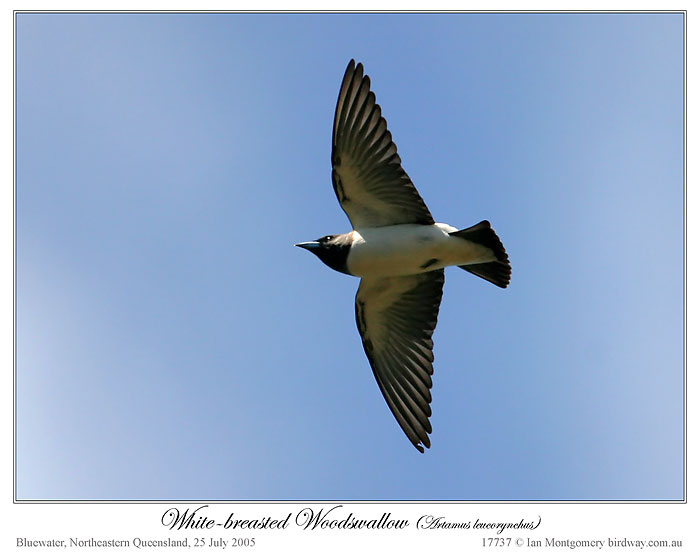
White-breasted Woodswallow (Artamus leucorynchus) by Ian

White-breasted Woodswallow (Artamus leucorynchus) by Ian

Some species are a source of continual pleasure even when they are very common, such as the White-breasted Woodswallow, which is to be seen daily in Northeastern Queensland, perching conspicuously on power-lines or trees and chasing insects, swallow-like, in small flocks. They are attractive birds, fun to watch and courageous, frequently mobbing raptors.

White-breasted Woodswallow (Artamus leucorynchus) by Ian

White-breasted Woodswallows “hanging out” by Ian

Woodswallows get their name from a superficial similarity to true swallows, though in flight they are stockier and lack forked tails as in the second photo. They aren’t related to swallows and form a family, the Artamidae, with the larger more crow-like Australian Magpie, Butcherbirds and Currawongs. The White-breasted Woodswallow is widespread through eastern and northern Australia and is resident in northern coastal areas but migratory or nomadic in other parts of its range.

They are sociable birds, as can be seen in the third photo, and often roost together in large numbers. The fourth photo shows a roost on power-lines near a set of traffic lights on a busy Townsville intersection. When I took the photo, at dusk, about 200 birds were present and the one looking down towards the camera had just elbowed its way into the middle of the row after landing on birds already in place.

White-breasted Woodswallow (Artamus leucorynchus) by Ian

White-breasted Woodswallow “Squeezed in” by Ian

Back at the website, the ‘Current Picks’ (Australian, New World, Old World and Other Wildlife) are:
Shy Albatross
Purple Honeycreeper
Razorbill
and Platypus

I’ve reformatted the Image Purchases page and published a scale of prices for digital images for the conservation- and/or education-related projects that account for most of the Birdway business: http://www.birdway.com.au/printpurchases.htm

Best wishes,
Ian

Ian Montgomery, Birdway Pty Ltd,
454 Forestry Road, Bluewater, Qld 4818
Phone: +61-7 4751 3115
Preferred Email: ian@birdway.com.au
Website: http://birdway.com.au


Lee’s Addition:

Love that last photo, Ian! Can they breathe?  :)

As Ian said, the Woodswallows belong to the Artamidae Family. There are 11 members and they live mainly in Australia and New Zealand. They are part of the Passeriformes Order and “they are among the very few passerines birds that soar, and can often be seen feeding just above the treetops.”

“The woodswallows have an Australasian distribution, with most species occurring in Australia and New Guinea. The Ashy Woodswallow has an exclusively Asian distribution, ranging from India and Sri Lanka through South East Asia to China, and the most widespread species is the White-breasted Woodswallow, which ranges from Peninsular Malaysia through to Australia in the south and Vanuatu and New Caledonia. The group reaches the easternmost extent of its distribution in Fiji with the endemic Fiji Woodswallow.” (Wikipedia)

Even the sparrow has found a home, And the swallow a nest for herself, Where she may lay her young— Even Your altars, O LORD of hosts, My King and my God. (Psalms 84:3 NKJV)

See:

Ian’s Birds of the Week

*

Ian’s Bird of the Week – Eastern Spinebill

Eastern Spinebill (Acanthorhynchus tenuirostris) male by Ian

Eastern Spinebill (Acanthorhynchus tenuirostris) male by Ian

Ian’s Bird of the Week – Eastern Spinebill by Ian Montgomery

Newsletter 07-21-10

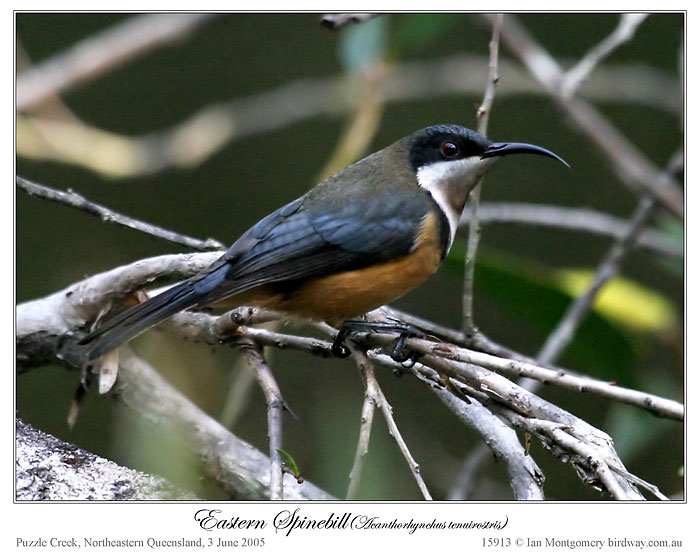
The Spinebills, Eastern and Western, are in my opinion the most elegant of the Honeyeaters so here is the Eastern Spinebill – I haven’t yet managed to photograph the Western Spinebill of SW Western Australia – with the winning combination of tasteful colours and long, fine, curved bill. The bill is adapted to probing for nectar in the flowers of Bottlebrushes, as in the first photo, or Grevilleas and they also feed on insects.

Eastern Spinebill (Acanthorhynchus tenuirostris) female by Ian

Eastern Spinebill (Acanthorhynchus tenuirostris) female by Ian

Males and females are subtly different as the male has a black crown with a sharp transition to the rufous nape while the female has a greyish crown with a gradual transition to the rufous nape. The bird in the first photo is a male, while the one in the second, coming down to drink in a creek, is a female.

Both these birds were photographed in the highlands around Paluma, not far from Townsville. The Eastern Spinebill is found in Tasmania and coastal southeastern and eastern Australia from the Mount Lofty Ranges in South Australia to Fraser Island in SE Queensland and there is an isolated population in the highlands of northeastern Queensland from Eungella near Mackay to Cooktown north of Cairns. This is perhaps a separate race, named cairnsensis.

I am keen to get feedback on recent changes to the website from visitors with slower, e.g. dial-up, connections. The inclusion of thumbnails to all the 142 bird families represented in the site means that the homepage – http://birdway.com.au/index.htm – has a lot of stuff on it to download. If you have found this a problem, please let me know ian@birdway.com.au as I can easily move the ‘Instant Guide to Bird Families’ to a separate page. This would make the homepage faster and make viewing all the thumbnails optional with a link from the homepage.

Best wishes,
Ian

Ian Montgomery, Birdway Pty Ltd,
454 Forestry Road, Bluewater, Qld 4818
Phone: +61-7 4751 3115
Preferred Email: ian@birdway.com.au
Website: http://birdway.com.au


Lee’s Addition:

I don’t know about going to Ian’s site with a slow connection, but I sure do enjoy his new layout. I can jump right to the family I am looking for. I really appreciate your hard work on the front page, Ian. Click to see more of Ian’s photos of Eastern Spinebills.

Spinebills are in the Meliphagidae – Honeyeaters Family which 182 species and is in the Passeriformes Order.

13–16 cm (5–6 in) long, the male Eastern Spinebill has a long thin downcurved black bill with a black head, white throat with a reddish patch and red iris. It has a brownish-red nape, a grey brown back and pale cinnamon underparts. The dark tail is tipped with white laterally. Females and juveniles are smaller and duller. The call is a rapid piping.

The Eastern Spinebill feeds on nectar from many plants, including the blooms of gum trees, mistletoes Amyema spp., Epacris longiflora, Epacris impressa(common heath), Correa reflexa, and various members of the Proteaceae such as Banksia ericifolia, Banksia integrifolia, Lambertia formosa and Grevillea speciosa, as well as small insects and other invertebrates. A 1982 study in the New England National Park in North-eastern New South Wales found that there was a large influx of birds coinciding with the start of flowering of Banksia spinulosa there. They have been known to feed from exotic plants such as Fuchsias.

My son, eat honey because it is good, And the honeycomb which is sweet to your taste; So shall the knowledge of wisdom be to your soul; If you have found it, there is a prospect, And your hope will not be cut off. (Proverbs 24:13-14 NKJV)

Ian’s Bird of the Week – Magpie Goose

Magpie Goose (Anseranas semipalmata) by Ian

Magpie Goose (Anseranas semipalmata) by Ian

Ian’s Bird of the Week – Magpie Goose by Ian Montgomery

Newsletter 7-14-10

Here’s another large species characteristic of northern Australia, particular northern Queensland and the top-end of the Northern Territory, that had so far avoided the Bird of the Week net. It is found in quite large numbers around Townsville in wetland such as the Town Common, where the first photo was taken, and grazing in the stubble left after harvesting sugar cane. It’s a sedentary species and nests here in the wet season during the first four months of the year.

Magpie Goose (Anseranas semipalmata) by Ian

Magpie Goose (Anseranas semipalmata) by Ian

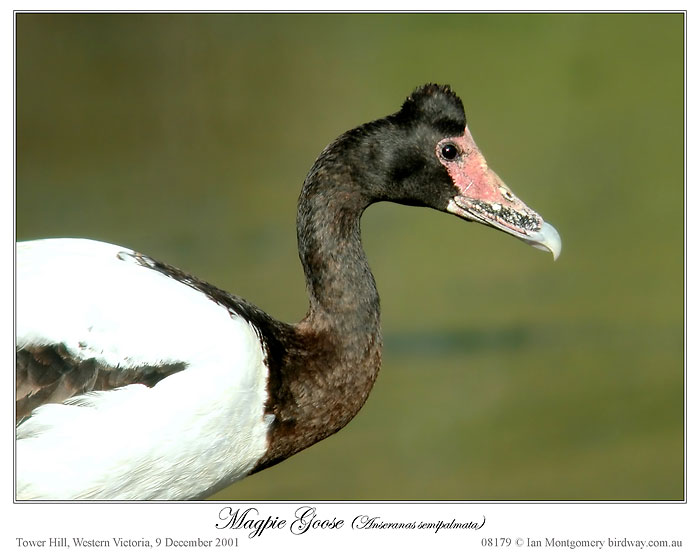
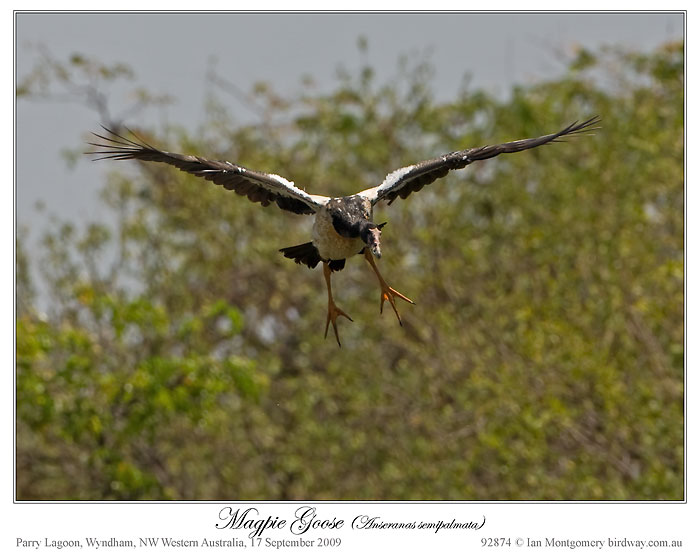
They have a pre-historic look about them and have some unusual features for a goose, or more correctly, goose-like bird. Not only the knobbed head, larger in males like the bird in the foreground in the first photo, but also the hooked beak. Both these features are more visible in the second photo. The third photo of the bird landing shows yet another oddity: the feet are only partially webbed and hence the specific name of semipalmata.

You’d be right in deducing that the Magpie Goose is only distantly related to other ducks and geese (family Anatidae) and is in fact the sole surviving member of a different lineage the family Anserantidae. These two families, along with another odd lineage the three species of Screamer in South America (Anhimidae), comprise the waterfowl order, the Anseriformes.

Magpie Goose (Anseranas semipalmata) by Ian

Magpie Goose (Anseranas semipalmata) by Ian

Magpie Geese were once common and widespread throughout northern, eastern and southeastern Australia but were hunted to extinction in the southeast and occur naturally now only from Broome in northern Western Australia to about Brisbane in southeast Queensland. Following reintroduction it is now getting re-established in some parts of New South Wales such as the Hunter Valley and of Victoria. The second photo was taken at Tower Hill in Western Victoria. It also occurs in southern PNG.

Best wishes,
Ian

Links:
Magpie Goose
Anatidae
Recent Additions (to 14 species)
Ian’s Picks:
Australian (a different Pitta)
New World (it only looks like a Glossy Ibis)
Old World (just in case you dismiss starlings)
Other Wildlife (this one isn’t red)

Ian Montgomery, Birdway Pty Ltd,
454 Forestry Road, Bluewater, Qld 4818
Phone: +61-7 4751 3115
Preferred Email: ian@birdway.com.au
Website: http://birdway.com.au


Lee’s Addition:

The three families Ian mentioned above are the Anhimidae – Screamers, the Anseranitidae – Magpie Goose and the Anatidae – Ducks, Geese & Swans. These are all in the Anseriformes Order

Geese are not mentioned by name in the Bible, but watching out for their eggs and hatchlings are mentioned:

If a bird’s nest chance to be before thee in the way in any tree, or on the ground, whether they be young ones, or eggs, and the dam sitting upon the young, or upon the eggs, thou shalt not take the dam with the young: But thou shalt in any wise let the dam go, and take the young to thee; that it may be well with thee, and that thou mayest prolong thy days.
(Deuteronomy 22:6-7 KJV)

*

Ian’s Bird of the Week – Australian Bustard

Australian Bustard (Ardeotis australis) by Ian

Australian Bustard (Ardeotis australis) by Ian

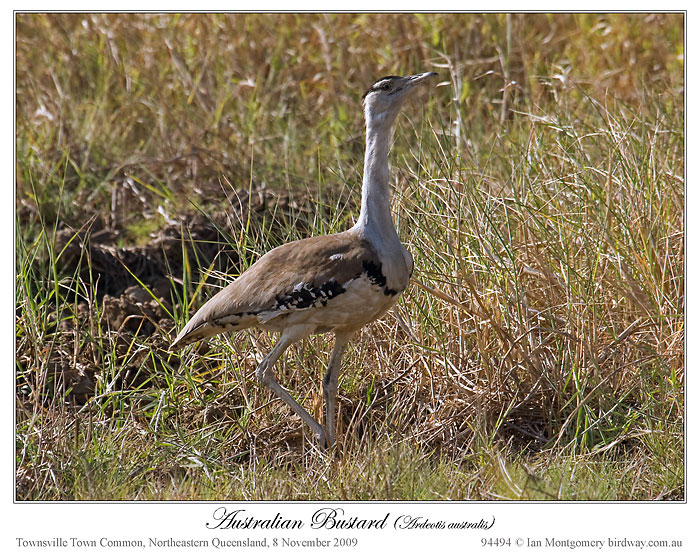
I’ve been slow to produce the bird of the week this week as, not having taken many photos recently, I had trouble choosing a suitable candidate. In the end, I did what I have been meaning to do for ages and extended my bird database to include records of all the birds of the week. Now I can easily see what I’ve missed and I’ve found many surprising omissions, including the Australian Bustard. Surprising because it’s a spectacular bird, one of my favourite, fairly easy to find around Townsville and one that I’d never seen before I moved up here in 2002.

Australian Bustard (Ardeotis australis) by Ian

Australian Bustard (Ardeotis australis) by Ian

The first photo, taken at the Townsville Town Common, shows a bird in a typical pose, bill held high and looking very dignified. Graham Pizzey uses the appropriate adjectives ‘lordly’ and ‘stately’. When disturbed they walk away at a steady pace, and take flight reluctantly, not surprising given their size and weight: the larger males average 120cm/48in in length and 8kg/18lbs in weight. When airborne, they fly strongly and look unstoppable, like the one in the second photo taken at Toonpan at the southern end of Ross River Dam near Townsville.

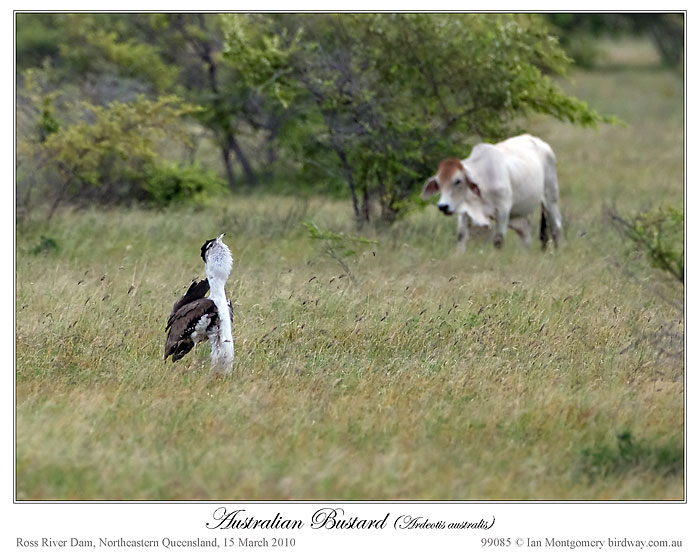
The land around the dam provides good, undisturbed bustard habitat and it is possible to see as many as 30 Bustards together, both at Toonpan and near the dam wall itself. The third photo, taken near the dam wall, shows a male displaying to the understandable astonishment of an unsuspecting cow. The display is quite extraordinary, with the bird extending the breast sac to the ground, drooping the wings, holding the tail erect against the back of the neck and puffing out the feathers of the neck. The bird walks slowly around making the sac swing, and, for a final touch, makes a roaring sound.

Australian Bustard (Ardeotis australis) by Ian

Australian Bustard (Ardeotis australis) by Ian

Bustards, apparently, make very good eating, reflected in the common name ‘Plains-Turkey’. So, worldwide (there are about 25 species) they have suffered seriously from hunting, loss of habitat and land use changes. The Australian Bustard is now rare in or absent from settled areas but still holds on in more remote areas. Most of the 25 or so species are smaller African ones, but there are 5 large species including the Great Bustard of Eurasia, the Arabian, the Kori Bustard of Africa and the endangered Great Indian Bustard. The latter two are closely related to the Australian Bustard and the three have in the past been treated as a single species.

On the website, I’ve finished updating the family thumbnail pages, so all now have the same format, the common background colours to distinguish regional thumbnails (Australian, New World, Old World), and labeled previous and next family buttons in the regional as well as the global pages. On the home page, I’ve added 4 ‘Ian’s Picks’ (Australian, New World, Old World and Other Wildlife) to share interesting photos which will be changed regularly. Currently, they are:

Red-tailed Tropicbird
Western Meadowlark
Buffy Fish-Owl
Black Flying-fox

Best wishes,
Ian

Other links:
Australian Bustard
Kori Bustard

Ian Montgomery, Birdway Pty Ltd,
454 Forestry Road, Bluewater, Qld 4818
Phone: +61-7 4751 3115
Preferred Email: ian@birdway.com.au
Website: http://birdway.com.au


Lee’s Addition:

The Australian Bustard is in the Otididae Family which has 27 members and they are the only family in the Otidiformes Order. The family includes Bustards, 7 Korhaans and 2 Floricans. The Bustards like to “move with a slow, deliberate, sedate walk, holding their head high and gently rocking backward and forward.” (National Geographic) After watching several videos of the different species, that is a very good description.

Nothing wrong with being stately or having a good bearing, but we should never act proud or think we are better than others. These birds are behaving the way the Lord created them to act and part of their behavior is to attract a mate.

For all that is in the world, the lust of the flesh, and the lust of the eyes, and the pride of life, is not of the Father, but is of the world. (1 John 2:16 KJV)

Keith has a video of two Australian Bustards walking.

Ian’s Bird of the Week – Willie Wagtail

Willie Wagtail (Rhipidura leucophrys) on Wallaby by Ian Montgomery

Willie Wagtail (Rhipidura leucophrys) on Wallaby by Ian

Ian’s Bird of the Week – Willie Wagtail ~ Ian Montgomery

Newsletter – 06-30-10

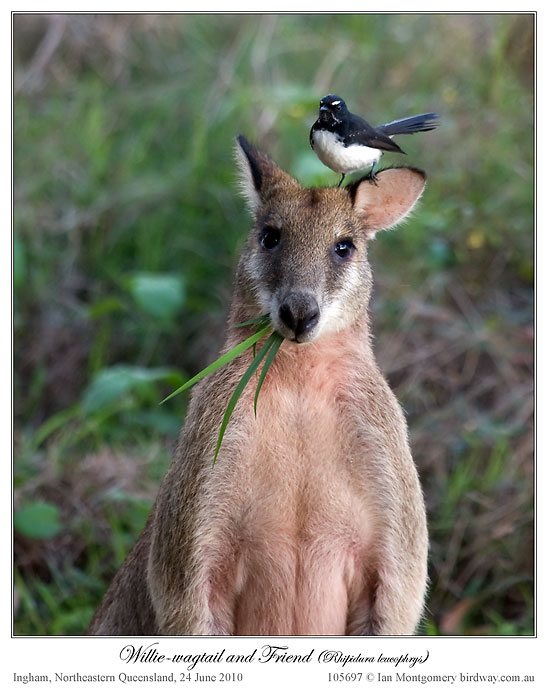
Very common birds like Willie-wagtails often get overlooked in the Bird of the Week in the pursuit of the rare and exotic. It takes the unusual antics of a particular individual to get noticed, such as this Willie-wagtail, perched cheekily on the head of an Agile Wallaby at Tyto Wetlands near Ingham last week.

Perhaps ‘unusual’ isn’t strictly true, as Graham Pizzey’s Field Guide to the Birds of Australia describes the behaviour of this species as: ‘bold, perky; watches from low branches, fence-posts … backs of farm-animals’. The wallaby might be offended at being described as a mere farm-animal, though this one seems to be doing its best to imitate a country yokel by chewing grass and assuming a dopey expression.

Willie Wagtail (Rhipidura leucophrys) on Wallaby by Ian Montgomery

Willie Wagtail (Rhipidura leucophrys) on Wallaby by Ian

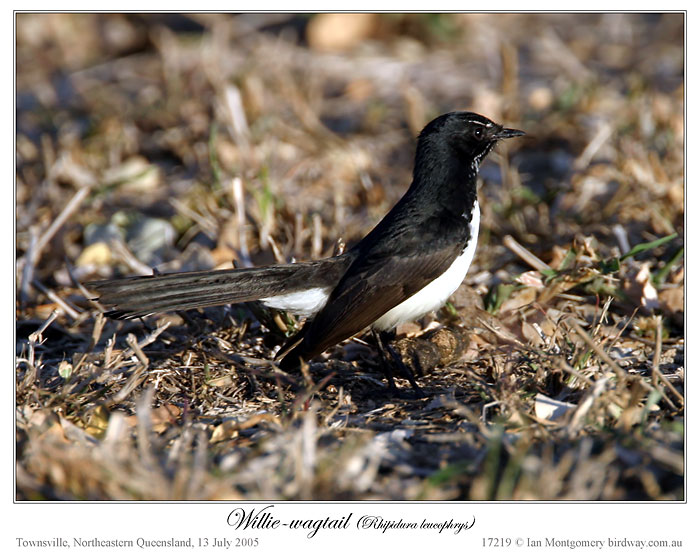
The Willie-wagtail is a popular and widespread species, occurring in a very wide range of habitats throughout Australia. It is absent from southern Tasmania and, for reasons not understood, curiously uncommon in the Townsville district, where the second photo was taken. It gets its name from its habit of fanning its tail and swinging it from side to side, (and spreading its wings) apparently to disturb the insects on which it feeds.

Back at the website, I’m continuing the task of updating all the family thumbnail pages. I’ve finished the first 100 families with only about 40 of the Passerine (perching bird) families to complete. Along the way, I’ve also added some new photos including ones of the following species:

Tawny Frogmouth
Burrowing Owl
Dollarbird
Red-backed Kingfisher
Yellow-billed Kingfisher

Best wishes,
Ian

Ian Montgomery, Birdway Pty Ltd,
454 Forestry Road, Bluewater, Qld 4818
Phone: +61-7 4751 3115
Preferred Email: ian@birdway.com.au
Website: http://birdway.com.au


Lee’s Addition:

I see Ian has a nice sense of humor. Love his description of the Wallaby. Neat little bird, thanks, Ian, for another great Bird of the Week.

Ian mentioned the birds as being “bold, perky; watches.” That brought to mind a few verses:

In the day when I cried out, You answered me, And made me bold with strength in my soul. (Psalms 138:3 NKJV)
The wicked flee when no one pursues, But the righteous are bold as a lion. (Proverbs 28:1 NKJV)
The eyes of the LORD are in every place, Keeping watch on the evil and the good. (Proverbs 15:3 NKJV)
Watch, stand fast in the faith, be brave, be strong. (1 Corinthians 16:13 NKJV)

The Wagtail is in the Rhipiduridae Family which includes all the Fantails, one Wagtail and one Silktail. The Order is the Passeriformes.

Below is a video of a Willie Wagtail on a rock, calling and waging tail, by Nick Talbot.

Ian’s Bird of the Week – White-rumped/Australian Swiftlet

White-rumped Swiftlet (Aerodramus spodiopygius) by Ian Montgomery

White-rumped Swiftlet (Aerodramus spodiopygius) by Ian

Ian’s Bird of the Week – White-rumped/Australian Swiftlet ~ by Ian Montgomery

Newsletter ~ 6-22-10

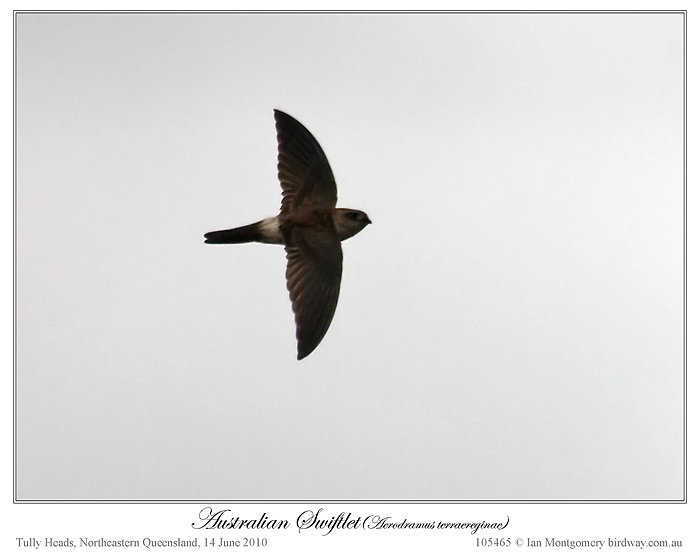
Swifts, true to their name, are a challenge to photograph but these White-rumped/Australian Swiftlets (more about names later) were feeding low over of a group of smallish trees, which helped.

These tiny birds (11-12cm/4.3-4.7in in length) are resident in Australia unlike their larger cousins, the Fork-tailed Swift and White-throated Needletail, and usually remain fairly close to their breeding caves. They are reasonably common in their restricted range of coastal northeastern Australia from the far north of New South Wales to Cape York in northern Queensland. Their sedentary nature is reflected in the existence of a paler race in the Chillagoe region of northeastern Queensland, only 130 km from the coast as the swift flies and much closer to the Atherton Tableland, where the nominate race is found.

Some species of swiftlet, including this one, use echo-location like bats to find their way around in caves, emitting a metallic clicking noise. There are about 26 species of swiftlet in Asia and Oceania, but only some if these echo-locate. Originally, they were (nearly) all put in the same genus Collocalia but in 1970, those species that use echo-location were moved to a separate genus Aerodramus. The White-rumped Swiftlet, Collocalia spodiopygius, was renamed Aerodramus spodiopygius.

White-rumped Swiftlet (Aerodramus spodiopygius) by Ian Montgomery

White-rumped Swiftlet (Aerodramus spodiopygius) by Ian

This was the start of a bumpy ride in the naming of these Australian swiftlets, which were then considered the same species as similar birds found in Micronesia and Polynesia. Recent DNA analysis supported the split into Aerodramus, but also suggested that the Australian birds (races terraereginae and chillagoensis) were sufficiently different to be treated as a separate species. Christidis and Boles (2008) support this recognition of the Australian Swiftlet, now named Aerodramus terraereginae. Meanwhile, Birdlife International has adopted neither the original split of Collocalia nor the recognition of the new species. So, we now have the confusion situation where both the English and Scientific names differ. So you could have someone from Birdlife International birdwatching in Queensland and saying ‘there is a White-rumped Swiftlet, Collocalia spodiopygius’ to Les Christidis who might respond, ‘looks like an Australian Swiftlet, Aerodramus terraereginae, to me!’.

And while we’re at it, terraereginae isn’t such a great name anyway, as It, whatever ‘It’ is, also occurs in northern New South Wales. Let me quote from an article in Wikipedia discussing the strengths of Linnaean taxonomy: ‘it can be used to organize the different kinds of living organisms, simply and practically. Every species can be given a unique (and hopefully stable) name, as compared with common names that are often neither unique nor consistent from place to place and language to language’. Hmmmm.

Back at the website, I hope I’ve finally reformatted all the pages that were causing problems in early versions of Internet Explorer. If you come across any that I’ve missed, please let me know (gently). I’ve resumed updating the family index pages and species galleries.

Best wishes,
Ian

Links:
White-rumped Swiftlet
Fork-tailed Swift
White-throated Needletail

Ian Montgomery, Birdway Pty Ltd,
454 Forestry Road, Bluewater, Qld 4818
Phone: +61-7 4751 3115
Preferred Email: ian@birdway.com.au
Website: http://birdway.com.au


Lee’s Addition:

Ian is having the same problems I am trying to keep up with the renaming and splitting and lumping of species. Keeps you busy when you have a website. Anyway, it is always interesting to see what bird Ian is going to expose us to each week. Hope you enjoy his newsletters as well as I do.

Even the stork in the heavens Knows her appointed times; And the turtledove, the swift, and the swallow Observe the time of their coming. But My people do not know the judgment of the LORD. (Jeremiah 8:7 NKJV)

The White-rumped (ex-Australian) Swiftlet (Aerodramus spodiopygius) is in the Apodidae Family. The Swiftlets, Swifts, Spinetails, Needletails, and Palm Swifts make up the family.

The Apodiformes Order includes the Aegothelidaes (Owlet-nightjars), Hemiprocnidaes (Treesifts), Apodidaes (Swifts), and the Trochilidaes (Hummingbirds).

So then, my beloved brethren, let every man be swift to hear, slow to speak, slow to wrath; (James 1:19 NKJV)

*

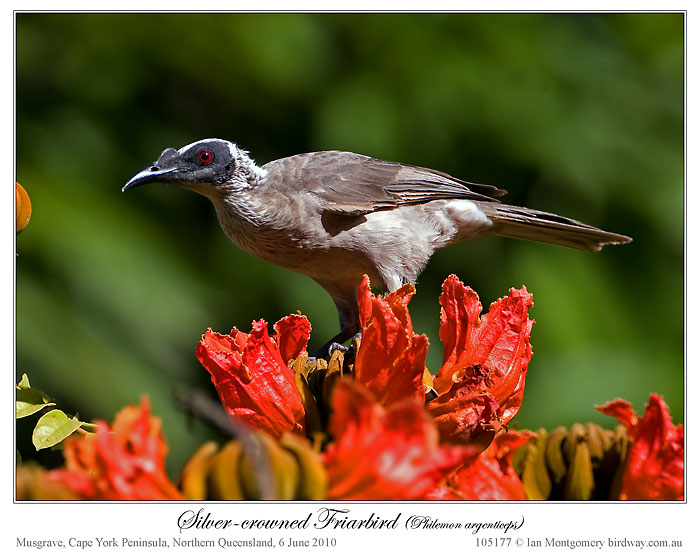
Ian’s Bird of the Week – Silver-crowned Friarbird

Silver-crowned Friarbird (Philemon argenticeps) by Ian

Silver-crowned Friarbird (Philemon argenticeps) by Ian

Ian’s Bird of the Week – Silver-crowned Friarbird ~ by Ian Montgomery

Last week, we had the splendid Palm Cockatoo at Mungkan Kandju National Park. On the way home, I spent the night at Musgrave, Cape York Peninsula, so that I could look for Golden-shouldered Parrots at Artemis Station where the owners, the Shephards, have worked tirelessly to save this utterly beautiful but endangered parrot. This featured as Bird of the Week last December, so I’ve chosen the Silver-crowned Friarbird as the main species this week.

Silver-crowned Friarbird (Philemon argenticeps) by Ian

Silver-crowned Friarbird (Philemon argenticeps) by Ian

At Musgrave, I camped under an African tulip tree, a popular ornamental introduction in northern Australia but now branded as a Class 3 weed in Queensland (may not be supplied or sold and removal may be required from environmentally sensitive areas). It is, however, very popular with the larger honeyeaters and after returning from Artemis, I noticed a smallish Friarbird feeding in the tree and making unfamiliar sounds, this Silver-crowned Friarbird, a species I’ve seen in the Northern Territory but not previously in northern Queensland, where the similar Helmeted Friarbird is much commoner.

The north Queensland race of the Helmeted Friarbird (yorki) also has a silver crown and frequently mid-identified. The Silver-crowned is better identified by its smaller size (27-32cm/11-12.6in compared with 32.5-37cm/12.8-14.6in), the shape of the bare patch on the cheek and the shape of the bill-knob. In the Silver-crowned Friarbird the black facial skin forms an angular point behind the eye but is rounded in the Helmeted. This isn’t always easy to see, so I have included the second photo which shows it better. The Silver-crowned has a more prominent bill-knob, but the knob is less obvious in juvenile birds of both species and variable in shape in the races of the Helmeted. The call is perhaps more reliable as the tone of the Silver-crowned is noticeably more nasal, sometimes described as ‘cat-like’ and also likened to the calls of the Koel. I’m rather deaf, but even I noticed the difference.

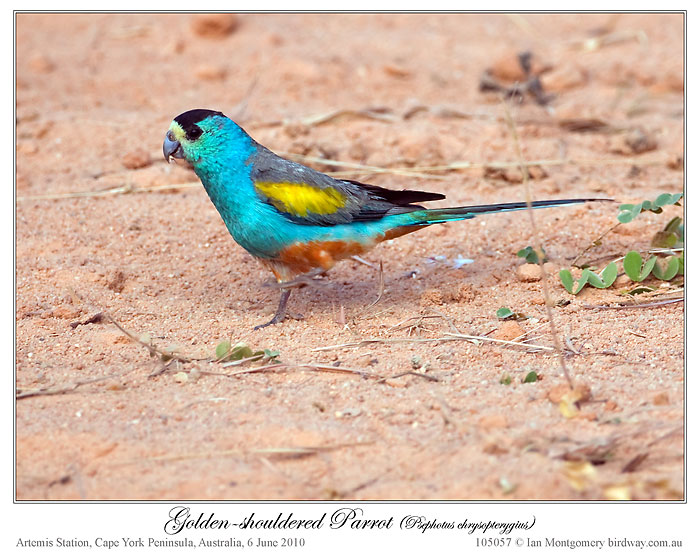
Golden-shouldered Parrot (Psephotus chrysopterygius) by Ian

Golden-shouldered Parrot (Psephotus chrysopterygius) by Ian

Sue Shephard found me a pair of Golden-shouldered Parrots feeding on the roadside and the male was quite approachable, so I’ve included a photo of this amazing parrot.

Back at the website, I’ve been labouring to fix the formatting problems discovered with old versions of Internet Explorer. I’ve fixed the home page and all the new format family index pages and am now updating the actual photo galleries. I’ve started with the galleries birds that appear at the top of the home page as ‘Ian’s Picks’, normally updated weekly, though I’ll leave the current crop for a few days longer.

As part of the reformatting, I’m adding a few refinements. In the family index pages, I’ve included ‘place-holders’ for regional thumbnail links that don’t apply (eg Australian Thumbnails for Woodpeckers) so that the regional thumbnail links always appear in the same location in both the family index pages and the species galleries and I’m including the other applicable regional thumbnail links in the regional index pages so that, for example, you can go straight from the Old World Woodpecker thumbnails to the New World Woodpecker thumbnails without having to go through the Global thumbnails.

I’ve also including the previous and next family pointers (and the names of the families) in the regional index pages so that, again, you don’t have to go to the Global level of thumbnails to get to the next or previous family. This all sounds more complicated that it actually is, so, if you are interested, have a look at the Woodpeckers: http://www.birdway.com.au/picidae/index.htm .

Best wishes,
Ian


Ian Montgomery, Birdway Pty Ltd,
454 Forestry Road, Bluewater, Qld 4818
Phone: +61-7 4751 3115

Preferred Email: ian@birdway.com.au
Website: http://birdway.com.au


Lee’s Addition:

Again, Ian has captured some fantastic photos of the birds. He has such a talent for his photography. Thanks again, Ian.

The Friarbirds are in the Meliphagidae Family of the Passeriformes Order.

The crown of the wise is their riches: but the foolishness of fools is folly. (Proverbs 14:24 KJV)

See also:
Ian’s Bird of the Week – Helmeted Friarbird

*

Ian’s Bird of the Week – Palm Cockatoo

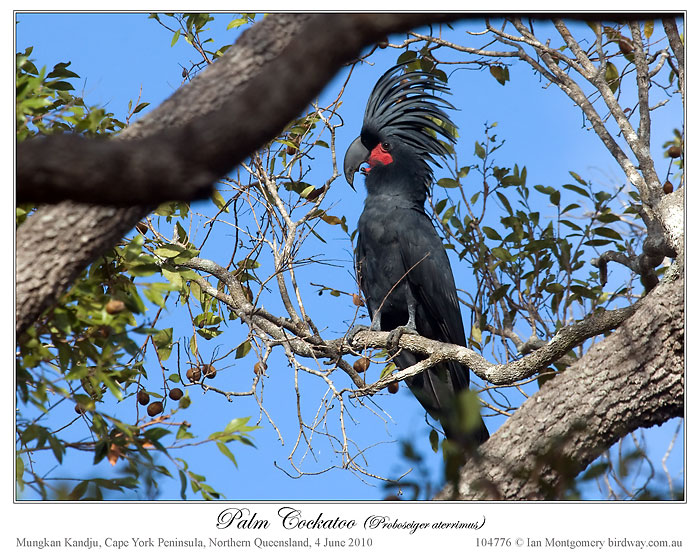
Palm Cockatoo (Probosciger aterrimus) by Ian

Palm Cockatoo (Probosciger aterrimus) by Ian Montgomery

Ian’s Bird of the Week – Palm Cockatoo ~ Ian Montgomery

I’ve just returned from Mungkan Kandju National Park between Coen and Weipa on Cape York Peninsula where I took part in the second of a series of Qld Parks and Wildlife surveys to measure the effect of feral animals on the park. It wasn’t all hard work, though, and during one of the surveys I got the opportunity to photograph a couple of Palm Cockatoos, my most ‘wanted’ bird on the Peninsula since I took some poor photos of them in early 2004 and again during the first Mungkan Kandju survey last November.

Palm Cockatoo (Probosciger aterrimus) by Ian

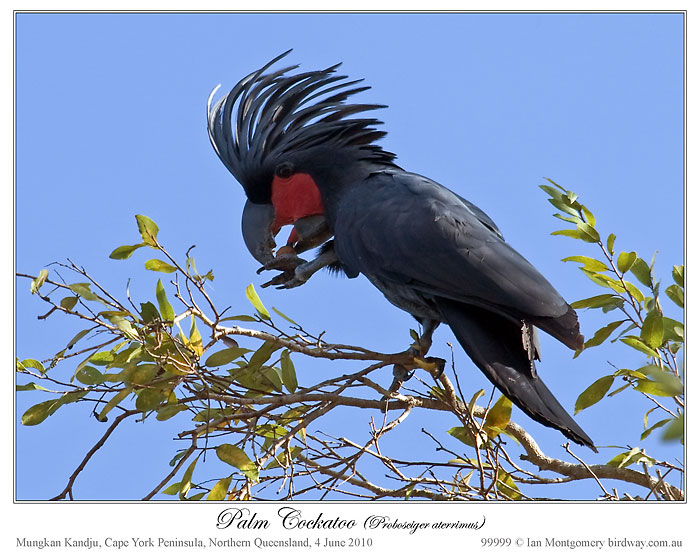
Palm Cockatoo (Probosciger aterrimus) by Ian

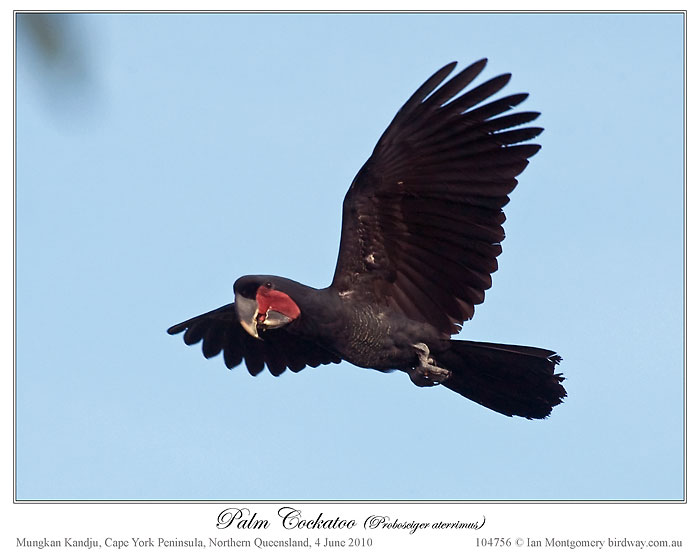
The first two photos show an adult Palm Cockatoo in a fruiting tree (Nonda Plum). Previously I’d found these birds rather shy, but the adult bird was prepared to tolerate me below the tree while it had breakfast. Palm Cockatoos are spectacular birds by any criterion,up to 64cm/24in in length, and unlike some cockatoos are not at all coy about displaying their huge crests. They have massive bills and in the second photo you can see the bird has evolved to be a huge nutcracker with wings. The lower bill is broad to prevent the fruit rolling out sideways while the upper bill has a big notch to hold the fruit in place and is slim and sharp like a blade. The tongue has a pad on the end used to manipulate the fruit, and if that isn’t enough the bird balances casually on one foot to leave the other free to use as a hand.

Palm Cockatoo (Probosciger aterrimus) by Ian

Palm Cockatoo (Probosciger aterrimus) by Ian

The third photos shows the other bird in flight. This is an immature bird, distinguishable by the barring on the chest, so I suppose that the adult bird was one of its parents. The young bird flew away when we approached and wasn’t seen again, but the adult seemed to think food was more important than parental care. Very young birds have a greyish rather than red face, so this one was old enough to look after itself.

Palm Cockatoos occur in Papua New Guinea and the Aru Islands but in Australia their range is restricted to the northern part of Cape York south to the Archer and Coen Rivers and Princess Charlotte Bay, so Mungkan Kandju is at the southern limit of their distribution. Within this range they are reasonably common on the edges of rainforest and in eucalyptus forest and they call loudly in flight.

I’m just about to post other photos of these birds to the website, so you can check them out at http://www.birdway.com.au/cacatuinae/palm_cockatoo/index.htm .

Best wishes,
Ian

Ian Montgomery, Birdway Pty Ltd,
454 Forestry Road, Bluewater, Qld 4818
Phone: +61-7 4751 3115
Preferred Email: ian@birdway.com.au
Website: http://birdway.com.au


Lee’s Addition:
The Palm Cockatoo is part of the Cockatoos & Allies – Cacatuidae Family in the Psittaciformes Order. This Order includes not only the Cockatoos, but also the New Zealand Parrot (Strigopidae) and Parrot (Psittacidae) families.

What magnificent birds the Lord has created in this Order.  Many of these have been captured and tamed, but is is nice to see these photos of the birds out in the wild.

For every kind of beasts, and of birds, and of serpents, and of things in the sea, is tamed, and hath been tamed of mankind: (James 3:7 KJV)

*

Ian’s Bird of the Week – Whistling Kite

Whistling Kite (Haliastur sphenurus) by Ian

Whistling Kite (Haliastur sphenurus) by Ian

Ian’s Bird of the Week – Whistling Kite  ~ by Ian Montgomery

I’ve just revised the eagle, hawk and allies galleries (Acciptridae http://www.birdway.com.au/accipitridae/index.htm ) on the website with the new format, larger image sizes and regional indices with different background colours. Eagles and hawks attract great interest generally and are the most popular targets for internet searches on the website. They’re also popular with birders and are a challenge to identify in flight, so a good place to start is the widespread and common Whistling Kite – the one we probably check most often to make sure it isn’t something more unusual like a Square-tailed Kite or Little Eagle.

Whistling Kite (Haliastur sphenurus) by Ian

Whistling Kite (Haliastur sphenurus) by Ian

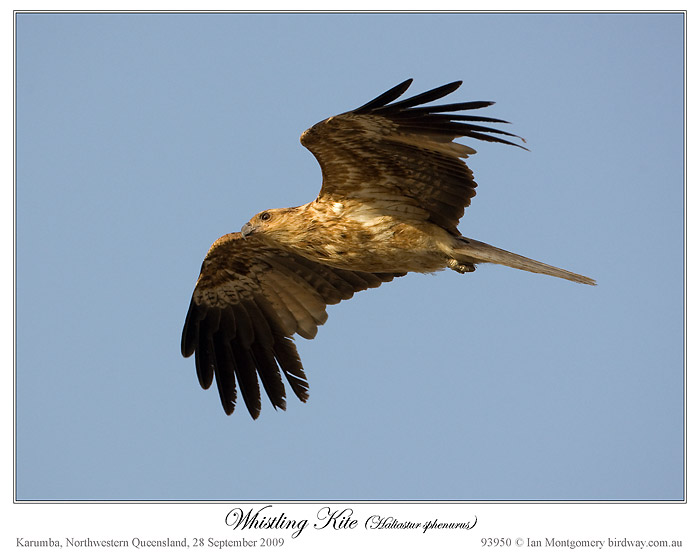
At 50-60cm/20-24in in length and with a wingspan of about 1.2m/47in, the Whistling Kite is just one of about a dozen Australian species of raptors in this size range and with colours in varying shades of coffee. So, leaving size and beverages aside, identification relies on other features particular underwing pattern, relative sizes and shapes of wings and tail and style of flight. As you can see in the first two photos, Whistling Kites have distinctive wing patterns, with the most notable feature being the contrasting outer very dark primaries*, very pale 3 or 4 inner primaries and very dark secondaries. The resulting pattern is a white spot on the trailing edge of the wing and a pale right-angle formed by the leading under-wing coverts and the pale primaries. This is diagnostic: other raptors have pale patches – windows or bull-eyes – but usually in the ‘palm’ of the hand or the leading edge and lack an abrupt right-angle.

Whistling Kite (Haliastur sphenurus) by Ian

Whistling Kite (Haliastur sphenurus) by Ian

*The primary flight feathers, usually numbering 9 -11 inmost species of birds (except Grebes, Storks and Flamingos – 12 –  and Ostriches – 16) and are attached to the ‘hand’ part of the wing (metacarpals and phalanges of the large second digit). The secondaries, very variable in number, are attached to the ulna of the ‘forearm’ between the ‘elbow’ (not obvious in birds as the humerus is short and thick for attachment of the large pectoral muscle) and the ‘wrist’ – the forward-pointing angle in the middle of the leading edge.

Whistling Kite (Haliastur sphenurus) by Ian

Whistling Kite (Haliastur sphenurus) by Ian

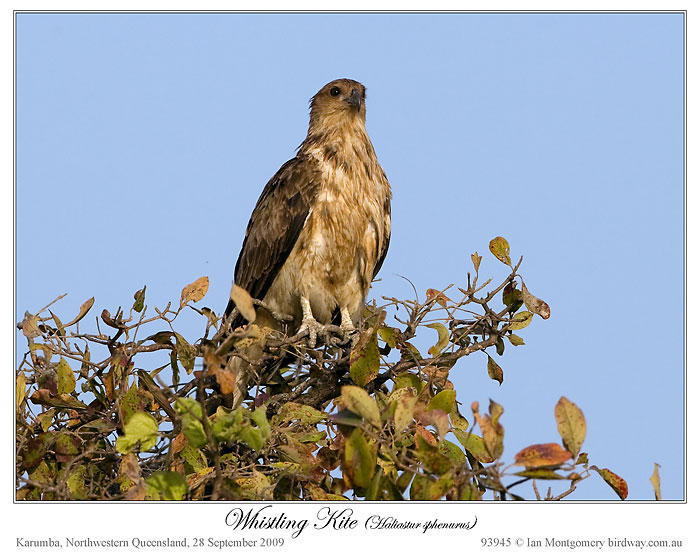
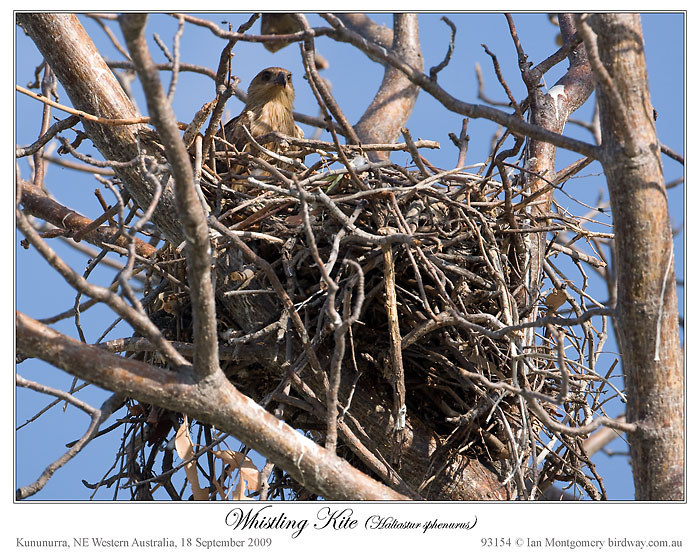
The tail of the Whistling Kite is characteristic too: long, latte coloured and paddle-shaped with a rounded and you can see in the first that the Whistling Kites swivel the tail like a paddle for steering. Most other raptors have darker tails with barring – the Whistling Kite has faint, barely visible bars. Whistling Kites glide with horizontally curved – rather than flat or angled wings – a bit like seagulls one draws as a kid and have a rather floppy untidy flight. When perched, they usually do so in an upright stance, rather like a Brown Falcon, as in the third photo. They build a typical raptor nest – bulky, with large sticks – high in a tree and re-used so that it gets very large after a number of years.

The Whistling Kite gets its name from its distinctively un-raptor-like call. Its is common throughout Australia except in the driest areas of western South Australia and eastern Western Australia. They take live prey including fish, so they are frequenty found near both fresh and salt water, but also feed on carrion and are often seen cruising along highways, along with Black Kites, Brahminy Kites and Wedge-tailed Eagles, looking for road-kills. Their only close relative is the Brahminy Kite, and these two species comprise (globally) the genus Haliastur.

Back at the website, I’ve applied the new format to the Cockatoos and Estrildid Finches, both also popular targets:
Best wishes,
Ian

Ian Montgomery, Birdway Pty Ltd,
454 Forestry Road, Bluewater, Qld 4818
Phone: +61-7 4751 3115
Preferred Email: ian@birdway.com.au
Website: http://birdway.com.au

Lee’s Addition:
Ian has been working hard on his website and it is really looking good. Ian, I like the new format. Click on his links for some really nice photographs of birds and other critters. Birdway.com.au
From his site, “28 May 2010: this site contains more than 5,000 photos of 1,234 bird species in the wild – 596 of these are on the main Australian list of Christidis & Boles, 2008 – and 83 photos of 23 species of reptiles and Australian mammals.”

And the vulture, and the kite after his kind; (Leviticus 11:14 KJV)

The Kite is a member of the Accipitridae Family and has 250 members. They are in the Accipitriformes Order. The family has Kites, Hawks, Eagles, and their allies. The Kite is also one of the Birds of the Bible and is in the “unclean” list of birds not to be eaten.

*

Ian’s Bird of the Week – Splendid Fairy-wren

Splendid Fairywren (Malurus splendens) by Ian Montgomery


Ian’s Bird of the Week – Splendid Fairy-wren  ~  Ian Montgomery

Newsletter – 5/25/10

It has been about 4 years since a Fairy-wren featured as Bird of the Week. It’s not for nothing that the Superb Fairy-wren made the list (No. 78) in David Chandler and Dominic Couzens’s ‘100 Birds to See before You Die’, so let’s rectify that with the Splendid Fairy-wren.

Splendid Fairywren (Malurus splendens) by Ian Montgomery

Splendid Fairywren (Malurus splendens) by Ian

All the male Fairy-wrens are stunningly beautiful and some of their names reflect that: Superb, Splendid and Lovely before getting to more prosaic names like Purple-crowned and Variegated. Maybe the bird-namers should have consulted the thesaurus. Mine includes (under splendid): spiffy, ritzy, glorious, lavish, swanky and sublime; ‘imperial’ might fit the Purple-crowned well. Anyway, the Splendid lives up to its name, as you can see in the first photo, even if ‘splendid’ has connotations of grand, perhaps inappropriate for a tiny bird 14cm/5.5in in length, much of which is tail.

It’s not as well known as the Superb, which occurs in all the southeastern Australia capitals from Brisbane to Adelaide via Hobart, but the Splendid rules supreme in Perth. As addition, it has wide range throughout Australia east of the Great Divide with three distinct races in eastern, central and western Australia. The one in the first and second photos is the eastern race melanotus, photographed in southwestern Queensland, identifiable by it cobalt- rather than violet-blue colour, paler cheek patch, narrow breast band and black back – visible in the second photo – with the latter giving this race its other name of Black-backed Fairy-wren. Incidentally, Fairy-wrens are unrelated to Northern Hemisphere wrens and together with the grasswren and emu-wrens comprise the Australo-Papuan family Maluridae.
Splendid Fairywren (Malurus splendens) by Ian Montgomery

Splendid Fairywren (Malurus splendens) by Ian

The third photo shows a male of the nominate western race in transition from non-breeding to breeding plumage. Fairy-wrens, like some very colourful ducks such as the Mallard, shed their bright colours in the non-breeding plumage and acquire the ‘eclipse’ plumage. This is similar to that of the female, though eclipse male fairy-wrens are often subtly different from females and young birds. In the case of Splendid Fairy-wrens, the eclipse male is distinguishable from the female by having a dark rather than tan bill, greyish rather than tan eye-ring, dark lores (between the eye and the bill) and blue wings.

Best wishes,
Ian

Links: Fairywrens


Ian Montgomery, Birdway Pty Ltd,
454 Forestry Road, Bluewater, Qld 4818
Phone: +61-7 4751 3115
Preferred Email: ian@birdway.com.au
Website: http://birdway.com.au


Lee’s Addition:The Splendid Fairywren is in the Maluridae Family which includes the 29 Australasian Wrens (Fairywren, Emu-wren, and Grasswren). They are in the Passeriformes Order.

Great are the works of the LORD; They are studied by all who delight in them. Splendid and majestic is His work, And His righteousness endures forever. He has made His wonders to be remembered; The LORD is gracious and compassionate. (Psalms 111:2-4 NASB)

Ian’s Bird of the Week – Cattle Egret

Western Cattle Egret (Bubulcus ibis) by Ian Montgomery

Eastern Cattle Egret (Bubulcus coromandus) by Ian Montgomery

Ian’s Bird of the Week – Cattle Egret   by Ian Montgomery

Eastern Cattle Egret (Bubulcus coromandus)2 by Ian Montgomery

Eastern Cattle Egret (Bubulcus coromandus)2 by Ian Montgomery

At a time when wildlife populations are generally under pressure, here is a success story about a species of bird, the Cattle Egret, that has undergone a spectacular world-wide expansion in range over the past century of or so.

In the 19th century, the Cattle Egret occurred only in tropical and subtropical Africa, southwestern Europe (the nominate race, Ardea ibis ibis) and in southern and southeastern Asia (the distinctive race Ardea ibis coromandus). Now, it breeds in every continent except Antarctica, though it turns up as a vagrant on sub-antarctic islands such as South Georgia and the South Orkney Island. Originally adapted to feeding with large herbivores, its expansion has followed the of spread humans with their livestock.

The expansion started in southern Africa with breeding first recorded in Cape Province in 1908. At about the same time, vagrants started crossing the Atlantic to eastern South America, where it probably became established in the 1930s but breeding was not proven until 1950 in Surinam and British Guiana. Some birds were reported in Florida in the 1940s and breeding was recorded in 1953. Since then, the species has spread all over South and Central America, much of the United States into Canada and has simultaneously expanded its range in southern Europe and the Middle East.

Eastern Cattle Egret (Bubulcus coromandus)3 by Ian Montgomery

Eastern Cattle Egret (Bubulcus coromandus)3 by Ian Montgomery

Concurrently, the Asian race was extending its range southeastwards and arrived in the Northern Territory in the 1940s. Cattle Egrets were first record in Victoria in 1949, southwestern Western Australia in 1959, South Australia in 1964, Tasmania in 1965 and started breeding in Queensland in 1963, the same year in which they were first recorded in New Zealand. Now, it is an abundant breeding bird in the warmer parts of Australia and mainly a winter and spring visitor to southern Australia, Tasmania and New Zealand.

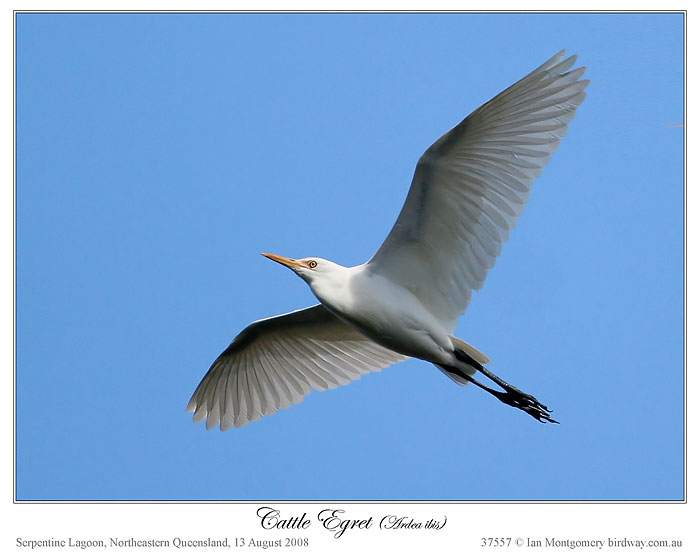
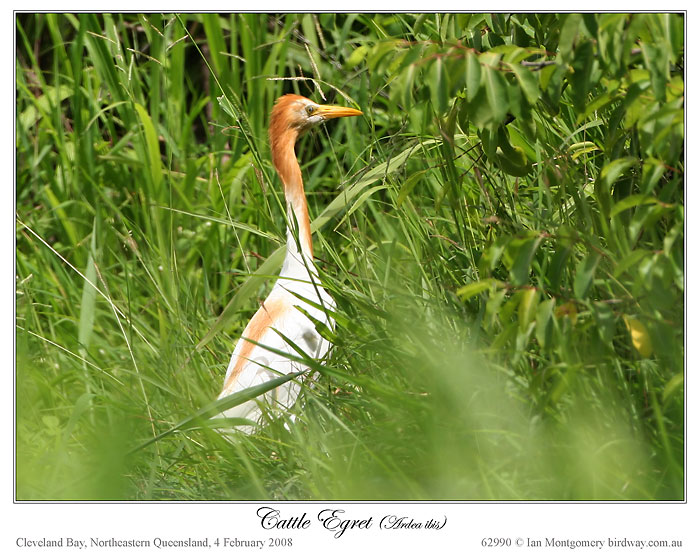
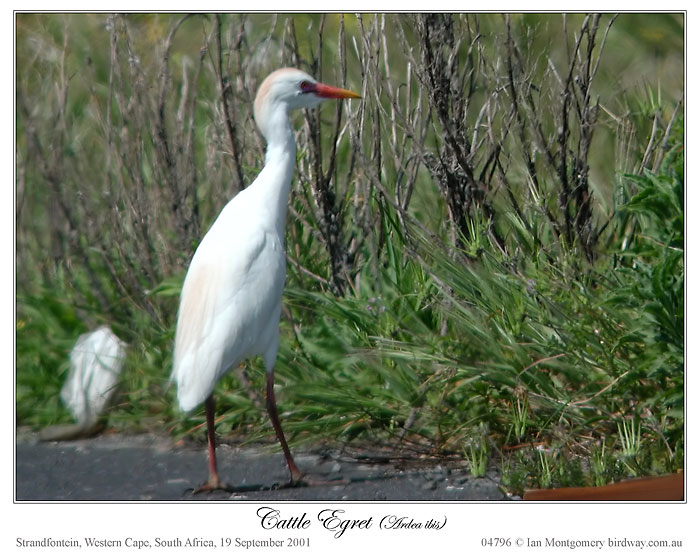
In non-breeding plumage, the feathers are almost entirely white (first photo, bird in flight) apart from traces of buff on the crown and looks like a dumpy version of the Intermediate Egret. When breeding the Asian/Australian race has extensive gold on the head, back and breast (second photo) and looks quite different from the much paler eastern race (third photo). The bird in the latter photo is perhaps atypically pale for an eastern bird, but it has the reddish bill, legs and iris that are the courtship colours of both races.

Eastern Cattle Egret (Bubulcus coromandus)4 by Ian Montgomery

Eastern Cattle Egret (Bubulcus coromandus)4 by Ian Montgomery

The fourth photo shows several Cattle Egrets standing guard in a proprietary manner around some young Brahmins at the Orient Wetland north of Townsville last Friday. Although they are very gregarious, the dominant birds exclude other birds from the favoured feeding spots just behind grazing animals. They feed mainly on grasshopper and other invertebrates disturbed by herbivores but are flexible and will eat a wide variety of other food including young birds. So, the global expansion has a dark side and I recently read an article, thank you Jeri, expressing concern about predation by Cattle Egrets on the nesting colonies of the Red-winged Blackbird in California (http://tricolor.ice.ucdavis.edu/ ).

Meanwhile back at the website, following last week’s release of the revised home page, I’ve been working on redesigning the family pages and species galleries to make them neater and easier to use. It will take time before the revisions get generally applied but you might like to check out the Crane family thumbnails(http://www.birdway.com.au/gruidae/index.htm ), colour-coded by region, and the Brolga gallery with larger images (http://www.birdway.com.au/gruidae/brolga/index.htm ). I’ve also increased the size of the photos in this week’s bird of the week. This will mean that I’ll probably often exceed the intended limit of 200KB for the weekly posting. Let me know if this is going to be a problem, but I suppose most of us now have broadband internet.

Best wishes,
Ian

Ian Montgomery, Birdway Pty Ltd,
454 Forestry Road, Bluewater, Qld 4818
Phone: +61-7 4751 3115
Preferred Email: ian@birdway.com.au
Website: http://birdway.com.au


Lee’s Addition:

The Cattle Egret is now, according to the I.O.C., divided into 2 species. The Eastern Cattle Egret (Bubulcus coromandus) and the Western Cattle Egret (Bubulcus ibis). The Eastern breeds in Asia and Australasia, and the western nominate form occupies the rest of the species’s range. Here in the United States, we have the Western Cattle Egret. Those of us who live here in Florida see them all the time, just like in Ian’s forth picture. You will see one or more per cattle. They love to stand right by them and look for bugs or whatever as the cows pull up the grass to eat. They seem to get along and the cattle don’t seem to mind them standing there, almost in their face sometimes. Thanks, Ian, for more great photos and information.

The Cattle Egrets are part of the Ardeidae Family which has Herons, Egrets and Bitterns. They are in the Pelicaniformes Order.

Now behold, I Myself do establish My covenant with you, and with your descendants after you; and with every living creature that is with you, the birds, the cattle, and every beast of the earth with you; of all that comes out of the ark, even every beast of the earth. (Genesis 9:9-10 NASB)


Family#26 – Ardeidae
*

Ian’s Bird of the Week – Striped Honeyeater

Striped Honeyeater (Plectorhyncha lanceolata) by Ian

Striped Honeyeater (Plectorhyncha lanceolata) by Ian

Ian’s Bird of the Week – Striped Honeyeater – by Ian Montgomery

I’ve been slow to produce this week’s bird as I’ve been burning the midnight oil rewriting the home page of the website – more about that later.

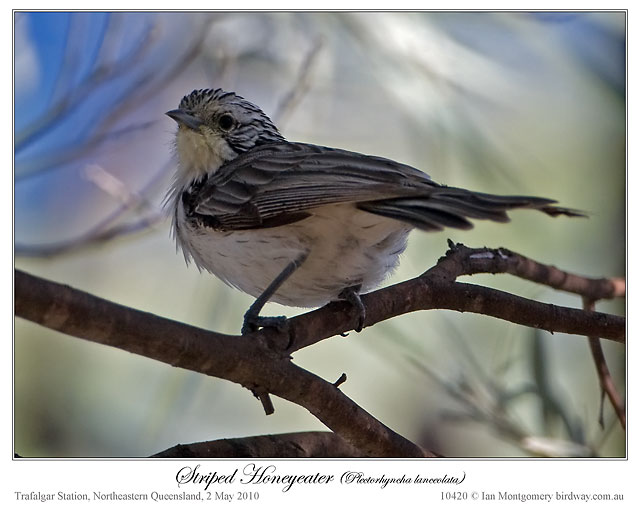
Last week we had the Southern Bookbook from a rewarding evening of spotlighting at Trafalgar Station south of Charters Towers. Daytime birding there produced some interesting birds, notably a Pictorella Mannikin among some Plum-headed Finches and pair of Striped Honeyeaters. this is an uncommon Honeyeater with some unusual features and, being in its genus, is not closely related to other Honeyeaters.

Striped Honeyeater (Plectorhyncha lanceolata) by Ian

Striped Honeyeater (Plectorhyncha lanceolata) by Ian

One such feature is a very un-honeyeater-like call that first attracted our attention. The field guides agree that it is mellow, rollicking or rolling, and rising and falling. To me it sounded like a loud gerygone, the rusty bicycle wheel of a Mangrove or Large-billed maybe, but I’m a bit deaf and you mightn’t agree. In appearance it is rather dapper, and seems formally dressed for the drier, fairly casual areas of eastern Australia in which it occurs, from the Spencer Gulf in South Australia to Cooktown in NE Queensland.

It shows its affinity with honeyeaters by having a brush tongue for nectar, but the narrow, pointed bill, shown in the second photo is in fact adapted to supplementing a sugary diet by probing for insects and orther invertebrates as illustrated by the bird in the third photo, which has just found a spider in some mistletoe. The trees are mulga, a dry country acacia, and typical habitat for Striped Honeyeaters, I included the second photo, as it isn’t often one gets to photograph birds from above, a bird’s eye view so to speak, unless they are acrobatic like these in search of food.

Striped Honeyeater (Plectorhyncha lanceolata) by Ian

Striped Honeyeater (Plectorhyncha lanceolata) by Ian

I’ve redone the home page to make it easier to find photos of the more than 1,200 species in the 142 families now represented. The main change is the inclusion of a set of 142 family thumbnails – called Instant Links to Bird Families – in taxonomic sequence to take you directly to the species thumbnails for each family. The family thumbnails have been selected to show a typical member of the family, and each one has a list of the included species which will appear if you hold the cursor over the thumbnail. If you know or can guess in which family to look, you can find out, without leaving the home page, whether a particular species is present in the website.

Having clicked on a family thumbnail, the species thumbnails then allow you to go directly to view the first photo of a particular species and the thumbnails of other photos of that species. You can therefore find and view any of the now more than 5,000 photos in just three clicks. All the 5,000 photos have both family thumbnail button(s) for global and regional thumbnails and home page buttons, so you can then move back up to the family level or return directly to the home page to repeat the process for an unrelated species.

To make room for the new Instant Links, I’ve moved the ‘Recent Additions’ to a horizontal, scrollable row of (currently more than 70) thumbnails. The most recent additions are visible on the left, older ones are revealed by scrolling to the right. Future thumbnails will include a message – viewable in the same way as the family thumbnail list by holding the cursor over the thumbnail – about the date of the addition and the number of new photos; current ones just have a message to the effect ‘Click here to go to the gallery of  . . ‘.
Links:
Instant Links to Bird Families http://www.birdway.com.au/#families
Recent Additions http://www.birdway.com.au/#updates
Southern Boobook http://www.birdway.com.au/strigidae/southern_boobook/index.htm
Pictorella Mannikin http://www.birdway.com.au/estrildidae/pictorella_mannikin/index.htm
Plum-headed Finch http://www.birdway.com.au/estrildidae/plum_headed_finch/index.htm
Best wishes,
Ian

Ian Montgomery, Birdway Pty Ltd,
454 Forestry Road, Bluewater, Qld 4818
Phone: +61-7 4751 3115
Preferred Email: ian@birdway.com.au
Website: http://birdway.com.au


Lee’s Addition:

Striped Honeyeaters are in the Meliphagidae – Honeyeaters Family of the Passeriformes Order. There are 142 members in that family.
*