Here am I, Where are You?

Always Honking

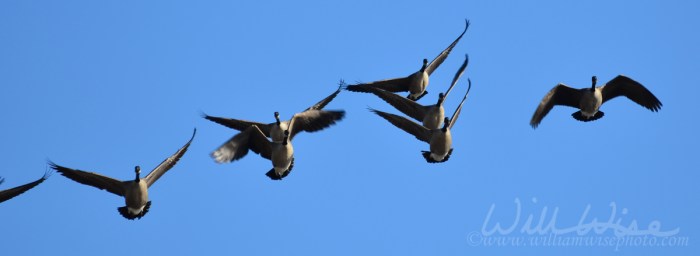
Honk…honk…honk!” Before you ever see the birds’ characteristic black heads and white cheek patches, you identify Canada Geese coming as they honk across the sky in their typical V-shaped pattern. It seems Canada Geese are always vocal; on the ground, in the air, while feeding, when waking up, just before they sleep… they are always honking.
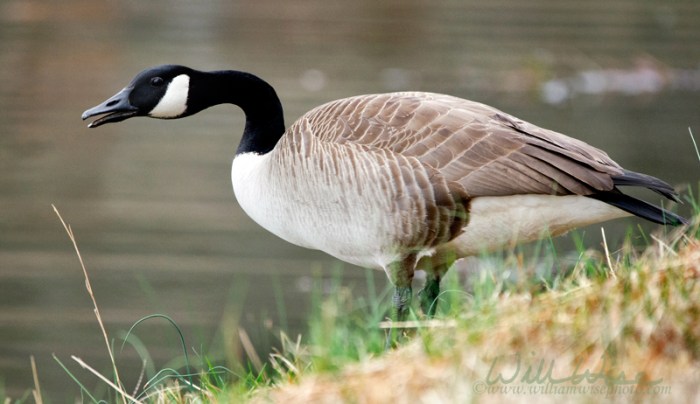
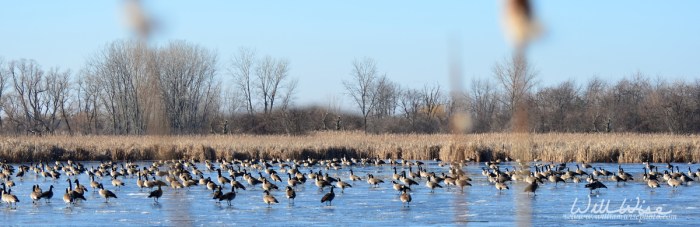
So that begs the question: what are they honking about? What are they saying? Biologists tell us they honk to keep family groups together; they honk to communicate rest or feeding areas; they honk to alert others of danger or predators; or, especially the younger birds, they just “go off with a jag of honking that seems to serve no other purpose than sheer exuberance – the expression of joy and excitement over the ability to fly with their friends and family.” 

Keeping it Together

Birds face many hazards during migration. Facing often severe weather and high winds, some may get blown off course or get caught in a storm. Inexperienced birds may chart a wrong course and fatally collide with tall buildings, windows, and other structures, or risk being shot by hunters. It is during the hardships of migration that honking becomes so important to Canada Geese. The blinding snow and rain, or thick fog, may make it impossible to see one another. So, as they toil through the sky, they honk to keep their flock together.

The geese are talking to one another. Each is saying to its companions, ‘Here am I… where are you? Here am I… where are you?’ Aloft in storm and cloud, the voices hold the flock together. They speak out loudly against wind and distance so that others of their kind, strayed or lost, may know the way. Under fair sky the calls continue for reassurance and to reassure. ‘Come along, do not tire. We are on the right course and will soon stop for rest.’ It is no fable, but a truth of nature; experienced elders lead the way.

Magnificent Voyagers, Waterfowl of North America

The experienced elder goose is leading the way with his honking, while the others follow honking encouragement to the others to keep to the course and not quit the flight. The grounded geese that left the flock because of weariness or injury can hear the incessant calling, “Here am I… where are you?” and rejoin their migrating families. It is the duty of those still in flight and on course to call out to their lost and weary relations to come back and return to the path.
Calling Out to Others

In life, many people around us may fly the wrong course or succumb to the hazards of life: failure and defeat, drugs and alcohol, apathy or crime. We have a duty to our fellow man to fly the right course and to lead them in a safe direction. We are to be leaders in our schools, on our jobs, in our families. We have a duty to not leave behind the weak and weary, and to help others to the safe places of rest and success that have been shown to us.

As Christians, we all have a duty to “honk” as the Canada Goose: “Here am I…where are you?” There are many – family members, friends, coworkers, schoolmates – that are lost and on the wrong course. They will never find the right course and follow Jesus if we, the ones that know the right path, don’t call out to them to follow. 

The New Living Translation of Romans 10:14 states, “But how can they call on him to save them unless they believe in him? And how can they believe in him if they have never heard about him? And how can they hear about him unless someone tells them?” If we remain silent, they will never find the way. Our constant, clear call of “Here am I…where are you? Here Am I…where are You?” makes it ever known to them to where they can return when they tire of the life of sin. ​
Where are You?

Before you can lead others and call “Here am I…”, do you know where you are heading? Are you on the narrow path that leads to life? If not, follow the voice of the Savior who “calls you out of darkness into His wonderful life” (I Peter 2:9). And if you do know the course, never quit your duty of calling out to those who are lost or weary. Like the geese that seem to never quit honking, so should you never cease making the call: “Here am I…where are you?  Here am I…where are you?


Hi, I’m wildlife photographer and nature writer William Wise. I was saved under a campus ministry while studying wildlife biology at the University of Georgia. My love of the outdoors quickly turned into a love for the Creator and His works. I’m currently an animal shelter director and live in Athens, Georgia with my wife and two teenage daughters, who are all also actively involved in ministry. Creation Speaks is my teaching ministry that glorifies our Creator and teaches the truth of creation. I am also a guest author at Lee’s Birdwatching Adventures and The Creation Club. — “What a wildly wonderful world, God! You made it all, with Wisdom at Your side, made earth overflow with your wonderful creations.” Psalms 104, The Message.
How To Know A Woodpecker – The Woodpeckers

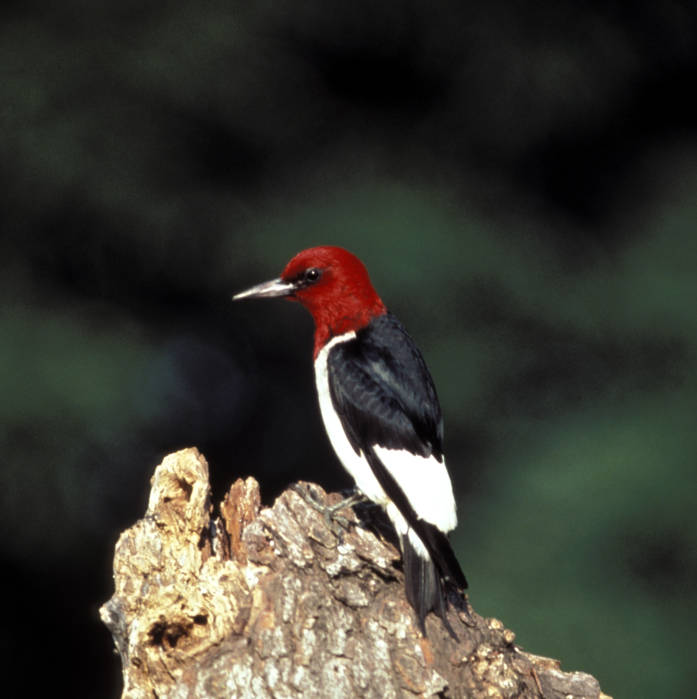
Red-headed Woodpecker (Melanerpes erythrocephalus) ©USFWS

Red-headed Woodpecker (Melanerpes erythrocephalus) ©USFWS


Chapter I

HOW TO KNOW A WOODPECKER

The woodpecker is the easiest of all birds to recognize. Even if entirely new to you, you may readily decide whether a bird is a woodpecker or not.

The woodpecker is always striking and is often gay in color. He is usually noisy, and his note is clear and characteristic. His shape and habits are peculiar, so that whenever you see a bird clinging to the side of a tree “as if he had been thrown at it and stuck,” you may safely call him a woodpecker. Not that all birds which cling to the bark of trees are woodpeckers,—for the chickadees, the crested titmice, the nuthatches, the brown creepers, and a few others like the kinglets and some wrens and wood-warblers more or less habitually climb up and down the tree-trunks; but these do it with a pretty grace wholly unlike the woodpecker’s awkward, cling-fast way of holding on. As the largest of these is smaller than the smallest woodpecker, and as none of them (excepting only the tiny kinglets) ever shows the patch of yellow or scarlet which always marks the head of the male woodpecker, and which sometimes adorns his mate, there is no danger of making mistakes.

Blue Nuthatch (Sitta azurea) by Ian

Blue Nuthatch (Sitta azurea) by Ian

The nuthatches are the only birds likely to be confused with woodpeckers, and these have the peculiar habit of traveling down a tree-trunk with their heads pointing to the ground. A woodpecker never does this; he may move down the trunk of the tree he is working on, but he will do it by hopping backward. A still surer sign of the woodpecker is the way he sits upon his tail, using it to brace him. No other birds except the chimney swift and the little brown creeper ever do this. A sure mark, also, is his feet, which have two toes turned forward and two turned backward. We find this arrangement in no other North American birds except the cuckoos and our one native parroquet. However, there is one small group of woodpeckers which have but three toes, and these are the only North American land-birds that do not have four well-developed toes.

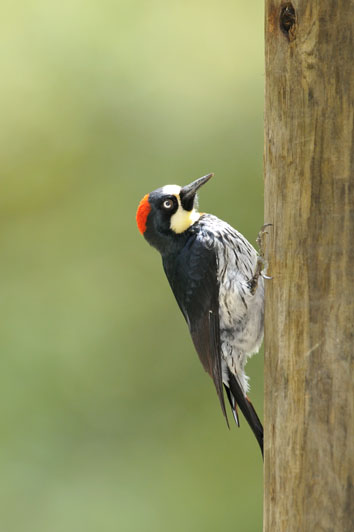
Acorn Woodpecker (Melanerpes formicivorus) by Reinier Munguia

Acorn Woodpecker (Melanerpes formicivorus) by Reinier Munguia

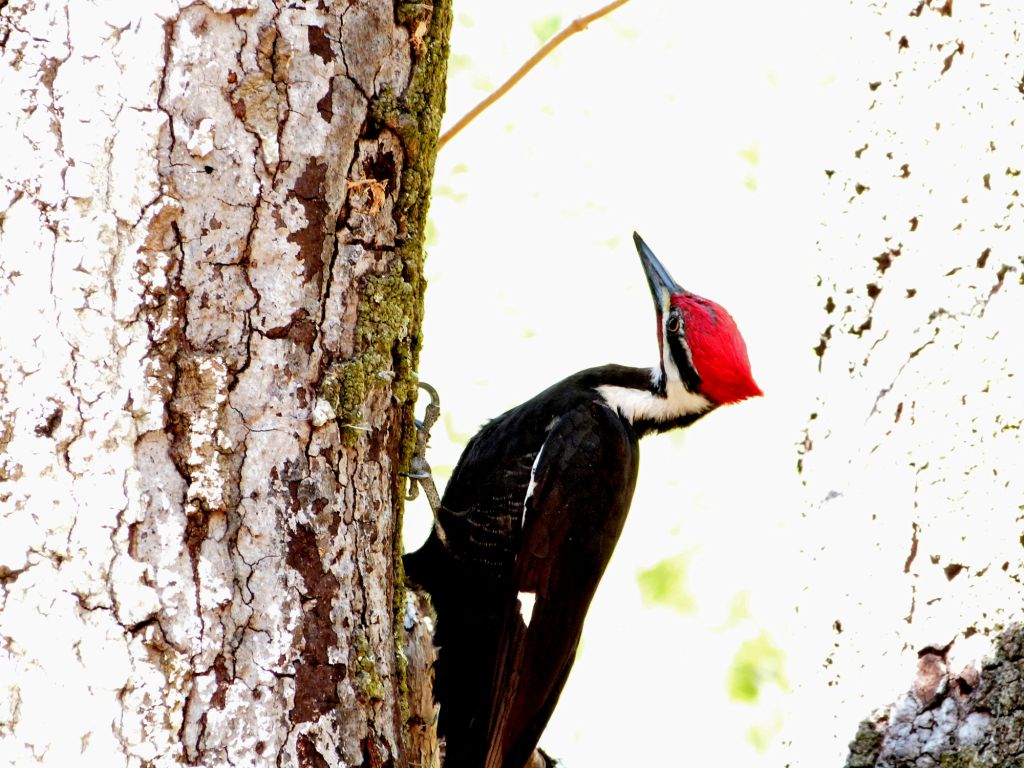
In coloration the woodpeckers show a strong family likeness. Except in some young birds, the color is always brilliant and often is gaudy. Usually it shows much clear black and white, with dashes of scarlet or yellow about the head. Sometimes the colors are “solid,” as in the red-headed woodpecker; sometimes they lie in close bars, as in the red-bellied species; sometimes in spots and stripes, as in the downy and hairy; but there is always a contrast, never any blending of hues. The red or yellow is laid on in well-defined patches—square, oblong, or crescentic—upon the crown, the nape, the jaws, or the throat; or else in stripes or streaks down the sides of the head and neck, as in the logcock, or pileated woodpecker.

Pileated Woodpecker by Lee

Pileated Woodpecker by Lee

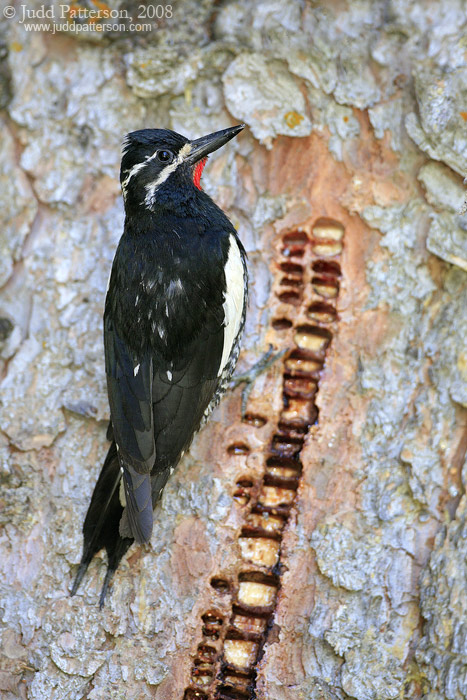
There is no rule about the color markings of the sexes, as in some families of birds. Usually the female lacks all the bright markings of the male; sometimes, as in the logcock, she has them but in more restricted areas; sometimes, as in the flickers, she has all but one of the male’s color patches; and in a few species, as the red-headed and Lewis’s woodpeckers, the two sexes are precisely alike in color. In the black-breasted woodpecker, sometimes called Williamson’s sapsucker, the male and female are so totally different that they were long described and named as different birds. It sometimes happens that a young female will show the color marks of the male, but will retain them only the first year.

Williamson's Sapsucker (Sphyrapicus thyroideus) by Judd Patterson

Williamson’s Sapsucker (Sphyrapicus thyroideus) by Judd Patterson

Though the woodpeckers cling to the trunks of trees, they are not exclusively climbing birds. Some kinds, like the flickers, are quite as frequently found on the ground, wading in the grass like meadowlarks. Often we may frighten them from the tangled vines of the frost grape and the branches of wild cherry trees, or from clumps of poison-ivy, whither they come to eat the fruit. The red-headed woodpecker is fond of sitting on fence posts and telegraph poles; and both he and the flicker frequently alight on the roofs of barns and houses and go pecking and pattering over the shingles. The sapsuckers and several other kinds will perch on dead limbs, like a flycatcher, on the watch for insects; the flickers, and more rarely other kinds, will sit crosswise of a limb instead of crouching lengthwise of it, as is the custom with woodpeckers.

Northern Flicker (Colaptes auratus) Red-shafted ©WikiC

Northern Flicker (Colaptes auratus) Red-shafted ©WikiC

All these points you will soon learn. You will become familiar with the form, the flight, and the calls of the different woodpeckers; you will learn not only to know them by name, but to understand their characters; they will become your acquaintances, and later on your friends.

This heavy bird, with straight, chisel bill and sharp-pointed tail-feathers; with his short legs and wide, flapping wings, his unmusical but not disagreeable voice, and his heavy, undulating, business-like flight, is distinctly bourgeois, the type of a bird devoted to business and enjoying it. No other bird has so much work to do all the year round, and none performs his task with more energy and sense. The woodpecker makes no aristocratic pretensions, puts on none of the coy graces and affectations of the professional singer; even his gay clothes fit him less jauntily than they would another bird. He is artisan to the backbone,—a plain, hard-working, useful citizen, spending his life in hammering holes in anything that appears to need a hole in it. Yet he is neither morose nor unsocial. There is a vein of humor in him, a large reserve of mirth and jollity. We see little of it except in the spring, and then for a time all the laughter in him bubbles up; he becomes uproarious in his glee, and the melody which he cannot vent in song he works out in the channels of his trade, filling the woodland with loud and harmonious rappings. Above all other birds he is the friend of man, and deserves to have the freedom of the fields.


Lee’s Addition:

Red-bellied Woodpecker (Melanerpes carolinus) by J Fenton

Red-bellied Woodpecker (Melanerpes carolinus) by J Fenton

For by him were all things created, that are in heaven, and that are in earth, visible and invisible, whether they be thrones, or dominions, or principalities, or powers: all things were created by him, and for him: (Colossians 1:16 KJV)

This is Chapter I from The Woodpeckers book. Our writer, Fannie Hardy Eckstorm, wrote this in 1901. There are 16 chapters, plus the Forward, which are about the Woodpecker Family here in America. All the chapters can be found on The Woodpeckers page. I added photos to help enhance the article. In 1901, photography was not like today.

Woodpeckers belong to the Picidae – Woodpeckers Family.

“Most species possess predominantly white, black, brown, green, and red plumage, although many piculets show a certain amount of grey and olive green. In woodpeckers, many species exhibit patches of red and yellow on their heads and bellies, and these bright areas are important in signaling. The dark areas of plumage are often iridescent. Although the sexes of Picidae species tend to look alike, many woodpecker species have more prominent red or yellow head markings in males than in females.”

“Members of the family Picidae have strong bills for drilling and drumming on trees and long sticky tongues for extracting food. Woodpecker bills are typically longer, sharper and stronger than the bills of piculets and wrynecks; however their morphology is very similar. The bill’s chisel-like tip is kept sharp by the pecking action in birds that regularly use it on wood. Species of woodpecker and flicker that use their bills in soil or for probing as opposed to regular hammering tend to have longer and more decurved bills. Due to their smaller bill size, many piculets and wrynecks will forage in decaying wood more often than woodpeckers. The long sticky tongues, which possess bristles, aid these birds in grabbing and extracting insects deep within a hole of a tree. It had been reported that the tongue was used to spear grubs, but more detailed studies published in 2004 have shown that the tongue instead wraps around the prey before being pulled out.”

“Woodpeckers, piculets and wrynecks all possess zygodactyl feet. Zygodactyl feet consist of four toes, the first (hallux) and the fourth facing backward and the second and third facing forward. This foot arrangement is good for grasping the limbs and trunks of trees. Members of this family can walk vertically up a tree trunk, which is beneficial for activities such as foraging for food or nest excavation. In addition to the strong claws and feet, woodpeckers have short strong legs. This is typical of birds that regularly forage on trunks. The tails of all woodpeckers except the piculets and wrynecks are stiffened, and when the bird perches on vertical surfaces, the tail and feet work together to support it.” (Wikipedia)

See:

Picidae – Woodpeckers Family

The Woodpeckers by Fannie Hardy Eckstorm

Falling Plates

*