Atlantic Puffin – The Deep Sea-Diver

Atlantic Puffin – The Deep Sea-Diver – by A J Mithra

Dubbed “sea parrots” as well as “clowns of the sea,”
Atlantic puffins sport large, brightly-colored beaks on their substantially-sized heads.

Atlantic Puffin (Fratercula arctica) by Bob-Nan

Atlantic Puffin (Fratercula arctica) by Bob-Nan

Crisp black and white markings on their plumage, as well as superior diving capabilities, have led people to compare the northern seabirds to penguins. It is brilliant in coloration during the summer months, but tends to fade to a deep or olive colored gray during the winter, and bloom like a flower to the same bright colors in the spring. Scientists believe that it might be part of the mating attraction, and helps them to get a mate, since it changes with the seasons.

The bright beaked Atlantic Puffin stay at sea most of their life, and when they are not swimming they ride the waves like a surfboard. They are excellent swimmers, using their wings to stroke the water with a flying motion to propel them along. They have large feet that they use to steer, rather like the rudders on a boat

GOD had created these Birds to surf over the waves…
But, GOD has called us to walk over storm and walk through fire…
We have a GOD who can steer us troubled waters….

When thou passest through the waters, I will be with thee; and through the rivers, they shall not overflow thee: when thou walkest through the fire, thou shalt not be burned; neither shall the flame kindle upon thee. (Isaiah 43:2)

They can dive down to depths of 200 feet or more usually stay underwater for only 20 or 30 seconds to get a meal of small fishes like herring or sand eels. Puffins primarily eat fish, particularly female Capelin, but will also eat crustaceans and squid.

These birds have to dive deep; else they may have starve, because, their favorite food is deep below the sea… Most of us love to pick up shells rather than go deep into the sea and collect pearls,

Is that the reason why, we always prefer to stand by the Living Water, instead of diving deep down?
The treasures lie deep down the sea and not by the beach…. Isn’t it?

He gathereth the waters of the sea together as an heap: he layeth up the depth in storehouses. (Psalm 33:7)

Puffins, although they prefer to ride the waves are incredibly fast fliers, and can flap their wings up to 400 times a minute and reach speeds of about 55-60 miles per hours in the air.

Puffins land on the coasts of North America, and in islands to breed every spring and summer.

Iceland is the place where about 60% of all Puffins breed. They choose rocky cliffs or tops of rocky hills to build the nests which are lined with soft feathers and grass. Puffin burrows are 1 to 2 meters deep, often turning at sharp angles to the right, left, up, and down.

How deep have we burrowed to lay the foundation of lives?

He is like a man which built an house, and digged deep, and laid the foundation on a rock: and when the flood arose, the stream beat vehemently upon that house, and could not shake it: for it was founded upon a rock. (Luke 6:48)

Atlantic Puffin (Fratercula arctica) by Ian

Atlantic Puffin (Fratercula arctica) by Ian

Puffins lay a single egg and rear a single chick each year. The parents take turns sitting on the egg for about 40 days before it hatches. When a chick hatches, its parents take turns feeding it by carrying small fish back to the nest in their bills. Once the chick hatches, the mother and father will take turns bringing it fish to eat several times a day.  To wean their chicks, puffins simply scale back the amount of food they bring them. Once hunger wins out, the chick will journey to the ocean during the night to avoid predators.

Sometimes, GOD will just not answer our prayers, you know why?
HE wants us to conquer new horizons.
GOD could have saved Daniel before he entered the lion’s den.
But, GOD preferred something different and taught the whole mankind, what perseverance is all about…

When you feel that, GOD is not answering your prayers, just know, that you’re going to do what you haven’t done before like Daniel..
When the going gets tough, the tough gets going…

I can do all things through Christ which strengtheneth me. (Philippians 4: 13)

Puffin couples often reunite at the same burrow site each year and mate again although it is unknown how they know where to go. Some believe they use visual reference points, others the moon or stars for navigation.
Broken marriages, broken relationships and broken families, where are we heading to?
Who navigates out lives? Whom do we consider as our guiding star?

NO JESUS NO PEACE…. KNOW JESUS KNOW PEACE….

For unto us a child is born, unto us a son is given: and the government shall be upon his shoulder: and his name shall be called Wonderful, Counsellor, The mighty God, The everlasting Father, The Prince of Peace. (Isaiah 9:6)

Atlantic puffins have the ability to carry several fish in their beaks at one time. They push the fish to the back of their mouth with their tongue, where ridges at the top of their bill secure the fish in place. This allows puffins to keep their mouth open to catch more fish without losing any in the process. In general, they can hold around ten fishes in their beak at once by holding them in an alternating end to end pattern.

GOD has given us Ten Commandments; how many can be seen in our lives?
Though we don’t carry all those Ten Commandments, are we carrying at least the one that JESUS gave us?

And the second is like unto it, Thou shalt love thy neighbour as thyself. (Matthew 22:39)

Some pairs exhibit a special behavior known as “billing” where the two birds rub their beaks together.
This often draws an excited crowd of other puffins to watch..
What sort of testimony do we have among our friends and family?
Does our life attract people towards CHRIST?

Then they that feared the LORD spake often one to another: and the LORD hearkened, and heard it, and a book of remembrance was written before him for them that feared the LORD, and that thought upon his name. (Malachi 3:16)
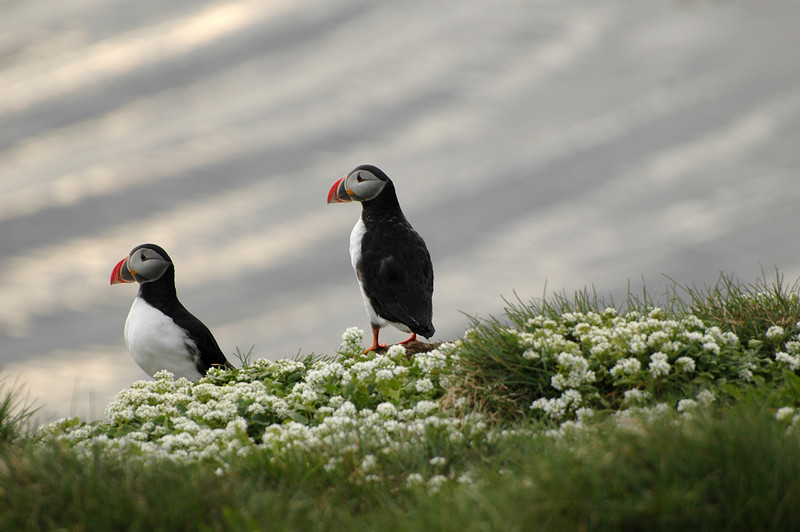
Atlantic Puffin (Fratercula arctica) by Bob-Nan

Atlantic Puffin (Fratercula arctica) by Bob-Nan

The chick stays in the burrow until it is able to fly. The young puffin uses a toilet area towards the front of the burrow away from the nest to stay clean. It cannot risk getting its feathers soiled and ruining the waterproof protection they provide.

How clean are we in spirit? What sort of life do we lead on week days?
Most of us come for a spiritual bath to church on Sundays.
Do we consider Church as a spiritual bathroom?

7 DAYS without JESUS makes 1 WEAK…

And Joshua said unto the people, Sanctify yourselves: for tomorrow the LORD will do wonders among you. (Joshua 3:5)

After 45 days, the chick leaves the burrow and spends 3-5 years at sea learning about feeding places and choosing a mate. In the wild, puffins can live around 20 years. Their main predator is the great black-backed gull, which can capture a puffin mid-flight  or swoop in on a puffin on the ground. Herring gulls are also a threat because they steal puffins’ fish…

Puffins spend their first three years of life out at sea.  They return to land once they reach maturity. Puffins are insulated from the cold by an oily coating on their feathers. Without this coating, they would never survive Atlantic winters..

Are we insulated by the blood of JESUS?
How to get insulated by the blood of JESUS?
Unless one dies for sins and lives with CHRIST and for CHRIST…

Nicodemus saith unto him, How can a man be born when he is old? can he enter the second time into his mother’s womb, and be born? Jesus answered, Verily, verily, I say unto thee, Except a man be born of water and of the Spirit, he cannot enter into the kingdom of God.(John3:4,5)

Your’s in YESHUA,

A J Mithra

Please visit us at: Crosstree

Puffins are in the Alcidae – Auks Family of the Charadriiformes Order

The Eagle – The Loyal Mate..

The Eagle – The Loyal Mate.. – by A. J. Mithra

Bald eagles are loyal to their mates during their lifetime.
An eagle will usually look for a new mate only if its companion dies.

So many out there still think, that JESUS is a dead god..
Is that the reason why they are on the lookout for a new god?
Well the truth is that, JESUS died for us but, HE rose again from the dead…
And above all, the greatest news is that, HE still lives…
By the way, are we loyal to our Creator?

I am he that liveth, and was dead; and, behold, I am alive for evermore, Amen; and have
the keys of hell and of death. (Revelation 1:18)

Together, they build huge nests known as “aeries” atop tall and strong trees.
They make use of twigs, grasses, soft mosses and feathers in making their nests.
They normally go back to their nests during breeding time and add
new materials to it each year.

Bald Eagle Brings Nesting Material by Aesthetic Photos

A new eagle’s nest measures an average of five feet in width and two feet in depth.
However, as their family grows, the nest also becomes larger reaching
more than ten feet wide and heavier.

A pair of Eagles not only builds so big a nest but also extends them every year…
Before we call ourselves as the bride, let us ask ourselves if we are of any help
to JESUS, our Bride groom, in the extension of HIS kingdom?
GOD has called us and chosen us to go and spell the Gospel to every nation..
What are we doing now? Just warming the Church benches every Sunday?

If any man’s work shall be burned, he shall suffer loss: but he himself shall be saved; yet so as by fire. (1 Corinthians 3 : 14)
We then, as workers together with him, beseech you also that ye receive not the grace of God in vain. (2 Corinthians 6:1 )

Bald Eagle by Ray's Wildlife Photography

By the age of four or five, bald eagles are already sexually mature during which
they look for a mate to have offspring with.
The mating season varies by region.
In the south, it may occur from the later part of September to November while
it may take place from January to March in the Great Plains and Mountain West.
In Alaska, the mating season is usually from late March to early April.
For a long time it was believed that eagles mated in the air,
while they were cart wheeling or sky dancing.
But the aerial displays are really a prelude to mating. Once the eagles are ready to mate,
they will then take to a tree branch or to their nest and then mate there,
using the nest or branch for support.

“JESUS ascended to heavens after HE rose from the grave….

HE will soon swoop down to take HIS bride for an aerial display,
a prelude to HIS marriage with the Church, HIS bride…

Oh Church! It’s time to put on your wedding dress, to meet the Bride-groom
Are you getting ready?

And he saith unto him, Friend, how camest thou in hither not having a wedding garment? And he was speechless. and he saith unto him, Friend, how camest thou in hither not having a wedding-garment? And he was speechless. Then said the king to the servants, Bind him hand and foot, and take him away, and cast him into outer darkness; there shall be weeping and gnashing of teeth. Then the king said to the servants, Bind him hand and foot, and cast him out into the outer darkness; there shall be the weeping and the gnashing of teeth. For many are called, but few are chosen. (Mathew 22: 12-14)

Bald eagles can mate throughout their life starting from the age of four.
Breeding may not occur annually for some eagles by voluntary choice.
They may instinctively realize bad timing because of weather,
nesting site availability, or food.
Eagles will bring fresh leafy sprays to the nest, not for use as part of the structure
or lining of the nest, but as a sort of decoration on top…
They serve as an advertisement that the nest and territory are occupied
and tell interloping eagles to stay away.
The fact that a piece of green and fresh vegetation is kept at the nest
indicates recent activity there.
So the fresh sprays might be a way of saying “This nest is taken.”
Or it might be a ”Gift of love” for its mate…
Or it may be to decorate its nest…

Each new morning, JESUS brings us HIS fresh new grace,
to remind us that in spite of all our shortcomings, HE still loves us…
HE wants to be the decoration of our lives…
Male Eagles bring a fresh new sprig every day as a gift of love to its mate….
But, our Lord JESUS has given HIS life for us to show HIS love…

Are we worthy to be HIS bride?

He that loveth father or mother more than me is not worthy of me: and he that loveth son or daughter more than me is not worthy of me. And he that taketh not his cross, and followeth after me, is not worthy of me. (Mathew 10 : 37,38)

Wish you all a blessed Easter!
Let the resurrected power of JESUS fill every home in every nation…

Your’s in YESHUA,
A. J. Mithra

Please visit us at: Crosstree

He is Risen! Happy Easter

Therefore doth my Father love me, because I lay down my life, that I might take it again. No man taketh it from me, but I lay it down of myself. I have power to lay it down, and I have power to take it again. This commandment have I received of my Father. (John 10:17-18 KJV)

Now if Christ be preached that he rose from the dead, how say some among you that there is no resurrection of the dead? But if there be no resurrection of the dead, then is Christ not risen: And if Christ be not risen, then is our preaching vain, and your faith is also vain. (1 Corinthians 15:12-14 KJV)

For more about Christ’s Resurrection – Please See:

Wordless Birds

Gospel Message

*

(Photo taken from an e-Mail)

Kirtland’s Warbler Reveals…

Kirtland’s Warbler Reveals… – by A. J. Mithra

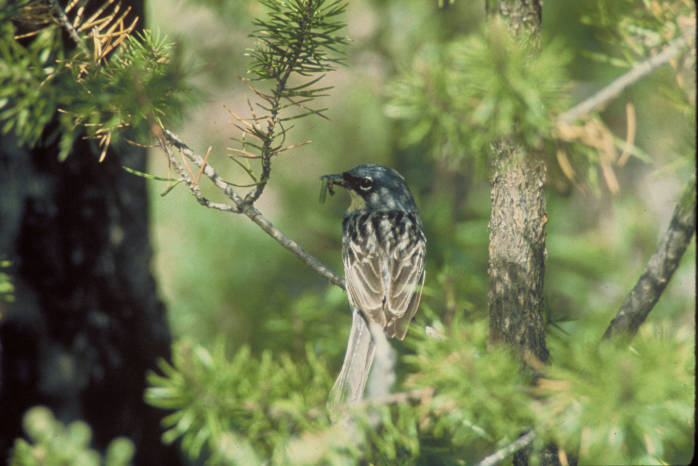
Kirtland's Warbler (Dendroica kirtlandii)©USFWS

Kirtland's Warbler (Dendroica kirtlandii)©USFWS

The Kirtland’s Warbler requires areas
with small jack pines for nesting.
The jack pine requires fire
to open its cones and spread its seeds.
The warbler first appears in an area
about six years after a fire when the new growth
is dense and is about 1.5 to 2.0 meters (5.0-6.5 feet) high.
After about 15 years,
when the trees are 3.0 to 5.0 meters (10.0 to 16.5 feet) high,
the warbler leaves the area…

These birds seem to know the time of GOD..
How do they know the age of those trees?
Is it because we have not tuned ourselves
to the frequency of GOD AND HIS time?
GOD has called us by our names to reveal
HIS plans in our lives..
But, we don’t seem to understand
the time to sow or the time to reap..

A time to be born, and a time to die; a time to plant, and a time to pluck up that which is planted; (Ecclesiastes 3:2)

Kirtland's Warbler (Dendroica kirtlandii) by Kent Nickell

Kirtland's Warbler (Dendroica kirtlandii) by Kent Nickell

The very specific habitat requirements
of this species are the main cause of its threatened status.
Despite nesting on the ground,
Kirtland’s Warbler will only nest amongst
9 – 13 year old jack pines (Pinus banksiana);
taller stands are abandoned for a new site.

Is it because the birds know that
there is going to be another fire very soon?
How amazing our GOD is?
HE has tuned the birds to HIS plans
and that is the reason the birds know,
when to nest among the pines and when to abandon them..
Do we know that we have to abandon this earth?
Do we know that there is going to be an eternal fire very soon?

And the devil that deceived them was cast into the lake of fire and brimstone, where the beast and the false prophet are, and shall be tormented day and night for ever and ever. (Revelation 20:10)

Your’s in YESHUA,

A J Mithra

Please visit us at: Crosstree

White-fronted Bee-eater – The Life Guards

White-fronted Bee-eater – The Life Guards – by A. J. Mithra

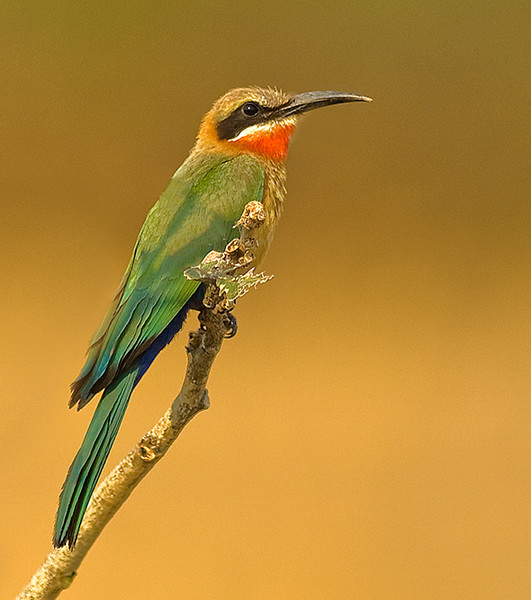
White-fronted Bee-eater (Merops bullockoides) by Bob-Nan

White-fronted Bee-eater (Merops bullockoides) by Bob-Nan

The White-fronted Bee-eater, Merops bullockoides, is a species of Bee-eater
widely distributed in sub-equatorial Africa.
This species, like other bee-eaters, is a richly colored, slender bird,
with a distinctive black mask, white forehead, square tail and a bright red throat.
The upperparts are green, with cinnamon under parts and their call is a deep squeak…
They nest in small colonies, digging holes in cliffs or earthen banks
but can usually be seen in low trees waiting for passing insects..
They hunt either by making quick hawking flights or gliding down
before hovering briefly to catch insects….

Our LORD, the provider and protector of the Universe, can still be seen
hanging on the Cross waiting for those passing souls to accept HIM as their savior…
Remember that HE had taken our place on the cross..
HE became a curse, so that we may be blessed…
What are you waiting for, invite JESUS into your life now, for, this is the day
that the LORD has made for you to invite HIM and rejoice forever and ever…

Who his own self bare our sins in his own body on the tree, that we, being dead to sins, should live unto righteousness: by whose stripes ye were healed. (1 Peter 2:25)
Christ hath redeemed us from the curse of the law, being made a curse for us: for it is written, Cursed is every one that hangeth on a tree: (Galatians 3:13)

Until the 1960s, scientists held that natural selection favors only those behaviors
that boost the survival chance of the individual and its offspring.
A bird that postpones its own reproductive potential to help another would seen doomed
from that evolutionary standpoint, but, many white-fronted bee-eaters
willingly place their relatives’ needs before their own to help close kin survival..

White-fronted Bee-eater (Merops bullockoides) by Africaddict

White-fronted Bee-eater (Merops bullockoides) by Africaddict

Family ties made the difference in nearly every case, with helpers foraging
for the most closely related nestlings 94 percent of the time.
Most in-law bee-eaters are females that have left their natal clan to join
the extended family of a mate and are socially integrated in the mate’s clan
but are genetically unrelated to members other than their own offspring.
These in-laws rarely “lift a feather,” even though their mates may be working hard
to bring in enough bees and other delectables for a related couple’s hungry brood…

In-laws may fly back to their natal clan during times when
the colony experiences a food shortage, and birds temporarily left their partners’ clans
to help their parents, or a parent and a stepparent, raise a family.
All of these helpers returned to their mates after the breeding season.

Though GOD loves the Jews- His chosen people, HE willingly places the needs of us,
the Gentiles, before the needs of HIS own people…
And HE seems to be postponing HIS marriage, so that no one is left out…
Nature is giving out signs to show that these are the last day…
Are we ready to meet THE KING?

Little children, it is the last time: and as ye have heard that antichrist shall come, even now are there many antichrists; whereby we know that it is the last time. (1 John 2: 18)

White-fronted African bee-eaters will face even spitting cobras when it comes to
defending its kin, and forage tirelessly for bees and delay having their own young—
all to help close relatives raise a clutch of baby birds.
Years of direct observation have led researchers to suggest this altruism is an inherited
trait that gives the “helper” bird’s family a survival edge in the harsh African Savannah….

Why would any bird engage in such magnanimous behavior?
Is it courageously noble in mind and heart?
Or is it generous in forgiving; eschewing resentment or revenge; unselfish behavior?

These birds are ready to face poisonous cobras to save the lives of its kin..
Did not our Savior JESUS give HIS life on the Cross to defend us
from the venomous serpent?

Did HE not generously give HIMSELF on the Cross to forgive our sin?
Did HE not show HIS unselfishness to take our place on the Cross?
Shall we all, once again rededicate our lives and run into the
nail-pierced, outstretched hands of our Savior?

Therefore if any man be in Christ, he is a new creature: old things are passed away; behold, all things are become new. (2 Corinthians 5: 17)

Have a Holy Friday..

Your’s in YESHUA,
A J Mithra

Please visit us at: Crosstree

See – The Gospel Message

Inspired by this Bird through an article on Science News by Kathy A Fackelmann http://findarticles.com/p/articles/mi_m1200/is_n23_v135/ai_7680117/ dated June 10th 1989…

Birds of the Bible – Cormorant II

And the pelican, and the gier eagle, and the cormorant, (Deuteronomy 14:17 KJV)

In the first Birds of the Bible – Cormorant, it was mentioned that they are one of the “unclean birds” not to be eaten, they have their own desalination system, and that they have been used for centuries in the Orient to catch fish for fishermen. Now, let’s look into some more facts about this family of birds.

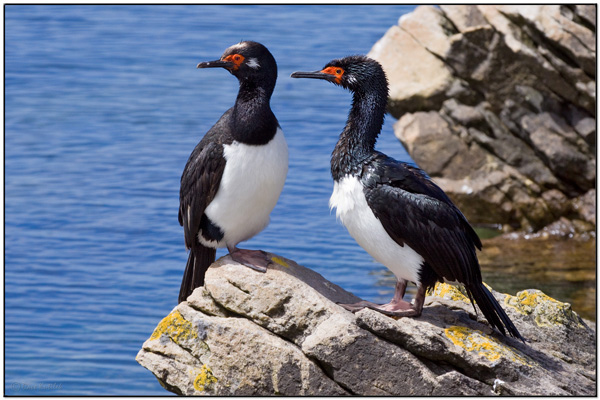
Rock Shag (Phalacrocorax magellanicus) by Daves BirdingPix

Rock Shag (Phalacrocorax magellanicus) by Daves BirdingPix

There are 36 Cormorants are in the Phalacrocoracidae Family of the Pelicaniformes Order. The family includes the Microcarbo genus (5) which has the Little Pied, Reed, Crowned, Little, and Pygmy Cormorants. The Phalacrocorax genus (21) includes Cormorants and Shags. The Leucocarbo genus (10) are all called Shags except for the Guanay Cormorant.

“There is no consistent distinction between cormorants and shags. The names “cormorant” and “shag” were originally the common names of the two species of the family found in Great Britain, Phalacrocorax carbo (now referred to by ornithologists as the Great Cormorant) and P. aristotelis (the European Shag). “Shag” refers to the bird’s crest, which the British forms of the Great Cormorant lack. As other species were discovered by English-speaking sailors and explorers elsewhere in the world, some were called cormorants and some shags, depending on whether they had crests or not. Sometimes the same species is called a cormorant in one part of the world and a shag in another, e.g., the Great Cormorant is called the Black Shag in New Zealand (the birds found in Australasia have a crest that is absent in European members of the species).” Apparently, they are just appearing after “their kind.” There is variation in size, names and colors, but they are all related.

And God created great whales, and every living creature that moveth, which the waters brought forth abundantly, after their kind, and every winged fowl after his kind: and God saw that it was good. And God blessed them, saying, Be fruitful, and multiply, and fill the waters in the seas, and let fowl multiply in the earth. (Genesis 1:21-22 KJV)

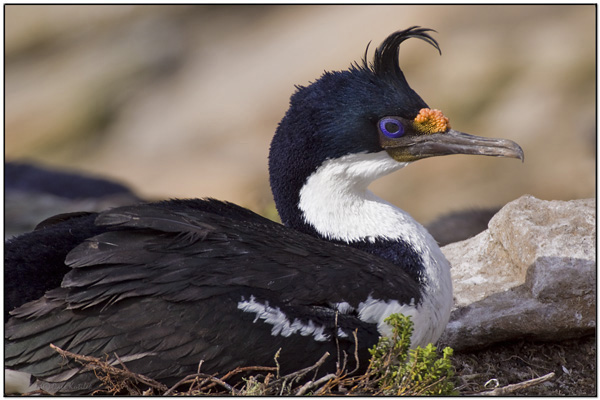
King Shag (Leucocarbo albiventer) by Daves BirdingPix

Cormorant” is a contraction derived from Latin corvus marinus, “sea raven”. Cormorants and shags are medium-to-large seabirds. They range in size from the Pygmy Cormorant (Phalacrocorax pygmaeus), at as little as 45 cm (18 in) and 340 g (12 oz), to the Flightless Cormorant (Phalacrocorax harrisi), at a maximum size 100 cm (40 in) and 5 kg (11 lb). The majority, including nearly all Northern Hemisphere species, have mainly dark plumage, but some Southern Hemisphere species are black and white, and a few (e.g. the Spotted Shag of New Zealand) are quite colorful. Many species have areas of coloured skin on the face (the lores and the gular skin) which can be bright blue, orange, red or yellow, typically becoming more brightly colored in the breeding season. The bill is long, thin, and sharply hooked. Their feet have webbing between all four toes, as in their relatives.

They are coastal rather than oceanic birds, and some have colonised inland waters – indeed, the original ancestor of cormorants seems to have been a fresh-water bird. They range around the world, except for the central Pacific islands.

Great Cormorant (Phalacrocorax carbo) by J Fenton

Great Cormorant (Phalacrocorax carbo) by J Fenton

All are fish-eaters, dining on small eels, fish, and even water snakes. They dive from the surface, though many species make a characteristic half-jump as they dive, presumably to give themselves a more streamlined entry into the water. Under water they propel themselves with their feet. Some cormorant species have been found, using depth gauges, to dive to depths of as much as 45 metres.

After fishing, cormorants go ashore, and are frequently seen holding their wings out in the sun. All cormorants have preen gland secretions that are used ostensibly to keep the feathers waterproof.

Cormorants are colonial nesters, using trees, rocky islets, or cliffs. The eggs are a chalky-blue colour. There is usually one brood a year. The young are fed through regurgitation. They typically have deep, ungainly bills, showing a greater resemblance to those of the pelicans’, to which they are related, than is obvious in the adults.”

The Cormorants and Shags are another of the Lord’s fantastic creations from an All-powerful Creator.

Some quotes from Wikipedia

Visit the Cormorant Page

Hoatzin – The Stinker

Hoatzin – The Stinker by A. J. Mithra

Hoatzin ( Opisthocomus hoazin) by Robert Scanlon

Hoatzin ( Opisthocomus hoazin) by Robert Scanlon

One of the most unusual birds, this interesting animal is
one bird that no one wants to keep in a cage.

The Hoatzin weight about 2 pounds, and is about 2 feet long, sometimes a bit more.
They have an almost entirely bare head, with a crest on top of it that is red,
and blue skin around the red eyes.

The Hoatzin is a rainforest bird, and lives in the lowland areas in the Amazon basin.
They love slow moving or swampy standing water, and the floods or small lakes..
It lives entirely in trees, vines and bushes, and is thus independent
of the different kinds of aquatic foods that each of these water types support.
In many areas the species is frequently associated with giant arums,
especially those of the genus Montrichardia, which constitute a favorite food.
In coastal zones Avicennia mangroves can be similarly important.
Hoatzins eat mostly young green leaves from rain forest plants.
An enlarged foregut containing bacteria helps them break down cellulose
and digest their food, an arrangement similar to that found in cattle.
When it has been ingested, the plant materials are fermented which gives
the bird a fairly foul odor, earning them the common name of Stinkbird..
Digestion takes many hours, and Hoatzins are often observed
resting the sternum on a branch.

The foregut of the Hoatzin accounts for a quarter of the bird’s weight,
and is so large that there is little room for flight muscles.

This accounts for the Hoatzin’s poor flying capability.

In many bird species, the period of time for which food is retained
is often measured in minutes, but the Hoatzin holds the record.
In experiments, liquids were retained for about 18 hours, and solids for 24-48 hours;
these retention times are similar to those found in sheep,
and are long enough to maintain stable populations of gut bacteria.

Hoatzin(Opisthocomushoazin) by Kent Nickell

Hoatzin(Opisthocomushoazin) by Kent Nickell

Like these birds who live by the waters,
We too live by the Living Waters, where we have protection and providence…
Like how these birds which live only on leaves and buds,
Some of us are still live like milk-fed spiritual babies..Why?
Is it because we always want to be mouth-fed?
Or is it because we have a fear to take responsibilities of a grown up?

For every one that useth milk is unskillful in the word of righteousness: for he is a babe. But strong meat belongeth to them that are of full age, even those who by reason of use have their senses exercised to discern both good and evil. (Hebrew 6:13,14)

We too don’t venture far and wide, like these birds,because,
We have not yet learnt to fly yet… You know why?
We eat lots of spiritual food, but we don’t exercise our faith…Do we?

These birds take 24 to 48 hours to digest their food, but,
we haven’t yet digested the spiritual food which we had years back….

GOD has called us to be fliers like an Eagle and not clumsy climbers like Hoatzin…
When are we going to start exercising our faith and get rid of those
Spiritual cholesterol which hinders our spiritual flight?

But refuse profane and old wives’ fables, and exercise thyself rather unto godliness. (1Timothy 4:7)

Hoatzin ( Opisthocomus hoazin) by Robert Scanlon

Hoatzin ( Opisthocomus hoazin) by Robert Scanlon

They live in groups, so the Hoatzin will have as many as 25 or 30 nests in one single tree.
Social groups of Hoatzins consist of a pair and their adult (mostly male) offspring …
The Hoatzin makes its nest in low branches in trees that hang out over the water
to avoid the predatory birds that might make a meal of their offspring.

Some of us are like these birds; we carry the Bible for protection…
Whereas, GOD expects us to carry HIS word in our hearts….
Even JESUS needed the word of GOD to fight against the devil when HE was tested
by satan, when HE started HIS ministry on earth…. Mathews 4:1 to 11
But, sadly, we still have our Bibles near our pillows for fear of evil..
Is THE BIBLE a scare-crow?

Therefore shall ye lay up these my words in your heart and in your soul, and bind them for a sign upon your hand, that they may be as frontlets between your eyes. (Deuteronomy 11:18)

The female Hoatzin will lay either two or three eggs, in a nest that is built of small twigs,
and hangs out over the water from a tree branch.
The two parents will both take turns keeping the eggs warm.
After about twenty eight days they will hatch.
The young Hoatzin will be fed by the parents the plant material
that the parents regurgitate.
All members participate in the feeding of chicks….
Hoatzin chicks have two claws on each wing, a feature that makes it easy for them
to climb and cling in the branches of trees.
Hoatzin chicks leave the nest frequently and may even dive into water
below the nest when danger threatens.

Drugs, sex, violence, hatred, pre-marital sex has become
the order of the hour for our youth…
Where is the NX-GEN heading?

Children, obey your parents in all things: for this is well pleasing unto the Lord. ((Colossians 3:20)

Look at these Hoatzin chicks; they leave the nest frequently,
Like how our children leave us without our knowledge…
What sort of spiritual nourishment do we regurgitate?
Ministry starts at home and GOD has given us children as gifts,

Lo, children are an heritage of the LORD: and the fruit of the womb is his reward. (Psalm 127:3)

It is our duty to take care of them, the way GOD wants us to…

Fathers, provoke not your children to anger, lest they be discouraged. (Colossians 3:21)

Have a blessed day!

Your’s in YESHUA,

A J Mithra

Please visit us at: Crosstree


Lee’s Addition:

Oilbird – Opisthocomidae Family
Interesting Things – Hoatzin

*

Mallefowl’s Incubators… by A. J. Mithra

Mallefowl’s Incubators…

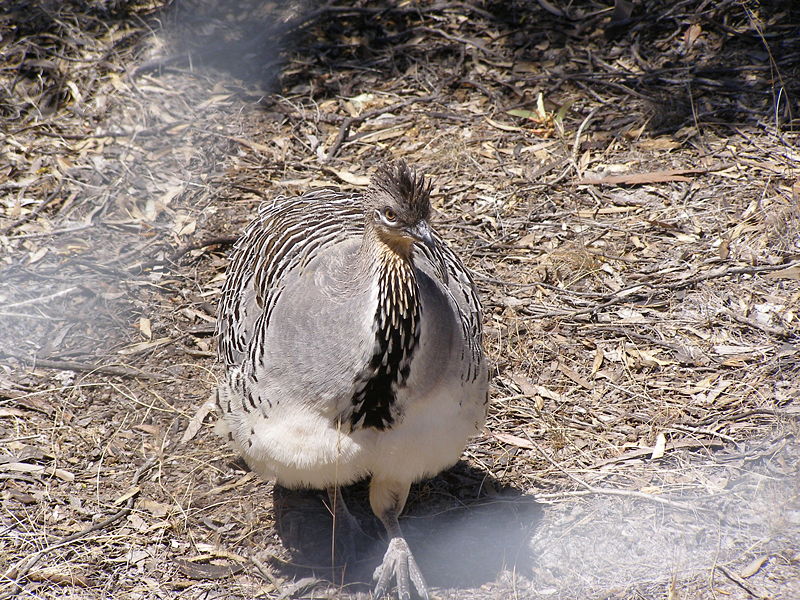
Malleefowl (Leipoa ocellata) by Wikipedia

Malleefowl (Leipoa ocellata) by Wikipedia

The Malleefowl is one of the three species of mound builders,
or Megapodiidae, found in Australia.
The birds are terrestrial and are distinguished by their habit of leaving eggs
to be incubated in sand or soil heated by the sun or volcanic action
or in mounds of rotting leaves built for that purpose, as Malleefowl do.
The Malleefowl is unique in that it is the only megapod
that makes its home in dry, inland scrub.

You are unique, one of a kind, because, GOD has created only one like you..
If a bird like Malleefowls can do what the other birds cannot do,
don’t you feel that you, whom GOD had created in HIS own image,
do greater things for HIM?
Come on, say,

I can do all things through Christ which strengtheneth me. (Phillipians 4:13)

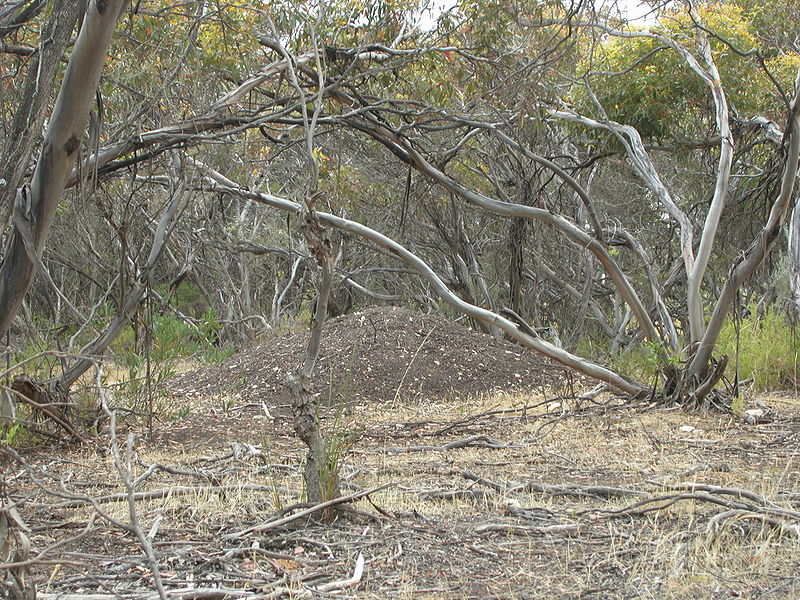
Malleefowl Mound ©Wikipedia

Malleefowl Mound ©Wikipedia

The Malleefowl has large and powerful feet,
which it uses to build enormous egg-incubating mounds.
In winter an area of ground is selected, typically a small open space
between the stunted trees of the mallee.
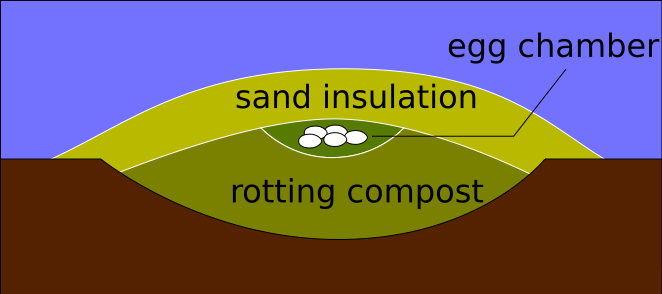
A depression, measuring about three metres across and just under a metre deep,
is scraped in the sandy soil.
An egg-chamber is constructed at the bottom of the mound.
The male does this by raking backwards with his feet.
(See video by Peter Nash of a Malleefowl working on mound)
GOD has given powerful feet for these birds… But, for us…?
HE has given us knees for survival…
Those who kneel before GOD can stand before anything…
It needs faith to kneel before GOD…

O come, let us worship and bow down: let us kneel before the LORD our maker.
(Psalm 95:6)

In late winter and early spring he will begin to collect organic matter.
Raking sticks, leaves and bark into wind-rows for up to 50 metres around the hole
he will build it into the nest mound rising up to 1.2 metres above the ground level
and with a diameter up to 8 metres.

Malleefowl (Leipoa ocellata) Mound by Wikipedia

Malleefowl (Leipoa ocellata) Mound by Wikipedia

The amount of litter in the mound will vary.
It may be mostly organic material, mostly sand, or somewhere in between.
After rain, he turns and mixes the material to encourage decay.
The timing varies with temperature and rainfall.
Throughout the breeding season the male has to ensure that the temperature
inside the mound is maintained at about 33°C – 91°F
The male puts his head into the mound and it is thought that he uses
his tongue to measure the temperature.
He must then either add or remove sand from the mound,
according to the temperature within it and the season.

In spring, much heat is given off by the rotting organic material
and the temperature needs to be reduced.
At dawn, the male rakes off the sand covering the litter,
and after allowing enough heat to escape he refills the hole with cool sand.
In summer, the male needs to protect the eggs from the heat of the sun.
He adds more and more sand to the mound, which absorbs the sun’s warmth.
Then, in the cool of the morning, he removes the sand and scatters it in the colder air.
When the sand has cooled down he puts it back on the mound.
During the cooler temperatures of autumn, the mound needs to be warmed up.
To do this the male digs almost all of the soil away in the morning,
spreading it out to be warmed in the sun.
Throughout the hottest part of the day, he places hot layers of sand on the mound,
so that as the sun goes down the nest has been rebuilt and is warm for the night.

From where did these amazing birds learn to maintain constant temperature?
Who taught them to use different materials for different seasons?
We say that we are filled by the Holy spirit but how are we in spirit?
Are we able to maintain the same temperature all through the week?
Or, we are just as hot as an oven, only in a Sunday service or a crusade?
These birds are so receptive to different season..
Are we receptive to the spirit?
These birds make it a point that they check the temperature and keep it constant..
Is our walk with GOD as constant as it was when we first accepted HIM in our lives?
GOD is very particular about maintaining a constant temperature….
That is why HE says,

So then because thou art lukewarm, and neither cold nor hot, I will spue thee out of my mouth. (Revelation 3:16)

Without maintaining a constant temperature, how can we expect our dreams to hatch?

While the male is keeping the temperature of the mound constant,
the female is busy laying eggs and helping with the digging.
Generally an egg is laid every four to eight days.
The female lays about 15 to 24 eggs in a season, although that number can be as high as 32.
The number varies with the availability of food.
Incubation time depends on temperature and can vary from between 50 and 100 days.
Hatchlings use their strong feet to break out of the egg,
then lie on their backs and scratch their way to the surface.
They struggle hard for five to ten minutes to gain 3 to 15 cm at a time.
After resting for an hour or so they start for the surface again.
It takes anywhere between 2 and 15 hours for them to make it all the way
out of the mound…

Though it takes so long to hatch, theses birds never lose their focus on the eggs,
always working hard to maintain a constant temperature..
We all have laid wonderful eggs, as again I mean, dreams..
But, are we working hard towards a constant focus on GOD,
so as to maintain a constant temperature?
Some of us maybe so dejected that our dreams are just dreams…
Some of us may ne wondering why it is taking so long for GOD,
and would have lost hopes too…
Here is a beautiful and a powerful verse for them from the Bible…

He hath made everything beautiful in his time:…. (Ecclesiastes 3:11)

Don’t be discouraged, your dreams have not turned rotten,
GOD still has them in HIS incubator…Your miracle is on its way,
Receive it in Faith…

To every thing there is a season, and a time to every purpose under the heaven: (Ecclesiastes 3:1)

Have a blessed day!

Yours in YESHUA,
A. J. Mithra

Please visit us at:  Crosstree

See Also:

Interesting Things-Only God Can Make an Instinct
Malleefowl by Wikipedia
Malleefowl
The Remarkable Malleefowl

Master Builder’s Master Builders… by AJ Mitra

Master Builder’s Master Builders…

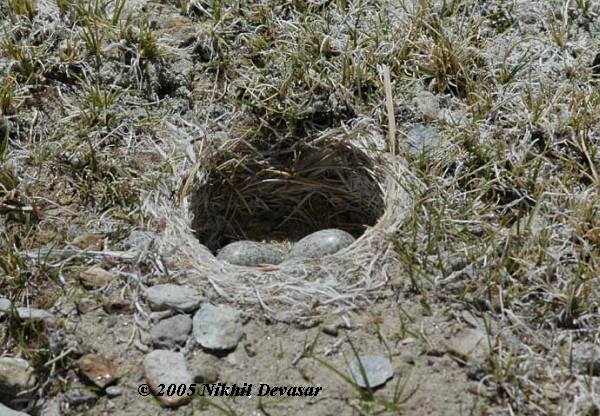
Horned Lark (Eremophila alpestris) Nest w/eggs by Nikhil Devasar

Birds are capable of grand engineering feats.
But are they engineers?
Not in the way you might think.
Just as birds know how to fly,
they know how to build a nest without instructions
or apprenticeship. It’s a matter of instinct.

Birds craft their nests without consciously thinking about it.
How then did some species of birds develop
such well-engineered, elaborate nests?

Horned Larks nests showed a significant northern bias
In orientation angle and were 49% shaded in the early afternoon,
the hottest part of the day.
A northern nest orientation ensures maximal shading
By the grass tuft to the south,
May protect nests from cool evening winds,
And provides increased daytime ventilation of the nest
through exposure to prevailing winds.
In addition, shade may also help conceal nests from predators.

From where did these birds learn to choose the location to build their nests?
Have we ever thought about the direction in which we need to have
the front door of our house?
Is our choice based on location or direction of the house?

When JESUS becomes our direction, HE gives the best location..

I am the door: by me if any man enter in, he shall be saved, and shall go in and out, and find pasture. (John 10:9)

Pectoral Sandpipers nest on the arctic tundra, often near water. The nest is lined with grass, moss and lichens.
They do not use lining materials according to local availability.
Instead, relative use was correlated with a material’s insulative quality when wet and they therefore use lining materials
appropriate to minimizing heat loss
given their damp breeding environment.

And he shall be like a tree planted by the rivers of water, that bringeth forth his fruit in his season; his leaf also shall not wither; and whatsoever he doeth shall prosper. (Psalm 1:3)

Blue Tit (Parus caeruleus) by Robert Scanlon

Blue Tit (Parus caeruleus) by Robert Scanlon

Female Blue Tits gather lavender, yarrow, curry, mint
and other scented plants for their nests shortly after laying eggs,
and continue to do so until the chicks leave home.
They are real botanists and do a great job exploiting their environment to protect their chicks..
The birds make a pot-pourri of 10 aromatic plants from the 250 species in their habitat.
Many of the chemicals in these plants ward off bacteria, viruses, parasites, fungi and insects.

Our nest is covered by the blood of JESUS and no harm shall enter…

And the blood shall be to you for a token upon the houses where ye are: and when I see the blood, I will pass over you, and the plague shall not be upon you to destroy you, when I smite the land of Egypt. (Exodus 12:13)

Common Waxbill (Estrilda astrild) by Daves BirdingPix

Common Waxbill (Estrilda astrild) by Daves BirdingPix

Common Waxbills are small African finches
select carnivore scat as a material to include in, on,
and around their nests to reduce predation risk…

A South American Ovenbird may take months
to fashion one nest from clay or mud mixed
with bits of straw, hair, and fibers.
The tropical sun bakes the walls brick-hard.

Bald Eagles, which use sticks, some two inches thick
and several feet long,
to make nests sturdy enough to support a human adult.
Chimney Swift using saliva as glue to help support its nest.

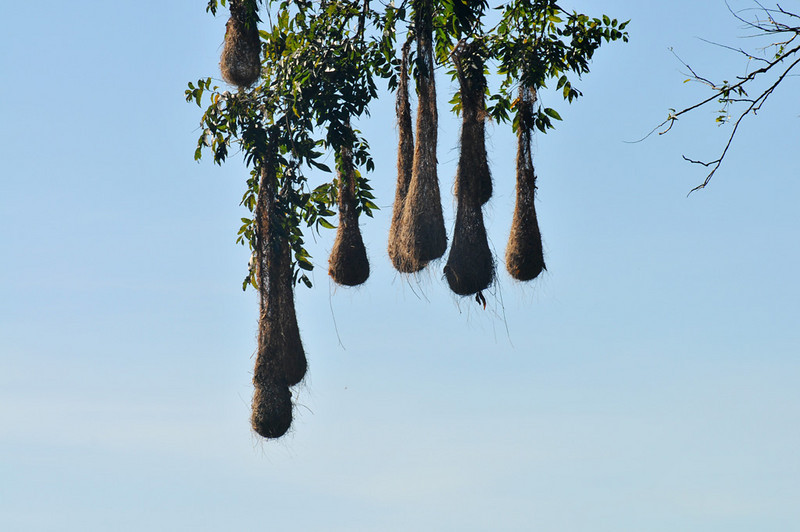
Crested Oropendola (Psarocolius decumanus) nests by Bob-Nan

Crested Oropendola (Psarocolius decumanus) nests by Bob-Nan

Baya Weaver nests in colonies of up to 20-30 pairs, usually in trees near freshwater and open ground. Their nests hang from a branch and look like an upside-down flask. A long tube leads to a side entrance, making it difficult even for snakes to enter the nest.
Nests are made entirely out of strips of grass that the birds collect by cutting
a notch in some tall grass, then stripping off a 30-60 cm long piece. A newly-made nest is green with fresh grass and turns brown as the grass dries. A bird may make up to 500 trips to complete a nest.

GOD has given us a home and a family with a purpose….
Most of us are trying hard to be like others and to live like others…
HE loves us as we are, so, let us live the way HE wants us to live…

Sparrows never try to live like Eagles. Do they?
If we are a sparrow, so be it and if we are an Eagle, so be it..
After all, a sparrow cannot live like Eagle and an Eagle cannot live like a Sparrow…

I will make a man more precious than fine gold; even a man than the golden wedge of Ophir. (Isaiah 13:12)

Bird nests vary from a simple accumulation of materials on the ground
to elaborate refuges in or on secluded & elevated substrates.
Nest construction and placement are correlated with flight ability.
Some birds create a simple depression in the ground to harbor their incubating eggs.

The progression of nest complexity moves from cryptic ground nests
to simple elevated nests..
Birds which constructs elevated nests in a bush or tree
or on a cliff or rock ledge tend to be better fliers than simple ground nesters.

You maybe wondering why GOD has placed you as a ground nester
while you desire to be an elevated nester…
You may be wondering why you have not got a place you feel that you deserve…
May be GOD feels that you would get hurt if you are an elevated nester..
Or maybe HE feels that you are not best equipped to be in a higher place…

Humble yourselves therefore under the mighty hand of God, that he may exalt you in due time: (1Peter 5:6)

GOD had HIS nest in heaven and because HE loved us so much,
HE stirred up HIS nest and wandered without a nest to be crucified for our sins…
So that HE may nest in us…

HE needs a nest, that is why HE is knocking at the door of your heart….
Do you have a place for HIM to nest?
Please note that HE is building an eternal nest for us live with HIM forever and ever.

Behold, I stand at the door, and knock: if any man hear my voice, and open the door, I will come in to him, and will sup with him, and he with me. (Revelation 3:20)

Your’s in YESHUA,

A. J. Mithra

Please visit us at: Crosstree

Birds of the Bible – Swan Loyalty

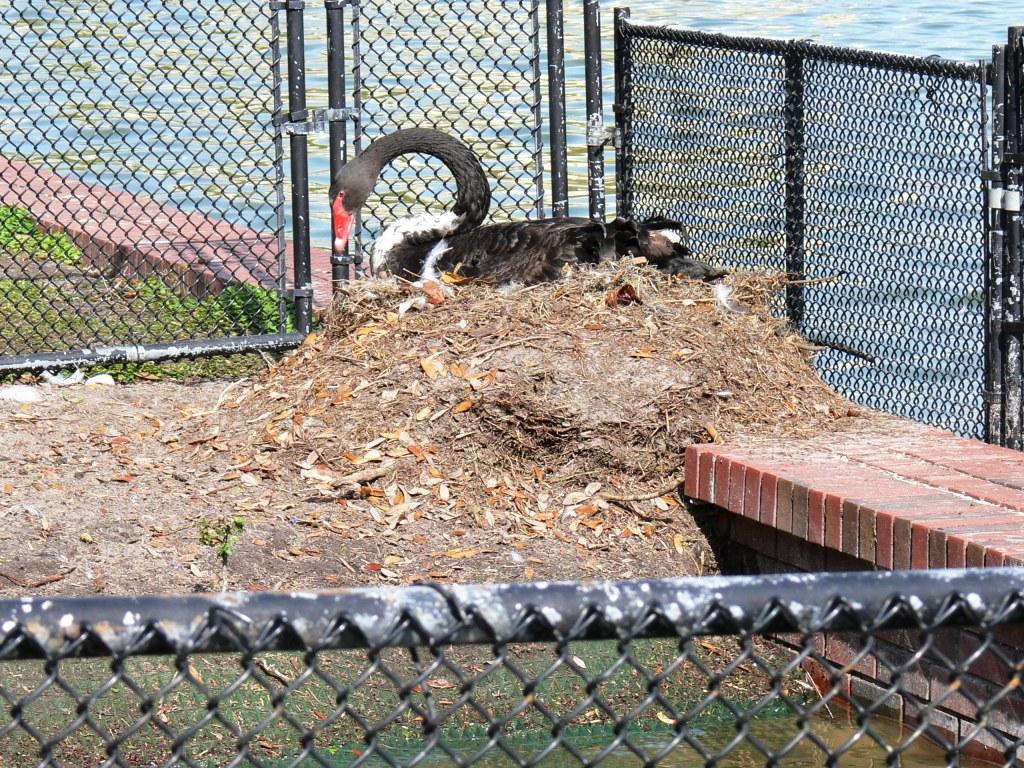
Black Swan nest at Lake Morton

Black Swan nest at Lake Morton

Dan and I went to Lake Morton in Lakeland. The Swans were building nest all over the place. When we were there several months back, one of the couples was just starting their nest. Now it is quite huge and they have even put a fence around it.

Swans are one of the Birds of the Bible listed in Deuteronomy 14:16 and Leviticus 11:18 as being one of the unclean birds that the Israelites were not to eat.

And the swan, and the pelican, and the gier eagle (Leviticus 11:18 KJV)

Here is an excerpt about the Swans and their loyalty to each other. This is from Creation Moments:
(I Corinthians 7:10) “Now to the married I command, yet not I but the Lord: A wife is not to depart from her husband.”

“Most water fowl are faithful to one mate over long periods of time. However, the swan is a champion of marital fidelity.

Mute Swan on Nest at Lake Morton

Mute Swan on Nest at Lake Morton

In North America, they are called Whistling Swans or Tundra Swans. Another member of the same species is usually found in Europe and Asia, where it is called Bewick’s Swan. Researchers report that each has a unique pattern of yellow and black on its bill, making individuals easy to identify. This allowed researchers to trace their lives over many years.

These beautiful creatures have relatively long life spans. One individual was traced for 26 years. Typically laying four eggs in nesting season, they breed for most of their lives. They are highly territorial. In a face-off for food or nesting area, the largest male is usually the winner. When there is a disagreement, the males face each other while their mates cheer them from the sidelines. Single swans enjoying a nice discovery of food are often driven off by couples. Couples are faithful for life. Researchers say that they have recorded no cases of divorce among successfully reproducing couples. Nor do they report any case of marital infidelity among swans. If a mate is lost, the survivor often takes over a year to settle down with another mate. In one case a survivor waited for six years.

Marital fidelity is also God’s instruction to humans. Today many factors are allowed to challenge marital fidelity. Often infidelity before or after marriage is portrayed as simply normal. But if swans can manage fidelity, we humans have no excuse for infidelity.”

For more information, go to the Birds of the Bible – Swans Page
Experts stunned by swan ‘divorce’ at Slimbridge wetland
Bewick’s Swans aka Tundra Swans

Worthen’s Sparrow – Lost, but found.. by A.J. Mithra

Worthen's Sparrow (Spizella wortheni) ©SFSeattle

Worthen's Sparrow (Spizella wortheni) ©SFSeattle

Worthen’s Sparrow (Spizella wortheni)
was originally discovered in the United States,
where just a single bird was caught on 16 June 1884,
near Silver City, New Mexico.
Video of Worthen’s Sparrow Singing
No Worthen’s Sparrows have since been captured in the country,
where it is now thought to be extinct.
Formerly, the bird also ranged over much of the Mexican Plateau.
That makes it one of the rarest sparrows in North America.
What is more, although flocks of the sparrow are sometimes seen in winter,
but its summer habitat was unknown

Worthen’s Sparrows do not migrate, but they move on
from nesting sites as soon as the breeding season ends.
Over the past 30 years, the sparrows have only been seen
in a 25km squared area in northeastern Mexico,
These historical records also suggested that
the sparrows like to breed in valleys full of desert scrub
and grassland habitat also filled by prairie dogs.

A team of researchers from BBC targeted areas of similar habitat,
particularly searching around the La Soledad valley
in the municipality of Galeana,
home to one of Mexico’s most important prairie dog locations
and found the species in Mexico after nearly 125 yrs..

GOD knew where to find Moses,
HE knew where to find Zacchaeus..
No matter how far away you’re from GOD or
how deep you’ve sunk into problems,
GOD knows where to find you, cos you are too precious
for HIM to abandon you..

We were lost, so HE climbed up the cross to find us..
GOD has kept you among Lions and serpents to glorify
HIS name through you ….

These birds which dwell among prairie dogs
seems to remind the words of King David, which says,

If I ascend up into heaven, thou art there: if I make my bed in hell, behold, thou art there.
If I take the wings of the morning, and dwell in the uttermost parts of the sea; (Psalm 139:8-9)

These birds are confined to open, arid shrub-grassland at elevations of 1,200-2,450 m
where breeding sites have been found in associations of :

1. Tarbush whose leaf extracts is an important source of bactericidal compounds
against multidrug-resistant M. tuberculosis.
2. Creosotebush, which is a virtual pharmacy for Native Americans
and the steam from the leaves was inhaled to relieve congestion.
It was also used in the form of a medicinal tea
to cure such ailments as flu, stomach cramps, cancer, coughs, colds, and others.
3. Fourwing Saltbush which gives cover and protection from winter cold and summer sun within its branches
and
4. Short Grassland…

GOD has created us and chosen us to reveal
HIS power through us…

The dwelling place of Worthen’s Sparrow is among
the shrub , whose trees are used for medicinal purpose..
Where ever Peter and Paul went, people received healing…
Do we heal people through words and deeds or……?

When JESUS, the word dwells in us and we in HIM,
our life shall heal and should heal all those who are around us..

He sent his word, and healed them, and delivered them from their destructions. (Psalm 107:20)

Have a blessed day!

Your’s in YESHUA,
A. J. Mithra

Please visit us at: Crosstree


Wordless Birds

Interesting Links:
Greg Lasley’s Worthen’s Sparrow
Worthen’s Sparrow – Bird Life International
Emberizidae – Buntings, New World Sparrows & Allies

Hermit Warbler – The worshiper.. by A. J. Mithra

Hermit Warbler – The worshiper..

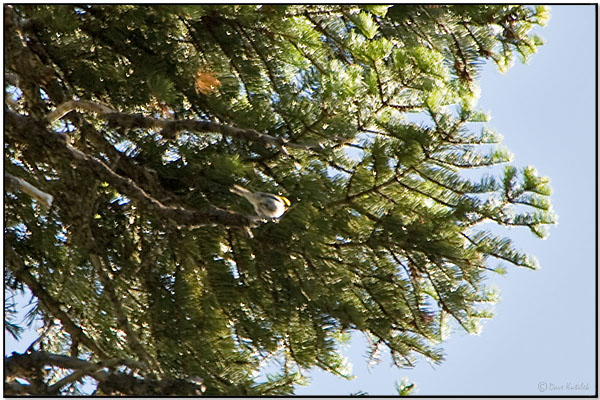
The Hermit Warbler lives in the tops
of some of the tallest trees on the planet…
It is more easily heard than seen while they forage for hidden insects,
or as they pluck berries from a dense grove of evergreen holly trees.

Hermit Warbler (Dendroica occidentalis) by Daves BirdingPix

Hermit Warbler (Dendroica occidentalis) by Daves BirdingPix

Here again we have another bird who loves
to dwell among the holly trees like the Azores Bullfinch
They are heard but not seen, cos, they dwell in high places…

Adam and Eve chose a different hiding place after they sinned..
GOD could hear them but cannot see..
If JESUS comes in search of us, where will he find us?
Where is your hiding place?
Can we boldly proclaim like Psalmist?

Thou art my hiding place and my shield: I hope in thy word. (Psalm 119:114)

Where have we set our affections?
Do we beseech JESUS who was lifted high for our sins?

If ye then be risen with Christ, seek those things which are above, where Christ sitteth on the right hand of God.

Hermit Warblers are most often found in mature coniferous forests,
from sea level to the mountains.
During breeding season,
they are most common in stands over 30 years old,
and are generally absent from stands under 20 years old.
They are generally found in the interior of large forests,
high in the canopy…

How do they know the age of stands?
From where did they receive this wisdom?
Do you feel that you lack in wisdom?
Here is a secret,

But seek ye first the kingdom of God, and his righteousness; and all these things shall be added unto you. (Matthew 6:33)

During migration and post-breeding,
Hermit Warblers are commonly found in mixed flocks.
When foraging they hop about the foliage,
moving from the trunk outward to branch tips
and then starting back at the trunk.
They also glean items from the foliage
while hovering, and will fly out to catch aerial prey.
Hermit Warblers can hang upside-down
to glean from the undersides of leaves and twigs.
Their preference for high, dense foliage
makes them difficult to spot,
but they can be heard singing regularly during the breeding season.
Males arrive on the breeding grounds before females.
They establish and defend territories by singing…

These birds know the secret of defense…
Our praise is the greatest defense against any attack
that satan may plan..
GOD loves to dwell among our praises,
and that is why Prophet Nehemiah appointed singers to
guard the walls of the city; you can read that in
the book of Nehemiah chapter 7…

I am the LORD thy God, which brought thee out of the land of Egypt: open thy mouth wide, and I will fill it. (Psalm 81:10)

Have a blessed day!

Yours in YESHUA,
A. J. Mithra

Please visit us at: Crosstree

See more of A. J.’s articles.