Christmas Attacks

Article from Creation Momments:

“Dear Friend of Creation,

Joy to the world, the Lord is come.
Let earth receive her King!

Cardinal by Aestheticphotos

As the great Christmas hymn reminds us, God so loved the world that He gave. Christmas is truly a time when even non-Christians in non-Christian cultures are reminded about the great joys of giving and receiving special gifts, and about doing good to others.

Yet the ACLU, other secular humanists and multiculturalists continue to wage war on Christmas – to try to ban even the mention of the word. Now even “Holiday Tree” is touted instead of “Christmas Tree.” Give me a break! It’s amazing how the worldly spirit of anti-CHRIST affects even the frequency of His respectful mention in our language. There is an attitude that squirms at the mere mention of God.

Where does this attitude come from? Answer: the sinful heart of mankind. And what is used as intellectual justification (subconsciously in many cases) for such an attitude? Answer: the doctrines of evolutionism.

We see in the whole irrational war on Christmas where the bias toward evolution and against creation comes from. Evolution is not propped up by science at all but by the depraved will of mankind to rid himself of accountability to his Maker.” To read the rest – CLICK HERE

Birds in Hymns – Hail to the Lord’s Anointed

Give the king Your judgments, O God, And Your righteousness to the king’s Son. He will judge Your people with righteousness, And Your poor with justice. (Psalms 72:1-2)

James Montgomery 1771-1854

James Montgomery 1771-1854

Words: James Mont­gom­ery, 1821.

Music: Ell­a­combe, Ge­sang­buch der Herz­ogl. Wirt­em­berg­isch­en Ka­thol­isch­en Hof­ka­pel­le (Würt­tem­berg, Ger­ma­ny: 1784); adapt­ed & har­mo­nized by Wil­liam H. Monk in the 1868 ap­pen­dix to Hymns An­cient and Mo­dern, num­ber 366
Al­ter­nate tunes:

* British Gren­a­diers, tra­di­tion­al Eng­lish mel­o­dy
* Crüger, from a chor­ale by Jo­hann Crü­ger, adapt­ed by Wil­liam H. Monk (1823-1889)
* Woodbird, tra­di­tion­al Ger­man mel­o­dy
* Zoan, Will­iam H. Hav­er­gal, 1845

William H. Monk (1823-1889)

[This hymn] is a me­tri­cal ver­sion of the Se­ven­ty-se­cond Psalm. It was writ­ten as a Christ­mas hymn and was first sung on Christ­mas Day, 1821, at a great con­vo­ca­tion of the Mo­ra­vi­ans in their set­tle­ment at Ful­neck. At a Wes­ley­an mis­sion­a­ry meet­ing, held in Li­ver­pool on Ap­ril 14 of the fol­low­ing year, 1822, when Doc­tor Adam Clarke pre­sid­ed, Mont­gom­ery made an ad­dress and closed it by the re­cit­al of this hymn with all of its verses…Doc­tor Clarke lat­er used it in his fa­mous Com­ment­a­ry in con­nect­ion with his dis­cuss­ion of the Se­ven­ty-se­cond Psalm. – Price, p. 103

Hail to the Lord’s Anointed

Hail to the Lord’s anointed, great David’s greater Son!
Hail in the time appointed, His reign on earth begun!
He comes to break oppression, to set the captive free;
To take away transgression and rule in equity.

He comes in succor speedy to those who suffer wrong;
To help the poor and needy, and bid the weak be strong;
To give them songs for sighing, their darkness turn to light,
Whose souls, condemned and dying, were precious in His sight.
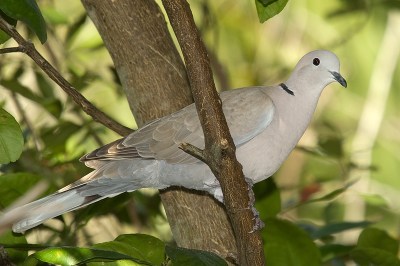
Eurasian Collared Dove (Streptopelia decaocto) by Reinier

Eurasian Collared Dove (Streptopelia decaocto) by Reinier

By such shall He be fearèd while sun and moon endure;
Beloved, obeyed, reverèd; for He shall judge the poor
Through changing generations, with justice, mercy, truth,
While stars maintain their stations, or moons renew their youth.

He shall come down like showers upon the fruitful earth;
Love, joy, and hope, like flowers, spring in His path to birth.
Before Him, on the mountains, shall peace, the herald, go,
And righteousness, in fountains, from hill to valley flow.

Arabia’s desert ranger to Him shall bow the knee;
The Ethiopian stranger His glory come to see;
With offerings of devotion ships from the isles shall meet,
To pour the wealth of oceans in tribute at His feet.

Kings shall fall down before Him, and gold and incense bring;
All nations shall adore Him, His praise all people sing;
For He shall have dominion o’er river, sea and shore,
Far as the eagle’s pinion or dove’s light wing can soar.
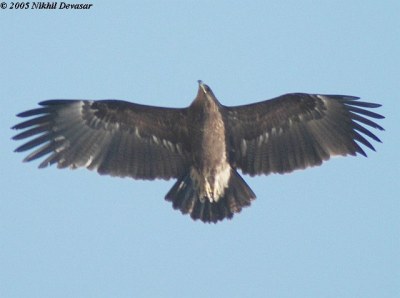
Greater Spotted Eagle (Aquila clanga) by Nikhil

Greater Spotted Eagle (Aquila clanga) by Nikhil

For Him shall prayer unceasing and daily vows ascend;
His kingdom still increasing, a kingdom without end:
The mountain dews shall nourish a seed in weakness sown,
Whose fruit shall spread and flourish and shake like Lebanon.

O’er every foe victorious, He on His throne shall rest;
From age to age more glorious, all blessing and all blest.
The tide of time shall never His covenant remove;
His Name shall stand forever, His Name to us is Love.


What a hymn that is packed full of many of the great truths about Christ.

Most information from The Cyber Hymnal

See ~ Wordless Birds

More ~ Birds in Hymns

*

Thanksgiving Turkey

Tomorrow, many of us here in the United States will be eating turkey on Thanksgiving Day. Luckily, many turkeys will survive our holiday and continue to roam around. Here locally in Polk County, Florida, I see a “rafter” of turkeys (name for a group of turkeys – incorrectly called a “gobble” or “flock”) from time to time. Near Bartow I have seen them many times in rafters up to 11 turkeys. Near Circle B Bar Reserve, I have seen other groups up to 8 turkeys.

Wild Turkey (Meleagris gallopavo) by Daves BirdingPix

Wild Turkey (Meleagris gallopavo) by Daves BirdingPix

The domestic turkey is a descendant of the Wild Turkey and features prominently in the menu of the Canadian and U.S. holidays of Thanksgiving and that of Christmas in many countries.

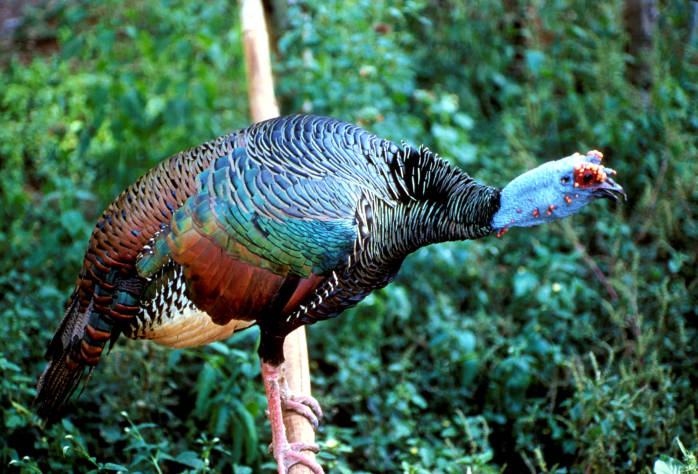
The Turkey is in the Galliformes Order and in the Phasianidae (Pheasants, Fowl & Allies) Family. There are two turkeys – Wild Turkey – Meleagris gallopavo and the Ocellated Turkey – Meleagris ocellata. The Wild is native to North American forrests and the Ocellated is native to the Yucatan Peninsula forrests. They are relatives of the Grouse family. Both Turkeys have a “distinctive fleshy wattle that hangs from the underside of the beak and a fleshy protuberance (flap of skin) that hangs from the top of its beak called a snood.” Turkeys are the heaviest member of the Galliformes order. The females are smaller and duller than the males. The male weighs from 11-24 lbs (5-11 kg) [record=38lbs] and measures 39-49 in (100-125 cm). They also have from 20,000-30,000 feathers.

 Ocellated Turkey (Meleagris ocellata) ©USFWS

Ocellated Turkey (Meleagris ocellata) ©USFWS

Congressional Proclamations from CreationWiki.
“The United States Congress set December 18, 1777, as a day of thanksgiving on which the American people “may express the grateful feelings of their hearts and consecrate themselves to the service of their divine benefactor” and on which they might “join the penitent confession of their manifold sins . . . that it may please God, through the merits of Jesus Christ, mercifully to forgive and blot them out of remembrance.” Congress also recommends that Americans petition God “to prosper the means of religion for the promotion and enlargement of that kingdom which consisteth in righteousness, peace and joy in the Holy Ghost.'”[1]
Congress set November 28, 1782, as a day of thanksgiving on which Americans were “to testify their gratitude to God for his goodness, by a cheerful obedience to his laws, and by promoting, each in his station, and by his influence, the practice of true and undefiled religion, which is the great foundation of public prosperity and national happiness.”

Giving thanks always for all things unto God and the Father in the name of our Lord Jesus Christ; (Ephesians 5:20 KJV)

See:
WhatBird’s Wild Turkey
Wikipedia’s Wild Turkey and Ocellated Turkey
Video of an Ocellated Turkey and a Wild Turkey displaying on Internet Bird Collection

When I Consider! – Complexity

When I Consider!

When I Consider!

Evidence From Biology – October 15

The more we learn about life, the greater the complexity we find. There were no sophisticated microscopes 150 years ago. Consequently, the leap of complexity from single-to-multiple-call organisms was greatly underestimated. The development of the computer has given us an even greater appreciation for the enormous complexity, extreme miniaturization, and vast storage capabilities of the brain. Consider a few other giant leaps that evolutionists must accept in order to hold onto their faith in evolution:

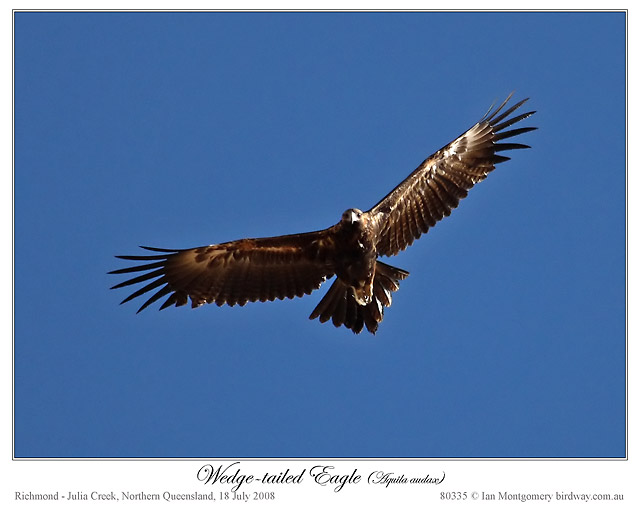
Wedge-tailed Eagles (Aquila audax) by Ian

Wedge-tailed Eagles (Aquila audax) by Ian

1. Flight somehow evolved on at least four different occasions (birds, insects, reptiles, mammals).

2. Photosynthesis somehow developed.

3. Cold-blooded animals somehow turned into warm-blooded animals.

4. Floating marine plants somehow changed into complex plants with roots, stems, and leaf systems.

5. Placental animals (the off-spring develop inside of their mother) somehow turned into marsupial animals (their off-spring develop within a pouch).

6. Egg-laying animals somehow developed the ability to give live births.

7. Insects somehow learned to totally rearrange themselves and change form in a process called metamorphosis (such as a caterpillar transforming into a butterfly).

8. Land mammals and reptiles such as whales, seals, dolphins, ichthyosaurs, and plesiosaurs somehow crawled back into the sea and developed all of the specialized organs needed for sea survival.

In the Beginning, 7th ED., p.17

Blessed is he…whose hope is in the LORD his God, the Maker of heaven and earth, the sea and everything in them… (Psalm 146:5-6)

(Article typed by Phyllis)

See the following articles at Creation Moments:

25 Reasons to Doubt the Theory of Evolution
The Miracle of Photosynthesis
The Insect with Two Brains
The God of Science

Birds of the Bible – Stork II

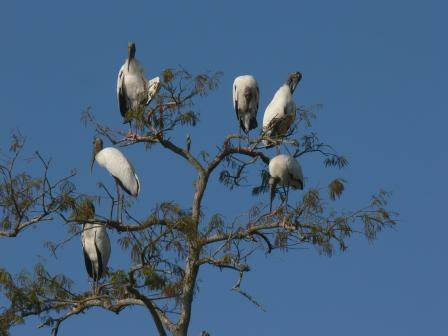
Wood Storks in Top of Tree by Lee

Wood Storks in Top of Tree by Lee

Yesterday, Dan and I went out to the Circle B Bar Reserve for some birdwatchng. I think I would have to call it, “Stork Day.” From our photos, I have counted well over 100 Wood Storks and that doesn’t count the ones we didn’t photograph. It is time to find out some more about the stork.

From the first Birds of the Bible – Stork article,we found out that the stork is on the unclean list of birds that were not to be eaten by the Israelites. (Leviticus 11:19 and Deuteronomy 14:18). Jeremiah 8:7, tells of “her appointed times” (migration) and Zechariah 5:9 mentions the “wings of a stork.”

Psalms is going to provide our thoughts for today.

The trees of the LORD are full of sap; the cedars of Lebanon, which he hath planted; Where the birds make their nests: as for the stork, the fir trees are her house. (Psalms 104:16-17)

 The Whole Tree

The Whole Tree

As you can tell from the photos, the storks like to hang out in the trees. The trees were loaded with them. We were out there recently (September 18th) and I did not see any on that visit. Jeremiah was correct, “Yea, the stork in the heaven knoweth her appointed times;” Migration has been underway and these are either resting while on their trip or they are going to be here for the winter.

“Storks (family Ciconiidae) make their nests of sticks, reeds and grass, in tall trees. When the chicks hatch, their thin, featherless skin is extremely vulnerable to the direct rays of the sun. The parent bird has two responses to the high temperature problem — if water is nearby, the stork fills its large beak, returns to the nest, and douses the tiny chicks with cooling water. If this is not sufficient, the parent then performs a most remarkable feat — it stands over the young and spreads its large wings over the entire nest, thus shading the chicks from the sun’s rays! Often it will do this for hours at a time.” from “Birdbrains?” at Answers in Genesis

Storks Shadowing Baby in Lakeland by Dan

Storks Shadowing Baby in Lakeland by Dan

When the Lord created the Stork, the knowledge to protect their babies was put in them. Our God and Savior has promised to meet our needs. If He cares about the birds, how much more does he care about us?

“Storks are large, long-legged, long-necked wading birds with long stout bills, belonging to the family Ciconiidae. They occur in most of the warmer regions of the world and tend to live in drier habitats than the related herons, spoonbills and ibises; they also lack the powder down that those groups use to clean off fish slime. Storks have no syrinx and are mute, giving no bird call; bill-clattering is an important mode of stork communication at the nest. Many species are migratory. Most storks eat frogs, fish, insects, earthworms, and small birds or mammals. There are 19 living species of storks in six genera.

Storks tend to use soaring, gliding flight, which conserves energy. Soaring requires thermal air currents. Ottomar Ansch??tz’s famous 1884 album of photographs of storks inspired the design of Otto Lilienthal’s experimental gliders of the late 19th century. Storks are heavy with wide wingspans, and the Marabou Stork, with a wingspan of 3.2 m (10.5 feet), shares the distinction of “longest wingspan of any land bird” with the Andean Condor.

Their nests are often very large and may be used for many years. Some have been known to grow to over 2 m (6 feet) in diameter and about 3 m (10 feet) in depth. Storks were once thought to be monogamous, but this is only true to a limited extent. They may change mates after migrations, and migrate without them. They tend to be attached to nests as much as partners.

Storks’ size, serial monogamy, and faithfulness to an established nesting site contribute to their prominence in mythology and culture.

This slideshow requires JavaScript.

*

Eye of the Beholder – Ibises and Crane

Sandhill Crane at Cirle B by Tommy Tompkins

Sandhill Crane at Cirle B by Tommy Tompkins

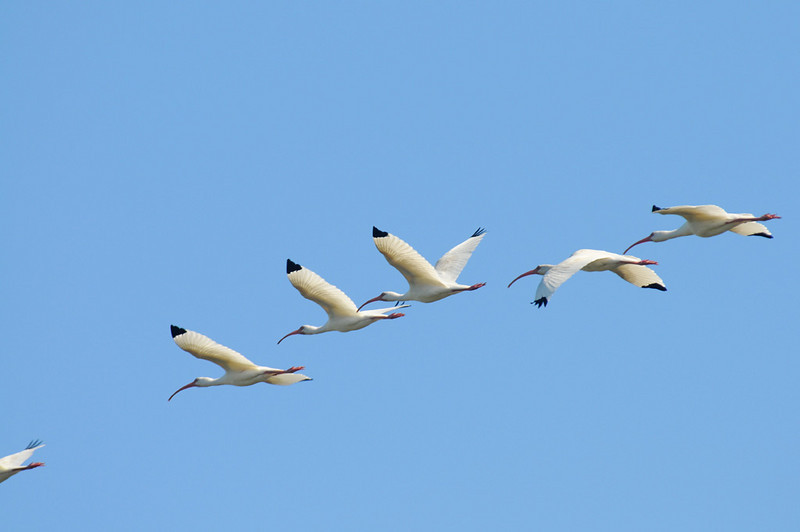
Last week while reading by the window that overlooks our small backyard, my eye caught movement. When I looked out, under the tree in the shade stood a Sandhill Crane surrounded by 8 or 9 White Ibises. The Ibises walked toward my way and were digging and checking out our lawn. The group kept moving and digging around as Ibises will do. They exited left of my view and the Sandhill was still standing in the same spot. Soon, from the left of view the Ibises came back and this time there were 11 of them. They walked back toward the crane and exited right. Crane still standing. Then a few minutes later, back they came right to left and this time there were 13 of them. The Crane was still standing there. Off they went to the left of my view. You got it, the crane was still standing there. Then, here they came the last time, left to right, and there were 14 of them this time. My stately Sandhill Crane was still standing there. All of this took place in about a 30 minute time span.

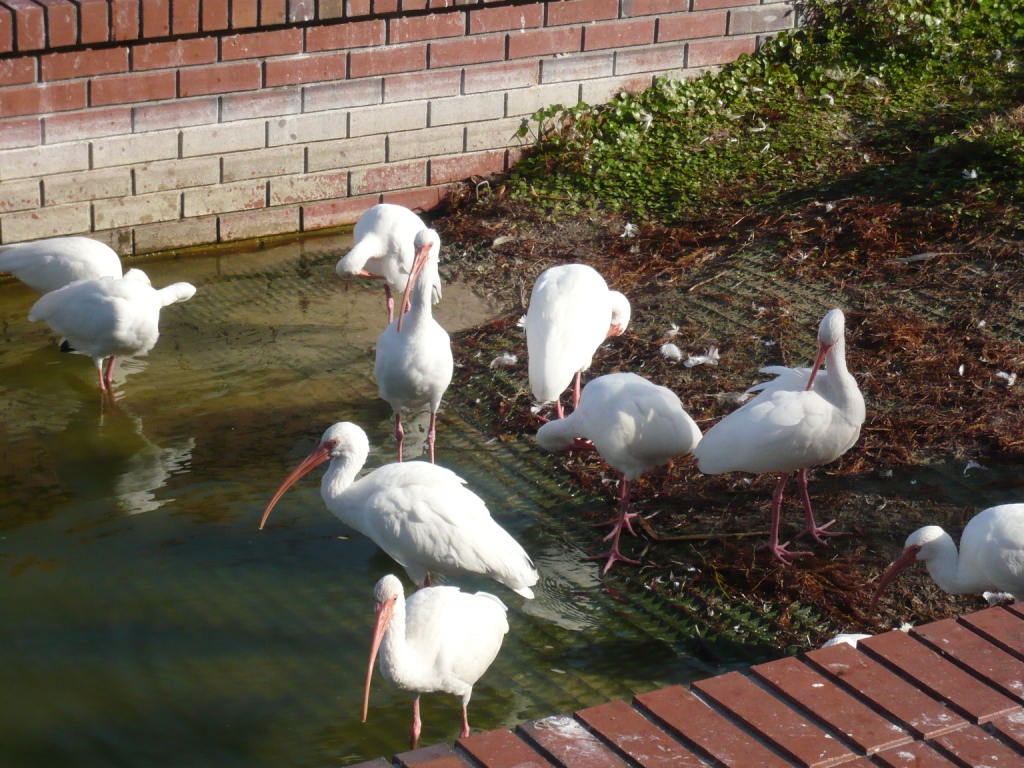
White Ibises at Lake Morton by Dan

White Ibises at Lake Morton by Dan

Needless to say, my reading was slowed down by all this activity. The ibises were digging around and yet they kept on the move. They put their beaks in the ground and pound up and down about 5 or 6 times and then move on and repeat the process over again. One or two of them will find something good to eat and will stay in the same spot to continue to dig. When they look up and see that the group has moved on, they immediately scurry off to catch up with the others. They have a funny little way of walking. This was repeated many times as they looked up and then followed the crowd.

I can come up with several applications for what was going on, but I will only choose one of them, for now.

God has given us His Word, the Bible, and in it we learn the truths about God the Father, Jesus Christ the Son, and the Holy Spirit who are one and are the great I AM.  The Word reveals truths about creation, salvation, sin, God’s attributes such as love, mercy, grace, judgment, justice, long-suffering, etc. As the Sandhill Crane stood, so should we stand firm in the truths taught in the Bible. We should not waver or try to change what has been written. Jesus has provided salvation, through His death on the cross, and invites us to accept His gift of salvation.

Jesus said to him, “I am the way, the truth, and the life. No one comes to the Father except through Me. (John 14:6)

Many people know the truth about Jesus, the Cross, God, creation, heaven, hell, etc., but do not apply it to their heart or soul. They either think, there is some other way and are always searching for some new “angle” of belief. Be it different religions, non-religion, atheism, or what ever.

Off on another search - American White Ibis by Bob-Nan

Off on another search - American White Ibis by Bob-Nan

Others who do accept the Lord Jesus Christ as their Savior, want to find some new “angle” to what the Bible teaches, by perverting it, or trying to twist it to where their “sin” is justified. Maybe are just not really “walking with the Lord” and want to live in sin or they become false teachers.

Both groups, unbelievers or believers, are like the Ibises who go away from the truth (crane), and try new things, then almost come back, sort of, and then scurry off to find something different. Even those who settle down, look up and see the crowd going a certain way, and run after that new thing.

Enter by the narrow gate; for wide is the gate and broad is the way that leads to destruction, and there are many who go in by it. Because narrow is the gate and difficult is the way which leads to life, and there are few who find it. (Matthew 7:13-14)

May we all seek the truth of God, accept the Lord’s salvation, and then live our lives according to God’s Word.

See:
The Gospel Message
Wordless Birds

Birds in Hymns – How Great Thou Art

Great is the LORD, and greatly to be praised; And His greatness is unsearchable. (Psalms 145:3)

Author: Carl Boberg, 1859-1940
Tr. By Stuart K. Hine, 1899-
Musician: Swedish Melody
Arr. By Stuart K. Hine, 1899-

(by Sean Fielder)

How Great Thou Art

American Yellow Warbler (Dendroica aestiva) by J Fenton

American Yellow Warbler (Dendroica aestiva) by J Fenton

O Lord my God! When I in awesome wonder
Consider all the worlds Thy hands have made,
I see the stars, I hear the rolling thunder,
Thy power throughout the universe displayed,

Refrain:
Then sings my soul, my Saviour God to Thee;
How great Thou art, how great Thou art!
Then sings my soul, my Saviour God to Thee;
How great Thou art, how great Thou art!

When through the woods and forest glades I wander
And hear the birds sing sweetly in the trees;
When I look down from lofty mountain grandeur
And hear the brook and feel the gentle breeze;

And when I think that God, His Son not sparing
Sent Him to die, I scarce can take it in;
That on the cross, my burden gladly bearing,
He bled and died to take away my sin;

When Christ shall come with shout of acclamation
And take me home, what joy shall fill my heart!
Then I shall bow in humble adoration
And there proclaim, my God, how great Thou art!

——————————————————————————–

HYMN HISTORY:

Northern Parula (Parula americana) by Reinier Munguia

Northern Parula (Parula americana) by Reinier Munguia

Boberg wrote the poem “O Store Gud” (O Great God) in 1885 with nine verses.

The inspiration for the poem came when Boberg was walking home from church near Kronobäck, Sweden, and listening to church bells. A sudden awe-inspiring storm gripped Boberg’s attention, and then just as suddenly as it had made its violent entrance, it subsided to a peaceful calm which Boberg observed over Mönsterås Bay. According to J. Irving Erickson:

Carl Boberg and some friends were returning home to Mönsterås from Kronobäck, where they had participated in an afternoon service. Nature was at its peak that radiant afternoon. Presently a thundercloud appeared on the horizon, and soon sharp lightning flashed across the sky. Strong winds swept over the meadows and billowing fields of grain. The thunder pealed in loud claps. Then rain came in cool fresh showers. In a little while the storm was over, and a rainbow appeared.

When Boberg arrived home, he opened the window and saw the bay of Mönsterås like a mirror before him… From the woods on the other side of the bay, he heard the song of a thrush…the church bells were tolling in the quiet evening. It was this series of sights, sounds, and experiences that inspired the writing of the song.[7]

According to Boberg’s great-nephew, Bud Boberg, “My dad’s story of its origin was that it was a paraphrase of Psalm 8 and was used in the ‘underground church’ in Sweden in the late 1800s when the Baptists and Mission Friends were persecuted.”  The author, Carl Boberg himself gave the following information about the inspiration behind his poem:

“It was that time of year when everything seemed to be in its richest colouring; the birds were singing in trees and everywhere. It was very warm; a thunderstorm appeared on the horizon and soon thunder and lightning. We had to hurry to shelter. But the storm was soon over and the clear sky appeared.

“When I came home I opened my window toward the sea. There evidently had been a funeral and the bells were playing the tune of ‘When eternity’s clock calling my saved soul to its Sabbath rest.’ That evening, I wrote the song, ‘O Store Gud.'”

[edit] Publication

Boberg first published “O Store Gud” in the Mönsterås Tidningen (Mönsterås News) on 1886 March 13.

The poem became matched to an old Swedish folk tune. and sung in public for the first known occasion in a church in the Swedish province of Värmland in 1888. Eight verses appeared with the music in the 1890 Sions Harpan.

In 1890 Boberg became the editor of Sanningsvittnet (The Witness for the Truth). The words and music were published for the first time in the 16 April 1891 edition of Sanningsvittnet. Instrumentation for both piano and guitar was provided by Adolph Edgren (born 1858; died 1921 in Washington D.C.), a music teacher and organist, who later migrated to the United States.

Boberg later sold the rights to the Svenska Missionsförbundet (Mission Covenant Church of Sweden). In 1891 all nine verses were published in the 1891 Covenant songbook, Sanningsvittnet.  These versions were all in 3/4 time. In 1894 the Svenska Missionsförbundet sångbok  published “O Store Gud” in 4/4 time as it has been sung ever since (cf. Time signature).
——————————————————————————–
Wikipedia – How Great Thou Art – History
SermonAudio – How Great Thou Art – Audio

See ~ Wordless Birds

More ~ Birds in Hymns

*
The Gospel Message

The Gospel Message is that Jesus Christ, the Creator, came to earth and died for us. It is up to us to accept, by faith, what He has done for us. He loves us, and wants to be our Savior, Lord, and King.

Please read the basic message of the whole gospel below and seriously consider that your eternal soul is very important to God, the Lord Jesus Christ, the Holy Spirit.

A.  God

  • He exists  (Hebrews 11:6)
  • He is holy  (1 Peter 1:15)
  • Man must be perfect to reach God  ( Matthew 5:48)
  • The measure of God’s holiness is the law  ( Romans 2:12, 13, 14, 15, 16)
  • He has judged sin  (Romans 6:23)

B.  Man

  • He is a sinner  (Romans 3:23)
  • He cannot save himself  (Ephesians 2:8,9)

C.  Jesus Christ

  • He died because of our sins  (1 Corinthians 15:3)
  • He rose again  (1 Corinthians 15:14)
  • He is the only Messiah (Savior)  (John 14:6), (1 Timothy 2:5)
  • He paid the price for our sins  (1 Corinthians 6:1920), (Hebrews 7:27)
  • That He is Lord, that is the right ruler of all, including us  (Romans 10:9, 10)

D.  Grace

  • Salvation is a free gift.  (Ephesians 2:8,9)
  • We can’t earn it  (Ephesians 2:8,9)

E.  Faith

  • We must totally yield ourselves to Christ  (Acts 16:31)
  • We accept what God has done  (John 13:20)
  • We trust in Christ alone for salvation  (John 14:6), (Ephesians 2:8,9, 10)
  • Repentance is inherent in Biblical Faith  (Acts 2:36)

F.  Commitment

  • We must be willing to turn from our sins and follow Christ  (2 Corinthians 5:15)

(The verses will pop up when mouse is placed over them)

If you have any further questions or would like assistance accepting Christ as your personal Savior, please contact me at Lee@Leesbird.com or contact my pastor, Rev. Nathan Osborne III.

wsbirdsbirdhouse(Pastor Osborne provided the above outline)

As much as we enjoy bird watching and enjoy seeing how many we can see or how many we can count on a list, remember the following verses:

For what will it profit a man if he gains the whole world, and loses his own soul? Or what will a man give in exchange for his soul? (Mark 8:36-37)

The Secret Only God Knows About Hummingbirds – by April Lorier

HummingBirdSMAll of my neighbors have hummingbird feeders on their porches. Why? Well, everyone knows there’s something very special about these birds. Yes, they are birds, and there’s a secret only God knows about them.

Hummingbirds are birds in the family Trochilidae, and are native to the Americas. They can hover in mid-air by rapidly flapping their wings 12–90 times per second (depending on the species). They can fly backwards, and are the only group of birds able to do so.

Hummingbirds do not spend all day flying, though. They don’t have the energy for that! The majority of their activity consists simply of sitting or perching.

Hummingbirds feed in many small meals, consuming many small invertebrates and up to five times their own body weight in nectar each day. They spend an average of 10-15% of their time feeding and 75-80% sitting and digesting.

Hummingbirds feed on the nectar of plants and are important pollinators, especially of deep-throated, tubular flowers. Like bees, they are able to assess the amount of sugar in the nectar they eat; they reject flower types that produce nectar which is less than 10% sugar and prefer those whose sugar content is stronger. Nectar is a poor source of nutrients, so hummingbirds meet their needs for protein, amino acids, vitamins, minerals, etc. by preying on insects and spiders, especially when feeding young.

Their English name derives from the characteristic hum made by their rapid wing beats. They can fly at speeds exceeding 33 mph.

What is awesome about humming birds is that aerodynamically, these birds are not able to fly, and yet they do!

As scientists try to figure out how hummingbirds are flying, I think God is smiling. It’s just another thing only The Creator knows, and that’s fine with me. Life should have some mystery, don’t you think?

(c) 2009 April Lorier

For since the creation of the world God’s invisible qualities—his eternal power and divine nature—have been clearly seen, being understood from what has been made, so that men are without excuse. Romans 1:20

Supplied by and reprinted with permission of April Lorier


See:
More of April’s Articles here

Lesson from Smallest Bird – by April Lorier

Lesson from smallest bird”

I was sitting in my car, waiting — I do not like waiting! — and a flock of birds fluttered up to me with expectant looks and frantic behavior. There were birds of all colors, including some with vibrant yellow eyes. I watched them display their pecking order and smiled. Just like people I thought.

Their chatter increased in volume and rhythm as they tried to convince me they would settle for the smallest crumbs of anything I had to offer. I especially noticed one little bird, the smallest of the flock, because the larger birds kept belaboring the point that he was least among the birds. Poor baby, I said as I leaned towards my glove compartment. Let’s see what I can find.

Voila! There was a package of two power bars! Excitedly, I smashed them up and threw them outside the window. That started a race for the crumbs! I noticed all of the birds except one rushed for the smallest crumbs as they pushed the little one out of the way.

I kept watching, hoping he would find at least one crumb. Then a funny thing happened. The smallest bird eyed a very large piece of the power bar and snatched it up. Then he quietly waddled away.

Meanwhile, the larger birds kept frantically scrounging for more crumbs, totally unaware that the best had already been taken away.

“Look at that,” The Spirit whispered, “all of the others settled for crumbs while one bird got enough to eat on all day. How many times do you settle for crumbs?”

It was like a light bulb went off inside my soul. God desires to give us riches beyond our wildest expectations, but we are living frantically in the moment and settling for what we can have NOW: mere crumbs, compared to what we could have if we but trusted in the character of God, our Heavenly Father!

Oh, God, thank You for the gift of this lesson. You not only provide for the birds, but use them to take Your children deeper in You.

(c) 2007-2009 April Lorier

For since the creation of the world God’s invisible qualities—his eternal power and divine nature—have been clearly seen, being understood from what has been made, so that men are without excuse. Romans 1:20

Supplied by and reprinted with permission of April Lorier.

See more of April’s Articles

*

Sparrows and God Care – by April Lorier

When I Consider! – DNA in Dinosaurs

When I Consider!

When I Consider!

Evidence from the Fossil Record – from A Closer Look at the Evidence, August 8.

“As soon as a plant or animal dies, its DNA begins to decompose. The oldest accurately known DNA samples are from a 4000-year old mummy. Based on the deterioration of the molecule from samples of this age. it is estimated that essentially no DNA could survive longer than 10,000 years. However, DNA segments have been found in magnolia leaves (dated by evolutionists at 17 million years), dinosaur bones (dated at 80 million years), scales of a fossilized fish (dated at 200 million years) Evolutionary scientists should be asking how DNA could still be contained in samples this old when more recent samples indicate that the DNA molecule is far too sensitive to have lasted this long. Perhaps there is something wrong with the old-earth dating methods and these fossils still contain DNA fragments simply because they are not as old as believed. These samples have been simply dated wrong due to faulty assumptions of radiometric dating methods.

Dinosaur Fossil from OCR.org

Dinosaur Fossil from OCR.org

Evolutionists have a similar problem with protein preserved in dinosaur bones. As with DNA, no protein should last 75 to 150 million years; yet protein has been found in dinosaur bones. These plant and animal remains are simply not as old as evolutionists believe.”

In the Beginning, 7th Ed., p29-30

Listen to Me, O Jacob, And Israel, My called: I am He, I am the First, I am also the Last. Indeed My hand has laid the foundation of the earth, And My right hand has stretched out the heavens; When I call to them, They stand up together. (Isaiah 48:12-13 NKJV)


More When I Consider! articles

See Also:
A Scientist Says He Has Isolated Dinosaur DNA
The Devastating Issue of Dinosaur Tissue, from ICR
Dinosaur Mania and Our Children, by Paul S. Taylor
They’re seeing it by not believing it – Williams: Is science cracking code of dinosaur DNA?
Scientists recover T. rex soft tissue

Birds of the Bible – Eagles III

This year I have been reading through the Bible in chronological order. In Jeremiah this week, the eagle showed up in three of the verses I was reading. If you know me by now, that calls for a blog about one of my favorite “Birds of the Bible” birds.

Jeremiah, the prophet, has been warning the people of Judah and Jerusalem that they were going to be punished by God because of their worship of other gods and turning from Him. Jeremiah was always in problems because; 1) few if any believed him, 2) the false prophets were telling the people that “all was well and that they would not be punished.” 3) they tried to kill him several times, 4) when confronted with the truth, knowing they would be killed or taken captive, they still refused to give up their false religions or turn to the LORD. So by chapter 48:28 he warns them – “You who dwell in Moab, Leave the cities and dwell in the rock, And be like the dove which makes her nest In the sides of the cave’s mouth.” (NKJV) (oops! the dove is for another blog) He is telling them to “leave town.”

Jeremiah 48:40-42 says:

For thus says the LORD: “Behold, one shall fly like an eagle, And spread his wings over Moab. Kerioth is taken, And the strongholds are surprised; The mighty men’s hearts in Moab on that day shall be Like the heart of a woman in birth pangs. And Moab shall be destroyed as a people, Because he exalted himself against the LORD.

Watch the following video and decide whether you think the fish was surprised.

In Jeremiah 49:16 and 22, the eagle is mentioned again. Eagles are known to make their nest as high up as they can and these people thought by being high up in the hills, that the enemy would not get them. Then in verse 22, it refers to flying like an eagle and spreads its wings. So the enemy (Nebuchadnezzar king of Babylon and his army) was going to come over them. Now the people are finally afraid.

Your fierceness has deceived you, The pride of your heart, O you who dwell in the clefts of the rock, Who hold the height of the hill! Though you make your nest as high as the eagle, I will bring you down from there,” says the LORD. (Jeremiah 49:16 NKJV)
Behold, He shall come up and fly like the eagle, And spread His wings over Bozrah; The heart of the mighty men of Edom in that day shall be Like the heart of a woman in birth pangs. (Jeremiah 49:22 NKJV)

Another of my favorite eagle videos of the eagles wings being spread:

Even though I used my favorite videos, this was not a enjoyable experience for these people. I trust we will heed the warnings of the Bible. God loves his chosen people, Israel (and all of us), but God cannot tolerate sin or denial of Himself.

He who is often rebuked, and hardens his neck, Will suddenly be destroyed, and that without remedy. (Proverbs 29:1 NKJV)
“Come now, and let us reason together,” Says the LORD, “Though your sins are like scarlet, They shall be as white as snow; Though they are red like crimson, They shall be as wool. If you are willing and obedient, You shall eat the good of the land; But if you refuse and rebel, You shall be devoured by the sword”; For the mouth of the LORD has spoken. (Isaiah 1:18-20 NKJV)

The people of Noah’s day had over 100 years of warning, but also refused to accept God, and were devoured, not by sword, but by a flood.


See Also:
Eagles for more articles, photos, and videos
Wordless Birds

*