So, what are they wading for, in South Florida?

Dr. James J. S. Johnson

“To everything there is a season, and a time to every purpose under the heaven … Everything He [i.e., God] has made beautiful, in its time: also He hath set eternity in their heart, so that no man can find [i.e., fully find/discover] the work that God has done from the beginning to the end.” (Ecclesiastes 3:1 & 3:11)

Lately I’ve been investigating birds of South Florida, especially those of the Everglades and the Florida Keys. God willing, I expect to be part of a scientific/educational tour of those parts of Florida, later this year (more on that later, D.v., if that trip becomes a reality!). Meanwhile, a few of those Florida birds are on my mind, so it’s timely to post a bit on some of these beauties. For starters, let’s consider some heron-like wading birds, the kinds that have long skinny legs, perfect for hunting food in shallow waters.

Interestingly, there is an “albino” version (endemic subspecies) of the Great Blue Heron, called the “Great White Heron”. In other words, this version of the Great Blue Heron is white, but it’s not a Great White Egret. It’s seen in the Florida Keys. In fact, there is a national wildlife refuge named for it: Great White Heron National Wildlife Refuge, just west of national Key Deer Refuge.

The face of a “Great White Heron” looks a lot like that of a regular Great Blue Heron — to compare, consider this mugshot of a Great Blue Heron.

Of course, South Florida has lots of inland and coastal waters, so the opportunities for hunting and eating aquatic prey seems boundless, as a practical matter (to a hungry heron). Consider this Great Blue Heron, eating what looks like a catfish. Of course, there are many other heron-like birds in South Florida. For another example, consider the Little Blue Heron, which is often found in the Everglades. The Little Blue Heron has bluish-grey plumage, ivory white legs and feet, and a whitish dagger-like bill.

For another wading bird of South Florida, consider the Roseate Spoonbill. Well-named, this rose-feathered wader has a distinctively spoon-shaped bill, used for capturing prey (and securing it as the bill-shaking bird drains out excess water before swallowing.

For another example, consider the American Flamingo (a/k/a Pink Flamingo), an icon of South Florida’s colorful wildlife. If the flamingo gets the right diet, and thus gets lots of carotenoid pigment, the red-to-pink color is vivid!

And we should not forget the Wood Stork, which Buddy Davis calls “the only stork of North America” (see SWAMP MAN, Buddy’s classic wildlife DVD produced by Answers in Genesis ministry).

WOOD STORK (“Iron-head”): Nat’l Park Service photo

The clunky-looking Wood Stork is nicknamed “Iron-hHead” (and “Flint-head”) due to its grey scaly neck and head.

Of course, the Snowy Egret is a Florida favorite — especially to LEESBIRD.COM visitors. Snowy legs are black, but look at those yellow feet! Some call them “golden slippers”, since they walk, strut, and amble upon their feet; others say “golden gloves” since snowies use them as prehensile fingers, grasping things.

One of my (this is JJSJ talking) all-time favorite wading birds, of Florida, is the White Ibis. Some become accustomed to eating bread crumbs provided by birdwatchers, e.g., in the Webels’ pondside backyard (St. Petersburg). And, in some public parks, white ibises might even eat bread crumbs out of your hand!

That’s it for now . . . please appreciate that God has providentially equipped the habitats of Florida to be bird’s havens, so those habitats are likewise birder’s havens! Yes, the Lord has made all of these birds “beautiful in their times”–and in ours too!

“To everything there is a season, and a time to every purpose under the heaven … Everything He [i.e., God] has made beautiful, in its time: also He hath set eternity in their heart, so that no man can find [i.e., fully find/discover] the work that God has done from the beginning to the end.” (Ecclesiastes 3:1 & 3:11)

Hey! Is that an egret standing atop my head? (Photo by Marcia Webel)

Tundra Swans Return, in November, to Chesapeake Bay

Swans Return, in November, for Chesapeake Bay Over-wintering

Dr. James J. S. Johnson

To every thing there is a season, and a time to every purpose under the heaven . . . .  He hath made every thing beautiful in his time; also He has set the world in their heart, so that no man can find out the work that God makes from the beginning to the end. (Ecclesiastes 3:1 & 3:11)

TUNDRA SWANS as “Winter Marylanders”
(Will Parson/Chesapeake Bay Program photo credit)

Seasons come and seasons go, demonstrating the faithfulness of God’s post-Flood promise to Noah and Noah’s Ark passengers:

While the earth remains, seedtime and harvest, and cold and heat, and summer and winter, and day and night shall not cease. (Genesis 8:22)

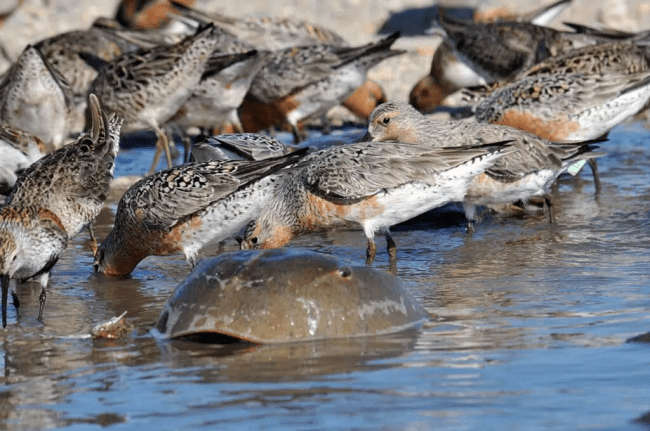
RED KNOTS eating horseshoe crab eggs
(USF&WS / Gregory Breese photo credit)

Only a half-year ago the May migrants were blanketing shorelands of the Delmarva [Delaware-Maryland-Virginia] Peninsula, and other parts of the the Chesapeake Bay’s watershed shorelands, here and there:

In May we were tramping the saltmarshes and beaches of the lower Delmarva Peninsula with biologists from the Nature Conservancy, collecting vital data on a variety of shorebirds, from willets to whimbrels, plovers to dunlins, red knots to ruddy turnstones. Some, like the curved-beaked whimbrels, may be airborne without stopping for up to five days, arriving at the lush marshes and mudflats of our region famished from their winter haunts in South America. For several weeks they will refuel here, nonstop, chowing down on fiddler crabs. Then, one spring evening, something in them stirs, and they are aloft by the thousands, not to alight before reaching breeding grounds that stretch from Hudson Bay to far northwest Canada’s Mackenzie River Delta. [Quoting Tom Horton, CHESAPEAKE BAY JOURNAL, 34(5):30 (July -August 2024).]

But now, in November, the phenological reverse occurs — because, during May (and earlier), migrant birds fly northward, to seek out their summer breeding grounds; whereas, during November (and earlier), migrant birds are flying southbound, leaving their breeding grounds behind, as they emigrate by air to their over-wintering grounds.

Come this autumn we’ll be on Deer Creek on the Susquehanna River . . . [including] days in the wet and snow over the winter, filming tundra swans, one of the largest long-distance migrators of the bird world. They [i.e., tundra swans] spend a good portion of their lives on the wing, moving from breeding grounds across Alaska’s North Slope and the Yukon each fall into the Chesapeake and North Carolina — a 9,000-mile round trip. . . . . In November, not long after the last monarch [butterfly, emigrating southward to Mexico] has passed through, and as the silver eels [migrating snake-shaped ray-finned fish] stream from the Chesapeake’s mouth toward Sargasso depths, there will come the lovely, wild hallooing of “swanfall” — the descent of the tundra swans from on high to grace our winter. [Quoting Tom Horton, CHESAPEAKE BAY JOURNAL, 34(5):30 (July -August 2024).]

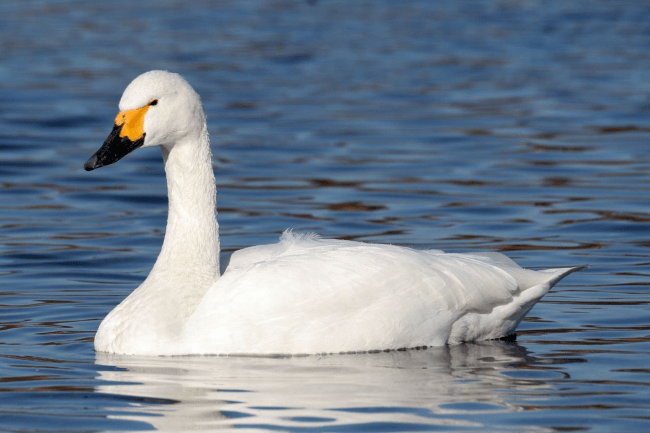
TUNDRA SWAN (Wikipedia / Maga-chan photo credit)

Tundra swans — they are huge [some would say “yooge”] geese-like birds.

So, what kinds of waterfowl are phenologically (and providentially) programmed, by the Lord Jesus Christ, to winter in ice-free estuaries like the Chesapeake Bay? 

“Duck, duck, goose!”—and swans (such as Tundra Swans), just to name the most obvious.  For example, Tundra Swans—being “yooge” birds—are easy to observe, especially if they are afloat in waters of an estuarial (or lacustrine) habitat that you may be visiting.

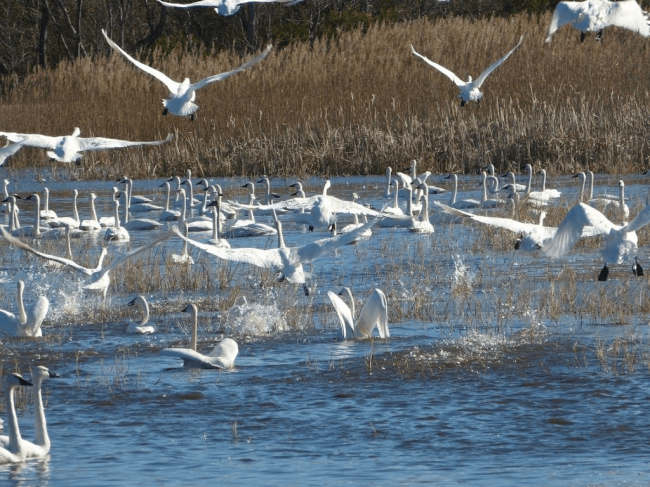
TUNDRA SWANS in North Carolina
(USF&WS photo / public domain)

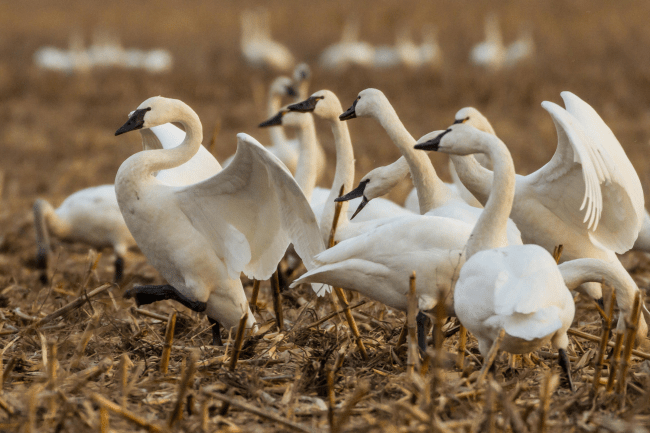
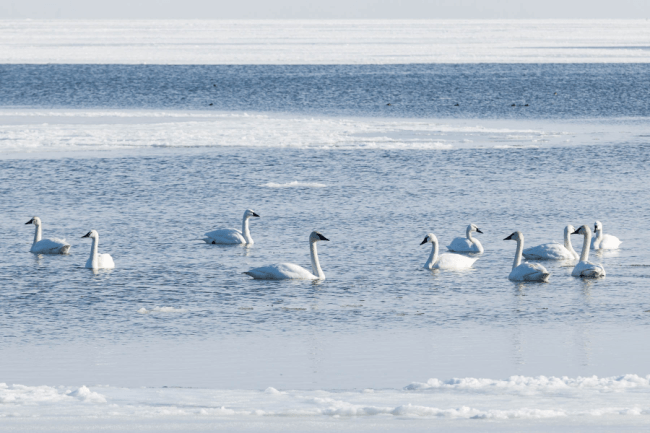
Swans are the largest waterfowl, and the tundra swans travel the farthest, more than 4,000 miles in some cases. They winter primarily on the Delmarva [Delaware-Maryland-Virginia] Peninsula and the estuarine edges of North Carolina. These large white birds are easily recognized by their black bills and straight or nearly straight necks. Tundra swans often form flocks on shallow ponds. [Quoting Kathy Reshetiloff, “Chesapeake’s Abundance Lures Wintering Waterfowl”, CHESAPEAKE BAY JOURNAL, 33(9):40 (December 2023), posted at http://www.bayjournal.com/columns/bay_naturalist/chesapeake-s-abundance-lures-wintering-waterfowl/article_4463317a-887f-11ee-a208-8768dc34c5a7.html .]

Wow! — what a wonder these wintering waterfowl are!

Or, more appropriately said, Hallelujah! — what a treasure of phenological providence these wonderful waterbirds are, showing God’s handiwork and caring kindness for His own creatures. May God bless them all, as they faithfully do their respective parts to “be fruitful, and multiply upon the earth” (Genesis 8:17).

TUNDRA SWANS
(Audubon Field Guide photo credit)

Why Egg-producing Woodpeckers Snack on Bones

Dr. James J. S. Johnson

To everything there is a season, and a time to every purpose under the heaven.  (Ecclesiastes 3:1)

KONICA MINOLTA DIGITAL CAMERA

RED-COCKADED WOODPECKER (Carolina Bird Club photo)

Woodpeckers are famous for eating insects—beetles, caterpillars, “grubs” (insect larvae), spiders, ants, etc.—as well as occasionally eating berries and other fruits.  But what about vitamins and minerals, how do woodpeckers get what they need? 

Consider this:  when you eat eggs—boiled, poached, or as omelets—do you discard the eggshells? Likewise, if you eat trout or turkey, do you recycle your fish or fowl bones?

Some birds and mammals eat broken eggshells or snail shells to get nutritionally valuable calcium.[1]  Also, some birds—such as Red-cockaded woodpeckers[2] and Alaskan sandpipers[3]—munch on bones, to get calcium, especially during breeding season.

Getting calcium (usually from calcium carbonate: CaCO3) is needful, of course, but how do birds know they need calcium, especially during the breeding season? 

A related question: how do expectant human mothers, who suddenly crave finfish or shellfish (or pickles, or Buffalo hot wings, or whatever) know that they need a nutritional change, while their physiologically transformed womb-factories busily build beautiful babies? 

God somehow provides an urge to eat certain foods that we need, when we need those foods—this is something we gained by so-called evolutionary “luck” or random “chance”!  In fact, successful reproduction of populations, whether they be human or animal, is something that is unfixable if reproduction is ever broken. (In other words, true extinction is forever—there are no second chances!)

Actually, calcium nutrition-satisfying behavior makes sense, biblically, because it helps Christ’s creatures to reproduce successfully, i.e., to “be fruitful and multiply”, so their kinds can “fill” (populate) Earth’s habitats. Thus, learning how creatures fulfill the Genesis Mandate helps us to “cast down” haughty imaginations (2nd Corinthians 10:4-5), such as the imaginations of Darwinists, who try to replace Christ with animistic “nature-creating-itself” mythology, masquerading falsely as “science” (1st Timothy 6:20)–as if inanimate “nature” could somehow “select” helpful results for promoting life on Earth!

During Creation Week (on Day #5, to be exact), the Lord Jesus Christ (as Creator[4]) commanded birds to reproduce (and “fill” environments); He also equipped them with what they need, to do so.  Many of the intricate details we are just now learning. 

Further complicating matters, successful reproduction requires a harmony of physical traits (biochemically regulated by genetics/epigenetics) with decision-based behaviors (which rely upon learning, by the non-physical “soul” of a bird).  The details of successfully blending physical body systems, with non-physical learned behaviors, is one of the “wonders without number” (Job 9:10) that we can admire God for, as we reverently study how God’s creatures live.[5] 

Of course, when creatures purposefully search local habitats for needed nutrients—including vital minerals like calcium—they exhibit continuous environmental tracking (CET), as they hunt and select what they need from their territory.  Thus, Christ equipped animals to actively select what they need, from their habitats—it is not true that habitats “select” or “shape” passive animals.[6]

So, what can we learn from our Lord Jesus Christ’s red-cockaded woodpeckers (Picoides borealis), that recycle calcium from collected bone fragments, consuming bone flakes just before and when they are laying eggs?

The females took bone fragments from raptor pellets located on the ground. … Small bone fragments were consumed at the pellets whereas larger pieces were taken to a tree trunk (by flight) where they were pecked and mandibulated. … Pieces of bone were cached by placing them between scales of [tree-trunk] bark and then hammering them with the bill until they were wedged. We confirmed that bones were cached by recovering two pieces of bone from trees and by observing birds recover cached bones, handle them and cache them elsewhere.2

Repasky, Blue, & Doerr article cited in endnote 2 (below)

Selecting and ingesting bone-pecked calcium is targeted and purposeful—not random—because mother woodpeckers seek and extract calcium from bone fragments during breeding seasons (hiding bone fragments for later “snacks”), mostly ignoring those bones when they cease producing eggs2,4,5—amazing! 

Darwinian trial-and-error “luck” cannot explain how these wise woodpeckers know to hunt and ingest calcium-rich bone flakes, timed to egg-producing seasons.4,5  However, the Lord Jesus Christ is the Mastermind of purposeful timing for all of His creation (Ecclesiastes 3:1), including female red-cockaded woodpeckers.

RED-COCKADED WOODPECKERS (James Audubon watercolor — public domain)

REFERENCES


[1] E.g., Mary Straus, “Calcium in Homemade Dog Food”, WHOLE DOG JOURNAL (May 28, 2019), at http://www.whole-dog-journal.com/food/calcium-in-homemade-dog-food/ (calcium from eggshells). See also Samuel L. Beasom & Oliver H. Pattee, “Utilization of Snails by Rio Grande Turkey Hens”, JOURNAL OF WILDLIFE MANAGEMENT, 42:916-919 (1978). 

[2] Richard R. Repasky, Roberta J. Blue, & Philip D. Doerr, “Laying Red-cockaded Woodpeckers Cache Bone Fragments”, THE CONDOR, 93(2):458-461 (1991).  Red-cockaded woodpeckers resemble 4 other American woodpeckers, the Ladder-backed Woodpecker, Downy Woodpecker, Hairy Woodpecker, and Nuttall’s Woodpecker.  It appears that Red-cockaded Woodpeckers can hybridize with Hairy Woodpeckers (Picoides villosus), which in turn hybridize with Ladder-backed Woodpeckers (Picoides scalaris), which hybridize with Downy Woodpeckers (Picoides pubescens) and with Nuttall’s Woodpecker (Picoides nuttallii). See Eugene M. McCarty, HANDBOOK OF AVIAN HYBRIDS OF THE WORLD (New York, NY: Oxford University Press, 2006), pages 107-108.

[3] Stephen F. MacLean, Jr., “Lemming Bones as a Source of Calcium for Arctic Sandpipers (Calidris spp.)”, IBIS (INTERNATIONAL JOURNAL OF AVIAN SCIENCE), 116:552-557 (1974).

[4] See John 1:1-10 & Colossians 1:16-17 & Hebrews 1:1-2, etc. 

[5] “Although qualitatively distinct from humans—who are made in God’s image (Genesis 1:27)—animals have what Scripture calls a “soul” (Hebrew nephesh). … But the resourcefulness of animals should not surprise us. Proverbs [30:24-28] informs us that God wisely installed wisdom into animals—even small creatures like ants, conies, locusts, and lizards.  Literally, these animals are “wise from receiving [God’s] wisdom.”7 Fascinating!” Quoting James J. S. Johnson, “Clever Creatures: ‘Wise from Receiving Wisdom’”, ACTS & FACTS, 46(3):21 (March 2017). 

[6] Randy J. Guliuzza, “A New Commitment to Deep Research”, ACTS & FACTS, 50(9):4-5 (September 2021).

RED-COCKADED WOODPECKER (Carolina Bird Club photo)

Hagerman NWR:  Missing the Northern Shovelers (and Other Winter Migrants)

Hagerman NWR:  Missing the Northern Shovelers and Other Winter Migrants

Dr. James J. S. Johnson

To everything there is a season, and a time to every purpose under the heaven.

Ecclesiastes 3:1
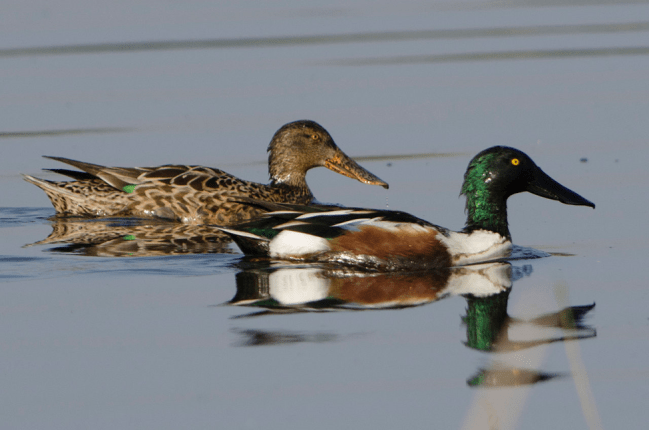
NORTHERN SHOVELER pair   (Wikipedia photo credit)

Recently I visited Hagerman National Wildlife Refuge (near Sherman, Texas — bordering Lake Texoma), hoping to see a lot of migratory birds, especially geese and ducks who visit wetlands for overwintering or for quick stopovers.  Compared to prior visits, it was a major disappointment.  Even the visitors center was locked, closed to visitors (with a posted sign claiming pandemic dangers as the excuse for the closure).

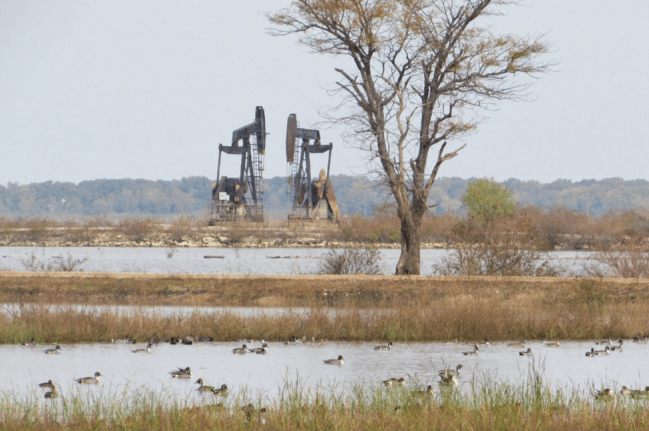
Possibly due to a year of drought, many of the large ponds were shrunken (leaving half-dried mud basins), demonstrating that water is the key ingredient for wetland habitats.  The winter wheat was mostly consumed, so the population of snow geese was minimal.  Dozens and scores of snow geese could be seen, but not the usual hundreds or thousands. An occasional Great Blue Heron could be seen. Meanwhile the oil pumps (“horseheads”) quietly pumped. Even the few ducks seemed bored.

The Northern Pintail ducks were few and far between.  And, worse, I saw no Northern Shoveler ducks at all. Likewise, I don’t recall seeing the usual Green-winged Teals. Those shallow drought-dried wetlands must have been unattractive to most of the avian winter visitors, such as migratory ducks and geese. 

HAGERMAN NATIONAL WILDLIFE REFUGE, near Sherman, Texas (10,000 Birds photo credit)

So maybe this limerick can express my birding disappointment, that day, at Hagerman NWR:

DROUGHTS DISAPPOINT BIRDWATCHING AT WINTER WETLANDS

Hagerman’s a refuge of peace,

Fit for migrating ducks and geese;

Yet no shovelers were seen,

Nor teals with wings green —

Just some pintails, and a few geese.

[JJSJ, AD2022-01-19]

Oh well, goodbye — maybe next winter will be better, for viewing winter migrants at Hagerman NWR.

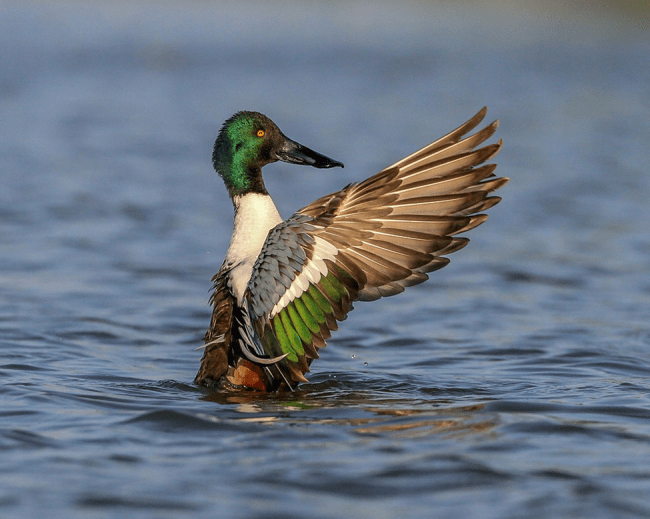
NORTHERN SHOVELER male in freshwater   (Steve Sinclair photo credit)