Swans Return, in November, for Chesapeake Bay Over-wintering
Dr. James J. S. Johnson
To every thing there is a season, and a time to every purpose under the heaven . . . . He hath made every thing beautiful in his time; also He has set the world in their heart, so that no man can find out the work that God makes from the beginning to the end. (Ecclesiastes 3:1 & 3:11)
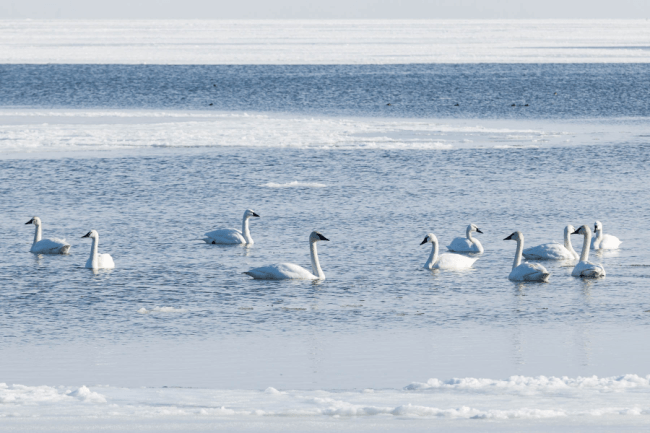
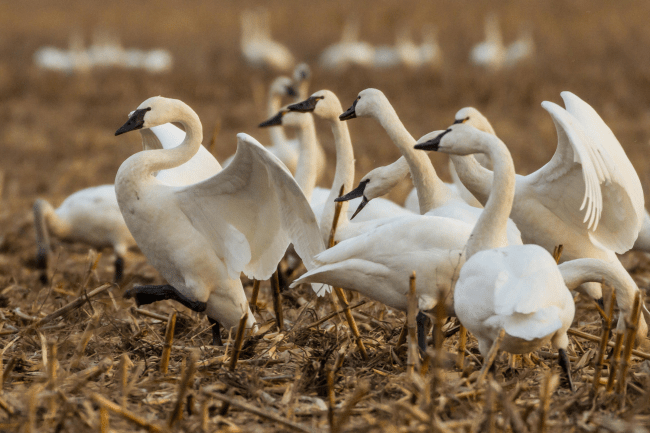
TUNDRA SWANS as “Winter Marylanders” (Will Parson/Chesapeake Bay Program photo credit)
Seasons come and seasons go, demonstrating the faithfulness of God’s post-Flood promise to Noah and Noah’s Ark passengers:
While the earth remains, seedtime and harvest, and cold and heat, and summer and winter, and day and night shall not cease. (Genesis 8:22)
Only a half-year ago the May migrants were blanketing shorelands of the Delmarva [Delaware-Maryland-Virginia] Peninsula, and other parts of the the Chesapeake Bay’s watershed shorelands, here and there:
In May we were tramping the saltmarshes and beaches of the lower Delmarva Peninsula with biologists from the Nature Conservancy, collecting vital data on a variety of shorebirds, from willets to whimbrels, plovers to dunlins, red knots to ruddy turnstones. Some, like the curved-beaked whimbrels, may be airborne without stopping for up to five days, arriving at the lush marshes and mudflats of our region famished from their winter haunts in South America. For several weeks they will refuel here, nonstop, chowing down on fiddler crabs. Then, one spring evening, something in them stirs, and they are aloft by the thousands, not to alight before reaching breeding grounds that stretch from Hudson Bay to far northwest Canada’s Mackenzie River Delta. [Quoting Tom Horton, CHESAPEAKE BAY JOURNAL, 34(5):30 (July -August 2024).]
But now, in November, the phenological reverse occurs — because, during May (and earlier), migrant birds fly northward, to seek out their summer breeding grounds; whereas, during November (and earlier), migrant birds are flying southbound, leaving their breeding grounds behind, as they emigrate by air to their over-wintering grounds.
Come this autumn we’ll be on Deer Creek on the Susquehanna River . . . [including] days in the wet and snow over the winter, filming tundra swans, one of the largest long-distance migrators of the bird world. They [i.e., tundra swans] spend a good portion of their lives on the wing, moving from breeding grounds across Alaska’s North Slope and the Yukon each fall into the Chesapeake and North Carolina — a 9,000-mile round trip. . . . . In November, not long after the last monarch [butterfly, emigrating southward to Mexico] has passed through, and as the silver eels [migrating snake-shaped ray-finned fish] stream from the Chesapeake’s mouth toward Sargasso depths, there will come the lovely, wild hallooing of “swanfall” — the descent of the tundra swans from on high to grace our winter. [Quoting Tom Horton, CHESAPEAKE BAY JOURNAL, 34(5):30 (July -August 2024).]
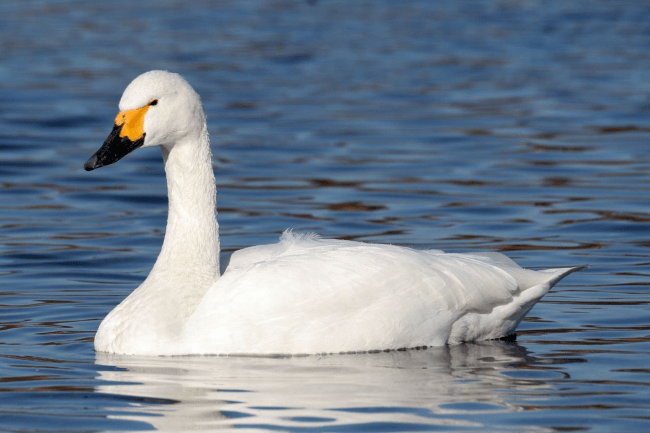
TUNDRA SWAN (Wikipedia / Maga-chan photo credit)
Tundra swans — they are huge [some would say “yooge”] geese-like birds.
So, what kinds of waterfowl are phenologically (and providentially) programmed, by the Lord Jesus Christ, to winter in ice-free estuaries like the Chesapeake Bay?
“Duck, duck, goose!”—and swans (such as Tundra Swans), just to name the most obvious. For example, Tundra Swans—being “yooge” birds—are easy to observe, especially if they are afloat in waters of an estuarial (or lacustrine) habitat that you may be visiting.
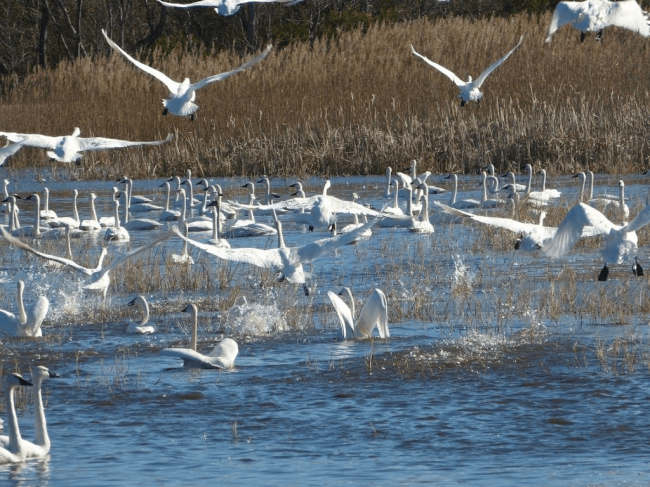
TUNDRA SWANS in North Carolina (USF&WS photo / public domain)
Swans are the largest waterfowl, and the tundra swans travel the farthest, more than 4,000 miles in some cases. They winter primarily on the Delmarva [Delaware-Maryland-Virginia] Peninsula and the estuarine edges of North Carolina. These large white birds are easily recognized by their black bills and straight or nearly straight necks. Tundra swans often form flocks on shallow ponds. [Quoting Kathy Reshetiloff, “Chesapeake’s Abundance Lures Wintering Waterfowl”, CHESAPEAKE BAY JOURNAL, 33(9):40 (December 2023), posted at http://www.bayjournal.com/columns/bay_naturalist/chesapeake-s-abundance-lures-wintering-waterfowl/article_4463317a-887f-11ee-a208-8768dc34c5a7.html .]
Wow! — what a wonder these wintering waterfowl are!
Or, more appropriately said, Hallelujah! — what a treasure of phenological providence these wonderful waterbirds are, showing God’s handiwork and caring kindness for His own creatures. May God bless them all, as they faithfully do their respective parts to “be fruitful, and multiply upon the earth” (Genesis 8:17).
While the earth remaineth, seedtime and harvest, and cold and heat, and summer and winter, and day and night shall not cease.
Genesis 8:22
Migrating birds remind me of what God said in Genesis 8:22, about the predictability of annual seasons. It’s really amazing if you think much about it: God selected Moses to report a conversation that God once had with Noah, at the conclusion of the worldwide Flood. In that conversation God promised Noah (and Noah’s family and descendants, which include all of us) that God would not send another global deluge.
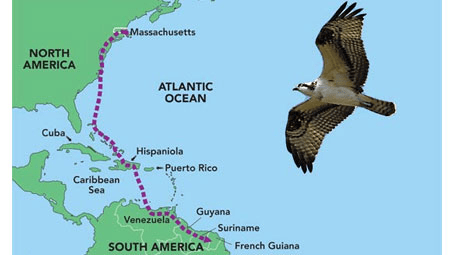
OSPREY MIGRATION (The Cornell Lab map, Laura Erickson photo credit)
Rather, day-night periods would continue with constant periodicity, plus weather patterns would be stabilized with predictable patterns, such as the cyclical seasons we know as summer, autumn, winter, and springtime. God’s creatures depend on day-night cycles, as well as on annual cycles–such as the 4 seasons which provide predictability to growing and harvesting food crops (Genesis 8:22, quoted above).
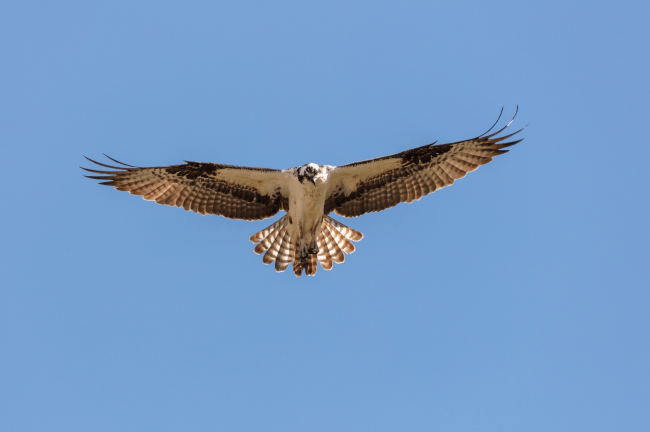
But not only do humans depend upon such phenology patterns, so do animals–especially migratory animals, such as many insects and birds. One such migratory bird is the OSPREY (Pandion haliaetus), also known as the Fish Hawk.
OSPREY (Free Photos and Images photo credit)
Although not all ospreys migrate, most do, according to Donald & Lillian Stokes, A GUIDE TO BIRD BEHAVIOR, volume III (Boston: Little Brown & Company,1989 ), pages 169-170. In fact, most ospreys of North America–such as those of the Chesapeake Bay region–are known for over-wintering in or near South America, regularly returning to North American ranges during spring:
The warmer temperatures have brought with them a familiar Chesapeake icon. Ospreys (Pandion haliaetus) occur in nearly every corner of the globe, but nowhere as abundantly as on the Chesapeake Bay.
Ospreys return to the Chesapeake every spring from southern wintering grounds. Their abundance in the Bay region is due to the availability of food: They feed exclusively on live fish.
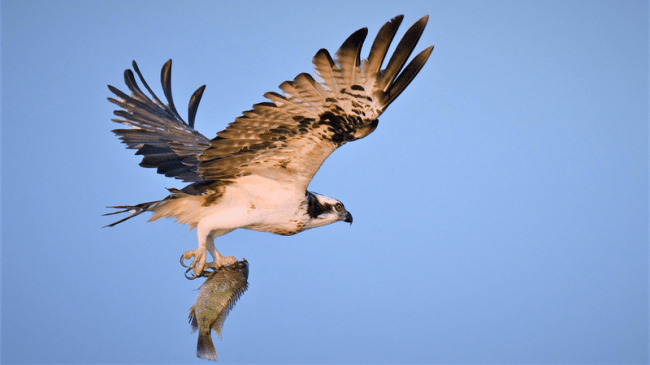
Their curved, sharp talons and rough-soled feet are designed to hold on to slippery fish.
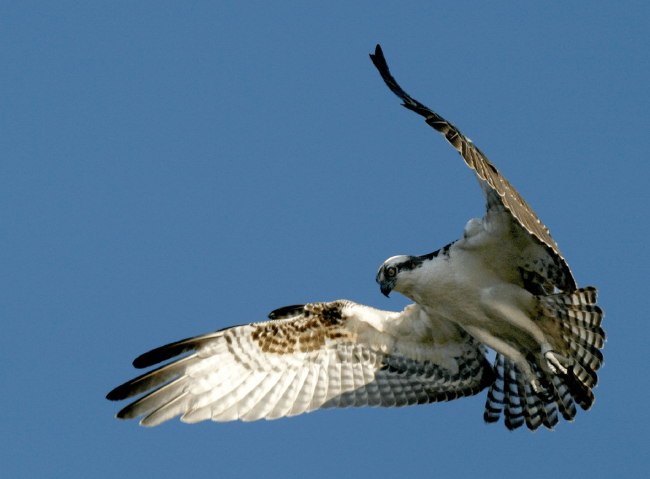
Large brown and white birds of prey, they’re about 2 feet long with wing spans of 4-5 feet. When in flight, their long, narrow wings take on the shape of an outstretched M.
Ospreys hunt by soaring over water, periodically hovering on beating wings to scan the surface for schooling or spawning fish. Upon sight of its prey, the osprey makes a spectacular dive. Folding its wings tightly, it descends swiftly and plunges feet first into the water, often submerging itself completely. Another technique is a shallow scoop for fish at the water’s surface.
In addition to food, the Chesapeake provides many favorable nesting areas over the water such as duck blinds, navigation markers or man-made nesting platforms. Offshore structures offer protection from predators like raccoons, and rapid detection and escape from danger. On land, ospreys may nest on high trees and utility poles.
Ospreys 3 years or older usually mate for life, and will use the same nest site year after year A recently reunited pair will begin the task of nest building or repair.
Kathy Reshetiloff, “Chesapeake’s Ospreys Mark Return of Spring”, CHESAPEAKE BAY JOURNAL (June 19th, A.D.2020).
OSPREY (PublicDomainPictures.net photo credit)
Thanks for that report, Kathy Reshetiloff–that report that repeatedly fits the return of spring. This year (A.D.2022) is no exception, according to a short report in the CHESAPEAKE BAY JOURNAL:
Standing watch over a channel marker, soaring above the water, effortlessly snatching a fish — ospreys are among the most recognizable bird species in the Chesapeake Bay region. And they have begun their annual springtime return from South America.
Staff writer, “A Sign of Spring: The Return of the Chesapeake’s Ospreys”, CHESAPEAKE BAY JOURNAL, 32(2):3 (April 2022).
The Osprey is a daytime-hunting raptor, like others hawks and eagles, seizing its prey after a successful chase. And for the Osprey, that hapless prey is most likely fish of some kind–more than 99% of the Osprey’s diet is some kind of fish!
OSPREY (PublicDomainPictures.net photo credit)
However, according to the University of Michigan’s Museum of Zoology website “Animal Diversity Web” [ AnimalDiversity.org entry for Pandion haliaetus ], an extra-hungry Osprey might catch and consume rodents (mice, rats, voles, squirrels), lagomorphs (rabbits, hares, pikas), small birds, salamanders, snakes, juvenile alligator, or even carrion (e.g., dead opossum, deer carcass). But those are rare dietary choices for an Osprey, because they have earned their common nickname, “Fish Hawk”.
Ospreys are not bashful about seizing fish prey, whether those prey are near the water’s surface or whether such prey is well below the water’s surface.
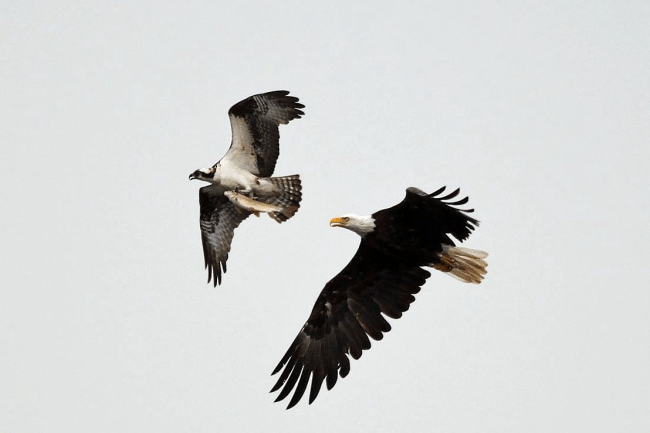
[The Osprey] is the only raptor that plunges into water feet first to catch fish. Can hover for a few seconds before diving. Carries fish in a head-first position for better aerodynamics [for post-catch flying]. Often harassed by Bald Eagles for its catch.
Stan Tekiela, BIRDS OF TEXAS FIELD GUIDE (Adventures Publications, 2004), page 79.
Hmm. that last “kleptoparasitism” fact–about eagles robbing ospreys of caught fish–where did I read about that recently? Oh yeah, I saw something about that on the best birdwatching blog in the world, LEESBIRD.COM — https://leesbird.com/2022/05/17/a-fisherman-robbed-chapter-20/.
Kleptoparasitic Eagle chasing Osprey with fish (CenteroftheWest.org photo credit)
It pays to be a regular reader of LEESBIRD.COM ! — thanks, Mrs. Lee Dusing, for the ongoing blessing your birding blog has been, for years, is now, and continues (God willing) to be. (And thanks also for your sterling service as an Adjunct Professor to ICR’s School of Biblical Apologetics, over the past few years.) But mostly, thanks for honoring the Lord Jesus Christ, (our Creator-Redeemer) and for continually blessing birdwatchers, like me, with the wonderful service that LEESBIRD.COM provides. : )
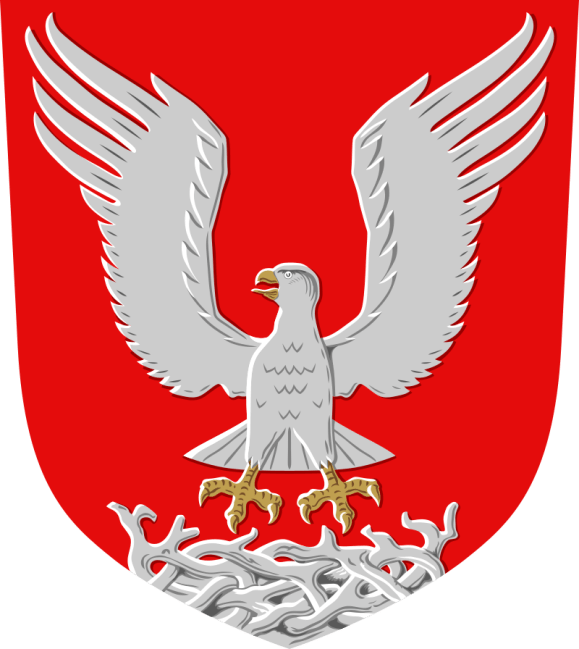
OSPREY featured on heraldic Coat-of-arms of Sääksmäki, Western Finland (public domain)
Can that which is unsavory be eaten without salt? Or is there any taste in the white of an egg? (Job 6:6)
EGGS NEPTUNE (eggs Benedict with crab — Trip Advisor photo)
Although we Americans sometimes over-salt our food, it is nonetheless true that it is perfectly Biblical to salt poultry eggs before you eat them — but what about crab eggs?
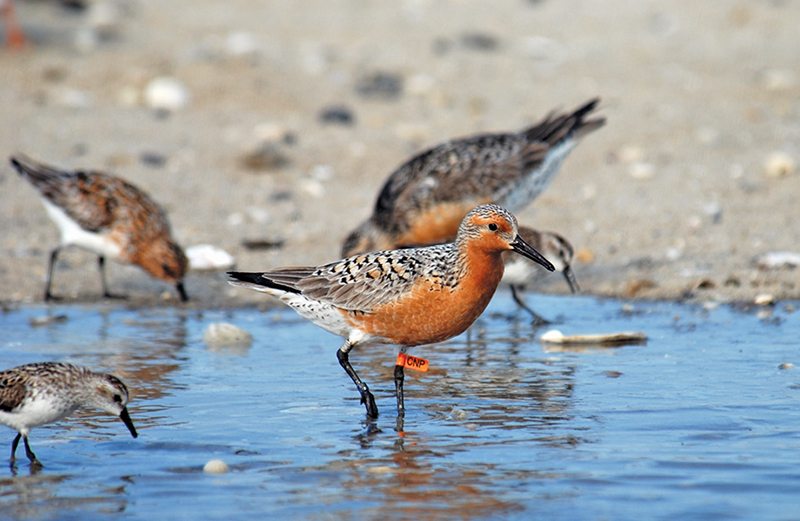
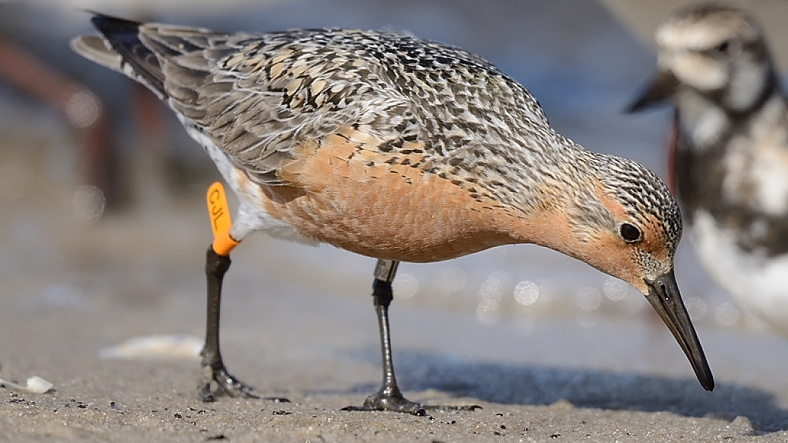
Since, during spring stopovers, Red Knots eat lots of Horseshoe Crab eggs on the beaches of Delaware Bay, — and the crabs who deposited those eggs just came from the salty seawater of the Atlantic Ocean, — it’s unlikely that the voracious Red Knots need to add salt, to flavor those crab eggs for eating.
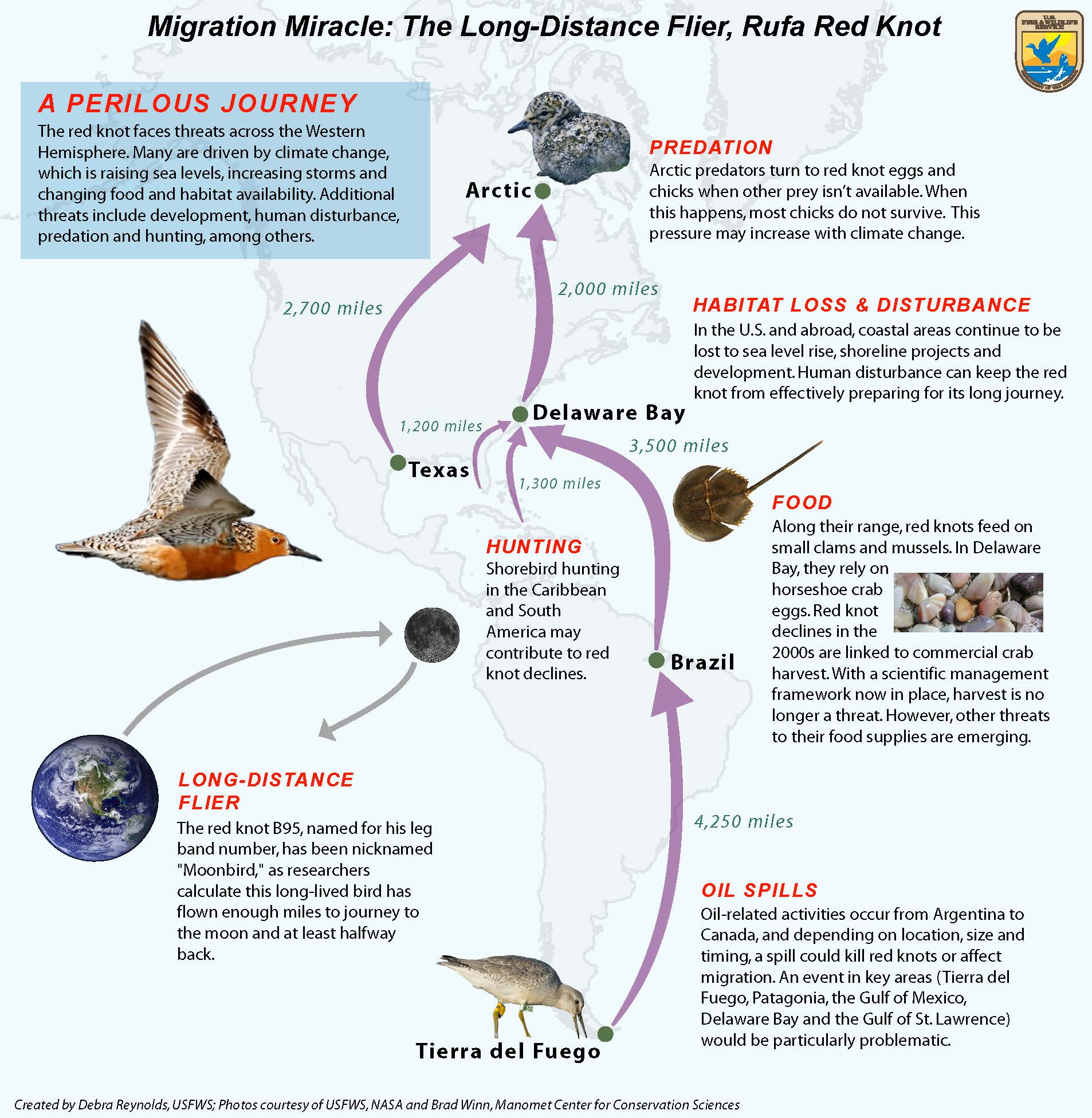
As an illustration of Genesis 8:22, this bird-blog has already reported on the magnificent migration of the Red Knot, which mileage-marathon marvel annually feasts on beach-buried Horseshoe Crab eggs during its yearly stopover at Delaware Bay, before the refueled shorebird continues its migration northward (toward its breeding grounds in Canada) during the spring. [See “Shorebirds Looney about Horseshoe Crabs”, at https://leesbird.com/2017/08/11/shorebirds-looney-about-horseshoe-crab-eggs/ .]
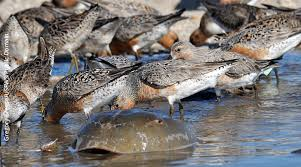
RED KNOT at Delaware Bay beach (USFWS photo / public domain)
As this USFWS chart (created by Debra Reynolds) shows, the long-distance adventures of the Rufa Red Knot are, in their repeated successes, providential miracles of populational migration.
In other words, when we think about how this works out, during each migratory cycle, our minds should automatically think about how amazingly clever and capable God is, to have arranged all of the Red Knot’s long-distance (and metabolic) bioengineering to work. The Red Knot is providentially programmed (“fitted”) to survive and thrive like this. [This can be compared to the providential programming that God has installed into the Arctic Tern — see “Survival of the Fitted: God’s Providential Programming”, ACTS & FACTS, 39(10):17-18 (October 2010), posted at http://www.icr.org/article/survival-fitted-gods-providential-programming/ .]
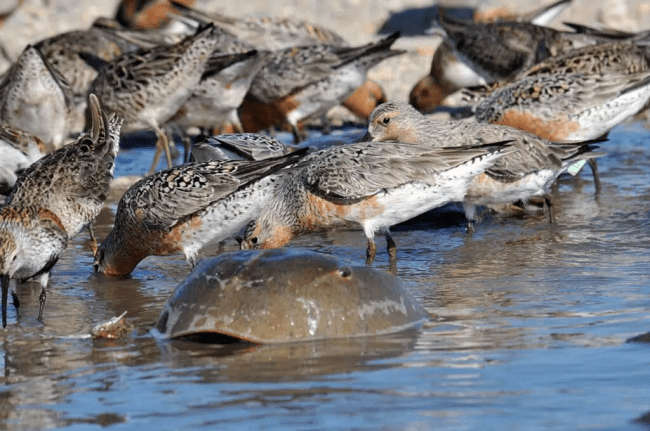
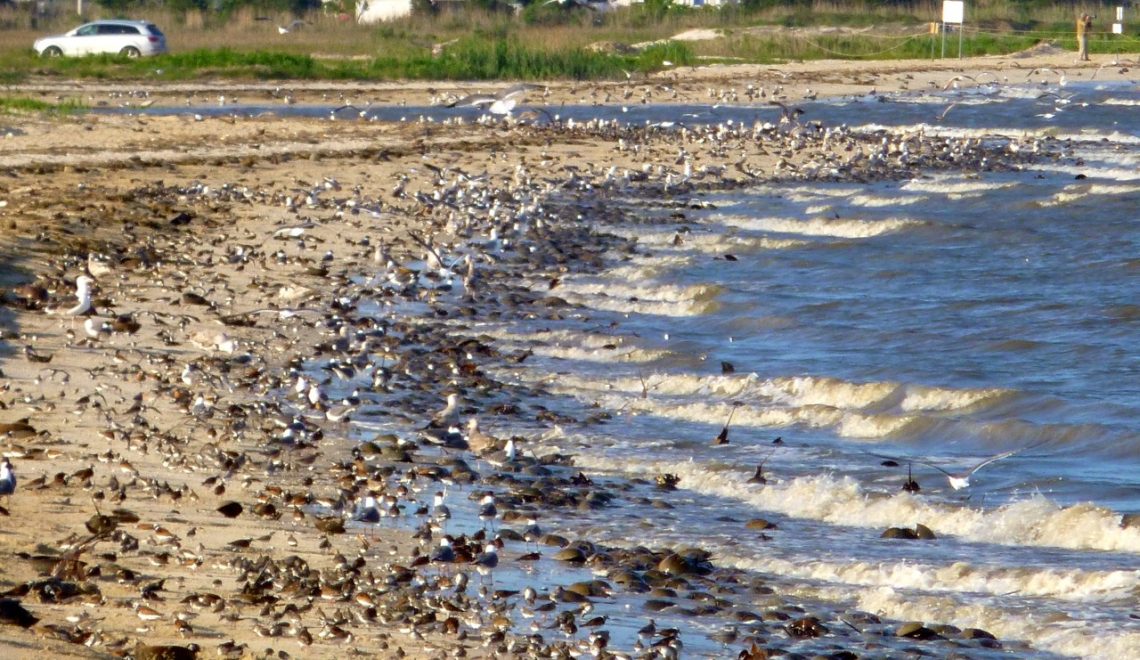
Of course, the hungry Red Knot is not alone in this all-you-can-eat “fast-food” fiesta – because the Red Knot is joined, at Delaware Bay beaches, by oövorous (i.e., egg-eating) “tablemates” including turnstones and sandpipers. [See Delaware Bay beach photographs below: left, USF&W / public domain; right, Larry Niles.]
(USFWS / public domain)
(Larry Niles photo)
All of which leads us to today’s limerick:
CONVERTING CRAB EGGS INTO MIGRATORY BIRD FUEL
Red Knots scoot about, on thin legs;
First come, first serve! — no one begs;
Horseshoe crab eggs, the treat —
And it’s “all-you-can-eat“!
Watch the shorebirds gulp down the crab eggs!
RED KNOTS eating crab eggs (N.J. Environment News photo)
Hmm, now I’m hungry! — it’s time to eat a couple of poached eggs, that my gourmet-whiz wife prepared for me this morning. (Of course, those eggs are slightly salted!)
Thankfully, the rhythms of our world are fairly predictable. Although the details differ, the overall cycles are regular:
While the earth remains, seedtimes and harvest, and cold and heat, and summer and winter, and day and night shall not cease. (Genesis 8:22)
Because of these recurring patterns migratory birds can depend on food being conveniently available when they migrate northward in the spring. In effect, “fast food” on the beach is a “convenience store” for famished feathered fliers.
For example, consider how the annual egg-laying (and egg-burying) activities of horseshoe crabs perfectly synchronize with the hunger of migratory shorebirds (e.g., red knots, turnstones, and sandpipers) that stopover on bayside beaches, for “fast food”, right where huge piles of crab eggs have just been deposited (and where some have been uncovered by tidewaters).
Horseshoe Crabs on Delaware Bay Beach
Photo by Gregory Breese / USF&WS
No need to worry about the birds eating too many crab eggs! – the egg-laying is so prolific (i.e., about 100,000 eggs per mother) that many horseshoe crab eggs are missed by the migratory birds, thus becoming the next generation of horseshoe crabs, plus the birds mostly eat the prematurely surfacing eggs that are less likely to succeed in life anyway!)
Timing is everything. Each spring, shorebirds migrate from wintering grounds in South America to breeding grounds in the Arctic. These birds have some of the longest migrations known. Delaware Bay is the prime stopover site and the birds’ stop coincides with horseshoe crab spawning. Shorebirds like the red knot, ruddy turnstone and semipalmated sandpiper, as well as many others, rely on horseshoe crab eggs to replenish their energy reserves before heading to their Arctic nesting grounds. The birds arrive in the Arctic before insects emerge. This means that they must leave Delaware Bay with enough energy reserves to make the trip to the Arctic and survive without food until well after they have laid their eggs. If they have not accumulated enough fat reserves at the bay, they may not be able to breed.
The world’s largest spawning population of horseshoe crabs occurs in Delaware Bay. During high tide, horseshoe crabs migrate from deep water to beaches to spawn. The female digs a nest in the sand and deposits between 4,000 and 30,000 eggs that the male will fertilize with sperm. A single crab may lay 100,000 eggs or more during a season. Horseshoe crab spawning begins in late April and runs through mid-August, although peak spawning in the mid-Atlantic takes place May 1 through the first week of June.
At low tide, adult crabs go back into the water but may return at the next high tide. Horseshoe crab spawning increases on nights with a full or new moon, when gravity is stronger and high tides are even higher. At the same time that migrating shorebirds arrive to rest and feed along Delaware Bay, horseshoe crab activity is high. While the crab buries its eggs deeper than shorebirds can reach, waves and other horseshoe crabs expose large numbers of eggs. These surface eggs will not survive, but they provide food for many animals. The shorebirds can easily feed on eggs that have surfaced prematurely.
Quoting Kathy Reshetiloff, “Migratory Birds Shore Up Appetites on Horseshoe Crab Eggs”, THE CHESAPEAKE BAY JOURNAL, 27(3):40 (May 2017).
Shorebirds and Horseshoe Crabs on Delaware Bay Beach
Photo by Larry Niles
Notice how it is the gravitational pull of the moon, as the moon goes through its periodic cycle, that causes the high and low tides – which facilitate the uncovering of enough horseshoe crab eggs to satisfy the needs of the migratory stopover shorebirds that pass through Delaware Bay. Notice how the moon provides a phenological “regulation” (i.e., the moon is physically ruling and correlating the interaction of the horseshoe crabs, the migratory shorebirds, and the bay’s tidewaters – in accordance with and illustrating Genesis 1:16-18).
At low tide, adult crabs go back into the water but may return at the next high tide. Horseshoe crab spawning increases on nights with a full or new moon, when gravity is stronger and high tides are even higher. At the same time that migrating shorebirds arrive to rest and feed along Delaware Bay, horseshoe crab activity is high.
Again quoting Kathy Reshetiloff, “Migratory Birds Shore Up Appetites on Horseshoe Crab Eggs”, THE CHESAPEAKE BAY JOURNAL, 27(3):40 (May 2017).
Map of Red Knot Winter Ranges, Summer Breeding Range, & Migratory Stopovers
Map by The Nature Conservancy, adapted from USF&WS map
So, you might say that these reproducing Horseshoe Crabs, and the myriads of migratory shorebirds, share phenological calendars because they’re all looney.





 Lee's Birdwatching Adventures Plus