Yellow-headed and Red-winged Blackbirds: Living on the Inside or the Outside?

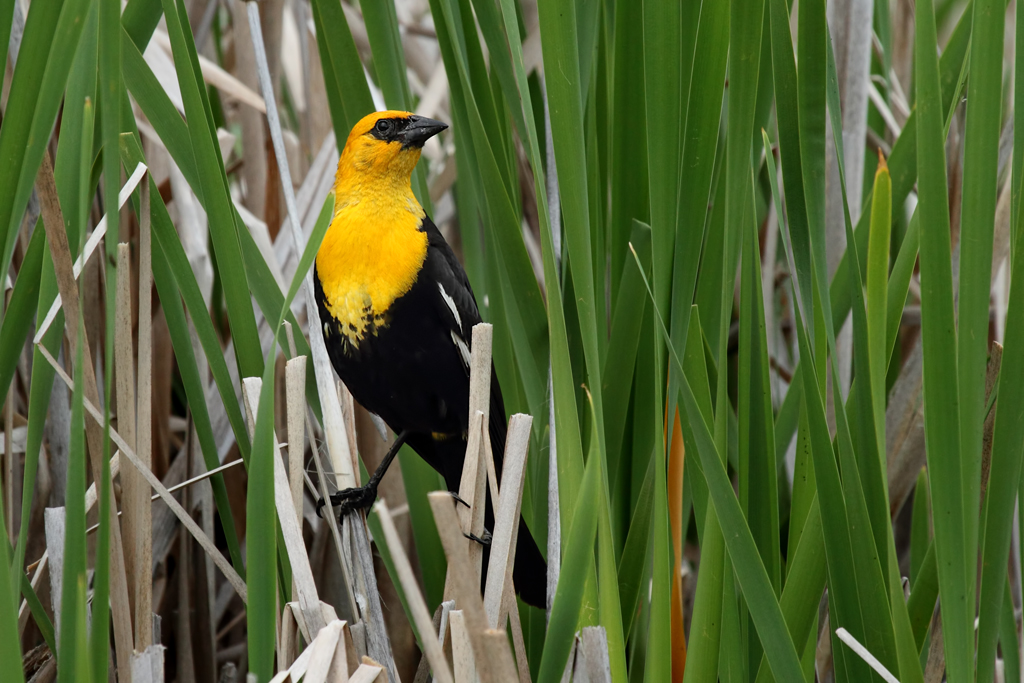
Yellow-headed Blackbird (Xanthocephalus xanthocephalus) ©WikiC Alan Vernon

Yellow-headed Blackbird (Xanthocephalus xanthocephalus) ©WikiC Alan Vernon

Draw nigh to God and He will draw nigh to you. (James 4:8)

Luzon Bleeding-heart by Dan

Orni-Theology

The Visitor Center at Jackson Hole, Wyoming (“Jackson Hole & Greater Yellowstone Visitor Center”), is a good place to go to for information on Grand Teton National Park, which borders the more-famous Yellowstone National Park.  Yet for bird-lovers, the visitor’s center itself is an attraction, in summer, because the marshy ponded area next to the building hosts a congregation of blackbirds, both Red-winged Blackbirds (Agelaius phoeniceus) and Yellow-headed Blackbirds (Xanthocephalus xanthocephalus).

If you are helping city kids to see these passerine icterids, tell them to “look for the tall corny-dogs growing in the wild” (cattails – Typha species, tall-stemmed wetland plants topped by a sausage-shaped flowering “spike”), around the pond.

As in many other lacustrine marshlands, red-winged blackbirds are often found perched among the cattails that grow as emergents among the wavy shoreline of pond.  For a redwing this is “prime real estate”, until the yellow-heads move in. How so?  In cattail dominated marsh-ponds, if both yellow-heads and red-wings are both present, the innermost places of the cattail “ring” are routinely occupied by the yellow-headed blackbirds, leaving the “outer” cattail positions (i.e., slightly farther away from the pond-water) for the redwings.

Why?  I have no idea why, but others have notice this. [E.g., see W. Braun’s observations in Blackbirds In Cattail Marshes , saying “The YHBs [yellow-headed blackbirds] clearly are the rulers of the cattails. They often, but not always, nest in the same marsh as the Red-winged Blackbird and the Common Grackles. The larger Yellow-headed Blackbird is dominant to the Red-winged Blackbird and displaces the smaller blackbird from the prime nesting spots.”]

Red-winged and Yellow-headed Blackbirds on Cattails ©Orcawatcher.com

Red-winged and Yellow-headed Blackbirds on Cattails ©Orcawatcher.com

Photo credit Orcawatcher.Com

But it reminds me of the dramatic difference between the apostle Peter and the Pharisee Nicodemus.  Peter was (almost) always close to Christ, and often so, but Nicodemus mostly kept his distance from Christ, at least publicly.

Far from being infallible, Peter is infamous for his cowardice that was indicted by a rooster crowing thrice (Luke 22:54-61).  Peter is also remembered for getting distracted, and becoming fearful, and sinking into the Sea of Galilee, after having miraculously walked on water for only a few steps (Matthew 14:24-33).  But Peter was wise enough to immediately cry out “Lord, save me!”  (And Jesus did.)  At least Peter did some walking on water (at Christ’s command, of course), which is a lot better than the other disciples who just stayed in the boat, as mere spectators, wonderfully how Jesus was enabling Peter to walk on water.
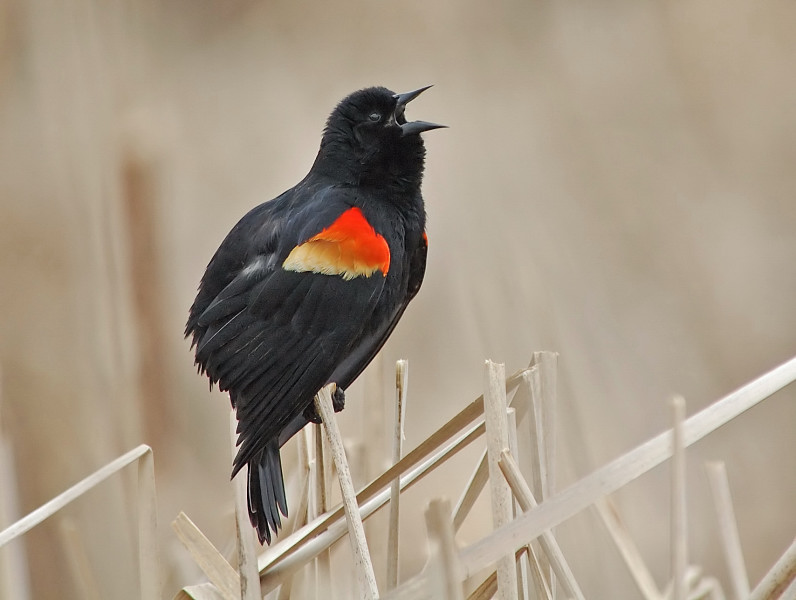
Red-winged Blackbird (Agelaius phoeniceus) by Ray

Red-winged Blackbird (Agelaius phoeniceus) by Ray

Likewise, Peter had the courage to step up and speak up – to call Jesus “the Christ, the Son of the living God” – a deed that the Lord Jesus commended Peter  — and God the Father —  for doing (Matthew 16:15-17).  And Peter did what he could to defend Jesus, in the Garden of Gethsemane, as Jesus was being arrested – Peter used a sword to chop off one man’s ear (Luke 22:49-51; John 18:10-11)!  (But unlike the Orcadian Viking known to history as Thorfinn Skull-splitter, Peter missed most of his victim’s head.)  It’s the thought that counts, right?
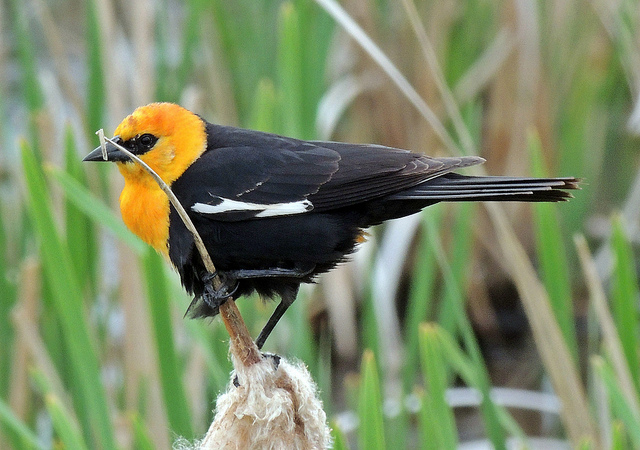
Yellow-hooded Blackbird (Chrysomus icterocephalus) ©Flickr Bob

Yellow-hooded Blackbird (Chrysomus icterocephalus) ©Flickr Bob

So you really have to love Peter.  (Jesus certainly did!)  Peter was one of the “inner” circle of three  –  just James, John, and Peter  — who were invited to witness the Lord Jesus Christ being glorified upon the Mount of Transfiguration (Matthew 17:1-8).  What an unforgettable privilege that was (2nd Peter 1:16-18)!  Jesus later invited the same “inner circle” of three to pray for Him in the Garden of Gethsemane (Matthew 26:37-38).  With all his faults, Peter was a truly privileged member of Christ’s “inner circle”.

But Peter’s privileges are not so high that we should feel sorry for Nicodemus.  Not at all!
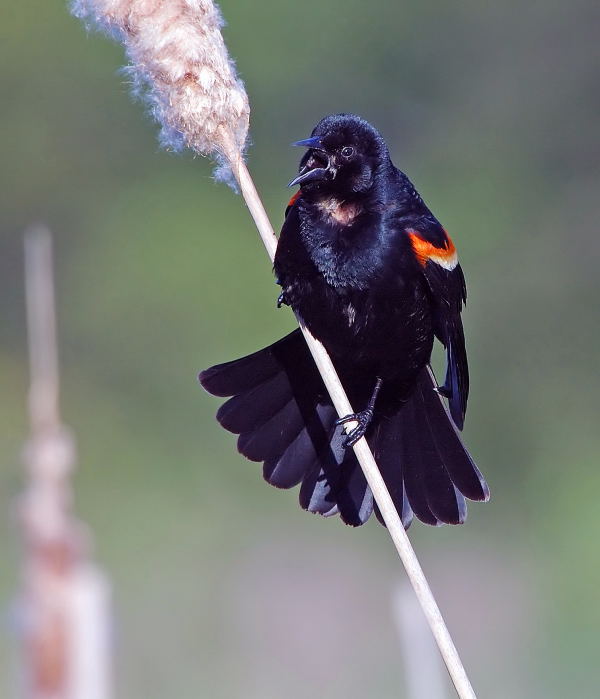
Red-winged Blackbird (Agelaius phoeniceus) by Ray

What a privilege it was for Nicodemus to be the first listener to hear, what we now read in, John’s third chapter (John 3:1-9), including the everlastingly famous promise of John 3:16, spoken by Jesus Himself!  Later Nicodemus took a modest stand for Jesus (John 7:50-52), and in time Nicodemus had an official role in Christ’s burial (John 19:39-40) three days before Jesus rose triumphantly from the grave!

Even so, if one had the choice, why visit Christ, in secret, keeping a distance from Him in public, when the opportunity to belong to His “inner circle” is available?

Am I more like Peter or Nicodemus?  Maybe that question will come to mind next time you see a group of “inner circle” yellow-headed blackbirds, perching on cattails, as the “outer circle” of cattails hosts the red-winged blackbirds. And, if you like the idea of being in the Lord’s “inner circle”, you might sing this as a prayer:  “Just a closer walk with Thee…”

James J. S. Johnson, with his family, has repeatedly visited Wyoming’s Jackson Hole Visitor Center, in summer, to admire the yellow-headed and red-winged blackbirds that congregate on and among the pond-ringed cattails there. (And a very special thank-you to Lee for teaching me how to edit the typos in this blog.)

*
Hidden-in-Plain-View Lesson from a Motmot: by James J. S. Johnson

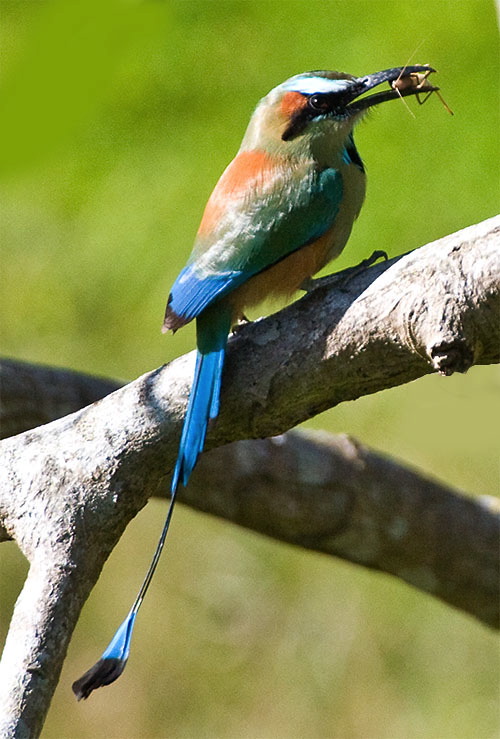
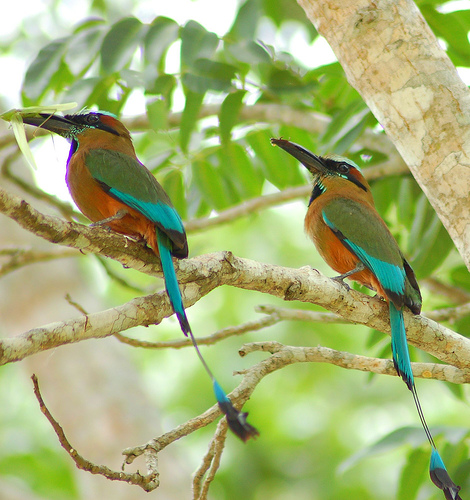
Turquoise-browed Motmot (Eumomota superciliosa) perching from JJSJ

Turquoise-browed Motmot (Eumomota superciliosa) perching from JJSJ

Hidden-in-Plain-View Lesson from a Motmot: 

God’s Beauty Outshines Human Ugliness

by James J. S. Johnson

The turquoise-browed motmot (Eumomota superciliosa) is an amazingly beautiful bird that few will see in the wild.  That kingfisher-like bird is a living testimony of God’s beauty and care.  Yet what a contrast that bird is to some of the ugliness sinful mankind has soiled this weary world with.  Consider the following as an illustration of this bittersweet contrast.

Consider the ancient Mayan ruins at Chichen Itza in the Yucatan peninsula of Mexico. At the top of the Temple of Kukulcan in Chichen Itza, human sacrifices took place. A stone knife was used to slice open the victim’s chest cavity, the heart was pulled out, held up as a sacrifice to the sun god while it was still beating, the head was severed, and the body tumbled down the stairs. Once the bloody bodies reached the bottom of the stairs, they were often eaten. Is it any wonder that the Mayas had problems with plagues, dying of diseases by the thousands?  (Providentially, God used Spanish conquistadors, such as Hernando Cortez, to abolish this genocidal holocaust.)

Also, there is a sinkhole located north of the Mayan Temple of Kukulcan, which is called the Sacred Cenote, or “Well of Sacrifice,” where they would toss people in to die by drowning in the murky water, and then the spectators would drink the water.  Some of the walls, not far from the temple and the cenote, exhibit rows upon rows (comparable to courses of bricks laid by bricklayers) of skull carvings (called “tzompantli”). The facial shape and expression of each skull carving is different—not just one generic skull model. Perhaps the sculptors were probably looking at different skulls when they carved them. Hundreds, even thousands of humans were sacrificed by the Mayas of the Yucatan and their neighbors. Similar holocausts were committed by the Aztecs of Central Mexico, where human sacrifices were processed in the Nahuatl language.

Fallen humanity, if unrestrained by the gospel and redeeming work of the Lord Jesus Christ, is a very ugly and cruel thing to see. Instead of seeing God’s traits of kindness, goodness, intelligence, the exact opposite is seen. In this Chichen Itza is no different than many other cultures, including the humanistic (human-preoccupied) cultures of our modern world. Humans have ignored God’s prior judgments and will continue to do so. God provides a witness; He provides an opportunity of deliverance through His grace, but many reject it.

But there is a brighter side to all of this:  God never leaves Himself without a witness (or a remnant).

Ironically, Chichen Itza displays not only God’s wrath (which is displayed by how God historically gave the bloodthirsty Mayas over to their own sinfulness), but also, if you look carefully, there is an avian exhibit of God’s love of beauty, even there: the turquoise-browed motmot which inhabits this region of Mexico’s Yucatan Peninsula.

Turquoise-browed Motmot (Eumomota superciliosa)-closeup from JJSJ

Turquoise-browed Motmot (Eumomota superciliosa)-closeup from JJSJ

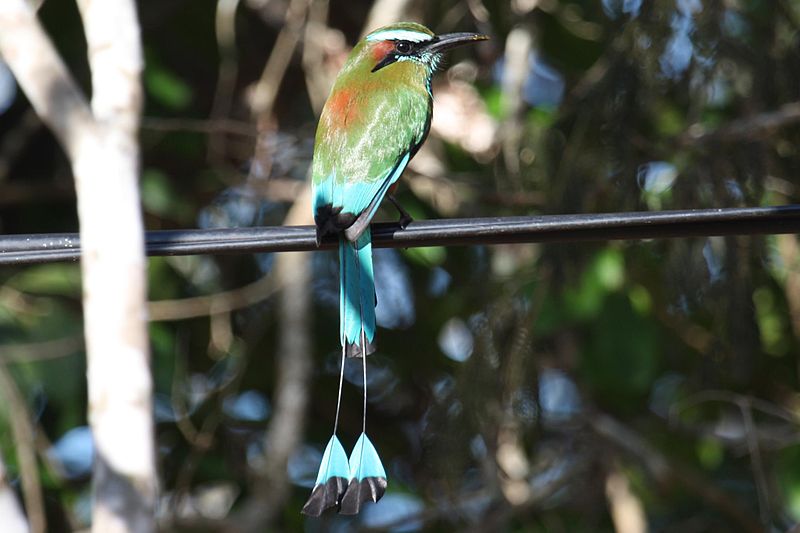
Specifically, if you walk northward from Kukulcan’s temple to the cenote (sacrifice sink-hole), there is a forest edge on the west side of the pathway, just before you arrive at the cenote, and in the large tree there (at that forest edge), creation scientists (Dr. Jan Mercer and this author) have observed turquoise-browed motmots perched in plain sight of those who walk by.  Here you can see two “pipe-cleaner” extensions of the tail, both with a colorful “brush” or “fan” on the end of those long tail feathers. What a beautiful bird!—a witness of God’s beauty in a place that was loaded with cruelty.

Unlike the colorful racquet-tailed turquoise-browed motmot, the Mayan handiwork at Chichen Itza was mostly a glorification of vile death, wretched idolatry, and ugly cruelty.  Tragically, for many generations, there, God’s truth was rejected, and idolatry prevailed.  The result is they “changed the truth of God into a lie” (Romans 1:25). What does God do with those who reject His Creatorship, according to Romans chapter one?  God punishes them with a “reprobate mind” (Romans 1:28), something like spiritual insanity. The “reprobate mind” judgment does not wait until the next life; it is imposed in this earthly life! One of the severest punishments that God ever imposes, unto those who reject the witness of His Creatorship and His glory, is that He gives people over to their love-of-the-lie wickedness.  (Romans 1:24).

Interestingly, the verb (in Romans 1:24) is an aorist verb, meaning the action is viewed as an event, as if it happened in a moment. It doesn’t mean it literally happened in just a split second, but it means it is being viewed as one action or one unit. There was a specific time when someone had rejected so much God-provided truth, inexcusably, that God said, “That’s it. I’m giving you over.” It’s a scary thing when God pulls back His restraints and mankind is allowed to just live out the selfish ugliness that is in the human heart.

When we reflect upon the season of Christmas, which we should do (suspending our distractions long enough to recall the Reason for this season), we should appreciate that God sent Christ to save a race of helplessly wretched sinners, Adam’s fallen race,   —  us  —  from the ugliness of self-proud and self-deluded ungodliness.  Yes, we all desperately need a Savior, Jesus Christ the righteous.  It is our Lord Jesus Christ – the Reason for the (CHRISTmas) season  —  Who is the author and finisher of everything that is truly beautiful in our lives.  God loves beauty, but our ungodliness is ugly.  So only God can (and does, if we avail ourselves to Him) salvage and remediate us from ugliness, both here and hereafter.  What a generous and gracious Kinsman-Redeemer Jesus is!

So even at Chichen Itza, a monument to human ugliness, we have the turquoise-browed motmot! —a wonderful witness of God’s shining beauty and love of life.   ><> JJSJ

Turquoise-browed Motmot (Eumomota superciliosa) ©WikiC

Turquoise-browed Motmot (Eumomota superciliosa) ©WikiC

(Adapted from James J. S. Johnson, “Turquoise-browed Motmot at Chichen Itza: Contrasting God’s Beauty with Mayan Ugliness”, Norfolk Heritage Review, June 1999; © AD1999 James J. S. Johnson)

See:

Other articles by James J. S. Johnson

Motmot Family – Momotidae – Motmots

*