Ian’s Bird of the Week – Pacific Robin

Pacific Robin (Petroica multicolor) by Ian 1

Pacific Robin (Petroica multicolor) by Ian 1

Ian’s Bird of the Week – Pacific Robin ~ by Ian Montgomery

Newsletter – 3/25/12

The Pacific Robin was another bird that I was keen to photograph on Norfolk Island. It has only recently been split from the mainland Scarlet Robin and, until that happened, it attracted little attention. As a consequence, I had trouble sourcing photos, particularly of adult males, and getting reliable material for the description of the species for the digital version of the Australian field guide by Pizzey and Knight.

It’s not common on Norfolk Island with an estimated population of 400-500 species and its distribution is restricted to areas of native forest. Happily, there was a resident family at the place, Palm Glen, where we did regular evening vigils for the Norfolk Island Parakeet and, being more confiding than Scarlet Robins, the members of the family proved to be good subjects for photography. The first photo shows the adult male. At first glance, it looks like a small Scarlet Robin, but closer examination reveals the diagnostic lack of white on the flight feathers of the wing and the outer tail feathers: the only white on the wing is the secondary wing coverts. Another supposed difference is a smaller area of white on the forehead, but this bird at least seemed to me to show much more white, extending back to a point above  the rear of the eyes. If you’re interested, compare with http://www.birdway.com.au/petroicidae/scarlet_robin/index.htm .
Pacific Robin (Petroica multicolor) by Ian 2

Pacific Robin (Petroica multicolor) by Ian 2 Fem L-Juv R

The second photo shows the adult female, left, and the juvenile, right, posing obligingly for comparison. Both lack the obvious white forehead spot characteristic of, in fact diagnostic of, their Scarlet Robin counterparts and also lack white in the outer tail feathers. The colours are also richer and the wing stripes are a deeper buff, almost blending with the buffish-brown of the rest of the wings and back. The third photos shows the same female face-on, and the lack of the white spot is more obvious: there is only slight white scalloping.

Pacific Robin (Petroica multicolor) by Ian 3 Fem
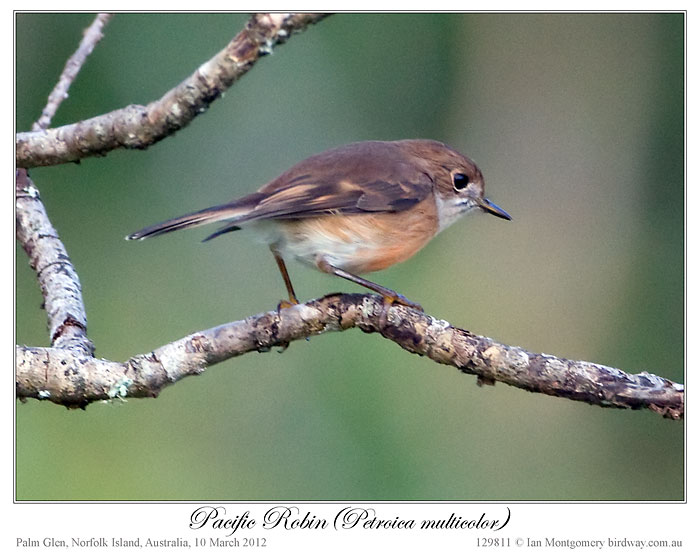
Pacific Robin (Petroica multicolor) by Ian 3 Fem

The fourth photo is another shot of the same juvenile, showing the lack of white on the outer tail feathers.
Pacific Robin (Petroica multicolor) by Ian 4 Juv

Pacific Robin (Petroica multicolor) by Ian 4 Juv

Having noticed the large amount of white on the forehead of the male, I kept an eye out for another individual and eventually photographed this one, fifth photo, on nearby Mount Pitt. This too had a large white spot.

Pacific Robin (Petroica multicolor) by Ian 5

Pacific Robin (Petroica multicolor) by Ian 5

The Pacific Robin, as now described, is quite widely distributed on islands in the South Pacific from the Solomons in the north via Vanuata and Fiji to Norfolk Island in the south. It is quite variable in plumage and 14 races have been described. It is closely related to the Tomtit of New Zealand, the males of which vary in colour from the white-breasted (North Island), through yellow-breasted (South Island) to the complete black race on the Snares: http://www.birdway.com.au/petroicidae/tomtit/index.htm. There is clearly enough material here to keep a South-sea-island-loving taxonomist busy for at least a lifetime and I won’t say anything further except to note an interesting historical twist in the story of the splitting of the Pacific and Scarlet Robins.

Norfolk Island was settled in the same year as Sydney, 1788, and one result of that was that the Scarlet Robin was described using a Norfolk Island specimen (the type specimen) by German Naturalist Johann Gmelin in 1789 and given the specific name multicolor. When the species was split 210 years later, the rules governing taxonomy insist that this name remains with the Norfolk Island bird, so the mainland species becomes the new one and was named boodang after the SE Australian race (up till thenPetroica multicolour boodang). To avoid confusion in Australia (at the risk maybe of increasing it in the Pacific Islands) the common name Scarlet was transferred to the new species and the new name Pacific was given to the old species.

I’m sure this family of birds at Palm Glen would be astounded to learn that their kind is the subject of such intense scrutiny!

Best wishes
Ian

*************************************************

Ian Montgomery, Birdway Pty Ltd,
454 Forestry Road, Bluewater, Qld 4818
Tel 0411 602 737 ian@birdway.com.au
>Check the latest website updates:
http://www.birdway.com.au/#updates


Lee’s Addition:

He answered and said to them, “When it is evening you say, ‘It will be fair weather, for the sky is red’; (Matthew 16:2 NKJV)

Those changes aught to keep the Bird Guide writers busy keeping up with the divisions and name changing. What a gorgeous bird and fantastic photography. Thanks again, Ian, for sharing all these great birds.

It seems small in the photos, so I checked to see its size. “The Pacific Robin is a small passerine, 4.5-5.3 in (11.5–13.5 cm) long and weighing .31-.38 oz (9–11 g.) Over much of its range it is the smallest species of bird. Pretty small.

The Pacific Robin is in the Petroicidae – Australasian Robins Family. Also see Ian’s Petroicidae  Family.

“The Pacific Robin is a seasonal breeder, although the timing of the breeding season varies across its range. Information on the timing of the season is patchy or absent in many islands. On Norfolk Island the breeding season is from September to December, and in Vanuatu the season is from October to January. Parents with young have been seen in mid August in the Solomon Islands and in June through to September in Samoa. The species builds a compact nest which is a cup of plant fibres and spider webs. The outside of the nest is decorated with moss and lichen, and is therefore easily overlooked. The nest is usually set into a fork or stump on a tree branch, or on a horizontal branch.

Around two to four eggs are laid in each clutch, with two being the typical clutch size in Norfolk Island, and two to three being typical in Fiji. The eggs are dull grey or greenish, and are incubated by the female. The nests of Pacific Robins are parastised by Fan-tailed Cuckoos where the two species co-occur.” (Wikipedia)

See – Pacific Robin (Wikipedia)

*
Ian’s Bird of the Week – Norfolk Island Parakeet

Norfolk Parakeet (Cyanoramphus cookii) by Ian 1

Norfolk Parakeet (Cyanoramphus cookii) by Ian 1

Ian’s Bird of the Week – Norfolk Island Parakeet ~ by Ian Montgomery

Newsletter ~ 3/15/12

Well, your unwavering moral and spiritual support has done it again: here is the Tasman or Norfolk Island Parakeet (better known here as the Green Parrot to distinguishing it from the introduced Red Parrot – the Crimson Rosella). Thank you very much!

We were met at the airport by Albury-Wodonga birder Dougald Frederick, excitedly carrying the news that there was a vagrant Ringed Plover at Slaughter Bay. So we picked up the hire cars, checked into our accommodation and went down to the Bay, whose name is a corruption of Slackwater Bay, rather than the site of a messy event in the generally nasty penal history of the island. Ringed Plovers are indeed rare in Australia, but I was brought up with them in Ireland and couldn’t conceal my impatience to get to Palm Glen near Mount Pitt, where Dougald had been regularly seeing the Parakeets in the evening.

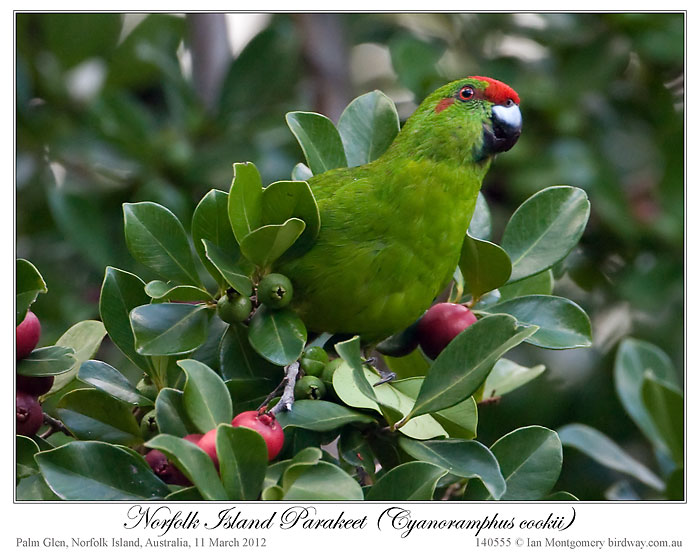
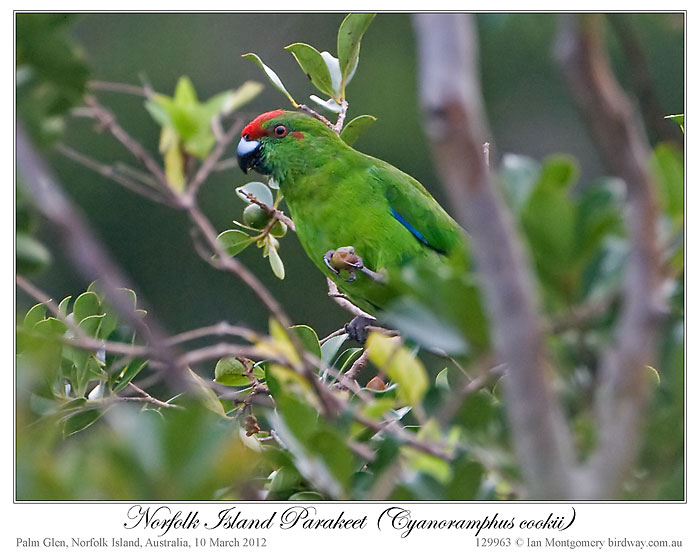
Eventually we went there and eventually, just before sunset and after my travelling companions had left to buy food for breakfast, the Parakeet in the first photo arrived and starting feeding on the feral guavas, fruiting prolifically around the picnic area. The guavas have dense foliage and the red fruit made the feeding Parakeets very hard to see. They were easier to see, but harder to photograph, when they used the top of the numerous tall Norfolk Island pines as vantage points, second photo. This less brightly coloured bird is a female or juvenile; the ones in the first and third photos are males.

Norfolk Parakeet (Cyanoramphus cookii) (fem or juv) by Ian 2

Norfolk Parakeet (Cyanoramphus cookii) (fem or juv) by Ian 2

After that, we visited Palm Glen regularly in the evenings and always saw at least one, distant Parakeet, with a flock of 6 on the second day when I took the third photo, the last occasion on which the birds were close enough to photograph. As well as being a pleasant spot to watch the sunset, it was also a good site for the other two remaining endemic species, the Norfolk Island Gerygone and the Slender- or Long-billed White-eye, and for the endemic races of the Golden Whistler and Grey Fantail.

Norfolk Parakeet (Cyanoramphus cookii) by Ian 3

Norfolk Parakeet (Cyanoramphus cookii) by Ian 3

The Norfolk Island Parakeet was originally regarded as a race of the Red-crowned Parakeet of New Zealand until genetic studies showed that it was sufficiently distinct to warrant the status of a full species. It came close to extinction in the 1980s when the population declined to an estimated 32 individuals with 4 breeding pairs (the sex ratio was heavily biased towards males). Since then, it has been the subject of an intense recovery program to control introduced predators and competitors, and the population is now estimated at perhaps 200 individuals, though our birding guide on Monday, Margaret Christian reckons that that is optimistic, given the frequency of sightings.

It’s a lovely island, friendly and historically interesting, so we have had an enjoyable week. If you intend to visit, we can highly recommend our accommodation, Poinciana Cottages – we all agreed that we could quite happily live in them permanently, and they gave me a free upgrade from an extra bed in one of our two cottages to solo occupancy of a third cottage. If you’re birding, then a morning spent with Margaret Christian is essential and she bakes delicious cake for morning tea. We also did a trip to Phillip Island for the seabirds. That too is highly recommended if the weather is suitable and David Bigg is the person to see about that.

Best wishes and much gratitude,

Ian

**************************************************
Ian Montgomery, Birdway Pty Ltd,
454 Forestry Road, Bluewater, Qld 4818
Tel 0411 602 737 ian@birdway.com.au
Check the latest website updates:
http://www.birdway.com.au/#updates


Lee’s Addition:

Glad we could assist with our prayers. What another neat creation to observe. I love the way they were designed to blend right in with the plants they like to eat. It protects them, but it does make for the challenge of birdwatching photographers and watchers. Thanks for your persistence, Ian.

Look at the birds of the air, for they neither sow nor reap nor gather into barns; yet your heavenly Father feeds them. Are you not of more value than they? (Matthew 6:26 NKJV)

The Norfolk Parakeet (Cyanoramphus cookii), also called Tasman Parakeet,[1] Norfolk Island Green Parrot or Norfolk Island Red-crowned Parakeet, is a species of parrot in the Psittacidae family. It is endemic to Norfolk Island (located between Australia, New Zealand and New Caledonia in the Tasman Sea).

Its natural habitats are subtropical or tropical moist lowland forests and plantations. It is threatened by habitat loss.

Check out Ian’s photos of others in the Psittacidae – Parrot Family.

*

Ian’s Bird of the Week – Yellow-crowned Parakeet

Yellow-crowned Parakeet (Cyanoramphus auriceps) by Ian 1

Yellow-crowned Parakeet (Cyanoramphus auriceps) by Ian 1

Ian’s Bird of the Week – Yellow-crowned Parakeet ~ by Ian Montgomery

Newsletter ~ 3/8/12

Last December, the Red-crowned Parakeet was the bird of the week http://www.birdway.com.au/psittacidae/red_crowned_parakeet/index.htm . That was photographed on Enderby Island in the Auckland Islands one of the New Zealand Sub-Antarctic islands. Here is a close relative the Yellow-crowned Parakeet photographed on the same trip in Fiordland on the South Island. I’ve chosen it for this week’s bird, as I’m going to Norfolk Island tomorrow and I need your moral and spiritual support to help me photograph the endangered Norfolk Island or Tasman Parakeet.

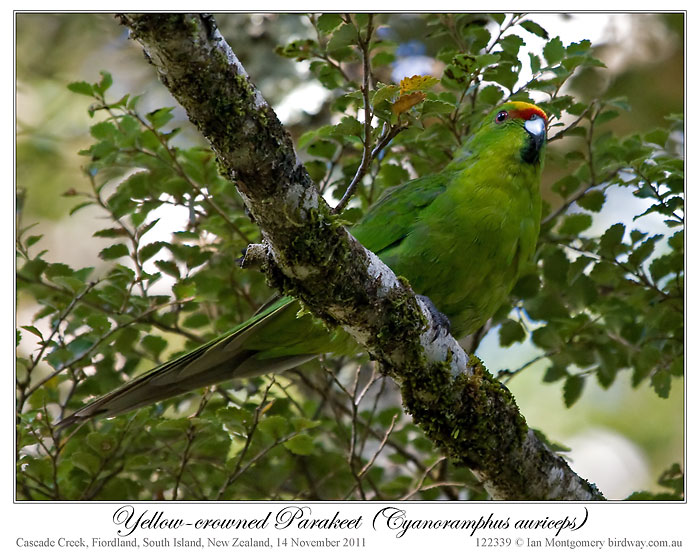
In Fiordland, I camped at Cascade Creek camping site because it’s within striking distance of Milford Sound for the Fiordland Penguin and also because it’s right beside a nature trail through Antarctic Beech forest to Lake Gunn. This particular trail had been recommended as a good site for various native birds including the Yellow-crowned Parakeet. I found the Parakeets with relative ease as they chatter away when feeding or in flight. In the first photo, the bird is perched in a beech tree, and you can see its lovely, serrated, spoon-shaped leaves.
Yellow-crowned Parakeet (Cyanoramphus auriceps) by Ian 2

Yellow-crowned Parakeet (Cyanoramphus auriceps) by Ian 2

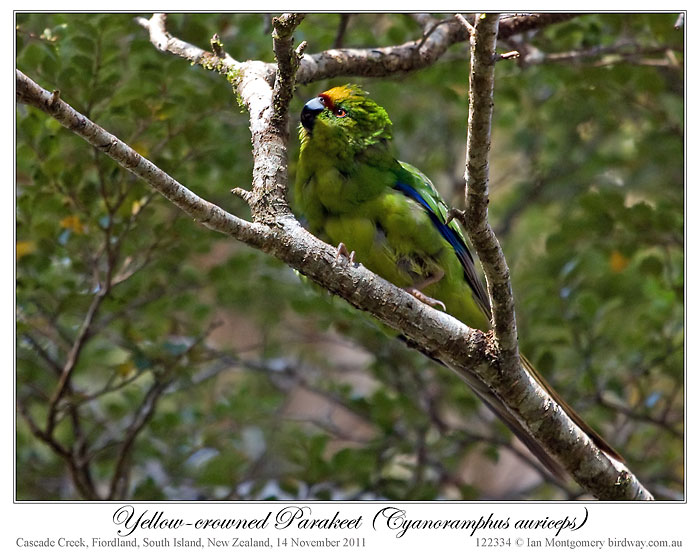
With a length of 23-25cm/9-10in, they’re smaller than the Red-crowned but otherwise very similar, apart from the colour of the crown and the lack of red behind the eye. In sunlight, the colours stand out well, as in the second photo, but in the shady areas of the forest they are well camouflaged and the presence of faded yellow leaves in both photos show well how the patches of colour in the plumage help to break up the outline of the bird.
Yellow-crowned Parakeet (Cyanoramphus auriceps) by Ian 3

Yellow-crowned Parakeet (Cyanoramphus auriceps) by Ian 3

The third photo shows another bird in a patch of sunlight on a very mossy tree stump. It’s a delightful forest, very Lord of the Rings, and it was easy to imagine encountering Treebeard along the way. It’s no wonder that the movie was filmed in New Zealand, and Tevora Lakes – not too far from here – was the location for Fangorn Forest, and you will, of course, remember that ‘Fangorn’ was the Sindarin for Treebeard http://en.wikipedia.org/wiki/Treebeard .
Yellow-crowned Parakeet (Cyanoramphus auriceps) by Ian Middle Earth

Yellow-crowned Parakeet (Cyanoramphus auriceps) by Ian Middle Earth

http://www.virtualoceania.net/newzealand/culture/lotr/Anyway, I’m wandering. The Norfolk Island trip is being organised by the same birders from Victoria that were my companions on the Sub-Antarctic trip. I’d originally turned down the invitation to join them on the grounds of extravagance so shortly after the other trip. We had such fun together, however, that I changed my mind, particular when their flights were re-routed through Brisbane, an easy, if horribly early, connection away from Townsville.

The Tasman/Norfolk Island Parakeet looks similar to the Red-crowned but yet smaller (21-26cm/8.3-10.2in). Like all the 10 members of this South Pacific genus (Cyanorhamphus – ‘blue bill’) it has suffered from the introduction of mammalian predators by Europeans, is classified as endangered and is restricted in distribution to the Norfolk Island National Park. Its numbers have increased recently from a dangerous low as a result of conservation efforts. There is talk of reintroducing it to Phillip Island, a small predator-freed island off Norfolk, and to Lord Howe, where a similar parakeet became extinct. It is thought to belong to the same species, hence the name Tasman Parakeet. So, wish me luck, keep your fingers crossed and transmit the same spiritual energy that is has been so successful before, and I’ll try to bring you the Tasman Parakeet as a future bird of the week.

Best wishes

Ian


Ian Montgomery, Birdway Pty Ltd,
454 Forestry Road, Bluewater, Qld 4818
Preferred Email: ian@birdway.com.au
Website: http://www.birdway.com.au/index.php


Lee’s Addition:

Our prayers will go with you for safety and that you might find your next “Bird of the Week.” We like following your adventures into the wilds. Must be nice to have so many parakeets and parrots around.

Check out Ian’s many members of the Parrots and Allies – Psittacidae Family photos. He has quite a collection of them. He has almost 50 species there. There are 350 total members in the Parrot family. Ian has a few more trips to take. When he mentioned “in the shady areas of the forest they are well camouflaged and the presence of faded yellow leaves,” it reminds me of how well their creator provided for their protection.

There will be a shelter to give shade from the heat by day, and refuge and protection from the storm and the rain. (Isaiah 4:6 NASB)

More – Bird of the Week articles

*

Ian’s Bird of the Week – New Zealand/Sub-Antarctic Snipe

Subantarctic Snipe (Coenocorypha aucklandica) by Ian 1

Subantarctic Snipe (Coenocorypha aucklandica) by Ian 1

Ian’s Bird of the Week – New Zealand/Sub-Antarctic Snipe ~ by Ian Montgomery

Newsletter ~ 2/29/12

My apologies for a late Bird of the Week. Lots of excuses are presenting themselves, as they do, but I won’t bore you with them. I’ve chosen another mostly good news conservation story from the Sub-Antarctic islands, the New Zealand or Sub-Antarctic Snipe. These are odd, dumpy, almost tail-less little snipe – length 23cm/9in – that occur now only on some of the islands south of New Zealand: Snares, Auckland Islands, Antipodes Islands and Campbell Island with a closely related species on Chatham Island.

We found them on Enderby Island, one of the Auckland Islands group, where the nominate subspecies (aucklandica) occurs. With their relatively short, curved bill they don’t look like your average snipe and they don’t behave like one either. Like the Auckland and Campbell Islands Teals they’re fairly confiding and allow close approach but, unlike the Teal, they can still fly, though are very reluctant to do so. When disturbed – and you have to nearly step on them to do that – they creep away mouse-like through the thick vegetation that they prefer and disappear with relative ease. Perhaps crake- or rail-like would be closer to the mark and the curved bill reminded me of the longer-billed rails such as the Virginia Rail http://www.birdway.com.au/rallidae/virginia_rail/source/virginia_rail_110552.htm .

Subantarctic Snipe (Coenocorypha aucklandica) by Ian 2

Subantarctic Snipe (Coenocorypha aucklandica) by Ian 2

By day they stay under cover, only venturing out onto more open areas at night. They feed on a wide variety of invertebrates that they the find by deeply probing the peaty island soil. The male, apparently, has a distinctive territorial call uttered at dawn and dusk and rendered as ‘queeyoo queeyoo’, and the extinct Stewart Island race is supposed to be responsible for the Maori legend of the hakawai or or hokioi, a frightening creature that called only at night (Heather & Robertson, Field Guide to the Birds of New Zealand). The males also perform a nocturnal display flight, making, like other snipe, a humming sound by vibrating the tail feathers, which, given the short tails of this species, one can imagine as being very high-pitched.

Subantarctic Snipe (Coenocorypha aucklandica) by Ian 3

Subantarctic Snipe (Coenocorypha aucklandica) by Ian 3

The third photo shows a pair of the snipe sneaking past the abundant yellow-flowered Bulbinella or Ross Lily, one of the characteristic, so-called ‘megaherbs’ of these islands http://en.wikipedia.org/wiki/Bulbinella_rossii.

The good part of the news is that although the New Zealand Snipe became extinct on the main islands following the arrival of the Pacific Rat with the Maoris a thousand years ago and the recent extinction of two races on Stewart Island and Little Barrier Island (the latter, ironically as a result of the introduction there of the Weka http://www.birdway.com.au/rallidae/weka/index.htm ), the remaining races seem to be doing quite well with a total population estimated at 34,000, of which two thirds occur on the smaller of the Auckland Islands, including Enderby.

Yet another race was thought to have become extinct on Campbell Island after the brig Perseverance, responsible for discovery of the island in 1810, was wrecked there in 1828 leaving the usual legacy of rats. This race remained undescribed and unseen until a small population was discovered on an almost inaccessible, nearby, little island called Jacquemart in 1997 during a search for the Campbell Island Teal. Rats were eliminated on the relatively huge – 11,000 hectare – main island in 2001 and the snipe have recolonised it from Jacquemart unaided. The race is now called, paradoxically, perseverence. Some of the more intrepid members of our party found some snipe on an arduous walk there in wet conditions on our last day. I’d had enough of boggy, wet walks through unrelenting waist-deep tussock grass by then and didn’t join them. Alas!

To make amends for the late BoftW, here is a non-bird of the week, Lumholtz’s Tree Kangaroo.

Lumholtz's Tree Kangaroo by Ian

Lumholtz's Tree Kangaroo by Ian

This obliging animal made a greatly-appreciated appearance in the middle of a Birds Australia North Queensland committee meeting 11 days ago when we were just about to debate a controversial agenda item. The meeting was being held at a member’s house in rainforest on the Atherton Tableland. A delightful interlude with this placid animal led to a very harmonious and well-mannered debate. There’s an obvious lesson there for choosing a suitable venue for meetings.

Best wishes
Ian


Ian Montgomery, Birdway Pty Ltd,
454 Forestry Road, Bluewater, Qld 4818
Phone: 0411 602 737 +61-411 602 737
Preferred Email: ian@birdway.com.au
Website: http://birdway.com.au


Lee’s Addition:

He causes the grass to grow for the cattle, And vegetation for the service of man, That he may bring forth food from the earth, (Psalms 104:14 NKJV)

Another neat bird and adventure by Ian. The Tree Kangaroo is also an adorable addition. We have the Wilson’s Snipe in this area, which is the only snipe seen by us. I am glad Ian let’s in on his adventures around the world. Better him having his “walks through unrelenting waist-deep tussock grass” than us. Thanks, Ian, for sparing us.

See all of Ian’s Birds of the Week – Click Here

*

Ian’s Bird of the Week – Auckland and Campbell Islands Teal

Auckland Teal (Anas aucklandica) Male by Ian 1

Auckland Teal (Anas aucklandica) Male by Ian 1

Ian’s Bird of the Week  – Auckland and Campbell Islands Teal

by Ian Montgomery

Newsletter ~ 2/16/12

The almost predator-free nature of the Sub-Antarctic Islands before the Europeans and their pests arrived is well illustrated by the existence of two closely-related flightless ducks on the Auckland and Campbell Islands. The first photo shows a male Auckland Islands Teal on Enderby Island – now their main stronghold – in the Auckland Islands group.

You can see how short the wings are, extending only two thirds of the way along the body instead of to the base of the tail as in their flying relatives the Chestnut Teal of Australia and the Brown Teal of New Zealand. This male is in breeding plumage and has greenish iridescence on the head and subtly beautiful barring on the flanks.

Auckland Teal (Anas aucklandica) Female by Ian 2

Auckland Teal (Anas aucklandica) Female by Ian 2

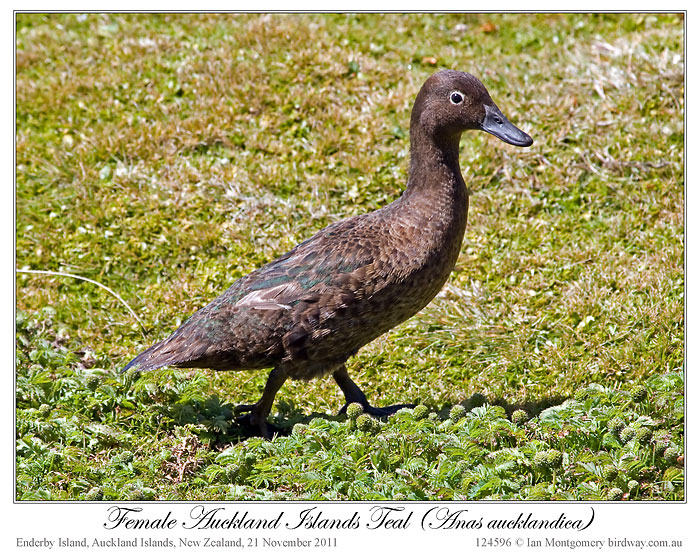
Females (and juveniles and eclipse-plumaged males) have more subdued colours and lack the green sheen on the head. The white eye-ring of both sexes is shared with the Brown Teal of New Zealand but not the Chestnut Teal of Australia. The third photo shows another female going for a stroll. Note the slightly drooping tail and upright stance, both characteristic of the two flightless species.

Auckland Teal (Anas aucklandica) Female by Ian 3

Auckland Teal (Anas aucklandica) Female by Ian 3

As you can probably judge from the photos, the teal were very confiding showing no alarm when closely approached. I had to retreat from the male to get it in focus – the lens I was using has a minimum focus distance of 1.8m/5.9ft, not usually an issue with wild birds! The first two photos were taken on one of the few bodies of freshwater on Enderby Island. Their more usual habitat is along the coast. We saw some in sheltered pools on a rock platform and they feed mainly on invertebrates and algae found in both attached and beach-stranded seaweed.

Campbell Teal (Anas nesiotis) by Ian 4

Campbell Teal (Anas nesiotis) by Ian 4

The fourth photo shows a vocal male Campbell Islands Teal on salt water near the landing wharf of that island. It’s very similar in appearance to the Auckland Islands Teal and both species were until recently treated as races of the flight-worthy Brown Teal of mainland New Zealand. Recent studies suggest that the the Brown Teal and Sub-Antarctic Teals were the product of separate colonisation events by the Australian Chestnut Teal, which occurs in New Zealand only as a rare vagrant.

The Sub-Antarctic Teals have suffered badly from the introduction of mammalian pests, particularly pigs, cats and rats (mice seem to affect them less). The Auckland Islands Teal is extinct on the main Auckland Island, but survives on six neighbouring island pig-less and cat-less island. The population is estimated at 600-2,000 individuals, appears stable, is classified as Vulnerable, and the New Zealand government is planning to eliminate pigs and cats from Auckland Island which will permit reintroduction of the Teal.

The Campbell Islands Teal was though to be extinct but a population of about 20 were rediscovered on nearby Dent Island in 1975, raising its status to Critically Endangered and the world’s rarest duck. A captive breeding program followed, leading to the establishment of a feral population on predator-free Codfish Island near Stewart Island in 1999 and 2000. Following the elimination of rats on Campbell Island, 50 birds were released there in 2005 and 55 in 2006. Successful breeding occurred in 2006. The total population, captive and wild, is now thought to be over 200 and its status has been downgraded to merely Endangered.

You can read the full story here http://terranature.org/tealcampbell_island.htm . It’s great to read a successful conservation story at a time of increasingly frequent bad news about wild populations.

Links to Ian’s Photos:

Aukland Islands Teal
Campbell Islands Teal
Chestnut Teal

Best wishes
Ian

Ian Montgomery, Birdway Pty Ltd,
454 Forestry Road, Bluewater, Qld 4818
Phone: 0411 602 737 +61-411 602 737
Preferred Email: ian@birdway.com.au
Website: http://birdway.com.au


Lee’s Addition:

That last Teal looks happy and “bushy eyed.” They must havee happy ducks and teals down there. Must be that lack of pigs and cats!

The Teals belong to the Anatidae – Ducks, Geese & Swans Family. There are 165 species in 48 genus including the Teals, Ducks, Shovelers, Wigeons, Pintails, Swans, Geese,  Pochards, Scaups, Eiders, Mergansers and all their allies. “Anatidae is the biological family of birds that includes ducksgeese and swans. The family has a cosmopolitan distribution, occurring on all the world’s continents except Antarctica and on most of the world’s islands and island groups. These are birds that can swim, float on the water surface, and in some cases dive in at least shallow water.” (Wikipedia)

And God blessed them, saying, “Be fruitful and multiply, and fill the waters in the seas, and let birds multiply on the earth.” (Genesis 1:22 NKJV)

*
Ian’s Bird of the Week – Kea

Kea (Nestor notabilis) by Ian #1

Kea (Nestor notabilis) by Ian #1

Ian’s Bird of the Week – Kea ~ by Ian Montgomery

Newsletter ~ 1/26/12

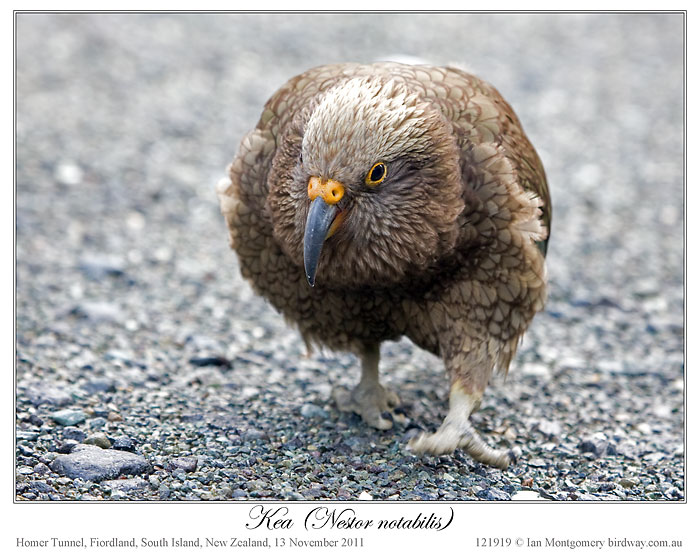
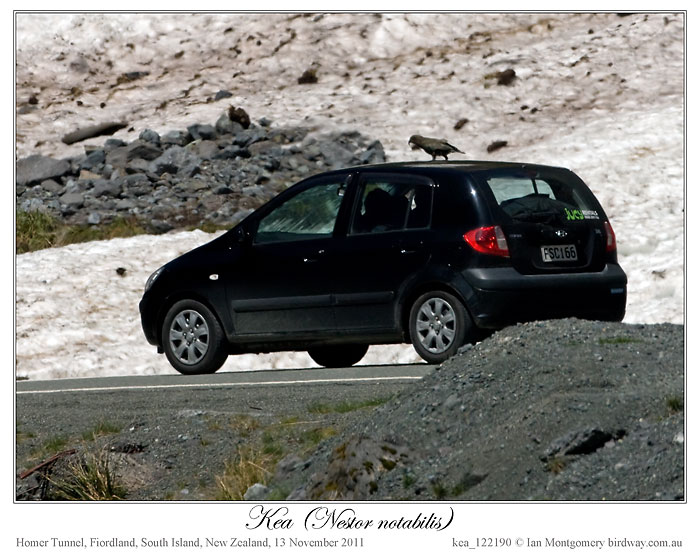
If you park near the entrance to the Homer Tunnel on the way to Milford Sound in Fiordland on the South Island of New Zealand, you are likely to be approached by one of these interesting-looking parrots.

‘Friendly-looking chap’, you might think, ‘I wonder what he’s after? Just saying Hello? Some food maybe?’. Wrong. This one, the Kea, has a one-track mind, and is only interested in destruction, or more specifically dismantling your vehicle.
Kea (Nestor notabilis) by Ian #2

Kea (Nestor notabilis) by Ian #2

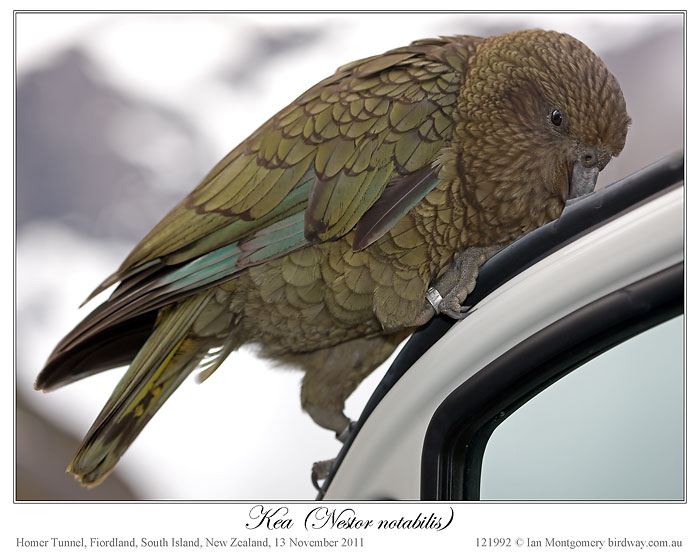
Quick as a flash, it and his pals will check it out for weak spots and set to work – this one with yellow cere, lower mandible and eye-ring is a juvenile delinquent (yes, that’s snow in the background, these are tough birds). Let’s see if we can rip the roof off.

Kea (Nestor notabilis) by Ian #3

Kea (Nestor notabilis) by Ian #3

Oh well, the roof was stronger than it looked. How about the braking light above the back door, this has some promising cracks.

Kea (Nestor notabilis) by Ian #4

Kea (Nestor notabilis) by Ian #4

Meanwhile, this hardened criminal (this is an adult bird) has learnt that the rubber is more vulnerable and attacks the lining of the front door.
Kea (Nestor notabilis) by Ian #5

Kea (Nestor notabilis) by Ian #5

And don’t think you can get rid of us by just driving off. We’ll hang on grimly until we get blown off by the breeze.

Kea (Nestor notabilis) by Ian #6

Kea (Nestor notabilis) by Ian #6

Keas have the reputation of being playful, but the intensity and obsessiveness of their attacks looked anything like a game to me and more like a compulsion. In fact, their attacks did no noticeable damage even though I parked the camper there for some time so that I could look for the Rock Wrens (Bird of the Week #438). According to my field guide ‘the worst offending birds are caught and transferred to distant sites or taken into captivity’. Sounds familiar.

At one time, Keas were supposed to kill sheep, and the resulting bounty led to their persecution and decline. They have been fully protected since 1986 and the population is recovering.
Keas are quite large birds, 46cm/18in in length and weighting up to 1Kg/2.2lbs. They and their relatives the Kaka and the Kakapo comprise a taxonomically distinct lineage of New Zealand parrots not closely related to any others and usually placed either in their own family (IOC) or sub-family (Birdlife International). While the flightless Kakapo is critically endangered and the subject of an intensive rescue mission http://www.kakaporecovery.org.nz/ , the Kea is quite common in Alpine areas of the South Island and the Kaka occurs in the forests of both islands, though I failed to find it on this trip. It’s good to leave something for the next visit.
Best wishes
Ian

Ian Montgomery, Birdway Pty Ltd,
454 Forestry Road, Bluewater, Qld 4818
Phone: 0411 602 737 +61-411 602 737
Preferred Email: ian@birdway.com.au
Website: http://birdway.com.au


Lee’s Addition:

Sounds like you might want to keep an eye on your personal property around those birds! It is amazing how much the birds vary in their habits and diets. Every time Ian writes about his encounters with the various birds, it’s always different and interesting. Keep up the great birding, Ian, we enjoy your encounters with our avian friends around the world.

I know all the birds of the mountains, And the wild beasts of the field are Mine. (Psalms 50:11 NKJV)

See Ian’s Cockatoos & Allies and his Parrots & Allies, which are part of the Strigopidae Family. Those parrots along with the Cockatoos – Cacatuidae and Parrots – Psittacidae Families make up the Psittaciformes Order.

*
Ian’s Bird of the Week – Paradise Shelduck

Paradise Shelduck (Tadorna variegata) by Ian 1

Paradise Shelduck (Tadorna variegata) by Ian 1

Ian’s Bird of the Week – Paradise Shelduck ~ by Ian Montgomery

Newsletter – 1/16/12

Shelducks are all rather splendid, so this one has to be particularly fine to earn the moniker ‘Paradise’. Interestingly, it is the white-headed female that is, I think, the more striking as in the first photo of a female having a drink (of salt water!) at Milford Sound.

Paradise Shelduck (Tadorna variegata) by Ian 2

Paradise Shelduck (Tadorna variegata) by Ian 2

The second photo shows the same bird stretching her wing to show us the gorgeous emerald green secondary flight feathers. Like all Shelducks, these are large ducks, averaging 63cm/25in in length and the males, averaging 1,700g/3.7lbs, are larger than the females, 1,400g/3.1lbs.
Paradise Shelduck (Tadorna variegata) by Ian 3

Paradise Shelduck (Tadorna variegata) by Ian 3

Meanwhile her mate, who has a dark brown head and finely patterned wing coverts, decides it’s time to go for a swim.
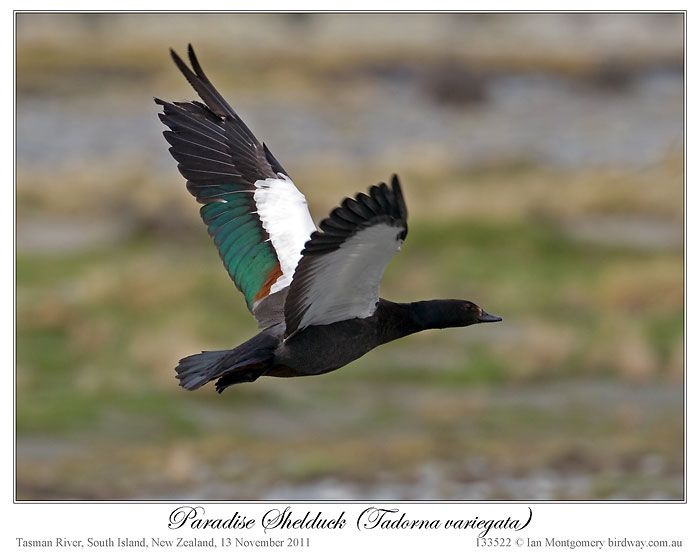
The males have the same black, emerald green and white wing pattern as the female as shown by this male flying along a river in the Waitaki Valley.
Paradise Shelduck (Tadorna variegata) by Ian 4

Paradise Shelduck (Tadorna variegata) by Ian 4

Unlike most other avian species where the female is more colourful, such as Buttonquails and Cassowaries, here there is no switching of gender roles: the female incubates the eggs while the male vigorously defends the territory from predators. Paradise Shelducks maintain pair bonds from one year to the next returning to the same territory. They are partial to both high country riverbeds and farmland and the population has benefitted from the clearing of land for pasture since European settlement.
The Paradise Shelduck is a New Zealand endemic, though a flock of 5 spent arrived on Lord Howe Island in March 1950 and remained for over a month so it is included in the official Australian list.
Best wishes
Ian

Ian Montgomery, Birdway Pty Ltd,
454 Forestry Road, Bluewater, Qld 4818
Phone: 0411 602 737 +61-411 602 737
Preferred Email: ian@birdway.com.au
Website: http://birdway.com.au


Lee’s Addition:

What a neat looking bird. Both the male and the female have such a clean look about them. Shelducks are part of the Anatidae – Ducks, Geese, and Swans Family. They are all in the Tadorna Genus which includes 6 Shelducks. We do not have Shelducks established here in the U.S.

And God blessed them, saying, “Be fruitful and multiply and fill the waters in the seas, and let birds multiply on the earth.” (Genesis 1:22 ESV)

See Ian’s Shelducks on his Birdway website.

Australian Shelduck

Paradise Shelduck

Common Shelduck

Radjah/Raja Shelduck

*

Ian’s Bird of the Week – South Island Wren/New Zealand Rockwren

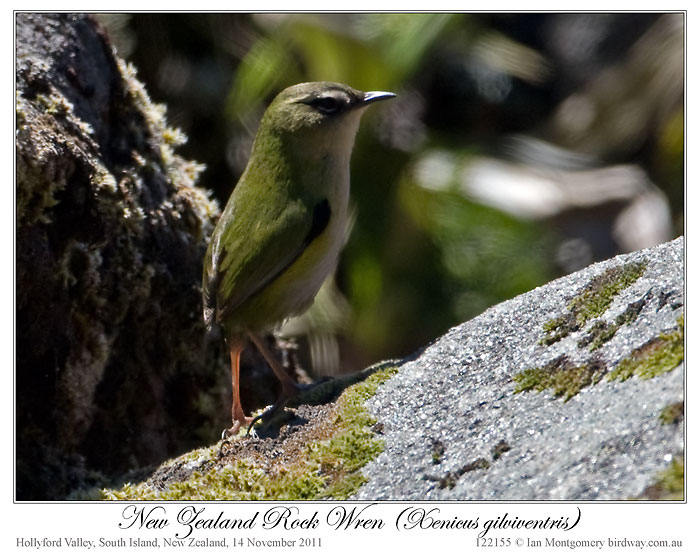
New Zealand Rockwren (Xenicus gilviventris) by Ian 1

New Zealand Rockwren (Xenicus gilviventris) by Ian 1


Ian’s Bird of the Week – South Island Wren/New Zealand Rockwren ~ by Ian Montgomery

Newsletter – 1-9-12

Happy New Year! To celebrate the New Year, here is a representative of an unusual new family for the website, the New Zealand Wrens. There it is usually called the Rock Wren, though its international name is the South Island Wren, to avoid confusion with the unrelated Rock Wren of North America.

I used the Birds of New Zealand Locality Guide by Stuart Chambers to plan my trip and, in it I read: ‘The Rock Wren(Rockwren) is one of New Zealand’s rarer species and one of its more difficult birds to find. It is also one of its gems.’ This of course proved compelling and, as one of its prime sites was near the Homer Tunnel on the way to Milford Sound where I was after the Fiordland Penguin, I made an effort to find it. Compared with say the notorious Australian Grasswrens, this proved relatively easy as the birds often stand on prominent rocks in fine weather, where they bob up and down in a very endearing way, and I found a pair on the second attempt.
New Zealand Rockwren (Xenicus gilviventris) by Ian 2

New Zealand Rockwren (Xenicus gilviventris) by Ian 2

Their upright stance and short tails gives them, like Pittas and Penguins, the fascinating appearance of little people and these are tiny. They measure 10cm/4in in length and the males, weighting about 16g are smaller and lighter than the females at 20g. They’re tough little birds, though, and occur only in rocky Alpine habitats above the tree-line on the South Island. the third photo shows where I found them.
New Zealand Rockwren (Xenicus gilviventris) Habitat by Ian 3

New Zealand Rockwren (Xenicus gilviventris) Habitat by Ian 3

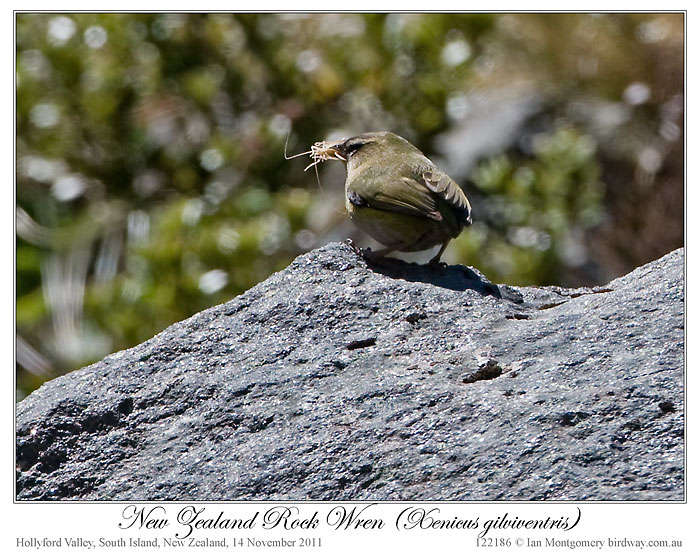
They have a flexible diet with a preference for invertebrates but also eat grass seeds and fruit. The bird in the fourth photo, has just caught a substantial grasshopper, presumably, given the season, for nestlings. The sexes differ in plumage and the green bird in the first two photos is a male. The one with the grasshopper looks browner, but I’m unsure whether that’s because it’s a female or is due to the angle of the light.
New Zealand Rockwren (Xenicus gilviventris) by Ian 4

New Zealand Rockwren (Xenicus gilviventris) by Ian 4

Only two species of New Zealand Wrens – the Acanthisittidae – survive, the other being the even smaller but more widespread Rifleman http://www.birdway.com.au/acanthisittidae/rifleman/index.htm , so named because of its upward tilted bill. This family has no close relatives among the Passerines and has long baffled taxonomists as reflected in the choice of Xenicus for the Rock Wren, meaning ‘strange’ (from the same Greek word as xenophobia). Recent DNA studies suggest that they diverged from the other passerines early in their evolution and probably qualify for their own sub-order, separate from the ‘true’ song birds the Oscines, and the mainly South American Sub-Oscines (which include some Australian representatives, notably the Lyrebirds and the Pittas).
I’ve added to the website most of the new Australian species from the Sub-Antarctic and Tasmanian sections of the trip – http://www.birdway.com.au/index.htm#updates – and am now working on the New Zealand additions. To accommodate them, I’m expanding the Australian section of the website to Australasian and indicating on the Australasian thumbnails whether each species is on the Australian and/or New Zealand lists. For an example, have a look at the Stilts and Avocets: http://www.birdway.com.au/recurvirostridae/index_aus.htm . As part of this change, I’m switching the taxonomic sequence of the Australasian section from Christidis and Boles, 2008, to Birdlife International. This will simplify the overall structure and cater for New Zealand additions not covered by C & B.
Best wishes

Ian

Ian Montgomery, Birdway Pty Ltd,
454 Forestry Road, Bluewater, Qld 4818
Phone: 0411 602 737 +61-411 602 737
Preferred Email: ian@birdway.com.au
Website: http://birdway.com.au


Lee’s Addition:

Four inches is a very tiny bird. Looking at photo #3, I am amazed that they found that little bird. Way to go, Ian.

let the inhabitants of the rock sing, let them shout from the top of the mountains. (Isaiah 42:11b KJV)

The Rockwren is in the Acanthisittidae – New Zealand Wrens Family. They are Passeriformes Order birds. Ian uses the Birdlife International for his list, whereas this site uses the IOC list. Very little differences.

See – Ian’s Birds of the Week

*

Ian’s Bird of the Week – Red-crowned Parakeet

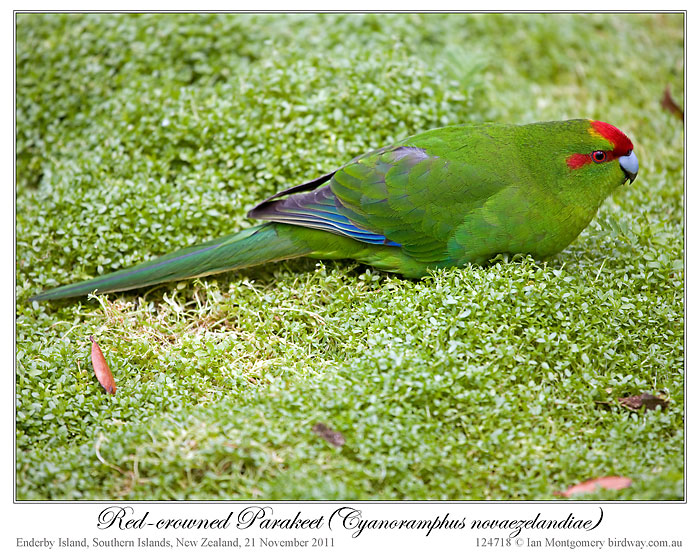
Red-crowned Parakeet (Cyanoramphus novaezelandiae) by Ian 1

Red-crowned Parakeet (Cyanoramphus novaezelandiae) by Ian 1

Ian’s Bird of the Week – Red-crowned Parakeet ~ by Ian Montgomery

Newsletter ~ 12/20/11

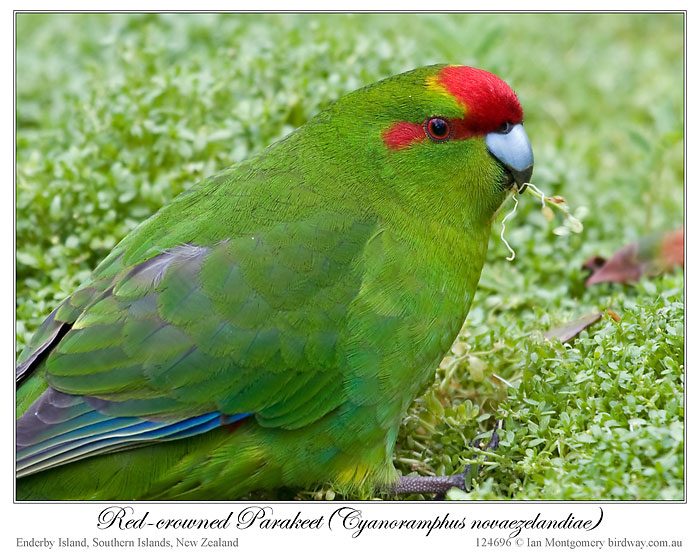
Christmas is nearly on us, so a bird in the Christmas colours of red and green seems appropriate. Here is the Red-crowned Parakeet, one of the relatively few non-seabirds encountered on the trip to the Sub-Antarctic Islands.

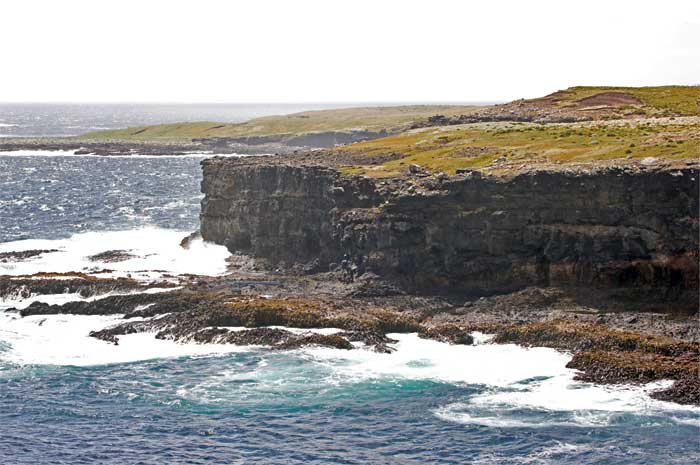
We found these birds at several locations on Enderby Island, one of the smaller of the Auckland Islands and the first site at which we actually landed after leaving Dunedin. Enderby Island is mainly basalt with rocky cliffs, as in the second photo, and it reminded me very much of St Paul Island in the Bering Sea that I visited three years ago. On both the vegetation is mainly tundra, though unlike the treeless St Paul Enderby has patches of very gnarled dwarf rata forest.
Red-crowned Parakeet (Cyanoramphus novaezelandiae) by Ian 2

Enderby Island by Ian 2

The Parakeets feed mainly on the ground and we found them both on the tundra and in the forest. They are herbivorous, and the bird in the first photo is feeding on the dense understory of the forest – the third photo shows the same bird in close-up eating very fine shoots and leaves.
Red-crowned Parakeet (Cyanoramphus novaezelandiae) by Ian 3

Red-crowned Parakeet (Cyanoramphus novaezelandiae) by Ian 3

The fourth photo shows a different bird feeding on the flower-heads of small herbs growing on the tundra near the beach where we landed.
Red-crowned Parakeet (Cyanoramphus novaezelandiae) by Ian 4

Red-crowned Parakeet (Cyanoramphus novaezelandiae) by Ian 4

I’m used to seeing parrots in more tropical locations, so it was a startling to see these small (25-28cm/10-11in long) elegant parrots in such a cold and rugged environment. They are obvious tough little birds, though their confiding habits, ground-feeding life-style and choice of low nesting sites makes them very vulnerable to introduced predators such as feral cats,rats and, in New Zealand, stoats. The Red-crowned Parakeet used to widespread throughout New Zealand but is now rare or extinct on the two main islands, though it survives well on Stewart and other offshore islands. As you can judge from the photos, the birds are very approachable and took little notice of us.
On the website, there are now nine species of penguins http://www.birdway.com.au/spheniscidae/index.htm and thirteen species of albatrosses http://www.birdway.com.au/diomedeidae/index.htm . The additional species of albatrosses include ones that were treated as sub-species by Christidis and Boles, 2008, but are now recognised as full species by Birdlife International and the IOC.
I wish you a safe and happy Christmas and best wishes
Ian


Ian Montgomery, Birdway Pty Ltd,
454 Forestry Road, Bluewater, Qld 4818
Phone: 0411 602 737 +61-411 602 737
Preferred Email: ian@birdway.com.au
Website: http://birdway.com.au


Lee’s Addition:

Thanks again, Ian, for sharing your great adventures. This parakeet, indeed, looks decked out for the colors of Christmas. Would be pretty to have a flock of them perching on a Christmas Tree. Merry Christmas to you, Ian, and our readers.

Then the angel said to them, “Do not be afraid, for behold, I bring you good tidings of great joy which will be to all people. For there is born to you this day in the city of David a Savior, who is Christ the Lord. (Luke 2:10-11 NKJV)

Check out Ian’s other Parrots and Parakeets at his Parrots & Allies Psittacidae Family page. Our Birds of the World Psittacidae Family page has more Parrot and Parakeet photos.

Ian’s Other Birds of the Week

*

Ian’s Bird of the Week – Royal Penguin

Royal Penguin (Eudyptes schlegeli) by Ian 1

Royal Penguin (Eudyptes schlegeli) by Ian 1

Ian’s Bird of the Week – Royal Penguin ~ by Ian Montgomery

Newsletter – 12/10/11

I think that this should really be the Bird of the Trip, if not the Year. The birders’ table at dinner on the last night on board had a vote for Bird of the Trip, and it was a close contest between the Light-mantled Sooty Albatross, featured last week, and my choice, the Royal Penguin. As I mentioned last week, Macquarie Island was for most of us the highlight of the trip, and the day spent on familiar terms with the penguins was memorably enchanting.

Four species breed there, the commonest being the Royal and King Penguins. The King Penguins are beautiful, very smart, elegant and colourful, but the smaller Royals (up to 75cm/30in in length) won hands down in terms of personality.
Royal Penguin (Eudyptes schlegeli) by Ian 2

Royal Penguin (Eudyptes schlegeli) by Ian 2

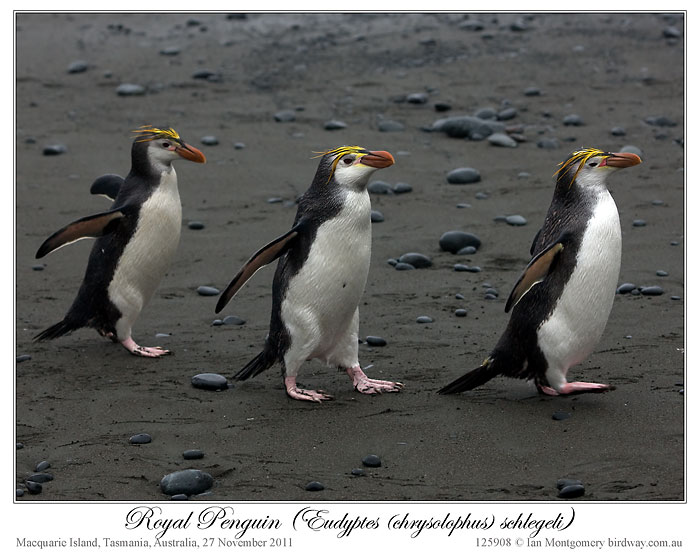
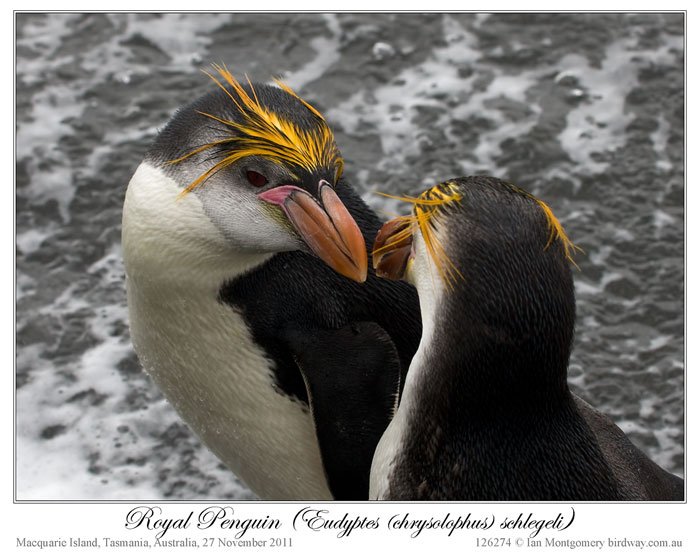
Who could fail to be endeared by the curious attention of the bird in the first photo or by the ones promenading along the beach as in the second photo or by the pair having a deep and meaningful exchange, as in the the third photo?
Royal Penguin (Eudyptes schlegeli) by Ian 3

Royal Penguin (Eudyptes schlegeli) by Ian 3

Apart from curiosity, the penguins appeared little affected by our presence. They would move out of the way if you walked towards them, but if you sat on the beach, they’d come over to check you out and nibble in an exploratory manner on clothing and cameras. The Labrador-eyed baby elephant seals would come over for a cuddle, but that’s another story.
Royal Penguin (Eudyptes schlegeli) by Ian 4

Royal Penguin (Eudyptes schlegeli) by Ian 4

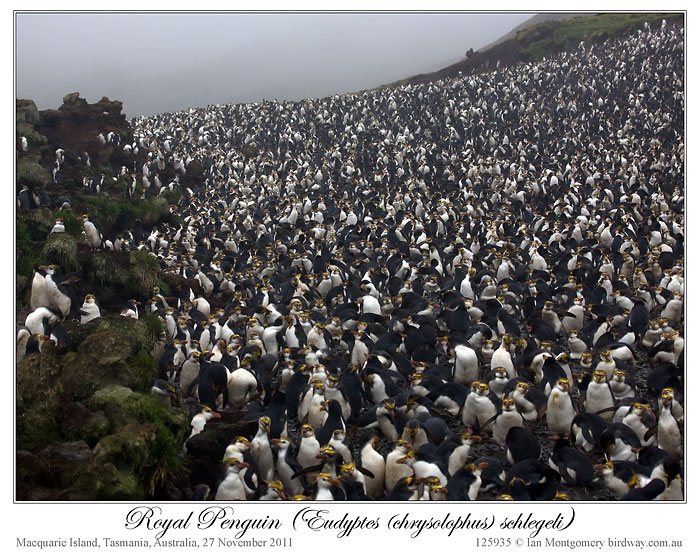
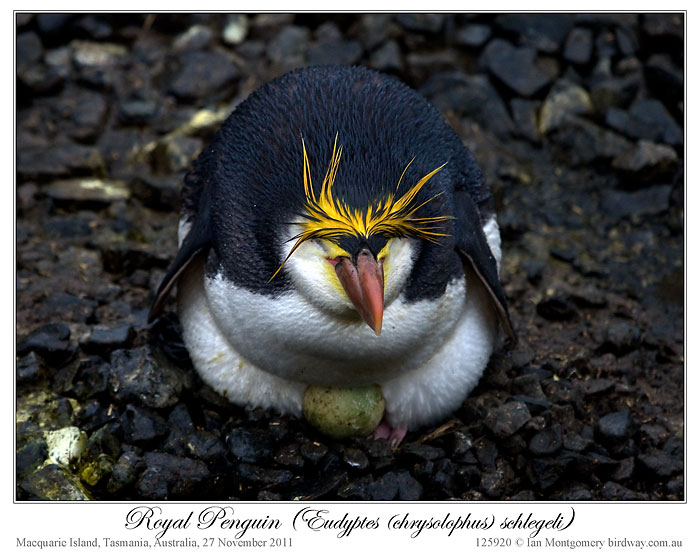
The beach was the promenade area but the real action was taking place at a huge rookery behind the beach, fourth photo. Here, many thousands of Royal Penguins were huddled on uncomfortable-looking stony nests incubating eggs like the long-suffering one having a bad-hair day in the fifth photo.
Royal Penguin (Eudyptes schlegeli) by Ian 5

Royal Penguin (Eudyptes schlegeli) by Ian 5

Woe betide a penguin getting too close to another one’s nest, and an individual moving through the colony was subject to a cacophony of abuse like the one in the sixth photo. The abusers didn’t appeared seriously aggressive, more just letting off steam and complaining about the crowded conditions. They did get serious, however, when the brown skuas attempted to steal their eggs and the area around the rookery was littered with empty egg shells.
Royal Penguin (Eudyptes schlegeli) by Ian 6

Royal Penguin (Eudyptes schlegeli) by Ian 6

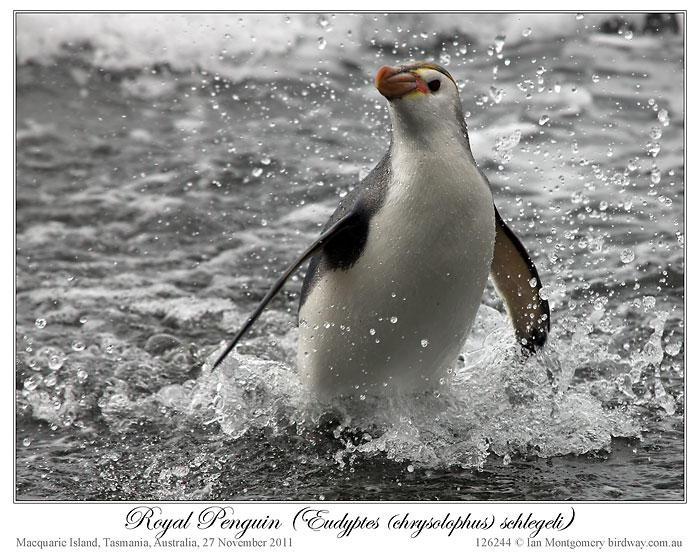
Now generally recognised as a separate species from the closely related Macaroni Penguin, the Royal breeds only on Macquarie Island and the population is estimated at 850,000 pairs. (Macaronis have black chins, Royal have white ones.) ‘Royal’ struck me as a quite inappropriate name: ‘court jester’ would be closer. Maybe that would be underestimating them: the one in the last photo looks like a real champion emerging from the surf, up there with any cross-channel swimmer.
Royal Penguin (Eudyptes schlegeli) by Ian 7

Royal Penguin (Eudyptes schlegeli) by Ian 7

I’m in Sydney now on my way home. The week spent in Tasmania in search of the local endemics was largely successful, despite sometimes miserable weather and I’m looking forward to making many additions to the website.
Best wishes
Ian

Ian Montgomery, Birdway Pty Ltd,
454 Forestry Road, Bluewater, Qld 4818
Phone: 0411 602 737 +61-411 602 737
Preferred Email: ian@birdway.com.au
Website: http://birdway.com.au


Lee’s Addition:

Wow! How do they ever know where their nest is located? That must have been some experience. That second photo looks like they are strutting their stuff.

The Penguins are in the Sphenisciformes Order and they make up the only family, the Spheniscidae Family. See Ian’s photos of the Penguins and then check out our Birds of the WorldSpheniscidae – Penguin family.

He sends out His command to the earth; His word runs very swiftly. He gives snow like wool; He scatters the frost like ashes; He casts out His hail like morsels; Who can stand before His cold? (Psalms 147:15-17 NKJV)

Apparently Penguins were designed to “stand before His cold.”

*

Ian’s Bird of the Week – Light-mantled Albatross

Light-mantled Albatross (Phoebetria palpebrata) by Ian 1

Light-mantled Albatross (Phoebetria palpebrata) by Ian 1

Ian’s Bird of the Week – Light-mantled Albatross ~ by Ian Montgomery

Newsletter ~ 12/1/11

We arrived in Hobart today at the end of successful visit to the Sub-antarctic Islands between New Zealand and Australia. We had a lot of very rough weather in the Southern Ocean but the weather was kinder to us at the various destinations and we managed make all the planned landings (Auckland Islands, Campbell and Macquarie Islands) and view the Snares from the zodiacs (where actual landings are not permitted). I managed to photograph most of the species on my target list and the highlight for most of us was Macquarie Island and its four nesting species of penguin.

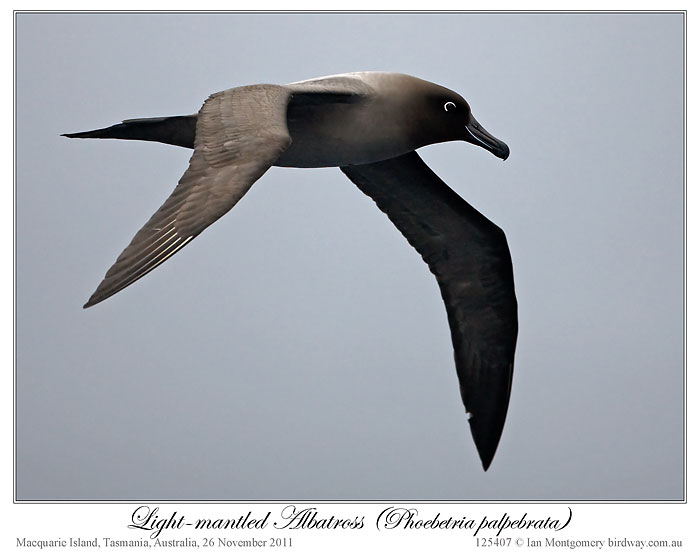
As the last Bird of the Week was the Yellow-eyed Penguin, I’ve chosen an albatross, the Light-mantled (Sooty) Albatross, for this week and will return to penguins later. This was the Albatross that I most wanted to see and also very popular with everyone else. My interest in it had been aroused when I’d heard it likened to a Siamese cat, a seal point in particular. The comparison is apt given the chocolate brown head and latte-coloured body, and the silky texture of the plumage is quite feline in appearance. The white partial eye-ring is striking and sets off the dark head colour very well.
Light-mantled Albatross (Phoebetria palpebrata) by Ian 2

Light-mantled Albatross (Phoebetria palpebrata) by Ian 2

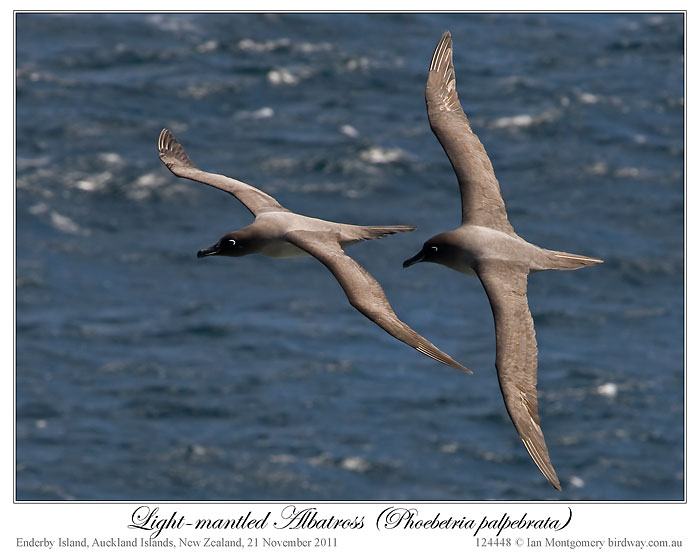
We saw Light-mantled Albatrosses quite frequently until we got close to Tasmania, encountering them first and best on Enderby Island, one of the Auckland Islands, as in the first photo but also at sea and at Macquarie Island as in the second photo. Macquarie Island is administratively part of the State of Tasmania even though it is a long way away and, as one of the Kiwis on board pointed out, geographically part of New Zealand. The Albatrosses were nesting on Enderby Island and it was here that we saw pairs indulging in their beautiful courtship flights, quite an aerial ballet, as in the third photo.
Light-mantled Albatross (Phoebetria palpebrata) by Ian 3

Light-mantled Albatross (Phoebetria palpebrata) by Ian 3

At this point, I though that the comparison with Siamese Cats broke down. I used to have a pair and. when the female was on heat, her behaviour was anything but elegant; demented would have been more like it.
Light-mantled Albatross (Phoebetria palpebrata) by Ian 4

Light-mantled Albatross (Phoebetria palpebrata) by Ian 4

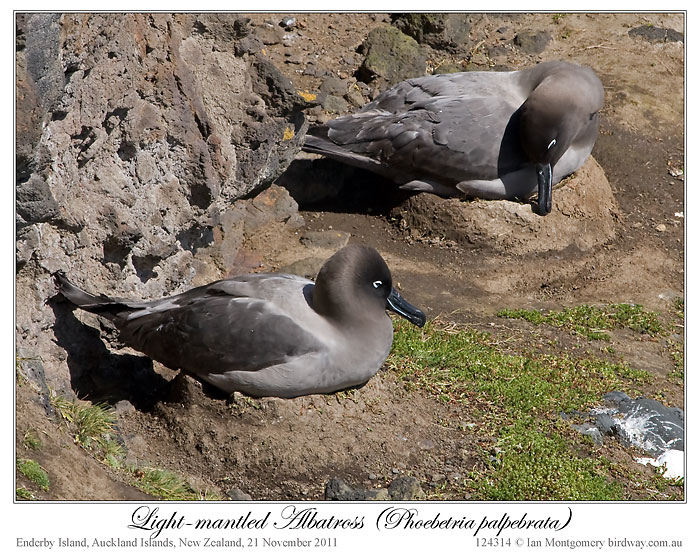
Some pairs were already nesting and incubating eggs. They chose small platforms on quite rocky cliffs and often nested in close proximity to each other, as in the fourth photo. Light-mantled are quite small by albatross standards, measuring about 84cm/33in in length with a wingspan of 215cm/85in. Their range is circumpolar in the colder waters of the Southern Ocean and are seen only rarely in the waters of mainland Australia and Tasmania proper.
Light-mantled Albatross (Phoebetria palpebrata) by Ian 5

Light-mantled Albatross (Phoebetria palpebrata) by Ian 5

On close inspection of the head of a Light-mantled, as in the last photo, the eyes are bluish and, as a final touch, the pale stripe on the bill is also blue. Yes, I know, same colour scheme as a Siamese Cat!
During the rougher parts of the voyage I had the opportunity to work on some of the photos and I have added the following species to the website: Snares, Fiordland and Yellow-eyed Penguins:
Best wishes
Ian

Ian Montgomery, Birdway Pty Ltd,
454 Forestry Road, Bluewater, Qld 4818
Phone: 0411 602 737 +61-411 602 737
Preferred Email: ian@birdway.com.au
Website: http://birdway.com.au


Lee’s Addition:

The hearing ear, and the seeing eye, the LORD hath made even both of them. (Proverbs 20:12 KJV)

What an absolutely neat looking bird. I love that eye ring. Makes the eyes very expressive. Looks like they built nests of mud.

It will be interesting to see what other neat birds that Ian has found on this trip. Not so sure I would have enjoyed those rough seas.

The Albatross are found in the Diomedeidae Family of the Procellariiformes Order. That order includes Petrel, Shearwater, Storm Petrel and Diving Petrel families.

Check out:

Ian’s Albatross Photos

Bird of the Week Newsletters

*

Ian’s Bird of the Week – Yellow-eyed Penguin

Yellow-eyed Penguin (Megadyptes antipodes) by Ian 1

Yellow-eyed Penguin (Megadyptes antipodes) by Ian 1

Ian’s Bird of the Week – Yellow-eyed Penguin ~ by Ian Montgomery

Newsletter – 11/22/11
I had intended the Fiordland Crested Penguin at Milford Sound to be the next bird of the week, but since then I have photographed the unusual and rarer Yellow-eyed Penguin at the well-known colony on the Otago Peninsula near Dunedin and chosen it instead.

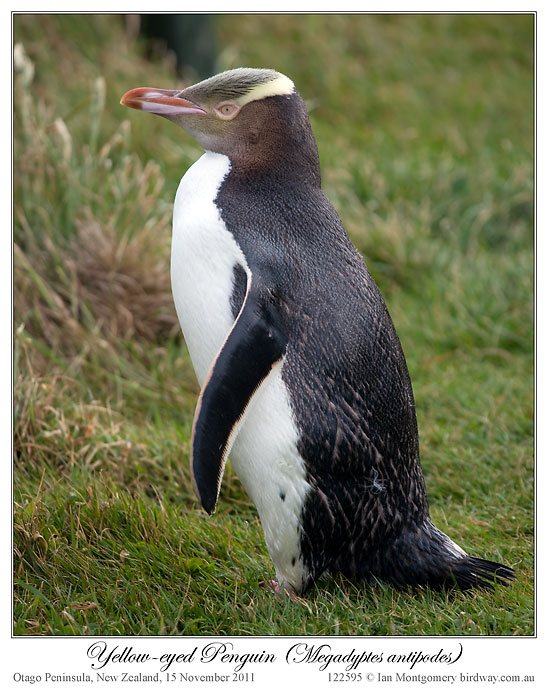
I went there in the evening as this is the time when the fishing member of the breeding pairs returns to relieve the incubating or baby-sitting member. The bird in the first photo is an adult that has just returned to the colony. The adults are distinguishable by having the yellow band joining the eyes around the nape of the head.
Yellow-eyed Penguin (Megadyptes antipodes) by Ian 2

Yellow-eyed Penguin (Megadyptes antipodes) by Ian 2

The bird in the second photo is another adult. Yellow-eyed Penguins are quite large, up to 79cm/31in in length and weighing up to 8kg. The males are larger than the females and penguins in general have heavy bones by bird standards to help them dive. When the pairs are reunited they typically perform mutual preening as in the third photo.
Yellow-eyed Penguin (Megadyptes antipodes) by Ian 3

Yellow-eyed Penguin (Megadyptes antipodes) by Ian 3

The total population of the species is about 2,000 pairs, mainly on Auckland and Campbell Islands, with about 150 pairs on Stewart Island and about 500 on the South Island. It has suffered from loss of coastal forest and still suffers from predation by introduced mammals such as feral cats. It is classified as endangered, but the population has been relatively stable over the last 30 years.
Yellow-eyed Penguin (Megadyptes antipodes) by Ian 4 juvenile

Yellow-eyed Penguin (Megadyptes antipodes) by Ian 4 juvenile

The bird in the fourth photo is a juvenile (they don’t breed until they are 3 or 4 years old) and lacks the yellow band on the back of the head.
More than 20 years ago, when on Stewart Island, I booked to go on a boat trip to an island that had both Yellow-eyed Penguins and Wekas, a large flightless rail. The weather was so bad that the trip was cancelled and both these species had represented unfinished business. On this trip I encountered Wekas at Milford Sound.
I’m in Dunedin for a second time now, having needed to drive to Christchurch to return the camper and then flown back. This produced a strangely disorientating feeling of deja-vu, as you quite reasonably expect to end up somewhere else after a flight, not where you’ve just been the day before. I have met up with my 3 travelling companions from Victoria and we are all excited at the prospect of sailing for the Sub-Antarctic Islands tomorrow. So, don’t expect another bird of the week or any communication for that matter until we reach Hobart where we are due on 1 December. I hope that by then I’ll have many more photos to share with you.
Best wishes
Ian

Ian Montgomery, Birdway Pty Ltd,
454 Forestry Road, Bluewater, Qld 4818
Phone: 0411 602 737 +61-411 602 737
Preferred Email: ian@birdway.com.au
Website: http://birdway.com.au


Lee’s Addition:

Ian has been putting out his newsletters close together lately. Most likely since he knows he will be away from an internet connection for awhile. This newsletter was received several days ago, but decided to space it to fill the gap of time before his next one arrives. I am looking forward to what this next part of his trip produces.

Penguins are in the Sphenisciformes Order. The family, Spheniscidae, is the only one in the order. The 18 Penguins are in 5 genera; Aptenodytes, Pygoscelis, Eudyptes, Megadyptes and Spheniscus. Check out Ian’s Penguins and the the complete Spheniscidae family here.

Let heaven and earth praise Him, The seas and everything that moves in them. (Psalms 69:34 NKJV)

*