Ian’s Bird of the Week – Tiger Shrike

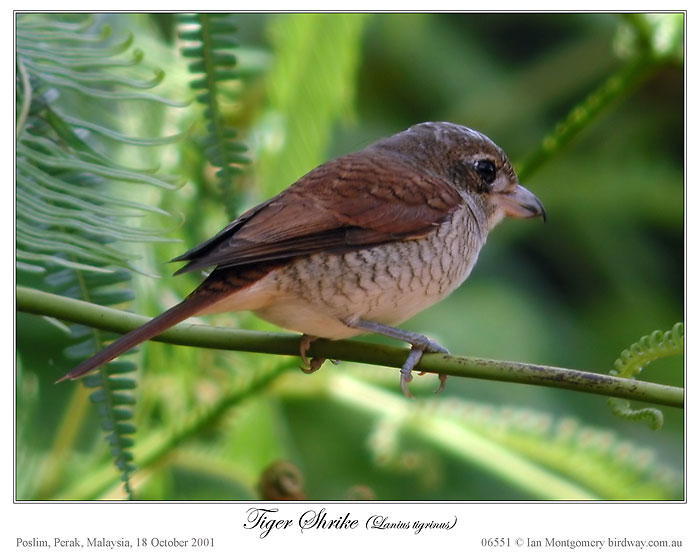
Tiger Shrike (Lanius tigrinus) by Ian

Tiger Shrike (Lanius tigrinus) by Ian

Newsletter – 7/21/11

The common names of many Australian birds reflect their apparent similarity to European birds, even if they are not closely related, for example Robins, Wrens of various sorts (Fairywrens, Scrubwrens) and Treecreepers. Some names are hybrid, such as Cuckoo-shrike, Shrike-thrush and Shrike-tit, meaning ‘looking like something between the two types’. That’s fine for Europeans and well-travelled birders who know what theses things look like, but some, particularly real shrikes, are almost complete unknown in Australia and the use of these names as qualifiers is of questionable value for the locals. So, I though it might be interesting to have a look at a real shrike and throw some light on the use of its name in Australian birds.

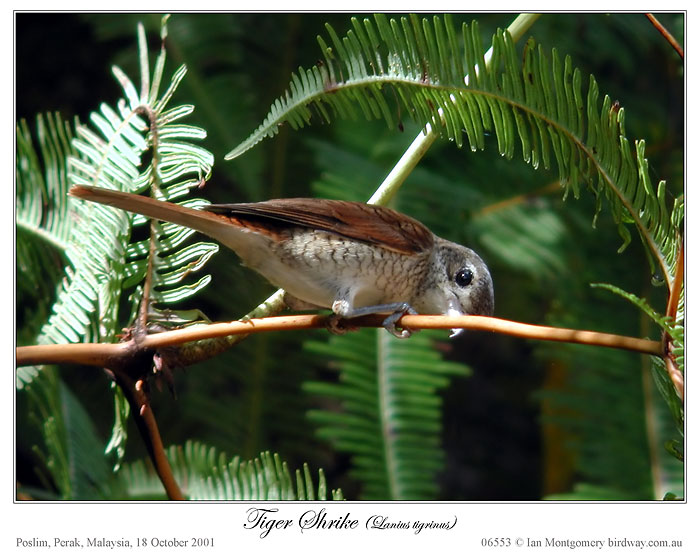
Shrikes, family Laniidae 33 species, are widespread through Eurasia and Africa; a couple of species occur in North America but they are unknown in South America. Two Asian Shrikes, the Tiger and the Brown , have made it to the Australian list as rare vagrants to Christmas Island, though the first Australian record of a Tiger Shrike was a road-killed one found near the port of Fremantle in Western Australia, raising the possibility of being ship-assisted (a black mark for a ‘real’ vagrant). The bird in the these two photographs was photographed in Malaysia.
Tiger Shrike (Lanius tigrinus) by Ian

Tiger Shrike (Lanius tigrinus) by Ian

You’ll notice the hooked bill, characteristic of all Shrikes, and an adaption to their predatory way of life. Shrikes capture both invertebrates and – unusually for song-birds – small vertebrates up to the size of small mammals and birds by waiting on a conspicuous perch for something to come within striking distance. They often store their prey on shrubs or impale them on thorns. Shrikes are small for raptors: the Tiger Shrike is 18cm/7in in length and the larger ones such as the Great Grey/Northern and Long-tailed reach only 26cm/10in and 28cm/11in, and a lot of that is tail.

So, for Australian bird names, read ‘hook-billed’ for ‘shrike’. The resemblance is mainly physical: Cuckoo-shrikes and Shrike-thrushes forage for insects and other invertebrates in the foliage of trees and the bills of Shrike-tits are adapted to prising open the bark of trees in search of invertebrates. For behavioural similarities, the also hook-billed Butcherbirds fit the bill, pun unintended but appropriate, as they also prey on small vertebrates and use bushes as larders. It’s a wonder that they didn’t get called Magpie-shrikes. Now, ‘magpie’, there’s another over-used name . . .

Best wishes
Ian


Ian Montgomery, Birdway Pty Ltd,
454 Forestry Road, Bluewater, Qld 4818
Phone: 0411 602 737 +61-411 602 737
Preferred Email: ian@birdway.com.au
Website: http://birdway.com.au


Lee’s Addition:

Another nice lesson from Ian about the birds of Australia and beyond. Also, more neat photos, this time of the Tiger Shrike. Thanks again, Ian, for helping us see and know about your birds “down under.” As he said, the Tiger Shrike is part of the Laniidae Family of the Passeriformes Order.

And some fell among thorns, and the thorns grew up, and choked it, and it yielded no fruit. (Mark 4:7 KJV)
Ian’s Bird of the Week – Little Grassbird

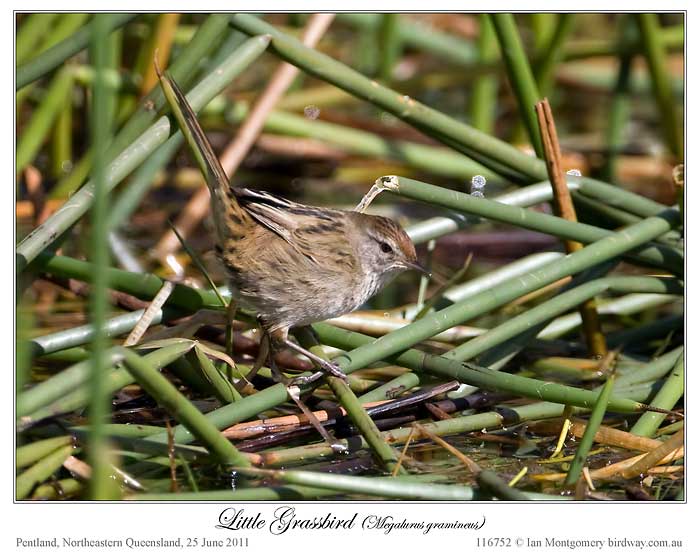
Little Grassbird (Megalurus gramineus) by Ian

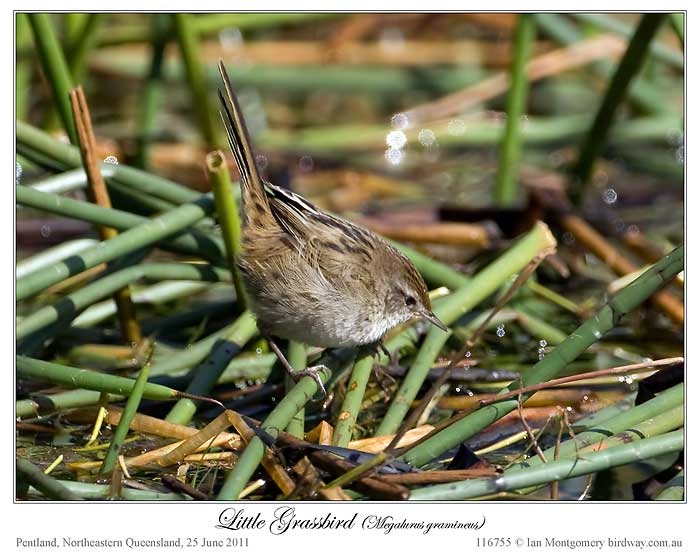
Little Grassbird (Megalurus gramineus) by Ian

Ian’s Bird of the Week – Little Grassbird ~ by Ian Montgomery

Newsletter – 7/3/2011

As well as the Baillon’s Crake, Pentland Dam produced another skulker, the Little Grassbird uncommon in North Queensland and usually heard rather seen – it has a distinctive, mournful three-note whistle.

I had prior warning, thank you again Len and Chris, so when a small dark bird – darker than another skulker present in the wetland, the Australian Reed-Warbler – appeared briefly, I got the camera ready in case it reappeared. It did eventually, and I got couple of quick shots before it disappeared for good.
Little Grassbird (Megalurus gramineus) by Ian

Little Grassbird (Megalurus gramineus) by Ian

The Little Grassbird is distributed quite widely in Australia, mainly in the eastern half of the mainland and Tasmania, though it does occur also in southern Western Australia and patchily through the Northern Territory as far as Kununurra across the border in northern Western Australia. Despite the name ‘Grassbird’, it occurs mainly in dense wetlands, though its only close Australian relative, the Tawny Grassbird http://www.birdway.com.au/sylviidae/tawny_grassbird/index.htm , is more flexible in its habitats.

Conventionally, the Grassbirds have been regarded as one of the Old World Warblers, family Sylviidae http://www.birdway.com.au/sylviidae/index.htm , though most bird taxonomists now accept that this family is a rather heterogeneous collection. Christidis & Boles, 2008, split it into a number of separate families and put the Grassbirds in a new one, the Megaluridae that also includes the Australian Songlarks and the Spinifexbird, while the Reed-Warblers also got their own family, the Acrocephalidae http://www.birdway.com.au/sylviidae/australian_reed_warbler/index.htm .
Best wishes
Ian


Ian Montgomery, Birdway Pty Ltd,
454 Forestry Road, Bluewater, Qld 4818
Phone: 0411 602 737 +61-411 602 737
Preferred Email: ian@birdway.com.au
Website: http://birdway.com.au


Lee’s Addition:

Ian just keeps coming up with his neat birds of the week. I am thankful that Ian lets me reproduce his newsletter on the blog. The birds he is exposing us to are fantastic and trust you enjoy them as much as I do. Many of his birds are from there in Australia and most of us will never get to travel to Australia to see those birds. So, continue to read his reports and do visit <a href=”http://birdway.com.au“>his website, Birdway, to see his many magnificent photos. Also look at the Birds of the Week here.

He causeth the grass to grow for the cattle, and herb for the service of man: that he may bring forth food out of the earth; (Psalms 104:14 KJV)

The Little Grassbird is in the Locustellidae Family.

See Ian’s other Birds of the Week

*

Ian’s Bird of the Week – Baillon’s Crake

Baillon's Crake (Porzana pusilla) by Ian

Baillon's Crake (Porzana pusilla) by Ian

Ian’s Bird of the Week – Baillon’s Crake ~ by Ian Montgomery

Newsletter – 6/27/11

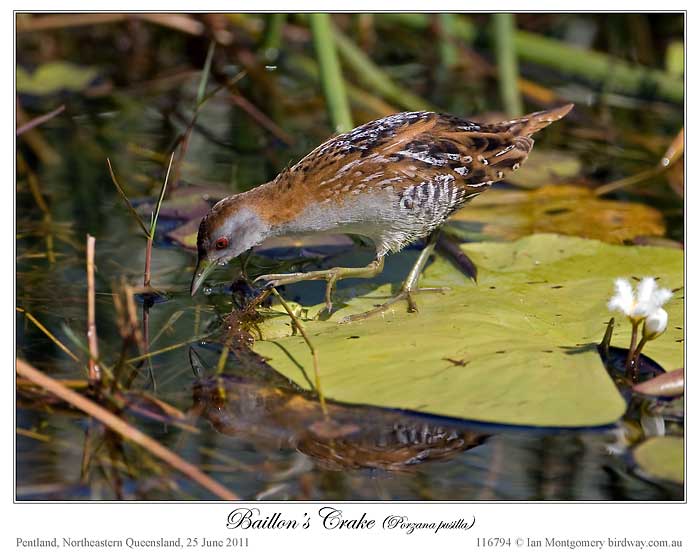
My apologies for a belated bird of the week. This week’s bird is the subject of some excitement at the moment in local birding circles with the reporting of unusual numbers of Baillon’s Crake (thank you Len and Chris!) at a small wetland at Pentland about 240km southwest of Townsville. So, I and some friends spent the weekend there. to have a look for this elusive species, uncommon in this part of the country.

Baillon’s, with a length of 15-18cm/6-7in is the smallest member of its family (Rallidae) found in Australia and not much larger than a house sparrow. Members of this species are particularly secretive even by crake standards usually preferring to skulk in reed beds and other aquatic vegetation, but sometimes venture out into the open in dull weather to feed though rarely as freely in sunshine as the ones at Pentland, as in the first photo. This bird is probably a female as HBW (Handbook of Birds of the World, which like many ‘handbooks’ needs a crane to lift it) reports that females have a rufous patch behind the eye.
Baillon's Crake (Porzana pusilla) by Ian

Baillon's Crake (Porzana pusilla) by Ian

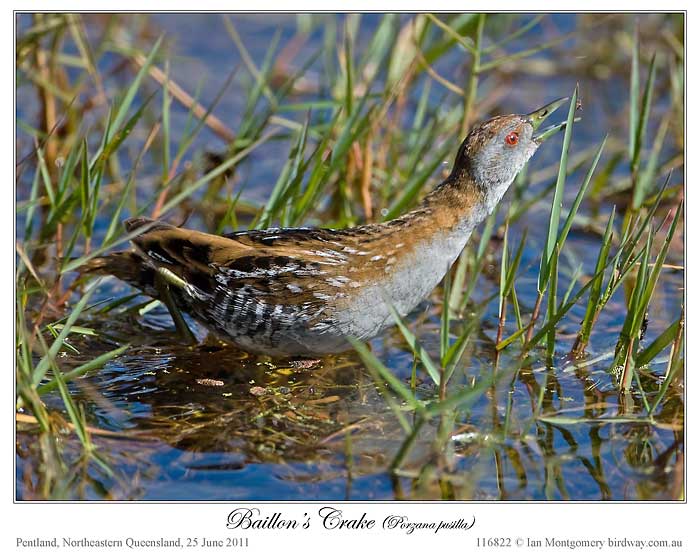
By that criterion, the bird on the lily pad in the second photo is a male with a completely grey cheek. It is also showing the long, rather jacana-like toes that enable it to walk over aquatic vegetation, both floating and submerged, though they will swim if necessary. They seemed reluctant to fly, but would do so to chase other birds that appeared to be encroaching on their patch.

Baillon's Crake (Porzana pusilla) by Ian

Baillon's Crake (Porzana pusilla) by Ian

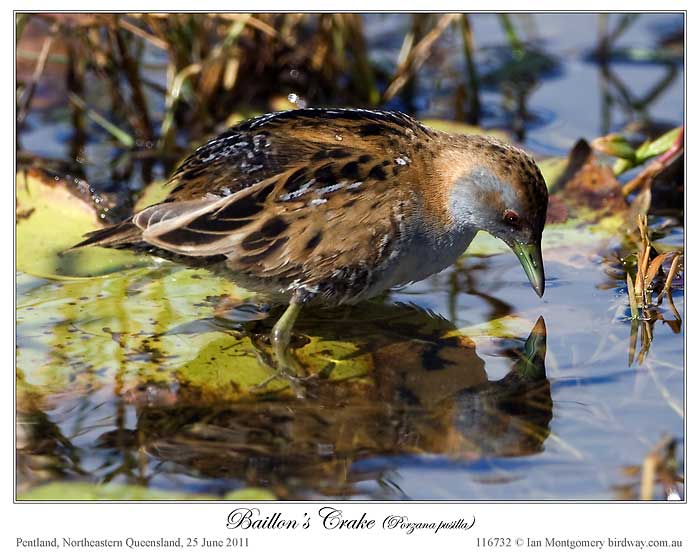
The third photo shows a bird snatching an invertebrate, maybe a small spider, off a blade of grass and stretching out its neck to full extent to do so. They would also pluck prey from under the surface and I watched one that appeared to be eating a mollusc. The fourth photo shows one peering intently at the water but its debatable whether it’s looking for dinner or, Narcissus-like, admiring its reflection (even if it is a female) while its lily pad sinks unnoticed below the surface – Baillon’s Crakes weigh about 35 g, a little over an ounce.

Baillon's Crake (Porzana pusilla) by Ian

Baillon's Crake (Porzana pusilla) by Ian

I think the bird in the fifth photo is a juvenile. The iris is brownish rather than red, the legs and bill are browner than in the adults and the underparts are buffish white, rather than grey.

Baillon's Crake (Porzana pusilla) by Ian

Baillon's Crake (Porzana pusilla) by Ian

Although Crakes in general appear reluctant to fly, they can do so well and over long distances, probably at night. They move around according to the availability of water (the wetland at Pentland sometimes dries out completely) and there is some evidence that Baillon’s Crakes move north in winter in Australia. It also has a wide distribution throughout Eurasia and Africa and a summer visitor in Europe. A separate race is found in New Zealand, it has been recorded on Macquarie Island, and a closely related species, now extinct, used to occur on Laysan Island between Midway Islands and Hawaii.

Incidentally, the smallest member of the family is the Inaccessible Rail found on Inaccessible Island in the Tristan Da Cunha Group with a length of 13-15.5 cm. Furthermore it the smallest flightless bird in the world, but, not having therefore to worry about its waistline, it is, at 40 g, heaver than Baillon’s Crake.
Best wishes,
Ian


Ian Montgomery, Birdway Pty Ltd,
454 Forestry Road, Bluewater, Qld 4818
Phone: 0411 602 737 +61-411 602 737
Preferred Email: ian@birdway.com.au
Website: http://birdway.com.au


Lee’s Addition:

Baillons are part of the Rails, Crakes & Coots – Rallidae Family of the Gruiformes Order. The Crake is in the same family as our Purple Gallinules, Common Gallinules or Moorhens and the American Coots we see often. We have Rails (Black, Clapper, King, Virginia, and Yellow) and the Sora here in Florida, but I never seem to spot them. The birds here are much larger than Ian just described. Would love to see one of them.

The most typical family members occupy dense vegetation in damp environments near lakes, swamps, or rivers. Reed beds are a particularly favoured habitat. They are omnivorous, and those that migrate do so at night: most nest in dense vegetation. In general, they are shy and secretive birds, and are difficult to observe.

Most species walk and run vigorously on strong legs, and have long toes which are well adapted to soft, uneven surfaces. They tend to have short, rounded wings and although they are generally weak fliers, they are, nevertheless, capable of covering long distances.

Can the papyrus grow up without a marsh? Can the reeds flourish without water? While it is yet green and not cut down, It withers before any other plant. So are the paths of all who forget God; (Job 8:11-13a NKJV)

See more of Ian’s Bird of the Week articles.
Family #46 – Rallidae

*

Ian’s Bird of the Week – White-headed Pigeon

White-headed Pigeon (Columba leucomela) by Ian

White-headed Pigeon (Columba leucomela) by Ian

Ian’s Bird of the Week – White-headed Pigeon ~ by Ian Montgomery

Newsletter – 6/15/11

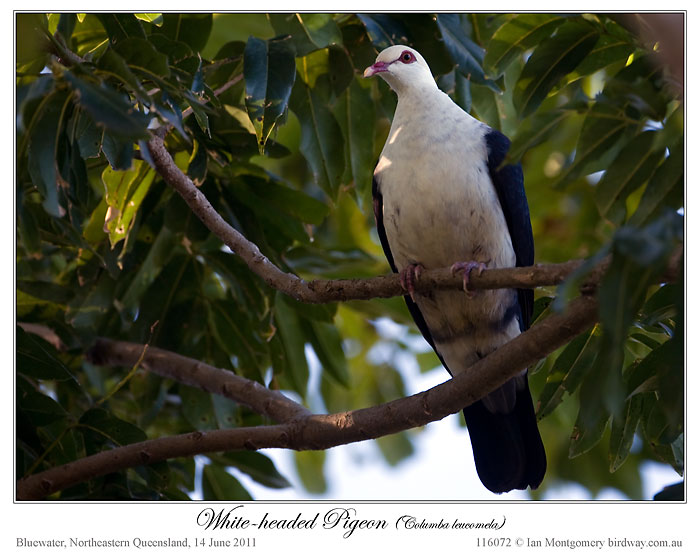
I’ve been preoccupied recently preparing photos for the digital publication that I first mentioned two weeks ago, so I haven’t taken many photos and hadn’t decided on this week’s bird when I took a break yesterday to put out the garbage. On the way back from the front gate, I spotted an adult male White-headed Pigeon feeding on the fruit of a boxwood shrub and took the long way round to the house to get my camera. The adult White-headed Pigeon was on my wanted list for the digital publication and hasn’t featured as a bird of the week, so two problems were solved simultaneously by just taking out the garbage. There’s a lesson there somewhere, I’m unsure what, but I do recall another occasion when I photographed Red-tailed Black-Cockatoos on a trip to the garbage dump: http://www.birdway.com.au/cacatuinae/red_tailed_black_cockatoo/source/redtailblackcockatoo02242.htm .

White-headed Pigeon (Columba leucomela) by Ian

White-headed Pigeon (Columba leucomela) by Ian

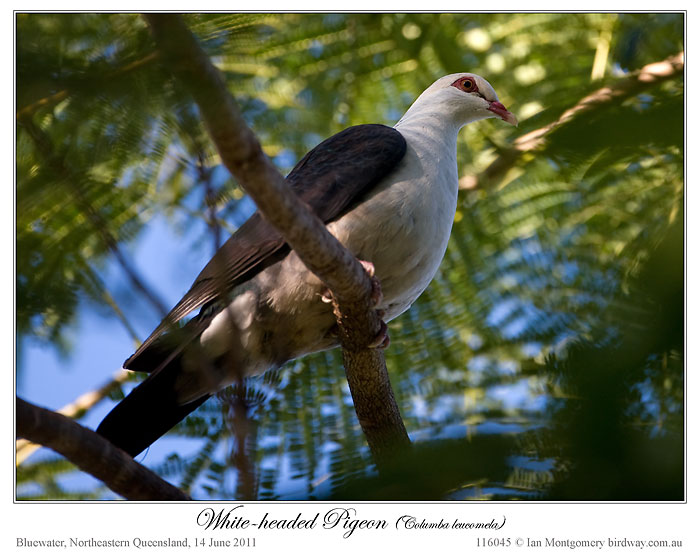
I disturbed him from the boxwood, but he flew up into a poinciana tree near the house (first photo) before retreating into the thicker foliage of what I think is an African mahogany (second photo), where he remained for ages.

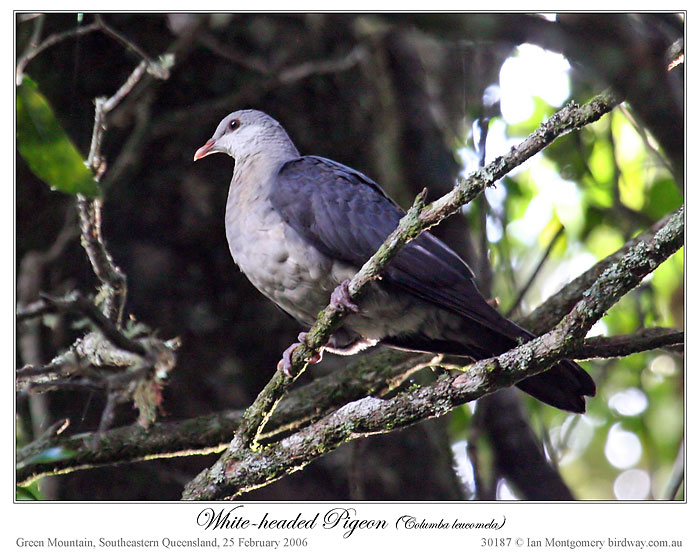
White-headed Pigeons are large (to 41cm/16in in length) and rather splendid with their red and white faces and slightly iridescent bluish grey wing feathers. Here in North Queensland, they occur usually only in highland rainforest, and this is the first one that I’ve seen here near the coast, though farther south in southern Queensland and northern New South Wales (their stronghold) they do occur in coastal areas. The range from Cooktown in the north to about Bermagui on the south coast of NSW but, like other fruit-eating pigeons, they are fairly nomadic and sometimes occur in eastern Victoria. So, I don’t know whether this one is yet another refugee from cyclone Yasi or has just wandered down from the Paluma Range looking for food, as other birds do in winter.

White-headed Pigeon (Columba leucomela) by Ian

White-headed Pigeon (Columba leucomela) by Ian

The third photo is an immature bird that I photographed some years ago in rainforest near O’Reilly’s Lodge in Lamington National Park in southeastern Queensland near the border with NSW. Immature birds have greyish, rather than white heads and breasts and a dark cap. Females are intermediate in colour between the juveniles and the adult male and also have the whitish cheek visible on the juvenile.

On a completely different subject have a look at this youtube video  if you want to see the piece that the recorder group to which I belong entered in the Recorder Romp competition organised recently by the ABC.

Best wishes
Ian


Ian Montgomery, Birdway Pty Ltd,
454 Forestry Road, Bluewater, Qld 4818
Phone: 0411 602 737 +61-411 602 737
Preferred Email: ian@birdway.com.au
Website: http://birdway.com.au


Lee’s Addition:

Behold, thou art fair, my love; behold, thou art fair; thou hast doves’ eyes. (Song of Solomon 1:15 KJV)

Doves are in the Columbidae Family of the Columbiformes Order.

*

Ian’s Bird of the Week – Red-billed Tropicbird

Red-billed Tropicbird (Phaethon aethereus) by Ian Montgomery

Red-billed Tropicbird (Phaethon aethereus) by Ian Montgomery

Ian’s Bird of the Week – Red-billed Tropicbird ~ by Ian Montgomery

Newsletter – 6/6/11

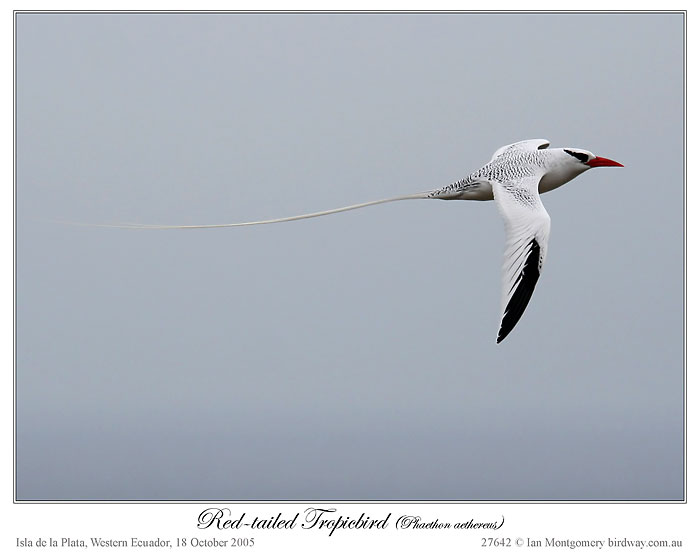
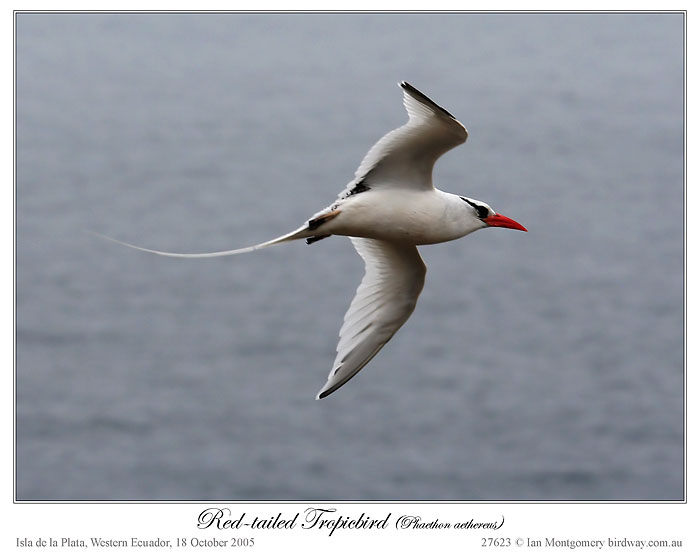
Last November a Red-billed Tropicbird was recorded on Lord Howe Island (http://aussiebirding.wildiaries.com/species/23736). This is the first Australian record and it is a long way from its closest breeding colonies in the Galapagos. I photographed this species in 2005 at another Ecuadorean site, Isla de la Plata (‘Silver Island’) so I thought I’d share it with you as Tropicbirds are among my favourite birds. Lord Howe Island, incidentally, has breeding Red-tailed Tropicbirds (http://www.birdway.com.au/phaethontidae/red_tailed_tropicbird/index.htm). Isla de la Plata is often called the poor man’s Galapagos as it’s a mere 40km from the Ecuadorean coast as can be visited on a day trip for about $40 and has some of the Galapagos specialties such as the Blue-footed Booby (http://www.birdway.com.au/sulidae/blue_footed_booby/index.htm).

Red-billed Tropicbird by Ian Montgomery

Red-billed Tropicbird (Phaethon aethereus) by Ian Montgomery

The Red-billed Tropicbird is easily distinguished from the closely related Red-tailed by its white tail streamers and black barring on the back and wings (first photo). It is the largest of the three species with a body length of about 50cm/20in, tail streamers of at least another 50cm/20in and a wingspan of about 1metre/40in. The two tail streamer feathers are longer in the male and used in aerial display and may also be used as a rudder in flight. They are fragile, often broken (second photo) and are replaced continually.

The courtship display of the Red-billed Tropicbird starts with a number of birds flying around near the colony which is usually on a rocky cliff. A pair of birds may then separate from the flock and start synchronised aerobatics, as in the third photo. This time I’ve embedded the photos in the body of the email; if this causes any problems, eg with older email programs that don’t support HTML, just let me know ian@birdway.com.au and I’ll revert to attaching them.
Red-billed Tropicbird (Phaethon aethereus) by Ian Montgomery

Red-billed Tropicbird by Ian Montgomery

This display may lead to a choice of nest site (from the air). Tropicbirds have webbed feet and weak legs and can move only with difficulty on land, so the choice of inaccessible cliff sites is supposed to offer protection from terrestrial predators and allow easy take off.

They feed by diving for prey, often flying fish and squid, as do gannets and boobies and, like them, have air sacs in the head and neck to absorb the impact of hitting the water. The tropical waters in which they feed have low prey densities so they travel far and when not breeding lead a pelagic existence. They aren’t closely related to gannet and boobies; DNA studies suggest that they have no close relatives and Christidis and Boles (2008) place the three members of the Tropicbird family, the Phaethontidae, in their own order, the Phaethontiformes. The third and smallest species is the White-tailed Tropicbird, best known in Australia as the apricot-coloured morph found on Christmas Island and known locally as the Golden Bosunbird (http://www.birdway.com.au/phaethontidae/white_tailed_tropicbird/index.htm).
I’ve had an encouraging response to last week’s request for photos of Australian birds that I can’t supply, with about 60 species of the wanted list being offered. There are still 200 to go, so have a look at the update wanted list to see if you can help.
On the website, I recently changed my policy of not including captive birds under any circumstances and have added photos of a Malleefowl (http://www.birdway.com.au/megapodiidae/malleefowl/index.htm) and Little Penguins (http://www.birdway.com.au/spheniscidae/little_penguin/index.htm)  in tolerably natural-looking sets.
Best wishes,
Ian

Ian Montgomery, Birdway Pty Ltd,
454 Forestry Road, Bluewater, Qld 4818
Phone: 0411 602 737 +61-411 602 737
Preferred Email: ian@birdway.com.au
Website: http://birdway.com.au

Lee’s Addition:

Ian made some interesting observations about the Tropicbirds:

  • Have webbed feet
  • Have weak legs
  • Can move only with difficulty on land
  • The choice of inaccessible cliff sites is supposed to offer protection from terrestrial predators and allow easy take off.
  • When diving for prey air sacs in the head and neck absorb the impact of hitting the water.

Looks like these features add up to a neatly created design to provide for and protect the tropicbirds.

Then God said, “Let the waters abound with an abundance of living creatures, and let birds fly above the earth across the face of the firmament of the heavens. (Gen 1:20)

The Tropicbirds are in the Phaethontidae – Tropicbirds Family. There are only three species in the family and they are the only family in the Phaethontiformes Order.

More of Ian’s Birds of the Week – Click Here

*

Ian’s Bird of the Week – Crimson-crested Woodpecker

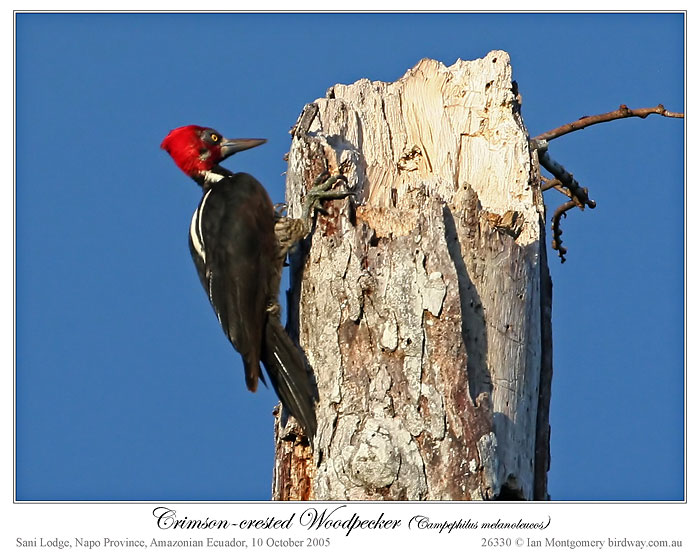
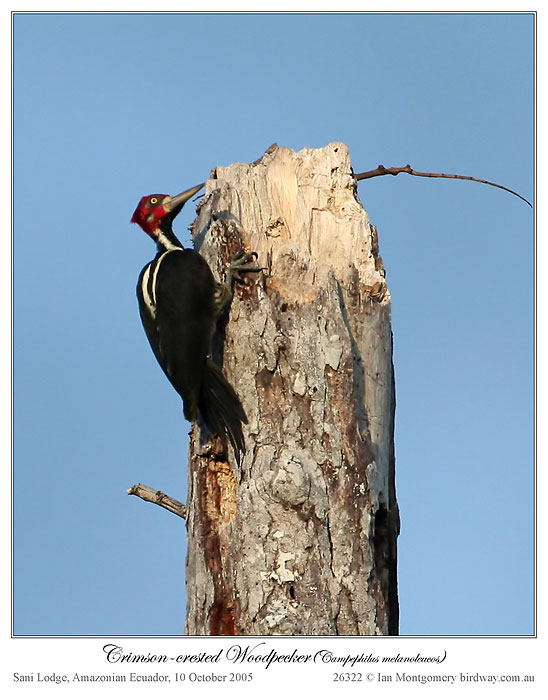
Crimson-crested Woodpecker (Campephilus melanoleucos) by Ian

Crimson-crested Woodpecker (Campephilus melanoleucos) by Ian

Ian’s Bird of the Week – Crimson-crested Woodpecker ~ by Ian Montgomery

Newsletter – 5/29/11

Those of you who have been on the list for a few years might remember from earlier posts that I’ve led a woodpecker-deprived existence, having lived first in Ireland and since then in Australia. Woody Woodpecker captured my imagination at an early age and I’ve been fascinated with woodpeckers ever since.

I was updating the woodpecker galleries on the website http://www.birdway.com.au/picidae/index.htm and this one made me laugh, so I though I’d share it with you. In the first photo it looks as if it’s staring in guilty shock at the tree and saying “Whoops! (or something stronger) Did I do that?” The second photo follows the same theme with a puzzled “Where did that tree go?” If you can think of better captions, please share them with me at ian@birdway.com.au and I’ll publish the best one next week.

Crimson-crested Woodpecker (Campephilus melanoleucos) by Ian

Crimson-crested Woodpecker (Campephilus melanoleucos) by Ian

The Crimson-crested Woodpecker (Campephilus melanoleucos) is 36cm/14in in length and a close relative of the larger (at least 48cm/19in) and legendary, maybe-extinct-maybe-not Ivory-billed Woodpecker of the southern USA (Campephilus principalis) about which there was so much excitement in 2004-5. The Crimson-crested is happily quite common with a wide range in northern South America. Campephilus incidentally means ‘grub loving’ as this group of woodpeckers finds the larvae of wood-boring beetles to their liking.

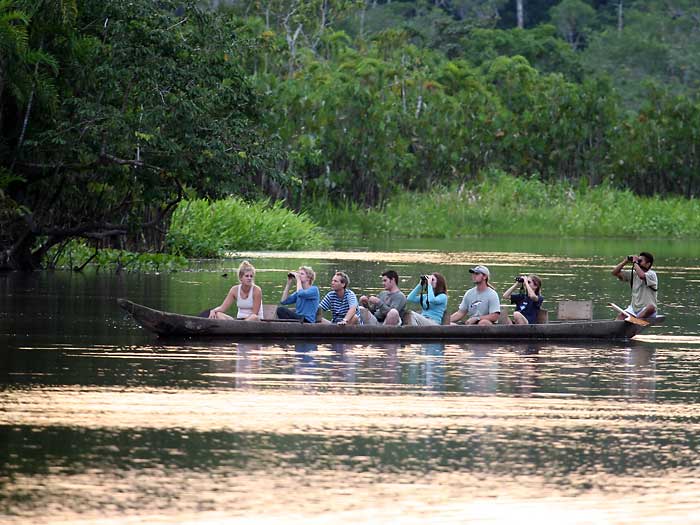
I photographed this Crimson-crested Woodpecker in 2005 from the dug-out canoe in the third photo, when staying at a lodge called Sani on the Rio Napo, a tributary of the Amazon, in eastern Ecuador. The lodge was on an oxbow lake away from the main river and the canoes, being very quiet, were ideal for bird watching though using a heavy (and expensive) 500mm lens in the canoe took some practice, not to mention recklessness.

Crimson-crested Woodpecker (Campephilus melanoleucos) by Ian Sani Canoe

Crimson-crested Woodpecker from Sani on the Rio Napo Canoe by Ian

Ireland happily is no longer a woodpecker-free zone as the Greater-spotted Woodpecker is in the process of colonising the country, after a big increase in the population in Britain, with successful breeding being report in Co. Down since 2005, Co. Wicklow since 2009 and Co. Wexford since 2010. See http://wlx.bright-server.com/do/ecco.py/view_item?listid=1&listcatid=1075&listitemid=8021&live=0 . We might have to wait a bit longer, though, for any Asian woodpeckers to come island-hopping across the Wallace line to Australia and eucalyptus mightn’t suit them.

I’ve started suppling photos of Australian birds to Guy Gibbon for a multimedia version of Pizzey and Knight for PCs and mobiles and I’ve also been given the task of sourcing photos that I can’t supply (both species and plumages). If you are interested, or know anyone who might be, I’d like to hear from you ian@birdway.com.au . Have a look at this News item on the website http://www.birdway.com.au/#aus_photos which has a link to the list of initially required species http://www.birdway.com.au/pdfs/wanted_species.pdf and links to similar publications by Guy covering British-Irish and Southern African birds.

Best wishes
Ian

Ian Montgomery, Birdway Pty Ltd,
454 Forestry Road, Bluewater, Qld 4818
Phone: 0411 602 737 +61-411 602 737
Preferred Email: ian@birdway.com.au
Website: http://birdway.com.au


Lee’s Addition:

Woody Woodpecker was also a favorite of mine. Here in the U. S., we have the Pileated Woodpecker (Dryocopus pileatus),  which seems to be quite similar to this Crimson-crested. Pileated adults are (40 to 49 centimetres (16 to 19 in) long; 250 to 350 grams (8.8 to 12 oz) mass) are mainly black with a red crest and a white line down the sides of the throat. That compares to the 36cm/14in of the Crimson-crested.  Apparently the Pileated is larger and in a different genus. There are 225 woodpeckers world-wide. The Piciformes Order has not only Woodpeckers – Picidae Family, but also eight other families.

The trees of the LORD are full of sap; the cedars of Lebanon, which he hath planted; Where the birds make their nests: as for the stork, the fir trees are her house. (Psalms 104:16-17 KJV)

*

Ian’s Bird of the Week – Masked Booby

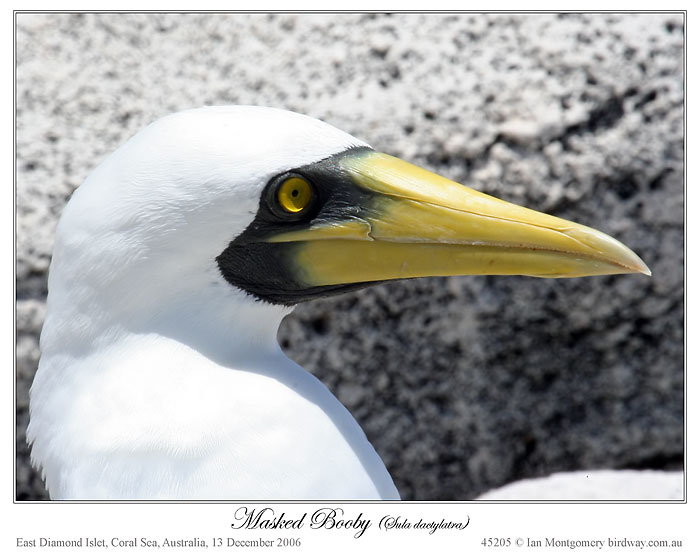
Masked Booby (Sula dactylatra) by Ian

Masked Booby (Sula dactylatra) by Ian

Ian’s Bird of the Week – Masked Booby ~ by Ian Montgomery

Newsletter – 5/20/11

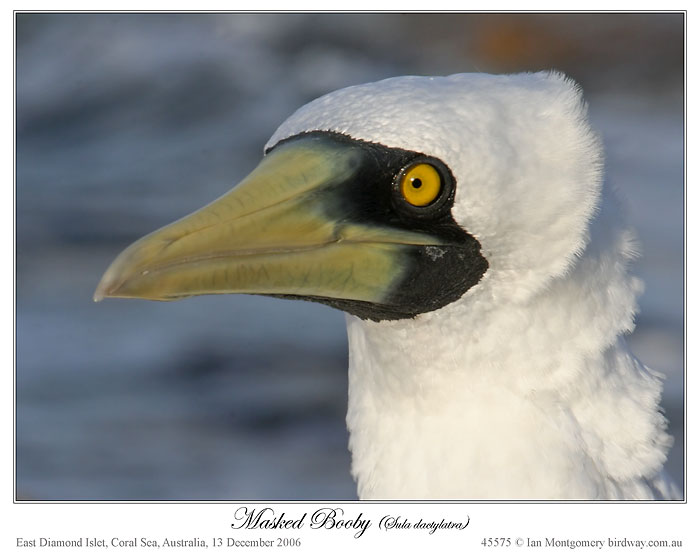
We got a good view of a female Lesser Frigatebird at Lucinda on Wednesday when we did our regular wader count so I considered this species for bird of the week, forgetting that it had featured in March. So here is another spectacular seabird instead: the Masked Booby.

Masked Booby (Sula dactylatra) by Ian

Masked Booby (Sula dactylatra) by Ian

The first photo shows a portrait of a male bird, distinguishable from the female by its yellow bill. That of the female, second photo, has a greenish tinge to it. As you can see from these photos, Boobies are very approachable and the name comes from the Spanish ‘bobo’ meaning clown or fool as sailors found the birds easy to catch.

Masked Booby (Sula dactylatra) by Ian

Masked Booby (Sula dactylatra) by Ian

The difference between the sexes is subtle though the female is larger and they are easier to tell apart when seen together, like the pair in the third photo on a beach. Boobies and Gannets are very social and have sophisticated behaviours for display, territorial disputes and fishing so the ‘bobo’ label was a bit hasty.

Masked Booby (Sula dactylatra) by Ian

Masked Booby (Sula dactylatra) by Ian

All these photos were taken at East Diamond Islet, a remote cay on the eastern edge of the Barrier Reef in the Coral Sea Islands Territory, within Australia’s territorial boundaries but outside Queensland. This cay is typical of Masked Booby colonies, far offshore in tropical or sub-tropical waters, and the birds fish in deep water and are not normally seen close to the coast. The range of the Masked Booby is right around the globe and in Australasia there are colonies in northern Western Australia, northeastern Queensland, Lord Howe and Norfolk Islands and the New Zealand Kermadec Islands. The birds at the last three sites have black rather than yellow eyes and belong to a different race. Another race in the eastern Pacific with orange bills has recently been split off as a separate species the Nazca Booby.

Masked Booby (Sula dactylatra) by Ian

Masked Booby (Sula dactylatra) by Ian

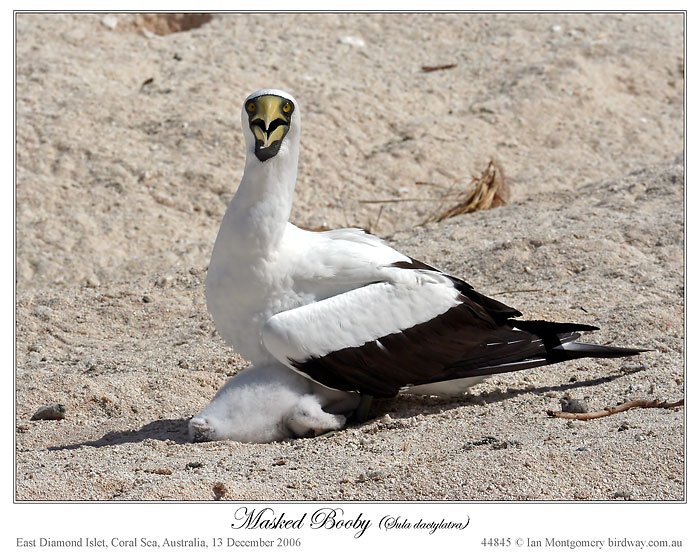
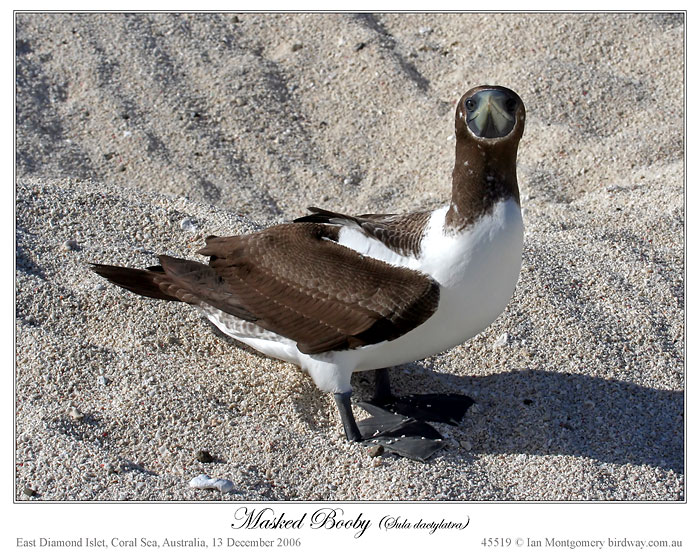
Masked Boobies nest both on rocky cliffs and flat areas and the female in the fourth photo is sheltering a nestling and simultaneously expressing a verbal protest at being photographed. They usually lay two eggs, but the second is only an insurance policy and the first nestling to hatch will kill its sibling if it also hatches. Juvenile birds, fifth photo, look quite similar to the closely related Brown Booby but are distinguishable by having a complete white collar which in front forms a white rather than brown upper breast.

Masked Booby (Sula dactylatra) by Ian

Masked Booby (Sula dactylatra) by Ian

The sixth photo is of a male in flight and shows the black tail that distinguishes it from the white phase of the Red-footed Booby. Like all the gannets and other boobies, the Masked feeds by spectacular plunge-dives for fish, all members of the family have air sacs off the bronchi to absorb the impact – the original airbags. The Masked is the largest of the boobies (to 86cm/34in with a wing-span of 1.7m/5.5ft) and its maximum dive has been estimated at 100m/330ft though it’s smaller than the gannets. Gannets can reach 10m/33ft depth just from the dive and then swim down to 20-25m and usually take the target fish on the way back up.

Links:
Wednesday’s female Lesser Frigatebird
Nazca Booby
Brown Booby
Red-footed Booby

Here are a couple of points from earlier postings. Last week I had an email from Brett who reported the northern race of the Eastern Yellow Robin at St George’s Basin, 200km south of Sydney and well south of the documented range to the Hunter Valley. He – brett@brettdaviswebsitedesign.com.au – would be interested to hear from others who have recorded it south of its supposed range. A month ago (Yellow White-eye) I inquired about a plant with large fruits and pink flowers. The plant in question is calotrope (Calotropis procera) – thank you to the respondents – an introduced weed, but popular with native birds such as this Red-headed Honeyeater in Broome.

Best wishes,
Ian


Ian Montgomery, Birdway Pty Ltd,
454 Forestry Road, Bluewater, Qld 4818
Phone: 0411 602 737 +61-411 602 737
Preferred Email: ian@birdway.com.au
Website: http://birdway.com.au


Lee’s Addition:

The Sulidae – Gannets, Boobies Family has 10 species. The three Gannets are the Northern, Cape, and Australian. The seven Boobies are the Blue-footed and Red-footed, Peruvian, Nazca, Brown and the Masked Booby which Ian just wrote about. This family is part of the Suliformes Order which also includes the Frigatebirds, Cormorants, shags and the Anhingas, darters families.

Talking about the young one and the nest of the ground reminds me of:

If you come across a bird’s nest in any tree or on the ground, with young ones or eggs and the mother sitting on the young or on the eggs, you shall not take the mother with the young. (Deuteronomy 22:6 ESV)

Ian’s Bird of the Week – Eastern Yellow Robin

Eastern Yellow Robin (Eopsaltria australis) by Ian

Eastern Yellow Robin (Eopsaltria australis) by Ian

Ian’s Bird of the Week – Eastern Yellow Robin ~ by Ian Montgomery

Newsletter – 5/10/11

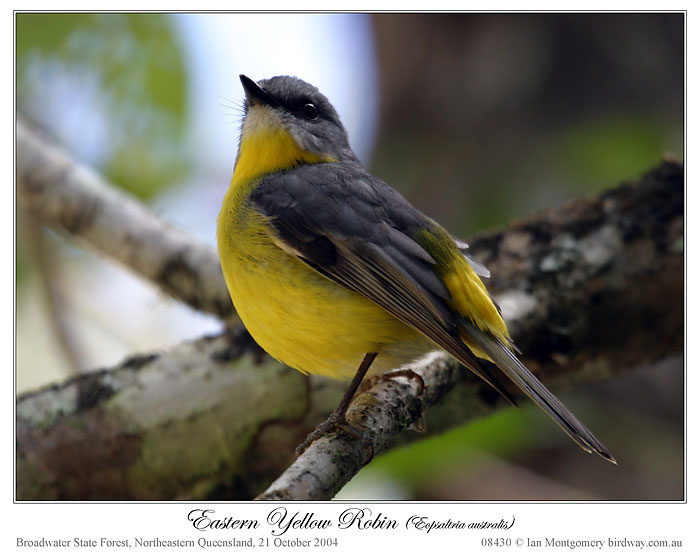
Here’s another familiar Australian species that hasn’t featured as Bird of the Week: the Eastern Yellow Robin. Familiar in mainland eastern Australia I should add, as it’s absent from Tasmania and it is replaced by the closely related Western Yellow Robin in southern Western Australia and southwestern South Australia. It’s familiar because its colourful and confiding and, with human contact, it gets quite tame in places such as picnic areas in parks.

Eastern Yellow Robin (Eopsaltria australis) by Ian

Eastern Yellow Robin (Eopsaltria australis) by Ian

The name Robin derives from the apparent similarity between the males of the several red-breasted Australian species (Rose, Pink, Flame, Scarlet and Red-capped Robins) and the European Robin, well known to the original white settlers. These not close related, however, as the European Robin is an Old World Flycatcher (family Muscicapidae) and the Australian, or strictly Australo-Papuan, Robins comprise their own family the Petroicidae. There are behavioural similarities too as a result of a similar lifestyle, and the Eastern Yellow Robin often watches patiently from conspicuous perches (including the trunks of trees) scanning the ground for invertebrate prey.
Eastern Yellow Robin (Eopsaltria australis) by Ian

Eastern Yellow Robin (Eopsaltria australis) by Ian

There are two races differing mainly in the colour of the rump. The nominate race, ranging from eastern South Australia to central New South Wales has an olive rump, while the northern race (chrysorrhoa) has a bright yellow rump, visible in the second photo, and is found from northern New South Wales to northeastern Queensland. Australo-Papuan Robins build beautiful cup-shaped nests and camouflage them by decorating the outside with bark, lichen and grasses, as in the third photo.

Links:
Recent non-avian additions to the website include photos of three species of Macropods (Kangaroo family) taken one evening during and after sunset at a waterhole on the recent trip to the Pilliga Forest :
Best wishes
Ian

Lee’s Addition:

What a neat little bird. Definitely different than what I think of a Robin.

If a bird’s nest chance to be before thee in the way in any tree, or on the ground, whether they be young ones, or eggs, and the dam sitting upon the young, or upon the eggs, thou shalt not take the dam with the young: But thou shalt in any wise let the dam go, and take the young to thee; that it may be well with thee, and that thou mayest prolong thy days. (Deuteronomy 22:6-7 KJV)

In the Birds of the World here you will find the two families – Petroicidae – Australian Robins and the Muscicapidae – Chats, Old World Flycatchers, plus Ian didn’t mention the Turdidae – Thrushes Family, which has our American Robin. Kind of confusing, isn’t it?

See all of Ian’s Bird of the Week articles.

*

Ian’s Bird of the Week – Eastern Rosella

Eastern Rosella (Platycercus eximius) by Ian

Eastern Rosella (Platycercus eximius) by Ian

Ian’s Bird of the Week – Eastern Rosella ~ by Ian Montgomery

Newsletter ~ 05-04-11

In the search for the rare, elusive and/or beautiful it is easy to take the common, familiar and beautiful for granted. This is especially true when something has been used as an advertising icon and an egregious example of this is the Eastern Rosella, used as an icon in Australia for Rosella tomato sauce, soup and chutney, first image. No doubt the brilliant red head and breast of the Eastern Rosella played a part in its selection, but the Rosella company is a bit coy on the subject and mentions that Rose and Ella were the daughters of the original owners when in 1895 they bought the trademark from the makers of a eucalyptus oil cure for rheumatism.

Eastern Rosella (Platycercus eximius) by Ian

Eastern Rosella (Platycercus eximius) by Ian

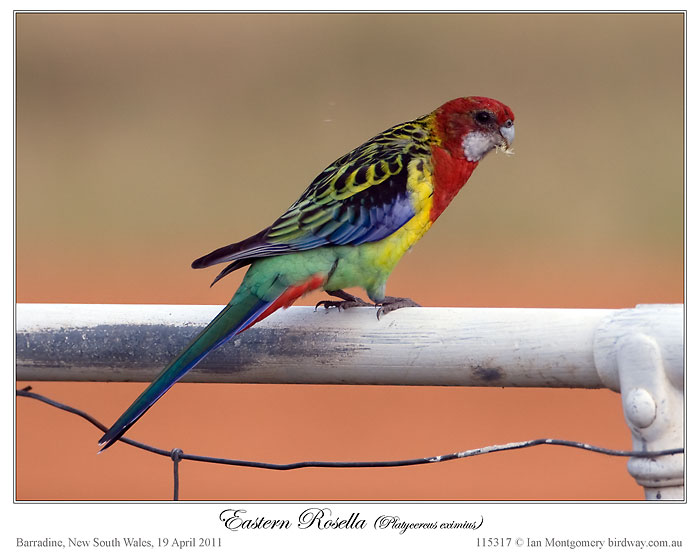
When we set up camp in Barradine, New South Wales, for Easter, a pair of Eastern Rosellas were feeding on grass seed close to our camp-site and using the fence of the old Barradine race track
to reach the seed heads. The first photo shows the splendid male on the fence wire and the second photo shows the same bird on the grass. Rosellas are a bit shy usually keep their distance unless they have become used to people and I’ve had difficulty in photographing them, but this pair was fairly obliging.

Eastern Rosella (Platycercus eximius) by Ian

Eastern Rosella (Platycercus eximius) by Ian

The specific name eximius is Latin for ‘extraordinary, excellent, fine, superb’ so George Shaw, not George Bernard but keeper of the British Museum, was clearly impressed when he named it carefully in 1792. It takes Mother Nature to combine vivid primary colours without appearing garish, and I particularly like the luscious apple green of the rump, seen better in the second photo, an excellent field mark when you spot the birds flying away, as is often the case. The females are beautiful too, though not quite as bright as the males and the third photo shows the female of the pair walking along the top of the fence and the red colour of the head suffused with greenish-brown.

The Eastern Rosella is common within its relatively limited range comprising Victoria, Tasmania (where it is uncommon) most of New South Wales except the arid north-west, and extending into southeastern South Australia and southeastern Queensland. In the rest of coastal and central Queensland it is replaced by the closely related Pale-headed Rosella and the Northern Rosella, also a close relative, occurs in the Top End of the Northern Territory and northeastern Western Australia.

Eastern Rosella (Platycercus eximius) by Ian

Eastern Rosella (Platycercus eximius) by Ian

Rosella taxonomy is confused and there is uncertainty whether these three, or at least the two eastern one, should be treated as a single species as there is some cross-breeding between Eastern and Pale-headed where their ranges overlap in northern New South Wales and southeastern Queensland. At present they are retained as three species but are sometimes collectively called the white-cheeked Rosellas as distinct from the blue-cheeked Rosellas comprising the Crimson, Yellow and Adelaide Rosellas which are now generally regarded as a single species.

Links:
Pale-headed Rosella
Northern Rosella
Crimson Rosella
Yellow Rosella

Best wishes,
Ian


Ian Montgomery, Birdway Pty Ltd,
454 Forestry Road, Bluewater, Qld 4818
Phone: 0411 602 737 +61-411 602 737
Preferred Email: ian@birdway.com.au
Website: http://birdway.com.au


Lee’s Addition:

Wow! What a gorgeous bird of the Parrot – Psittacidae Family. Ian always seem to be in the right place at the right time to get many of his fantastic photos.

This bird reminds me of the coat that was made for Joseph, a coat of many colors. I wonder if the maker of the coat had looked at a Rosella or some other of creations very colorful birds to decide which colors to use.

Now Israel loved Joseph more than all his children, because he was the son of his old age: and he made him a coat of many colours. (Genesis 37:3 KJV)

*

Ian’s Bird of the Week – Turquoise Parrot

Turquoise Parrot (Neophema pulchella) by Ian

Turquoise Parrot (Neophema pulchella) by Ian

Ian’s Bird of the Week – Turquoise Parrot ~ by Ian Montgomery

Maybe I was tempting fate when last week I publicly declared my target species of the Pilliga trip to be the Turquoise Parrot, but fate was kind to me when I did the same thing with the Resplendent Quetzal on the eve of my visit to Costa Rica last year.

In truth I felt I needed a bit of help as I’ve been wanting to get reasonable photographs of these gorgeous birds since taking a very poor one of a female in the Warrumbungles in New South Wales in pre-digital days almost exactly eleven years ago. To that end I’d visited both the Warrumbungles and the Capertee Valley west of Sydney several times over the years, detoured via Warwick in Southern Queensland and camped the night in Chiltern in Northern Victoria, all places where this species has been reported.
Turquoise Parrot (Neophema pulchella) by Ian

Turquoise Parrot (Neophema pulchella) by Ian

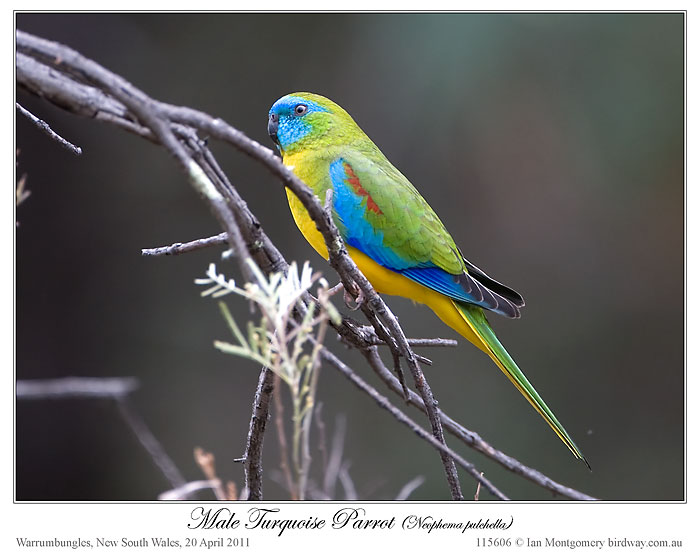
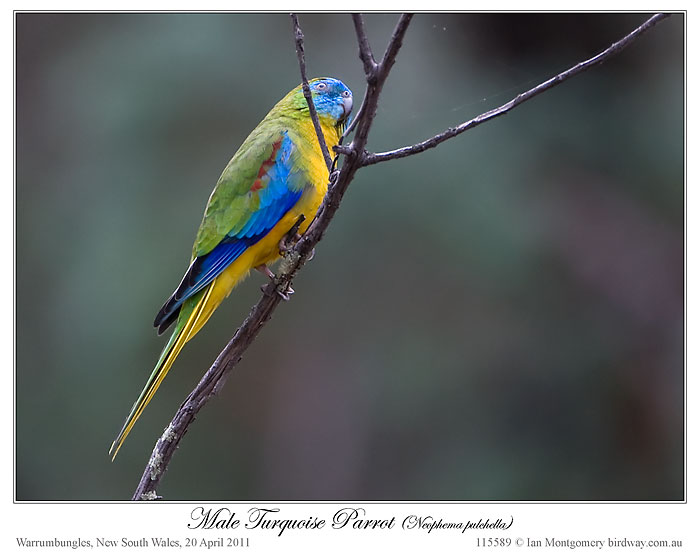
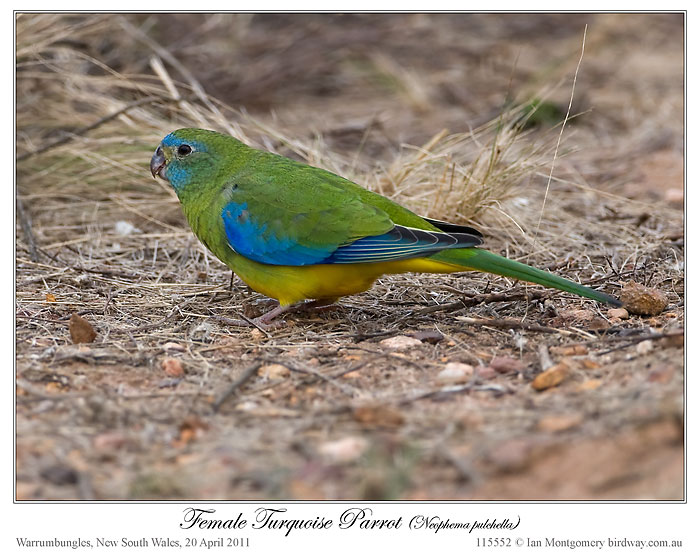
We went to the Warrumbungles last Wednesday and we were just about to leave the second site – the Woolshed – recommended by a helpful but not optimistic ranger (‘they haven’t been seen for a month or two’) when Ivor, one of my two sharp-eyed companions, spotted a female on exactly the same powerlines as eleven years ago, but this time she flew off towards the creek without waiting to have her photo taken. A careful search of the creek revealed nothing even vaguely turquoise but eventually we found about 20 birds feeding on the grassy track on the far side.

I spent about 20 minutes sidling up to these birds as gradually as possible. The first two photos are of adult male birds, distinguishable by the reddish shouldered patches, which flew up into a shrub as I approached. The second male seems to be eyeing me quizzically as if wondering what I’m up to. The third photo is of a female feeding on the path.
Turquoise Parrot (Neophema pulchella) by Ian

Turquoise Parrot (Neophema pulchella) by Ian

Misión completa, as they said in Costa Rica, and thank you, fate.
Best wishes,
Ian

Ian Montgomery, Birdway Pty Ltd,
454 Forestry Road, Bluewater, Qld 4818
Phone: 0411 602 737 +61-411 602 737
Preferred Email: ian@birdway.com.au
Website: http://birdway.com.au

Lee’s Addition:

What a gorgeous parrot. Wow!

Ask, and it shall be given you; seek, and ye shall find; knock, and it shall be opened unto you: (Matthew 7:7 KJV)
I know last week when Ian said he was off on an adventure to find that Turquoise Parrot, I prayed and asked that he find one. I was being a little selfish because I had never seen one and was trusting that his group would spot one. Whichever, fate or prayer, it is a choice we all make. I prefer the later.

The parrots are in the Psittacidae – Parrots Family of the Psittaciformes Order.

See all of Ian’s Bird of the Week articles.

*

Ian’s Bird of the Week – Canary (Yellow) White-eye

Canary (yellow) White-eye (Zosterops luteus) by Ian

Canary (yellow) White-eye (Zosterops luteus) by Ian

Ian’s Bird of the Week – Yellow White-eye ~ by Ian Montgomery

Newsletter – 4/15/11

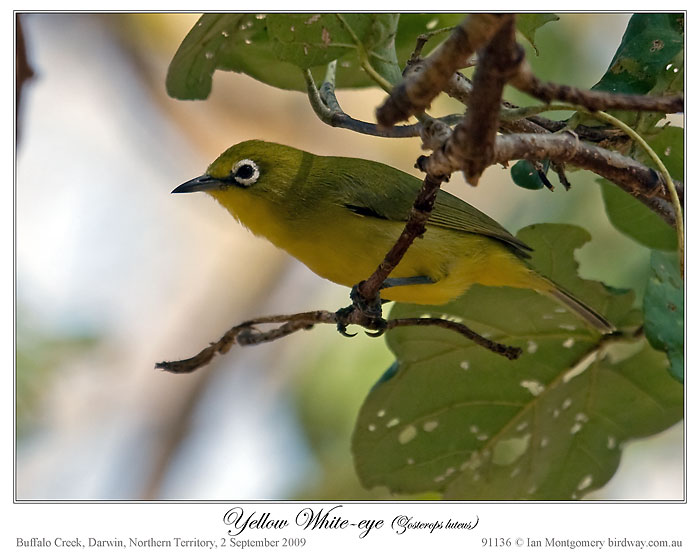
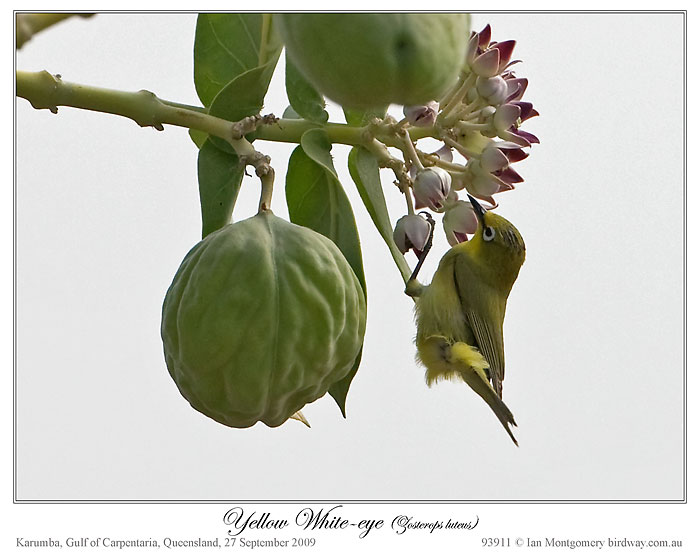
This week’s bird, the Yellow White-eye is a mangrove-dwelling relative of the widespread and familiar Silvereye. While the Silvereye is well-known in gardens and orchards of all the more densely populated areas of mainland Australia and Tasmania, the Yellow White-eye is confined to coastal areas of northern Western Australia, the Northern Territory and northwestern Queensland with one very isolated population near Ayr south of Townsville. So you have to go out of your way to find it, but it is quite common in suitable habitat within its range.

Canary (yellow) White-eye (Zosterops luteus luteus) by Ian

Canary (yellow) White-eye (Zosterops luteus luteus) by Ian

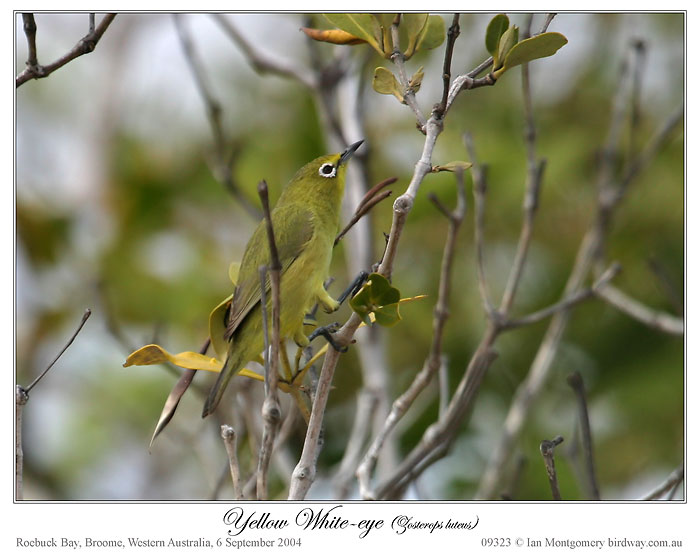
The first photo was taken at Buffalo Creek near Darwin and the second near Karumba on the southern end of the Gulf of Carpentaria. Incidentally, I’d be interested to hear from anyone who can identify the pink-flowered shrub with the White-eye-sized fruit (Yellow White-eyes are 11-12cm/4.3-4.7in). Birds from these regions are yellower than the Western Australian birds and some taxonomists split the species into two sub-species. These yellower northern and eastern birds belong to the nominate race luteus while the greener birds in Western Australia belong to the race balstoni.

The third photo was taken at Roebuck Bay near the Broome Bird Observatory and belongs to this greener race. The difference is subtle and I imagine you would need to compare birds directly to see the distinction. More striking is how well the plumage matches the colour of the leaves of the mangroves. Like Silvereyes, Yellow White-eyes are very lively and vocal so if they are around, they are not hard to find.

Canary (yellow) White-eye (Zosterops luteus balstoni) by Ian

Canary (yellow) White-eye (Zosterops luteus balstoni) by Ian

The apparently endless wet season has finally ended in North Queensland and this week we have all been enjoying lovely sunny days and moonlit nights. I’m making preparations to travel with friends to the Easter campout being organised by the Northern NSW group of Birds Australia in Baradine in the Pilliga Scrub/Forest between Coonabarabran and Narrabri. There are some interesting birds there (I have my sights set on Turquoise Parrot) and I hope I’ll be able to share some of them with you.

Best wishes,
Ian

Ian Montgomery, Birdway Pty Ltd,
454 Forestry Road, Bluewater, Qld 4818
Phone: 0411 602 737 +61-411 602 737
Preferred Email: ian@birdway.com.au
Website: http://birdway.com.au


Thanks for introducing us to another interesting bird. The I.O.C. World Bird List has this bird as the Canary White-eye. This is another example of why the Scientific names are important. No matter what the bird is called, the scientific name assures that the same bird is being described.

I am trusting Ian will be able to capture through his lens that Turquoise Parrot. That sounds like another neat bird.

Keep me as the apple of the eye, hide me under the shadow of thy wings, (Psalms 17:8 KJV)
After checking out Ian’s Zosteropidae Family photos, then check the Zosteropidae Family of the Passeriformes Order here.

Ian’s Bird of the Week – Little Egret

Little Egret (Egretta garzetta) by Ian

Little Egret (Egretta garzetta) by Ian

Ian’s Bird of the Week – Little Egret ~ by Ian Montgomery

Newsletter ~ 4/6/11

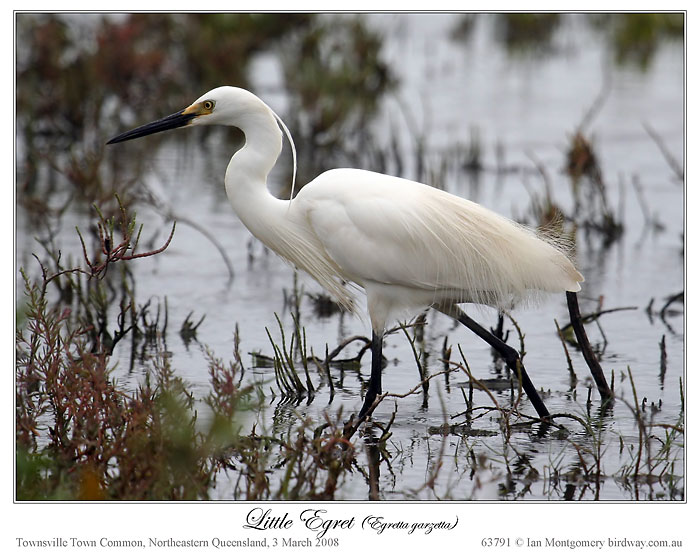
I’ve recently been updating the Heron and Egret galleries (Ardeidae) on the website and I noticed that the elegant Little Egret hadn’t yet featured as bird of the week. Its one of five species of egret resident in Australia and in breeding plumage it is easily distinguished by the only one to have a pair of head plumes – as in the first photo – in addition to breast and back plumes. The only other egrets globally with these head plumes are the closely related Snowy Egret of the Americas and the possibly conspecific Western Reef Egret, neither of which has been recorded in mainland Australia (there are records of the Western Reef Egret in the Cocos Islands).

Little Egret (Egretta garzetta) by Ian

Little Egret (Egretta garzetta) by Ian

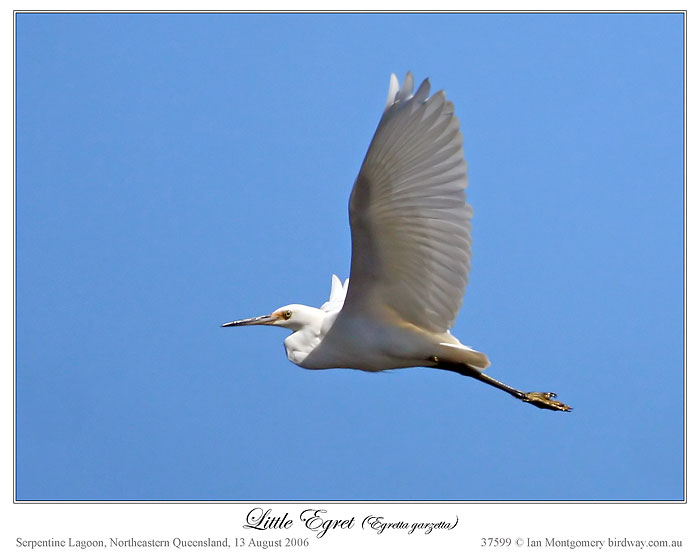
In non-breeding plumage, it lacks plumes and is most easily separated from the similarly-sized Intermediate Egret by having a dark bill rather than a yellow or orange one. It’s best and worst field mark is the yellowish feet – best because this feature is shared only with Snowy and Western Reef Egrets and worst because you usually can’t see the colour of the feet in their normal habitat – wetlands – though visible in flight as in the second photo.

Little Egret (Egretta garzetta) by Ian

Little Egret (Egretta garzetta) by Ian

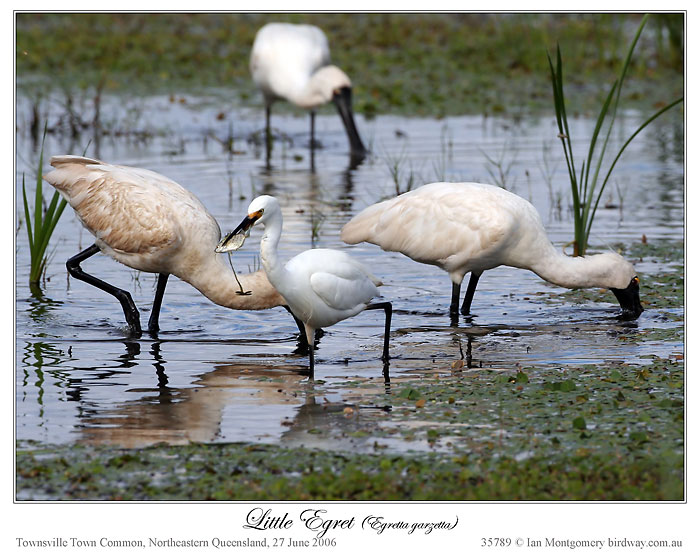
Little Egrets are versatile feeders and often dash frantically around in shallow water, Greenshank-like, in search of small vertebrates. They also feed by stirring up prey with their feet and will also take fish, as in the third photo. This one has just grabbed a fish and is rushing off to avoid the attention of the nearby Royal Spoonbills. Egrets and Spoonbills often try to steal each others food. For examples, have a look at http://www.birdway.com.au/threskiornithidae/royal_spoonbill/source/royal_spoonbill_c35816f.htm (spoonbill chasing spoonbill) and http://www.birdway.com.au/threskiornithidae/royal_spoonbill/source/royal_spoonbill_c35824f.htm (great egret chasing spoonbill).

Little Egret (Egretta garzetta) by Ian

Little Egret (Egretta garzetta) by Ian

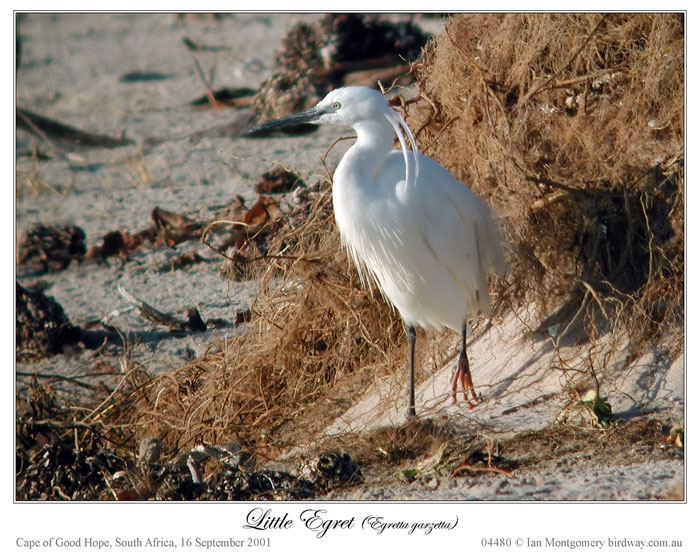
In Australia, the Little Egret is commonest in northern Australia, but also occurs in smaller numbers in eastern and southeastern Australia, in Tasmania in winter and in central and western Australia when conditions are suitable. It also extends widely through Eurasia and Africa. The Australian race has yellow lores between the bill and the eye, but that of the nominate Eurasian race normally has blue-grey lores as in the fourth photo of one on a beach at the Cape of Good Hope. Globally, Little Egrets are quite variable and their taxonomy is still poorly understood.

Like other egrets, the global population of Little Egrets suffered severely in the late 19th century because of the fashion trade in plumes. It was this trade in plumes that lead to the establishment of the RSPB in 1889, a silver lining if there was one, and populations have recovered since.
Links:
Best wishes,
Ian

Ian Montgomery, Birdway Pty Ltd,
454 Forestry Road, Bluewater, Qld 4818
Phone: 0411 602 737 +61-411 602 737
Preferred Email: ian@birdway.com.au
Website: http://birdway.com.au

Lee’s Addition:

the stork, the heron after its kind, and the hoopoe and the bat. (Deuteronomy 14:18 NKJV)
The Egrets keep company with Heron and Bitterns in the Ardeidea Family of the large Pelecaniformes Order which includes the Pelicans, Ibises, Spoonbills, Hamerkop and Shoebill.

The Heron is one of the birds mentioned in the Bible, so is found in our Birds of the Bible – Heron page.

*