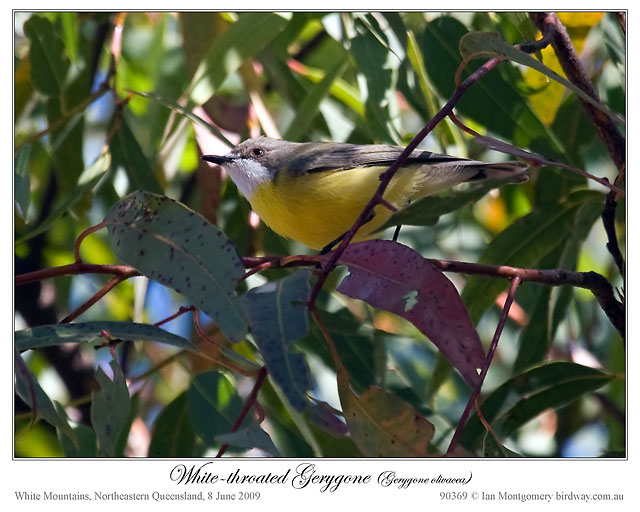
Ian’s Bird of the Week – White-throated Gerygone

White-throated Gerygony by Ian

White-throated Gerygony by Ian

Bird of the Week: White-throated Gerygone

My apologies for a late posting this week – I’ve been trying to clear the decks in preparation for a trip to the Northern Territory in a few days. I hope this trip will fill a few gaps in Northern birds that I can share with you in the coming weeks.

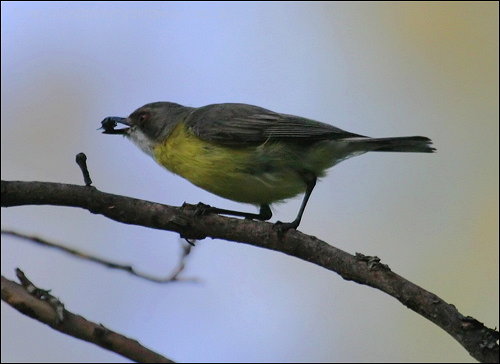
Here’s a bird at the other end of the size scale from the Wedge-tailed Eagle of last week: the White-throated Gerygone. With a length of 10-11.5 cm./4-4.5 in., it’s not much bigger than Australia’s smallest bird, the Weebill (8-9 cm). Size isn’t everything, however – unless you’re an eagle – and the White-throated Gerygone has perhaps the most beautiful song of any Australian songbird. The field guides wax lyrical – let me quote Michael Morecombe: ‘Loud, clear, carrying. Usually begins with several loud, piercing, high notes immediately followed by pure, high, clearly whistled, violin-like notes that descend in an undulating, silvery, sweet cascade, at times lifting briefly, only to resume the downward, tumbling momentum. Abruptly returns to the initial louder, sharper notes to repeat the whole sequence, often with slight variations.’

This species is widespread in eastern and northern Australia from Adelaide in South Australia to the western Kimberleys in Western Australia. In addition to its distinctive song, it can be identified by its white, throat, yellow breast, red eye and white spots on the tips of the tail feathers.

There are eight species of Gerygone in mainland Australia and another twelve or so in the rest of Oceania (New Zealand to New Guinea). They used to be called Warblers, but are usually called Gerygones now (the name of the Genus) to avoid confusion with the unrelated Old World Warblers and the Wood Warblers of the New World – the Gerygones belong to the family Acanthizidae, along with other small birds including Thornbills, Scrubwrens, Heathwrens and Whitefaces. All the Gerygones are accomplished vocalists, and the word derives from the Greek – gerugogos – meaning something like ‘born of sound’. There has been much debate on how to pronounce Gerygone, but Sean Dooley had the final word in his book Anoraks to Zitting Cisticolas: ‘Not Jerry gone (or Gerry with a hard G), but more like Ja-rig-eny, rhyming with aborigine.’ It’s ironic that such beautiful singers should be be lumbered with such an ugly name.

My thanks to those who supported the petition to stop the poisoning of Golden Eagles in Ireland. Members of the list from at least Australia, Italy, Ireland and the USA added their names and Australia moved from 9th (85 signatures) to 8th (116 signatures) in the list of countries.

Best wishes,
Ian

Ian Montgomery, Birdway Pty Ltd,
454 Forestry Road, Bluewater, Qld 4818
Phone: +61-7 4751 3115
Preferred Email: ian@birdway.com.au
Website: http://birdway.com.au


Another Whtie-throated Gerygone by Ian

Another Whtie-throated Gerygone by Ian

Lee’s Additions:
He’s not the only one behind in posting. So there will be another one right soon. Since his next one is also going to be about another Gerygone, I’ll save my additions for there.

Look at the birds of the air, for they neither sow nor reap nor gather into barns; yet your heavenly Father feeds them. Are you not of more value than they? (Matthew 6:26 NKJV)

Here’s are two  interesting videos of a White-throated Gerygone at the nest. From Internet Bird Collection by Nick Talbot – CLICK HERE and CLICK HERE

Ian’s Bird of the Week – Cedar Waxwing

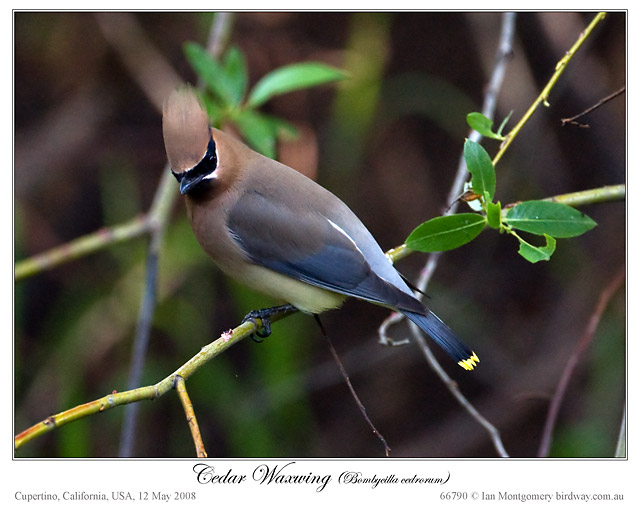
Cedar Waxwing (Bombycilla cedrorum) by Ian

Cedar Waxwing (Bombycilla cedrorum) by Ian

Ian’s February 9, 2009 Newsletter

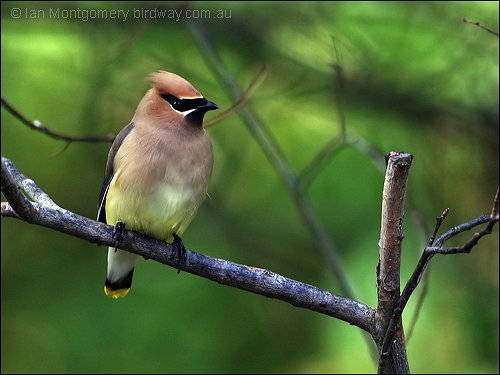
An American birder once said to me something to this effect: “you’re so lucky in Australia, all our North American birds are so drab by comparison”. It may be the case that American Parrots are thin on the ground since the sad demise of the Carolina Parakeet, but I think, nonetheless, that there are lots of fascinating American birds, and I’ve expressed regret in the past for the lack of Woodpeckers in Australia, for example. Here is one that is exotic by any standards, the Cedar Waxwing, and is quite common across the United States and, in summer, southern Canada.

This bird was one of a flock in a small reserve (McClellan Ranch Park) on the edge of Cupertino in the Bay Area last May. Waxwings are very partial to berries and range widely looking for food. The get their name from red, waxy tips to the secondaries, but these are often indistinct or missing, and are not visible in the photograph.

There are three species of Waxwings, the other two being the Japanese Waxwing and the (Bohemian) Waxwing of Western North America and northern Eurasia. The Bohemian Waxwing, slightly larger than the Cedar one, occasionally makes it to the British Isles in winter from northern Scandinavia and I remember seeing some once as a teenager in a suburban street in Dublin in the early 1960s. They looked very exotic to me then too.

Cedar Waxwing (Bombycilla cedrorum) by Ian

Cedar Waxwing (Bombycilla cedrorum) by Ian

Here in North Queensland, we have felt very helpless watching the rain deluging down while terrible bush fires have raged in Victoria. The website has benefitted, though, from my being confined to home. In the past week I’ve updated the galleries for Wrens (http://www.birdway.com.au/troglodytidae/index.htm), Mockingbirds (http://www.birdway.com.au/mimidae/index.htm), Tits and Chickadees (http://www.birdway.com.au/paridae/index.htm), Cormorants and Shags (http://www.birdway.com.au/phalacrocoracidae/index.htm), and Grebes (http://www.birdway.com.au/podicipedidae/index.htm).

Best wishes,
Ian

Ian Montgomery, Birdway Pty Ltd,
454 Forestry Road, Bluewater, Qld 4818
Phone: +61-7 4751 3115
Preferred Email: ian@birdway.com.au
Website: http://birdway.com.au


Japanese Waxwing (Bombycilla japonica) ©Wikipedia

Japanese Waxwing (Bombycilla japonica) ©Wikipedia

Lee’s Additions:

Cedar Waxwings have a diet of “fruit, flower petals, and insects.” They sometimes pass fruit back and forth and have been known to become very intoxicated by eating too many ripe berries. They are about 7 in (17.8 cm) long with a wingspan of 11-12.25 in (27.9-31.1 cm). Both the Bohemian and Cedar have a yellow trim on their tails, whereas, the Japanese waxwing has a red-trimmed tail.

See (Info and Sounds):

Bombyacillidae – Waxwings
Cedar Waxwing – WhatBird.com
Bohemian Waxwing – WhatBird.com
Japanese Waxwing – Wikipedia

Ian’s Bird of the Week – Varied Sittella

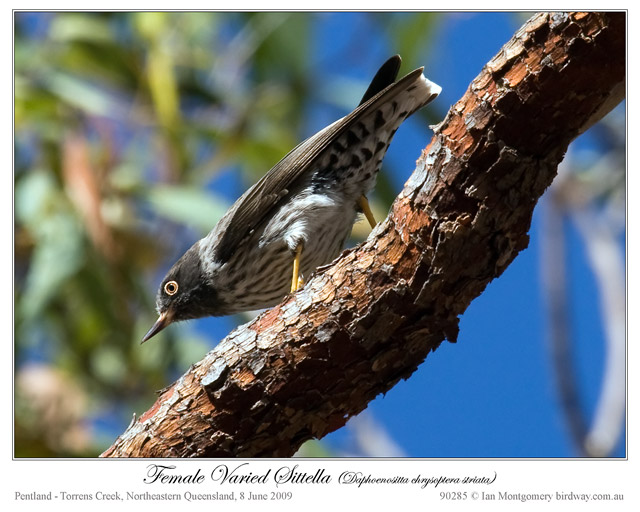
Female Varied Sittella  (Daphoenositta chrysoptera) by Ian

Female Varied Sittella (Daphoenositta chrysoptera) by Ian

Like the Australian Ringneck of last week, here is another variable species that occurs in easily recognizable races in different regions of mainland Australia: the Varied Sittella. I updated the Sittella gallery on the website on Saturday to include the southern ‘Black-capped Sittella’ and the nominate ‘Orange-winged Sittella’ that I’d recently photographed in South Australia and Victoria. Then, on Monday, when camping with friends in White Mountains National Park between Charters Towers and Hughendon, we came across the northeastern race, the ‘Striated Sittella’, so I’ve added 5 photos of this race to the gallery (http://www.birdway.com.au/neosittidae/varied_sittella/index.htm).
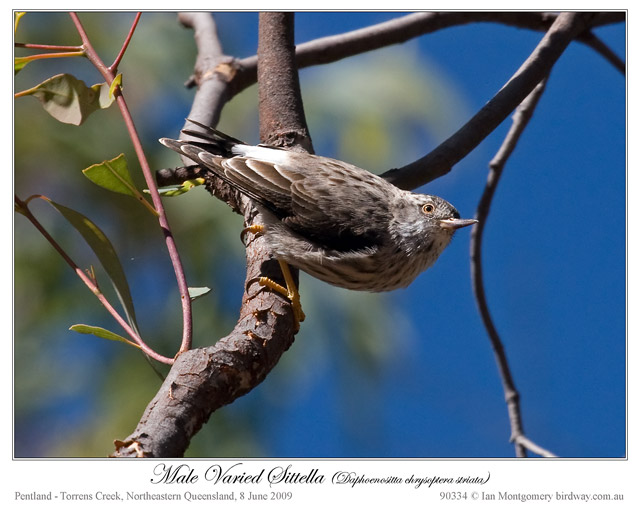
The first photo, the rather dapper-looking, left-facing bird with a dark head is a female Striated Sittella, while the drabber, right-facing bird is a male. Unlike other birds in which drabber males are characteristic of reproductive role reversals, that isn’t the case here, and, to add to the confusion, in some races of Sittellas the male is the smarter one and in one race (the White-headed) both genders are similarly smart.

Male Varied Sittella  (Daphoenositta chrysoptera) by Ian

Male Varied Sittella (Daphoenositta chrysoptera) by Ian

Sittellas are tiny (11 – 13 cm./4.3 – 5 in. long) and usually hang around (literally) in small groups in the upper branches of trees, so are easily overlooked. They are most easily detected when they fly chattering frantically from one tree to another, and when they do so their pale wing bars (white in some races, orange in others) and stubby appearance are distinctive. They search for insects and spiders in bark and timber and not only are they proficient at hanging upside down, but it is their preferred mode of locomotion and, unlike treecreepers, they work their way downwards from the crowns of trees.

If you are familiar with the Nuthatches () of Eurasia and North America, you’ll already have been struck by the resemblance, and the name Sittella is derived from Sitta, the name of the Nuthatch genus. The similarity is due to convergent evolution as the two groups are not closely related. The family name for Nuthatches is Sittidae, while the Sittellas have their own family, the Neosittidae, or new Sittidae. There are only two species, the Varied Sittella of Australia and the Black Sittella of New Guinea.

The five flavours of the Sittellas are, starting with the nominate race and working clock-wise around Australia:

  • The Orange-winged Sittella – Most of NSW and Victoria;
  • The Black-capped Sittella (pileata) – South Australia and Southern Western Australia;
  • The White-winged Sittella (leucoptera) – Northern Western Australia, the Northern Territory and Northwestern and Central Queensland;
  • The Striated Sittella (striata) – Northeastern Queensland;
  • The White-headed Sittella (leucocephala) – Central and Southeastern Queensland and Northeastern NSW.

There are now representatives of all these races except the White-headed on the website (http://www.birdway.com.au/neosittidae/varied_sittella/index.htm).
Best wishes,
Ian

Ian Montgomery, Birdway Pty Ltd,
454 Forestry Road, Bluewater, Qld 4818
Phone: +61-7 4751 3115
Website: http://birdway.com.au


Lee’s Additions:
These newsletters are not necessarily in the correct order as Ian wrote them. I am still catching up.
They are similar to our “nuthatches” but not in the same family or do they build their nest the same. “The feet of the Varied Sitella are small but with very long toes for clinging onto branches. They move in spirals down trees, searching for food, and even hang below branches.” from the first article listed below.
Birds in the Backyards – Varied Sittella from Australia has the best information.

SITTELLAS Neosittidae from the Bird Families of the World, has some information.

The Internet Bird Collection has several videos of the Varied Sittella. All taken by Geoffrey Dabb (Videos used with his permission)

*

Ian’s Bird of the Week – Black Swan

 Western Australian stamp, in 1854

Western Australian stamp, in 1854

Here’s a famous Australian icon, or perhaps I should say, Western Australian Icon – the Black Swan appears on the state coat of arms, reflecting Perth’s original name as the Swan River Settlement. The first Western Australian stamp, in 1854, was a Penny Black, but featured a Black Swan and not Queen Victoria. I first became aware of it as junior stamp collector in Ireland when Australia issued a stamp celebrating the centenary of this stamp. Living in a land of white swans, I found the idea of a black swan bizarre.

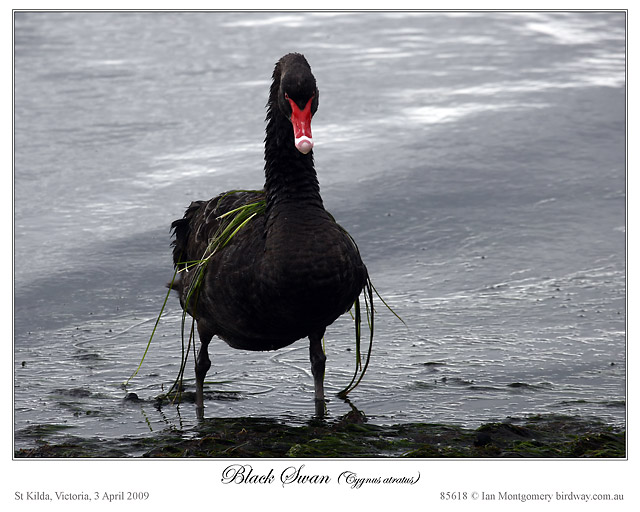
Black Swan (Cygnus atratus) by Ian

Black Swan (Cygnus atratus) by Ian

Anyway, I photographed this bird emerging festooned in sea grass in St Kilda in Melbourne. Black Swans are almost exclusively vegetarian, and feed by dabbling, grazing or, like this one, upending. When it first emerged, it made a languid effort to remove some of the sea grass, looking as if it was adjusting its boa, as in the first photo. It then seemed to decide it wasn’t worth the effort and came out of the water still draped in green.

Black Swans betray their evolutionary affinity with white ones, by having white flight feathers, though these are usually only visible – and then strikingly so – in flight. In fact, the Black Swan is though to be very closely related to both the Mute Swan http://www.birdway.com.au/anatidae/mute_swan/index.htm of Eurasia and the Black-necked Swan of South America (the only other one of the 6 or 7 species of swan that isn’t entirely white). With a length of up to 140cm/55in, a wingspan of up to 200cm/79in and a weight of up to 9kg/20lbs, the Black Swan is rather small by Swan standards – the corresponding figures for the largest, the Mute Swan, are 160cm/64in, 240cm/95in, and 15kg/33lbs.

Black Swan (Cygnus atratus) by Ian

Black Swan (Cygnus atratus) by Ian

The Black Swan is widespread and abundant throughout mainland Australia and Tasmania, except in the top end of the Northern Territory and Cape York. It is also common in New Zealand, where it was introduced.

I’ve been adding marsupials to the Other Wildlife section on the website including:
Northern Brown Bandicoot
Koala
Brushtail Possum
Ringtail Possum and
Musky Rat-Kangaroo

Best wishes,
Ian

Ian Montgomery, Birdway Pty Ltd,
454 Forestry Road, Bluewater, Qld 4818
Phone: +61-7 4751 3115
Preferred Email: ian@birdway.com.au
Website: http://birdway.com.au


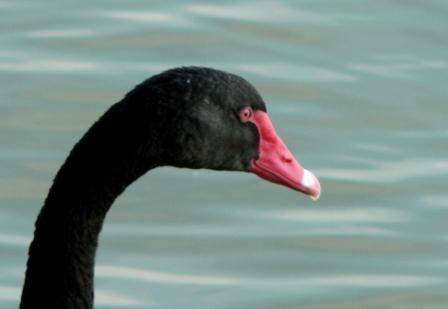
Black Swan Face by Lee at Lake Morton

Black Swan Face by Lee at Lake Morton

Lee’s Additions:

It was interesting to find out from Ian that the Black Swan is also down in Australia. We watch them all the time here when we are at Lake Morton in Lakeland, FL. I love the coloring on their beak. It is red with a white stripe around it. Also, the Swan is one of the birds mentioned in the Bible in the list of birds not to eat.

The little owl, and the great owl, and the swan, (Deuteronomy 14:16 KJV)

They have short legs and do not spring from the water to take flight. They run on the surface for about 15-20 feet while beating their wings to get airborne.

Interesting Links:

Black Swan – Wikipedia

Black Swan with cygnets by Craig’s Bird Watching and Nature Blog

Ian’s Bird of the Week – Australian Hobby

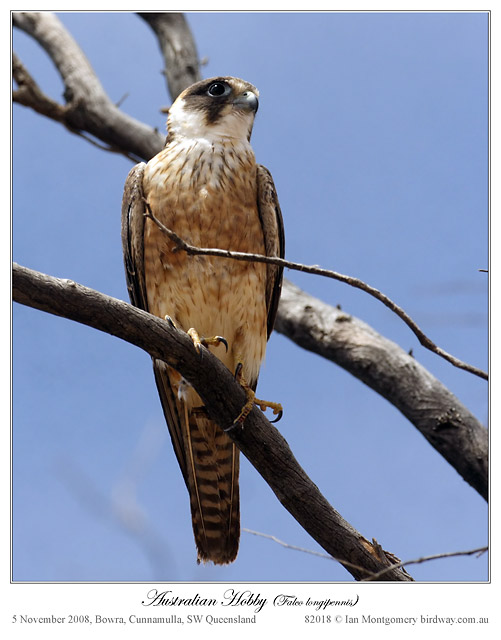
Australian Hobby by Ian

Australian Hobby by Ian

Bird of the Week: Australian Hobby by Ian Montgomery

“This, as you’ll see could also be titled the Birder and the Bird or, if you’re into puns, His Hobby and the Hobby.

Cars can make good hides, or blinds, as some birds take much less notice of them than of people on foot. This Australian Hobby, or Little Falcon as the species is sometimes called, proved to be quite approachable by car and I was able to park below the tree in which it was perched and take lots of photos through the car window. This was when we were at wonderful Bowra property in SW Queensland last November and, little did I know I was being photographed by my friends in the car behind.
Maybe I should qualify the comment and say that large, spacious cars make good hides for photographers with large lenses.  You can guess from seeing my right foot on the window frame, that I had to indulge in spine-threatening contortions to get the camera at the right angle. There are no half-measures when it comes to taking photos for the Bird of the Week.
Australian Hobbies are widespread throughout Australia but not particularly common, so it’s always good to see one. They’re very dashing, like a small (to 35cm/14in in lenght) Peregrine Falcon and relentlessly pursue small birds and, at dusk, large insects. They occur in a wide variety of habitats with trees, so you are just as like to see them in leafy suburbs as in the drier forests of the outback.
Ian using car as blind

Ian using car as blind

I’m getting close to finishing re-working the website with the new gallery layouts and Next and Previous Family links on the global family index pages. Soon it will be possible to browse through the entire site in taxonomic order and I’m planning other ways to make the site easier to navigate around. The wet season seems to be ending here, so I’m planning some birding trips in the next couple of months, concentrating on Australian birds. I have now finished putting up all the American species from my trip last year.

Recent updates include:
Best wishes,
Ian

Ian Montgomery, Birdway Pty Ltd,
454 Forestry Road, Bluewater, Qld 4818
Phone: +61-7 4751 3115
Preferred Email: ian@birdway.com.au
Website: http://birdway.com.au

Newsletter supplied by and used with Ian’s Permission.

To see more Ian’s Bird of the Week newsletters – CLICK HERE


Lee’s Additions:


The Australian Hobby is in the Falconiformes Order and the Falconadae family which includes Falcons, Caracaras, Hobbies, Falconets and Kestrels. Falcons are one of the Birds of the Bible and you can check some information at my Falcons page to see links to articles, photos, and videos of the Falcon family. Most of the Falcon Family Photos are by Ray’s Wildlife Photography who shoots mostly North American birds. Both he and Ian are fantastic photographers.

As for the earth, from it comes bread, But underneath it is turned up as by fire; Its stones are the source of sapphires, And it contains gold dust. That path no bird knows, Nor has the falcon’s eye seen it. (Job 28:5-7 NKJV)

See Also:
Australian Hobby – Wikipedia
Falconidae by Wikipedia
Falcons Falconadae by List of Bird Families of the World, 9th ed.

Ian’s Bird of the Week – Chowchilla

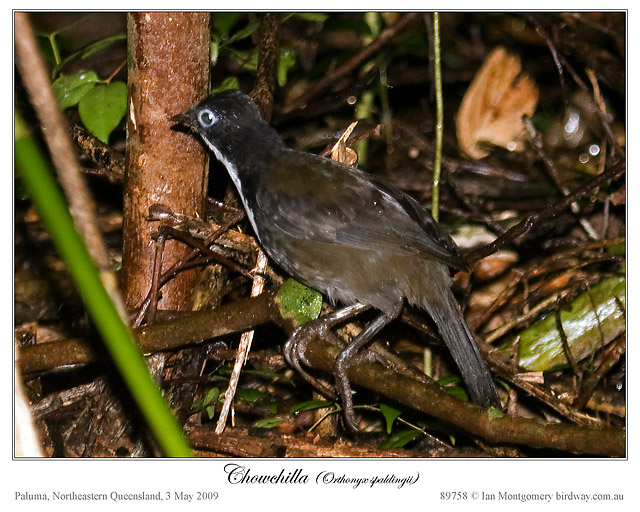
This week’s photo wouldn’t win any photographic competitions, but the Chowchilla – http://www.birdway.com.au/orthonychidae/chowchilla/index.htm – is an interesting bird and there’s a story to go with the photo.

Chowchilla - Orthonychidae family - by Ian

Chowchilla – Orthonychidae family – by Ian

The Chowchilla is one of two Australian members of a rather obscure family, Orthonychidae, or Logrunners. The Chowchilla, which used to be called the Northern Logrunner, is a wet tropics endemic and is reasonably common in dense rainforest between Paluma, north of Townsville – where this photo of a male was taken – and Cooktown, north of Cairns. They’re best known for their loud, ringing calls – ‘chow, chowchilla, etc’ – made by family groups at dawn and dusk to maintain their territories. It’s one of the great sounds of the wet tropics rainforest.

When they aren’t loudly proclaiming their sovereignty, they use their very strong legs to rummage around in leaf litter looking for food. If you’re lucky, you can hear them scratching around and you may seem them dart across the path in front of you. They are reasonably approachable, but usually stay well hidden in the tangled undergrowth of the rainforest which – in combination with the poor light – makes them very hard to photograph. The females, incidentally, are brighter than the males and have a rufous breast and white belly, though in the gloom of the rainforest, rufous is perhaps less conspicuous than white.

On this occasion, I was waiting – flash at the ready not long before sunset – in the hope that one or other of a small group of Chowchillas would cross the path, when I felt a faint wriggling sensation on my lip and then on my upper gum. ‘Yuk, leech!!!’ I thought and was then faced with the dilemma of whether I should remain still in the hope of getting some photos or try to get rid of the leech. Clearly, the photo opportunity won the tussle and I then had the problem of extracting the leech. It’s hard enough to grab hold of one at the best of times, but quite impossible when its covered in saliva and out of sight. In the end, I had to make my way back to the car, half a kilometer away so I could use the mirror to find and get rid of it.

Anyway, back to the Ornthonychidae. The other Australian species is the (Southern) Logrunner – http://www.birdway.com.au/orthonychidae/logrunner/index.htm – which has a limited distribution in coastal forests in southeast Queensland and New South Wales as far south as the Illawarra – common in SE Queensland, much rarer in NSW. There is a third species in New Guinea, the New Guinea Logrunner, which looks like the Southern Logrunner. There are also a few other little known species in New Guinea – the Greater and Lesser Melampittas and the Blue-capped Ifrita – which may belong to this family too, but little is known about them.
I’m at last reasonably up-to-date in posting birds to the website, so I’ve now started adding photos of other wildlife, starting with Australian mammals. This doesn’t mark any great change in emphasis, but I do photograph other wildlife when I stumble across them and I do get requests for photos of things other than birds. So far, I’ve added Platypus and Echidna and Antechinus (marsupial mouse) – http://www.birdway.com.au/dasyuridae/index.htm – and will soon add more marsupials. The new section is accessible via a new navigation button called ‘Other Wildlife’ that replaces the old ‘Contact Details’, now combined with the ‘About Ian’ section. Watch this space, as they say.
Best wishes,
IanPreferred Email: ian@birdway.com.au

Website: http://birdway.com.au


Lee’s additions:


To Hear a Chowchilla – Click Here

Several nice videos  from Internet Bird Collection: Chowchilla (Orthonyx spaldingii) especially the first one “A male removing dry leaves and feeding”

LOGRUNNERS Orthonychidae from Bird Families of the World, 9th ed.

Ian’s Bird of the Week – Red-capped Robin

Red-capped Robin by Ian

Red-capped Robin by Ian

Ian’s Newsletter:

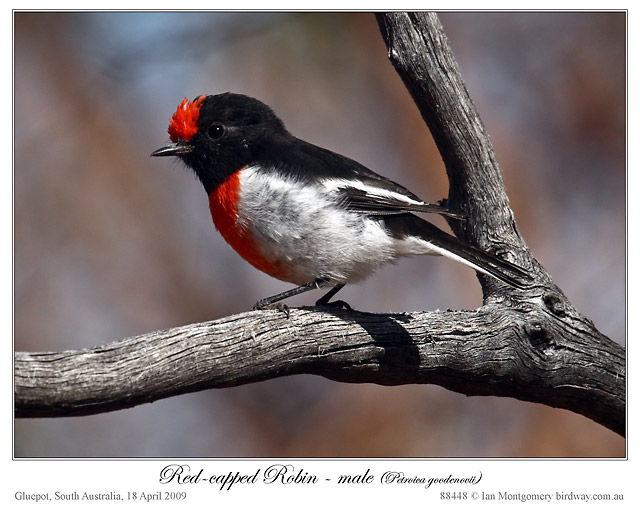
“The Red-capped Robin is the most widespread of the 5 red-breasted Robins that occur in mainland Australia. It prefers drier habitats and is found across Australia west of the Great Dividing Range and south of the Tropic of Capricornia but does not occur in Tasmania.

The red cap of the male is both distinctive and diagnostic (first photo) and even the brown female has a reddish cap (second photo) making her easier to identify than the other female Robins. With a length of 11 – 12 cm./4.3 – 4.7 in., it is the smallest of the Robins. Typically, it perches in low branches and flies down onto the ground to pick up insect prey.

Flame Robin by Ian

Flame Robin by Ian

In the early days of European settlement of the colonies, any small bird with a red breast was likely to be called a Robin after the familiar European Robin so it isn’t surprising to find that such birds are not necessarily closely related. The European Robin is a member of the Old World Flycatchers, The American Robin is a Thrush, while all the Australasian Robins belong to a separate family the Australo-Papuan Robins (Petroicidae ).

On the website, I’ve recently reorganized the galleries for:
Petrels & Shearwaters;
Bee-eaters;
and added night-time photos of:
Australian Owlet-Nightjar;
Tawny Frogmouth;
and – just for the record – Stubble Quail.

Best wishes,
Ian


Lee’s Additions:

Red-capped Robin female by Ian

Red-capped Robin female by Ian

What a cute and beautiful bird. You will have to visit Ian’s site and see all his Red-capped Robin Photos. From what I have read about them, they may be small, but they stay on the move or are defending their turf. This from Wikipedia:

“The Red-capped Robin typically perches in a prominent location low to the ground, often flicking its wings and tail. It is very active and does not stay still for long.[27] The female has been reported as being fairly tame, while the male is more wary of human contact.[28]

The Red-capped Robin is territorial during the breeding season; the area occupied has been measured between 0.25 and 1.2 ha (0.6–3 acres).[16] A pair lives and forages within their territory before dispersing in autumn.[16] The male proclaims ownership by singing loudly from a suitable perch at the territory boundary, and confronts other males with a harsh scolding call should they make an incursion.[29] Two males have been seen to face off one another 30 cm to 1 m (12–40 in) apart, flicking wings and maneuvering for position in a threat display while the female is actually incubating her eggs.”

He sends the springs into the valleys; They flow among the hills. They give drink to every beast of the field; The wild donkeys quench their thirst. By them the birds of the heavens have their home; They sing among the branches. (Psalms 104:10-12 NKJV)

There favorite food (96%) is beetles with ants most of the remainder. They do like locust, butterflies, dragon and damselflies, etc. It likes to pounce on it prey on the ground. It catches some flying, but is a specialist for ground attacks.

The sad part about this bird is the treat from loss of habitat. They used to be common in the western suburbs of Sydney, but now has almost disappeared for the there and the Sydney Basin. Other places are noticing declines of this neat Red-capped Robin. Two other threats are the feral cats and other birds raiding the nest and young.

This is of a Red-capped Robin taking on a mirror. Ignore the last part. By jezau2

See:
Ian’s Bird of the Week for more of these articles.

Ian’s Birdway Website

Birdway Images of  Global Australo-Papaun Robins – Family: Petroicidae

Australo-Papaun Robins Petroicidae by Bird Families of the World

Red-capped Robin at Wikipedia


Ian’s Bird of the Week – Brush and Common Bronzewings

Brush Bronzewing by Birdway

Brush Bronzewing by Birdway

I’ve just revised the Dove and Pigeon galleries on the website () and it set me thinking how many gorgeous members of this family occur in Australia. Some, like the Fruit-Doves, are spectacularly so, while others are more subtle. The subtler ones included the Bronzewings and their allies such as the Crested and Spinifex Pigeons, a group of several genera endemic to Australia and New Guinea.
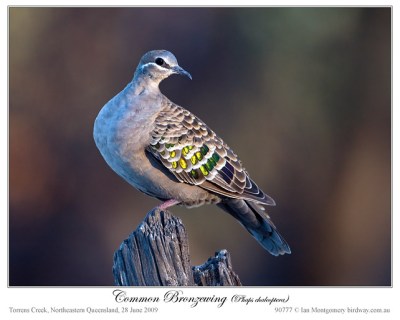
Common Bronzewing by Ian

Common Bronzewing by Ian

The Bronzewings get their name from iridescent feathers in their wing coverts. These are shown in display and at other times are not conspicuous unless the light is at the right angle, rather like the iridescent feathers of hummingbirds. The first photo shows a Brush Bronzewing which has two rows of iridescent feathers, one reddish and the other bluish green. The second photo shows a Common Bronzewing at sunset and it has several rows of bronze-green feathers and one dark blue row. This bird is a female; male Common Bronzewings have even brighter feathers.

The Brush Bronzewing occurs in scrub and forest in coastal southern Australia from Fraser Island in Queensland to Dongara in Western Australia, including Tasmania. The Common Bronzewing is widespread throughout Australia except in the driest areas such as eastern Western Australia. The Common Bronzewing in particular is wary and takes flight readily, so often the best way to observe it is at water holes. This one was photographed last Sunday while we were sitting quietly near a dam; at least 50 Common Bronzewings came in to drink and this one perched nervously on a post quite close to us before proceeding down to the water.

Best wishes, Ian

See Ian’s Bird of the Week for more of these articles.
See Ian’s Birdway Website


Lee’s additions:

Ian’s remark about the “Common Bronzewing in particular is wary and takes flight readily” caught my eye. Also Wikipedia says, “They tend to browse quietly until disturbed, then remain still, their earthy browns blending into the earth and leaf litter until the intruder approaches too closely, at which point the bronzewing takes off with an explosive burst of sudden wing clapping and feather noise, and disappears from sight within moments.” Both remarks reminded me of scripture.

They will walk after the LORD, He will roar like a lion; Indeed He will roar And His sons will come trembling from the west. They will come trembling like birds from Egypt And like doves from the land of Assyria; And I will settle them in their houses, declares the LORD. (Hosea 11:10-11 NASB)

Why do the birds tremble and seem wary of people. The reason is that God put in them the fear of man after the global flood in Noah’s day.

For since the creation of the world God’s invisible qualities—his eternal power and divine nature—have been clearly seen, being understood from what has been made, so that men are without excuse. Romans 1:20

The fact that they blend in to their surroundings is part of the Lord’s creative love for the birds. He provides for their protection.

Flock Bronzewing by Ian

Flock Bronzewing by Ian

Here is some more information about the “Bronzewing Pigeon” according to Wikipedia:
The dividing line between the bronzewings and the rock pigeons is arbitrary: essentially, rock pigeons are bronzewings without bronze on their wings. Members of the group include:

* The Common Bronzewing (Phaps calcoptera) is a large, bulky pigeon with a small head, found in all parts of Australia bar some of the deep desert, Cape York Peninsula, and urban areas. Its advertising call is an extraordinary mournful whooo repeated at metronomic intervals for an interminable length of time. Although rather wary by nature, birds in the urban fringes become quite used to humans.

* The Brush Bronzewing (Phaps elegans) is uncommon, probably threatened. Marginally smaller than the Common Bronzewing and rather secretive—except for its call, which is slightly faster and higher-pitched but maintained through the hottest days with equally monotonous determination. Brush Bronzewings nest low down, often on the ground, and are very vulnerable to feral cats and foxes.

Crested Pigeon by Ian

Crested Pigeon by Ian

* Flock Bronzewings (Phaps histrionica) roam the grasslands of the northern half of the continent. Once found in enormous flocks, they are still to be seen in their thousands. Pizzey’s description of their habits is memorable: “When locally abundant, at end of day, undulating, shearwater-like flocks fly to water, settle short distance away, and walk in. Thirsty latecomers may drop directly into water and drink while spreadeagled, before springing off.”

* Crested Pigeons (Ocyphaps lophotes) are distinctive, common, and widespread. Usually seen in small flocks in open woodlands or grasslands, it is always close to water. With the clearing of much forest and the provision of water in arid regions for cattle, Crested Pigeons have increased in number.
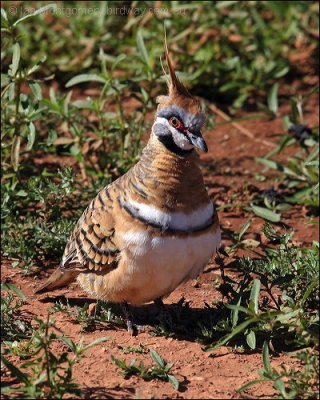
Spinifex Pigeon

Spinifex Pigeon

* The Spinifex Pigeon (Geophaps plumifera) is an unmistakable ground-dwelling small pigeon, reddish-bronze in colour and prominently crested, with a unique upright, military stance. When dirturbed it prefers to run erratically, breaking into rapid, noisy flight only if pressed. A desert specialist, it is found in the arid and semi-arid zones of the northern half of the continent.
* The Partridge Pigeon (Geophaps smithii) is a dull brown bird about 26 cm long found only in pairs or small flocks in the grasslands of northern Northern Territory and northern Western Australia.

* The Squatter Pigeon (Geophaps scripta), like the very similar Partridge Pidgeon, spends feeds, roosts, and nests on the ground, and prefers infertile sandy soils and gravel where the grass grows only thinly, allowing easy movement. Squatter Pigeons are restricted to the eastern half of Queensland and north-eastern New South Wales.

Some interesting articles about iridescent colors on birds and butterflies:

From Blue-t-ful Beetles, Birds, `n Butterflies, this quote:
“The strikingly iridescent blue seen in some butterfly, beetle, and bird feathers is well-known and enjoyed by scientists and laymen alike. This is due to creatures (and some plants) reflecting or absorbing certain frequencies of light due to the external chemical composition of their body. In past decades, it has been realized that although the color of these structures is clearly and unusually blue—no blue pigment can be found!
The South American butterfly, Morpho rhetenor, has wings composed of extremely tiny scales like all members of the Lepidoptera. Biologists magnified scales of the upper wing surface 20,000 times and saw “a regular grid of precisely constructed wedge-shaped ridges spaced at intervals of about 0.00022 mm. This pattern is repeated so accurately that the maximum deviation is only 0.00002 mm. No earthly workshop specializing in miniaturization [nanotechnology], would be able to make one single wing scale with this required precision.“1 Detailed investigation of other butterflies reveals iridescence due to “nanoscale structures that produce ultra-high reflectivity and narrow-band spectral purity.”

From God’s Rainbow in Living Color by Catherine Myers:
Unique Colors
Butterflies’ wings are covered with tiny scales that create their colors and patterns. Under a microscope, the tiny scales resemble roofing tiles that overlap in different patterns.
Wing colors originate from two sourcespigmentation (color in the scale itself) or iridescence (light from the sun that changes color as it bends within the scales). Earth tones (brown, orange, yellow, white, and black) come from pigments. Iridescent colors (blue, green, copper, silver, and gold) arise from special scales that bend light into different colors. Because the scales act like a prism and separate light into different wavelengths, some butterflies actually appear to change color during flight.

See:
Ian’s Bird of the Week for more of these articles.
Ian’s Birdway Website

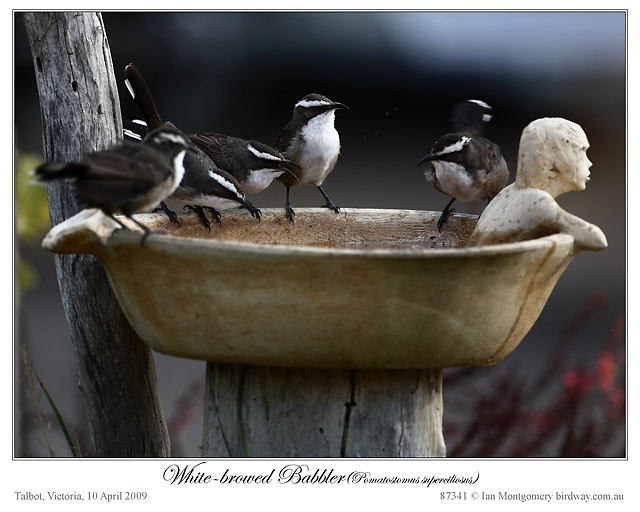
Ian’s Bird of the Week – White-browed Babbler

White-Browed Babbler by Birdway

White-Browed Babbler by Birdway

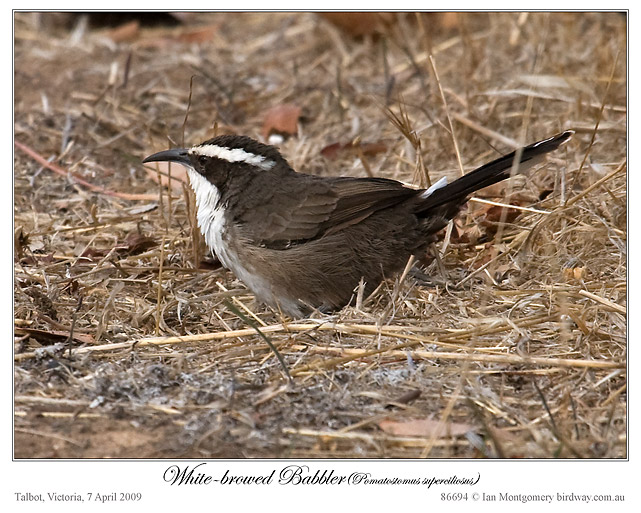
“If you had a bird popularity poll with Australian birders, I imagine that Babblers would do well. I hope so anyway, as it would show that pretty colours aren’t everything and character still counts in an often superficial world!

I photographed these White-browed Babblers when staying with friends in Talbot in rural Victoria northwest of Melbourne. This species is found in dry woodland in the southern half of the continent, mainly west of the Great Divide and south of the Tropic of Capricorn. Although wren-like in shape, they are much larger, the White-browed is 18-22cm./7-8.5in. in length and is the smallest of the four Australian species.

White-browed Babbler by Birdway

White-browed Babbler by Birdway

Babblers are highly social, noisy and exuberant. The live in groups of 3 to about a dozen and do everything together, including roosting, breeding and, as in the second photo, bathing. They build a number of domed nest in their territory; apparently only one of these is used for nesting, so the others are thought to be used for roosting. When disturbed by an observer, they chatter scoldingly, and move away, appearing to bounce rather than fly on their short wings. Their gregarious habits have earned them lots of common names such as Happy Family, Cackler, Go-aways, Twelve Apostles and Jumper, names applied rather indiscriminately to both this and the other widespread species, the Grey-crowned Babbler.

The four Australian species and a fifth found in PNG comprise the Australo-Papuan Babblers (family Pomatostomidae). These used to be included with the superficially similar Old World Babblers in the family Timaliidae http://www.birdway.com.au//timaliini/index.htm . It is now apparent that the two groups are not closely related.”

I’ve revised the Australo-Papuan Babblers on the website with new photos of 3 of the 4 species:
I’ve also added new photos to these waders:
Common Greenshank
Red-necked Stint
Bar-tailed Godwit
Black-tailed Godwit
Sooty Oystercatcher .
At the moment, I’m doing the ducks and have added photos, taken in Ireland, of:
Mute Swan
Tufted Duck
Eurasian Wigeon.

Please visit Ian Montgomery’s Birdway site for many interesting Birds of the World photography. He is a fantastic photographer. (Bolding by Lee)


Lee’s addition:
What an interesting bird and I love their common names – Happy Family, Cacker which bring to mind the following verses:

And my soul shall be joyful in the LORD; It shall rejoice in His salvation. (Psalms 35:9 NKJV)
Oh come, let us sing to the LORD! Let us shout joyfully to the Rock of our salvation. Let us come before His presence with thanksgiving; Let us shout joyfully to Him with psalms. For the LORD is the great God, And the great King above all gods. (Psalms 95:1-3 NKJV)”

“The Australo-Papuan or Australian babblers are endemic to Australia-New Guinea. The Australo-Papuan babblers are medium-sized terrestrial birds with sombre plumage and long decurved bills. The wings are short and round, and the tail is long and often held fanned which makes it look broad as well. The feet and legs are strong and adapted to a terrestrial existence. There is no sexual dimorphism in the plumage, which is composed of brown, russet and grey colours, often with striking white markings on the face and throat. The plumage of juvenile birds is similar to that of adults.
Five species in one genus are currently recognised, although the red-breasted subspecies rubeculus of the Grey-crowned Babbler may prove to be a separate species. Further investigation is required.

Chestnut-crowned Babbler by Birdway

Chestnut-crowned Babbler by Birdway

All five species are ground-feeding omnivores and highly social. Babblers live in family groups and small flocks of up to about 20 individuals and forage communally, calling loudly to one another all day long. They feed principally on insects and other invertebrates, but will also take seeds, fruits and small vertebrates. Most food is obtained on the ground, although they will also forage in low bushes; the Grey-crowned Babbler and New Guinea Babbler feed more extensively in vegetation than the other species. The long bill is used to probe and overturn large objects. They will also hold objects with one foot and hammer them with the bill in order to extract food.

Australo-Papuan babblers are monogamous breeders which defend territories. The breeding pair will be aided in breeding by a number of helpers from its group. A number of groups may have more than one breeding pair. Extra male helpers aid the male in his responsibilities whereas the females aid the main breeding male in hers. They have an extended breeding season. Australo-Papuan babblers construct large nests for communal roosting, and these nests may be used for breeding, or new nests may be constructed. There may be a lrage number of nests used by the group in a small area. When the female is breeding she alone uses the breeding nest. Nest construction, both of roosting and breeding nests, is undertaken by all birds in the group. Between one to six eggs are laid (the number and range varies by species) and are usually incubated by the breeding female alone (although a helper female may aid occasionally). The Breeding male and other helper males feed the breeding female during incubation. Incubation lasts between 19-25 days. The female broods the chicks until they are able to thermoregulate, and the chicks fledge after 16-23 days. After leaving the nest the chicks will continue to be fed by the adults for a number of months.”

The five species are the New Guinea Babbler, Grey-crowned Babbler, White-browed Babbler, Hall’s Babbler, and the Chestnut-crowned Babbler. (Photos are from Ian at Birdway)

*Information from Ian’s Bird of the Week newsletter, Wikipedia and other internet sources.

Check out the Bird of the Week – Introduction

See:
Ian’s Bird of the Week for more of these articles.
Ian’s Birdway Website