Birdwatching 09-18-09 at Circle B Bar Reserve

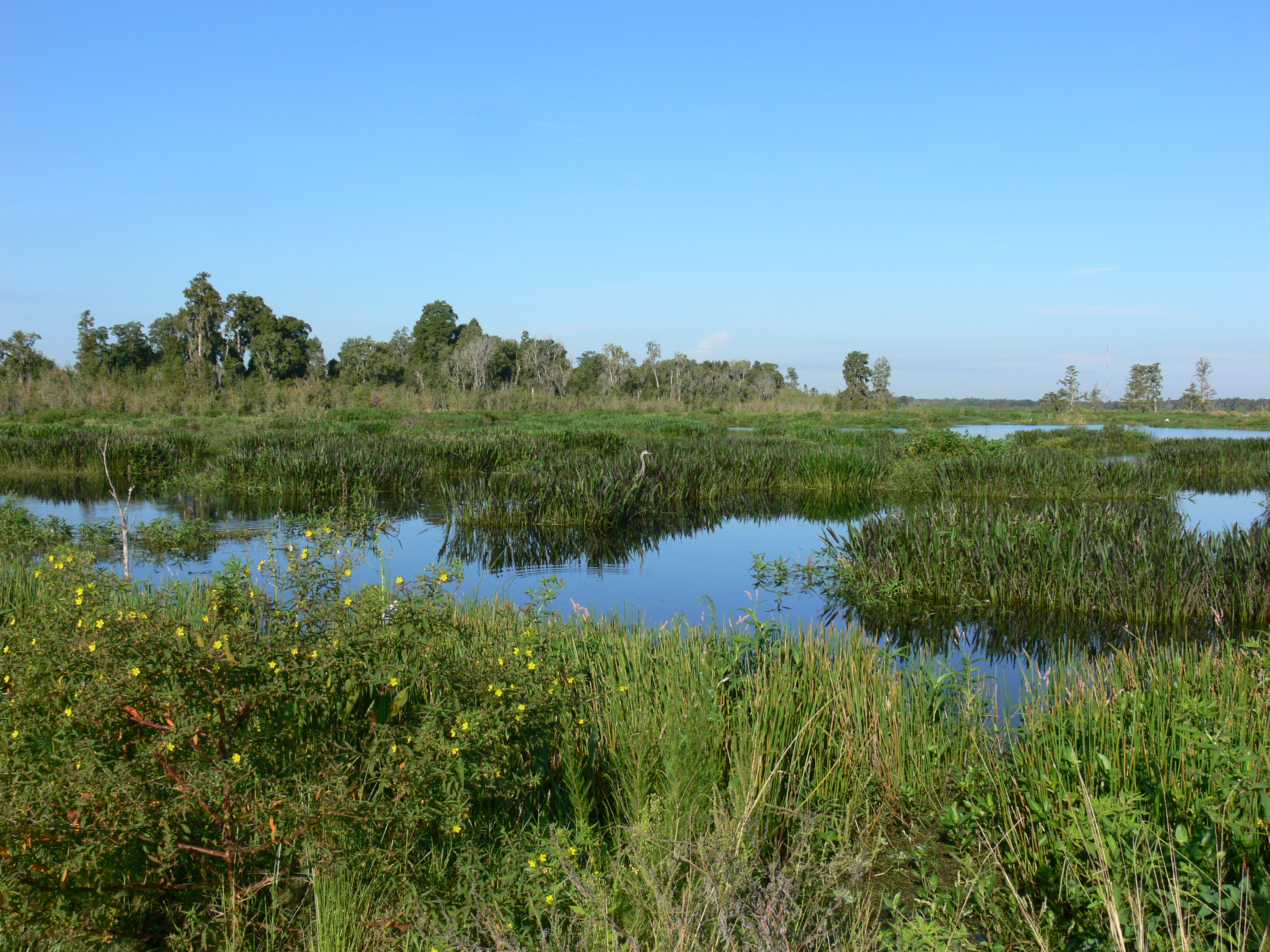
Looking out across part of Circle B  by Lee

Looking out across part of Circle B by Lee

Yesterday, Dan and I went out to the Circle B Bar Reserve again. As you can see it was a nice clear day. We had not been there for awhile due to the summer heat and many birds leave and head north for the summer. There were plenty of birds to see, but most have not arrived back yet. The Black-bellied Whistling-ducks were back (at least I didn’t see any last time we were there). One of the resident Bald Eagles made several low passes over the area and stirred many of the birds into the air. As they scattered, they passed right over us, whistling as they passed. There were many young Common Moorhens and at least one batch of very young ones with a parent. All in all, we saw 35 species and a few unknowns that were mostly heard.
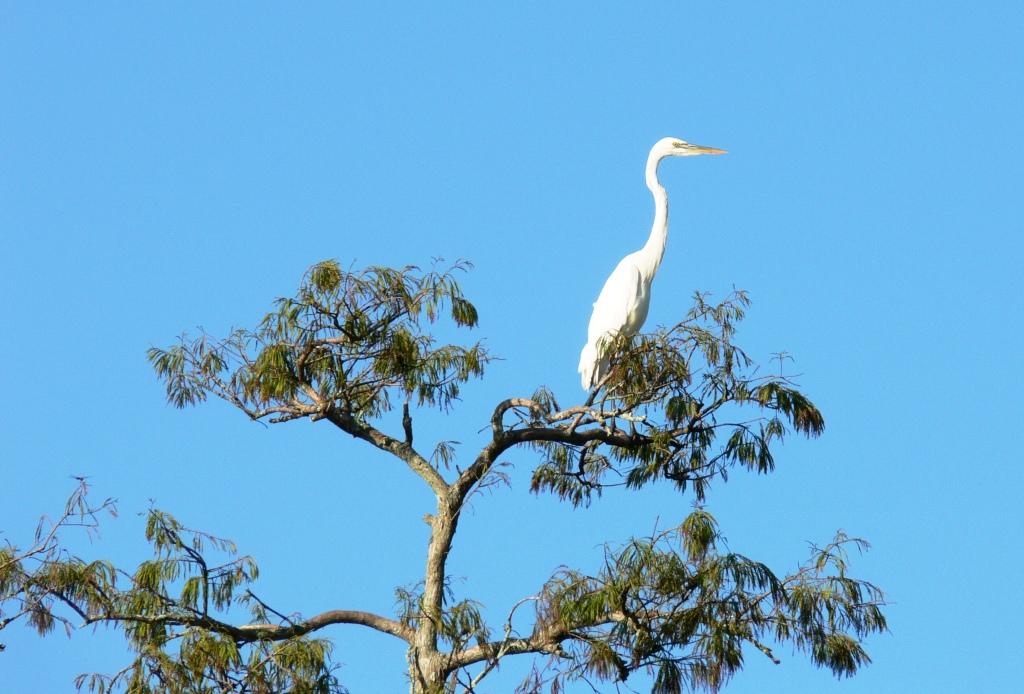
Western Great Egret (Ardea alba) Circle B by Lee

Western Great Egret (Ardea alba) Circle B by Lee

Here is a list of what we saw or heard in the order they were found:
Muscovy Ducks (just outside the park), 3 Sandhill Cranes, Mourning Doves, Black Vultures, Turkey Vultures, Ospreys, Carolina Wren, Pileated Woodpeckers, Tufted Titmouse, Great Blue Herons, Great Egrets, Red-Bellied Woodpecker, 2 Bald Eagles, Black-Bellied Whistling Ducks, Cattle Egrets, Pied-billed Grebe, Common Moorhens, Purple Gallinules, 2 Northern Harrier, 2 Red-shouldered Hawks, Little Blue Herons, Red-winged Blackbirds, Killdeer, Glossy Ibises, White Ibises, Snowy Egret, Fish Crows, Anhingas, 1 Double-crested Cormorant, Green Heron, Belted Kingfishers, Blue Jays, 2 Cardinals (M/F), Blue-grey Gnatcatcher, 5 or 6 Northern Bob-Whites. I also spotted a warbler with yellow and black, but it was too quick to get a good ID.

*

This slideshow requires JavaScript.

*

All Slide shows can be clicked on for a larger view.

For other birdwatching trips to the Circle B Bar Reserve

*

Birds of the Bible – What Birds Can Tell – 1

Belted Kingfisher (Megaceryle alcyon) by Daves BirdingPix

Belted Kingfisher (Megaceryle alcyon) by Daves BirdingPix

But now ask the beasts, and they will teach you; And the birds of the air, and they will tell you; Or speak to the earth, and it will teach you; And the fish of the sea will explain to you. Who among all these does not know That the hand of the LORD has done this, (Job 12:7-9 NKJV)

One of my favorite birds that I enjoy watching is the Kingfisher. The ones we have here in Florida (Belted Kingfishers) are rather plain compared to others around the world, but they all have a characteristic look of a very long bill on a large head and a short neck. It is the bill that those in Japan have studied that is amazing.

Japan has electric trains that speed over 200 miles per hour or 322 kilometers per hour. They are very safe and have a great record, but a noise problem had been plaguing them until they observed the Kingfisher’s beak. When the speeding trains went through the tunnels, it caused a “tunnel boom” which goes against their strict sound pollution laws.

Blue-eared Kingfisher (Alcedo meninting) by Nik

Blue-eared Kingfisher (Alcedo meninting) by Nik

“Eiji Nakatsu, the train’s chief engineer and an avid bird-watcher, asked himself, “Is there something in Nature that travels quickly and smoothly between two very different mediums?” Modeling the front-end of the train after the beak of kingfishers, which dive from the air into bodies of water with very little splash to catch fish, resulted not only in a quieter train, but 15% less electricity use even while the train travels 10% faster.” (Learning Efficiency from Kingfishers)

Bullet Train

Bullet Train

The “tunnel boom” is caused  “when a train passes through such a tunnel at high speed, it compresses the air in front of the engine. Upon leaving the tunnel, this air rushes outward, creating a loud thunderclap, or sonic boom. Nearby windows rattle, and people are awakened by the noise.” (Don DeYoung, Answers) When the engineers did wind tunnel experiments they found that “the kingfisher’s bill is ideally shaped for a smooth, streamlined transition from air into water. This drastic change in pressure is similar to the change a bullet train experiences when emerging from a tunnel into the open air.”

By observing one of God’s created birds, the kingfisher, they were able to solve a serious problem. The Lord in His great wisdom has provided us many critters and other things to observe so that they may “tell us” things that will benefit us.

Whoso is wise, and will observe these things, even they shall understand the lovingkindness of the LORD. (Psalms 107:43 KJV)

See Also:

Speeding Bullet – Answers V4, #3
Kingfisher – Train by Discovery of Design
Learning Efficiency from Kingfishers by Biomimicry Institute

*

Early Bird by GeHof

Here’s an interesting video of tribute to birds, especially Those Early Birds Getting The Worm. From GeHof who posted it at YouTube.
What else was I to do today while we are having stormy weather here in Central Florida? I have been “Birdwatching” the internet.

When I Consider! – Elephant Ears and Scarab Beetles

When I Consider!

When I Consider!

Evidence From Biology – September 12

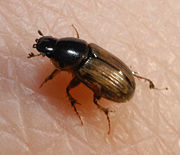
180px-Aphodius_specThere is an amazing relationship between certain types of elephant ear and the scarab beetle. It has only been recently learned that many elephant ear plants depend completely on the scarab beetle for pollination. Elephant ears make a flower stalk, called a spadix, which has three different kinds of flowers: male, female, and sterile. The beetles are drawn to help in the pollination process of crawling around on the spadix to get to the sterile flowers, which they love to eat. In the process of crawling around on the spadix to get to the sterile flowers, the beetles also pick up pollen from the male flowers and pollinate the female flowers.

Elephant-Ear-Plant

Elephant-Ear-Plant

It is amazing that none of the male or female flowers are ever eaten though they look exactly like the sterile flowers! The plant has produced a sacrificial look-alike in order to attract a specific pollinating insect which has no interest in its productive flowers. How could the plant have known to do this? Why would it ever produce a flower useless except for the actions of another creature? This miraculous interdependency had to have been specifically designed.

Letting God Create Your Day, Vol. 4, p29

O Lord GOD, You have begun to show Your servant Your greatness and Your mighty hand, for what god is there in heaven or on earth who can do anything like Your works and Your mighty deeds? (Deuteronomy 3:24 NKJV)

From A Closer Look at the Evidence, September 12, by Richard and Tina Kleiss

See Also:
Mystery of the Elephant Ears at ©Creation Moments

Elephant Ear Story from Cloudbridge Nature Reserve
Miniature Elephant Ear Surprise by A Neotropical Savanna
Xanthosoma Giant Elephant Ear Plants by Central Florida Farms

More  “When I Consider!”  articles.

Birds of the Bible – Birds of Every Sort

American Flamingo (Phoenicopterus ruber) by Africaddict

American Flamingo (Phoenicopterus ruber) by Africaddict

When I came across this verse about “every kind of bird” and “birds of every sort,” I decided it would be great to show some of the really fantastic birds that I have seen recently in the photos I am sorting for the Birds of the World blog. This will be done, but also the verses themselves are very interesting.

Thus says the Lord GOD: “I myself will take a sprig from the lofty top of the cedar and will set it out. I will break off from the topmost of its young twigs a tender one, and I myself will plant it on a high and lofty mountain. On the mountain height of Israel will I plant it, that it may bear branches and produce fruit and become a noble cedar. And under it will dwell every kind of bird; in the shade of its branches birds of every sort will nest. And all the trees of the field shall know that I am the LORD; I bring low the high tree, and make high the low tree, dry up the green tree, and make the dry tree flourish. I am the LORD; I have spoken, and I will do it. (Ezekiel 17:22-24 ESV)

Tufted Puffin by Dave's BirdingPix

Tufted Puffin by Dave's BirdingPix

Nebuchadnezzar had placed one of the family of David on the throne in Judah. This signified taking the seed of the land and planting it, but it did not succeed. But as these verses tell of a future time when there will be a “tender one” from the topmost twigs, referring to the Messiah, the tender one, and the tribe of Judah, main tribe. The Messiah is often referred to as a branch in prophecy.

Painted Sandgrouse (Pterocles indicus) by Nikhil

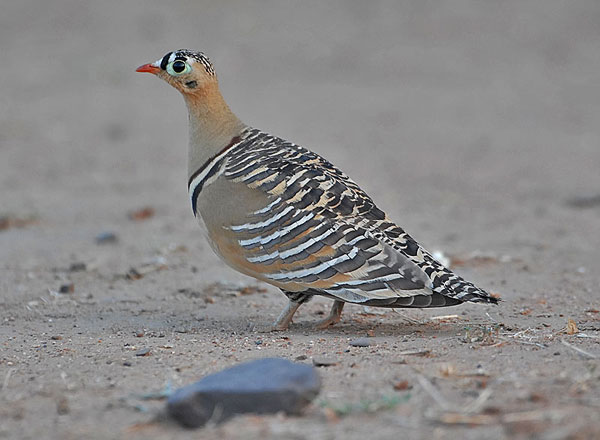
Painted Sandgrouse (Pterocles indicus) by Nikhil

“Nebuchadnezzar and Zedekiah was made on this ground, and the name of Jehovah was brought in to confirm it. It was not the Gentile who broke the covenant. Zedekiah added to his other sins that of rendering impossible the existence of a people and a kingdom that belonged to God. The name of Jehovah was more despised and trampled under foot by him than by the Gentile king. He intrigues with Egypt to escape from the dominion of Nebuchadnezzar, whom God Himself, in judgment, had set up as supreme. This filled up the measure of iniquity, and brought on the final judgment. But it left room for the sovereignty of God, who would bring down the high tree and exalt the low tree, who would dry up the green tree and make the dry tree to flourish. His grace would take the little forgotten branch of the house of David and raise it up in Israel upon the mountain of His power, where He would cause it to become a goodly cedar, bearing fruit, and sheltering all that would seek the protection of its shadow. All the powers of the earth should know the word and the works of Jehovah.” From John Darby’s Synopsis.

Cedar Waxwing (Bombycilla cedrorum) by J Fenton

Cedar Waxwing (Bombycilla cedrorum) by J Fenton

“The twig planted by the Lord will grow there into a glorious cedar, under which all birds will dwell. The Messiah grows into a cedar in the kingdom founded by Him, in which all the inhabitants of the earth will find both food (from the fruits of the tree) and protection (under its shadow). For this figure, compare Daniel 4:8-9. צִפֹּור כָּל־כָּנָף, birds of every kind of plumage (cf. Ezekiel 39:4, Ezekiel 39:17), is derived from Genesis 7:14, where birds of every kind find shelter in Noah’s ark. The allusion is to men from every kind of people and tribe. By this will all the trees of the field learn that God lowers the lofty and lifts up the lowly.” From Keil & Delitzsch Commentary on Old Testament

Salvation is open to all people no matter what background, nationality, or tongue you speak. As the birds of every sort enjoy the shade and provisions of the tree, may you enjoy the Salvation of Lord and all His blessings He provides.

See: Wordless Birds

This is Birds of Every Sort – Part 1 (Non-Passerines)
*

This slideshow requires JavaScript.

*

Saddle Creek Birdwatching – 09/05/09

Saddle Creek Park - Polk County, FL

Saddle Creek Park - Polk County, FL

Today Dan and I headed out to join the group at Saddle Creek, who do a walk each Saturday from Mid-August to October. By the time I figured out that my legs would cooperate and decided to go, the group had already gone down the trail. So we just birded on our own. In just the hour we stayed there, we were able to see or hear at least 26 species, plus the few unknowns.
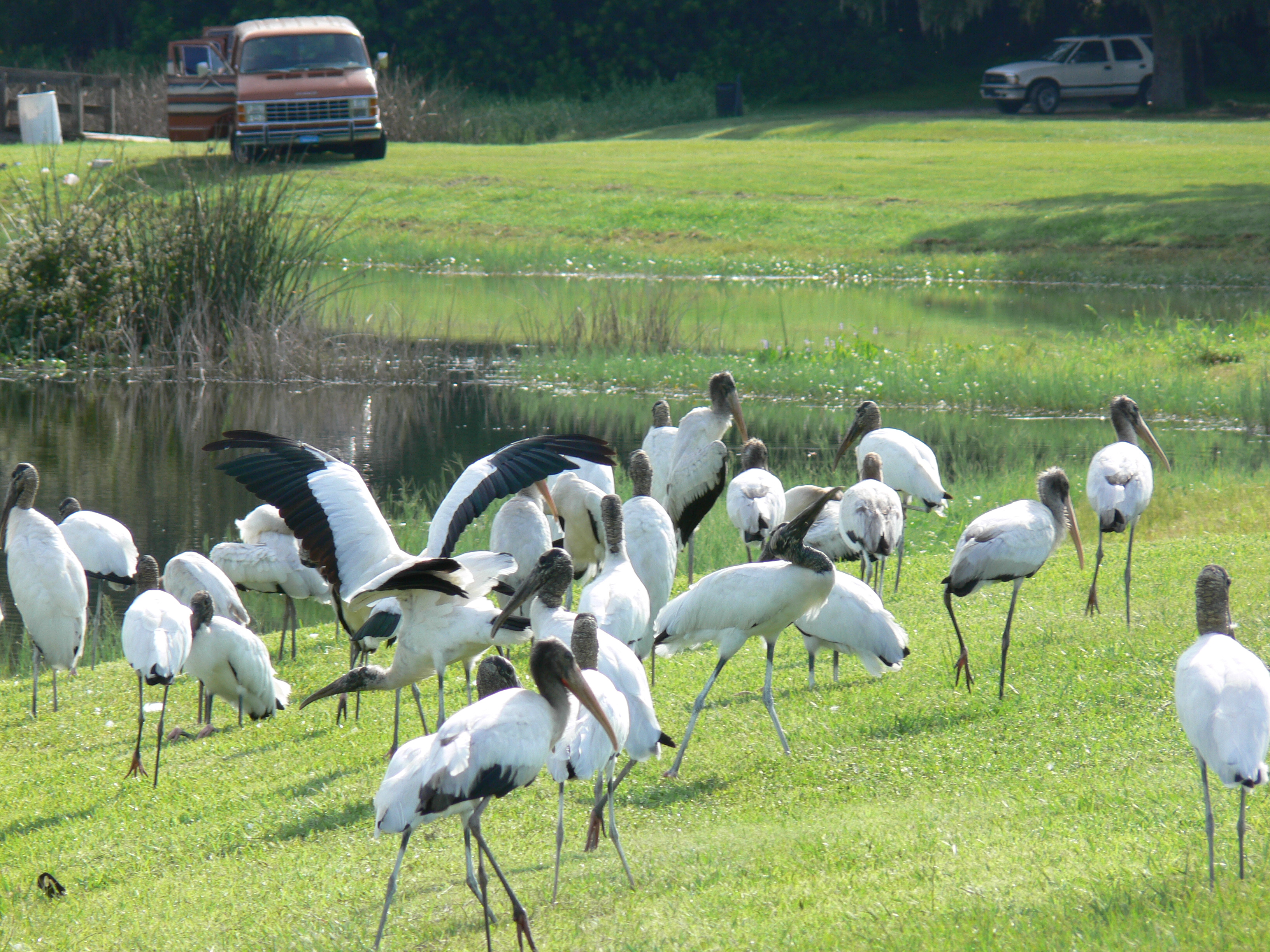
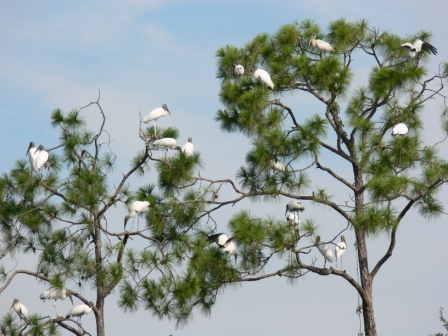
When we first entered the park, we were greeted by over 40 Wood Storks (see photos). They were standing around, flying around and sitting in trees, so an accurate count was difficult. On the way to the trails we spotted, Great Blue Herons, Anhingas, Pied-billed Grebe, Great Egret, Common and Boat-tailed Grackles, Northern Mockingbird, Eurasian-collared Doves and Mourning Doves and a Muscovy Duck.

Wood Storks at entrance

Wood Storks at entrance

Back at the parking area for the trails, we heard wood being banged on and sure enough a Pileated Woodpecker was right in the tree above our heads. Later we also heard a Downy and a Red-bellied Woodpecker. Along the open area by the pond were several female Common Yellowthroats, Great Blue Heron, Little Blue Heron, Tricolored Heron and in the pond were several Common Moorhens being kept company by two large alligators.

Wood Stork Tree

Wood Stork Tree

While we were watching them, 3 Sandhill Cranes flew over and then some Fish Crows flew by. As we walked along the bushes at the edge of the lake we spotted a Blue Jay, Northern Cardinal, Blue-Grey Gnatcatcher, Belted Kingfisher and heard a Carolina Wren.
All in all, it was a nice birding morning. It was 75° when we started with about 85% humidity. Other than the humidity, it was a great day to enjoy God’s Creation.

*

This slideshow requires JavaScript.

*

Birds of the Bible – Hoopoe II

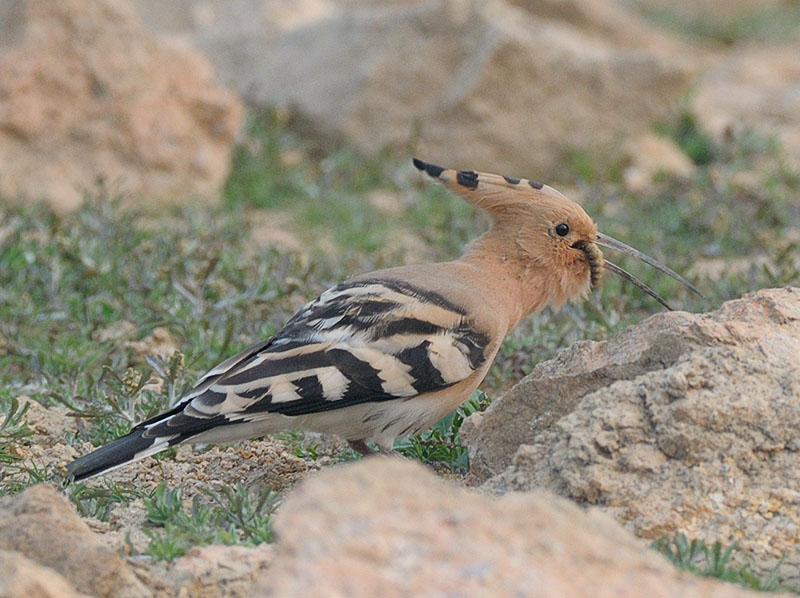
Eurasian Hoopoe (Upupa epops) by Ian

Eurasian Hoopoe (Upupa epops) by Ian

The Hoopoe was introduced in Birds of the Bible – Hoopoe and would like to add more information about the Hoopoe.

The Hoopoes are in the BUCEROTIFORMES Order which includes Hoopoes, Wood Hoopoes, Hornbills and Ground Hornbills. I have revised this information since the 1st article. Wikipedia (now updated) had them with the woodpeckers, but the records I am using from the I.O.C. (2009) places them with the hornbills and in the Upupidae Family

The three Upupidae members are the Eurasian, African, and Madagascar Hoopoes. (Some say these three are basically the same.) The Wood Hoopoes are in the Phoeniculidae Family that consists of the Forest, White-headed, Green, Black-billed, Violet and Grant’s Wood Hoopoes. That family also has the Black, Common and Abyssinian Scimitarbills.

“The Hoopoe is a medium sized bird, 25–32 cm (9.8-12.6 in) long, with a 44–48 cm (17.3-19 in) wingspan weighing 46-89 g (1.6-3.1 oz). The species is highly distinctive, with a long, thin tapering bill that is black with a fawn base. The strengthened musculature of the head allows the bill to be opened when probing inside the soil. The hoopoe has broad and rounded wings capable of strong flight; these are larger in the northern migratory subspecies. The Hoopoe has a characteristic undulating flight, which is like that of a giant butterfly, caused by the wings half closing at the end of each beat or short sequence of beats.” (Wikipedia) It appears that the Lord has created this bird with just what it needs find its food.

Eurasian Hoopoe

Eurasian Hoopoe

“The Hoopes have well developed anti-predators defences in the nest. The uropygial gland of the incubating and brooding female is quickly modified to produce a foul-smelling liquid, and the glands of nestlings do so was well. These secretions are rubbed into the plumage. The secretion, which smells like rotting meat, is thought to help deter predators, as well as deter parasites and possibly act as an antibacterial agent. The secretions stop soon before the young leave the nest. In addition to this secretion nestlings are able to direct streams of faeces at nest intruders from the age of six days, and will also hiss at intruders in a snake like fashion. The young also strike with their bill or with one wing.” This point could well have been why the Hoopoe was placed on the “unclean list” of birds not to eat.

the stork, the heron after its kind, the hoopoe, and the bat. (Lev 11:19 NKJV)
the stork, the heron after its kind, and the hoopoe and the bat. (Deu 14:18 NKJV)

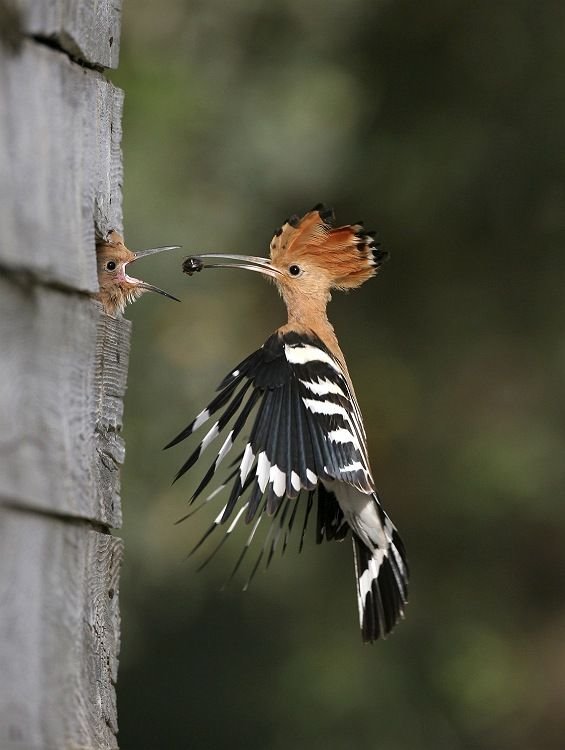
Hoopoe Feeding Young from an email

Hoopoe Feeding Young from an email

The lapwing – דוכיפת duchiphath, the upupa, hoopoe, or hoop, a crested bird, with beautiful plumage, but very unclean. See Bochart, and Scheuchzer. Concerning the genuine meaning of the original, there is little agreement among interpreters.” from Adam Clarke’s Commentary on the Bible.

John Gill’s Exposition of the Whole Bible says, “and the lapwing; the upupa or hoopoe; it has its name in Hebrew, according to Jarchi, from its having a double crest; and so Pliny (o) ascribes to it a double or folded crest, and speaks of it as a filthy bird; and, according to Aristotle (p) and Aelian (q), its nest is chiefly made of human dung, that by the ill smell of it men may be kept from taking its young; and therefore may well be reckoned among impure fowl. Calmet (r) says, there is no such thing as a lapwing to be seen in any part of England; but there are such as we call so, whether the same bird with this I cannot say:”

The LORD was teaching the Israelites to obey by not eating certain animals and birds, but it appears that this was also beneficial for their health and well being.

Casting down imaginations, and every high thing that exalteth itself against the knowledge of God, and bringing into captivity every thought to the obedience of Christ; (2 Corinthians 10:5 KJV)

See also:

Birds of the Bible – Hoopoe I
Hoopoe Photos
Hoopoe Videos
Hoopoe at Wikipedia
Hoopoes Upupidae by Bird Families of the World
Wood hoopoe by Wikipedia

Not What My Hands

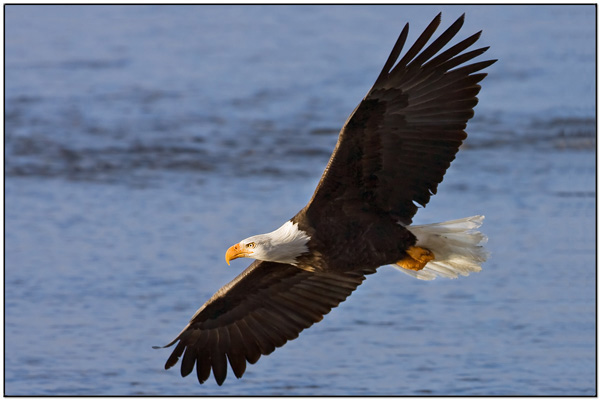
Bald Eagle flying by Dave's BirdingPix

Bald Eagle flying by Dave's BirdingPix

Sunday night at our church (Faith Baptist Church, Winter Haven, FL) our young people were giving reports and testimonies of their summer youth trips. They went to three different places through out the summer and did things from teaching VBS to painting house and cleaning up around them. They also went to a leadership training in Pennsylvania. One of the highlights of the evening was a song that Reagan and Lauren sang. Since it had this line, “And I have come to hide beneath your wings,” I asked Stephen to put it on YouTube. He did, and here is that song. It has a tremendous message to it.

I trust you will enjoy the song and most of all, the words.

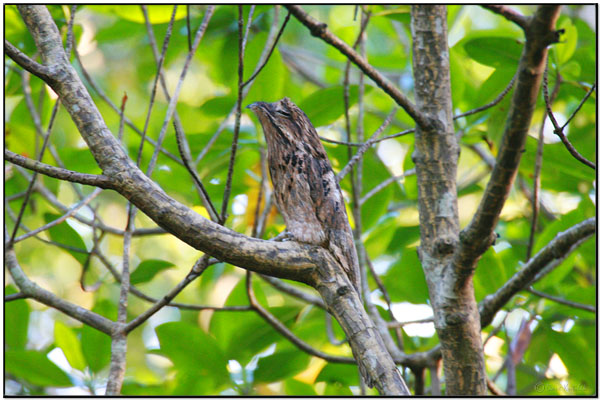
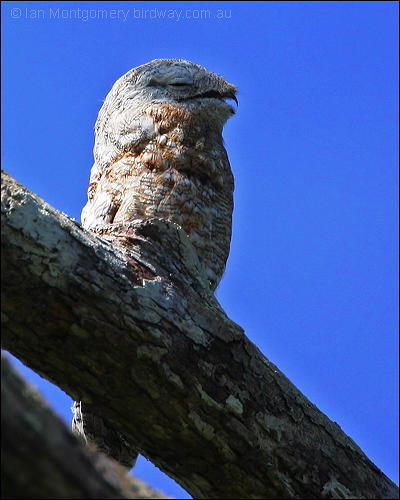
Common Potoo (Nyctibius griseus)

Common Potoo (Nyctibius griseus) by Daves BirdingPix

Common Potoo (Nyctibius griseus) by Daves BirdingPix

While going through the photos for the Birds of the World pages to get them ready to post, I came across this amazing bird.

The Common Potoo (or Lesser) (Nyctibius griseus) is almost hard to find in this photo. Their camouflage colors of brown, black, and grey plumage makes them look just like tree bark. They sleep during the day sitting up and look like a dead branch. Their mouth is quite large which lets them catch prey (flying insects) when they make “quick, short, silent flights.” The Potoo is active at dawn and dusk. They are related to the nightjars and frogmouths and are sometimes called Poor-me-ones, because of the haunting calls. There are seven species in the Nyctibius genus in tropical Central and South America. They seem to prefer humid forests, but a few occur in drier forests.

They do not build a nest, but find a limb with a depression and lay their single egg there. Both parent help with incubation, which takes 30-35 days.

The Great Potoo is 48-60 cm (19-24 in) long, and the Lesser or Common is 33-38 cm (13-15 in) long.
The following Potoo sounds are from xeno-canto America
Great Potoo – Long Tailed Potoo – Northern Potoo – Andean Potoo – Common or Lesser Potoo – White-winged Potoo

Great Potoo (Nyctibius grandis) by Ian's Birdway

Great Potoo (Nyctibius grandis) by Ian’s Birdway

The potoos are:

The Lord created the Potoo’s with a great plumage that blends in so well. This is for its protection and it serves the bird well. The thing that amazed me about the Potoo is how well it conforms to its surroundings. We are told in Romans 12:2 that we are not to be conformed to the world or to look and act like the unrighteous around us. We are to be transformed or changed by the renewing of our mind.

And be not conformed to this world: but be ye transformed by the renewing of your mind, that ye may prove what is that good, and acceptable, and perfect, will of God. (Romans 12:2 KJV)

Interesting Links:
Potoo by Wikipedia
Common Potoo Nyctibius griseus by Mangoverde World Bird Guide

Lee’s Birds of the World

When I Consider! – Woodpecker and Bones

When I Consider!

When I Consider!

“Evidence from Biology”

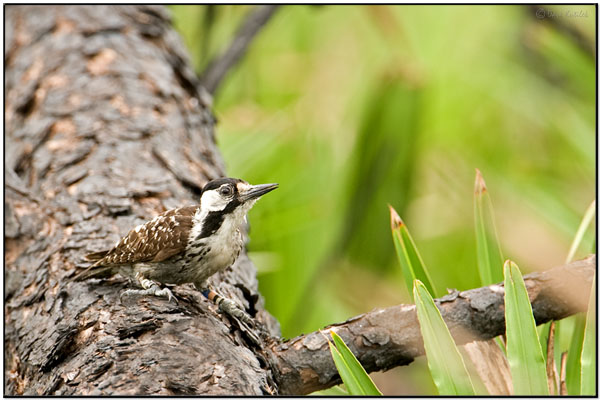
“In His Word, God tells us that He cares for His creatures. One can observe repeated examples of this in nature. Every creature on Earth has been programmed to take care of itself. An example is the female Red-Cockaded Woodpecker, which changes her diet to include more calcium at egg-laying time. Scientist have found that the woodpecker starts gathering, storing, and eating bone fragments a few days before laying her eggs. Bones contain an extremely high concentration of calcium, which is needed for the shells of the woodpecker’s eggs. After her eggs are laid and her body requires less calcium, the woodpecker shows little interest in pieces of bone.

Red-cockaded Woodpecker (Picoides borealis) by Daves BirdingPix

Red-cockaded Woodpecker (Picoides borealis) by Daves BirdingPix

Where did this instinct to eat bones originate? How does the woodpecker know when she can stop eating bone fragments? Would this process have taken place before the Fall, when the world was a perfect paradise? No one knows, but it is apparent that this instinct had to be programmed into the woodpecker for it to survive in the current fallen world. What a leap of faith to believe that the woodpecker’s ability to meet her need for increased calcium just “evolved” by chance!

Letting God Create Your Day, Vol.3, p.22″

Look at the birds of the air, for they neither sow nor reap nor gather into barns; yet your heavenly Father feeds them. Are you not of more value than they? (Matthew 6:26 NKJV)

A Closer Look at the Evidence, Aug 5, by Richard and Tina Kleiss


An excerpt from U.S. Fish & Wildlife Service, “Red-cockaded Woodpecker Picoides borealis

“Red-cockaded woodpeckers rarely come to the ground. They even bathe in water-filled depressions on tree limbs. Recent research notes that female red-cockaded woodpeckers search for bone bits on the forest floor and stuff them in tree crevices. Zoologists say it is the first known instance of a bird hoarding something for its mineral, rather than caloric, content. Calcium-rich bone is not rare, but the birds probably seek it to ensure stronger eggshells. They stash it in a tree so they won’t have to eat on the ground where they are vulnerable to predators.”

Birds in Hymns – Awake, Thou Careless World, Awake

Heaven and earth shall pass away: but my words shall not pass away. (Luke 21:33 KJV)

Words: Jo­hann Rist, Neu­er Him­lische Lied­er son­der­bahr­es Buch (Lün­e­burg: 1651), p. 248 (Wach’ auf, wach’ auf, du sich’re Welt);
trans­lat­ed from Ger­man to Eng­lish by Ca­ther­ine Wink­worth, Cho­rale Book for Eng­land (Lon­don: Long­man, Green, Long­man, Ro­berts and Green, 1863), num­ber 27.
Music: Com­pos­er un­known.
Johann Rist (1607-1667)

Awake, Thou Careless World, Awake
For the Music

Awake, thou careless world, awake!
That final judgment day will surely come;
What Heav’n hath fixed time cannot shake,
Time never more shall sweep away thy doom.
Know, what the Lord Himself hath spoken
Shall come at last and not delay:
Though Heav’n and earth shall pass away,
His steadfast Word can ne’er be broken.

Awake! He comes to judgment, wake!
Sinners, behold His countenance
In beauty terrible, and quake
Condemned beneath His piercing glance.
Lo! He to whom all power is given,
Who sits at God’s right hand on high,
in fire and thunder draweth nigh,
To judge all nations under Heaven.

Bird Caught in a Snare

Bird Caught in a Snare

Awake! thou careless world, awake!
For none can tell how soon our God shall please
That suddenly that day should break?
No human wisdom fathoms depths like these.
O guard thee well from lust and gree;
For as the bird is in the snare,
Or ever of its foe aware,
So comes that day with silent speed.

Yet He in love delayeth long
The final day, and grants us space
To turn away from sin and wrong,
And mourning seek in time His help and grace.
He holdeth back that best of days,
Until the righteous shall approve
Their faith and hope, their constant love;
So gentle us-ward are His ways!

But ye, O faithful souls, shall see
That morning rise in love and joy,
Your Savior comes to set you free,
Your Judge shall all your bonds destroy:
He, the true Joshua, then shall bring
His people with a mighty hand
Into their promised father-land,
Where songs of victory they shall sing.

Rejoice! the fig tree shows her green,
The springing year is in its prime,
The little flowers afresh are seen,
We gather strength in this great time;
The glorious summer draweth near,
When all this body’s earthly load,
In light that morning sheds abroad,
Shall was as sunshine pure and clear.

Arise, and let us night and day
Watch for our Lord, and study o’er His Word,
And in the Spirit ever pray,
That we be ready when His call is heard;
Arise, and let us haste to meet
The Bridegroom standing at the door,
That with the angels evermore
We too may worship at His feet.


Go to more Hymns – CLICK HERE