Birdwatching Tips #2

Making List of Your Birdwatching Adventures
Many people keep list of the things they see and hear while out birdwatching. There are several kinds of list you might want to consider starting.

Life List
This is a list of all the birds species you have seen or heard. The sound of a bird you heard is acceptable in lists (if you can figure out what you heard or recorded.) It is good to get a date and location of the first sighting of each new bird.

Trip Lists
I also keep a birding list when I go birdwatching. If we go to Lake Hollingsworth or Merritt Island NWR, I keep a list of that outing. I list all the birds I see or hear at that place. Like the other lists given here, I put the date, location, weather condition (sunny, overcast, windy, etc) time and whatever else is important. Sort of like a combined list and field note. It is my way of doing it. I then enter each trips list at ebird.com. (I’ll explain that in another blog post.)

Keeping Field Notes
These are your impressions of the bird as you observe it. You could describe it in words, sketches, colored pens, etc. to help identify the bird later. When you are at home with your reference guides, these notes will help to figure out which bird you saw and nail the ID.Your first impression of the bird’s size, proportions, colors and markings, bills, leg color, what the bird is doing, song or sounds, and the habitat, plus a sketch can all be helpful later.
Keeping a Bird-Watching Journal
The Journal differs from Field Notes in that it is less technical and more your impressions of the whole experience of watching the birds. Along with the date and location, you can detail the weather, the surroundings, what you think the bird is doing in more personal terms, how that makes you feel, etc.
Keeping a Birds of the Bible List or Journal

Study to show thyself approved unto God, a workman that needeth not to be ashamed, rightly dividing the word of truth. (2 Timothy 2:15 KJV)

Do your best to present yourself to God as one approved, a worker who has no need to be ashamed, rightly handling the word of truth. (2 Timothy 2:15 ESV)

So, why not have a list or journal of the birds you come across as you read the Bible. All of us come across the name of a bird or general reference to birds. Put the name down and the reference and come back later and dig a little deeper.
How to dig deeper?
Read the context of the verse. How is it being used?
  • Is it just in a list or is it the object of a lesson?
  • What is that lesson and how does it apply to me?
  • Is the bird mentioned elsewhere in scripture? Use a concordance or Bible software like e-Sword.
  • Use Naves Topical Bible or similar help to find out about birds.
  • Look up the bird online and in Bird guides.

More ideas could be mentioned, but you be creative and do what helps and motivates you to find out more about the Birds of the Bible. Later, drop a comment or email and we can share your ideas on this.

Interesting Things – Feathered Pilots

SmileyCentral.com

An Interesting Email I Received Today
Job 12:7, 9
But now ask the beasts, and they will teach you, and the birds of the air, and they will tell you.Who among all these does not know that the hand of the LORD has done this.
You are the pilot of a Boeing 767 airliner, bringing the great ship in for a landing. Approaching the airport, you extend the slat on the leading edge of each wing so that you have more lift as your speed slows. As the runway nears, you raise the nose of the plane to catch more air. In the final moments of landing you bring the feathers, which act as air breaks, out of the wing to reduce your lift and settle easily onto the runway.
Yet without any training, young birds do this very same thing every day. High-speed photography has revealed that birds follow each one of these sequences as they approach and land. First, as they prepare to land, they slow their speed and increase their lift by extending and lowering the front part of the wing. Then, to slow even more, they angle their body from a horizontal flying position to a more upright angle. Finally, they drop the feathers on the back of their wing – after which the plane’s feathers are named – to settle nicely on a tree branch, with virtually no effort at all.
Yes, the principles of flight, refined by over 80 years of man’s experience, were simply taught to the birds by our loving Creator. What a wonderful testimony birds offer to the work of our Creator!
Prayer: Dear creating and saving Heavenly Father, all man’s combined experience and learning throughout history does not begin to compare to Your understanding of all things. Help me to remember this as I hear man brag to himself about all he has accomplished. In Jesus’ Name. Amen.

References: “A Lesson in Landing,” Time-Life, Flight
Visit Web Site Donate Catalog Subscribe Unsubscribe
©2005 Creation Moments, Inc. All Rights Reserved.
Call us at 1-800-422-4253

Birds of the Bible – Owls

Owls are an interesting species. Most of them are nocturnal, so we don’t see them very frequently. At least I don’t see them, but since I like to stay up late, I have heard them at night. Sometimes they are thought of as wise and drawings are made of them with glasses. Maybe that is because they have such huge eyes in respect to their head size. God has given them great ability to see at night with more rods than cones in their eyes that help gather light. They do not move their eyes up and down or side to side as we do, but instead move their head. No, they do not turn it all the way around. They can turn it 270 degrees though.
When owls fly, they are swift and silent as they hunt for prey, such as small animals and rodents. Their wings were designed to give them stealth. Their hearing is very sensitive and they can locate prey even if there is very low light. The sound of an owl can be “eerie” or of a “hoot” or “screech” sound.

  • There are at least 222 owl species worldwide.
  • There are 19 species here in the continental U.S.
  • The Elf Owl is the smallest in the world. It is 5.75 inches and likes the desert.

  • The Great Horned Owl is our largest in the US. It is 22 inches. They are also the only known predator of the Bald Eagle.
  • The little owl, owl, and big owl are mentioned in scripture.
  • The owls are in the “unclean” list. Lev 11:16-17, Deut 14:15-16

Here is an interesting quote from Wayne Blank’s Birds of the Bible. “Some insects and other creatures wear a disguise which actually frightens birds away. Most small birds are afraid of owls, and one insect has a clever way…the owl butterfly has large ‘eyes’ on its wings.”

The destruction of Babylon in Isaiah 13:19-22 mentions the owls that inhabit the deserted or wasted area. In comparing verse 21, it was interesting how the different Bible translations described them. Here are a few examples: “full of doleful creatures” (ASV); “hoot owls” (CEV); “ful of great Owles” (Bishops); “howling creatures” (ESV); the KJV, NASB, and NKJV all call them “owls”; and the MSG has “vacant houses with eerie night sounds.”

Other references to owls are found in Isaiah 34:11-13, Jeremiah 50:39, and Micah 1:8.

In Isaiah 43:20 the beast of the field, dragons, and owls honor the Lord because he has given water in the wilderness and rivers in the desert to provide drink for them. The next verse tells of his people giving praise. This brings to mind the hymn, Fairest Lord Jesus

Fairest Lord Jesus! Ruler of all nature!
O Thou of God and man the Son!
Thee will I cherish, Thee will I honor,
Thou, my soul’s glory, joy, and crown!
Fair are the meadows, Fairer still the woodlands,
Robed in the blooming garb of spring:
Jesus is fairer, Jesus is purer,
Who makes the woeful heart to sing.
Fair is the sunshine, Fairer still the moonlight,
And all the twinkling starry host:
Jesus shines brighter, Jesus shines purer,
Than all the angels heav’n can boast.
Beautiful Saviour! Lord of the nations!
Son of God and Son of Man!
Glory and honor, Praise, adoration,
Now and forevermore be Thine!

I have really had a difficult time deciding what to put in this blog. There were so many good items to choose from.

Long-eared Owl with yellow-orange eyes from Germany

Two articles from Creation Moments:

Parents Who Are Wise as Owl

Calculating Owls Article – Calculating Owls Audio
*

Funny Owl and the Water Sprinkler

Birdwatching Trip to Bok Sanctuary

On Good Friday we were at Bok Sanctuary in Lake Wales, FL enjoying a beautiful cloudless day. The orange grove there was in full bloom and the aroma drifted over the whole place. We were birding, taking pictures, and appreciating God’s goodness. The birds were full of songs and they came out for us to see them. Could that have been because I asked the Lord to do just that? If He can make a donkey talk and and cause it to stop before an angel, and bring ravens to feed a prophet, surely He could answer my prayer. He did!

Here is a list of what we saw and heard: Cardinals, Blue Jays, Mourning Doves, Mockingbirds, Brown Trashers, Red-bellied Woodpecker, a pair of American Kestrels sitting close, Fish Crows, Gray Catbird, Great Blue Heron, Black and Turkey Vultures, Osprey, and my two prize catches – a Black and White Warbler and a Ruby-crowned Kinglet.

We also saw a cactus in bloom.

Of course there were plenty of squirrels to put up with.

Happy Easter

Happy Easter to all of you from
Lee’s Birdwatching Adventures.
Today was a great day, with both morning and evening services being a blessing. I trust your day was also blessed as you reflected on the Resurrection of Christ and what it means to our lives.
Lee

Eye of the Beholder – Mockingbird

Observing the Northern Mockingbird must have some lessons we can learn. I can think of two off hand. Well, actually one of them comes from my husband. The song of the mockingbird uses a “vocal mimicry or appropriation” to make “sounds of other species (as well as non-avian sounds such as the barking of dogs, screeching of machinery, or human whistling) sometimes incorporated into a bird’s repertoire.” (“Vocal Copying,” The Birder’s Handbook) They listen, incorporate, and assimilate those songs and produce sounds into a very melodious song. Their song is usually a phrase repeated three times or so, and then a new phrase is sung. This can go on for hours.

Lesson #1: He could be like a person, who hears things and then repeats it three or more time. Sort of like a gossiper.

Lesson #2: (My preference) He could be like a Christian who listens to sermons, Sunday School lessons, other Biblical lessons, songs, has personal devotions, etc. then meditates and incorporates what they have heard into their life. Their life then produces a “song,” or way of life that is pleasing to others and especially to the Lord.

And besides they learn to be idle, wandering about from house to house, and not only idle but also gossips and busybodies, saying things which they ought not. (1Ti 5:13)

Also

Charge them that are rich in this world, that they be not high-minded; nor trust in uncertain riches, but in the living God, who giveth us richly all things to enjoy; That they do good, that they be rich in good works, ready to distribute, willing to communicate; Laying up in store for themselves a good foundation against the time to come, that they may lay hold on eternal life. (1Ti 6:17-19)

Till I come, give attendance to reading, to exhortation, to doctrine. Neglect not the gift that is in thee, …. Meditate upon these things; give thyself wholly to them; that thy profiting may appear to all. (1Ti 4:13-15)

Update 7/23/08: Check out   “Mockingbird Imitates Surprising Sounds

Birds of the Bible – Storks

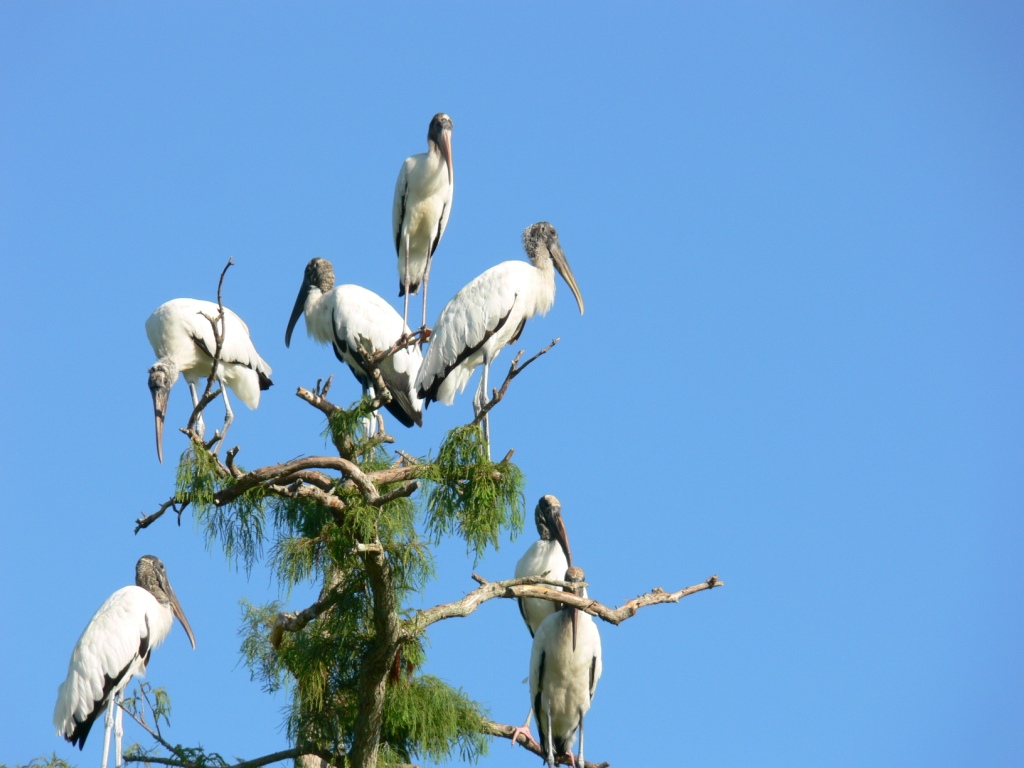
Many people think of babies being delivered when a Stork is mentioned. I am amazed when I watch the Wood Storks here in Florida. When they are on the ground, they are very unbecoming (aka-ugly), but when they are flying, it is so awesome to see the gracefulness of their flight and how beautiful their wings are.

The Wood Stork is a large bird (35”) that has huge long legs and a wing span of five and a half feet. It is the only stork that breeds here in the U.S. There are 19 species of storks worldwide. It has a long, thick, down-curved bill, and its head is black and un-feathered. The Stork is a wadder and raises its young in late winter in Florida during the dryer season. When the water is lower, the fish concentrate, and the Wood Stork and other birds can find an ample supply to feed their young. When they fly, they hold the neck extended.

Pictures by my friend Reineir Munguia, (Professional Photographer)
The stork is found in the list of unclean birds in Lev 11:19 and in Deu. 14:18
In Psalms the list is repeated with a comment here about the stork.

Where the birds make their nests; The stork has her home in the fir trees. Psa(104:17)

My picture of a Wood Stork in tree and Reinier’s much better one.

Jeremiah refers to the migration of birds and how they know when it’s time to leave. Here is an interesting quote from an article from Israel: The Bird’s Eye View By Sherri Mandell

Israel may be a small country, but thousands of birds annually take advantage of its passage-friendly flyway and the welcoming sanctuaries that dot the country.
The ancients considered Israel the center of the world, and it certainly feels that way if you look up at the sky in the spring and autumn. Half a billion migrating birds, more than 230 species, fly in Israeli air space on annual migrations between Europe, western Asia and Africa.
These journeys were noted long ago: “The stork in the heaven also knows her appointed times; and the turtledove, swift and the crane observe their time of coming” (Jeremiah 8:7).
“Tourists are sometimes afraid to visit here,” observes Alen Kasel, education director of the Jerusalem Bird Observatory, “but [the birds] never abandon us.”

Zechariah alludes to the “wings of a stork”.

Then I raised my eyes and looked, and there were two women, coming with the wind in their wings; for they had wings like the wings of a stork, and they lifted up the basket between earth and heaven. (Zec 5:9)


How To Identify A Bird

Try to decide the size of the bird being observed. When you start looking in the guide books, the approximate size will be very helpful.

Smaller than a Sparrow – 2 to 5 inches

Sparrow Size – 5 to 8 inches

Robin Size – 8 to 12 inches

Pigeon Size – 12 to 16 inches

Crow Size – 16 to 24 inches

Goose Size – 24 to 36 inches

Larger than a Goose

Below are links to helpful articles on the internet about spotting birds and then how to identify them. There are plenty of online resources that specialize in this. No sense re-inventing the wheel.

Parts of a Bird from About Birds

Bird Idenification Tips from About Birds

Birding for Beginners Ten Tips for New Birders – from Wildbirds.com

There are some good articles on the internet that will help you get started identifying birds. Some of the simpler ones are:

How to identify a Bird – from Birdwatcher’s Digest

Bird Identification – from Wildbirds.com

*

Interesting Things – Fleas, Birds and Tools


In the Birds of the Bible – Partridge, I Samuel 26:20 mentioned the flea. Here are a few interesting things about the flea. (I’m sure birds must get some.)

A Day at the Flea Circus
Animals Don’t Need Technology
The Crafty Flea

Check out these interesting things about birds and their use of tools.

The Tool-Using Bird
Animals That Make and Use Tools
Tool Users That Are Something to Crow About

Monkey uses a rock to open shells by Earthtouch

Birds of the Bible – Partridge

California Quail sometimes called California Partridge

California Quail sometimes called California Partridge

Chukar Partridge (Alectoris chukar) by Ian

Chukar Partridge (Alectoris chukar) by Ian

Partridges, which number 39, are part of the Phasiaidae family which has 155 species worldwide (only 16 in North America) that includes Chukar, Francolin, Quail, Pheasants, Junglefowl, Peafowl, and Peacocks. The Grouse and Wild Turkey are also related to them.

  • The Phasaidae family has a “chicken-like” appearance. These are medium-sized birds intermediate between the larger pheasants and the smaller quails.
  • The Partridges are native to Europe, Asia, North Africa, and the Middle East. They are ground-nesting seed-eaters. Their diet consists of mostly grains, fruits and some insects.
  • Many species are hunted for sport or game.
  • Eggs: from 5-20 in nests. “…20 or more often represents laying of more than one gray partridge hen in same nest; ring-necked pheasant also known to lay eggs in nest of gray partridge.” (The Audubon Encyclopedia of North American Birds, pg. 690) It appears some lay eggs, but get others to do the hatching.
  • The partridge is a “clean” bird.

The Partridge is only mentioned twice in Scripture. In Jeremiah, the fact is that other birds put their eggs in the nest of a partridge and then expect the nesting bird to do all the work, sitting, feeding, and fledging the chicks.

I, the LORD, search the heart, I test the mind, Even to give every man according to his ways, According to the fruit of his doings. “As a partridge that broods but does not hatch, So is he who gets riches, but not by right; It will leave him in the midst of his days, And at his end he will be a fool.” (Jer 17:10-11)

We find the second reference to a partridge in I Samuel. David is being hunted by Saul.

So now, do not let my blood fall to the earth before the face of the LORD. For the king of Israel has come out to seek a flea, as when one hunts a partridge in the mountains.” (1Sa 26:20)

I promised to present the birds, not explain all the verses. I’ll leave that for our pastors.

Red-legged Partridge

*

Back to Birds of the Bible – Partridge Page

*