Ian’s Bird of the Week – Sulphur-crested Cockatoo

Sulphur-crested Cockatoo (Cacatua galerita) by Ian

Sulphur-crested Cockatoo (Cacatua galerita) by Ian

Newsletter – 11/5/2009

This one should perhaps be called Book of the Week, as my choice of species is to mark the release by Dorling Kindersley Australia of ‘BIRD Australia’ and I’m celebrating because they used more than 200 of my photos. Dorling Kindersley is part of Penguin Group and specializes in richly illustrated reference works. If you were on this list 2 years ago (20 November 2007), you would have received a Gibberbird photo and news of the publication of the original UK edition ‘BIRD The Definitive Visual Guide’, which included more than 100 of my photos.

The first photo of the Sulphur-crested Cockatoo, in light of the setting sun, appears as a double page spread in ‘BIRD Australia’. I’m biased, of course, and think it is a splendid book, so I’ll quote the objective Graeme Hamilton, CEO of Birds Australia (the organization not the book), who says in the foreword: “BIRD Australia superbly illustrates the astonishing diversity of Australian birds . . .”. Christmas is coming so check it out: http://www.penguin.com.au/lookinside/spotlight.cfm?SBN=9781740336994&Page=details .
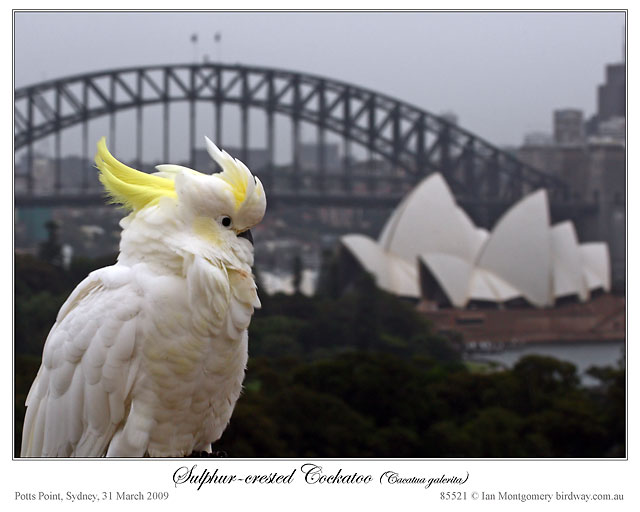
Sulphur-crested Cockatoo (Cacatua galerita) by Ian

Sulphur-crested Cockatoo (Cacatua galerita) by Ian

The first photo was taken in December 2005 from an apartment in Potts Point. The apartment belongs to friends of mine and I regularly stay there when visiting Sydney. Sulphur-crested Cockatoos are visitors there too and sometimes come up from the Domain to perch on the balcony.

When I took that photo, I later regretted not using a smaller aperture to improve the depth of field and make the background icons sharper. It’s one of the rules of bird photography that you (almost) never get the same opportunity twice. Rules are made to be broken, and the Cockatoos reappeared when I was visiting Sydney in March of this year. This time it was a wet and windy day, and the ruffled feathers and crest of the Cockatoo in the second photo seemed to me to be mimicking the sails on the Opera House.

Recent additions to the website include more photos from the northern trip:

Black-tailed Treecreeper
Pied Heron
Blue-faced Honeyeater
Red-headed Honeyeater
Bar-breasted Honeyeater
Crested Pigeon
Eastern Osprey

Best wishes,
Ian

Preferred Email: ian@birdway.com.au
Website: http://birdway.com.au


Lee’s Addition:

Talk about a “bad hair day” (feather day in this case)! What a beautiful bird! Many of these birds have been tamed and make nice pets, though I think they should be free to roam. You can enjoy more of Ian’s Sulphur-crested Cockatoo photos (Click here), All photos of Ian’s (Australian) Cockatoos & Allies – [Family: Cacatuidae]

For every kind of beast and bird, of reptile and creature of the sea, is tamed and has been tamed by mankind. (James 3:7 NKJV)

Cockatoos are in the Psittaciformes Order which includes  Cacatuidae family of Cockatoos, the Strigopidae family of New Zealand Parrots and the Psittacidae’s, which are all the rest of the Parrots and their allies.

“A cockatoo is any of the 21 species belonging to the bird family Cacatuidae. Along with the Psittacidae (the true parrots) and the Strigopidae, they make up the order Psittaciformes. The name cockatoo originated from the Malay name for these birds, kaka(k)tua (either from kaka “parrot” + tuwah, or “older sister” from kakak “sister” + tua, “old”). Placement of the cockatoos as a separate family is fairly undisputed, but it is not resolved whether or not other living lineages of parrots (such as the lories and lorikeets) are as distinct as they appear. The family has an Australasian distribution, ranging from the Philippines and the eastern Indonesian islands of Wallacea to New Guinea, the Solomon Islands and Australia.

Cockatoos are, on average, larger than true parrots; however, the Cockatiel, the smallest cockatoo, is a small bird, while the largest cockatoo, the Palm Cockatoo, at 55–60 cm (22–24 in) long is smaller than the larger macaws and several other parrots. Their plumage is generally less colourful than that of other parrots, being mainly white, grey or black with some colour elsewhere. They have strong bills and feet, and are instantly recognisable by their showy crests. The diet of the cockatoos is composed of seeds, tubers, corms, fruit, flowers and insects. They often feed in large flocks, particularly if they feed on the ground. Cockatoos are monogamous and nest in tree hollows.

Cockatoos are popular birds in aviculture, although, for some species, the largely illegal trade in wild-caught parrots has threatened their survival. Some cockatoo species are adversely affected by habitat loss and particularly by the loss of suitable hollows for nesting when large, mature trees are cleared; conversely, some species have adapted well to human changes and are considered agricultural pests.” (From Wikipedia – Cockatoo)
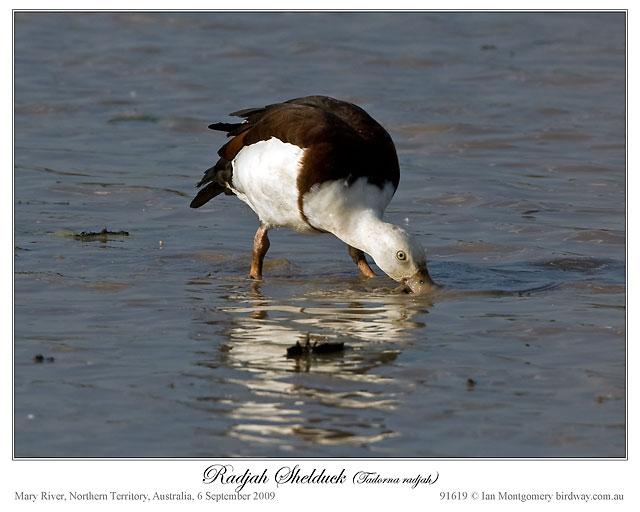
Ian’s Bird of the Week – Raja (Radjah) Shelduck
Raja Shelduck (Tadorna radjah) by IanNewsletter – 10/28/2009

Raja Shelduck by Ian

Raja Shelduck by Ian

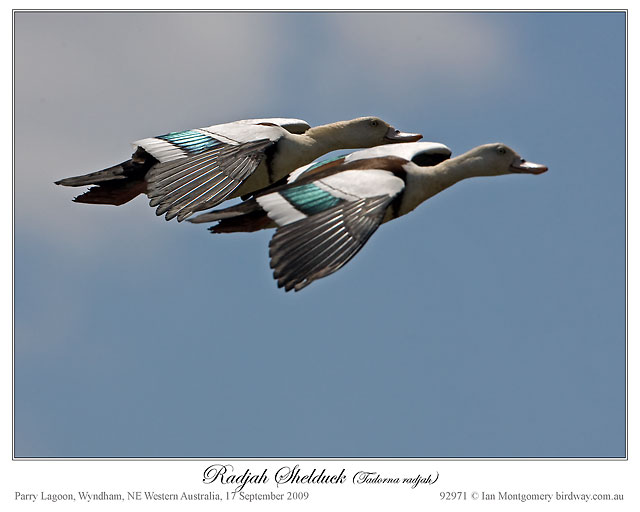
The Radjah Shelduck is a rather handsome duck of coastal tropical Australia. From a distance, the plumage looks black and white, but the dark plumage is actually chestnut. It is often seen feeding by dabbling in shallow water, as in the first photo, working its way around the margins of lagoons and wetlands. Such areas can get very muddy towards the end of the dry season and the white plumage of the birds becomes stained, as in the bird coming in to land in the second photo. In flight the green speculum on the upper surface of the wings is conspicuous as shown in the third photo.

Pair of Raja Shelduck by Ian

Pair of Raja Shelduck by Ian

The range of the Radjah Shelduck currently extends from Broome in the west to Rockhampton in the east, though it is scarce to rare outside the Northern Territory. It also found in New Guinea and eastern Indonesia. It used to occur as far south as northeastern New South Wales. It occurs on both fresh and saltwater,and is usually seen in pairs or small flocks. When resting, it often perches in paperbark trees over water and it nests in tree hollows.

I’m progressively adding photos from the northern trip to the website. Recent additions include:

Brahminy Kite
Azure Kingfisher
Crimson Finch
Rufous-banded Honeyeater
and Silver-crowned, Helmeted and Little Friarbirds

Best wishes,
Ian

Ian Montgomery, Birdway Pty Ltd,
454 Forestry Road, Bluewater, Qld 4818
Phone: +61-7 4751 3115
Preferred Email: ian@birdway.com.au
Website: http://birdway.com.au


Lee’s Addition:


The latest I.O.C. list of bird names lists the Radjah as Raja Shelduck. They keep changing things and it is hard to keep up with them. At least the left the “Shelduck” part alone.

The genus name Tadorna comes from Celtic roots and means “pied waterfowl”, essentially the same as the English “shelduck”.

Raja Shelduck showing collar by Ian

Raja Shelduck showing collar by Ian

Both the male and female of the species are mostly white, with dark wingtips and a distinctive “collar” of dark feathers. Seen from above in flight, the birds have green bands on the tops of their wings. The female has a harsh rattle and the male has a breathy, sore-throat whistle.

The species prefers the brackish waters of mangrove flats and paperbark tree swamps, but will visit freshwater swamps, lagoons, and billabongs further inland during the wet season.

The Raja Shelduck forms long-term pair-bonds, and is usually encountered in lone pairs or small flocks. During the wet season the males commonly become very irritable, and have been observed attacking their mates.

The diet consists mainly of mollusks, insects, sedge materials and algae. Pairs start searching for nesting sites during the months of January and February. They nest close to their primary food source, often in the hollow limbs of trees, which makes habitat destruction a particular issue.

Raja Shelduck does not use nesting materials except for some self-supplied down feathers. Egg-laying is usually done by May or June, but depends on the extent of the wet season. The clutches range from 6 to 12 eggs. Incubation time is about 30 days.

The Raja Shelduck is listed as a protected bird in all states of Australia and penalties exist for harming or disturbing them.

I know every bird of the mountains, And everything that moves in the field is Mine. (Psalms 50:11 NASB)

Information from Wikipedia with editing.

To see more of these Birds of the Week

Ian’s Bird of the Week – Wedge-tailed Eagle

Wedge-tailed Eagles (Aquila audax) by Ian

Wedge-tailed Eagles (Aquila audax) by Ian

Newsletter –  8/13/2009

The choice this week of Wedge-tailed Eagle was inspired by reading about the project to reintroduce Golden Eagles to Ireland, see http://www.goldeneagle.ie/ . There is good news and bad news there, but more about that later.

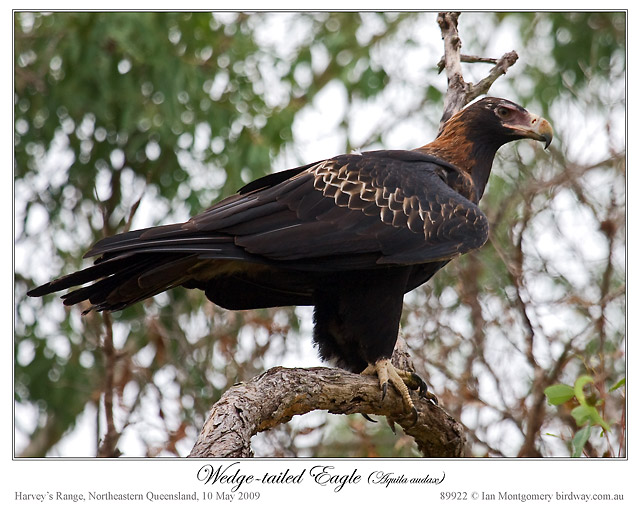
Wedge-tailed Eagles (Aquila audax) and Golden Eagles (Aquila chrysaetos) are very closely related and considered by some to belong to a ‘super-species’. The genus Aquila, the classical eagles, comprises 12 species and all have feathered legs, giving them a trousered appearance as in the first photo. The Wedge-tailed Eagle occurs commonly throughout mainland Australia and southern New Guinea as the nominate race (meaning it bears the same name as the species – audax) and in Tasmania as the endangered race fleayi where only 60 – 80 pairs remain.

Wedge-tailed Eagles (Aquila audax) by Ian

Wedge-tailed Eagles (Aquila audax) by Ian

Eagles have long suffered persecution from landholders by shooting and poisoning because of their supposed predation on livestock, particularly lambs. The Golden Eagle and the White-tailed Sea-Eagle became extinct in Ireland early in the 20th century along with other raptors such as the Red Kite, while the Common Buzzard retained a tenuous toe-hold on Rathlin Island, in Northern Ireland, with about 20 pairs. One of the success stories of conservation in Ireland is that Buzzards have recolonized most of Ireland since the use of Strychnine as a ‘pest’ bait – aimed at foxes and Hooded Crows – was banned in the Irish Republic in 1990. http://www.birdway.com.au/accipitridae/common_buzzard/index.htm

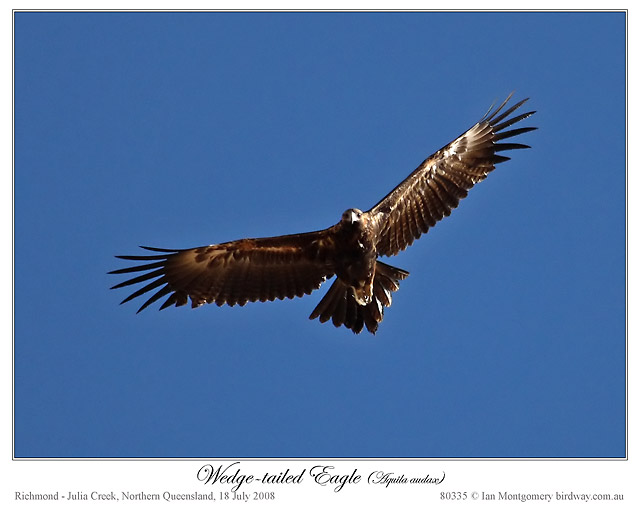
One of my regrets as a youngster in Ireland – even before I became a fanatical birdwatcher – was that the skies of the rugged west coast were empty of large raptors. I felt that a soaring eagle – like the Wedge-tailed in the second photo – was the one thing lacking from such dramatic and romantic landscapes. I have a clear memory of climbing Slievemore (‘big mountain’) in Achill Island, Co Mayo, at the age of 9 or 10 and deliberately misidentifying a kestrel as an eagle and reporting it to my mother. Sensible mothers, like mine (‘yes, dear’), know how to distinguish childish fantasies from deliberate lies. I’ve only just discovered that the name Achill, is though to derive an old Irish word ‘eccuill’ meaning, you’ve guessed it, eagle. http://www.minauncliffcottages.com/achill_island.htm

Back to the present. There was celebration in Ireland in 2007 on the occasion of the first fledging of a (reintroduced) Golden Eagle in the Irish Republic in over a century in Glen Veigh, a national park in Co. Donegal. The 2008 season produced, disappointingly no new recruits, but I read this morning that the same pair has just reared two young (with a bit of help from their friends). Jubilation has been tempered by the poisoning of some of the Golden Eagles in Donegal, some of the reintroduced White-tailed Sea-Eagles in Killarney, Co. Kerry, and Red Kites in Co. Wicklow. Neither of the latter two species have bred yet, so it remains to be seen whether the sheep farmers of Ireland will continue to disappoint romantic kids, young and old, in the 21st century.

If you want to do something, you can add your signature to a petition about these poisonings being organized by the Golden Eagle Trust. As of today, there were nearly 7,000 signatures from 59 countries with Australia coming 9th with 85 signatures.

Best wishes,
Ian

Ian Montgomery, Birdway Pty Ltd,
454 Forestry Road, Bluewater, Qld 4818
Phone: +61-7 4751 3115
Preferred Email: ian@birdway.com.au
Website: http://birdway.com.au


Lee’s Addition:
The eagle is mentioned many times (34 in KJV) in the Bible. They were not to be eaten and I am sure those few remaining pairs are thankful for that. Their strength, rapid and swift flights, gatherings, nests, spreading of wings, and other aspects are mentioned. One of my favorite verses is:

But they that wait upon the LORD shall renew their strength; they shall mount up with wings as eagles; they shall run, and not be weary; and they shall walk, and not faint. (Isaiah 40:31 KJV)

Ian’s Bird of the Week – Spotted Harrier

spotted_harrier_80355

Newsletter: 10-23-09

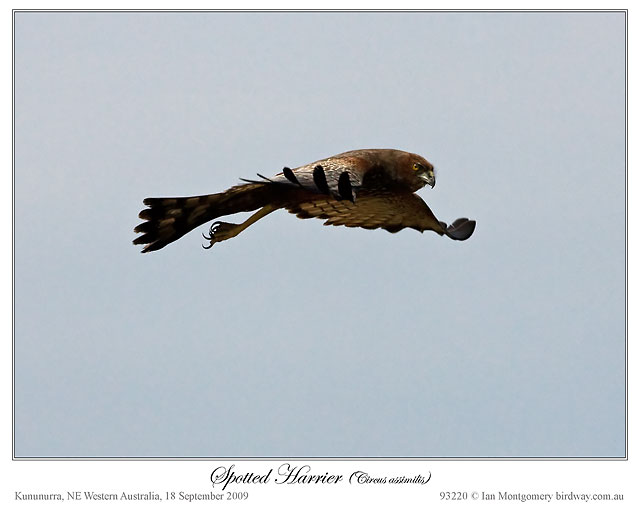
A striking raptor that is encountered regularly in small numbers when travelling through the drier parts of Australia is the Spotted Harrier, and we came across several on the trip to Northern Australia. Harriers hunt by patrolling low over open ground flying buoyantly or gliding with upswept wings, relying on stealth to capture terrestrial prey, such a birds, small mammals and reptiles.

Spotted Harrier (Circus assimilis) by Ian

Spotted Harrier (Circus assimilis) by Ian

Like Grass Owls, they have very long legs for seizing prey in grasslands and they often fly with their legs dangling as in the first two photos. This bird has the characteristic, pale-spotted chestnut underparts of the adult plumage but the upperparts are brownish rather than grey and appears sub-adult. The other bird, taken from below, is an adult and has a grey neck and the chestnut facial disc that gives it a slightly owlish appearance.

The Spotted Harrier has a wide distribution in mainland Australia, but occurs in Tasmania only as a vagrant. In wetter areas such as wetlands, it is replaced by the Swamp Harrier. There are 13 species of Harrier worldwide. All of these nest on the ground, with the exception of the Spotted Harrier which nests in small trees.

Recent additions to the website include:

a distant shot of a Sandstone Shrikethrush
and new photos of:
Golden Bowerbird
Wedge-tailed Eagle
Rainbow Bee-eater
(Far) Eastern Curlew

Spotted Harrier (Circus assimilis) by Ian

Spotted Harrier (Circus assimilis) by Ian

Best wishes,
Ian

Ian Montgomery, Birdway Pty Ltd,
454 Forestry Road, Bluewater, Qld 4818
Phone: +61-7 4751 3115
Preferred Email: ian@birdway.com.au
Website: http://birdway.com.au


Lee’s Addition:

The harrier is not specifically mentioned by name in the Bible, but it is in the same family with the hawks, kites and eagles, which are all mentioned.

Doth the hawk fly by thy wisdom, and stretch her wings toward the south? (Job 39:26)

As Ian said, there are 13 Harriers worldwide. There are also 2 Marsh Harriers and 2 Harrier-Hawks. I have shown all of them in Taxonomic order. There are links to the ones I could find. They are part of the Family Accipitridae, which includes Kites, Hawks & Eagles and all are in the ORDER ACCIPITRIFORMES.

Western Marsh Harrier (Circus aeruginosus) by Nikhil
Eastern Marsh Harrier (Circus spilonotus) ©
Papuan Harrier (Circus spilothorax) ©
Swamp Harrier (Circus approximans) by Ian
African Marsh Harrier (Circus ranivorus) by Africaddict
Reunion Harrier (Circus maillardi) ©
Malagasy Harrier (Circus macrosceles) ©
Long-winged Harrier (Circus buffoni) ©WikiC
Spotted Harrier (Circus assimilis) by Ian
Black Harrier (Circus maurus) Video by Keith
Northern Harrier (Circus cyaneus) by Jim Fenton
Cinereous Harrier (Circus cinereus) ©
Pallid Harrier (Circus macrourus) ©
Pied Harrier (Circus melanoleucos) by Nikhil
Montagu’s Harrier (Circus pygargus) by IanVideo by Keith
African Harrier-Hawk (Polyboroides typus) ©WikiC- Video by Keith
Madagascar Harrier-Hawk (Polyboroides radiatus) ©Wikipedia

Ian’s Bird of the Week – White-breasted Whistler

White-breasted Whistler

White-breasted Whistler

Newsletter: 10/13/2009

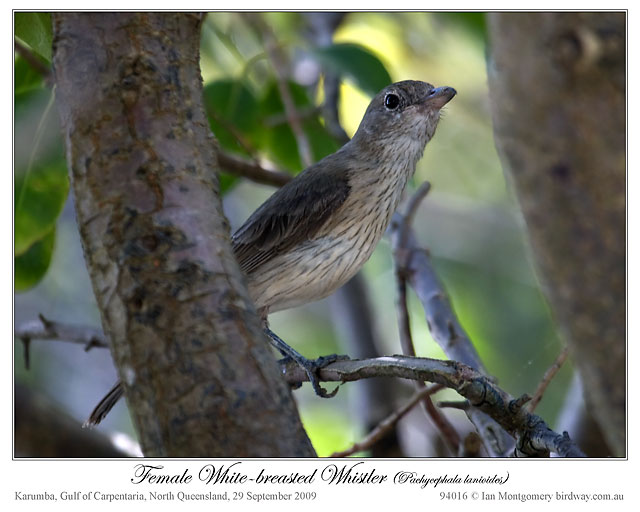
As I was driving south from Katherine, NT, on the first day of my return journey home and faced with the prospect of repeating in reverse the long drive through Mount Isa, Adventure whispered seductively in my ear ‘why not go home via the Gulf of Carpentaria and look for White-breasted Whistlers?’. So, I turned left at Daly Waters and drove to Karumba via Borroloola, NT (first night) and Burketown, QLD (second night). That drive involved about 700 km of gravel road and half a dozen river fords, but I was rewarded on day 2 by great views (no photos though) of a Grey Falcon on the Northern Territory side of the border with Queensland.

Female White-breasted Whistler

Female White-breasted Whistler

I found a female and young White-breasted Whistler – and insufferable numbers of little biting sandflies – in the mangroves at Karumba Point, but no males so I decided to do the sensible thing and go out with Ferryman River Cruises on the Norman River: http://www.ferryman.net.au/ (07) 4745 9155. Not only did Alison and Glen know their birds and where to find them but are also enthusiastic members of the bird of the week list. So, the three of us had a great morning on the river and they found me the White-breasted Whistlers and other good things like Red-headed Honeyeaters. They also have some friendly Black-necked Storks (Jabirus) and various raptors only too ready to put on a good display in return for garfish. So, if you’re ever in Karumba, you know what to do.

White-breasted Whistlers, particularly the females, look like Rufous Whistlers but are much more robust with large, (invariably muddy) hooked bills adapted for feeding in mangroves on invertebrates such as small crabs. The males, first photo, are more distinctive with a completely black head, a rufous collar and a white breast. The large, hooked bill is much more like that of the related Shrike-thrushes and the specific name lanoides refers directly to Lanius, the generic name for (true) Shrikes. The second photo is a young male in the middle of acquiring adult male plumage but still has the streaky buff breast of young birds and females. The third photo shows a female peering coyly through the mangroves. Rufous Whistlers were also present at Karumba Point and the first bird that I got excited about and photographed turned out to be just that. White-breasted Whistlers occur in mangroves in northwestern and northern Australia from Carnarvon in the west to western Cape York in the east.

Recent additions to the website include:
Immature Mangrove Golden Whistler
Additional photos of:
Grey Whistler
Orange-footed Scrubfowl
Hooded Parrot
Red-collared (Rainbow) Lorikeet
Barking Owl

White-breasted Whistler (Immature)

White-breasted Whistler (Immature)

The bushfires in Bluewater are now all under control thanks to the efforts of the fire service and the SES and my house still stands! My thanks to those of you who expressed their concern. I was glad, though, that I cut short my trip to Sydney as the situation was still threatening when I returned.

Best wishes,
Ian

Ian Montgomery, Birdway Pty Ltd,
454 Forestry Road, Bluewater, Qld 4818
Phone: +61-411 602 737
Preferred Email: ian@birdway.com.au
Website: http://birdway.com.au


Lee’s Addition:
Australasian Whistlers make up the bulk of whistlers (Australia with 8 and New Guinea with 15). There are 41 species in 6 genera. They also are found in Southeast Asia and some Pacific Islands. They are known for the melodious songs and I had hoped to find a recording of the bird whistling, but couldn’t find one. Maybe someone can leave a comment with a link to a recording.

I did find a video by Nick Talbot, of a Rufous Whistler singing. It is posted on my Whistlers and Allies page.

They have a head that is rounded and fairly large. “One of their earlier alternative names was ‘thick head’ (from which the Latin family name, Pachycephalidae, is derived).” (From Complete Birds of the World, National Geographic) The birds are between 12-20 cm. or 5-8 in. in length and only weigh .5-1.5 oz. or 13-44 g. Also from the book, “Obvious features are the fairly large, rounded head, short, thick neck, and short, stubby, thick bill. The wings are short and broad, with 10 primaries; in most species the wings are rounded, but in two (including the most migratory), the wing-tips are pointed. Tails vary in length, being longest in the larger species; they have 12 feathers and are squared-ended or slightly notched. The legs and feet are strong, especially in the larger species.”

The whistlers do most of their feeding among the upper foliage of trees and feed on spiders and insects they find on leaves or “hovering in flight.”

Glad he made that different trip home so we can share in his find. I am also glad the fires were in control.

Keep up the great photography and newsletters.

In that day the LORD will whistle for the fly that is in the remotest part of the rivers of Egypt and for the bee that is in the land of Assyria. (Isaiah 7:18 NASB)

See also Ian’s Whistler Pages:
Gilbert’s Whistler
Grey/Brown Whistler
Golden Whistler
Mangrove Golden Whistler
Rufous Whistler
White-Breated Whistlers

Ian’s Bird of the Week – Yellow-rumped Munia/Mannikin

Yellow-rumped Munia by Ian Montgomery

Yellow-rumped Munia by Ian Montgomery

Newsletter – 10/6/2009

Although last week’s bird, the Gouldian Finch, was a welcome encounter in Wyndham my main target in the Kununurra district of NE Western Australia was another finch, the Yellow-rumped Munia or Mannikin (members of the genus Lonchura are usually called Mannikins in Australia and Munias overseas).

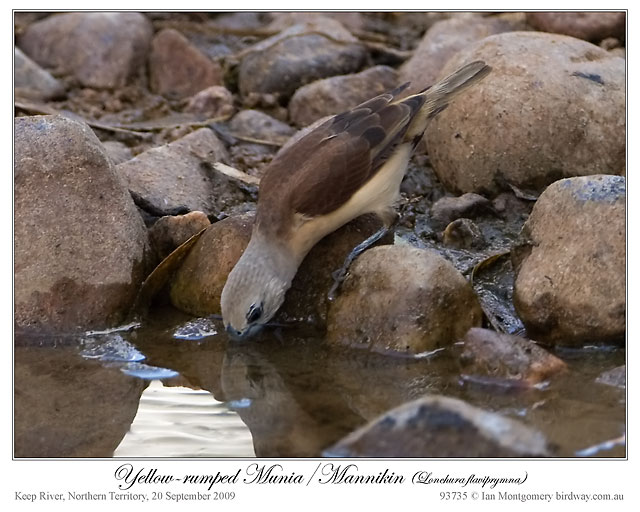
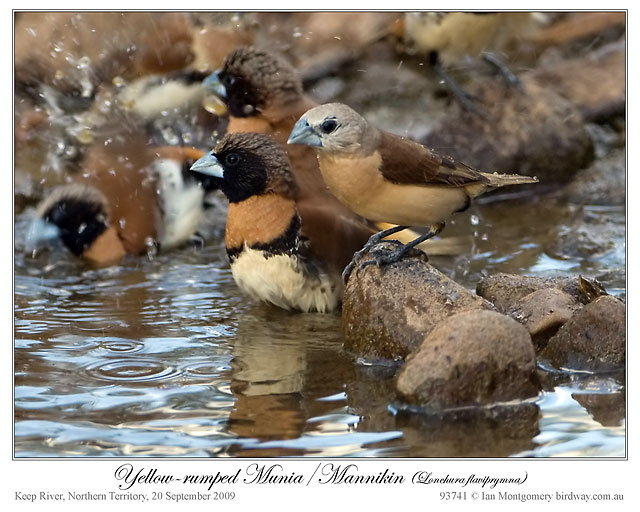
This species has a very restricted distribution, occurring only in the eastern Kimberley and in northwestern Northern Territory. It is supposed to be quite abundant in the Ord River irrigation area near Kununurra. We searched quite diligently in many of its favourite locations without finding any and it wasn’t until, on the return journey, I saw this single bird in the company of Chestnut-breasted Munias/Mannikins at a water hole in the Keep River district on the Northern Territory side of the border.

Yellow-rumped Munia by Ian Montgomery

Yellow-rumped Munia with Chestnut-breasted Munias by Ian Montgomery

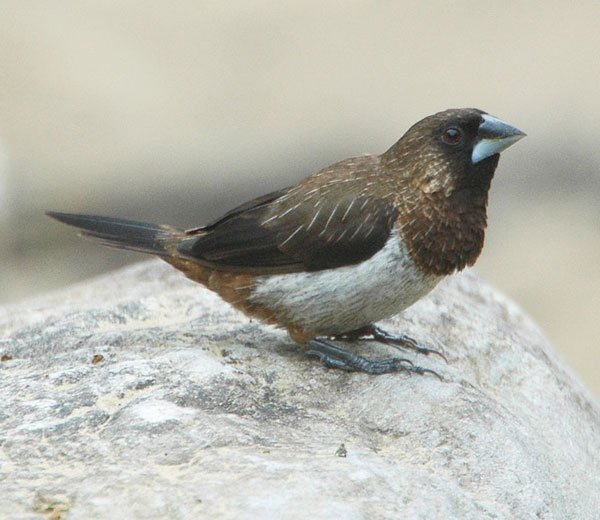
Compared with the almost meretricious plumage of the Gouldians and the exuberance of the bathing Chestnut-breasteds, ‘restrained elegance’ comes to mind in both the appearance and behaviour of the Yellow-rumped: tasteful but subtle colours and decidedly demure beside its frolicking companions. Even when drinking, as in the second photo, it sipped delicately from a high perch as if not wanting to spoil its costume. The Yellow-rumped is closely related to the more widespread Chestnut-breasted and, in addition to consorting together, they sometimes interbreed.

I’m in Sydney briefly for last night’s presentation to Birding NSW. It was an enjoyable evening with a delightful group of people but I am returning home prematurely this afternoon. There were several bushfires burning near my house in unseasonably hot and dry weather and I don’t feel comfortable being away longer than necessary.

I’ve posted a dozen photos of the Gouldian Finches at Wyndham to the website to join several that I took at Mornington Station in the Kimberley five years ago: http://www.birdway.com.au/estrildidae/gouldian_finch/index.htm .

Best wishes,
Ian

Ian Montgomery, Birdway Pty Ltd,
454 Forestry Road, Bluewater, Qld 4818
Phone: +61-7 4751 3115
Preferred Email: ian@birdway.com.au
Website: http://birdway.com.au


Lee’s Addition:


Checked out Ian’s Gouldian Finch photos and they are really neat.

The Munia/Mannikins are in the Waxbill Family of Estrilidae. Their genus, Lonchura, consists of the following birds of which I have included links to photos and videos:

Bronze Mannikin –  Video Lonchura cucullata
Black-and-white MannikinVideo Lonchura bicolor
Red-backed Mannikin Lonchura nigriceps
Magpie Mannikin Lonchura fringilloides
White-rumped Munia Nik – Video Lonchura striata
Javan Munia  –  Video Lonchura leucogastroides
Dusky Munia –  Video Lonchura fuscans
Black-faced MuniaVideo Lonchura molucca
Scaly-breasted Munia Ian’s  – Video Lonchura punctulata
Black-throated Munia  –  Video Lonchura kelaarti
White-bellied Munia Lonchura leucogastra
Streak-headed Munia  –  Video Lonchura tristissima
White-spotted Munia Lonchura leucosticta
Five-colored Munia –  Video Lonchura quinticolor
Tricolored Munia Lonchura malacca
Chestnut MuniaVideo Lonchura atricapilla
White-headed Munia –  Video Lonchura maja
Pale-headed Munia  –  Video Lonchura pallida
Great-billed Munia Lonchura grandis
Grey-banded Munia Lonchura vana
Grey-headed Munia Lonchura caniceps
Grey-crowned Munia Lonchura nevermanni
Hooded Munia Lonchura spectabilis
New Ireland Munia Lonchura forbesi
Mottled Munia Lonchura hunsteini
Yellow-rumped Munia Ian’s Lonchura flaviprymna
Chestnut-breasted Munia Ian’s  –  Video Lonchura castaneothorax
Black Munia Lonchura stygia
Black-breasted Munia  –  Video Lonchura teerinki
Eastern Alpine Munia Lonchura monticola
Western Alpine Munia –  Video Lonchura montana
Sooty Munia Lonchura melaena
Timor Sparrow Lonchura fuscata
Java Sparrow Ian’s Lonchura oryzivora
Pictorella Munia Ian’s Heteromunia pectoralis

Two verses come to mind about these birds. While I was looking for extra photos of the birds, I found many of these birds have been kept as pets and also the diet of most of these is grain and seeds.


For every kind of beast and bird, of reptile and creature of the sea, is tamed and has been tamed by mankind. (James 3:7)
And as he sowed, some seed fell by the wayside; and the birds came and devoured them. (Matthew 13:4)

Ian’s Bird of the Week – Gouldian Finches

#1 Red-headed Gouldian Finch by Ian

#1 Red-headed Gouldian Finch by Ian

Newsletter 10-03-09

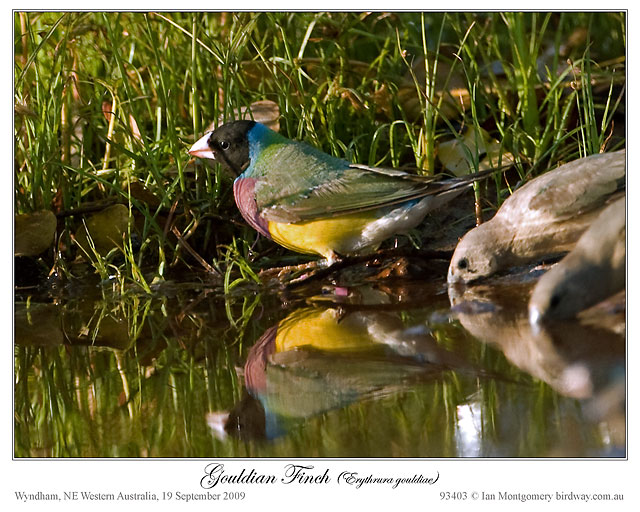
I’m now back home in North Queensland, so it’s perhaps appropriate to select as bird of the week one photographed at the farthest point reached during the trip: Wyndham on the Cambridge Gulf in NE Western Australia. I wanted to go to Wyndham, 100 Km from Kununurra, only because it is on the coast and the journey didn’t seem complete without reaching it. When there, we discovered from the locals that 600 Gouldian Finches were coming in at sunrise to drink at sprinklers in the town.

#2 Black-headed Gouldian Finch by Ian

#2 Black-headed Gouldian Finch by Ian

600 of any endangered species is an awful lot and too good to miss, so a couple of days later I got up at 3:45 am and drove the 100 Km to get there just before sunrise. The usual spot for the finches was very quiet – the Gouldian Finch Recovery Team had been banding them there on previous mornings and had probably put them off it – but I found them at another watering hole nearby. It was possible to drive right up to it, so I stayed in the car and photographed them out of the car window to disturb them less. Naturally, I was too busy to count, but 600 was probably a fair estimate and at one point I had two flocks totally maybe 200 birds in attendance. Most of the birds were juveniles, so they would appear to have had a good breeding season. This was also the case at another water hole near Mary River in Kakadu where we saw maybe 50 Gouldians.

#3 Red-headed with Juveniles

#3 Red-headed with Juveniles

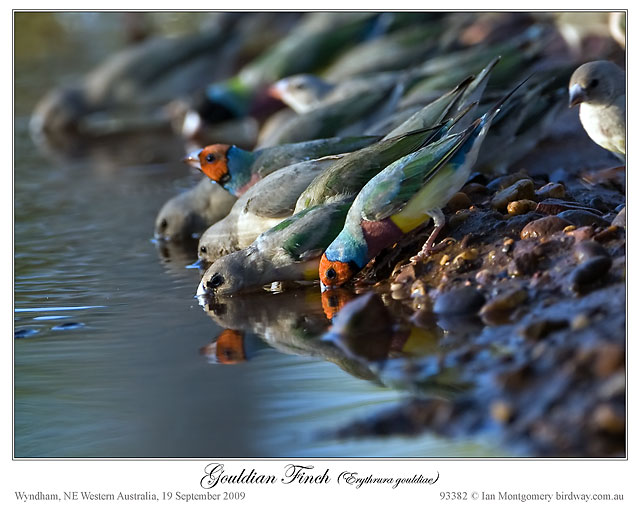
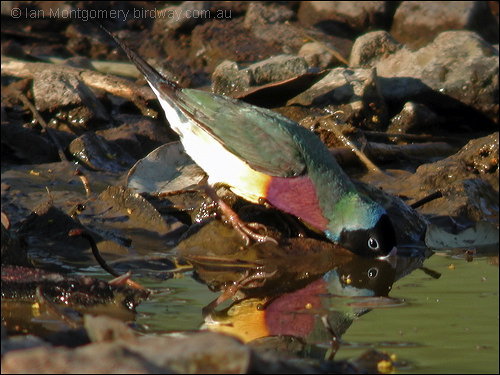
Gouldians come in three forms, depending on the colour of the facial mask. The first photo shows a Red-headed (with, out of focus, a Black-headed in the background and a juvenile in the foreground). The second shows a Black-headed about to drink, beside two juveniles. The third shows two Red-headed birds drinking with juveniles in various degrees of acquiring the adult plumage. The Black-headed is the commonest form (about 75%), then the Red-headed (about 24%) with 1% or less Golden-faced. The females are like the males but less strongly coloured.

I’ve started adding photos from the trip to the website. So far I’ve added:

White-quilled Rock-Pigeon
Chestnut-quilled Rock-Pigeon
Banded Fruit-Dove
Ground Cuckooshrike
Green-backed Gerygone

I’m making a brief visit to Sydney next week to give a talk, with lots of photos, on my 2008 trip to Alaska to Birding NSW on Tuesday 6th Oct. The meeting is open to anyone who would like to attend and is in the Mitchell Theatre, Level 1, Sydney Mechanical School of Arts, 280 Pitt Street, Sydney (between Park and Bathurst): http://www.birdingnsw.org.au/ . The meeting starts at 7:00 pm and my presentation is being preceded by a book launch by author Peter Roberts.

Best wishes,
Ian

Ian Montgomery, Birdway Pty Ltd,
454 Forestry Road, Bluewater, Qld 4818
Phone: +61-7 4751 3115
Preferred Email: ian@birdway.com.au
Website: http://birdway.com.au


Lee’s Addition:
What neat looking finches and what an adventure Ian has been on. I am not sure which was the “earlier bird.” 3:45am is my sleeping time! Thanks, Ian, for getting there so early so we can enjoy your great photos.


Here are some quotes from Wikipedia about the Gouldian Finch:
The Gouldian Finch, Erythrura gouldiae (or Chloebia gouldiae), also known as the Lady Gouldian Finch, Gould’s Finch or Rainbow Finch , is a colourful passerine bird endemic to Australia.”

Gouldian Finch (Erythrura gouldiae) by Ian

Gouldian Finch (Erythrura gouldiae) by Ian

“The Gouldian Finch was described by British ornithological artist John Gould in 1844 and named after his wife Elizabeth. It is also known in America as the Rainbow, Gould, or Lady Gouldian Finch (although Mrs Gould did not hold the title Lady). In Australia it is always called Gouldian Finch. It is a member of the weaver-finch family Estrildidae, which is sometimes considered a subfamily of Passeridae.”
“Gouldian Finches are about 130–140 mm long. Both sexes are brightly coloured with black, green, yellow, red and other colours. The females tend to be less brightly coloured. One major difference between the sexes is that the male’s chest is purple, while the female’s is a lighter mauve colour.

Gouldian Finches’ heads may be red, black, or yellow. People used to think they were three different kinds of finches, but now it is known that they are colour variants that exist in the wild.[1] Selective breeding has also developed mutations (blue, yellow and silver instead of green back) in body colour and breast colour.”

Now Israel loved Joseph more than any other of his sons, because he was the son of his old age. And he made him a robe of many colors. (Genesis 37:3 ESV)

“Juveniles have distinctive colours. Their heads, sides and necks are grey, and their backs, wings and tail feathers are olive green. Their undersides are pale brown. Beaks are blackish with a reddish tip. Their legs and feet are light brown. Newly hatched Gouldian finches are pink and naked until about 12 days old when the beginnings of feathers start to appear. Very young birds also have blue, phosphorescent beads on the sides of their beaks to help their parents see them in the dark.”

“Like other finches, the Gouldian Finch is a seed eater. During the breeding season, Gouldian Finches feed mostly on ripe or half-ripe grass seeds of Sorghum Spc. During the dry season they forage on the ground for fallen seed. During the wet season, Spinifex grass seed [Triodia Spc] is an important component of their diet. So far Gouldians have been recorded as consuming 6 different species of grass seed but during crop analysis researchers have never so far found insects.”

“Gouldian finches generally make their nests in holes in trees, generally within a kilometre or so of water. They usually breed in the early part of the dry season, when there is plenty of food around. The male courtship dance is a fascinating spectacle. When a male is courting a female, he bobs about ruffling his feathers to show off his colours. He expands his chest and fluffs out his forehead feathers. After mating, a female lays a clutch of about 4–8 eggs. Both parents help brood the eggs during the daytime, and the female stays on the eggs at night. When the eggs hatch, both parents help care for the young. Gouldian Finches leave the nest at between 19 and 23 days and are independent at 40 days old.

Young Gouldians are very fragile until their final moult. Some breeders believe parent-raised Gouldians have greater success rearing young than those fostered by other species, such as society or spice finches.

It has been shown scientifically that female finches from Northern Australia are controlling the sex of their offspring, according to the head colour of their male counterpart. Gouldian Finches should not be mated with Gouldian Finches of a different head colour (black-head with red-head etc.) as such a mating will result in an inbalance in the sex ratio of the young, with a greater proportion of male offspring being produced.”

Ian’s Bird of the Week – Grey-crowned Rosy Finch

Grey-crowned Rosy Finch (Leucosticte tephrocotis) by Ian

Grey-crowned Rosy Finch (Leucosticte tephrocotis) by Ian

Newsletter 03-25-09

I have at last finished major changes to the website and can now look forward to turning my attention back to Australian birds. I’m planning trips soon to chase up a few Australian species that haven’t made it to the website yet.

Grey-crowned Rosy Finch (Leucosticte tephrocotis) by Ian

Grey-crowned Rosy Finch (Leucosticte tephrocotis) by Ian

In the meantime, here is yet another bird from St Paul Island in the Bering Sea. Most of the birds there are seabirds or waders and only 4 species of passerine nest there. One is a summer visitor – the Lapland Longspur – while 3 are residents – the Snow Bunting and the Bering Sea races of the Winter Wren and the Gray-crowned Rosy-Finch, both larger than the mainland races. The Rosy-Finch is a startlingly beautiful bird which stands out in the harsh tundra: pink doesn’t mean delicate!

The bird on the rock, in the first photo, is a male, while the second, perched on a garbage container beside the wall of the airport/hotel is a female. This unfortunate bird had just lost its newly fledged offspring to an Arctic Fox which we saw running sneakily away with something in its mouth as we arrived back at the hotel. The mother searched everywhere frantically, calling repeatedly and it was sad to watch.

Artic Fox by Ian

Artic Fox by Ian

Life is tough in the Bering Sea and the foxes have to make do like everyone else. There are no other terrestrial mammals, so their usual diet of Lemmings is missing. Instead they feed all year round on marine invertebrates, particularly sea urchins, and whatever else they can scavenge along the coast including seaweed. In the nesting season, they raid the nests of seabirds and we saw another fox on a cliff top making off with the egg of a Murre (Guillemot). The good news, from an avian point of view, is that there are no resident raptors and the only other scavenger is the resident Glaucous-winged Gull.

The visible changes to the website include a consistent structure for bird families and their index (thumbnail) pages, conforming, as far as possible, to both the Birdlife International taxonomy (definition of families and order of species) for non-Australian birds and to Christidis & Boles (2008) for Australian Birds.

I’ve finished linking all the top-level family indices with Previous and Next buttons so you can now navigate through the more than 130 families represented on the site following the Birdlife International sequence.

Behind the scenes, the changes will make the website easier to maintain and update so I can spend more time taking photographs!

Best wishes,
Ian

Ian Montgomery, Birdway Pty Ltd,
454 Forestry Road, Bluewater, Qld 4818
Phone: +61-7 4751 3115
Preferred Email: ian@birdway.com.au
Website: http://birdway.com.au


Lee’s Additions:


I added links to photos of the birds he mentioned in his newsletter. I always enjoy looking the bird when I see its name.

But we see him who for a little while was made lower than the angels, namely Jesus, crowned with glory and honor because of the suffering of death, so that by the grace of God he might taste death for everyone. (Hebrews 2:9 ESV)

“The Gray-crowned Rosy Finch, Leucosticte tephrocotis, is a medium-sized finch.

Adults are brown on the back and breast and mainly pink on the rest of the underparts and the wings. The forehead and throat are black; the back of the head is grey. They have short black legs and a long forked tail. There is some variability in the amount of grey on the head.

Their breeding habitat is rocky islands and barren areas on mountains from Alaska to the northwestern United States. They build a cup nest in a sheltered location on the ground or on a cliff.

These birds are permanent residents on some islands and in the Canadian Rockies. Other birds migrate south to the western United States.

These birds forage on the ground, many fly to catch insects in flight. They mainly eat seeds from weeds and grasses, and insects. They often feed in small flocks.

At one time, this bird, the Black Rosy Finch and the Brown-capped Rosy Finch were considered to be the same species as the Asian Rosy Finch.”
(From Wikipedia – Gray-crowned Rosy-finch) Gray change to Grey in August 2009

See:  http://rosyfinch.com

Ian’s Bird of the Week – Crested Tern

Newsletter 03-20-09

Crested Tern now Swift Tern (Thalasseus bergii) by Ian

Crested Tern now Swift Tern (Thalasseus bergii) by Ian

Please accept my apologies for a late posting this week.
At the end of January I was in Cairns and we visited Palm Cove, north of the city, to search for an immature Laughing Gull
(http://www.birdway.com.au/larini/laughing_gull/index.htm), that has been spending the Northern winter there. Laughing Gulls are rare trans-Pacific vagrants in Australia and always cause some excitement when they appear.
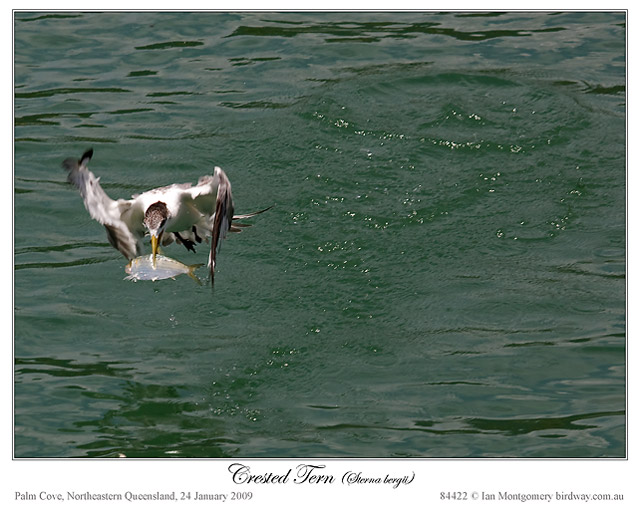
We found, and photographed, the gull okay, but while waiting for it to do its occasional forays for scraps past the fishermen on the wharf, I passed the time by photographing an immature, fishing Crested Tern – right at the other end of the Australian rarity scale and the commonest and most widespread marine tern. As luck would have it, just while I was photographing it flying towards me, it dived and caught, by tern standards anyway, a substantial fish.
Crested Tern now Swift Tern by Ian

Crested Tern now Swift Tern by Ian

In the first photo, you can see the greenish back of the fish at the surface just below the bill of the bird. The tern is braking its fall by spreading its wings and tail and has its feet splayed out in front of it ready for the impact with the water.

In the following photo, less that a second later, the tern has caught the fish expertly over its centre of gravity and is working hard to regain height. It didn’t drop the fish and the tern last disappeared into the distance with its prize.
Terns normally catch quite small fish, so it would be easy to speculate that this was an error of judgment on the part of an inexperienced bird. Or maybe it was just showing off in front of a camera-laden tourist.
One of the reason for a late posting is that I’ve been busy working on the website. The Next and Previous Family links that I mentioned last week now navigate through 30 more families beyond the New World Flycatchers as far as the Swallows. Substantially revised galleries include various Australian families such as:

Recently, I received a copy of a delightful and informative electronic document called ‘How Birds Fly’ by Stuart Cousland that he prepared and presents to schools in Victoria in his role of Education Coordinator for the (Mornington) Peninsula Bird Observers Club (part of BOCA). Some of my photos were used in it. I highly recommend it and copies are available free either on CD or as 5MB email attachment by contacting him on seastar@pac.com.au or (03) 5988 6228.

Best wishes,
Ian

Ian Montgomery, Birdway Pty Ltd,
454 Forestry Road, Bluewater, Qld 4818
Phone: +61-7 4751 3115
Preferred Email: ian@birdway.com.au
Website: http://birdway.com.au


Lee’s Addition:
23-66-1723 Swift Tern (Thalasseus bergii) Breeding by IanThe Crested Tern that Ian mentions was hard to find on the new I.O.C. list. They keep changing names and genus around and the list was update in August this year. The Sterna bergii or Crested Tern was taken out of the Sterna genus and placed in the Thalasseus genus. Then they changed it to Swift Tern. You think that didn’t take some searching to find out it’s new name.
Here are some facts from Wikipedia:”The Greater Crested Tern, Crested Tern or Swift Tern, (Thalasseus bergii), is a seabird in the tern family which nests in dense colonies on coastlines and islands in the tropical and subtropical Old World. Its five subspecies breed in the area from South Africa around the Indian Ocean to the central Pacific and Australia, all populations dispersing widely from the breeding range after nesting. This large tern is closely related to the Royal and Lesser Crested Terns, but can be distinguished by its size and bill colour.”
Swift Tern (Thalasseus bergii) Non-breeding by Ian

Swift Tern (Thalasseus bergii) Non-breeding by Ian

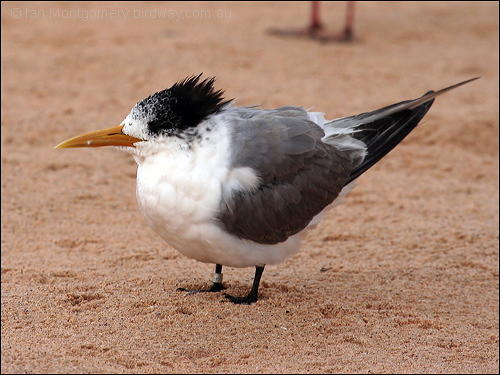
“The Greater Crested Tern has grey upperparts, white underparts, a yellow bill, and a shaggy black crest which recedes in winter. Its young have a distinctive appearance, with strongly patterned grey, brown and white plumage, and rely on their parents for food for several months after they have fledged. Like all members of the genus Thalasseus, the Greater Crested Tern feeds by plunge diving for fish, usually in marine environments; the male offers fish to the female as part of the courtship ritual.”

This is an adaptable species which has learned to follow fishing boats for jettisoned bycatch, and to utilise unusual nest sites such as the roofs of buildings and artificial islands in salt pans and sewage works. Its eggs and young are taken by gulls and ibises, and human activities such as fishing, shooting and egg harvesting have caused local population declines. There are no global conservation concerns for this bird, which has a stable total population of more than 500,000 individuals.”

Swift Tern (Crested) (Thalasseus bergii) by Ian

Swift Tern (Crested) (Thalasseus bergii) by Ian

“The Greater Crested Tern is a large tern with a long (5.4–6.5 cm, 2.1–2.6 in) yellow bill, black legs, and a glossy black crest which is noticeably shaggy at its rear. The breeding adult of the nominate subspecies T. b. bergii is 46–49 cm (18–19 in) long, with a 125–130 cm (49–51 in) wing-span; this subspecies weighs 325–397 g (11.4–14.0 oz). The forehead and the underparts are white, the back and inner wings are dusky-grey. In winter, the upperparts plumage wears to a paler grey, and the crown of the head becomes white, merging at the rear into a peppered black crest and mask.”

The adults of both sexes are identical in appearance, but juvenile birds are distinctive, with a head pattern like the winter adult, and upperparts strongly patterned in grey, brown, and white; the closed wings appear to have dark bars.  The nests are located on low‑lying sandy, rocky, or coral islands, sometimes amongst stunted shrubs, often without any shelter at all. The nest is a shallow scrape in the sand on open, flat or occasionally sloping ground. It is often unlined, but sometimes includes stones or cuttlefish bones.

Fish are the main food of the Greater Crested Tern, found to make up nearly 90% of all prey items with the remainder including cephalopods, crustaceans and insects. Unusual vertebrate prey included agamid lizards and green turtle hatchlings.

“The Great Crested Tern feeds mostly at sea by plunge diving to a depth of up to 1 m (3 ft), or by dipping from the surface, and food is usually swallowed in mid-air. Birds may forage up to 10 km (6 mi) from land in the breeding season.”

The Greater Crested Tern occurs in tropical and warm temperate coastal parts of the Old World from South Africa around the Indian Ocean to the Pacific and Australia.”

Then He said to them, “Follow Me, and I will make you fishers of men.” (Matthew 4:19 NKJV)

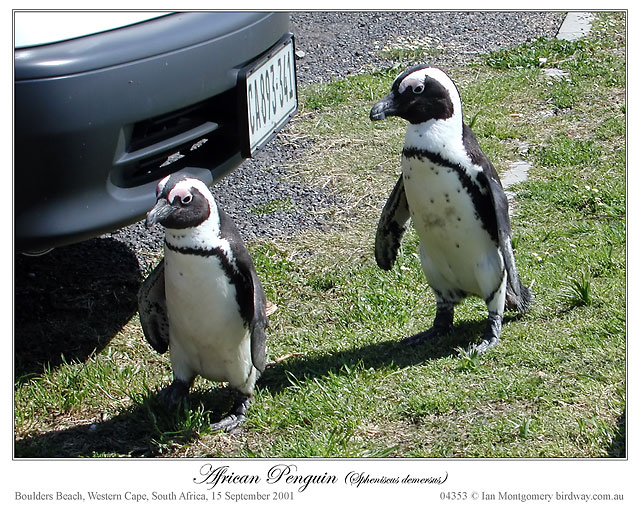
Ian’s Bird of the Week – African Penguin

African Penguin by Ian

African Penguin by Ian

Newsletter – 7/16/2009

Well now, as they say, for something completely different here is the African Penguin. I was reviewing the contents of the website a few days ago, and noticed that there weren’t any penguins. Not having yet succeeded in photographing the only resident Penguin resident in mainland Australia, the Little Penguin, I rectified this by digging out some photos of what used to be called Jackass Penguins that I took in South Africa in 2001.

African Penguins strolling by Ian

African Penguins strolling by Ian

You’re right if you think that the background in the first photo isn’t snow, or even sand for that matter, and your suspicions will be confirmed by the second one – the photos were taken in the car park at Boulders Beach south of Cape Town. (The ‘CA’ of the car number plate refers to the old Cape Province.) The penguin colony is right beside the car park, and I found that the car park itself was the easiest place to photograph these very cooperative subjects.

The name Jackass Penguin refers to the braying sound that these birds make but, as their South American relatives make similar noises and this species is the only one resident in Africa, the name African Penguin is now preferred. Being a cynic, I had thought that the name change was for reasons of political correctness. With a length of 63cm/25in this is a smallish but not tiny penguin – much larger than the Little Penguin (40-45cm/16-18in).

It occurs right around southern Africa from Port Elizabeth in the east to northern Namibia in the west. The colony at Boulders Beach is a tourist attraction, and is something of a bad-news/good-news story. The bad news is that feline predators such as leopards have become less common in populated areas, but the good news is that this has allowed the Penguins to establish mainland colonies at a couple of sites near Cape Town. Two pairs first nested at Boulders Beach in 1982 and there are now over 3,000.

On the website, I recently revised the galleries for Storks, including the Jabiru or Black-necked Stork and Bustards, mainly the Australian Bustard though I’ve added a couple of ancient shots (originally on film!) of the rather similar Kori Bustard of Africa for comparison  .

Best wishes,
Ian

Ian Montgomery, Birdway Pty Ltd,
454 Forestry Road, Bluewater, Qld 4818
Phone: +61-7 4751 3115
Preferred Email: ian@birdway.com.au
Website: http://birdway.com.au


See Spheniscidae – Penguin

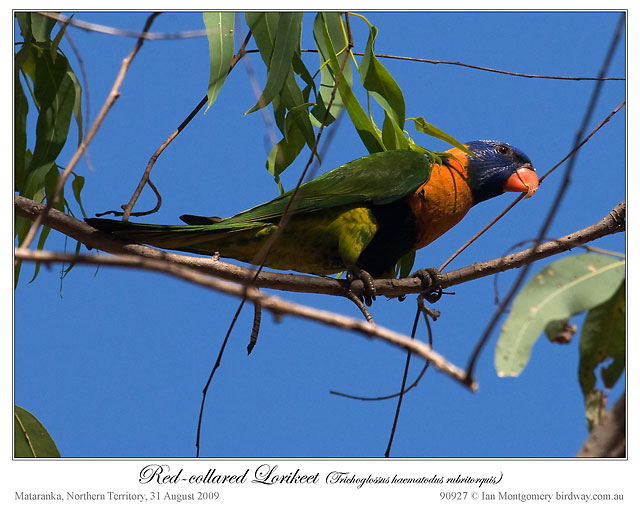
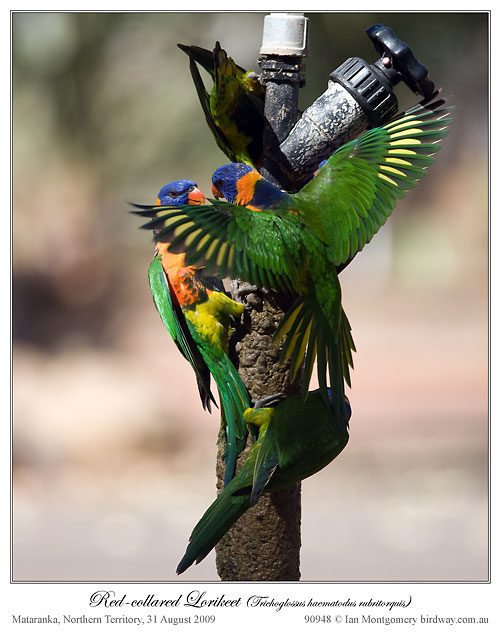
Ian’s Bird of the Week – Red-collared Lorikeet

Red-collared Lorikeet (Trichoglossus rubritorquis) by Ian

Red-collared Lorikeet (Trichoglossus rubritorquis) by Ian

Newsletter 9/3/2009

Here’s the catch-up bird of the week as promised yesterday.

Red-collared Lorikeet (Trichoglossus rubritorquis) by Ian

Red-collared Lorikeet (Trichoglossus rubritorquis) by Ian

If you looked at the photos and said “that’s just a Rainbow Lorikeet!”, you’d be right, sort of, and if you said “that’s like a Rainbow Lorikeet but different” you’d be right exactly. This is the Northern race (rubritorquis) of the Rainbow Lorikeet and is sufficiently distinct to have once been considered a separate species, the Red-collared Lorikeet. The differences include the orange, rather than yellowish-green nape and the orange, rather than red, breast and black, rather than purple, belly.

It’s range is similar to that of the previous bird of the week, the Green-Backed Gerygone – including both the Kimberley district of NW Western Australia and the Top End of the Northern Territory – but it extends farther east around the Gulf of Carpentaria as far as Western Cape York Peninsula in Queensland.

Like the eastern race, this is a noisy, gregarious and common bird and very easy to take for granted. It took an English birder (thank you, Nigel!) to point out how amazingly beautiful and colourful the Rainbow Lorikeets are, a comment that stopped me in my tracks and made me regard them in a new light.

I took these photos during my stopover in Mataranka. This place is famous for its thermal springs which feed the Roper and Little Roper Rivers with permanent water. The water emerges at a temperature of 34ºC/93ºF which would be wonderful in a cold climate, but is far from refreshing when the air temperature is 37º as it was when I was there. For my second swim, I chose to swim with the (shy) Freshwater Crocodiles http://www.birdway.com.au/crocodylidae/freshwater_crocodile/index.htm farther down the Roper River where the water was cooler.

The permanent water makes Mataranka an oasis in a dry landscape with great stands of Fan Palms and Pandanus. The similarity to :Lawn Hill and Adel’s Grove in Northwestern Queensland is more than just a coincidence, as Lawn Hill Creek is fed by the same giant, subterranean, geological structure as Mataranka, perhaps 600-700 km away. The only thing missing at Mataranka is the Purple-crowned Fairywren http://www.birdway.com.au/maluridae/purple_crowned_fairywren/index.htm .

Anyway, time to pack up and leave Darwin for Kakadu. I hope that I’ll have something more special than a mere subspecies for you next week!

Best wishes,
Ian

Ian Montgomery, Birdway Pty Ltd,
454 Forestry Road, Bluewater, Qld 4818
Phone: +61-7 4751 3115
Preferred Email: ian@birdway.com.au
Website: http://birdway.com.au


Rainbow Lorikeet (Trichoglossus moluccanus) by Ian

Rainbow Lorikeet (Trichoglossus moluccanus) by Ian

Lee’s Addition:
Here is a link to the Rainbow Lorikeet that Ian mentioned. He has some fabulous shots of them.

Some interesting facts about the Lories and Lorikeets from Wikipedia:

“The Red-collared Lorikeet, Trichoglossus rubritorquis, is a species of parrot found in wooded habitats in northern Australia (north-eastern Western Australia, northern Northern Territory and far north-western Queensland). It is sometimes considered a subspecies of the Rainbow Lorikeet, but today most major authorities consider them as separate species.[2][3] No other member of the Rainbow Lorikeet group has an orange-red collar over the nape.”

“Lories and lorikeets are small to medium-sized arboreal parrots characterizedby their specialized brush-tipped tongues for feeding on nectar and soft fruits. The species form a monophyletic group within the parrot family Psittacidae. Traditionally, they were considered one of the two subfamilies in that family (Loriinae), the other being the subfamily Psittacinae, but new insights show that it is placed in the middle of various other groups. To date, this issue has not been resolved scientifically. They are widely distributed throughout the Australasian region, including south-eastern Asia, Polynesia, Papua New Guinea and Australia, and the majority have very brightly colored plumage.”

Morphology

Tongue of a Lory


“Lories and lorikeets have specialized brush-tipped tongues for feeding on nectar and soft fruits. They can feed from the flowers of about 5,000 species of plants and use their specialized tongues to take the nectar. The tip of their tongues have tufts of papillae (extremely fine hairs), which collect nectar and pollen. In the wild, lorikeets feed on nectar and pollen from plants and flowers.

Lorikeets have tapered wings and pointed tails that allow them to fly easily and display great agility. They also have strong feet and legs. They tend to be hyperactive and clownish in personality both in captivity and the wild.”

Its leaves were beautiful and its fruit abundant, and in it was food for all. The beasts of the field found shade under it, and the birds of the heavens lived in its branches, and all flesh was fed from it. (Daniel 4:12 ESV)

Ian’s Bird of the Week – Hooded Parrot

Hooded Parrot (Psephotus dissimilis) Male by Ian 1

Hooded Parrot (Psephotus dissimilis) Male by Ian 1

Newsletter 9-23-2009
I’m on a very shaky internet connection in Katherine, NT, so there is no guarantee that this will get through!

After Kakadu, we stayed at Pine Creek NT for a couple of days before heading off to Kununurra WA. Pine Creek’s main claim to fame is that it is the best place in the world to see Hooded Parrots.

The Hooded Parrot is one of three species of Psephotus that nest, or nested, in burrows in termite mounds. Of these, the Paradise Parrot is, alas, extinct, the Golden-shouldered of Cape York is, sadly, endangered, and only the Hooded Parrot of the Top End of the Northern Territory is tolerably secure. That said, its range is limited – South Alligator River in the east to Pine Creek in the west and Mataranka in the south – and is more restricted than formerly.

Hooded Parrot (Psephotus dissimilis) Male by Ian 2

Hooded Parrot (Psephotus dissimilis) Male by Ian 2

Pine Creek has, or at least uses, lots of water in a dry landscape and has lots of sprinklers and a Water Garden. Many birds take advantage of this, including the Hooded Parrot and the proprietor of the Lazy
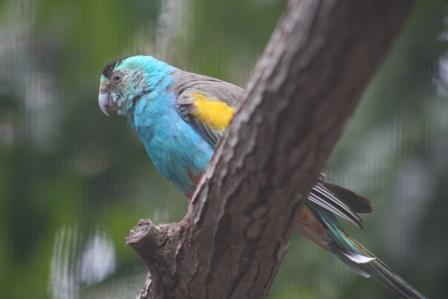
Lizard caravan park told us which sprinkler to turn on at sunrise to attract the parrots. This worked both mornings, and the birds came in to drink at pools forming on the nearby road (the male in photo 1), to
drink and bathe in the wet grass (the male in photo 2) or from the sprinkler itself after it had been turned off (the female in photo 3). We saw 15 – 20 birds each morning, and the proprietor told us that the birds are more numerous than formerly.

Hooded Parrot (Psephotus dissimilis) Female by Ian 3

Hooded Parrot (Psephotus dissimilis) Female by Ian 3

I plan to head back towards Townsville tomorrow. It has been a successful trip: my companion and I are still talking, and I’ve photographed about half of the 35 species on my target list. So, I’ll have some more interesting birds to share with you in the coming weeks.

Best wishes,
Ian

Ian Montgomery, Birdway Pty Ltd,
454 Forestry Road, Bluewater, Qld 4818
Phone: +61-7 4751 3115
Preferred Email: ian@birdway.com.au
Website: http://birdway.com.au


Lee’s Addition:


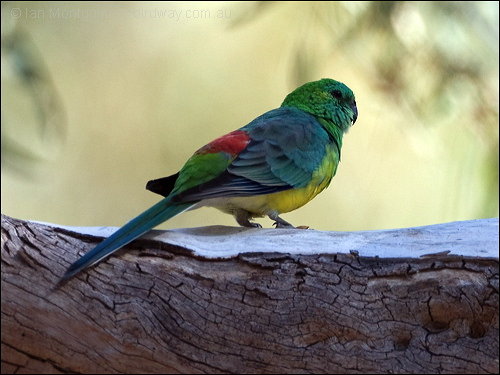
Red-rumped Parrot (Psephotus haematonotus) by Ian

Red-rumped Parrot (Psephotus haematonotus) by Ian

Mulga Parrot (Psephotus varius) by Ian

Mulga Parrot (Psephotus varius) by Ian

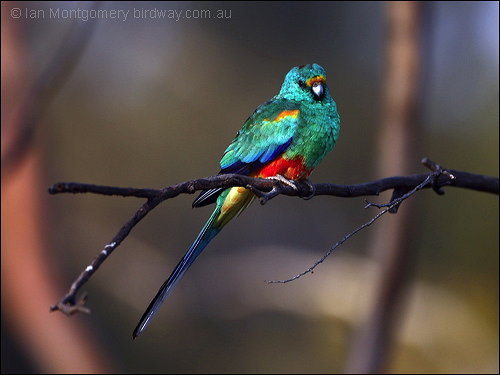
Looking at the genus Psephotus, there are only four left in the world and Ian has photos of three of them on his website. Since he is traveling and has a shaky internet connection, I checked his site and found the other two he has. The Red-rumped Parrot and the Mulga Parrot are shown here.

“The Golden-shouldered Parrot lives in open forest, where it feeds on small grass seeds, principally those of firegrass. An important habitat requirement is the provision of terrestrial termite mounds, which the bird uses for nesting in. This has led to the parrot also being known as the Antbed Parrot.and they can fly good.  The

Golden-shouldered Parrot (Psephotus chrysopterygius) Wikipedia

Golden-shouldered Parrot (Psephotus chrysopterygius) Wikipedia

Golden-shouldered Parrot will build a nest in the taller termite mounds (up to 2 m high), and will dig a burrow into them when the mound has been softened by the rains. A long tunnel is dug down into the mound, and capped off by a nesting chamber. The clutch size is between 3–6 eggs, which are incubated for 20 days. The mound regulates the temperature of the nest in the chamber, so that the eggs can be left unattended while the parents feed.” from Wikipedia

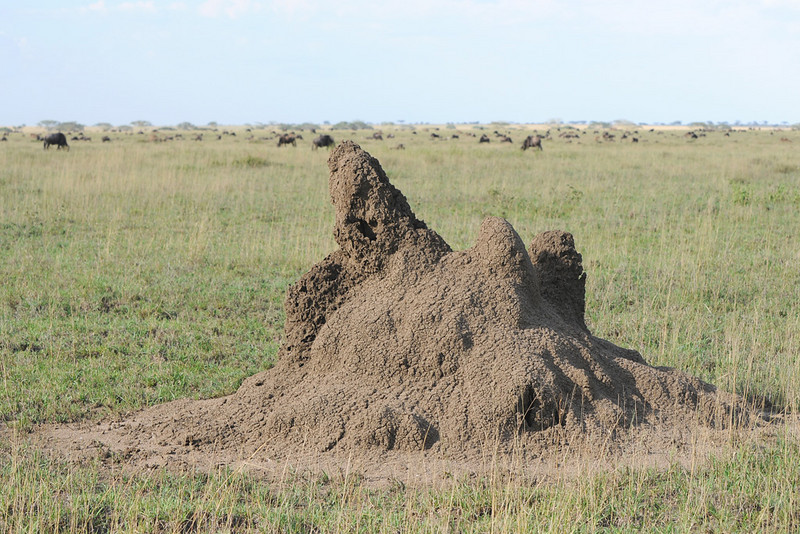
Termite Mound in Tanzania by Bob-Nan

Termite Mound in Tanzania by Bob-Nan

I remembered seeing a termite mound while looking through Bob and Nan’s gallery. This was in Tanzania, but I am sure they are similiar. (I hope)

And Jesus saith unto him, The foxes have holes, and the birds of the air have nests; but the Son of man hath not where to lay his head. (Matthew 8:20 KJV)