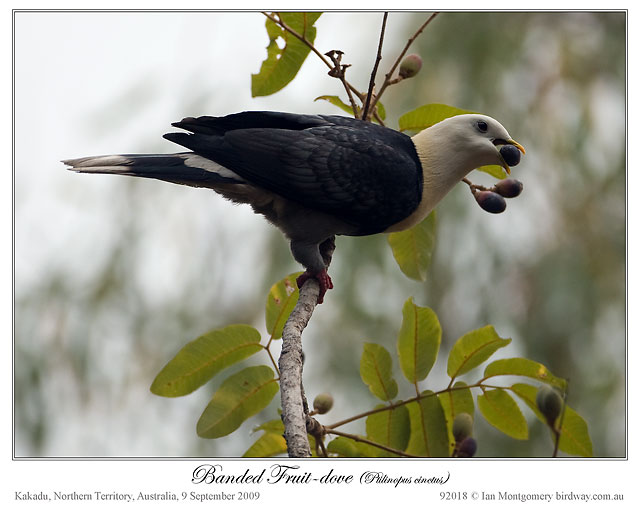
Banded Fruit Dove (Ptilinopus cinctus) by Ian
Ian’s Newsletter – 09/18/2009
We did, in fact, find and photograph the White-quilled Rock-Pigeon on Wednesday, but rather than send another Rock-Pigeon as Bird of the Week, here is another, perhaps more photogenic, member of the pigeon family, the Banded Fruit-Dove. This was on my secondary target list (seen previously but not photographed) but high-priority none-the-less as it’s a splendid bird, uncommon and with a very restricted range in Australia, though it also occurs in Indonesia.
In Australia it occurs only in relict rain-forest patches in gullies of the sandstone escarpments of Arnhem Land and Kakadu. It’s usually shy and, like other fruit-doves, easier to hear than see as it usually keeps to to the foliage of fruiting trees. This bird, however, was gorging itself on the fruit of a tree with sparse foliage and didn’t seem to take much notice of us. It gets its name from the black band across the breast. The white head and breast makes it look rather like the Pied Imperial-Pigeon but is actually a member of the Ptilinopus genus that includes some of Australia’s most spectacular Fruit-Doves, the Wompoo, Rose-crowned and Superb (all at http://www.birdway.com.au/columbidae/index_aus.htm ).
We are still in Kununurra in Western Australia but start the return journey eastwards tomorrow. The hot weather hasn’t relented: it reached 41ºC yesterday, and it is easy to see why the local tourist season is almost finished – only mad dogs and birders etc.
Best wishes,
Ian
—
Ian Montgomery, Birdway Pty Ltd,
454 Forestry Road, Bluewater, Qld 4818
Phone: +61-7 4751 3115
Preferred Email: ian@birdway.com.au
Website: http://birdway.com.au
Lee’s Addition:
So I said, “Oh, that I had wings like a dove! I would fly away and be at rest. (Psalms 55:6 NKJV)
I added links to the other birds Ian mentioned above and more photos below:
Pied Imperial-Pigeon (Ducula bicolor)
Wompoo Fruit-Dove (Ptilinopus magnificus)
Rose-crowned Fruit-Dove (Ptilinopus regina)
Superb Fruit-Dove on a nest (Ptilinopus superbus)
Video of a Banded Fruit-Dove by Mark Sutton at IBC
| Ptilinopus magnificus |







 Lee's Birdwatching Adventures Plus