Graceful Prinia (Prinia gracilis) by Nikhil Devasar
If they
do not eat well
the night before,
they would surely die…That’s why,
the birds sing
at dawn,
to advertise to the world
that,
they are still alive
and that,
they are ready to face
another tough day ahead
in life…
Did you sing
for the LORD
this morning?
Why I ask you this
is cos,
those who are dead
never sing..
Do they?
Wilt thou show wonders to the dead? shall the dead arise and praise thee? Selah. (Psalm 88:10)
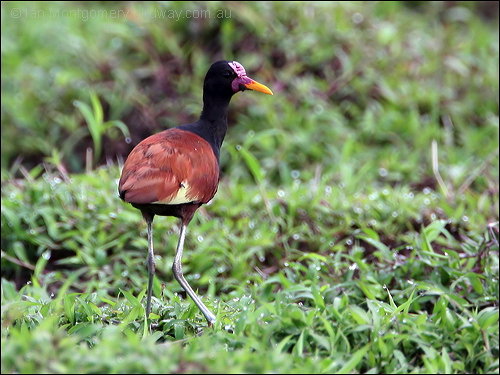
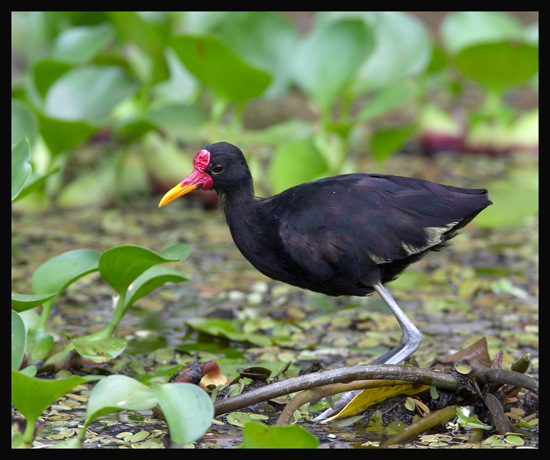
The Wattled Jacana is a wader which is a resident breeder from western Panama and Trinidad south through most of South America east of the Andes. Common in lowlands from Panama to northern Argentina mainly east of the Andes in southern part of range.
Frequents freshwater marshes, lakes and slow-flowing rivers where it wades in damp vegetation or walks on floating water plants, foraging for fish and insects to eat and to build their nests. Lily pads and other floating vegetation in swamps and marshes are home to jacanas.
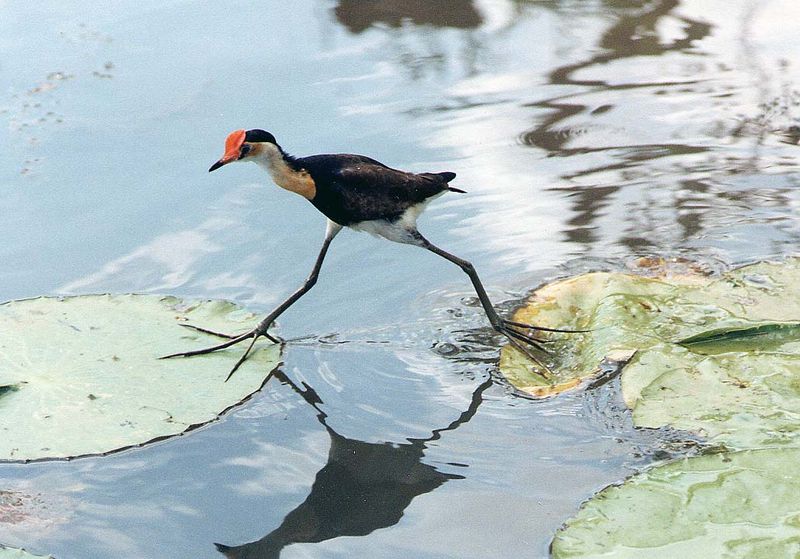
The Wattled Jacana (Jacana jacana) is unmistakable with its exaggerated feet that are fit for a fairy tale and red, turkey like wattles. Also called the lily-trotter, its toes and toenails distribute its weight over large areas to help it sprint across aquatic vegetation as if defying gravity.
People may pass discouraging comments on your height, color, status and so on.. Remember, that our God is not a respecter of person…
The survival of these birds hinges on their exaggerated legs and toes…
God had created everything in us for a specific plan, so that His name maybe glorified…
What people see in you as weakness is in fact, your God made tool for survival…
Brothers saw Joseph as a dreamer, but, God saw him as a redeemer..
People saw Moses as a slow of speech , but God saw him as a leader..
King Saul saw David as a small boy, but, God saw him as a King…
…: for the LORD seeth not as man seeth; for man looketh on the outward appearance, but the LORD looketh on the heart. (1 Samuel 16:7)
Wattled Jacana (Jacana jacana) by Robert Scanlon
The jacana (zhah-suh-NAH) is a skilled swimmer and diver—fitting adaptations for life on the Amazon River. Flooded meadows offer a floating feast of small fishes, insects, snails and vegetation. With its long, thin beak it can pluck bugs and other goodies from the tangles of floating vegetation and even turn plants over to see what’s hiding beneath. During the dry season, jacanas wade along rivers, oxbow lakes and irrigation ditches scavenging for leftovers. If threatened, young chicks, as well as adults, stay underwater for long periods of time with only the tips of their bills above water. They can also swim underwater to avoid predators.
When life threatens, the best chance of survival comes from staying under the Living Water…
We sure can learn this 100% survival technique from these birds…
There is not only 24×7 protection, but also, abundance under the Living Water …
And there shall be a tabernacle for a shadow in the daytime from the heat, and for a place of refuge, and for a covert from storm and from rain. (Isaiah 4:6)
Jacana eggs are true works of art. They are a deep tan color, with very dark markings that look like dribbled lines of paint, crisscrossing the entire egg in an abstract design that is different on each egg. The eggs are very glossy and shiny and look as though they have been highly polished. This “wet” appearance is nature’s camaflouge, helping the eggs resemble the glossy surface of surrounding vegetation.
Males are the primary nest builders, incubators and caretakers. Jacana nests are built on mostly submerged plants. If the nest starts to sink, or the eggs are otherwise endangered, the male may pick them up and carry them under his wings to a new site. It is the male incubates the eggs, with two eggs held between each wing and the breast, and looks after the chicks…
Our God, the nest builder, has built an eternal nest for us in heaven..
Our God, the incubator, incubates our future…
Our God, the caretaker, is the one who takes care of even our smallest need…
He is the one who not only carries us but also our dreams under His wings..
He is the one who holds us close to His bosom..
What an awesome God we have!!!!!
He shall cover thee with his feathers, and under his wings shalt thou trust: his truth shall be thy shield and buckler. (Psalm91:4)
Meanwhile, the female has left the male to find more males to breed with. She does not participate in raising chicks. After the female lays her first nest of four or so eggs, she is freed to find more mates—up to five simultaneously—and lay more eggs. She will aggressively fight with marauding female competitors to both protect her male partners and ensure that she can keep laying eggs. If, however, the eggs or chicks die, she will reunite with the first male and lay another clutch of eggs. These behaviors are a matter of survival, not a lapse of fidelity.
Eve preferred to see the garden all by herself…
If she hadn’t gone out alone, she wouldn’t have fallen into satan’s trap…
Most of us have gone away from His presence only to be battered and bruised..
Like these birds, we come back to God only after dreams die, spirit broken, left alone and feel defeated…
God is still waiting like the father of the prodigal son, arms stretched to embrace us back into His presence…
Are we willing to get back to the basics before The King returns? Note, He will return without prior notice…
Come unto me, all ye that labour and are heavy laden, and I will give you rest.
Take my yoke upon you, and learn of me; for I am meek and lowly in heart: and ye shall find rest unto your souls. For my yoke is easy, and my burden is light. (Matthew 11:28 to 30)
Jacanas are in the Jacanidae Family of eight species. The Jacanidae family is only one of nineteen families in the Charadriiformes Order known as Shorebirds and Allies.
To give an idea of how they walk around on leaves, here is a Comb-crested Jacana (Irediparra gallinacea) by Keith B – A bird walking across water lily leaves.
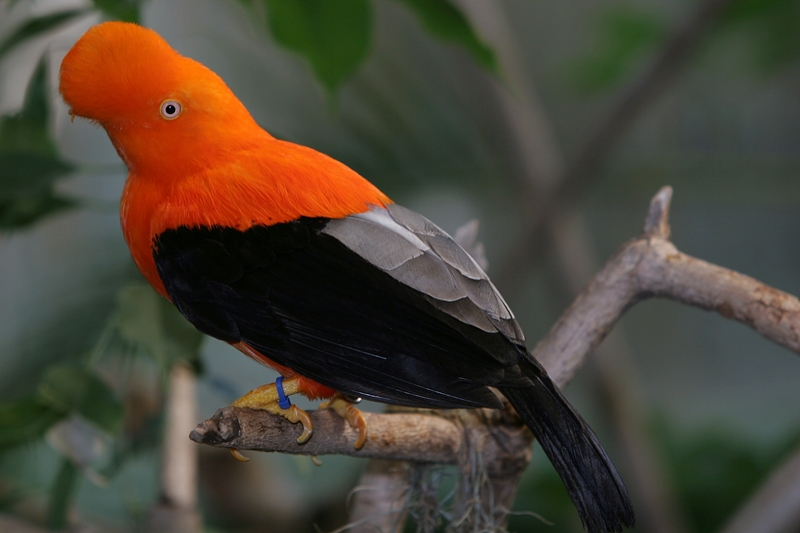
Andean Cock-of-the-rock (Rupicola peruvianus) by SanDiegoZoo
The Andean Cock-of-the-rock – The Changer… ~ by a j mithra
The Andean Cock-of-the-rock is a medium sized bird, living in the Andes, from Venezuela South to Bolivia. It’s one of the most spectacular birds, with strikingly bright colours. Spotting this beautiful bird is not very common, though, as they’re extremely shy and don’t usually fly near humans.
Males displaying by ibirdcollection
Mature males spend much of their time in leks, which are communal courtship sites, where many males gather and practice their “mating dance”. This ritual consists of challenging a rival male for displaying their force, by flapping wings, jumping, running around, nodding and giving off a variety of squawking and grunting calls. When females visit the lek, these “mating dances” become even more intense, more loud and often turn into a display of bright colours and loud, strange sounds. After this, the female chooses the most impressive male to mate with. It is also notable, that due to defecation of seeds by the males, leks are often rich in vegetation.
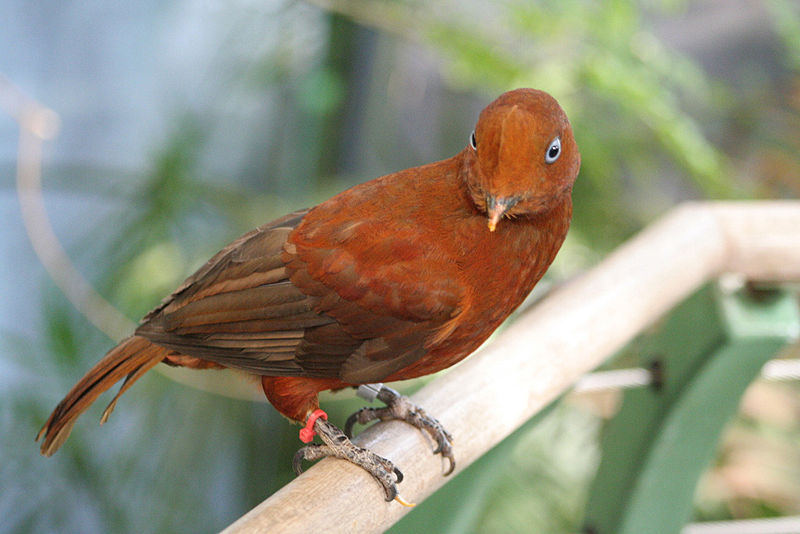
Andean Cock-of-the-rock (Rupicola peruvianus) female by SanDiegoZoo
While the females incubate the Andean Cock-of-the-rock males have gone back to the lek, in search of another female partner. Most of the males’ life revolves around activities in the lek, challenging rivals, practicing their “mating dances” and attracting females, while most of the females’ life concentrates upon nesting and incubating the eggs.
God expects the Church, His the bride, to just concentrate on expanding His kingdom..
His reason for choosing us is not to just warm the church benches, but, to go in search of His lost sheep…
But go rather to the lost sheep of the house of Israel. (Matthew 10:6)
The Cock-of-the Rock is one of the world’s most spectacular birds. It’s fantastic plumage and colorful courtship display equal those of any bird of paradise. It is the national bird of Peru for it’s beautiful plumage, resembling a bird from the paradise. Being one of the most beautiful birds, the Andean Cock-of-the-rock is one of the nature’s wonders.
The Andean Cock-of-the-Rock is distributed in the Andes from Venezuela south to Bolivia, while the Guianan Cock-of-the Rock is found in the more ancient, and highly eroded mountains that lie east of the Andes and north of the Amazon River….
When Moses came down from Mount Sinai after forty days, His face shone radiantly…
These beautiful birds are found in highly eroded mountains… Is that the reason they look so beautiful?
When we dwell on THE ROCK, we sure would turn beautiful like Him… Remember that He had created us in His image…
Arise, shine; for thy light is come, and the glory of the LORD is risen upon thee. (Isaiah 60:1)
When the Cock-of-the-Rock eats fruit, it swallows many of the seeds whole and most of these are not damaged when they pass through its digestive system. Thus, many seeds remain capable of germinating when the Cock-of-the-Rock defecates or regurgitates them at considerable distances from the parent trees. In this way, the Cock-of-the-Rock plays an important role in dispersing seeds of many different species of forest trees. When the Cock-of-the-Rock eats fruit, it swallows many of the seeds whole and most of these are not damaged when they pass through its digestive system.
Since the adult male Cock-of-the-Rock concentrates his time and activities around the lek, and the adult female concentrates her time and activities around cliff nest sites where several females may build nests in close proximity to each other, seeds are deposited more frequently at leks and at nest sites. Once, seeds of 21 species of plants under the perches of males. All were believed to have been defecated or regurgitated by the males.
Likewise, collected droppings under a nest of the Guianan Cock-of-the-Rock in French Guiana, was found to have the seeds of 52 plant species. In an earlier study, collected droppings under 7 nests of the Andean Cock-of-the-Rock at a site west of Cali, Colombia, had the seeds of at least 35 plant species.
Andean Cock-of-the-rock (Rupicola peruvianus) by Wiki
When high densities of seeds are deposited in this way at Cock-of-the-Rock leks or nest sites,and when environmental conditions are favorable for their germination and growth, the abundance and diversity of plant species growing from these seeds can be greatly increased at leks and nests, making the plant communities at these sites different from that of the surrounding forest.
The lek was located on the ridge of a steep granite hill, and its vegetation differed markedly from that of the surrounding forest and nearby ridge tops. While most of the flora at these other sites was fairly homogeneous, the vegetation at the Cock-of-the-Rock lek was a mosaic of plant species typical of many different communities. After analyzing the lek vegetation more thoroughly, researchers concluded that the greater part of it resulted from long-term seed dispersal by Cock-of-the-Rock males.
If the feeding habit of these birds can change the whole environment, our feeding habit on the word of God should have changed everyone around us…
If these birds can change a steep granite hill in to a mosaic of plant species typical of many different communities, so can we with a little help from God change, all stony hearts in to a garden of the Lilly of the valley and the Rose of Sharon…
It all depends on how many seeds we sow and how long we sow without looking at how many had sprouted…
Our job is to just sow and water…
So then neither is he that planteth any thing, neither he that watereth; but God that giveth the increase. (1 Corinthians 3:7)
Andean Cock-of-the-Rock has a close cousin in the Guianan Cock-of-the-rock. They are both in the Cotingidae – Cotinga Family which is part of the Passeriformes Order. The Cotingidae not only has those 2 birds, but 62 others including the Cotingas, Plantcutters, Berryeaters and Fruiteaters, Bellbirds, Pihas, Fruitcrows, a Capuchinbird and 3 Umbrellabirds.
Whip-poor-will (Caprimulgus vociferus) by BirdsInFocus
Whip-poor-wills belong to an unusual family of birds called nightjars – because their loud repetitive songs “jar” the silence of the night – or goatsuckers – because of a superstition that these birds fly into farmyards during the night and drink milk from the livestock.
The name Whip-poor-will and that of many other nightjars – approximates what the bird seems to say.
Whip-poor-wills are thought to migrate individually; however, they are so well synchronized that they tend to arrive in the same place at the same time, giving the impression that they are traveling in flocks. Migrating alone yet arriving at the same place, at the same time.. Amazing!
Though each one of us a journeying alone on life’s highway, all of us are on the verge of migrating forever to the same place at the same time… The Universe is about to close down soon..
Are we getting ready for migration?
And if I go and prepare a place for you, I will come again, and receive you unto myself; that where I am, there ye may be also. (John 14:3)
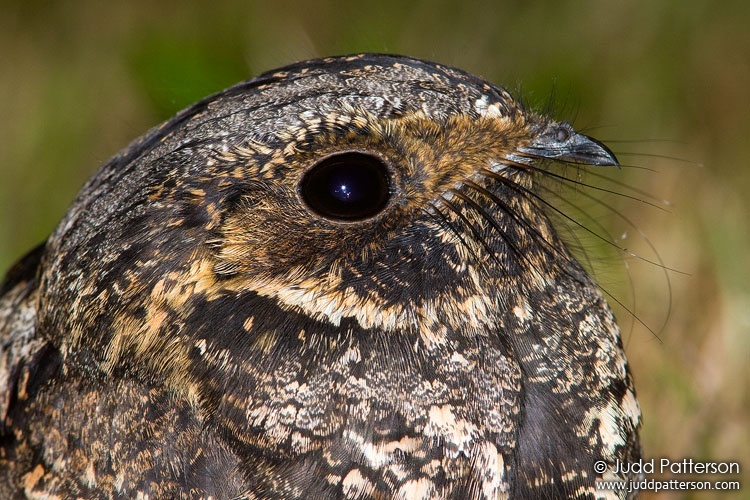
Nightjars have a structure in the eye called the tapitum lucidum. This structure holds tiny oil droplets that allow the retina of the eye to absorb more light, giving the birds superior vision at low light levels. This makes it possible for nightjars to hunt for the abundant insects that appear at dusk and dawn, and on moonlit nights— they watch for flying insects silhouetted against the backdrop of the night sky.
Nightjars have rictal bristles—long stiff bristles that form a comb overhanging the side of the upper beak. The purpose of rictal bristles is uncertain but they may protect the birds’ eyes from large struggling insect prey, or they may function as a net to help catch insects.
The Common Poorwill uses torpor to hibernate through the winter. This bird can lower its body temperature and suspend activity for more than three months when the weather is cold and insects are scarce…
GOD calls us as the Light of the World… But sadly, most people are still in the dark, not able to see THE LIGHT…
The light of the body is the eye: if therefore thine eye be single, thy whole body shall be full of light. ( Mathew 6: 22 )
Whip-poor-will breeding coincides with the full moon in late spring, when insects are plentiful and hunting is easy. The female lays eggs around the time of the full moon when she is well fed and healthy; the eggs hatch about 10days before the next full moon, when it’s easy for the adult birds to catch insects to feed their young; and the young birds are independent by the next consecutive full moon, when it’s easy for them to find their own food.
Some go for it when they think that they are not ready for a baby…
Some go for it due to pressure from their spouses…
Some go for it when they find that, their professional growth may come to a halt..
There are still some in countries like India, who go for it, if the baby is found to be a girl….
That “IT” is what people call as Abortion? Sadly, we human live in a system where Abortion is legal in most countries…
Here the decision of rearing a chick does seem to have been taken by the female bird… But the so called human beings treat Women like incubators…
How dare we take the rights in our hands to stop GOD’s creation?
Do birds use contraceptives or go for an abortion? Birds seem to have control over the timing of birth of their offspring. It is a shame that we don’t have control, or can we call it self-control?
These Birds are so concerned about their offspring’s future, even before they lay eggs.. Whereas we plan after the child is born… Even GOD had created our every need much before we entered our mother’s womb…
Lo, children are an heritage of the LORD: and the fruit of the womb is his reward.” (Psalm 127:3 )
Raising children is a ministry which GOD had given to parents…
Raising them for HIS glory or aborting HIS reward is our choice…
Let GOD give us wisdom to make the right choice at the right time..
Whip-poor-wills say there name and that is one reason it is call that.
Whip-poor-wills are of the Caprimulgidae family which includes Nightjars, Nighthawks, Poorwills, Pauraque, and the Chuck-wills-widow. These are all part of the Caprimulgiformes Order. That Order includes the Nightjars, Frogmouths, Oilbird, and Potoos.
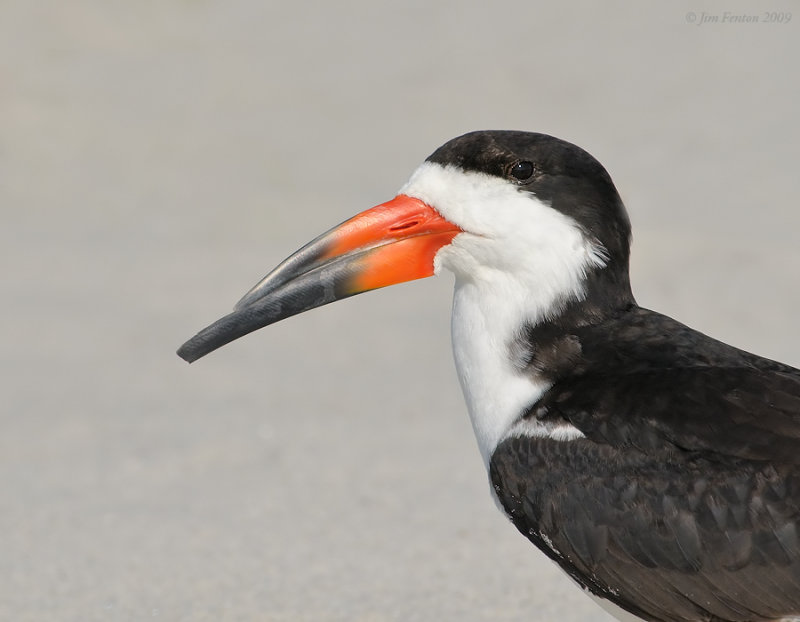
The Black Skimmer – The Graceful Flier… ~ by a j mithra
Black Skimmer (Rynchops niger) by J Fenton
The Black Skimmer, Rynchops niger, is a tern-like seabird, one of three very similar birds species in the skimmer family. It breeds in North and South America.
Northern populations winter in the warmer waters of the Caribbean and the tropical and subtropical Pacific coasts, but the South American races make only shorter movements in response to annual floods which extend their feeding areas in the river shallows.
The Black Skimmer breeds in loose groups and its referred habitats include sandy or gravelly bars and beaches, shallow bays, estuaries, and salt marsh pools. The remarkable bill of the Black Skimmer sets it apart from all other American birds.
The Black Skimmer is the only American representative of the skimmer family. The other two, rather similar, species are the African Skimmer and the Indian Skimmer (by Nikhil). All use the same unusual feeding method.
Black Skimmer (Rynchops niger) by Quy Tran
The Black Skimmer is the only bird species in the United States that has a larger lower mandible than upper mandible. The large red and black bill is knife-thin and the lower mandible is longer than the upper. The bird drags the lower bill through the water as it flies along, hoping to catch small fish. At hatching, the two mandibles are equal in length, but by fledging at four weeks, the lower mandible is already nearly 1 cm longer than the upper. Its use of touch to catch fish lets it be successful in low light or darkness.
Do you feel that your looks are not as good as the others? Do you feel that God could have created you a bit taller or fairer?
God has never done a mistake, but still, we had crucified Him…
If Joseph had not landed into the prison, he would not have become The Prime Minister of Egypt…
If Naaman had not suffered from leprosy, He would not have known the real God…
If Zachcheaus had benn born tall, He too wouldn’t have know God…
God has a purpose in the way He had created us…
If these birds had equal mandible, they would’ve perished, for they would not have known how to fish…
You are unique and God did not create any one like you and He is faithful to finish the work He had started in you…
Being confident of this very thing, that he which hath begun a good work in you will perform it until the day of Jesus Christ: (Philippians 1:6)
Black Skimmer (Rynchops niger) by AestheticPhotos
Skimmers have a light graceful flight, with steady beats of their long wings. They feed usually in large flocks, flying low over the water surface with the lower mandible skimming the water (in order of importance) for small fish, insects, crustaceans and molluscs caught by touch by day or especially at night. They spend much time loafing gregariously on sandbars in the rivers, coasts and lagoons they frequent. Although the Black Skimmer is active throughout the day, it is largely crepuscular (active in the dawn and dusk) and even nocturnal….
These birds seem to know that fish come to the surface of the water in large numbers during night…
That is the reason, they leave alone their younger ones at night, and forage during the night, flying low, skimming the water with their lower mandibles..
It is good to start the day reading the word of God.. But, how many of us read the Bible before going to bed? Do we carry the lamp during the day, or during the night? When darkness surrounds you and you have lost your way. Just read the Bible..
Thy word is a lamp unto my feet, and a light unto my path. (Psalm 119:105)
Do you know that night prayers are more powerful? That is the reason God asks us to watch and pray…
Jesus Himself had set an example of praying all through the night before He chose His twelve disciples….
And it came to pass in those days, that he went out into a mountain to pray, and continued all night in prayer to God. And when it was day, he called unto him his disciples: and of them he chose twelve, whom also he named apostles; (Luke 6:12,13)
Black Skimmer (Rynchops niger) by Ian
Are you in the midst of decision making, which you think may change your life? Just do what Jesus did…
When you watch skimmers, it is neat to watch the trail or path they leave in the water. That brings to mind several passages about paths:
Thus saith the LORD, which maketh a way in the sea, and a path in the mighty waters; (Isaiah 43:16 KJV)
Thou wilt shew me the path of life: in thy presence is fulness of joy; at thy right hand there are pleasures for evermore. (Psalms 16:11 KJV)
Teach me thy way, O LORD, and lead me in a plain path, because of mine enemies. (Psalms 27:11 KJV)
Make me to go in the path of thy commandments; for therein do I delight. (Psalms 119:35 KJV)
Thy word is a lamp unto my feet, and a light unto my path. (Psalms 119:105 KJV)
Enter not into the path of the wicked, and go not in the way of evil men. (Proverbs 4:14 KJV)
Ponder the path of thy feet, and let all thy ways be established. (Proverbs 4:26 KJV)
Keith made a video of a Black Skimmer flying about and dipping its beak. Its head pulls downward as it grabs a fish.
a j mithra has completed another video about the plight of the birds in Louisiana. Here is what he wrote on YouTube:
“The care and help shown by some amazing souls to clean and release the oil birds, inspired me to do this video… Though we live far away from Louisiana, on the other side of the globe, I still feel that, though not directly but indirectly I am also the reason for the disaster… We all have a part in the restoration of nature.. I have done what I could… What about you? Have you planned to do something for Louisiana? If you are not able to, at least you can pray and raise prayer warriors… Isn’t it?”
A righteous man regardeth the life of his beast: but the tender mercies of the wicked are cruel. (Proverbs 12:10 KJV)
Also, he writes:
God asked Noah to take in every species with him in the Ark. For God knew that man’s survival is based on wild life.. If Noah had not taken them into the Ark, he wouldn’t have had a Raven or a Dove to check the water level.. Balaamt wouldn’t have had a donkey to speak to him.. Moses wouldn’t have met God in the burning bush while shepherding his flock… Samson wouldn’t have had a donkey’s jaw bone to kill thousand enemies…Elijah would have starved without a raven to feed him…Well, even our Lord Jesus wouldn’t have had a manger and He wouldn’t have had the chance of going for a donkey ride…
God wanted man to take care of wild life and that is why some of His commandments are as follows…
In like manner shalt thou do with his ass; and so shalt thou do with his raiment; and with all lost thing of thy brother’s, which he hath lost, and thou hast found, shalt thou do likewise: thou mayest not hide thyself. Thou shalt not see thy brother’s ass or his ox fall down by the way, and hide thyself from them: thou shalt surely help him to lift them up again.” (Deuteronomy 22:3-4)
If a bird’s nest chance to be before thee in the way in any tree, or on the ground, whether they be young ones, or eggs, and the dam sitting upon the young, or upon the eggs, thou shalt not take the dam with the young: But thou shalt in any wise let the dam go, and take the young to thee; that it may be well with thee, and that thou mayest prolong thy days. ” Deuteronomy 22:6-7
Pelican caught in the Oil Spill
Every church in every nation is trying hard to reach as many souls as possible for the extension of God’s kingdom before this earth ceases to exist,,, If only the church could take initiative to create an awareness of the importance of preserving nature and if only the believers take part in it, we may not be able to stop this earth from destruction but we can postpone the inevitable.. Through which, we can reach more souls for the extension of God’s kingdom.. Will the church take their next step if not their first step towards restoration of nature?
Well, we may not have Biblical evidence to support my views.. I don’t care if someone says that it is not Biblical to postpone the closing down of the earth.. It is just out of selfishness and the thirst to reach more dying souls before the end of life on earth made me think this way…
When we all raise to restore the wild life, God would surely call us righteous.. Cos, God says, “A righteous man regardeth the life of his beast:… (Proverbs 12:10.)
Who knows? Maybe God may change His mind when two or more are gathered in His name for a righteous cause.. I would like to remind everyone about how Abraham stood before the Lord when God came down to destroy Sodom (Genesis Chapter 18) Let us take care of the wildlife like never before….
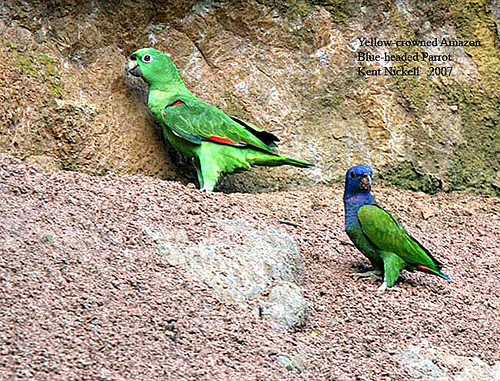
Geophagy, or the phenomenon of eating mineral bound clay is not exclusive to macaws. Even Australian Cockatoos have been documented to seek out clay for medicinal and remedial purposes.
Over the centuries the ancients have known of the healing properties of the so-called, edible clays. Civilizations as culturally diverse as the Essenes, Chinese, Mayans and Anasazi practiced clay healing. In the southwestern deserts of the USA and Mexico, fabled medicine men regularly trekked up to 100 miles to their prized caches of living clay….
GOD remembers that HE created us from dust…
That is the reason that JESUS used clay to create a fresh pair of eyes for a blind man…
He answered and said, A man that is called Jesus made clay, and anointed mine eyes, and said unto me, Go to the pool of Siloam, and wash: and I went and washed, and I received sight. (John 9:11)
Today, clay is being rediscovered not only for mud baths and facials, but also as a topical application for a plethora of human skin problems including: acne, sunburn, Eczema, Psoriasis, and warts, coupled with internal usage, usually 650 mg of 30 – 60 mesh material in capsules or tablets, taken twice daily, in-between meals, steady testimonials stream-in to beauticians, practitioners and health consultants alike, about the reduction of wrinkles, sun spots, varicose veins, and heavy metal accumulations in the vital organs. Several physicians have gone on-record commenting about the positive affects clay, particularly montmorillonite, has had on temperament, and the psychology of certain troubled individuals.
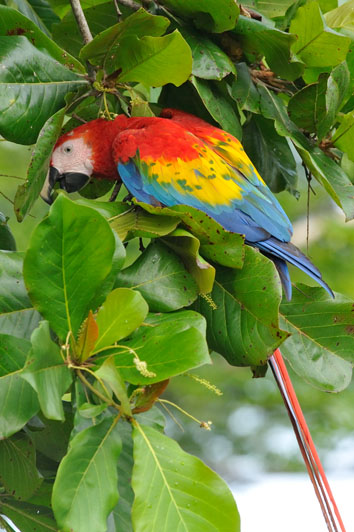
Macaws eat clay from certain river banks from morning 6 am till about 11 am..
Like how some of us spend hours with the beautician and at the gym, yearning to look young and beautiful..
How many hours, or minutes do we spend with the eternal Beautician? Look what happened to Moses after spent 40 days with GOD in Mount Sinai…
And when Aaron and all the children of Israel saw Moses, behold, the skin of his face shone; and they were afraid to come nigh him. (Exodus 34:30)
Looks like GOD owns a beauty parlor too…Isn’t it?
Yellow-crowned Amazon, Blue-headed Parrot by Kent Nickell
Now you have to decide if you really need to go to the beautician, or stay still at home and worship the LORD, so that, the eternal beautician would start beautifying your body, mind and soul..
It is almost axiomatic that behind every illness, malady or deformity, there is a mineral deficiency of one type or another. One of the finest clays for parrots and people alike, is montmorillonite. It is used in pet foods, human supplementation, for livestock and extensively in agriculture. Every member of the food chain benefits from it. Montmorillonite is rich in silicon, one of the most prevalent elements found in the heart and key to the structural integrity of plants and bones because of the synergy it creates with calcium and phosphorous….
Here are some beauty tips,
But he answered and said, It is written, Man shall not live by bread alone, but by every word that proceedeth out of the mouth of God. (Matthew 4:4)
It (HIS commandments) shall be health to thy navel, and marrow to thy bones. (Proverbs 3:8)
It also contains an impressive amount of oxygen, about 50%, due to all of the various oxides found in the clay’s other minerals. On the other hand air is only about 21% oxygen…
If clay contains oxygen, we, whom GOD took from the clay should have oxygen which gives life..
Do we really have JESUS – THE LIFE – THE OXYGEN?
For God so loved the world, that he gave his only begotten Son, that whosoever believeth in him should not perish, but have everlasting life. (John 3:16)
Galah (Eolophus roseicapilla) by Ian
The benefits of clay licking enhanced fertility, increased survival rate of young, fewer psychological abnormalities due to stress, malnutrition, confinement and lack of natural sunlight, more beautiful appearance over all and healthier birds. The Macaws seem to know the importance of clay to live a wrinkle free life…
How many have overcome spiritual deficiency, through our lives? If GOD had taken us from the miry clay, it means, that we should have the qualities of clay? Do others get strengthened through our lives? Do we heal people by our words? Do we bring stress on others’ lives, or give everyone a wrinkle free life? GOD has created, called and commissioned us to heal and not hurt…
How are we?
Out of the same mouth proceedeth blessing and cursing. My brethren, these things ought not so to be. (James 3:10)
Heal the sick, cleanse the lepers, raise the dead, cast out devils: freely ye have received, freely give.” (Matthew 10:8)
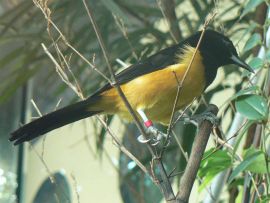
Montserrat Oriole – The Super Survivor ~ by a j mithra
Montserrat Oriole (Icterus oberi) by Wiki
A British led expedition has discovered one of the world’s rarest species of bird surviving yards from the crater of the volcano that devastated the Caribbean island of Montserrat four years ago. Led by a scientist from the Royal Society for the Protection of Birds, the research team found at least 25 pairs of Montserrat Orioles (Icterus oberi) living beneath the rim of the Soufriere Hills volcano.
Since 1997, the birds have remained hidden, marooned by ash in a square-mile patch of forest less than a mile from the crater. They have survived regular showers of volcanic debris and frequently endured rock falls caused by the active crater.
Your life may be marooned by ash and debirs… People may think that you will not survive and your chapter is over… But, when you start serving the Lord, He will start everything afresh for you..
No weapon that is formed against thee shall prosper; and every tongue that shall rise against thee in judgment thou shalt condemn. This is the heritage of the servants of the LORD, and their righteousness is of me, saith the LORD. (Isaiah54:17)
This promise from God is not for everyone you know? It is the heritage of the servants of the Lord…
Start serving the Lord and claim the promise of God…
Montserrat Oriole (Icterus oberi) by Wiki female Zoo Frankfurt
Chris Bowden, the RSPB biologist who led the expedition, said, “It’s incredible to think that one of the last remaining havens for a bird teetering on the verge of extinction is so close to the crater of an exploding volcano. These birds live near the crater of an exploding volcano, and they still survive..
But, no matter how close you’re from danger, remember that, nothing can harm you when Jesus becomes your refugee…
The fiery fire couldn’t consume even a single hair of Shadrach, Meshach and Abednego, when they were thrown inside the furnace..
When thou passest through the waters, I will be with thee; and through the rivers, they shall not overflow thee: when thou walkest through the fire, thou shalt not be burned; neither shall the flame kindle upon thee. ” (Isaiah 43:2)
The oriole once was found in three main areas: the bamboo forest east of Galways Soufrière, the leeward slopes of the Chances Peak mountain and the Centre Hills (especially the Runaway Ghaut area). The diet of the bird consists mainly of insects and fruits…
If God can provide fruits and insects to these birds which lives near a volcano, will He not take care of your needs?
Remember you, whom God created in His own image are more precious than these birds aren’t you?
In common with other members of its genus, the Montserrat Oriole expertly weaves a basket nest which is suspended beneath a leaf of a broad leaved plant. More unusual, the Centre Hills population of orioles uses almost exclusively the leaves of Heliconia caribbaea as a nest plant. Appropriately enough, this is the national plant of Montserrat. This preference is a distinct oddity. It is unusual for a bird to be so specialised on one plant species, and the orioles take it even further, as they avoid both young and old leaves, selecting those that are of intermediate age.
The use of Heliconia leaves is convenient for researchers, making nests rather easy to find, but perhaps an imperfect strategy for the birds. Heliconia leaves are vulnerable to falling over in droughts and under ash fall… And how these leaves are able to hold the nest of these birds in spite of being vulnerable to falling over in droughts and under ash fall?
How these birds are able to select leaves of intermediate age, though it is considered as an imperfect strategy?
We have a God who brings everything from nothing… Human knowledge cannot comprehend His wisdom…
And base things of the world, and things which are despised, hath God chosen, yea, and things which are not, to bring to nought things that are: That no flesh should glory in his presence. (1 Corinthians 1:28,29)
The Montserrat Oriole has a curious relationship with the people of its island home. It is the national bird, and a ubiquitous symbol, seen all over the island in arts, crafts and advertising and is a source of pride and great interest. Yet most Montserratians confess to never having seen one in the wild. Having become Montserrat’s only endemic bird species it has shown a remarkable longevity.
Its ability to withstand the various assaults of volcanic eruptions and hurricanes is undoubtedly one of the reasons for its popularity and it symbolizes the resilience that the people of Montserrat have demonstrated in abundance in recent years.
God has called you to inspire people around you by your presence…
They should see Christ in you and they should say,
… These that have turned the world upside down are come hither also; (Acts 17:6)
The Space sharing seed storing Redpoll… ~ by a j mithra
Common Rosefinch (Carpodacus erythrinus) by Nikhil Devasar
Common Redpolls live year round in open boreal and tundra habitats near the Arctic circle and throughout northern Canada and Alaska. While only the northernmost populations migrate, this species does have periodic irruptions that takes it as far south as northern Montana, Minnesota, Wisconsin, North Dakota, Michigan, New York and the northern New England states.
Common Redpolls have a similar distribution throughout northern Europe and Asia, and they have also been introduced to New Zealand, where they can be commonly found. Breeds in open subarctic coniferous forest and scrub and avoids dense forests. Winters in open woodland and scrub, weedy fields, and suburban and urban areas. They form flocks throughout the year, and they flock even during the nesting season…
Unlike many small birds, Common Redpolls are not aggressive and easily share space with other small bird species…
Do we flock together as one?
The Bible says,
And if one prevail against him, two shall withstand him; and a threefold cord is not quickly broken (Eccleciastes 4:12)
These birds seem to know the secret of staying together. They not only flock together but also share space with the other small birds…
Do we share the blessings which God has showered upon us? We cannot resemble Christ unless we share like how He shared His everything on the cross..
And whosoever shall give to drink unto one of these little ones a cup of cold water only in the name of a disciple, verily I say unto you, he shall in no wise lose his reward. (Mathew 10:42)
Redpolls have throat pouches for temporarily storing seeds. They may fill their pouches with seeds quickly then fly away to swallow the seeds in a more protected, warmer spot.
Do we fill our hearts everyday with the word of God and store them? The kingdom of God is like a seed? How can we sow, if we have not stored enough seeds in our lives? Do you know that the devil also can quote the word of God to deceive us?
Please read Mathew 4:1-11 to know how Jesus was tempted by the devil and how He spoke the word of God to overcome the devil…
When you are pushed into the dark, the word will give you light..
Thy word is a lamp unto my feet, and a light unto my path. (Psalm119:105)
When you are sick, the word will heal you. He sent his word, and healed them, and delivered them from their destructions. (Psalm 107:20)
Now get filled with His Word for Jesus is the Word…
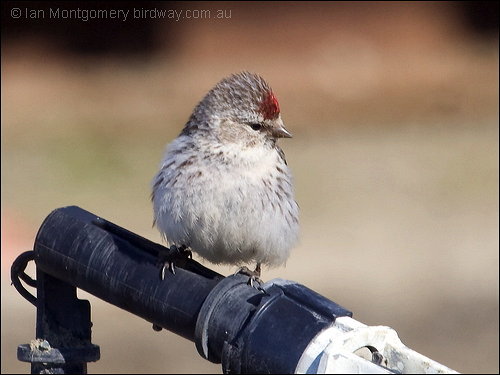
Hoary Redpoll (Carduelis hornemanni) by Ian
The Hoary Redpoll has very fluffy body feathers that help it stay warm in extremely cold temperatures. It has feathers on areas of its body that are bare in most other birds. If temperatures get too warm, it may pluck out some of its body feathers. These feathers will grow back in a few days.
God has given each one of a unique identity to show how special we are.. But, sometimes we may have to get rid of our identity to be elevated to a higher place…
Joseph was the overseer of the household of Potiphar, an officer of Pharaoh… But, when his master’s wife held his garment and asked him to lie with her, Joseph left behind his garment got rid of his identity and ran away… That was the turning point and the launching pad which lifted Joseph to become The Prime Minister of Egypt…
Please read Genesis 39:1to13
Redpolls eat their favorite niger seed or sunflower seeds, seeds of trees such as birch, and of grasses and other plants. On their breeding grounds redpolls also feast on the explosion of buzzing insects that emerge, seemingly without respite in the Arctic summer….
Redpolls feed on small branches, often hanging upside down and uses its feet to hold food items….
A Redpoll finch, or (Common Redpoll – carduelis flammea, bearing a ring with Chinese inscriptions has made a “sensational” trip all the way to Sweden.. The bird, a small finch with a red crown and black chin weighing about 10.5 grams (0.37 ounces), was found on December 29 west of Stockholm, some 6,670 kilometers (4,144.5 miles) from where it was marked in China… While this is the first time a bird marked in China has been found in Sweden, a Redpoll bearing Chinese markings was found in neighboring Norway in 2003 and three birds of the same species marked in Europe have turned up in China.
“This shows that there is some kind of pattern here and that this bird didn’t just happen to fly astray …
If God can take these 10.5 gramme birds as far as 4,114.5miles, will He not carry you to greater heights? When people look at your life they would wonder what kind of pattern did God use, to lift you? Remember, you are much more precious than these birds….
He brought me up also out of an horrible pit, out of the miry clay, and set my feet upon a rock, and established my goings. (Psalm 40:2)
With all the oil that is leaking into the Gulf of Mexico, at this point, Louisiana is taking a direct hit. a j mithra, who lives in India and has seen the destruction of their birds has made the following video. He told me he wept while making the video. Since he is one of our writers, I am posting it here also.
It is hard to watch not only the birds, but all of the wildlife and the people who are being harmed by this oil spill. Our hearts and prayers go out to those whose lives are being so greatly affected. Unfortunately, we are all under the curse and this is just one more example of it. One this is certain, this oil spill did not catch God by surprise.
For I reckon that the sufferings of this present time are not worthy to be compared with the glory which shall be revealed in us. For the earnest expectation of the creature waiteth for the manifestation of the sons of God. For the creature was made subject to vanity, not willingly, but by reason of him who hath subjected the same in hope, Because the creature itself also shall be delivered from the bondage of corruption into the glorious liberty of the children of God. For we know that the whole creation groaneth and travaileth in pain together until now. And not only they, but ourselves also, which have the firstfruits of the Spirit, even we ourselves groan within ourselves, waiting for the adoption, to wit, the redemption of our body. (Romans 8:18-23 KJV)
The Superb Fairywren – The Corporate Mob ~ by a j mithra
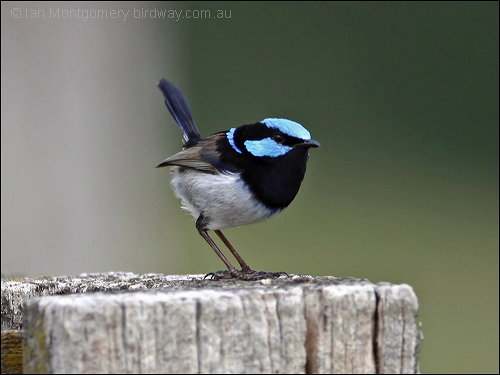
Superb Fairywren (Malurus cyaneus) by Ian
The Superb Fairywren is one of 12 species of the genus Malurus, commonly known as Fairywren, also known as the Superb Blue-wren or colloquially as the Blue Wren, is a passerine bird of the Maluridae family found in Australia and lowland New Guinea..
The Superb Fairywren can be found in almost any area that has at least a little dense undergrowth for shelter, including grasslands with scattered shrubs, moderately thick forest, woodland, heaths, and domestic gardens. It has adapted well to the urban environment and is common in suburban Sydney, Canberra and Melbourne.
Superb Fairywrens are predominantly insectivorous. They mainly eats insects and supplements its diet with seeds. They eat a wide range of small creatures (mostly insects such as ants, grasshoppers, shield bugs, flies, weevils and various larvae) as well as small quantities of seeds, flowers, and fruit….
During winter, when food may be scarce, ants are an important ‘last resort’ food, constituting a much higher proportion of the diet Nestlings, in contrast to adult birds, are fed a diet of larger items such as caterpillars and grasshoppers…
Their foraging, termed ‘hop-searching’, occurs on the ground or in shrubs that are less than two meters high. Because this foraging practice renders them vulnerable to predators, birds tend to stick fairly close to cover and forage in groups….
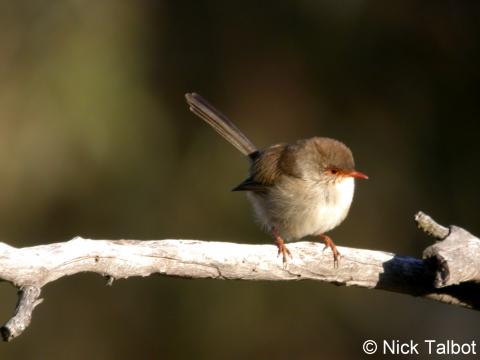
Superb Fairy-wren (Malurus cyaneus) Female by Nick Talbot
The Superb Fairywren is a cooperative breeding species, with pairs or groups of 3–5 birds maintaining and defending small territories year-round. The group consists of a social pair with one or more male or female helper birds that were hatched in the territory, though they may not necessarily be the offspring of the main pair. These birds assist in defending the territory and feeding and rearing the young…
Birds in a group roost side-by-side in dense cover as well as engaging in mutual preening. The group often shelters and rests together during the heat of the day. If only we, as believers, could learn to stick close together, we can easily turn satan, our predator in to a prey…
That is why the Bible says,
For where two or three are gathered together in my name, there am I in the midst of them. Mathew 18:20
Jesus too asked His disciples to go in twos to minister unto people…
Now after these things the Lord appointed seventy others, and sent them two and two before his face into every city and place, whither he himself was about to come. Luke 10:1
Again, if two lie together, then they have warmth; but how can one be warm [alone]? Ecclesiastes 4:11
These beautiful birds seem to know the secret of not only sticking close together, but also, engage in mutual preening…
We may call ourselves as the body of Christ but, when are we going to learn to stick together as one and help one another to grow in the Lord?
Several courtship displays by Superb Fairywren males have been recorded. The ‘sea horse flight’, named for its seahorse-like undulations, is one such display. During this exaggerated flight, the male—with his neck extended and his head feathers erect—tilts his body from horizontal to vertical, and descends slowly and springs upwards by rapidly beating his wings after alighting on the ground.
The ‘face fan’ display may be seen as a part of aggressive or sexual display behaviors; it involves the flaring of the blue ear tufts by erecting the feathers…
These male bird’s tilting of its body reminds us of God’s mercy..
The following verse shows the (horizontal) mercy and (vertical) grace of God…
For as the heaven is high above the earth, so great is his mercy toward them that fear him. As far as the east is from the west, so far hath he removed our transgressions from us. Psalm 103:11, 12
That is the reason Jesus descended slowly from heaven and gave His life for you and me…
Remember He took four thousand years since Adam and Eve to come down from heaven to redeem mankind from sin and shame..
And He ascended rapidly to heaven, to prepare a mansion for us…
Is there a better mating display on the face of the earth than the descending and ascending of our Lord Jesus to save the entire human race? Thank You Jesus, for your mercy and grace…..
Vocal communication among Superb Fairywrens is used primarily for communication between birds in a social group and for advertising and mobbing, or defending a territory. Superb Fairywrens’ alarm call is a series of brief sharp chits, universally given and understood by small birds in response to predators. Females also emit a purr while incubating. The basic, or Type I, song is a 1–4 second high-pitched reel consisting of 10–20 short elements per second and is sung by both males and females. Males also possess a peculiar song-like Type II vocalization, which is given in response to the calls of predatory birds, commonly Grey Butcherbirds (Cracticus torquatus). The purpose of this behavior, which does not elicit a response from other nearby wrens, remains unknown…. It may serve to announce male fitness, but this is far from certain…
Though this bird’s alarm call does not elicit response from other nearby wrens, it never stops reminding others about the presence of the predator through its calls..
No matter how they respond, God has kept us as watchmen over His people to warn about the presence of the predator..
Ezekiel 33:4-7 shows us God’s purpose in our lives…
Then whosoever heareth the sound of the trumpet, and taketh not warning; if the sword come, and take him away, his blood shall be upon his own head
He heard the sound of the trumpet, and took not warning; his blood shall be upon him. But he that taketh warning shall deliver his soul.
But if the watchman see the sword come, and blow not the trumpet, and the people be not warned; if the sword come, and take any person from among them, he is taken away in his iniquity; but his blood will I require at the watchman’s hand.
So thou, O son of man, I have set thee a watchman unto the house of Israel; therefore thou shalt hear the word at my mouth, and warn them from me.
Like all Fairywrens, the Superb Fairywren is an active and restless feeder, particularly on open ground near shelter, but also through the lower foliage. Movement is a series of jaunty hops and bounces, with its balance assisted by a proportionally large tail, which is usually held upright, and rarely still. The short, rounded wings provide good initial lift and are useful for short flights, though not for extended jaunts. During spring and summer, birds are active in bursts through the day and accompany their foraging with song. Insects are numerous and easy to catch, which allows the birds to rest between forays. Food is harder to find during winter and they are required to spend the day foraging continuously…
These birds are restless feeders and they also sing while foraging….
If only we become restless feeders like these birds on the word of God and if only we sing and praise Jesus continuously all through the day, our Lord would encompass us with His presence…
Remember our Lord dwells among our praises…
Be careful for nothing; but in every thing by prayer and supplication with thanksgiving let your requests be made known unto God. (Philippians 4:6)
The Capercaillie is a resident in northern Europe and Asian coniferous forests,especially in hills and mountains, and in the mountains of central eastern Europe. It also has population outposts in the Pyrenees and Scottish Highlands. The Capercaillie is restricted to pinewood habitat in northern Scotland..
It prefers old, open pine forests with lush ericaceous ground cover, though in summer it is occasionally found in mature Oakwood..
Male capercaillies have a complex display that they use to attract females to mate with them in the Spring. This display is usually a communal affair at a traditional site known as a lek, which originates from the Norse word meaning ‘to dance’. They may also use a transient arena or even display from trees in response to the presence of a female. Initially the display song involves tapping and gurgling which accelerates to a drum roll that earned the bird his Gaelic name, capull-choille, the horse of the woods.
This drum roll is followed by a noise which rather resembles a cork being pulled out of a bottle, and the final song phase involves alternating gurgling and wheezing.To many people, this soft dawn song is rather surprising for such a large bird, especially as the purpose is to attract hens from afar. However, it is now recognized that parts of the song are below the human range of hearing. The subsonic part of the call is thought to carry well over distance and to be audible to other Capercaillie.
Like how the soft dawn song of the male is inaudible to human hearing, so is God’s voice inaudible to worldly souls….
God wants to speak to us early in the morning, when others cannot hear it, but, His bride, the Church only can hear it..
But how many Churches are awake early in the morning? Remember, God calls us as His Church…Are we awake at dawn to hear His voice?
Moses rose up early and went to Mount Sinai.. (Exodus34:4)
Joshua and his men rose early and went around the fort of Jericho, (Joshua 6:15)
Most servants of God sought the Lord early and they found the answers for their problems.. Wake up bride, it is time to listen to His voice..
I love them that love me; and those that seek me early shall find me. Proverbs 8:17
During the song the male has his tail held vertical and fanned out, his beak pointing skywards and the wings held out and drooped. In this posture the cock may slowly strut forward and often does a `flutter-jump’ following the cork pop part of the song. This involves leaping rapidly with noisily flapping wings, a brief glide and fluttering or crashing back to the ground. Once the hens have been drawn in to the lekking area, the cock’s display becomes more intense, but less vigorous with the flutter-jumping usually stopping…
During the mating season the males are very aggressive and have been known to attack bird watchers! Direct confrontation between competing suitors frequently occurs and has been described as a “vicious explosion of buffeting wings and snapping bills – the pair may not cease until one is dead”. By the end of the mating season the dominant alpha males often sport various cuts and bald patches from these fights.
Our Lord had to confront satan and in the process, He was battered and bruised for our sins and took the stripes to heal us…
He is the Alpha who sports, nail pierced hand and feet, ploughed back, thorn-crowned head and a spear pierced rib…
He took everything to redeem us, save us and heal us…
But he was wounded for our transgressions, he was bruised for our iniquities: the chastisement of our peace was upon him; and with his stripes we are healed. Isaiah 53:5
In spite of all the sufferings, He is still seen knocking at the door for a space in our hearts? For what? Just to live with us and for us forever and ever…
Behold, I stand at the door, and knock: if any man hear my voice, and open the door, I will come in to him, and will sup with him, and he with me. Revelation 3:20
When are we going to let Him in to take over our lives completely?
The Capercaillie hen lays five to eight eggs in early May. Her nest is a scrape on the ground, frequently in a hollow under a tree. The cock plays no part in the brooding or rearing of the chicks. The precocious buff and reddish chicks all hatch at the same time. At this point they are very vulnerable to a wide range of predators and at a young age they are able to fly short distances over the heather.
The hen is very protective and keeps her brood close to her with muted contact calls. In summer the Capercaillie feed close to and even on the ground. Their diet includes buds, shoots, seeds and berries. This dictates their preference for open pinewood habitats with lush ground cover of heather and dwarf shrubs that provide not only ample food but protection too. In winter they are arboreal and pine needles are eaten by nipping off the leading shoots of conifers.
Capercaillie can be surprisingly nimble when climbing the branches of pine trees. They are renowned for being shy and very difficult to see except during the displaying season. If they are disturbed they will initially freeze; if flushed they take off with a characteristic crashing as the bird leaves the foliage, and they can fly with surprising agility between trees, even in dense forest…
God wants us to freeze like these birds when we are being disturbed… Don’t you remember the following verse?
Be still, and know that I am God: I will be exalted among the heathen, I will be exalted in the earth. Psalm 46:10
Being herbivorous, Capercaillies have a profound effect on the vegetation they browse upon. For example, they act as agents for the dispersal of the berries they eat, especially for the blaeberry (Vaccinium myrtillus).
In the past, Capercaillie have not been highly regarded by foresters because of their winter habit of eating the leading shoots of conifers. In a sparsely wooded area, or where growth is less vigorous, this can check the growth and trees can take up to five years to recover. However, in a large native forest this damage is negligible and indeed adds to the variety and beauty of the shapes of Scots pine trees.
Capercaillie makes full use of a varied pinewood habitat. In winter the birds need pine trees for food and in summer good ground cover of shrubby vegetation for nesting and chick rearing. This reliance on, and exacting needs of, a varied but specific habitat led to their extinction in the past when the forests were destroyed by people.
The dramatic decline of these birds has focused attention on their habitat requirements and has shown that they act as a good indicator of the health and extent of varied mature forest cover.
We, as believers should act as a good indicator of the health of the body of Christ…Churches are being turned into pubs and malls.. Is this a good indication of the health of the body of Christ?
These birds would become extinct without a pinewood habitat…
Without Churches, we believers would become extinct too… Those dark days are not very far off… When the Lord returns, we are answerable to all those dying souls around us.. What are we doing to stop this decline of churches?
I know thy works, that thou art neither cold nor hot: I would thou wert cold or hot. So then because thou art lukewarm, and neither cold nor hot, I will spue thee out of my mouth. Revelation 3:15, 16
Have a blessed day!
Your’s in YESHUA, a j mithra
Please visit us at: Crosstree








 Lee's Birdwatching Adventures Plus