Arctic Terns – The Light Seekers

Arctic Terns – The Light Seekers

Arctic Tern (Sterna paradisaea) by J Fenton

Arctic Tern (Sterna paradisaea) by J Fenton

The Arctic Terns
see more daylight
than the other birds,
cos,
it flies about 19,000 kilometers
from the Arctic to the Antarctic
and back every year
during migration….
Which means,
in its life time
it would travel a distance
equal to going to the moon
and back…
We too can do,
what others can’t
when we see more of
JESUS , THE LIGHT….

But if we walk in the light, as he is in the light, we have fellowship one with another, and the blood of Jesus Christ his Son cleanseth us from all sin. (1John1:7)

A thought from a j mithra

*

The Artic Tern is in the Laridae Family.

*

Birds in Hymns – Prayer For Creation

I do set my bow in the cloud, and it shall be for a token of a covenant between me and the earth. (Genesis 9:13 )

Words: Cathy Yost, 2000. This hymn was the win­ning ent­ry in Oc­to­ber, 2000, of a na­tion­al Cre­a­tion Hymn Com­pe­ti­tion spon­sored by the Cent­ral Pres­by­ter­i­an Church of Hous­ton, Tex­as.
Music: Beach Spring, from the Sac­red Harp, by Ben­ja­min F. White, 1844
Benjamin F. White (1800-1879)

PRAYER FOR CREATION © 2001 Cathy Yost
The author gives permission for use in worship services and gatherings to celebrate God’s Creation.
For further information contact: Cathy Yost, First Presbyterian Church,
100 East Adams Avenue, Kirkwood, MO 63122, USA

Prayer for Creation

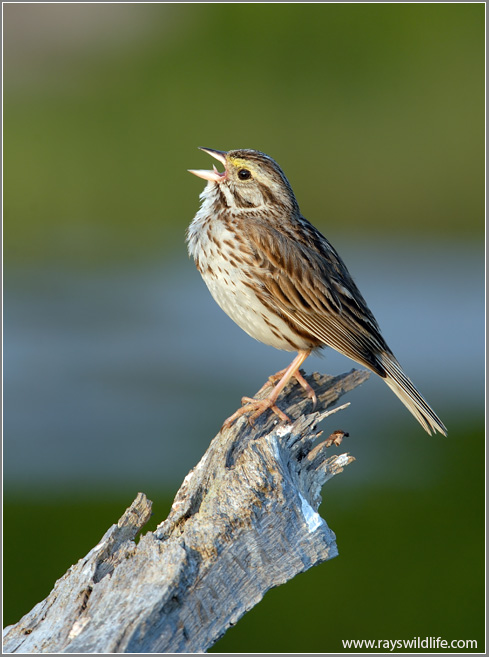
Savannah Sparrow singing by Ray

Savannah Sparrow singing by Ray

O, Creator of the cosmos, we present our hearts in prayer.
We are awestruck by your glory, which surrounds us everywhere.
From the birdsong of the morning to a stormy sky at night,
You reveal yourself in Nature, in its gentleness and might.

Through each rainbow that you send us you renew your covenant
With the earth and all life on it, telling us of your intent
That each living thing should flourish, in its own way, in its place.
You call us to new awareness of our neighbors and their space.

In our eagerness to prosper, we have ravaged what was good.
Using more than what was needed, taking everything we could.
We have changed the gentle order you intended for the earth.
Now we humbly ask the wisdom to be part of its re-birth.

We seek mercy, we seek vision, and the courage we will need
As we work to help the victims of the sins of human greed.
By our choices, in our actions, may we be part of your plans.
Help us gently till the Garden you’ve entrusted to our hands.

Prayer For Creation

Most information from The Cyber Hymnal

See ~ Wordless Birds

More ~ Birds in Hymns

*

Love and Sorrow

Many of my friends have sent me the photos of the Swallow that was hit by a car and then how her mate reacted. I found this YouTube by kirchiman1000 of that email and decided to post it. It shows the feelings and concern that birds have for each other.

The post of Skippy’s birthday a few days ago also shows how the death of their mate affects them. When the Lord created the creatures, he put the ability to love in them. We should learn from them.

But ask the beasts, and they will teach you; the birds of the heavens, and they will tell you; (Job 12:7 ESV)

As the Father hath loved me, so have I loved you: continue ye in my love. If ye keep my commandments, ye shall abide in my love; even as I have kept my Father’s commandments, and abide in his love. These things have I spoken unto you, that my joy might remain in you, and that your joy might be full. This is my commandment, That ye love one another, as I have loved you. Greater love hath no man than this, that a man lay down his life for his friends… These things I command you, that ye love one another. (John 15:9-13, 17  KJV)

He that loveth not knoweth not God; for God is love. (1 John 4:8 KJV)

Worship – Our Mating Song

Worship – Our Mating Song  ~ by a j mithra

Indian Scops Owl (Otus bakkamoena) pairby Nikhil Devasar

Indian Scops Owl (Otus bakkamoena) pairby Nikhil Devasar

If birds
don’t sing,
they wouldn’t find
a mate
and
if they don’t find a mate,
there would be
no reproduction…
If there is no reproduction,
there would a major
Ecological disaster…
If we don’t worship,
the presence of the LORD
wouldn’t be there,
if the presence of the LORD
is missing,
the church would be empty,
if the churches are empty
there would be a
Spiritual catastrophe…

But thou art holy, O thou that inhabitest the praises of Israel. (Psalm 22:3)

A thought from a j mithra

*

The Indian Scops Owl is in the Strigidae Family.

*

Ian’s Bird of the Week – Cape Barren Goose

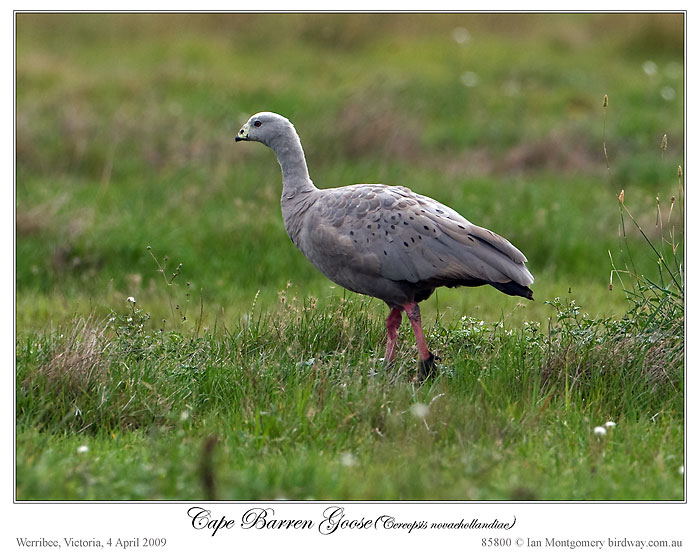
Cape Barren Goose (Cereopsis novaehollandiae) by Ian

Cape Barren Goose (Cereopsis novaehollandiae) by Ian

Ian’s Bird of the Week – Cape Barren Goose ~ by Ian Montgomery

Newsletter 08-14-10

Here’s one, the Cape Barren Goose, from the other end of Australia for a change, taken last year at the euphemistically named Western Treatment Plant at Werribee southwest of Melbourne.

It’s a large goose, to 100cm/40in in length with drooping wing feathers when standing, giving it a slightly 19th Century bustle. It has a large greenish-yellow cere and red legs with black feet. Its range includes Northern Tasmania, the islands of Bass Strait and the south coast of Australia from Victoria in the east to islands near Albany in Western Australia. It’s not particularly common with a population estimated at about 17,000 but the population is stable and it has been introduced to a number of places including Kangaroo Island in South Australia and New Zealand.

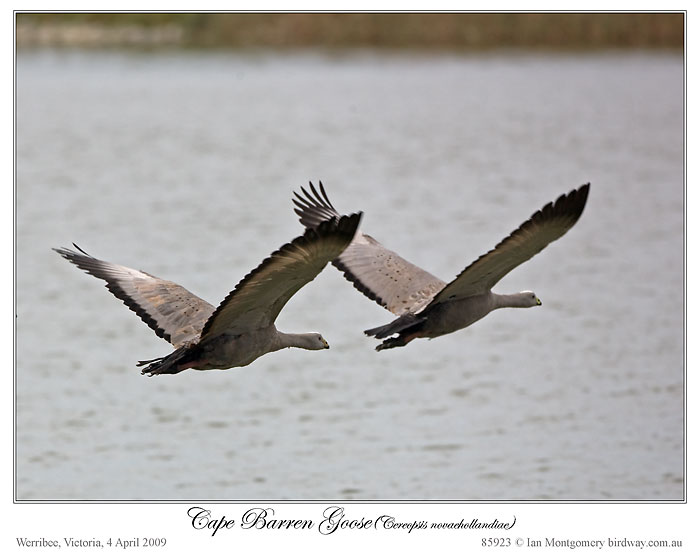
Cape Barren Goose (Cereopsis novaehollandiae) by Ian

Cape Barren Goose (Cereopsis novaehollandiae) by Ian

The birds are grazers and feed on grasslands and cultivated pastures. They are wary, and when they take flight they fly strongly, as in the second photo.

The Birds Australia Congress starts in Townsville this evening and the Campout starts next Monday. So, if you’re attending I’ll look forward to catching up with you. In the meantime, in haste, I haven’t updated Ian’s Picks on the website but will do so when I get a moment and will let you know.

Link: http://www.birdway.com.au/anatidae/cape_barren_goose/index.htm

Best wishes,
Ian


Ian Montgomery, Birdway Pty Ltd,
454 Forestry Road, Bluewater, Qld 4818
Phone: +61-7 4751 3115
Preferred Email: ian@birdway.com.au
Website: http://birdway.com.au


Lee’s Addition:

Looks like Ian is off on another one of his adventures down there in Australia. The Cape Barren Goose is in the Anatidae Family along with Ducks, Teals, Shelducks, Mergansers, Geese, Swans and their allies and are part of the  Anseriformes Order.

And to every beast of the earth and to every bird of the heavens and to everything that creeps on the earth, everything that has the breath of life, I have given every green plant for food.” And it was so. And God saw everything that he had made, and behold, it was very good. And there was evening and there was morning, the sixth day. (Genesis 1:30-31)

*

Disciplined Avian

Disciplined Avian ~ by a j mithra

Orange-bellied Leafbird (Chloropsis hardwickii) by W Kwong

Orange-bellied Leafbird (Chloropsis hardwickii) by W Kwong

Birds are
very disciplined
in every area
of their lives..
Be it,
food selection,
preening their feathers,
their songs,
their courtship,
their nesting,
their migration
and all that they do,
they are so well organized
and disciplined…
We human,
preach about discipline,
but,
never are we disciplined
in practicing what
we preach…

To every thing there is a season, and a time to every purpose under the heaven: (Ecclesiastes 3:1)

A thought from a j mithra

*

The Orange-bellied Leafbird is part of the Chloropseidae Family.

*

Birds of the Bible – The Thrush

Varied Thrush (Ixoreus naevius) by Daves BirdingPix

Varied Thrush (Ixoreus naevius) by Daves BirdingPix

Even the stork in the sky Knows her seasons; And the turtledove and the swift and the thrush Observe the time of their migration; But My people do not know The ordinance of the LORD. (Jeremiah 8:7 NASB)

The Thrush is only used in one verse and then in only the CEV, (ERV), GNB, LITV, NASB, and the NAS77 versions of the Bible.
The other versions translate the word “עגוּר or ‛âgûr” (H5693), pronounced “aw-goor’, as a swallow. H5693 is only used in 2 verses in the Bible, Jeremiah 8:7 and Isaiah 38:14. In Isaiah, the different versions all translate it as a “swallow.”

At any rate, this gives the opportunity to introduce the Thrush. Jeremiah is referring to the migration of the birds and how they know when to go and when to come back, but God’s people don’t always know what is expected of them.

There are two Thrush families, Turdidae Family (184) – most of them and the Muscicapidae Family (297) has some thrushes in it.

Thrushes are plump, soft-plumaged, small to medium-sized birds, inhabiting wooded areas, and often feed on the ground or eat small fruit. They range in size from the Forest Rock-thrush, at 21 g (0.74 oz) and 14.5 cm (5.7 in), to the Blue Whistling-thrush, at 178 g (6.3 oz) and 33 cm (13 in). Most species are grey or brown in colour, often with speckled underparts.

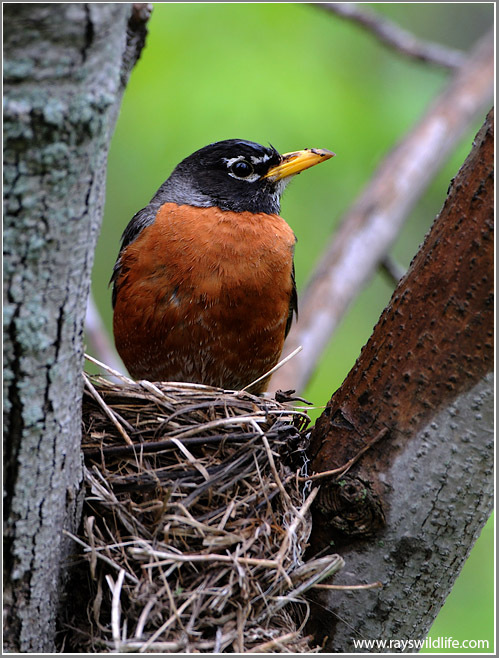
They are insectivorous, but most species also eat worms, snails, and fruit. Many species are permanently resident in warm climes, while others migrate to higher latitudes during summer, often over considerable distances. Our well know American Robin and Bluebirds are part of the Thrush family and are migratory.
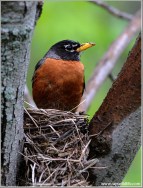
American Robin (Turdus migratorius) in nest by Ray

American Robin (Turdus migratorius) in nest by Ray

Thrushes build nest that are cup-shaped and line them with different things including mud. Both parent help in raising the young,  which normally number two to five per brood. Many have two broods a year.

According to Wikipedia the Turdus Genus has the “true thrushes” and it has 65 species in that genus. According to Scripture, I would venture to say that they are all in the same “kind” and have just been busy obeying the command given them to when they came off the Ark.

Bring out with you every living thing of all flesh that is with you, birds and animals and every creeping thing that creeps on the earth, that they may breed abundantly on the earth, and be fruitful and multiply on the earth. (Genesis 8:17 NASB)

Some examples of their migration:

  • Some species show circuitous migratory routes that reflect historical range expansions and are far from optimal in ecological terms. An example is the migration of continental populations of Swainson’s Thrush, which fly far east across North America before turning south via Florida to reach northern South America
  • The Himalayan Kashmir Flycatcher and Pied Thrush both move as far south as the highlands of Sri Lanka.
  • The Song Thrush breeds in forests, gardens and parks, and is partially migratory with many birds wintering in southern Europe, North Africa and the Middle East;
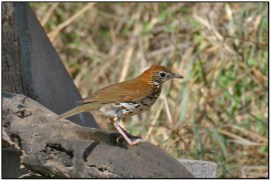
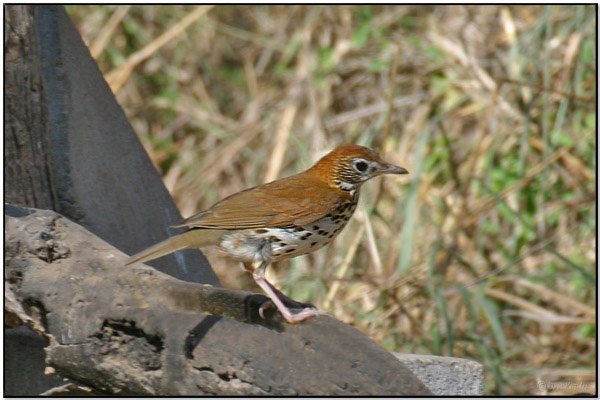
Wood Thrush (Hylocichla mustelina) by Daves BirdingPix

Wood Thrush (Hylocichla mustelina) by Daves BirdingPix

  • The Wood Thrush’s breeding range extends from Manitoba, Ontario and Nova Scotia in southern Canada to northern Florida and from the Atlantic coast to the Missouri River and the eastern Great Plains. It migrates to southern Mexico through to Panama in Central America in the winter, mostly in the lowlands along the Atlantic and Pacific coasts. It generally arrives on the U.S. Gulf Coast during the first week of April. Fall migration usually begins in mid-August and continues through mid-September. Migration takes place at night,[9] allowing them to find their direction from the stars and orient themselves by detecting the Earth’s magnetic field.
  • The Grey-cheeked Thrush migrates to northern South America. This species is a rare vagrant to Europe. Its northerly breeding range and long-distance migration make it one of the more regular North American passerine migrants to cross the Atlantic.
  • The Northern Wheatear makes one of the longest journeys of any small bird, crossing ocean, ice, and desert. It migrates from Sub-Saharan Africa in Spring over a vast area of the northern hemisphere that includes northern and central Asia, Europe, Greenland, Alaska, and parts of Canada. In Autumn all return to Africa, where their ancestors had wintered. Arguably, some of the birds that breed in north Asia could take a shorter route and winter in south Asia; however, their inherited inclination to migrate takes them back to Africa.

The Thrush families are very interesting birds and they definitely migrate. When they were created, their Creator put a destination and a great ability for them to migrate to those places.

For by Him all things were created that are in heaven and that are on earth, visible and invisible, whether thrones or dominions or principalities or powers. All things were created through Him and for Him. And He is before all things, and in Him all things consist. (Colossians 1:16-17 NKJV)

Back to our verse in Jeremiah. The last part of the verse says, “But My people do not know The ordinance of the LORD.”

I like what Matthew Henry said about the whole passage in which the verse is found. Jeremiah 8:4-13:
“What brought this ruin? 1. The people would not attend to reason; they would not act in the affairs of their souls with common prudence. Sin is backsliding; it is going back from the way that leads to life, to that which leads to destruction. 2. They would not attend to the warning of conscience. They did not take the first step towards repentance: true repentance begins in serious inquiry as to what we have done, from conviction that we have done amiss. 3. They would not attend to the ways of providence, nor understand the voice of God in them, Jer_8:7. They know not how to improve the seasons of grace, which God affords. Many boast of their religious knowledge, yet, unless taught by the Spirit of God, the instinct of brutes is a more sure guide than their supposed wisdom. 4. They would not attend to the written word. Many enjoy abundance of the means of grace, have Bibles and ministers, but they have them in vain. They will soon be ashamed of their devices. The pretenders to wisdom were the priests and the false prophets. They flattered people in sin, and so flattered them into destruction, silencing their fears and complaints with, All is well. Selfish teachers may promise peace when there is no peace; and thus men encourage each other in committing evil; but in the day of visitation they will have no refuge to flee unto.”


Wordless Birds

See:

Birds of the Bible – Thrushes (Added 3/14/11)

Birds of the Bible

Birds of the Bible – Thrush Songs

Birds of the World – Turdidae FamilyMuscicapidae Family

*

The Seasons Are Fixed By Wisdom Divine

The trees of the LORD are full of sap; the cedars of Lebanon, which he hath planted; Where the birds make their nests: as for the stork, the fir trees are her house. The high hills are a refuge for the wild goats; and the rocks for the conies. He appointed the moon for seasons: the sun knoweth his going down. (Psa 104:16-19)

Charles H. Gabriel (1856-1932)
Words: Paraphrase of Psalm 104; author un­known.
Music: As­pin­wall, Charles H. Gab­ri­el (1856-1932)

The seasons are fixed by wisdom divine,
The slow-changing moon show forth God’s design;
The sun in his circuit his Maker obeys,
And running his journey hastes not nor delays.

The Lord makes the night, when, leaving their lair,
The lions creep forth, God’s bounty to share;
The Lord makes the morning, when beasts steal away
And men are beginning the work of the day.

Graceful Prinia (Prinia gracilis) by Nikhil Devasar

Graceful Prinia (Prinia gracilis) by Nikhil Devasar

How many and wise Thy works are, O Lord!
The earth with the wealth of wisdom is stored;
The sea bears in safety the ships to and fro,
And creatures unnumbered it shelters below.

Thy creatures all look to Thee for their food;
Thy hands open wide, they gather the good;

Thy face Thou concealest, in anguish they yearn;
Their breath Thou withholdest, to dust they return.

Thy Spirit, O Lord, makes life to abound,
The earth is renewed, and fruitful the ground;
To God ascribe glory and wisdom and might,
Let God in His creatures forever delight.

Before the Lord’s might earth trembles and quakes,
The mountains are rent, and smoke from them breaks;
The Lord I will worship through all of my days,
Yea, while I have being my God I will praise.

Rejoicing in God, my thought shall be sweet,
While sinners depart in ruin complete;
My soul, bless Jehovah, His Name be adored,
Come, praise Him, ye people, and worship the Lord.

**

Most information from The Cyber Hymnal

Graceful Prinia is in the Cisticolidae Family

Look at the birds of the air, for they neither sow nor reap nor gather into barns; yet your heavenly Father feeds them. Are you not of more value than they? (NKJV)

Birds are not exactly mentioned, but they are in Psalm 104 and the Lord does provide for them freely. This is a great hymn and felt it needed to be included.

*

Happy Birthday – Skippy at National Aviary

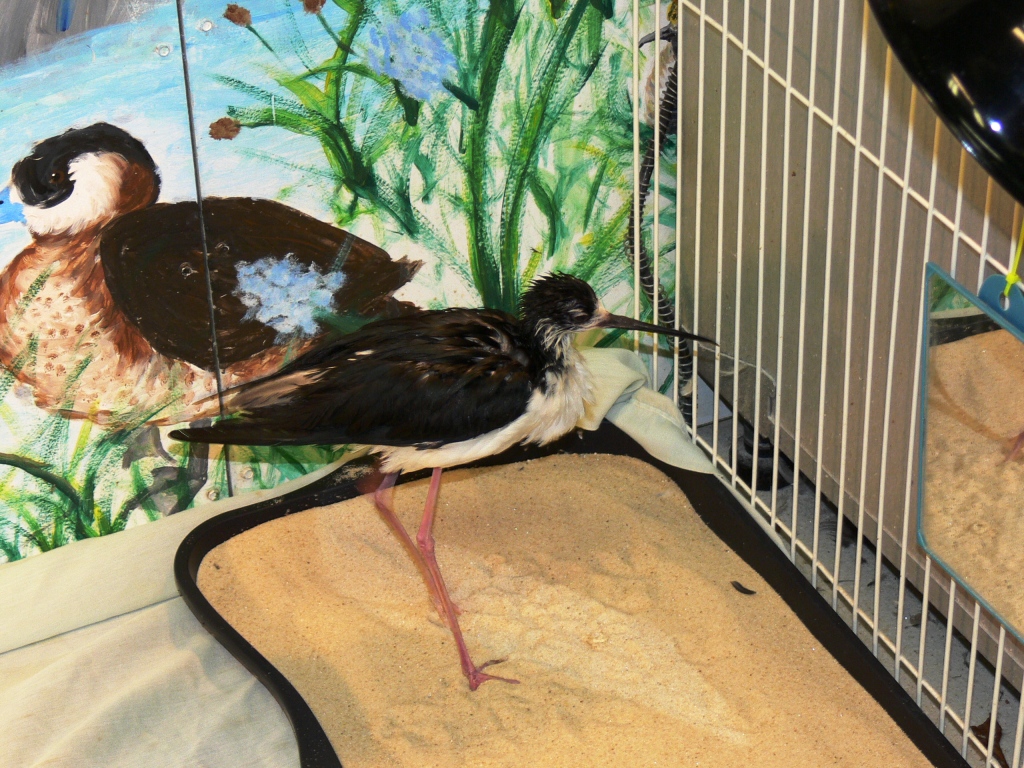
Black-necked Stilt - Skippy

"Skippy" - Black-necked Stilt

Today is the 23rd birthday of “Skippy” the Black-necked Stilt. We met him on Friday at the National Aviary in Pittsburg, PA. Dan and I had the privilege of visiting  the National Aviary recently and thoroughly enjoyed our two days we spent there. “Skippy” is not on exhibit, but is behind the scenes and well taken care of by the hospital staff.

We were given some very special treatment at the Aviary and were allowed to see several of their “behind-the-scenes” operations. The hospital, breeding room, kitchen, an outdoor exhibit (closed right now) and other places were shown. I am thankful for meeting the “bird nurse” the day before our visit at a book store. I was looking at the bird books (of course) when I met Sarah. Long story short, she told us that she would show us around and did she ever. This is just the first of the articles to be written about the Aviary.

National Aviary Hospital Sign

National Aviary Hospital

We were in the Hospital section where the older birds are kept. These are ones who have been active in shows or have just been there a long time and are sort of in their “geriatric” stage of life. The birds there are kept comfortable and their health is maintained as well as can be. They are all very special and each had a story attached to them. I sort of felt right a home in there, since I have my fair share of aches and pains as I age.

We met “Skippy” who is kept in an area that has a fence (around it to create a pen). I may not get all the details right (I’m getting old, remember), but when his life long mate died, he wanted to give up and was very sad. That caused his health to deteriorate and he ended up in the “hospital.”  In memory of his sweetheart, they had painted a mural on the wall. One day he discovered the painting of his mate and parked right there beside it. His health started improving. They decided to put a fence around that area and that is where we found him the other day.

Today is Skippy’s birthday and he turns 23. HAPPY BIRTHDAY, SKIPPY! He is one of the longest known living Black-necked Stilts. The photo shows him beside the painting of his mate and a part of his pen. There is a mirror hanging there which he love to look in.

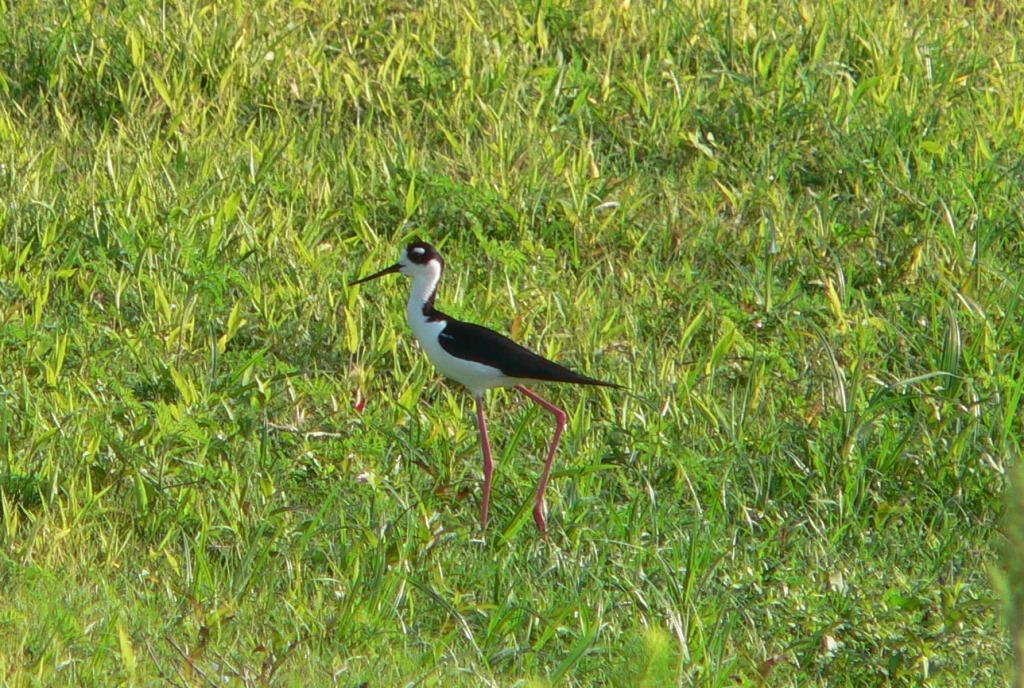
Black-necked Stilt at Circle B Bar Reserve

Black-necked Stilt at Circle B Bar Reserve by Lee

Black-necked Stilts (Himantopus mexicanus) are in Recurvirostridae Family which includes Avocets and Stilts. There are only 11 species in the family. They are in the Charadriiformes Order. This Stilt is a locally abundant shorebird of American wetlands and coastlines. We see them quite frequently around our area. I saw my first one in 2000 in the Rockport, TX.

“Adults have long pink legs and a long thin black bill. They are white below and have black wings and backs. The tail is white with some grey banding. A continuous area of black extends from the back along the hindneck to the head. There, it forms a cap covering the entire head from the top to just below eye-level, with the exception of the areas surrounding the bill and a small white spot above the eye. Males have a greenish gloss to the back and wings, particularly in the breeding season. This is less pronounced or absent in females, which have a brown tinge to these areas instead. Otherwise, the sexes look alike. (From Wikipedia)

They usually have 3-5 young and both of them take turn incubating the eggs for 22-26 days. The young can be swimming within 2 hours of birth. Check out the Aviary’s webpage on the Black-necked Stilt for more information about it.

Who teacheth us more than the beasts of the earth, and maketh us wiser than the fowls of heaven? (Job 35:11)

Is it wrong to be sad when someone dies? I think Skippy was only showing his love and concern for the bird he had spent so much time with.

When Jesus therefore saw her weeping, and the Jews also weeping which came with her, he groaned in the spirit, and was troubled, And said, Where have ye laid him (Lazarus)? They said unto him, Lord, come and see. Jesus wept. Then said the Jews, Behold how he loved him! (John11:33-36)

Birds – Watchers of Light

Birds – Watchers of Light ~ by a j mithra

American Golden Plover (Pluvialis dominica) at National Aviary by Lee

American Golden Plover (Pluvialis dominica) at National Aviary by Lee

Changes in the
level of sunlight,
causes migratory birds
to migrate…
Are you ready
to migrate
to heaven?
Cos,
the darkness
is fast approaching
and
THE LIGHT
is on the way
to trigger the migration
for the last time…

Watch therefore, for ye know neither the day nor the hour wherein the Son of man cometh. Mathew (25:13)

A thought from a j mithra

*

The Pacific Golden Plover is in the Charadriidae Family and a long distance migration bird.

*

Birds in Hymns – Thou Sweet, Beloved Will Of God

And be not conformed to this world: but be ye transformed by the renewing of your mind, that ye may prove what is that good, and acceptable, and perfect, will of God. (Romans 12:2 KJV)

Words: Ger­hard Ter­steeg­en, Geist­lich­es Blum­en-Gärt­lein, first edi­tion, 1729, Book III, number 19 (Lieb­wer­ther, süss­er Gott­es-Wille); trans­lat­ed from Ger­man to Eng­lish by Em­ma Be­van, 1858.

Music: Holl­ey, George Hews, 1835 .
Al­ter­nate tune: •Abends, Her­bert S. Oak­e­ley, 1874

This is the Abends tune by Oakeley

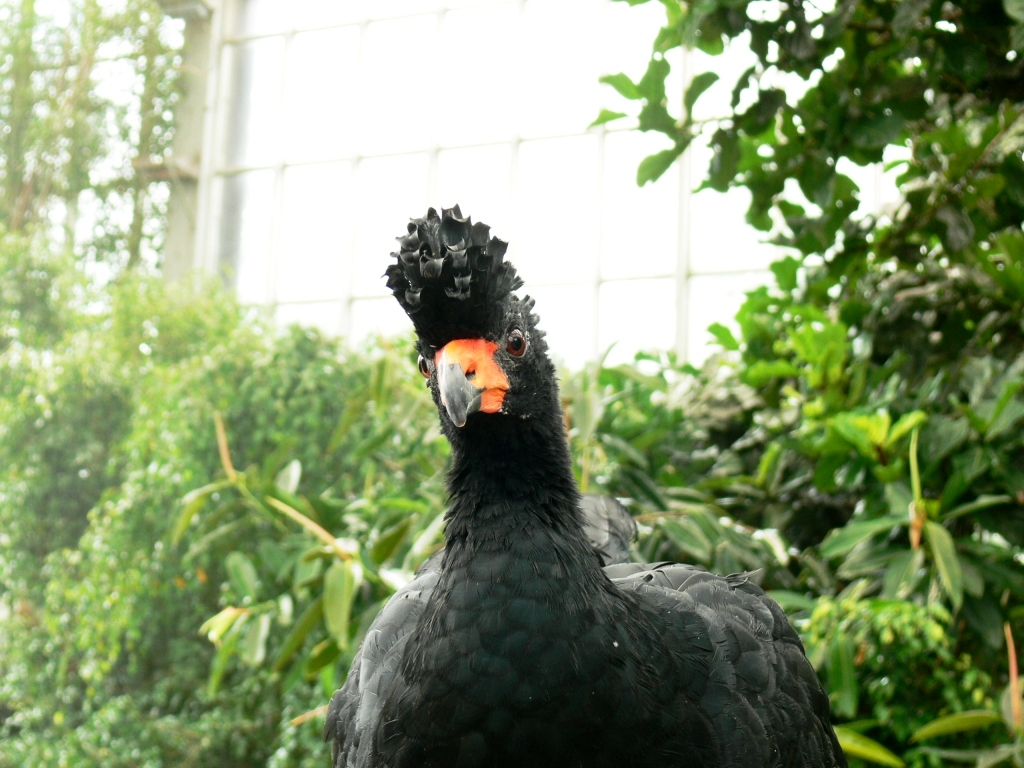
Wattled Curassow (Crax globulosa) at National Aviary by Lee

Wattled Curassow (Crax globulosa) at National Aviary by Lee

Thou sweet, belovèd will of God,
My anchor ground, my fortress hill,
My spirit’s silent, fair abode,
In thee I hide me and am still.

O Will, that willest good alone,
Lead thou the way, thou guidest best;
A little child, I follow on,
And, trusting, lean upon thy breast.

Thy beautiful, sweet will, my God,
Holds fast in its sublime embrace
My captive will, a gladsome bird,
Prisoned in such a realm of grace.

Within this place of certain good,
Love evermore expands her wings,
Or, nestling in thy perfect choice,
Abides content with what it brings.

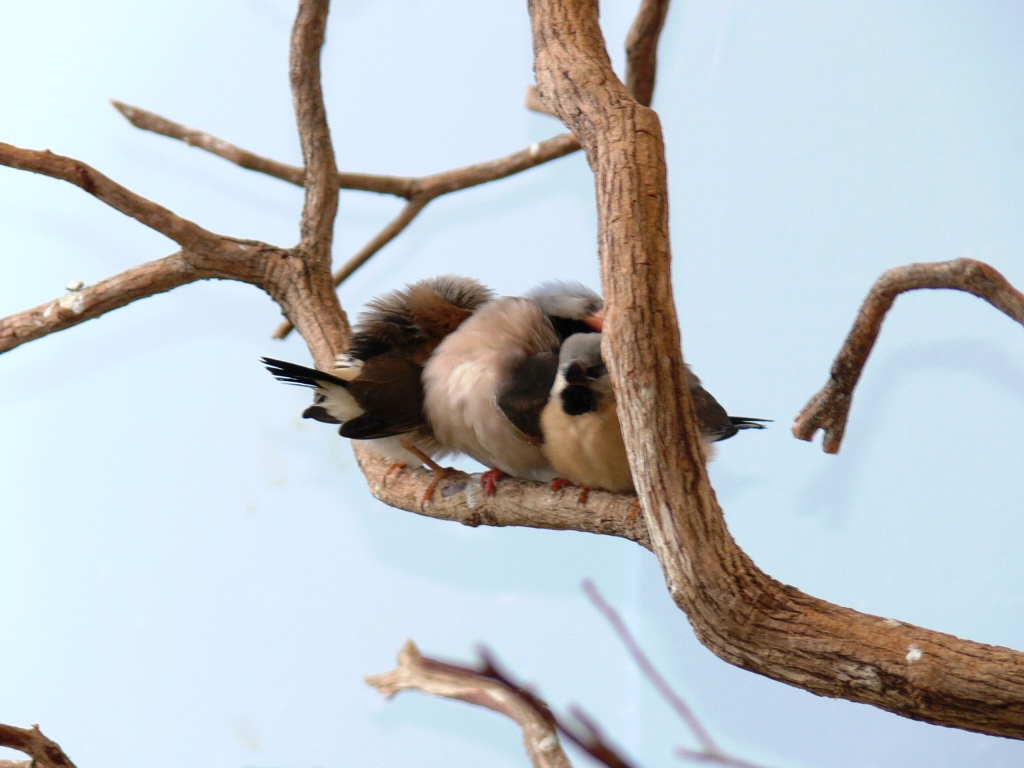
Long-tailed Finch (Poephila acuticauda) babies by Lee at National Aviary

Long-tailed Finch (Poephila acuticauda) (Spike-tailed) babies by Lee at National Aviary

O lightest burden, sweetest yoke!
It lifts, it bears my happy soul,
It giveth wings to this poor heart,
My freedom is thy grand control.

Upon God’s will I lay me down,
As child upon its mother’s breast;
No silken couch, nor softest bed,
Could ever give me such deep rest.

Thy wonderful grand will, my God,
With triumph now I make it mine;
And faith shall cry a joyous Yes!
To every dear command of thine.

Most information from The Cyber Hymnal

See ~ Wordless Birds

More ~ Birds in Hymns

I chose the Wattled Curassow because when we encountered the bird at the National Aviary, it seemed very glad, especially at feeding time. It practically got in my face. The Long-tailed (Spike-tailed) Finches are fairly young.

*

Blue Chaffinch – The High Dwellers

Blue Chaffinch – The High Dwellers ~ by a j mithra

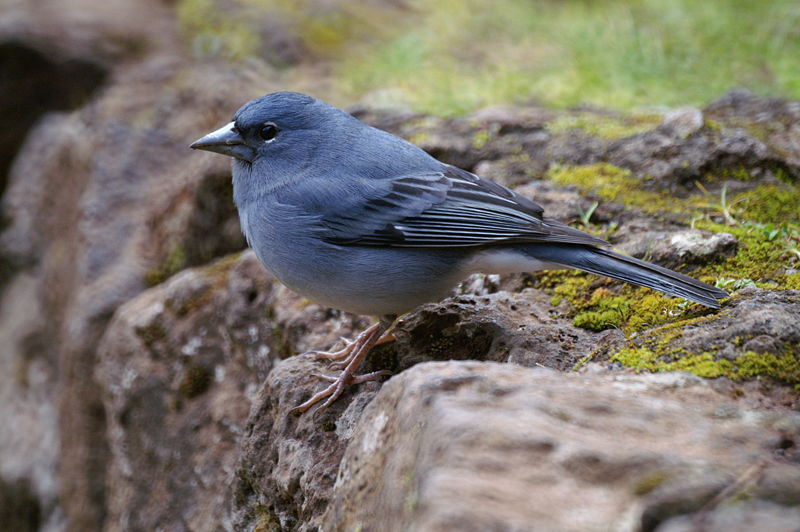
Blue Chaffinch (Fringilla teydea) ©WikiC

Blue Chaffinch (Fringilla teydea) ©WikiC

Little birds called
Blue Chaffinch
always prefer to live
about 700 to 2000 meters
above sea level..
They always build
their nests about
1000 meters above sea level
high on pine trees
which grow on the hills…
No storm shall
harm you
when you nest your hopes
on the higher place..
My hope rests
and
nests on the
most high place
called JESUS…
What about you?

The LORD is my rock, and my fortress, and my deliverer; my God, my strength, in whom I will trust; my buckler, and the horn of my salvation, and my high tower. (Psalm 18:2)

A thought from a j mithra

*

The Blue Chaffinch is in the Fringillidae Family

*