Last week was not conducive for birdwatching trips. Between windy overcast days, stormy rainy evenings, and doctor visits we didn’t get out and about, nor was I on the computer much. So, I have decided to share our visits to Santa Ana National Wildlife Refuge in Alamo, Texas. That is way “down in the valley” and sits on the Rio Grande River. We spent two winters in our RV in that area and were able to visit the refuge.
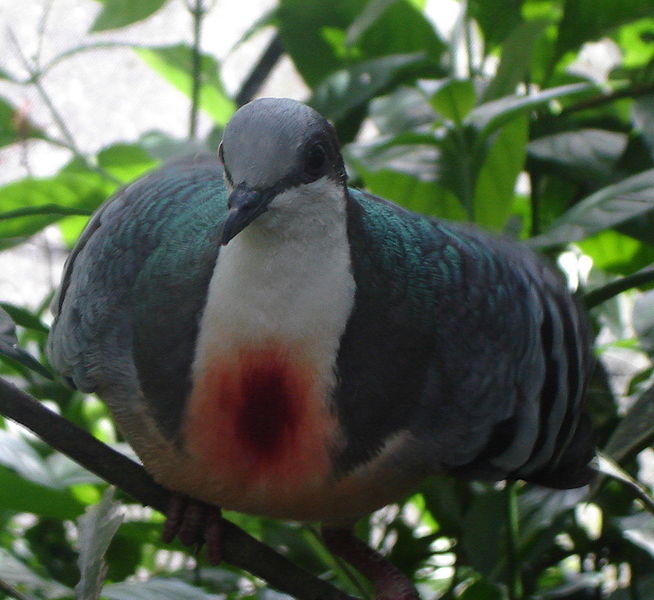
The first time we visited (Nov 01’) with our friend Betty, who is an experienced birder. It is nice to have someone along who can help ID the birds. They have a welcome center that has some feeders right by the entry way. Within about 5-10 minutes, I was able to see my first Green Jay, Buff-bellied Hummingbird, Golden-fronted Woodpecker, Great Kiskadee, Inca Dove, Red-billed Pigeon and the Plain Chachalaca,. Some of the birds only come over the Rio Grande a few miles, so I was thrilled to see them. I am including pictures of them. These were taken with an older digital camera, so they are so so.
The Eye of the Beholder series will be about how a bird’s habits or mannerisms are viewed. That in turn brings to mind an application and scripture that can be a lesson or encouragement for others. If you have an idea for an article, of that theme, then send me the article and you can be one of my guest authors.
My Birdwatching Adventures is a “work in progress” and I am still developing ideas and am willing to have others involved with me. I already have my husband helping me by providing some editing, photos, and moral support.
If you would like to author some blog articles, please leave a comment with an email address or send an email to: lee@leesbird.com.
Thank you for visiting and hopefully enjoying Lee’s Birdwatching Adventures Plus.
Lee
The House Sparrow is the first bird in a new series (Eye of the Beholder) of how I or others see birds . In last week’s Birds of the Bible – Sparrow I blog, attention was drawn to how it is many times mentioned as a “pest.” The reason for this reference is the House Sparrow has taken over many other bird’s nests, houses, cavities, etc. They hog food from the “prettier and more desirable” birds.
Let’s look at the other side of the coin. The House Sparrow has learned to adapt to whatever is given it. They make do with whatever living space they can find (Did you ever notice how many letters of signs have nests in them?), and are able to eat what’s available (even at McDonald’s and Burger King). Many birds are so specialized in their diets and where they live, that as man or birds encroach in their area, they cannot adapt to the new situation. Many birds have become extinct over the years, not being able to cope. You have to give Sparrows credit for surviving after having been uprooted from their homeland. God has allowed this little brown bird, the House Sparrow, to be content and make do with what is provided.
To me, the sparrow reminds us of what the Bible says about being able to adapt and accept what the Lord allows to come into our lives. The Bible says,
“Not that I speak in regard to need, for I have learned in whatever state I am, to be content: I know how to be abased, and I know how to abound. Everywhere and in all things I have learned both to be full and to be hungry, both to abound and to suffer need. I can do all things through Christ who strengthens me.” (Php 4:11-13)
Sparrows are mentioned in at least seven verses in the Bible, but because of other applications associated with them, this is only Part I.
I am amazed at the articles that mention Sparrows as “Trash birds” or brushed off in articles about birds. Some examples:
“..he refers to common birds of no interest to him as ‘trash birds.’ With the possible exception of pigeons and House (English) Sparrows, there is no such thing as a trash bird” The Complete Idiot’s Guide to Birdwatching, p. 25.
“…until the problem species disperse.”
They can distract you from the less common birds, resulting in lost viewing opportunities – those other birds slip away while you’re trying to determine whether that brownish bird is “just” a song sparrow or something more exciting.
“…blackbirds, cowbirds, grackles, and house sparrows. If you’re inundated by these less desirable birds, you may want stop offering corn.”
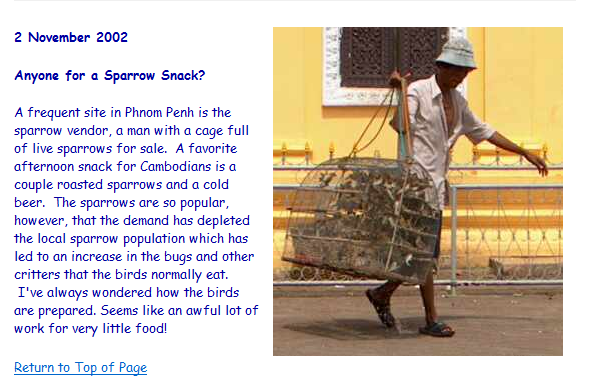
Anyone for a Sparrow Snack?
Click Picture to Enlarge
Can you believe this? A Sparrow Snack?
“The large North American (House Sparrow) population is descended from birds deliberately imported from Britain in the late 19th century. They were introduced independently in a number of American cities in the years between 1850 and 1875 as a means of pest control. The mistake was realized after they were well established and by 1883 they were already considered pests and their introduction a disaster.
While declining somewhat in their adopted homeland, House Sparrows are one of the most abundant birds in North America, with a population estimated at approximately 150 million. …In the United States and Canada, the House Sparrow is one of only three birds (the other two being the European Starling and the Rock Pigeon) not protected by law. As an invasive non-indigenous species, it is legal to kill House Sparrows and destroy their eggs at any time in most places in the United States. These three introduced species are now each more widespread and common on the continent than are any other birds.” (Wikipedia)
The sparrow is just trying to live and take care of it’s family.
Are not two sparrows sold for a copper coin? And not one of them falls to the ground apart from your Father’s will. But the very hairs of your head are all numbered Do not fear therefore; you are of more value than many sparrows. (Mat 10:29-31)
“Are not five sparrows sold for two copper coins? And not one of them is forgotten before God. But the very hairs of your head are all numbered. Do not fear therefore; you are of more value than many sparrows. (Luk 12:6-7)
“The next time that you see a sparrow, remember God is interested in that sparrow. An eloquent preacher said one time that there is never a sparrow dies but that God goes to its funeral. I am not that eloquent, so I don’t usually talk like that, but it impressed me—not a sparrow dies, but that God goes to its funeral.
God is interested in you. The next time you see a sparrow, remember God cares about you so much more than about that sparrow.
“Do not fear therefore; you are of more value than many sparrows.” (Birds of the Bible Study, Dr Joe Temple)
Hymns: He the pearly gates will open
Like a sparrow hunted, frightened,
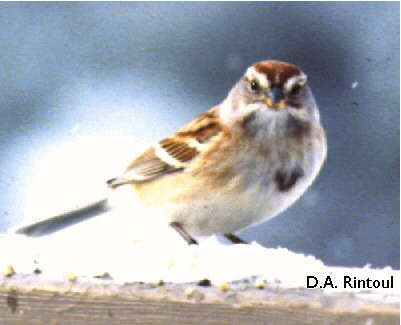
American Tree Sparrow
Weak and helpless— such was I;
Wounded, fallen, yet He healed me—
He will heed the sinner’s cry.
Refrain:
He the pearly gates will open,
So that I may enter in;
For He purchased my redemption
And forgave me all my sin.
His eye is on the sparrow
Why should I feel discouraged?
Why should the shadows come?
Why should my heart feel lonely?
And long for heaven and home
When Jesus is my portion
A constant friend is He
His eye is on the sparrow
And I know He watches over me
His eye is on the sparrow and I know He watches me
I sing because I’m happy
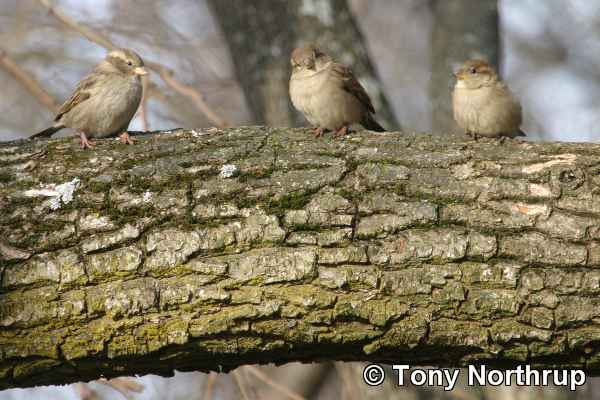
Three Sparrows
I sing because I’m free
His eye is on the sparrow
And I know He watches me
His eye is on the sparrow
And I know He watches me
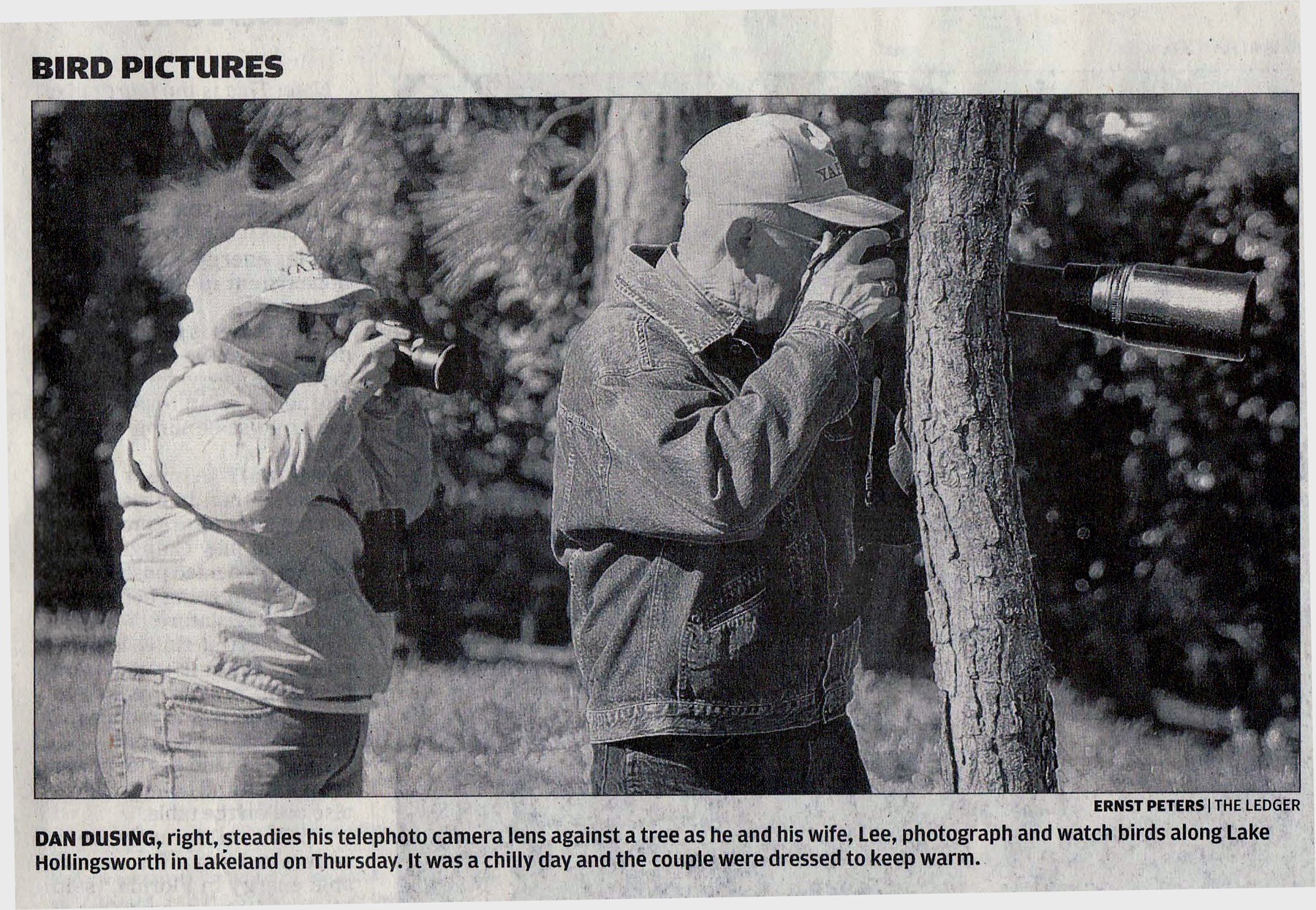
Our latest bird watching trip was last Thursday, the 28th, to Lake Hollingsworth in Lakeland. It turned out to be an interesting time. The true birder came out in us, because it was COLD. It was 45 degrees when we got there around 10:00 am and the wind was whipping off of the lake. I mean, this is Florida, you know! We were bundled-up, while there were some visitors walking around the lake in SHORTS (You know, the ones from Canada and Wisconsin, etc.); some of the “Floridarized” residents even had gloves on. Well, anyway, while we were taking pictures of a group of White Pelicans, a photographer was taking a picture of us. We ended up in Saturday’s “The Ledger,”our local newspaper. You never know what will happen when you go birding.
Article from the Lakeland, FL Ledger
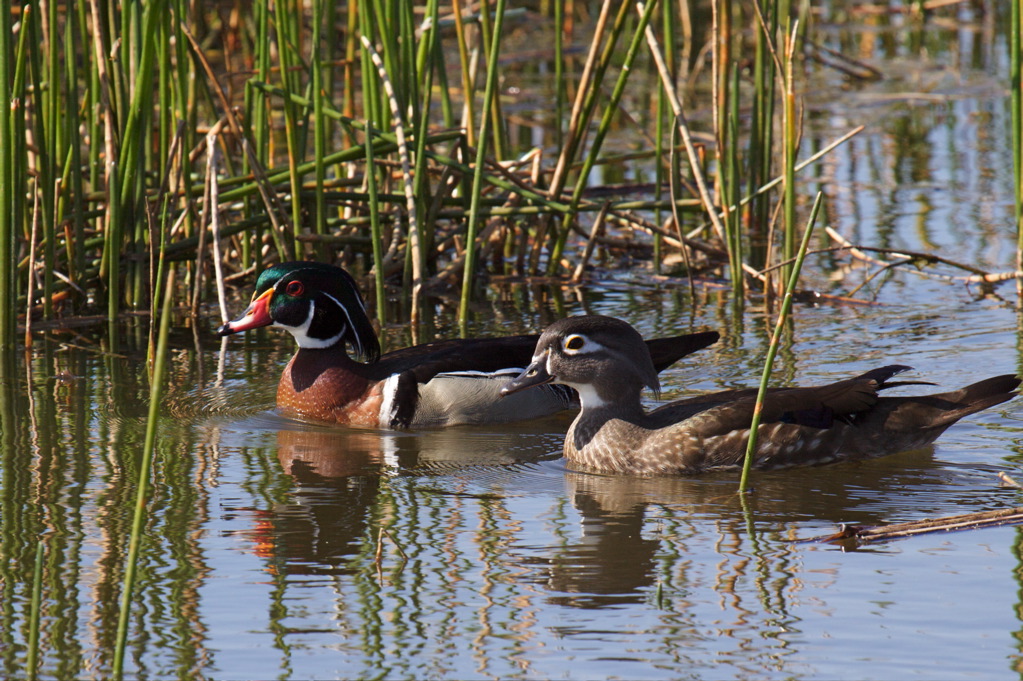
In between shivers, we watched the White Pelicans and got some good pictures. One of my favorite finds was to see a Black-crowned Night-Heron. It was the closest I have ever gotten to one. The rest of the birds seen were: Great Blue Herons, Little Blue Heron, Coots, Common Moorhens, Purple Gallinules, Mallards, Pied-billed Grebe, Tree Swallows, Redwings, Ospreys, and the normal bunch of Grackles and Vultures. Not a bad day, considering how Cold it was.
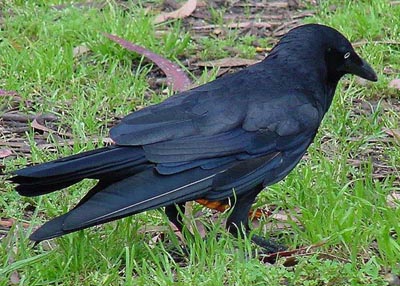
According to Thayer’s Birding Software, the Common Raven in the U.S. is 24 inches long (from beak to tail), with about a four foot wingspan, has “entirely black plumage, a large, heavy bill, wedge-shaped tail, long shaggy feathers on chin and throat, larger than crows and has relatively short legs.” It resides more out west than here in the east, though they show up in some areas in the east. You might find them in the desert, forest, canyons, foothills, mountains, and other places. “They are “often seen along highways eating road kill.” They are in the same family as Crows, Jays and Magpies.
Two Ravens mentioned in Israel: are the Brown-necked Raven
Brown-necked Raven, Israel
Raven Master
and Common Raven.
Bible Facts about the Raven
They were on the ark and the first to leave. (Gen 8:7)
Noah opened the window of the ark and let a raven fly out, for the purpose of ascertaining the drying up of the waters. The raven went out and returned until the earth was dry, but without being taken back into the ark” (Keil & Delitzsch Commentary on the Old Testament)
Two thoughts I have. The raven was the first bird to see the new world after the flood and if the raven had re-entered the ark, he would have corrupted it, since he was “unclean.”
Ravens are considered an unclean bird. They eat mostly carrion. (Lev 11:13-15)
Ravens fed Elijah. (I Kings 17:4-6)
“Elijah was commanded to hide himself. If Providence calls us to solitude and retirement, it becomes us to go: when we cannot be useful, we must be patient; and when we cannot work for God, we must sit still quietly for him. The ravens were appointed to bring him meat, and did so. Let those who have but from hand to mouth, learn to live upon Providence, and trust it for the bread of the day, in the day. God could have sent angels to minister to him; but he chose to show that he can serve his own purposes by the meanest creatures, as effectually as by the mightiest.” (Matthew Henry’s Commentary)
“and these provisions were ready prepared, the bread made and baked, and the flesh boiled, broiled, or roasted;” (John Gill’s Exposition of the OT)
The hair was “black as a raven.” (Song of Solomon 5:11)
Who provides food for the raven, When its young ones cry to God, And wander about for lack of food?” (Job 38:41)
“Sing to the LORD with thanksgiving; Sing praises on the harp to our God, Who covers the heavens with clouds, Who prepares rain for the earth, Who makes grass to grow on the mountains. He gives to the beast its food, And to the young ravens that cry.” (Psa 147:7-9)
They are mentioned in Luke 12:24 as not sowing or reaping, nor gathering and that God feeds them.
“Consider the ravens, for they neither sow nor reap, which have neither storehouse nor barn; and God feeds them. Of how much more value are you than the birds?”
A hymn that mentions Ravens:
Sometimes a Light Surprises It can bring with it nothing,
But He will bear us through;
Who gives the lilies clothing
Will clothe His people too:
Beneath the spreading heavens
No creature but is fed;
And He who feeds the ravens
Will give His children bread.
World List of Ravens:
Little Raven, Relict Raven, Forest Raven, Chihuahuan Raven, Brown-necked Raven, Common Raven, Fan-tailed Raven, White-necked Raven, Thick-billed Raven
Other interesting facts:
Ravens are considered one of the most intelligent birds.
They have a Raven Master. “It’s said that when the ravens leave the Tower, the Tower will crumble and the kingdom will crumble with it.” To see the article: Tower of London
I have been thinking about the Birds of the Bible Series I am working on. Yesterday, we finished our Missions Conference at Faith and was motivated even more to do this blog. Today, while searching the internet for information for my next article, I realized again how many others have done similar blogs. Shades of doubt began to form. So, why am I doing this?
The Lord has helped me to REMEMBER why.
1. The Lord wants us to praise Him and declare His mighty and wondrous works. Great is the LORD, and greatly to be praised; And His greatness is unsearchable. One generation shall praise Your works to another, And shall declare Your mighty acts. I will meditate on the glorious splendor of Your majesty, And on Your wondrous works. (Psa 145:3-5) 2. I love bird watching and am amazed and awed at the how God created the birds. Their beauty, structure, song and habits are amazing. To know that they are under the “curse” along with us, and still they are inspiring.
3. As we sang yesterday, “Little Is Much When God Is In It”. My efforts may be small, and this won’t be a famous blog, but to share with others my love for birds and the Lord is strong.
4. My husband also greatly reassured me.
There are a lot of great websites that teach about the Birds of the Bible and others that are all about birds. I will try to share those sites for your information and try not to “re-invent the wheel.”
We were on the way to birding in Lakeland and had stopped by the Southeastern University for breakfast, when we spotted these three Roseate Spoonbills feeding in their lake. (Feb 2008)
Today we drove to Fort DeSoto Park in Pinellas county to “add birds to my life list.” Well, it turned out that as we drove over there, the clouds kept multiplying more and more. So, with overcast skies and a windy temp of 63 degrees, we found very few birds who wanted to have their picture taken or even be seen. We took a few pictures and then stopped by the Gandy causeway to feed some gulls and grackles.
Here is a list of today’s birds:
Going and coming home – Ospreys, Cattle Egrets, Mockingbird, Boat-tailed Grackles, Ring-billed Gulls, Turkey Vultures, Brown Pelican, Rock Doves(pigeons), Double-crested Cormorants sitting on the light posts on the bridge across Tampa Bay, Mourning Doves, Great Egret, and a Loggerhead Shrike, Ibises, and several UFO (unidentified flying objects-“birds”)
At Fort DeSoto – Brown Pelicans, Great Egret, Mourning Moves, 5 Black-hooded Parakeets, Loggerhead Shrike, Killdeer, Kingfisher, 2 American Kestrel, Reddish Egret, Ring-billed and Laughing gulls. We spotted an Ospreys’ nest and saw the baby stick it’s head up several times. Got one picture of it. Also have pictures, that I need to figure out what I saw. Stay tuned.
On Gandy Causeway – Fed ring-billed and laughing gulls, boat-tailed grackles and saw royal terns and some more that I still need to ID.
Not too bad of a day, in spite of the overcast skies.
Today we will start with the Eagle, which our pastor used as the theme of his article in this month’s Window. Here in North America we have the Bald Eagle (our National symbol) and the Golden Eagle, Stellar’s Eagle and White-tailed Eagle. The Bald Eagle’s “bald spot” doesn’t appear until they are 4 or 5 years old and develop a white head and tail. The Bald Eagle is only in North America. In Israel you might see a Short-toed Eagle, Great or Lesser Spotted Eagle, Steppe, Imperial, Golden, Booted, or Bonelli’s Eagle.
I love to watch an eagle flying; it stops me in my tracks. We are lucky here in Polk County to have many this time of the year. Stay alert and also visit the South Lake Howard Nature Center to see a pair sitting either on the tower or at the nest. Ask most anyone there and they will point out the nest.
Eagle on Tower Near Lake Howard and Eagle in Nest at Lake Howard Nature Park.
Job 9:26 – “Like an eagle swooping on its prey.”
Pro 30:19 – “The way of an eagle in the air”
Jer 49:22 – “fly like the eagle”
Hab 1:8 – “They fly as the eagle that hastens to eat.”
Pro 23:5 –“They fly away like an eagle toward heaven.”
An African Eagle
“Birds display a wide range of patterns in flight. Swifts and swallows use a fast, gliding motion. Ducks and geese have sustained, powerful flight. Birds of prey such as eagles and falcons usually catch their targets by swooping from high in the sky, capturing their victims after a swift dive—which may reach speeds of 250 kilometers an hour (165 mph). As the bird swoops to the ground, it spreads its powerful wings to act as a brake.” (“Created to fly,” Creation 16(3), June 1994)
Click link to see a Bald eagle hovering and landing on rock.
For those of us in the “older generation,” Job 9:25-26 (NKJV) reminds us that we need to stay active for our Lord because our life passes by swiftly. “Now my days are swifter than a runner; They flee away, they see no good. They pass by like swift ships, Like an eagle swooping on its prey.”
A few more facts about eagles:
Eagles are mentioned in hymns such as: They That Wait Upon the Lord –“They shall mount up with wings as eagles:” The Mercy Seat – “Ah, there on eagle wings we soar,” Art Thou Afraid? – “On eagles’ wings they mount, they soar, Their wings are faith and love,”
In Israel, the eagle is the largest bird and has an eight foot wing span.
There are at least 25 verses in the Bible that mention the eagle.
The eagle is an “unclean” bird.
There is much more to say about eagles, but we will leave them to continue with the many other birds mentioned in the Bible. A parting remark by C. H. Spurgeon quoted on Pg 57 of John Stott’s The Birds Our Teachers, follows:
“Brother, your failure, if you fail, will begin in your faith. The air says to the eagle, Trust me; spread thy broad wings; I will bear thee up to the sun. Only trust me. Take thy foot from off yon rock which thou canst feel beneath thee. Get away from it, and be buoyed up by the unseen element.’ My brethren, eaglets of heaven, mount aloft, for God invites you. Mount! You have but to trust him.”







 Lee's Birdwatching Adventures Plus